
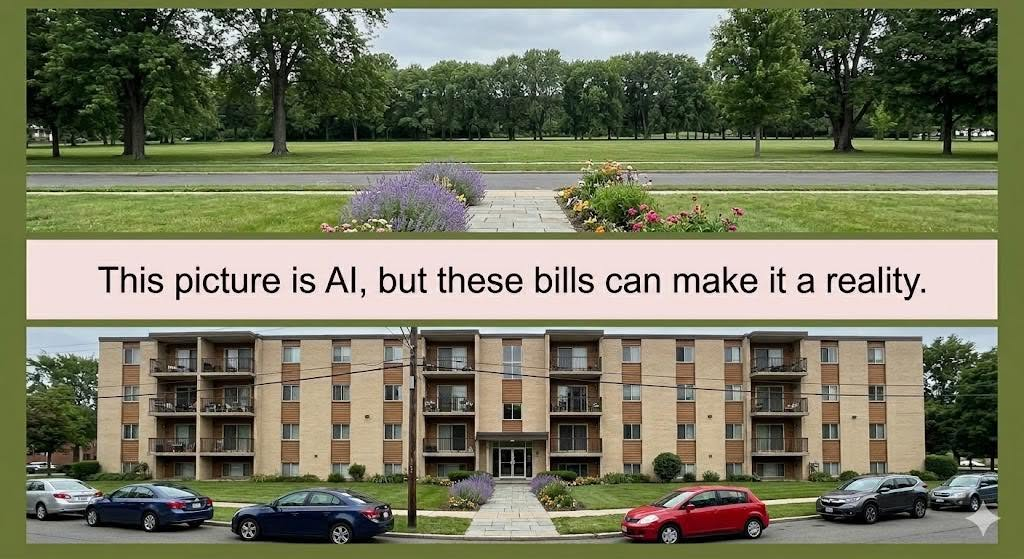
The Fight for Local Control: Why Trenton’s New Housing Bills Are a Wake-Up Call for NJ Suburbs
photo courtesy of Westwood Mayor Ray Arroyo
the staff of the Ridgewood blog
Westwood NJ, A major legislative battle is quietly unfolding in Trenton, and its outcome could fundamentally rewrite the rules of suburban life across New Jersey.
According to Westwood Mayor Ray Arroyo, a series of state-level housing bills are moving through the legislative pipeline that threaten to strip municipalities of their local zoning authority. If passed, these measures would enforce a “centralized command and control” model, effectively allowing state lawmakers and academic planners to override the decisions of local land-use boards.
Mayor Arroyo describes the shifting dynamic as a legislative “freight train” aimed at an urbanizing transformation of the classic, small-town suburban model—an aspirational standard that has defined communities like the Pascack Valley for generations.
The Three Controversial NJ Housing Bills on the Radar
Local governing bodies are voicing strong objections to three specific pieces of legislation that mandate building density changes “as of right,” completely bypassing local Master Plans.
1. S-1766: The Stranded Asset Bill
This legislation allows developers to override local zoning laws to construct high-density, multifamily, mixed-use developments on qualifying, underutilized shopping centers. In Westwood, Mayor Arroyo warns that this legislation potentially puts the local K-Mart Plaza directly into play for major redevelopment without local oversight.
-
Status: Voted 3-2 out of the Senate Committee on Housing and Urban Affairs, advancing to the full Senate.
-
Official Tracker: NJ Legislature S-1766 Bill Search
2. S-2680: The Additional Dwelling Unit (ADU) Bill
This bill would force municipalities to permit an Additional Dwelling Unit (ADU)—such as a tiny home, garage apartment, or basement suite—on every single-family lot. Opponents argue that allowing this “as of right” effectively eliminates zoning protections for traditional single-family neighborhoods.
-
Official Tracker: NJ Legislature S-2680 Bill Search
3. S-1836: The Religious Properties Redevelopment Bill
Next up in the committee queue, this piece of legislation would permit religious properties to be redeveloped into high-density residential housing. Because the vast majority of religious institutions are historically nestled deep within quiet residential neighborhoods, the local impact could be immediate.
-
Official Tracker: NJ Legislature S-1836 Bill Search
The “Killing Blow”: Eliminating Parking Minimums Beyond the structural changes, a companion bill aims to eliminate minimum on-site parking requirements for developers. Local leaders warn this will allow builders to max out their property footprints with more revenue-generating housing units while pushing the resulting private parking burden directly onto local public streets.
Why One-Size-Fits-All Mandates Hurt NJ Municipalities
The core objection from North Jersey officials is not necessarily the substance of the housing measures, but rather the elimination of local small-d democracy. Towns across the Pascack Valley already routinely adapt their master plans to balance property tax revenues, economic realities, and market demands.
However, local zoning boards argue that statewide land-use overrides fail to account for unique geographical constraints:
-
Infrastructure Capacity: School districts, sewer systems, and emergency services are scaled to current local zoning limitations.
-
Environmental Pressures: Flooding and traffic congestion land completely differently in a town like Westwood compared to a shore town in Monmouth County or a city in Hudson County.
-
Lack of Transparency: Many of these committee hearings are announced late on Friday afternoons for Monday morning votes, leaving virtually no time for local officials or residents to voice opposition or submit amendments.
What’s Next for Local Residents?
As these bills advance toward full partisan Senate votes and a potential signature from the Governor, local leaders are urging residents to stay informed and reach out directly to the elected officials sitting on the deciding committees.
When state-level decisions are decoupled from local realities, suburban communities are left to manage the infrastructure fallout alone. As Mayor Arroyo notes, shaping and enhancing the physical environment is always best left to the land-use boards and elected officials who actually have to live with the consequences of their decisions.
Tell your story #TheRidgewoodblog , #Indpendentnews, #information, #advertise, #guestpost, #affiliatemarketing,#NorthJersey, #NJ , #News, #localnews, #bergencounty, #sponsoredpost, #SponsoredContent, #contentplacement , #linkplacement, Email: [email protected]
#NJPolitics #LocalZoning #PascackValley #WestwoodNJ #NJHousing #SuburbanDevelopment #LandUse






These losers want to make our nice suburban towns like their shit hole cities of Newark Paterson and Camden
The ethos of a town is in part large expressed by the quality of its people. That being the case, most of your nice suburban towns are already shitholes in spirit.
only due to the NY attitudes by the newbies. when we were a republican town, people treated each other with respect. whether you agreed with them or not
What changed you?