
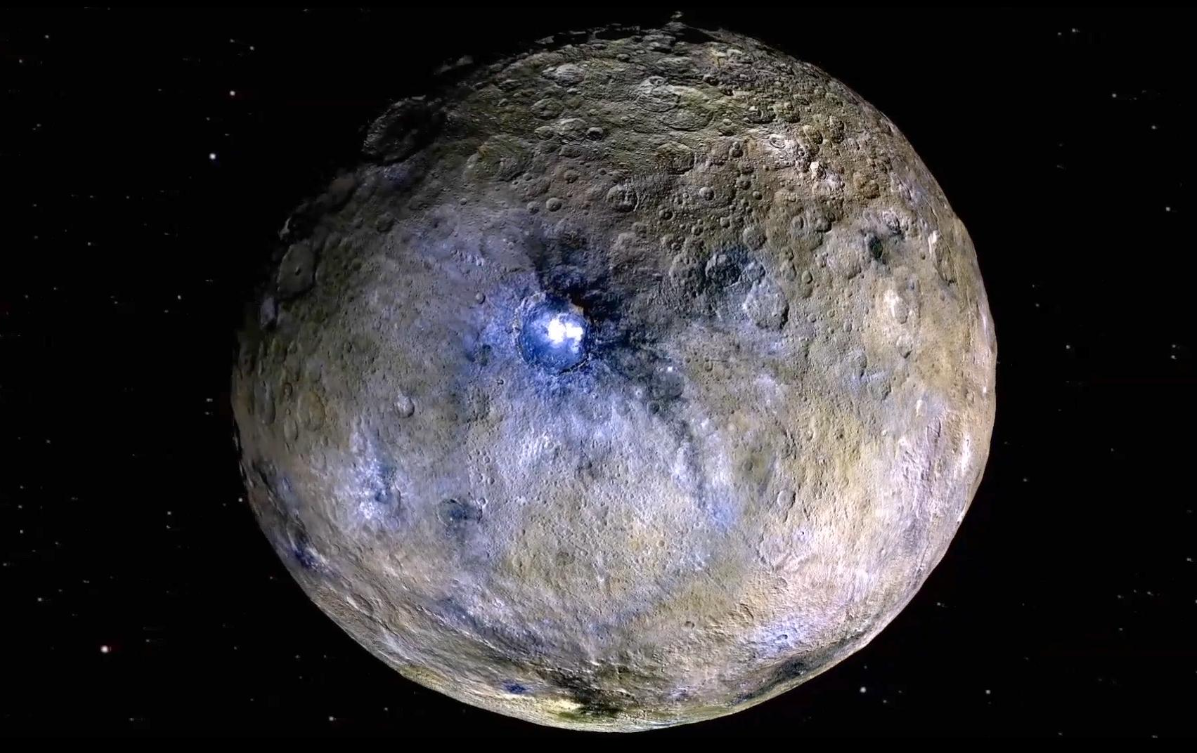
Aliens Next Door? NASA Discovery Reveals Dwarf Planet Ceres Once Had the Right Conditions for Life
the staff of the Ridgewood blog
Ridgewood NJ, Extraterrestrial life may have once existed much closer to Earth than scientists ever imagined. According to a groundbreaking study published in Science Advances, Ceres—the icy dwarf planet located in the asteroid belt between Mars and Jupiter—once possessed the precise chemical and thermal conditions needed to support microbial life.
While researchers have not found direct proof that living organisms ever inhabited Ceres, computer models now confirm that the dwarf planet possessed all three key ingredients for life: liquid water, organic molecules, and a continuous source of chemical energy.
Key Takeaways from the Discovery
-
Crucial Energy Source: Radioactive decay inside Ceres’ core generated hydrothermal fluids—hot, mineral-rich water surging into its ancient subsurface ocean.
-
Earth-Like Habitability: The chemical conditions mimic Earth’s deep-sea hydrothermal vents, which support flourishing ecosystems of chemotrophic microbes without sunlight.
-
Dawn Mission Data: Findings build on data collected by NASA’s Dawn spacecraft, which orbited Ceres between 2015 and 2018 and detected organic molecules and bright salt deposits.
-
Solar System Implications: Dozens of similar icy dwarf planets and moons may have served as the most abundant type of habitable environment in the early solar system.
Inside Ceres: How an Ancient Ocean World Fueled Potential Life
Discovered in 1801 and measuring roughly 590 miles across, Ceres was long regarded as little more than a barren rock. However, thermal and chemical modeling led by Sam Courville, a PhD candidate at Arizona State University, reveals a complex geological history.
Roughly 2.5 to 4 billion years ago, radioactive decay inside Ceres’ rocky core generated intense heat. This heat forced hot, gas-enriched water to rise into its subsurface ocean, creating a rich chemical environment.
“On Earth, when hot water from deep underground mixes with the ocean, the result is often a buffet for microbes — a feast of chemical energy. So it could have big implications if we could determine whether Ceres’ ocean had an influx of hydrothermal fluid in the past.”
— Sam Courville, Arizona State University
Ceres Today: A Frozen Time Capsule
Unlike moons like Jupiter’s Europa or Saturn’s Enceladus, which remain geologically active due to tidal flexing from their massive parent planets, Ceres orbits alone.
As its internal radioactive heat faded over time, Ceres froze over. Today, surface temperatures plunge to –81°F, and what remains of its ancient ocean is locked beneath an icy crust as concentrated, salty brine.
| Feature | Ancient Ceres (2.5–4 Billion Years Ago) | Modern Ceres |
| Internal Heat Source | Active radioactive core decay | Extinct / Cooled |
| Water State | Subsurface liquid ocean with hydrothermal vents | Trapped, frozen, concentrated brine |
| Habitability Potential | High (water, organics, chemical fuel) | Very Low (frozen wasteland) |
What This Means for the Search for Extraterrestrial Life
While the chances of finding living organisms on Ceres today are slim, the study reshapes how astrobiologists search for habitability across the universe.
If modest, isolated bodies like Ceres could sustain hydrothermal ocean environments for billions of years, similar
Follow the Ridgewood blog has a brand-new new X account, we tweet good sh$t
https://x.com/TRBNJNews
https://truthsocial.com/@theridgewoodblog
https://mewe.com/jamesfoytlin.74/posts
#news #follow #media #trending #viral #newsupdate #currentaffairs #BergenCountyNews #NJBreakingNews #NJHeadlines #NJTopStories
- Tags:
#SpaceNews#NASA#Astronomy#AlienLife#Ceres#Science#SolarSystem





