Ridgewood’s Nicole Parks Named to Ridgewood News All-Suburban Softball Team
JULY 4, 2014 LAST UPDATED: FRIDAY, JULY 4, 2014, 12:31 AM
BY GREG TARTAGLIA
SPORTS EDITOR
RIDGEWOOD — An historic softball season in The Ridgewood News All-Suburban area had it roots in the Big North Freedom Division.
Led by undefeated Bergen County and State Group 3 champion Indian Hills (34-0), four teams from the division combined to produce nine of the 18 players on this year’s first team. The Braves supplied four, Northern Highlands three, and Ridgewood and Paramus one each.
Bergen County runner-up Immaculate Heart (31-2) leads all schools with five representatives, and its Big North United Division rival Paramus Catholic placed one among the 13 seniors, three juniors, a sophomore and a freshman. Ramsey, Midland Park and Hawthorne garnered one spot apiece.
A whopping eight players repeat on the top squad, led by Steph Thomas of IHA, who completed the All-Suburban “cycle” with her fourth first-team bid. The three-time overall honorees are IHA’s Rachel Pollard (2012-14 first team) and Daniella Ibarra (2012 Sophomore of Year, 2013-14 first team) and Ridgewood’s Nicole Parks (2012 second team, 2013-14 first team).
So deep was the talent pool this spring that four others repeat on the second team: Ridgewood’s Kelly Skettini, Ramsey’s Jess Juhlin and Fair Lawn’s Sam Colca (2013-14) and Paramus’ Kelsey Settecasi (2012 and ’14).
Hallie Donofrio of Waldwick is the Sophomore of the Year, while Northern Highlands’ Chris Broking is the Coach of the Year…..
NICOLE PARKS, Ridgewood — This senior right-hander finally was able to put her full pitching arsenal on display and led the Maroons (20-7) to an eight-win improvement over last season. A first-team outfielder in 2013, she showed no signs of the ankle injury that kept her out of the circle and came back with an 18-6 record, 0.86 ERA and .155 opponent’s batting average. She struck out 249 in 150 innings and threw four no-hitters (including a perfect game against Bergenfield), upping her career mark to 24-9 with five no-hitters. Bound for the University of Albany, she hit .375 with three home runs, 22 RBI and had a .648 slugging percentage.
– See more at: https://www.northjersey.com/sports/high-school-sports/girls-softball/softball-stars-rewrite-history-books-1.1046366#sthash.rY5IfGZb.dpuf
Author: James
Participant falls of float and is injured during Ridgewood July 4th parade
Photo credit: Boyd A. Loving
Participant falls of float and is injured during Ridgewood July 4th parade
July 4th 2014
12:54 PMRidgewood NJ, Ridgewood PD officers, led by Lieutenant William Amoruso (uniformed white shirt with hat in photos), investigate an incident in which a parade participant fell off of a parade float and sustained a serious head injury. The victim walked on her own power to a nearby ambulance, but was transported to a local hospital for evaluation. The parade was halted while the victim was attended to and police also removed the float and pickup truck that was towing it from the parade. The incident occurred in the intersection of Oak Street and East Ridgewood Avenue. Paramedics from The Valley Hospital in Ridgewood also attended to the victim. Police on the scene were observed checking all paperwork associated with the pickup truck and towed trailer involved. Both vehicles were observed parked at a nearby Mason’s Hall following the parade’s finish. No word on whether any summonses were issued in connection with the incident.
Photo credit: Boyd A. Loving
Ridgewood Celebrates the 4th of July
U.S. Seen as Biggest Oil Producer After Overtaking Saudi Arabia
By Grant Smith Jul 4, 2014 11:56 AM ET
The U.S. will remain the world’s biggest oil producer this year after overtaking Saudi Arabia and Russia as extraction of energy from shale rock spurs the nation’s economic recovery, Bank of America Corp. said.
U.S. production of crude oil, along with liquids separated from natural gas, surpassed all other countries this year with daily output exceeding 11 million barrels in the first quarter, the bank said in a report today. The country became the world’s largest natural gas producer in 2010. The International Energy Agency said in June that the U.S. was the biggest producer of oil and natural gas liquids.
“The U.S. increase in supply is a very meaningful chunk of oil,” Francisco Blanch, the bank’s head of commodities research, said by phone from New York. “The shale boom is playing a key role in the U.S. recovery. If the U.S. didn’t have this energy supply, prices at the pump would be completely unaffordable.”
Oil extraction is soaring at shale formations in Texas and North Dakota as companies split rocks using high-pressure liquid, a process known as hydraulic fracturing, or fracking. The surge in supply combined with restrictions on exporting crude is curbing the price of West Texas Intermediate, America’s oil benchmark. The U.S., the world’s largest oil consumer, still imported an average of 7.5 million barrels a day of crude in April, according to the Department of Energy’s statistical arm.
https://www.bloomberg.com/news/2014-07-04/u-s-seen-as-biggest-oil-producer-after-overtaking-saudi.html
We, the people are violent and filled with rage: A nation spinning apart on its Independence Day
School shootings, hatred, capitalism run amok: This 4th of July, we are in the midst of a tragic public derangement
JIM SLEEPER
FRIDAY, JUL 4, 2014 09:45 AM EDT
By the rude bridge that arched the flood,
Their flag to April’s breeze unfurled,
Here once the embattled farmers stood
And fired the shot heard ’round the world.
–Ralph Waldo Emerson, “Concord Hymn,” 1837
For centuries most Americans have believed that “the shot heard ’round the world” in 1775 from Concord, Massachusetts, heralded the Enlightenment’s entry into history. Early observers of America such as G.W.F. Hegel, Edward Gibbon and Edmund Burke believed that, too. A new kind of republican citizen was rising, amid and against adherents of theocracy, divine-right monarchy, aristocracy and mercantilism. Republican citizens were quickening humanity’s stride toward horizons radiant with promises never before held and shared as widely as they were in America.
The creation of the United States really was a Novus ordo seclorum, a New Order of the Ages, a society’s first self-aware, if fumbling and compromised, effort to live by the liberal expectation that autonomous individuals could govern themselves together without having to impose religious doctrines or mystical narratives of tribal blood or soil. With barely a decorous nod to The Creator, the founders of the American republic conferred on one another the right to have rights, a distinguished group of them constituting the others as “We, the people.”
That revolutionary effort is not just in trouble now, or endangered, or under attack, or reinventing itself. It’s in prison, with no prospect of parole, and many Americans, including me, who wring our hands or wave our arms about this are actually among the jailers, or we’ve sleepwalked ourselves and others into the cage and have locked ourselves in. We haven’t yet understood the shots fired and heard ’round the world from 74 American schools, colleges and military bases since the Sandy Hook School massacre of December 2012.
These shots haven’t been fired by embattled farmers at invading armies. They haven’t been fired by terrorists who’ve penetrated our surveillance and security systems. With few exceptions, they haven’t been fired by aggrieved non-white Americans. They’ve been fired mostly by young, white American citizens at other white citizens, and by American soldiers at other American soldiers, inside the very institutions where republican virtues and beliefs are nurtured and defended.
https://www.salon.com/2014/07/04/we_the_people_are_violent_and_filled_with_rage_a_nation_spinning_apart_on_its_independence_day/
Time to Reclaim our Independence : Let’s party like it’s 1776
Time to Reclaim our Independence : Let’s party like it’s 1776.
Thursday, July 3rd, 2014
by Daniel Horowitz
On this day 238 years ago, the Continental Congress adopted the 1338-word Declaration of Independence in which we declared, “We hold these truths to be self-evident, that all men are created equal, that they are endowed by their Creator with certain unalienable Rights, that among these are Life, Liberty and the pursuit of Happiness.”
11 years later, as Benjamin Franklin left Independence Hall after the Constitutional Convention crafted the new constitution, he was reportedly asked by a lady, “well doctor, what have we got, a republic or a monarchy?” He famously replied, “a republic, if you can keep it.”
Sadly, many of us are spending this 4th of July wondering if our Founders would recognize that republic – that beacon of freedom built upon a strong civil society and ordered liberty. So many ordinary Americans feel our republic is long lost to a foreign socialist utopia centrally managed by an elitist oligarchy in the form of two corrupt political parties.
This small minority of radicals has completely vitiated our most fundamental characteristic as a republic – our sovereign borders. We are now languishing from the flood of over 100,000 illegal immigrants teaming over our southern border, adding to the millions of illegals already here. At stake is nothing less than the preservation of our civil society, sovereignty, and solvency as a nation and as a stable economy. They drain our resources, health care, education, and criminal justice system.
Our veterans are suffering waiting for care under single-payer health care, while private health care providers are being forced to provide immediate treatment to illegal aliens and are being threatened with arrest for speaking out against the threat of diseases. Border agents protecting our republic are now being sued by illegal immigrants for doing their jobs.
We feel like strangers in our own country.
Even without the illegal invasion, our republic is hanging on by a thread.
Almost every American is involuntarily subservient to the federal government for his or her retirement security and healthcare. Over 46 million people, and one-in-four children, rely upon government for food stamps. Under the new Obamacare mandates, an estimated 79 million Americans will be enrolled in Medicaid and CHIP. This culture of dependency, an anathema to our spirit of independence, has saddled us with over $1 million in debt and unfunded obligations for every American taxpayer.
Meanwhile, ordered liberty in a constitutional republic needs a strong civil society and strong families in order to thrive, much like fish in water. Yet, the cultural degeneration, promulgated and encouraged by this small societal elite, has permeated every aspect of American life – to the extent that those of us who adhere to traditional family values are now ostracized and castigated. We have reached the point where we need a group of unelected judges to grant us small morsels of religious liberty from their high benches in Washington. The small minority who push this invidious anti-family agenda now seek to eradicate the very existence of gender to the degree that private individuals and businesses are now being forces to accommodate bizarre and licentious practices.
The “Republican” Party was supposed to serve as the bulwark against attempts to supplant our republican form of government, yet they have become part and parcel of the problem. Decades’ worth of treachery directed towards the party faithful from its leadership has finally culminated with the Mississippi election last week. A long-serving Republican, with the blessing of the entire party establishment, engaged in fraud and race-baiting to repudiate his own party base and steal the election.
We are now living through the worst consequences of elective despotism that James Madison warned about in Federalist 48. Indeed we are strangers in our own country and in our own party.
But thankfully, as we celebrate another Independence Day, there are signs that the original zeal for constitutional governance and freedom still runs through the veins and DNA of so many Americans. We have witnessed ordinary citizens risking their careers and reputation to challenge the entrenched political class with almost no funding and very little resources. Most of them came up short on the first try, but so many of them came close and have succeeded in exposing the duplicitous career politicians.
https://madisonproject.com/2014/07/time-to-reclaim-our-independence/
July 2, in 1776, New Jersey granted the right to vote to all inhabitants over 21 and possessed of property worth at least 50 pounds
On this day July 2, in 1776, New Jersey granted the right to vote to all inhabitants over 21 and possessed of property worth at least 50 pounds (about $86 dollars).
“That all inhabitants of this Colony, of full age, who are worth fifty pounds proclamation money, clear estate in the same, and have resided within the county in which they claim a vote for twelve months immediately preceding the election, shall be entitled to vote for Representatives in Council and Assembly; and also for all other public officers, that shall be elected by the people of the county at large.”
This included women and free blacks. However, universal suffrage did not last. By 1807 the women and free blacks of New Jersey lose their right to vote. The repeal was sponsored by a politician who was nearly defeated 20 years earlier when his opponent rallied the women to vote.

![]()
INDEPENDENCE DAY: WHAT JULY 4 REALLY MEANS
by Tom Bowden | June 26, 2014
“I can say,” wrote Ayn Rand, “not as a patriotic bromide, but with full knowledge of the necessary metaphysical, epistemological, ethical, political and esthetic roots — that the United States of America is the greatest, the noblest and, in its original founding principles, the only moral country in the history of the world.”
Rand’s bold claim was based on the political philosophy contained in the Declaration of Independence — contained explicitly, in Jefferson’s immortal statement that government’s sole purpose is to protect the individual’s rights to life, liberty and the pursuit of happiness — and contained implicitly, in moral principles of rational self-interest that Rand herself made explicit almost two hundred years later.
“It is in this context — from the perspective of the bloody millennia of mankind’s history — that I want you to look at the birth of a miracle: the United States of America,” Rand wrote elsewhere. “If it is ever proper for men to kneel, we should kneel when we read the Declaration of Independence.”
On July 4, we commemorate political independence from England and pay tribute to the Founders’ moral vision of the sovereign individual who deserves freedom to live by his own independent judgment. But to achieve that ideal in the twenty-first century, we desperately need Ayn Rand’s perspective on individual rights and how government can protect them. Here are some resources for those who want to explore the deeper significance of Independence Day:
Ayn Rand on “America” (from The Ayn Rand Lexicon)
Ayn Rand on the “Founding Fathers” (from The Ayn Rand Lexicon)
Ayn Rand on “Man’s Rights” and “The Nature of Government” (essays available here)
“Atlas Shrugged: America’s Second Declaration of Independence” (essay by Onkar Ghate)
“The Meaning of Independence Day” (video by Mike Berliner)
Boston Tea Party – July 4 keynote (video, part 1 and part 2, by Yaron Brook)
“Atlas Shrugged: A Paean to American Liberty” (op-ed by Don Watkins)
“Kagan’s Updated Declaration of Independence” (blog post by Tom Bowden)

![]()
The New Jersey Contingent Who Signed the Declaration of Independence
The significant aspect of the Declaration of Independence is that it changed the American “rebellion” against Great Britain into a “revolution.” From April 19, 1775 until July 2, 1776 the war was being fought so the colonists could regain their rights as Englishmen that had been taken away by the British from 1763-1775.
On July 2, 1776 the Second Continental Congress approved the resolution by Richard Henry Lee from Virginia that “these United Colonies are, and of Right ought to be Free and Independent States, that they are Absolved from all Allegiance to the British Crown, and that all political connection between them and the State of Great Britain, is and ought to be totally dissolved ……”
This was truly a revolutionary statement. John Adams felt that July 2 would be the day that would be “solemnized with Pomp and Parade with shows, games, sports, bonfires and illuminations from one end of this Continent to the other …….”
The Declaration of Independence is on public display at the National Archives in Washington, D.C.
About the Signers
All of the colonies were represented in Philadelphia to consider the delicate case for independence and to change the course of the war. In all, there were fifty-six representatives from the thirteen colonies. Fourteen represented the New England Colonies, twenty-one represented the Middle Colonies and twenty-one represented the Southern Colonies. The largest number (9) came from Pennsylvania. Most of the signers were American born although eight were foreign born. The ages of the signers ranged from 26 (Edward Rutledge) to 70 (Benjamin Franklin), but the majority of the signers were in their thirties or forties. More than half of the signers were lawyers and the others were planters, merchants and shippers.
Together they mutually pledged “to each other our Lives, our Fortunes and our sacred Honor.”
The New Jersey Contingent Who Signed the Declaration of Independence
They were mostly men of means who had much to lose if the war was lost. None of the signers died at the hands of the British, and one-third served as militia officers during the war. Four of the signers were taken captive during the war and nearly all of them were poorer at the end of the war than at the beginning. No matter what each of these men did after July 1776, the actual signing of the Declaration of Independence which began onAugust 2 ensured them instant immortality.
The following gives a bit of information about each signer AFTER the signing of the Declaration of Independence.
The New Jersey Contingent Who Signed the Declaration of Independence
Abraham Clark
Abraham Clark (1726-1794)-Abraham Clark was a farmer, surveyor and politician who spent most of his life in public service. He was a member of the New Jersey state legislature, represented his state at the Annapolis Convention in 1786, and was opposed to the Constitution until it incorporated a bill of rights. He served in the United States Congress for two terms from 1791 until his death in 1794.
John Hart
John Hart (1711-1779)-John Hart became the Speaker of the Lower House of the New Jersey state legislature. His property was destroyed by the British during the course of the Revolutionary War, and his wife died three months after the adoption of the Declaration of Independence. During the ravaging of his home, Hart spent time in the Sourland Mountains in exile.
Francis Hopkinson
Francis Hopkinson (1737-1791)-Francis Hopkinson was a judge and lawyer by profession but also was a musician, poet and artist. When the Revolutionary War was over, he became one of the most respected writers in the country. He was later appointed Judge to the U.S. Court for the District of Pennsylvania in 1790.
Richard Stockton
Richard Stockton (1730-1781)-Richard Stockton was trained to be a lawyer and graduated from the College of New Jersey. He was elected to the Continental Congress in 1776 and was the first of the New Jersey delegation to sign the Declaration of Independence. In November 1776 he was captured by the British and was eventually released in 1777 in very poor physical condition. His home at Morven was destroyed by the British during the war and he died in 1781 at the age of 50.
John Witherspoon
John Witherspoon (1723-1794)-John Witherspoon was the only active clergyman among the signers of the Declaration of Independence. He was elected to the Continental Congress from 1776-1782, elected to the state legislature in New Jersey from 1783-1789 and was the president of the College of New Jersey from 1768-1792. In his later years he spent a great deal of time trying to rebuild the College of New Jersey (Princeton).
Source: https://www.constitutionfacts.com/
One of the myths surrounding the Declaration of Independence involves the signing
The Signing
One of the myths surrounding the Declaration of Independence involves the signing. It was not signed on July 4th by anyone except John Hancock, the president of the Second Continental Congress, and Charles Thomson, the secretary to congress. They signed the working copy which was then sent to the printer, John Dunlap.
The rest of the Signers did not have the opportunity to add their names until August when the engrossed copy was ready. The Committee of Five hired Timothy Matlack, a Philadelphian who was well known for his excellent penmanship, to hand write the Declaration. On August 2, 1776 it was ready.
One tradition which is correct was the John Hancock stepped forward to be the first to sign it. Another tradition has it that afterwards Hancock explained the reason for the size of his signature saying, “so that fat King George can read it without his glasses.” The remaining members of congress took turns signing by geographical order beginning with New England and working south to Georgia. Having finally received orders, even the members from New York were able to sign though their state had abstained from the vote on independence. A few men were absent from congress during the signing and so had to add their names at a later date. Some of those could not find room to sign with the others from their state. A few who voted for independence never had the opportunity to sign while others who were not present for the vote requested and received permission to affix their signatures.
One thing that is not a myth is that these men were committing treason, a crime punishable by death.
The following is a list of the signers in the order that they added their names. How many are you familiar with? How many people are willing to take the time to learn about them?
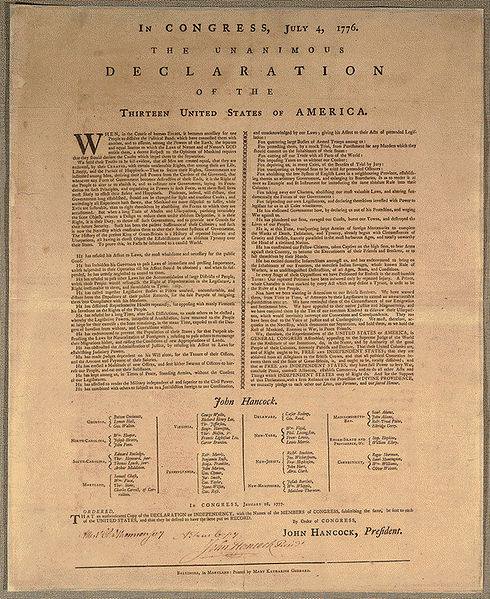
The 56 signatures on the Declaration appear in the positions indicated:
Column 1
Georgia: Button Gwinnett, Lyman Hall, George Walton
Column 2
North Carolina: William Hooper, Joseph Hewes, John Penn
South Carolina: Edward Rutledge, Thomas Heyward, Jr., Thomas Lynch, Jr., Arthur Middleton
Column 3
Massachusetts: John Hancock
Maryland: Samuel Chase, William Paca, Thomas Stone, Charles Carroll of Carrollton
Virginia: George Wythe, Richard Henry Lee, Thomas Jefferson, Benjamin Harrison, Thomas Nelson, Jr., Francis Lightfoot Lee, Carter Braxton
Column 4
Pennsylvania: Robert Morris, Benjamin Rush, Benjamin Franklin, John Morton, George Clymer, James Smith, George Taylor, James Wilson, George Ross
Delaware: Caesar Rodney, George Read, Thomas McKean
Column 5
New York: William Floyd, Philip Livingston, Francis Lewis, Lewis Morris
New Jersey: Richard Stockton, John Witherspoon, Francis Hopkinson, John Hart, Abraham Clark
Column 6
New Hampshire: Josiah Bartlett, William Whipple
Massachusetts: Samuel Adams, John Adams, Robert Treat Paine, Elbridge Gerry
Rhode Island: Stephen Hopkins, William Ellery
Connecticut: Roger Sherman, Samuel Huntington, William Williams, Oliver Wolcott
New Hampshire: Matthew Thornton

![]()
The Clause Removed : That one was against the institution of slavery
In our study of the Declaration of Independence it was pointed out that there were originally 28 grievances though the final draft lists only 27. One grievance was removed. That one was against the institution of slavery.
“He has waged cruel war against human nature itself, violating its most sacred rights of life & liberty in the persons of a distant people who never offended him, captivating & carrying them into slavery in another hemisphere, or to incur miserable death in their transportation thither. This piratical warfare, the opprobrium of infidel powers, is the warfare of the CHRISTIAN king of Great Britain. Determined to keep open a market where MEN should be bought & sold, he has prostituted his negative for suppressing every legislative attempt to prohibit or to restrain this execrable commerce: and that this assemblage of horrors might want no fact of distinguished die, he is now exciting those very people to rise in arms among us, and to purchase that liberty of which he has deprived them, & murdering the people upon whom he also obtruded them; thus paying off former crimes committed against the liberties of one people, with crimes which he urges them to commit against the lives of another.”
One fact about the Revolution which is not commonly known was that some colonists joined the Patriot cause due to a desire to end slavery rather than a wish to be independent. Laws made by the colonial legislatures to limit the institution had been blocked by the royal governors. Great Britain had no desire to end the lucrative trade in slaves. They were left with but one recourse to end slavery, independence. With this as a motivation, why was slavery then continued in the new country? Why was the grievance against it removed?
Thomas Paine said,
“It is never to be expected in a revolution that every man is to change his opinion at the same moment. There never yet was any truth or any principle so irresistibly obvious that all men believed it at once. Time and reason must cooperate with each other to the final establishment of any principle; and therefore those who may happen to be first convinced have not a right to persecute others, on whom conviction operates more slowly. The moral principle of revolutions is to instruct, not to destroy.”
Because some of the Patriots and Founders had come to the conclusion that slavery was wrong, does not mean that they all had. Slavery was an ancient tradition. During the time of the Founders it was practiced all around the world. The society in which they lived contained multiple class levels from the king and royal family down to the commoner. Slavery was just one more layer. In addition the economy of many colonies was dependent upon slave labor. So is the question really why they failed to end slavery or is a better question how did any of them ever come to decide it was wrong?
Either because not all changed their opinion at the same time or because of the dependence on slavery, during the debates on the Declaration the colonies of the Deep South demanded that the clause be removed. The delegates from South Carolina and Georgia, possibly led by Edward Rutledge, threatened that their colonies would fight on the side of Great Britain if the section remained. This was not an empty threat. The southern colonies had a higher percentage of Loyalists than their northern neighbors, and Georgia was the youngest of the colonies, only 43 years old. Her ties to the mother country had not had much time to loosen. Faced with the possibility of disunited states, Thomas Jefferson had no choice but to remove the clause.
But the demise of the clause was not the end of the idea. Prior to declaring independence all thirteen of the colonies practiced slavery. As the states wrote their new constitutions, many put an end to it within their own borders. Most of the states took a gradual approach. A date was set. Those born after that date were free. That is how it came about that at the time of the Civil War, there were still slaves living in New Jersey, though by then too old to work. Others ended slavery more immediately. When the Massachusetts Supreme Judicial Court ruled slavery to be illegal under a clause in the states’ constitution all slaves were freed. When Vermont was added to the union, its constitution prohibited slavery. By 1804, every state north of the Mason Dixon Line had outlawed slavery. Even those states that did not ban slavery outright, as Jefferson tried unsuccessfully to do in Virginia, placed limits on slavery such as banning the importation and exportation of slaves. And in 1807 Thomas Jefferson signed into law an act finally ending the importation of slaves into the United States.
Other actions revealed the Founders general views on slavery. In 1787, the Second Continental Congress passed the Northwest Ordinance. This act dealt with the territory north of the Ohio River. One of the most significant parts of it was the prohibition of slavery in U.S. territories. “There shall be neither slavery nor involuntary servitude in the said territory.”
It took 89 years for this particular promise of the Declaration to be fulfilled, but it was. Had the colonies been united at the beginning on the issue of slavery, or had the principles of liberty been followed by the succeeding generations, perhaps the Civil War could have been avoided and emancipation occurred sooner. Disunity and the ignoring of foundational principles had consequences. In our first century as a nation that consequence was war. What is it today?
The List of Grievances from the Declaration of Independence
1. He has refused his Assent to Laws, the most wholesome and necessary for the public good.
2. He has forbidden his Governors to pass Laws of immediate and pressing importance, unless suspended in their operation till his Assent should be obtained; and when so suspended, he has utterly neglected to attend to them.
3. He has refused to pass other Laws for the accommodation of large districts of people, unless those people would relinquish the right of Representation in the Legislature, a right inestimable to them and formidable to tyrants only.
4. He has called together legislative bodies at places unusual, uncomfortable, and distant from the depository of their public Records, for the sole purpose of fatiguing them into compliance with his measures.
5. He has dissolved Representative Houses repeatedly, for opposing with manly firmness his invasions on the rights of the people.
6. He has refused for a long time, after such dissolutions, to cause others to be elected; whereby the Legislative powers, incapable of Annihilation, have returned to the People at large for their exercise; the State remaining in the mean time exposed to all the dangers of invasion from without, and convulsions within.
7. He has endeavoured to prevent the population of these States; for that purpose obstructing the Laws for Naturalization of Foreigners; refusing to pass others to encourage their migrations hither, and raising the conditions of new Appropriations of Lands.
8. He has obstructed the Administration of Justice, by refusing his Assent to Laws for establishing Judiciary powers.
9. He has made Judges dependent on his Will alone, for the tenure of their offices, and the amount and payment of their salaries.
10. He has erected a multitude of New Offices, and sent hither swarms of Officers to harass our people, and eat out their substance.
11. He has kept among us, in times of peace, Standing Armies without the Consent of our legislatures.
12. He has affected to render the Military independent of and superior to the Civil power.
13. He has combined with others to subject us to a jurisdiction foreign to our constitution, and unacknowledged by our laws; giving his Assent to their Acts of pretended Legislation:
14. For Quartering large bodies of armed troops among us:
15. For protecting them, by a mock Trial, from punishment for any Murders which they should commit on the Inhabitants of these States:
16. For cutting off our Trade with all parts of the world:
17. For imposing Taxes on us without our Consent:
18. For depriving us in many cases, of the benefits of Trial by Jury:
19. For transporting us beyond Seas to be tried for pretended offences
20. For abolishing the free System of English Laws in a neighbouring Province, establishing therein an Arbitrary government, and enlarging its Boundaries so as to render it at once an example and fit instrument for introducing the same absolute rule into these Colonies:
21. For taking away our Charters, abolishing our most valuable Laws, and altering fundamentally the Forms of our Governments:
22. For suspending our own Legislatures, and declaring themselves invested with power to legislate for us in all cases whatsoever.
23. He has abdicated Government here, by declaring us out of his Protection and waging War against us.
24. He has plundered our seas, ravaged our Coasts, burnt our towns, and destroyed the lives of our people.
25. He is at this time transporting large Armies of foreign Mercenaries to complete the works of death, desolation and tyranny, already begun with circumstances of Cruelty & perfidy scarcely paralleled in the most barbarous ages, and totally unworthy the Head of a civilized nation.
26. He has constrained our fellow Citizens taken Captive on the high Seas to bear Arms against their Country, to become the executioners of their friends and Brethren, or to fall themselves by their Hands.
27. He has excited domestic insurrections amongst us, and has endeavoured to bring on the inhabitants of our frontiers, the merciless Indian Savages, whose known rule of warfare, is an undistinguished destruction of all ages, sexes and conditions.
Second Continental Congress voted for independence on July 2, 1776

Second Continental Congress voted for independence on July 2, 1776
We have looked at Richard Henry Lee’s Resolution on Independence. We have learned about the Committee of Five who was responsible for writing the Declaration of Independence. We have read every line of the document and picked them apart. But what happened after it was adopted?
As already discussed the member of the Second Continental Congress voted for independence on July 2, 1776. That should have been America’s birthday. It is not and the Declaration is the reason why.
The duties of the Committee of Five were not complete with the presentation of the Declaration to Congress. They still had one task to complete – getting it printed. As already shown, the Declaration was not signed on the 4th because it was not ready. On that date only John Hancock and Charles Thomson as president and secretary signed the draft which was then delivered to printer John Dunlap. Dunlap worked through the night and the next morning, July 5th, the Dunlap Broadsides were complete. It is estimated that around 200 of these were produced and sent out to the Patriot leaders in each state, to the Continental Army, and of course to Europe. John Adams even sent one to his wife Abigail in Massachusetts. These copies were read aloud in towns across the country, and the people were so moved that it was the date of the Declaration which is honored. Today there are 26 Dunlap Broadsides still known to exist.
The more familiar hand written Declaration was the work of Timothy Matlack, a name which should be familiar to fans of the film National Treasure. Matlack was a Philadelphian known for his fine penmanship. The engrossed copy he created was the one which was signed by the members of Congress. This copy was produced not on paper but on parchment, a material made from sheep or other animal skin. Today there are multiple copies of the engrossed Declaration made from the original. One of these copies is kept at Independence Hall in Philadelphia, Pennsylvania. Another, thought to be Jefferson’s own copy, is in the possession of the Library of Virginia. The original, the one signed on August 2nd, 1776 is kept in the rotunda of the National Archives building in Washington, D.C.
In addition to the Dunlap Broadsides and the engrossed copy a third well-known edition was produced. In 1777 Congress asked Mary Katherine Goddard to create a new broadside which would include the signatures, something the Dunlap Broadsides did not include. Nine of these still exist.
The fact that multiple copies of a 200 year old document have been preserved with such care and are so highly valued by collectors should give us pause to consider how well we value this original founding document.
Ridgewood 4th of July Parade Start Time Changed to 9:45 am
July 4th – Parade at 10AM; Rain or Shine
(Lightning would be the only reason for cancellation)
Fireworks – scheduled for 9PM on Vet’s Field; alternate date 7/5; Information – www.ridgewoodjuly4th.org
Check back for any weather updates
July 4th Parade and Fireworks Tickets and Schedule Updates
July 4th Updateswww.ridgewoodjuly4th.org
Parade begins at 10AM – Godwin Avenue & S. Monroe Avenue, travels under the train trestle, takes a right on Broad Street, left on E. Ridgewood Avenue, left on Maple Avenue, then right on Linwood – ending at Northern Parkway. The Garber Square paving project will have no impact on the normal July 4th Parade route. The Complete Streets Paving Project will be completed later in the summer.
Fireworks – Gates open at 6PM to come on to Veteran’s Field to view the entertainment and fireworks. Tickets are required. Tickets in advance for $8 at local businesses – Backyard Living; ConnectOne Bank; Chestnut Catering – Deli;Daily Treat; Goffle Brook Farm; Harding Wines; Harolds’s Farm; Hogan’s Restaurant Diner; Hosking’s Propane; Drinks Wine and Spirits; Ridgewood Car Wash; Ridgewood Cycle Shop; The Wine Seller; town and Country Apothecary. Tickets at the Veteran’s Field Gate will be $15 Adults and $10 Children.