Each year at this time school children all over America are taught the official Thanksgiving story, and newspapers, radio, TV, and magazines devote vast amounts of time and space to it. It is all very colorful and fascinating.
It is also very deceiving. This official story is nothing like what really happened. It is a fairy tale, a whitewashed and sanitized collection of half-truths which divert attention away from Thanksgiving’s real meaning.
The official story has the pilgrims boarding the Mayflower, coming to America and establishing the Plymouth colony in the winter of 1620-21. This first winter is hard, and half the colonists die. But the survivors are hard working and tenacious, and they learn new farming techniques from the Indians. The harvest of 1621 is bountiful. The Pilgrims hold a celebration, and give thanks to God. They are grateful for the wonderful new abundant land He has given them.
The official story then has the Pilgrims living more or less happily ever after, each year repeating the first Thanksgiving. Other early colonies also have hard times at first, but they soon prosper and adopt the annual tradition of giving thanks for this prosperous new land called America.
The problem with this official story is that the harvest of 1621 was not bountiful, nor were the colonists hardworking or tenacious. 1621 was a famine year and many of the colonists were lazy thieves.
In his ‘History of Plymouth Plantation,’ the governor of the colony, William Bradford, reported that the colonists went hungry for years, because they refused to work in the fields. They preferred instead to steal food. He says the colony was riddled with “corruption,” and with “confusion and discontent.” The crops were small because “much was stolen both by night and day, before it became scarce eatable.”
In the harvest feasts of 1621 and 1622, “all had their hungry bellies filled,” but only briefly. The prevailing condition during those years was not the abundance the official story claims, it was famine and death. The first “Thanksgiving” was not so much a celebration as it was the last meal of condemned men.
But in subsequent years something changes. The harvest of 1623 was different. Suddenly, “instead of famine now God gave them plenty,” Bradford wrote, “and the face of things was changed, to the rejoicing of the hearts of many, for which they blessed God.” Thereafter, he wrote, “any general want or famine hath not been amongst them since to this day.” In fact, in 1624, so much food was produced that the colonists were able to begin exporting corn.
What happened?
After the poor harvest of 1622, writes Bradford, “they began to think how they might raise as much corn as they could, and obtain a better crop.” They began to question their form of economic organization.
This had required that “all profits & benefits that are got by trade, working, fishing, or any other means” were to be placed in the common stock of the colony, and that, “all such persons as are of this colony, are to have their meat, drink, apparel, and all provisions out of the common stock.” A person was to put into the common stock all he could, and take out only what he needed.
This “from each according to his ability, to each according to his need” was an early form of socialism, and it is why the Pilgrims were starving. Bradford writes that “young men that are most able and fit for labor and service” complained about being forced to “spend their time and strength to work for other men’s wives and children.” Also, “the strong, or man of parts, had no more in division of victuals and clothes, than he that was weak.” So the young and strong refused to work and the total amount of food produced was never adequate.
To rectify this situation, in 1623 Bradford abolished socialism. He gave each household a parcel of land and told them they could keep what they produced, or trade it away as they saw fit. In other words, he replaced socialism with a free market, and that was the end of famines.
Many early groups of colonists set up socialist states, all with the same terrible results. At Jamestown, established in 1607, out of every shipload of settlers that arrived, less than half would survive their first twelve months in America. Most of the work was being done by only one-fifth of the men, the other four-fifths choosing to be parasites. In the winter of 1609-10, called “The Starving Time,” the population fell from five-hundred to sixty.
Then the Jamestown colony was converted to a free market, and the results were every bit as dramatic as those at Plymouth. In 1614, Colony Secretary Ralph Hamor wrote that after the switch there was “plenty of food, which every man by his own industry may easily and doth procure.” He said that when the socialist system had prevailed, “we reaped not so much corn from the labors of thirty men as three men have done for themselves now.”
Before these free markets were established, the colonists had nothing for which to be thankful. They were in the same situation as Ethiopians are today, and for the same reasons. But after free markets were established, the resulting abundance was so dramatic that the annual Thanksgiving celebrations became common throughout the colonies, and in 1863, Thanksgiving became a national holiday.
Thus the real reason for Thanksgiving, deleted from the official story, is: Socialism does not work; the one and only source of abundance is free markets, and we thank God we live in a country where we can have them.
* * * * *
Mr. Maybury writes on investments.
This article originally appeared in The Free Market, November 1985.
A Veterans Day Message from Bergen County Executive Kathleen A. Donovan
Each year at this time I struggle to find the words that will appropriately reflect the deep respect and admiration I hold for our U.S. military veterans..
There are, I have come to learn, no words that can adequately reflect our gratitude and repay the debt we collectively owe to the men and women who served in the U.S Armed Forces and continue to serve us to this day.
The simplest and best words I can come up with to commemorate this day are simply to say to our veterans: Thank You.
Thank you for your sacrifice and your commitment to your country. Thank you for your bravery on the battlefield; thank you for putting your lives on the line and your personal lives on hold while you protected America’s interest around the globe. And thank you for giving us the freest nation on earth – the shining beacon of hope for the rest of the world.
For the past 240 years, beginning when our colonialist first embraced the fight for liberty, Americans have made an unwavering commitment to freedom and a pledge to fight tyranny wherever it exists in the world. When the call to arms has come, American men and women have answered, willingly and unselfishly.
The unique American commitment to Liberty has never waned, no matter what the price. And the price has been steep for many individuals and their families.
Millions of American families have been heartbroken by the loss of a loved one who fought and died in uniform — and millions more have been forced to live with wounds, both physical and psychological that have afflicted our U.S. servicemen and women.
The families who stand by proudly while their sons and daughters serve the cause for freedom deserve our thanks today too. They live with fear every day for their children. I pray that their sons and daughters will be returned safely to them.
And so, at the 11th hour, of the 11th day, of the 11th month, we pause and remember and thank our veterans.
A little history lesson on Halloween for the Christians who believe it’s a Pagan holiday
Djmc King Cassanova
So since I can’t help myself… Lets have a little history lesson on Halloween for the Christians who believe it’s a Pagan holiday reserved for witches and devil worshippers (not saying any names to avoid the impending embarrassment that is surely heading your way)
Oh, and for those who think this Athiest can’t possible know anything about religion lets just add this little tidbit: I was raised Catholic, have read the bible all the way through many times, have done extensive research and am well versed on many religions, (and yes this does include Wiccan). I am not one to tell anyone they are wrong for their religious views, unless of course they are wrong based on fact and plain common sense. So, lets have a history lesson, shall we? I think we all could use one.
Halloween falls on the eve of the Christian holy days of All Hallow’s Day and All Saints Day. the days are collectively known as Hallowmas. Like many other major “holidays” in Christianity, celebrations begin the night before. This includes All Hallow’s which is where Halloween got its name from: Hallow’s Eve.
Hallowmas is used to honor the saints and to pray for recently departed souls who haven’t reached Heaven yet. It was customary for people, known as criers, to dress in black and ring a bell to call on Christians to remember departed souls. The custom of trick or treating came from the Christian custom of “souling”. Children would go door to door collecting “soul cakes” as means of praying for souls stuck in purgatory. During Hallowmas, Churches that were too poor to have displayed relics of saints allowed parishioners to dress up as martyred Saints as a way to honor them.
In many countries of Europe, Christians believe that once a year the souls return for a party known as the “danse macabre” which is actually depicted in decor on the walls of many churches and cemeteries. This is where the custom of modern day costume parties originates.
Halloween was (and still is) celebrated to honor the Saints and the souls of the deceased. In many countries children dress as departed Saints and other biblical figures.
Yes there are some Christians (nonconformist protestants in particular) who at one point believed that the spirits who returned were evil since they believed in predestination therefore redefining Hallow’s Eve without purgatory. Their homes and barns were blessed to protect themselves from evil spirits and the witches that were thought to accompany them.
My history lesson on “witches” and Wiccan religion will have to be another time. That being said, as with anything in life, things can be twisted to reflect your own personal beliefs or changed completely. Excellent example would be the Swastika which, up until Hitler got his hands on it, represented life and good luck. Hallowmas didn’t have a negative connotation until the Protestants tweaked it to coincide with their own beliefs.
Halloween was and still is a Christian holiday.
That concludes our history lesson. Be sure to hand out the big candy bars to the pagan children running the streets worshipping the devil.
Observed on the first Monday in September, Labor Day pays tribute to the contributions and achievements of American workers. It was created by the labor movement in the late 19th century and became a federal holiday in 1894. Labor Day also symbolizes the end of summer for many Americans, and is celebrated with parties, parades and athletic events. ( https://www.history.com/topics/labor-day )
The History of Labor Day
Labor Day: How it Came About; What it Means
Labor Day, the first Monday in September, is a creation of the labor movement and is dedicated to the social and economic achievements of American workers. It constitutes a yearly national tribute to the contributions workers have made to the strength, prosperity, and well-being of our country.
Labor Day Legislation
Through the years the nation gave increasing emphasis to Labor Day. The first governmental recognition came through municipal ordinances passed during 1885 and 1886. From these, a movement developed to secure state legislation. The first state bill was introduced into the New York legislature, but the first to become law was passed by Oregon on February 21, 1887. During the year four more states — Colorado, Massachusetts, New Jersey, and New York — created the Labor Day holiday by legislative enactment. By the end of the decade Connecticut, Nebraska, and Pennsylvania had followed suit. By 1894, 23 other states had adopted the holiday in honor of workers, and on June 28 of that year, Congress passed an act making the first Monday in September of each year a legal holiday in the District of Columbia and the territories.
Founder of Labor Day
More than 100 years after the first Labor Day observance, there is still some doubt as to who first proposed the holiday for workers.
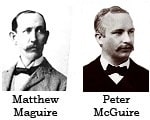
Some records show that Peter J. McGuire, general secretary of the Brotherhood of Carpenters and Joiners and a cofounder of the American Federation of Labor, was first in suggesting a day to honor those “who from rude nature have delved and carved all the grandeur we behold.”
But Peter McGuire’s place in Labor Day history has not gone unchallenged. Many believe that Matthew Maguire, a machinist, not Peter McGuire, founded the holiday. Recent research seems to support the contention that Matthew Maguire, later the secretary of Local 344 of the International Association of Machinists in Paterson, N.J., proposed the holiday in 1882 while serving as secretary of the Central Labor Union in New York. What is clear is that the Central Labor Union adopted a Labor Day proposal and appointed a committee to plan a demonstration and picnic.
The First Labor Day
The first Labor Day holiday was celebrated on Tuesday, September 5, 1882, in New York City, in accordance with the plans of the Central Labor Union. The Central Labor Union held its second Labor Day holiday just a year later, on September 5, 1883.
In 1884 the first Monday in September was selected as the holiday, as originally proposed, and the Central Labor Union urged similar organizations in other cities to follow the example of New York and celebrate a “workingmen’s holiday” on that date. The idea spread with the growth of labor organizations, and in 1885 Labor Day was celebrated in many industrial centers of the country.
A Nationwide Holiday
The form that the observance and celebration of Labor Day should take was outlined in the first proposal of the holiday — a street parade to exhibit to the public “the strength and esprit de corps of the trade and labor organizations” of the community, followed by a festival for the recreation and amusement of the workers and their families. This became the pattern for the celebrations of Labor Day. Speeches by prominent men and women were introduced later, as more emphasis was placed upon the economic and civic significance of the holiday. Still later, by a resolution of the American Federation of Labor convention of 1909, the Sunday preceding Labor Day was adopted as Labor Sunday and dedicated to the spiritual and educational aspects of the labor movement.
The character of the Labor Day celebration has undergone a change in recent years, especially in large industrial centers where mass displays and huge parades have proved a problem. This change, however, is more a shift in emphasis and medium of expression. Labor Day addresses by leading union officials, industrialists, educators, clerics and government officials are given wide coverage in newspapers, radio, and television.
The vital force of labor added materially to the highest standard of living and the greatest production the world has ever known and has brought us closer to the realization of our traditional ideals of economic and political democracy. It is appropriate, therefore, that the nation pay tribute on Labor Day to the creator of so much of the nation’s strength, freedom, and leadership — the American worker.
10 recipes for the perfect Labor Day barbecue
Published August 29, 2013
FoxNews.com
While summer may be coming to a close, the end of grilling season is still a long way away. This Labor Day, take advantage of the fact that the old Weber isn’t covered with snow or plastered with rotting leaves. Think about it. You’ve only got a few more weeks before summer is over and the neighbors think you’re crazy for firing up the grill in a blizzard.
To aid in your Labor Day celebration, we’ve come up with a list of recipes that pay tribute to summer and welcome the fall. From barbecued turkey wings to a fall berry cocktail, we’ve compiled all the makings of an epic Labor Day feast. So turn on the grill, loosen that belt and let the Labor Day party begin.
In observance of Labor Day, Village offices will be closed Monday, September 2. There will also be no garbage or recycling collection that day. The Recycling Center on E. Glen Avenue will also be closed.
All offices and services resume operation Tuesday, September 2.
CARSON: MLK would be alarmed by black-on-black violence, lack of family values Ben S. Carson is professor emeritus of neurosurgery at Johns Hopkins University.
It is hard to believe that 50 years have elapsed since the famous “I have a dream speech” of Dr. Martin Luther King Jr. on the Mall in Washington. I was an 11-year-old child in Detroit languishing in the midst of poverty, but very interested in the strides that were being made in the civil rights movement.
I was the only black kid in my seventh-grade class and over the previous two years had risen from the bottom of the class to the top. My mother had forced us to read, which had a profound positive effect on both my brother Curtis and myself. I was quite optimistic that things were getting better for black people in America.
If King could be resurrected and see what was going on in America today, I suspect he would be extraordinarily pleased by many of the things he observed and disappointed by others. He, like almost everyone else, would be thrilled to know that there was a two-term black president of the United States of America and a black attorney general, as well as many other high government officials, business executives and university presidents.
Perhaps just as thrilling would be the sight of black doctors, lawyers, airline pilots, construction foremen, news anchors, school superintendents and almost any other position imaginable in America. The fact that seeing blacks in such positions no longer raises eyebrows is a testimony to the tremendous progress that has been made in America over the last 50 years.
DoD Training Manual: ‘Extremist’ Founding Fathers ‘Would Not Be Welcome In Today’s Military’
Manual lists people concerned with “individual liberties, states’ rights, and how to make the world a better place” as potential extremists
Adan Salazar
Infowars.com
August 24, 2013
Conservative watchdog group Judicial Watch recently obtained a Department of Defense training manual which lists people who embrace “individual liberties” and honor “states’ rights,” among other characteristics, as potential “extremists” who are likely to be members of “hate groups.”
Marked “for training purposes only,” the documents, obtained Thursday through a Freedom of Information Act request submitted in April, include PowerPoint slides and lesson plans, among which is a January 2013 Air Force “student guide” distributed by the Defense Equal Opportunity Management Institute simply entitled “Extremism.”
Judicial Watch’s FOIA request asked for “Any and all records concerning, regarding, or related to the preparation and presentation of training materials on hate groups or hate crimes distributed or used by the Air Force.”
As the group notes, “The document defines extremists as ‘a person who advocates the use of force or violence; advocates supremacist causes based on race, ethnicity, religion, gender, or national origin; or otherwise engages to illegally deprive individuals or groups of their civil rights.’”
The manual goes on to bar military personnel from “active participation” in such extremist organization activities as “publicly demonstrating,” “rallying,” “fundraising” and “organizing,” basically denying active-duty military from exercising the rights they so ardently fight to defend.
It begins its introduction of a section titled, “Extremist ideologies,” by describing the American colonists who sought independence from British rule as a historical example of extremism.
“In U.S. history, there are many examples of extremist ideologies and movements. The colonists who sought to free themselves from British rule and the Confederate states who sought to secede from the Northern states are just two examples,” according to the training guide.
In a section drawing inspiration from a 1992 book titled “Nazis, Communists, Klansmen, and Others on the Fringe: Political Extremism in America,” the manual also lists “Doomsday thinking” under “traits or behaviors that tend to represent the extremist style.”
Why Capitalism Is Awesome
July/August 2013
By Chris Berg
Each year the glossy business magazine FastCompany releases a list of what it considers to be the “World’s 50 Most Innovative Companies.” This list is populated much as you would expect. In 2012 the leader was Apple, followed by Facebook, Google, and Amazon.com. Spot a theme? In the top 10, there are only two companies that are not primarily digital companies. One, Life Technologies, works in genetic engineering. (The other — try not to laugh — is the Occupy Movement. FastCompany describes them as “Transparent. Tech savvy. Design savvy. Local and global. Nimble.”) Not only are most of them digital firms, but they’re all flashy and unique, and they’re almost all household names.
Everybody from Forbes to BusinessWeek hands out most innovative company awards. They’re all pretty similar and predictable. But these lists have a perverse effect. They suggest that the great success of capitalism and the market economy is inventing cutting edge technology and that if we want to observe capitalist progress, we should be looking for sleek design and popular fashion. Innovation, the media tells us, is inventing cures for cancer, solar panels, and social networking.
But the true genius of the market economy isn’t that it produces prominent, highly publicized goods to inspire retail queues, or the medical breakthroughs that make the nightly news. No, the genius of capitalism is found in the tiny things — the things that nobody notices.
A market economy is characterized by an infinite succession of imperceptible, iterative changes and adjustments. Free market economists have long talked about the unplanned and uncoordinated nature of capitalist innovation. They’ve neglected to emphasize just how invisible it is. One exception is the great Adam Smith.
In his Wealth of Nations, the example he used to illustrate the division of labor was a pin factory. He described carefully the complex process by which a pin is made. Producing the head of the pin “requires two to three distinct operations.” To place the head on the wire is a “peculiar business.” Then the pins have to be whitened. The production of a pin, Smith concluded, is an 18-step task.
Smith was making an argument about specialization, but just as important was his choice of example. It would be hard to think of something less impressive, less consequential than a pin. Smith wanted his contemporaries to think about the economy not by observing it from the lofty heights of the palace or the lecture hall, but by seeing it from the bottom up — to recognise how a market economy is the aggregate of millions of little tasks. It’s a lesson many have not yet learned. We should try to recognise the subtleties of the apparently mundane.
CAPITALISM MEANS EFFICIENCY
Ikea’s Billy bookshelf is a common, almost disposable, piece of household furniture that has been produced continuously since 1979. It looks exactly the same as it did more than three decades ago. But it’s much cheaper. The standard model — more than six feet tall — costs $59.99. And from an engineering perspective the Billy bookshelf is hugely different from its ancestors.
In those 30 years the Billy has changed minutely but importantly. The structure of the back wall has changed over and over, as the company has tried to reduce the weight of the back (weight costs money) but increase its strength. Even the studs that hold up the removable book shelves have undergone dramatic changes. The studs were until recently simple metal cylinders. Now they are sophisticated shapes, tapering into a cup at one end on which the shelf rests. The brackets that hold the frame together are also complex pieces of engineering.
Ikea is a massive company. Tiny changes — even to metal studs — are magnified when those products are produced in bulk. There is no doubt somebody, somewhere in the Ikea product design hierarchy whose singular focus has been reducing the weight and increasing the strength of those studs. They went to sleep thinking about studs and metals and the trade-offs between strength and weight. Their seemingly inconsequential work helps keep Ikea’s prices down and its profits high. With each minute change to the shape of the Billy’s metal studs they earn their salary many times over.
Being massive, however, Ikea has an advantage: it is able to hire specialists whose job is solely to obsess about simple things like studs. Ikea is well-known for its more prominent innovations — for instance, flat-packing, which can reduce to one-sixth the cost of shipping — and the extremely low staffing of its retail stores.
For big-box retailers, innovation is about efficiency, not invention. Extremely resilient supply chains may not win glossy innovation awards but they are the source of much of our modern prosperity. But Ikea is big and famous. So let me suggest another icon of capitalist innovation and dynamism: pizza.
CAPITALISM TASTES BETTER, CHEAPER
Pizza is one of our most mundane and simple foods. It would be the last place most people would look for innovation and engineering. It is, at its most basic, a thin bread topped by tomatoes and cheese — a food of the poor of Naples exported, which is endlessly interpreted by the rest of the world.
Forty-one percent of Americans eat pizza at least once a week, whether purchased frozen and reheated in home ovens, delivered, taken away, or cooked from scratch at home. All of these choices are more complicated than they seem. Keeping a pizza crisp long out of the oven so that it can be delivered, or making sure it will crisp up in a variable home oven after having been frozen for weeks is anything but simple.
Moisture is the enemy. For frozen pizzas, this means that toppings have to be precooked precisely to avoid some ingredients being burned while others are still heating through. Frozen pizza takes a lot of abuse — it is partially thawed each time it is transferred from manufacturer to supermarket to home freezer. So the dough has to be precisely regulated to manage its water content.
Cheese freezes poorly, and consumers expect it to melt evenly across the base, so manufacturers obsess about cheese’s pH range and its water and salt content. And of course all these decisions are made with an eye on the customer’s budget and the manufacturer’s profitability. The consumers of familysized frozen pizzas tend to be extremely price sensitive. The opportunities for innovation in processes, equipment, automation, and chemistry are virtually endless.
It gets even more complicated when we factor in changing consumer tastes. The modern pizza customer doesn’t just want cheese, tomato, and pepperoni. As food tastes grow more sophisticated they look for more sophisticated flavors, even in frozen pizza. It’s one thing to master how cheddar or mozzarella melts. Dealing with more flavorful brie or smoked Gouda is another thing entirely. Like Ikea’s stud specialist, there are hundreds of people across the world obsessed with how frozen cheese melts in a home oven. These sorts of complications are replicated across every ingredient in this simple product. (How does one adapt an automated pepperoni dispenser to dispense feta instead?)
Customers demand aesthetic qualities too. Frozen products have to look authentic. Customers like their pizza crusts to have slight burn marks, even if home ovens won’t naturally produce them. So manufacturers experiment with all sorts of heating techniques to replicate the visual result of a woodfired oven.
Takeout pizza seems easier but has almost as many complexities. Some large pizza chains are slowly integrating the sort of sauce and topping applicators used by frozen goods manufacturers. Cheese is costly and hard to spread evenly. The pizza chain Dominos uses a proprietary “auto-cheese,” which takes standardized blocks of cheese and, with a push of a button, shreds them evenly across a base.
Moisture problems are even more endemic in takeout pizza. The cooked pizza has to survive, hot and crispy and undamaged, for some time before it is consumed. If the box is closed, the steam from the hot pizza seeps through the bread, making it soft and unappealing. But an open box will lose heat too quickly. Engineers have struck a balance. Vents in the box and plastic tripods in the centre of the pizza encourage airflow. Deliverers carry the pizzas in large insulated sleeves to keep the heat in but reduce risk of steam damage.
We could easily replicate this analysis for almost every processed or manufactured food in the typical supermarket. Then we could reflect on the complexity of serving food, not in a home kitchen, but on an airplane flying more than 600 miles per hour and 37,000 feet in the air, cooked in a tiny galley for hundreds of people at a time.
Some of the most extraordinary logistical accomplishments of the modern world are entirely unnoticed. Some — like airline food — we actively disparage, without recognizing the true effort behind them.
CAPITALISM IS ABOUT INNOVATION, AS WELL AS INVENTION
One of the great essays in the free market tradition is Leonard Read’s “I, Pencil.” Read was the founder of the influential American think tank the Foundation for Economic Education. In his essay, he adopts the perspective of an ordinary wooden lead pencil and purports to write his genealogy. He began as a cedar tree from North California or Oregon, was chopped down and harvested and shipped on a train to a mill in San Leandro, California, and there cut down into “small, pencil-length slats less than onefourth of an inch in thickness.”
Read’s point: “Not a single person on the face of this earth” knows how to make a pencil on their own. The construction of a pencil is entirely dispersed among “millions of human beings,” from the Italians who mine pumice for the eraser to the coffee manufacturers who supply their drinks to the cedar loggers in Oregon.
Read was vividly illustrating a famous point of Friedrich Hayek’s — these separate people manage, through nothing but the price system, to make something extraordinarily complex. None of the pumice miners intend to make a pencil. They simply want to trade their labor for wages. Adam Smith’s invisible hand does the rest. Read published his essay in 1958. The chemical formula for the eraser, known as the “plug,” has changed repeatedly over the half century since. The production is highly automated, and the supply lines are tighter.
Chemicals are added to keep the eraser from splitting. Synthetic rubber production in 2012 is much different than it was in 1958. These tiny plugs look pretty much the same but have evolved in a dozen different ways. “I, Pencil” magnificently captures the complexity of markets, but it doesn’t quite capture their dynamism. The millions of people involved in pencil production aren’t merely performing their market-allocated tasks but are trying to find new ways to make their tiny segment easier, cheaper, and more profitable. The pencil market — as far from a cutting-edge firm like Facebook as you could imagine — is still full of entrepreneurs trying to break apart established business models to shave costs and rationalize supply chains. In 1991 a gross of 144 simple, Chinese-made wood pencils sold on the wholesale market for $6.91. In 2004 that price had dropped to $4.48.
And this is before we consider the variety of pencils available to consumers — not just wooden ones of different shapes, sizes, colors, and densities, but mechanical pencils, jumbo sized children’s pencils, rectangular carpenters’ pencils (rectangular pencils can’t roll away) and on, and on, and on. It is to capitalism’s great disadvantage that there’s nothing inherently exciting about pencils. Humans like novelty. We like invention. We like high-technology breakthroughs that will change the world.
I, PORK
The most insightful book about capitalism published in the last decade isn’t a treatise on economics or philosophy but an art project. In Pig 05049, the Dutch artist Christien Meindertsma starkly shows photographs of the 185 separate products that are made from a single pig.
Every part of a slaughtered pig is sold and repurposed. Obviously, we’re familiar with pork and ham but how many people realise that pig bones are converted into a glue that holds sandpaper together? Or that pig fat is a constituent part of paint, helping its spread and giving it a glossy sheen? Pig parts are found in everything from yogurt to train brakes to photography paper to matches — even in bullets.
One response to Meindertsma’s book is to see it as simply a modern-day reworking of Leonard Read’s pencil. But it’s more than that. Pig 05049 reveals what a market economy tries to obscure: the deep complexities of individual products.
That single pig was stripped down and shipped to factories and markets across the world. It went into matches and copper and crayons and floor wax. These products are as mundane as can be imagined — what consumer spends more than a moment’s thought on which crayon to purchase, let alone how those crayons are produced? But as Meindertsma points out, the distinctive smell of many crayons comes from fatty acids, which in turn come from pig bone fat, used as a hardening agent.
Pig 05049 was published in 2007. The oleochemical industry — that is, the industry that derives chemicals from natural oils and fats — is one of the most innovative in the world. Like any industry experiencing rapid technological and scientific change, it is restructuring as well, moving production from Western Europe and the United States to China, Malaysia, and Indonesia.
Six years is a long time in a competitive marketplace. As simple as they seem, those crayons are changing: costs of production have been shaved down, raw materials are being utilized more efficiently, and supply lines are being tightened. Amazon now lists 2,259 separate products in the children’s drawing crayon category alone.
GOVERNMENT DOESN’T UNDERSTAND INNOVATION
If FastCompany has a warped view about the nature of innovation in a market economy, it is not alone. Governments do, too. The Australian federal government has its very own minister for innovation, and his Department of Industry, Innovation, Science, Research and Tertiary Education doles out grants for inventions and startups. Its Commercialisation Australia program sponsors inventors who “have transformed an innovative idea into reality.”
Innovation Australia funds grant-seekers to turn their “ground-breaking ideas into commercial products.” This is the invention fetish — the idea that technological progress occurs when dreamers have great ideas. All society needs to do is subsidize dreams into reality.
But ideas are the easy part. Getting things done is hard. Setting up a business, paring down costs, acquiring and retaining market share: those are the fields in a market economy where firms win or lose. The brilliance of the market economy is found in small innovations made to polish and enhance existing products and services. Invention is a wonderful thing. But we should not pretend that it is invention that has made us rich.
We have higher living standards than our ancestors because of the little things. We ought to be more aware of the continuous, slow, and imperceptible creative destruction of the market economy, the refiners who are always imperceptibly bettering our frozen pizzas, our bookshelves, our pencils, and our crayons.
“We identify the flag with almost everything we hold dear on earth, peace, security, liberty, our family, our friends, our home. … But when we look at our flag and behold it emblazoned with all our rights we must remember that it is equally a symbol of our duties. Every glory that we associate with it is the result of duty done.”
Preserving your Precious Heirlooms and Antiques with Bari Falese
Sunday, March 24 from 1:30–4:00 p.m. at the Ridgewood Public Library Auditorium
Ridgewood NJ, Have you ever wondered how best to care for and preserve that precious heirloom given to you by a relative? Do you have an antique piece that you want to preserve for future generations? Join Bari Falese at the Ridgewood Public Library on Sunday, March 24 at 1:30 p.m. Bari, an expert conservator with 30 years of experience, will speak about the care, cleaning, and storage of your heirlooms and antiques. She will help the audience understand the importance of preservation, how to use archival materials for care and storage, and how to triage items that have been damaged over time.
There will be a $5 admission charge to hear Bari speak. For an additional $5, Bari will look at your heirloom or antique item and give you actionable feedback on preserving it. If you would like Bari to look at your precious item, please register by emailing us.
This program is sponsored by The Ridgewood Historical Society and the Ridgewood Public Library. Proceeds raised will help support the Schoolhouse Museum and their preservation efforts.
Our expert Bari Falese has over 30 years experience in museums, galleries and conservation laboratories. She is a conservator and a curator. \ She has designed, prepared, and installed exhibits and been responsible for the care, assessment, and preservation of textiles, artifacts, and ephemera.
Bari has completed studies in ceramics, silver, pewter, painting, sculpture, printing, and textile arts. She holds a BA in Studio Art and in Chinese Studies and an MA in Studio Art. She completed a second masters degree at Seton Hall University in Museum Studies. In addition she has studied textile conservation at F.I.T.
Bari worked at the Newark Museum as assistant registrar. She currently works as an assistant textile conservator at The Textile Conservation Laboratory at the Cathedral Church of St. John the Divine in New York City. She is the sole proprietor of MTS as a consultant to museums, historic societies and private clients. For the last four years Bari has been a consultant at the Schoolhouse Museum helping to design and install exhibits.
Since 1997 Bari has taught preservation workshops to audiences ranging from Science Scouts to Elderhostel groups. She offers programs on the care of objects in museum settings and in the home. Bari continues to be a guest instructor for the Seton Hall University Museum Professions MA Program.
Each year at this time school children all over America are taught the official Thanksgiving story, and newspapers, radio, TV, and magazines devote vast amounts of time and space to it. It is all very colorful and fascinating.
It is also very deceiving. This official story is nothing like what really happened. It is a fairy tale, a whitewashed and sanitized collection of half-truths which divert attention away from Thanksgiving’s real meaning.
The official story has the pilgrims boarding the Mayflower, coming to America and establishing the Plymouth colony in the winter of 1620-21. This first winter is hard, and half the colonists die. But the survivors are hard working and tenacious, and they learn new farming techniques from the Indians. The harvest of 1621 is bountiful. The Pilgrims hold a celebration, and give thanks to God. They are grateful for the wonderful new abundant land He has given them.
The official story then has the Pilgrims living more or less happily ever after, each year repeating the first Thanksgiving. Other early colonies also have hard times at first, but they soon prosper and adopt the annual tradition of giving thanks for this prosperous new land called America.
The problem with this official story is that the harvest of 1621 was not bountiful, nor were the colonists hardworking or tenacious. 1621 was a famine year and many of the colonists were lazy thieves.
In his ‘History of Plymouth Plantation,’ the governor of the colony, William Bradford, reported that the colonists went hungry for years, because they refused to work in the fields. They preferred instead to steal food. He says the colony was riddled with “corruption,” and with “confusion and discontent.” The crops were small because “much was stolen both by night and day, before it became scarce eatable.”
In the harvest feasts of 1621 and 1622, “all had their hungry bellies filled,” but only briefly. The prevailing condition during those years was not the abundance the official story claims, it was famine and death. The first “Thanksgiving” was not so much a celebration as it was the last meal of condemned men.
But in subsequent years something changes. The harvest of 1623 was different. Suddenly, “instead of famine now God gave them plenty,” Bradford wrote, “and the face of things was changed, to the rejoicing of the hearts of many, for which they blessed God.” Thereafter, he wrote, “any general want or famine hath not been amongst them since to this day.” In fact, in 1624, so much food was produced that the colonists were able to begin exporting corn.
What happened?
After the poor harvest of 1622, writes Bradford, “they began to think how they might raise as much corn as they could, and obtain a better crop.” They began to question their form of economic organization.
This had required that “all profits & benefits that are got by trade, working, fishing, or any other means” were to be placed in the common stock of the colony, and that, “all such persons as are of this colony, are to have their meat, drink, apparel, and all provisions out of the common stock.” A person was to put into the common stock all he could, and take out only what he needed.
This “from each according to his ability, to each according to his need” was an early form of socialism, and it is why the Pilgrims were starving. Bradford writes that “young men that are most able and fit for labor and service” complained about being forced to “spend their time and strength to work for other men’s wives and children.” Also, “the strong, or man of parts, had no more in division of victuals and clothes, than he that was weak.” So the young and strong refused to work and the total amount of food produced was never adequate.
To rectify this situation, in 1623 Bradford abolished socialism. He gave each household a parcel of land and told them they could keep what they produced, or trade it away as they saw fit. In other words, he replaced socialism with a free market, and that was the end of famines.
Many early groups of colonists set up socialist states, all with the same terrible results. At Jamestown, established in 1607, out of every shipload of settlers that arrived, less than half would survive their first twelve months in America. Most of the work was being done by only one-fifth of the men, the other four-fifths choosing to be parasites. In the winter of 1609-10, called “The Starving Time,” the population fell from five-hundred to sixty.
Then the Jamestown colony was converted to a free market, and the results were every bit as dramatic as those at Plymouth. In 1614, Colony Secretary Ralph Hamor wrote that after the switch there was “plenty of food, which every man by his own industry may easily and doth procure.” He said that when the socialist system had prevailed, “we reaped not so much corn from the labors of thirty men as three men have done for themselves now.”
Before these free markets were established, the colonists had nothing for which to be thankful. They were in the same situation as Ethiopians are today, and for the same reasons. But after free markets were established, the resulting abundance was so dramatic that the annual Thanksgiving celebrations became common throughout the colonies, and in 1863, Thanksgiving became a national holiday.
Thus the real reason for Thanksgiving, deleted from the official story, is: Socialism does not work; the one and only source of abundance is free markets, and we thank God we live in a country where we can have them.
* * * * * Mr. Maybury writes on investments. This article originally appeared in The Free Market, November 1985.
Dead Presidents: New $100 bills stolen en route to Fed facility
By James O’Toole @CNNMoney October 12, 2012: 7:40 PM ET
NEW YORK (CNNMoney) — Unknown thieves stole a “large amount” of newly-designed $100 bills bound for a Federal Reserve facility in New Jersey on Thursday, the FBI said.
Frank Burton, Jr., spokesman for the FBI’s Philadelphia division, said the theft occurred at some point between when the shipment of bills landed at the Philadelphia airport on a commercial flight from Dallas at 10:20 Thursday morning, and when the shipment reached its New Jersey destination around 2:00 p.m., when the courier service transporting the bills reported some missing.
Burton declined to comment on the amount taken, but said it was substantial.
Editors Note: Christopher Columbus was a very controversial figure in his day ,perhaps even more so than now. Many students of history suggest that Columbus would have thrived in today’s culture of “no press is bad press ” and would have basked in all the attention.
Columbus Day
Columbus Day is a U.S. holiday that commemorates the landing of Christopher Columbus in the New World on October 12, 1492. It was unofficially celebrated in a number of cities and states as early as the 18th century but did not become a federal holiday until the 1937. For many, the holiday is a way of both honoring Columbus’ achievements and celebrating Italian-American heritage. Throughout its history, Columbus Day and the man who inspired it have generated controversy, and many alternatives to the holiday have appeared in recent years.
https://www.history.com/topics/columbus-day
Origins of Columbus Day
A U.S. national holiday since 1937, Columbus Day commemorates the arrival of Christopher Columbus in the New World on October 12, 1492. The Italian-born explorer had set sail two months earlier, backed by the Spanish monarchs King Ferdinand and Queen Isabella. He intended to chart a western sea route to China, India and the fabled gold and spice islands of Asia; instead, he landed in the Bahamas, becoming the first European to explore the Americas since the Vikings set up colonies in Greenland and Newfoundland during the 10th century.
Later that month, Columbus sighted Cuba and believed it was mainland China; in December the expedition found Hispaniola, which he though might be Japan. There, he established Spain’s first colony in the Americas with 39 of his men. In March 1493, the explorer returned to Spain in triumph, bearing gold, spices and “Indian” captives. He crossed the Atlantic several more times before his death in 1506; by his third journey, he realized that he hadn’t reached Asia but instead had stumbled upon a continent previously unknown to Europeans.
Columbus Day in the United States
The first Columbus Day celebration took place in 1792, when New York’s Columbian Order–better known as Tammany Hall–held an event to commemorate the historic landing’s 300th anniversary. Taking pride in Columbus’ birthplace and faith, Italian and Catholic communities in various parts of the country began organizing annual religious ceremonies and parades in his honor. In 1892, President Benjamin Harrison issued a proclamation encouraging Americans to mark the 400th anniversary of Columbus’ voyage with patriotic festivities, writing, “On that day let the people, so far as possible, cease from toil and devote themselves to such exercises as may best express honor to the discoverer and their appreciation of the great achievements of the four completed centuries of American life.”
In 1937, President Franklin D. Roosevelt proclaimed Columbus Day a national holiday, largely as a result of intense lobbying by the Knights of Columbus, an influential Catholic fraternal benefits organization. Originally observed every October 12, it was fixed to the second Monday in October in 1971.
https://www.history.com/topics/columbus-day
Columbus Day Alternatives
Opposition to Columbus Day dates back to the 19th century, when anti-immigrant groups in the United States rejected the holiday because of its association with Catholicism. In recent decades, Native Americans and other groups have protested the celebration of an event that indirectly resulted in the colonization of the Americas and the death of millions: European settlers brought a host of infectious diseases, including smallpox and influenza, that decimated indigenous populations; warfare between Native Americans and the colonists claimed many lives as well. The image of Christopher Columbus as an intrepid hero has also been called into question. Upon arriving in the Bahamas, the explorer and his men forced the native peoples they found there into slavery; later, while serving as the governor of Hispaniola, he allegedly imposed barbaric forms of punishment, including torture.
In many Latin American nations, the anniversary of Columbus’ landing has traditionally been observed as the Dìa de la Raza (“Day of the Race”), a celebration of Hispanic culture’s diverse roots. In 2002, Venezuela renamed the holiday Dìa de la Resistencia Indìgena (“Day of Indigenous Resistance”) to recognize native peoples and their experience. Several U.S. cities and states have replaced Columbus Day with alternative days of remembrance; examples include Berkeley’s Indigenous Peoples Day, South Dakota’s Native American Day and Hawaii’s Discoverer’s Day, which commemorates the arrival of Polynesian settlers.
https://www.history.com/topics/columbus-day
Columbus Day Traditions
In many parts of the United States, Columbus Day has evolved into a celebration of Italian-American heritage. Local groups host parades and street fairs featuring colorful costumes, music and Italian food. In cities and towns that use the day to honor indigenous peoples, activities include pow-wows, traditional dance and lessons about Native American culture.
Village Offices will be closed October 8 in Observance of Columbus Day
Village of Ridgewood offices, in obverance of Columbus Day. Garbage and recycling will not be collected. The schedule will resume on Tuesday, October 9.