If there’s one financial task that causes many of us to stick our heads in the sand, it’s taxes.
Planning ahead to reduce a tax bill is not most people’s idea of a fun time. But for those on a fixed income, keeping taxes low is one of the key ways to reduce retirement expenses. And for people who plan to relocate when they retire, it’s crucial they understand the tax implications of that move.
For example, if you’re keeping an eye on your retirement expenses, you probably should rethink any plans to move from Nevada—which levies no individual income tax—to New Mexico, which taxes Social Security benefits and, to some degree, income from pensions and retirement accounts, according to an analysis by Wolters Kluwer Tax & Accounting, a research and software company. (Keep in mind that states frequently change their tax laws.)
Ridgewood NJ, Al Zdenek noticed early in his career that his clients, and people in general, had not received a good financial education and had not surrounded themselves with the best advisors. As a result, they were not making the best financial decisions for themselves or their families and at times were making disastrous choices.
This is what inspired Zdenek to write the book “Master Your Cash Flow” (www.MasterYourCashFlowBook.com), which provides the way to make the 100 percent correct financial decision and help individuals and families grow and retain wealth and live the life they want now and in the future.
“Educating someone on how to consistently make the best financial decisions lets them avoid the costly mistakes most make in their lives,” says Zdenek, president, CEO and founder of Traust Sollus Wealth Management. “By consistently making the best financial decisions, they can find more cash flow to spend or save. Saving this new cash flow, they may achieve financial independence sooner, work less in life and have less anxiety and stress in their financial lives.”
Zdenek says one way that people can start reaching their financial goals is by using debt smarter, and getting away from the mindset that all debt is bad. Well-run business uses debt to increase shareholders. People can do the same to increase their wealth.
Here are some more ways to empower people to transform lives by consistently making the best financial decisions possible.
• Focus. Many don’t know where to begin to take control of their cash flow. If you don’t know, get help, says Zdenek. The busy lives that people lead can cause them to not spend the time looking at the amounts they spend and why. Those who don’t focus on where their money is going could end up wasting a lot of it, and in the long run have to work harder and longer in life. • Don’t Concentrate On Just Saving Pennies At The Expense of Living How You Wish Now. Zdenek and Madonna probably don’t run in the same circles, but they do have one thing in common: Neither one believes in just saving pennies and not enjoying life. While Madonna was hoping for some bling in her ‘80s hit song “Material Girl,” Zdenek says go ahead and buy that pumpkin spice latte from Starbucks. It is necessary in your life to enjoy the things that make you happy, just as long as you continue to make smart decisions on bigger issues that affect your future wealth so that you can live the way you want for the rest of your life. • Look High And Low. There are plenty of overlooked places where people find opportunities for increased cash flow. Those include proper income tax planning, structuring debt property, finding a better job, taking full advantage of company benefits, leasing vs buying, running your business more effectively, managing property and casualty insurance effectively and many more.
“I want to educate people on how to make the best financial choices for themselves and their loved ones, 100 percent of the time,” Zdenek says. “In doing this, they are empowered to live the lives they wish, now and in the future.”
About Al Zdenek
Al Zdenek is the president, CEO and founder (1982) of Traust Sollus Wealth Management, a boutique wealth management firm dedicated to empowering people to transform their lives and live the life they wish now and in the future. This is done by consistently making the best financial decisions. His book, “Master Your Cash Flow,” (www.MasterYourCashFlowBook.com) shows readers how to determine the wealth they need and then find additional cash flow and, if saved, build wealth sooner or have more wealth to live the lifestyle they desire now and forever.
Few things make retirees more nervous than the possibility their savings could run dry.
May 21,2017
the staff of the Ridgewood blog
Ridgewood NJ, And the situation can be even more troublesome for women, who are at greater risk of outliving their money because, on average, they live longer than men. In fact, women over the age of 65 are 80 percent more likely than men to spend their retirement years impoverished, according to a study by the National Institute on Retirement Security.
“Many women don’t realize just how long they may live in retirement and how long their savings need to last,” says Beth Andrews, founder of Networth Advisors (www.bethandrews.info), a financial-planning firm that recently launched the Woman’s Worth® program with the goal of improving the retirement outlook for female clients.
“These days, it’s not unusual for someone to live into their 80s or 90s, and even past 100,” Andrews says. “Your retirement, in other words, could last many more years than you ever imagined.”
Women typically face situations men don’t.
“Just think of it this way,” Andrews says. “Most men die married. Most women die single. Generally, that means men will have someone who’s caring for them right up to the end. Women will be left to care for themselves.”
She suggests a few steps women should consider to reduce their risk of running out of money before they run out of life:
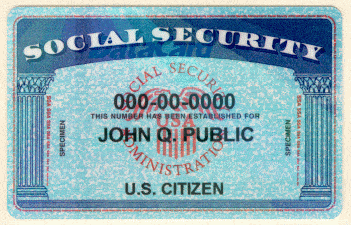
Delay Social Security. You can claim your Social Security benefits as early as age 62, but if that’s your plan you might want to reconsider, Andrews says. Taking Social Security early means you permanently will receive a lower monthly payment. Unless a personal situation forces your hand, she says, it may be better to wait until you reach your full retirement, which is from 66 to 67, depending on when you were born. If you can put off claiming Social Security until you are 70, those monthly payments would grow even more.
Plan for inflation. Too many people – women and men – think in terms of today’s dollars when they are trying to plot out how much money they will need in retirement. As decades pass and the cost of living rises, those dollars are going to buy a lot less — so it’s essential that you factor inflation into your retirement planning, Andrews says.
Take care of your health. This one might not sound like a financial issue, but medical bills and long-term care expenses can gobble up savings quicker than nearly any other expense. Regular exercise and healthy eating can go a long way toward keeping both your body and your savings account fit.
“There are other things you’ll want to consider as well,” Andrews says. “For example, you may want to put off retirement and keep working longer than you originally planned. The important thing, though, is that you start thinking about what your retirement plan is and what you need to do to help make sure it doesn’t fall apart.”
About Beth Andrews
Beth Andrews, a CPA and Certified Financial Planner®, is founder of Networth Advisors LLC (www.bethandrews.info). As an experienced financial advisor, she specializes in the areas of retirement planning, retirement distribution planning, tax strategies, investments and insurance. Beth offers investment advisory services through AE Wealth Management (AEWM), LLC. Networth Advisors and AEWM are not affiliated companies. She and her husband Todd, a retired millwright for US Steel, have been married for 23 years and live in Eighty Four, PA near their family. Andrews received her accounting degree from Indiana University and started as a financial advisor in 1997. She founded Networth Advisors to help clients accumulate, protect and enjoy their wealth.
Omaha, Nebraska , our friend Prince Dykes of the Investors Show wanted to share a recap while he makes the rounds at his first experience at a Berkshire Hathaway Annual Meeting . Hopefully you enjoy the footage as much as we did.
Check out Prince’s interview with Bill Gates and a fun chat with a couple from New Jersey.
Prince can be found regularly on the “The Investor Show” channel on Youtube were he interviews investors and entrepreneurs
Plenty of things can kill the romance in a relationship.
March 20,2017
the staff of the Ridgewood blog
Ridgewood NJ, But traditionally, money and all the complications that come with it sit near the top of the list.
“I’ve worked with hundreds of married clients and have seen a lot of spending habits over the years, both good and bad,” says Dan Carter, an Investment Advisor Representative for Safeguard Investment Advisory Group (www.safeguardinvestment.com).
“There’s no doubt that when the numbers in the bank account start dropping, the tempers can start flaring.”
Carter recalls that when he and his wife were planning their wedding, the minister declined to perform the ceremony unless they met with him three times beforehand.
“Guess what he talked about – money,” Carter says. “He said money can cause a lot of problems in a marriage. When the wolves are at the door, couples stress, argue, and often break up.”
In fact, 20 percent of couples say that financial decisions cause tension in their relationships every day, and 31 percent say money issues lead to stress weekly, according to a survey by the American Institute of CPAs and the Ad Council.
The key is for couples to get on the same page about money, Carter says. Tensions can’t help but grow if one spouse is extraordinarily frugal while the other is a spendthrift. He suggests:
• Sit down and talk about what is important. If a husband’s financial goals and a wife’s financial goals are at odds, trouble is inevitable. He might want to stash more away for retirement. Her chief concern might be saving enough to help the kids through college. The important thing is that each understands the other’s priorities and concerns, and then they can work from there, Carter says. • Understand that there must be a balance. Some couples spend recklessly, racking up massive credit-card debt, while others go to the opposite extreme, fearful of parting with money for anything other than basic necessities. Be disciplined, but treat yourselves once in a while, Carter says. An occasional splurge isn’t a bad thing. Couples can benefit from a dinner at a nice restaurant or a weekend trip to the beach. “The problem is when splurging becomes the norm,” Carter says. “But life shouldn’t just be one dreary chore after another. You do need to live a little.” • Ignore the Joneses. Let your neighbors, relatives and co-workers do what they do, buying unnecessarily expensive cars, living in houses they can’t afford and traveling to exotic destinations that are really outside their budgets. Enjoy life, but live within your means.
“There are plenty of sayings about money, like ‘money can’t buy you love’ and ‘the love of money is the root of all evil,’ ” Carter says. “Those sayings may contain a little truth, but I’d say money also can be a useful tool, a very positive thing. If you use it wisely, it can enhance your life and your loved ones’ lives, too.”
About Dan Carter
Dan Carter, an Investment Advisor Representative for Safeguard Investment Advisory Group (www.safeguardinvestment.com), has 18 years experience in the insurance and estate planning industry. Carter also is the radio host for a financial radio program, “The Big Picture Radio Show,” on KVTA 1590, Ventura County’s Gold Coast “News Talk” station. Carter holds California Life-Only and Accident and Health licenses (#0C32681), and holds a Series 65 license, and is registered through the Financial Industry Regulatory Authority (FINRA).
Wesley Learns to Invest
by Prince Dykes MBA (Author), Wesley Dykes (Author)
March 4,2017
the staff of the Ridgewood blog
Ridgewood NJ, For the first time ever a fiction book offers a kid-friendly introduction to the stock market and investing. In “Wesley Learns to Invest”a father teaches his son about the ins and outs of saving and investing.
Young Wesley is about to turn eleven years old, and he really wants a new GS4 gaming system. But money doesn’t grow on trees, so Wesley will have to work hard and save his money to be able to make that purchase. Wesley’s dad helps him out by teaching him the importance of investing and how stocks work.
Wesley Learns to Invest follows Wesley and his dad as they walk through a financial journey—from discovering what the stock market is, to choosing the right stocks, making a purchase, and receiving a dividend check. With his dad’s advice, Wesley is able to set goals and work toward them. Offering a gentle introduction to stocks and long-term goals, Wesley Learns to Invest offers a fun and engaging way for adults to demonstrate to children the value of making smart decisions and spending money in a way that will yield the best benefit rather than simply seeking instant gratification.
The author Prince Dykes, MBA, IAR, SA , is an award-winning author /podcast host/youtuber and International Speaker.
Prince hosts the Investor Show (Podcast). After completing my MBA, in 2012 and earning his series 63, series 65, and insurance licenses while serving active duty in the military, Prince dedicated his life to educating children and adults on the power of investing.
With his Investor Show where he interviews investors from all over the world Prince has gained thousands of followers, hundreds in sales/downloads and even was a ABC Shank Tank Finalist. Currently, he is raising money to fund the cartoon based on the book Wesley Learns to Invest which will educate kids and adults on the world of investing.
Are there health benefits to staying in the work force longer?
The scientific research is inconclusive, though it tends to tilt toward “yes.” This is particularly pronounced among people who find work fulfilling in the first place, who tend to be office workers, teachers and others whose workplace is not, say, a factory or a construction site.
More so than people in most previous generations, baby boomers are continuing to work past their early 60s, often well beyond. Sometimes, this means delaying retirement from a longtime job, but it can instead involve some kind of bridge job, part-time employment or self-employment. It turns out that, these days, older Americans who retire — in the sense of completely withdrawing from the paid labor force — are increasingly in the minority.
“What is the benefit of work? Activation of the brain and activation of social networks may be critical,” Nicole Maestas, an associate professor of health care policy at Harvard Medical School, said in an interview.
Researchers have long assumed that only well-educated and healthier people benefit from working after a certain age. Lately, however, scholars and retirees themselves have been exploring an intriguing question with implications for both potential workers and policy makers: Is a job a force for keeping older people mentally and physically healthy?
Owning a car offers freedom and convenience, but it also comes with stress. As with most big purchases, the state you live in can have a huge impact on costs, and a new study confirms that car ownership in coastal cities can be a time consuming and expensive experience.
According to SmartAsset, a personal finance advice site, Newark, NJ, is the worst city in the United States to own a car. Why? Newark’s proximity to New York City makes traffic a nightmare, as nearly 5 million people in the metro area attempt to drive to work every day. This gridlock costs the average driver $1,739 in traffic costs, due to travel time and extra fuel consumed while idling.
To compile its list, SmartAsset looked at several factors of car ownership, including number of hours spent in traffic, annual cost of traffic, the number of repair shops, accessibility to parking garages, stress, public transportation options and theft.
Speaking of theft, Newark is also a tough on car owners because, well, your car might get stolen. According to the New Jersey State Police, there were 2,412 total motor vehicle thefts in Newark in 2014. That is equal to 8.66 car thefts per 1,000 residents. In comparison, Arlington, Va. had the lowest number of thefts per capita on SmartAsset’s list, with 157 thefts a year, or 0.7 thefts per 1,000 residents.
Ridgewood NJ, The use of robo-advisors is on the rise among investors looking for an alternative way to get help with financial planning.
In fact, a report by the consulting firm A.T. Kearney predicted that robo-advisors will be managing 5.6 percent of Americans’ investment assets by 2020, up from 0.5 percent when the report was done in 2015.
Despite the intriguing name, don’t imagine that robo-advisors resemble something from a science fiction movie, with lights flashing as they dole out warnings about dangers to your portfolio.
Instead, a robo-advisor is an online wealth-management service that uses a software program to provide automated advice based on an algorithm.
Robo-advisors have their merits. Clients save money, at least on the front end, because fees are usually lower, says Rick Rivera, a partner at Safeguard Investment Advisory Group (www.safeguardinvestment.com).
The required minimum investment also usually is low, which could be helpful for young investors who haven’t had time to build wealth.
“If you’re a do-it-yourselfer, it might work for you,” Rivera says. “But is it something that saves you money for the long term? Maybe not.”
Investors should weigh the advantages against the disadvantages, he says. Examples of when robo-advisors fall short include:
• Looking at the big picture. Robo-advisors are limited to what their software is designed to handle. Human financial planners don’t have that limitation. They can provide advice based on the bigger picture of how all of a person’sassets, tax liabilities and other factors interact and affect each other.
• Adapting to market fluctuations. Questions remain about just how well robo-advisors react to rapid market changes. Recently, when U.S. markets experienced extreme volatility because of Brexit – the United Kingdom’s vote to leave the European Union – at least one robo-advising firm halted all its trading. “People were saying this could have been negative for those trying to buy when stock prices dropped,” Rivera says.
• Helping with estate or long-term care planning. Older clients often are concerned about how to best leave wealth to their heirs through trusts or other means. They also worry about whether they will need expensive long-term care that
can eat away at their savings. These aren’t areas robo-advisors usually venture into, but human ones do. “We can say here are your options, here is what we can do to protect you,” Rivera says. “We can show them avenues that robo-advisors
can’t.”
Ultimately, robo-advisors may appeal to those who have uncomplicated portfolios and can get by on general advice, but for many investors a one-size-fits-most approach doesn’t cut it, Rivera says.
“I can’t tell you how many times someone has come to me and said they heard that all life insurance is bad, or all annuities are bad, or all mutual funds are bad,” Rivera says.
“But each of those things is created for a specific purpose. Whether they are good or whether they are bad depends on your needs. That’s where human advisors can step in and help you weigh just what those needs are.”
About Rick Rivera
Rick Rivera is a partner at Safeguard Investment Advisory Group (www.safeguardinvestment.com) and has more than two decades of experience in the financial industry providing guidance to those planning for retirement. He is an investment advisor representative holding a series 65 license, as well as Life-Only and Accident and Health licenses in California.
After roughly four decades of non-stop work, it certainly can be enticing
August 17,2016
the staff of the Ridgewood blog
Ridgewood Nj, You can begin drawing Social Security as early as age 62, finally getting back those dollars you’ve been paying into the system, possibly since you were a teenager handling cashier duties for a fast-food restaurant.
But taking Social Security a few years shy of traditional retirement age comes with a caveat. Your monthly check will be reduced, so you’ll draw as much as 30 percent less than you would if you waited until your full retirement age, which is 66 to 67 for most people these days.
At the other end of the equation, if you put off filing for Social Security until you’re 70, you can increase the amount of those checks.
So what’s a potential retiree to do?
“Unfortunately, there’s no perfect answer that applies to everyone,” says Alexander Joyce, president and CEO of ReJoyce Financial (www.ReJoyceFinancial.com). “When I’m working with a client, I’ll look at their entire financial situation and see how Social Security fits in. It’s not always an easy decision and there’s no exact science to follow.”
But Joyce says there are a few things to keep in mind as you approach 62 and begin mulling your options:
• Your neighbor’s decision isn’t your decision. It might be interesting to hear what other people have done, but that doesn’t mean you should follow suit. Their financial situation may be very different from yours, Joyce says. The right answer for them could be the absolutely wrong answer for you. • Working in retirement makes a difference. Many people like to continue working, at least part-time, even after they begin drawing Social Security. But that can have ramifications. If you’ve reached full retirement age, no problem. Make as much money as you like. But if you take Social Security early, there’s a $15,720 annual limit on how much you can earn. For every $2 over that, you’ll lose $1 of Social Security. • Maybe you need the money now. It could be that you worked the numbers and decided to wait until your full retirement age. But then fate intervened. You lost your job or health problems keep you from working. “There certainly are very good reasons why some people begin drawing their Social Security at 62,” Joyce says. • Maybe you don’t need the money – just yet. If your finances are in good order, your savings robust and your employment stable, putting off Social Security until you’re 70 could make sense because you would be able to optimize the amount of those monthly checks. For example, if your full retirement age is 66, you would be able to receive 132 percent of your monthly benefit if you delayed filing for four years, according to the Social Security Administration website.
“Ultimately, the decision is yours, but it’s important to make that decision knowing all the implications,” Joyce says. “While there’s no right answer that applies to everyone, there could be at least a best answer that applies to you.”
About Alexander Joyce
Alexander Joyce is president and CEO of ReJoyce Financial LLC (www.ReJoyceFinancial.com). He’s also a Safe Money and Retirement Income Planning specialist, and has hosted radio shows, such as “The Safe Money and Income Radio Show” and “The Ask Mr. Annuity Radio Show.” Joyce is a licensed professional in Indiana and specializes in working with people who are near retirement or who are already retired, with wealth management, income planning, and asset protection strategies.
For the past year or so I have espoused the opinion that chaos in Europe is good for the US because of capital flight from Europe to the US. That capital is funding the Last Ponzi Game Standing, the US Treasury market and US economy.
Here’s how that works. As Europe destabilizes, big money exits the problem markets of Greece, Portugal, Ireland, Italy, and particularly Spain. Ireland and Italy have stabilized somewhat in recent months, but money is still pouring out of Greece, Portugal, and Spain. Much of it is transferred to the US to purchase Treasuries and probably big cap stocks to some degree. These purchase funds flow into the US Treasury and US bank accounts. The Treasury subsequently spends the cash it borrowed from these sources, and it ends up in US bank accounts.
Of every dollar the US Government spends, on average over the course of the year approximately 35 cents comes from borrowing. Some of that borrowing comes from domestic sources. About 8% of it over the past year has come from foreign central banks. Of the rest, the US Treasury TIC report says that Europeans made net purchases of $76 billion of US Treasury Bonds in the second quarter. That was equivalent to 30% of the new Treasuries issued. In other words, it appears that European capital flight accounted for 30 cents of every dollar of debt the Treasury raised. That debt accounted for 35 cents of ever dollar the government spent. Therefore, roughly 10 cents of every dollar of US government spending driving the US economy came from European capital flight.
Given those cash flows, anyone who argues that what’s bad for Europe is bad for the US is simply wrong. If Europe somehow manages to ameliorate its problems, or even create the impression that it is doing something to solve them, then these flows would slow down or even stop. The obvious effect would be that long term US bond yields would be forced to rise in order to attract investors. Alternatively, the US government would need to spend less or tax more in order to reduce borrowing. Any of those outcomes would slow the economy. The other option would be for the Fed to step into the breach to monetize the debt. No doubt that would have an immediate response in the commodities pits, driving the cost of energy, materials, and food into the stratosphere, which in turn would crush the US economy.
So the last thing the US needs is for the European situation to improve. In fact, the worse things are over there, the greater the capital flows from there into the US.
It is true that some of the capital flooding out of Spain, Portugal, and Greece heads to Germany. As a result European bank deposits in total have remained relatively stable. But that doesn’t account for all of the capital flowing from those countries. Some of it heads for the UK and elsewhere, and it seems clear that some of it heads for the US where it funds the Last Ponzi Game Standing.
Scramble for safety as Spain fears grow
By Vivianne Rodrigues in New York
Wednesday 18.20 BST. Risk appetite is deteriorating sharply as hopes for Chinese stimulus measures are dashed and concerns grow over Spain’s banking problems.
In the US, eurozone fears were compounded after a report showed pending home sales dropped by the most in a year, sending the S&P 500 index down more than 1 per cent. The broad measure of US stocks is on track to close the month of May 6 per cent lower.
Dollar tumbles to 3-yr low; data underpins rate view
By Gertrude Chavez-Dreyfuss | Reuters – Thu, May 5, 2011
* Weak U.S. jobs, services data add to dollar’s woes
* Euro hits 17-month high but fades ahead of ECB meeting
* Dollar at 6-week low vs yen; high-yield FX struggles
* One-month euro/dollar implied vols rise again (Updates prices, adds more details on options)
NEW YORK, May 4 (Reuters) – The dollar slumped to a three-year low against major currencies on Wednesday and its outlook darkened further as surprisingly soft economic data underpinned expectations that U.S. interest rates will remain low this year.
The greenback also fell to a record low against the Swiss franc and against the yen fell below 80.50, the lowest level since major central banks intervened to weaken the Japanese currency on March 18.
Separate reports on Wednesday showed a sharp slowdown in the vast U.S. services sector and less hiring by private companies in April.