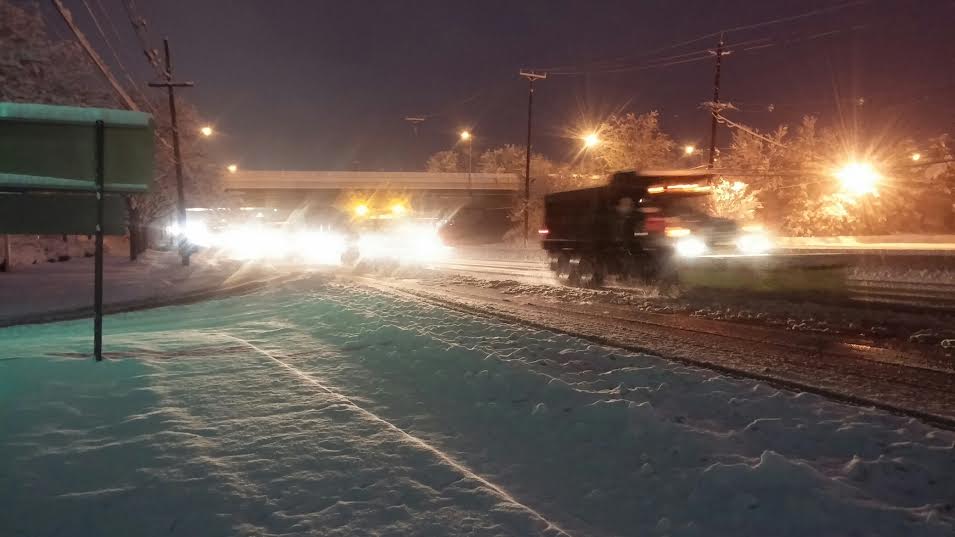
Trenton NJ, In order to allow ample time for roadways, parking lots and sidewalks to be cleared and made safe for travel, the State of New Jersey has authorized a delayed opening two hours from normal start times for all non-essential state employees on Thursday, March 8, 2018.
Essential employees should report to work on their regular schedule.
Current road conditions are available at the New Jersey Department of Transportation website at www.511nj.org
New Jersey State Police will be out on patrol if you need us.
Remember…driving at speeds too fast for the road conditions is often a contributing factor in snow-related crashes and spinouts. Take it slow and leave extra room between yourself and the vehicle in front of you should you have to brake unexpectedly.
Steer clear of downed power lines. Always assume they are live and dangerous!!!
Be sure to follow us on social media and check the weather in your area for updates and to plan ahead! For those living in Central and Southern New Jersey visit US National Weather Service Philadelphia/Mount Holly https://www.weather.gov/phi/.
For those living in Northern New Jersey and the New York Metro area visit US National Weather Service New York NY https://www.weather.gov/okx/.
Pets are family too! Include them in your emergency plans. Bring them indoors! If you’re cold, they are cold! Visit animalemergency.nj.gov to find out more!
If you, a family member or a neighbor have special needs, be sure to visit Register Ready, New Jersey’s Special Needs Registry for Disaster Planning, to get started on making your emergency plan NOW. Visit www.registerready.nj.gov or call NJ 2-1-1 for assistance.
Trenton NJ, New Jersey suffers from the worst business climate in the United States . If not for the close proximity to New York in the north and Philadelphia in the south there would be virtually no business here at all . Jobs and companies have fled the Garden State non stop since the Kean Administration and yes it can only get worse. Democratic state Senate President Stephen Sweeney said on Tuesday that state coffers can get the money they need by enacting a 3 percent surcharge on corporate income.
The increase in the state’s corporation business tax rate from 9 percent to 12 percent on businesses with more than $1 million in income is the Democrats’ latest counterpunch to federal tax reform that slashed taxes on corporations but limited the state and local taxes residents can deduct.
It seems New Jersey Democrats will not rest until the very last business has left the state .
In 2017 the Tax Foundation rated New Jersey’s Business Climate the worst in the nation. The Tax Foundation said “New Jersey, for example, is hampered by some of the highest property tax burdens in the country, is one of just two states to levy both an inheritance tax and an estate tax, and maintains some of the worst-structured individual income taxes in the country.”
In the 2017 Tax Foundation State Business Tax Climate Index , New Jersey scored and Overall Rank of 50 (Dead Last) Corporate Tax Rank 42, Individual Income Tax 48, Sales Tax 45 , Unemployment Insurance Tax 25,Property Tax Rank 50 (Dead Last again) .
So it is no surprise to everyone except New Jersey Democrats , the when moving company United Van Lines released its 36th in 2014 annual study of customer migration patterns, analyzing a total of 125,000 moves across the 48 continental states in 2012. The study provides an up-to-date, representative snapshot of overarching moving patterns in the U.S., and reveals a mass exodus from the Northeast. At No. 1, New Jersey has the highest ratio of people moving out compared to those moving in. Of the 6,300 total moves tracked in the state last year, 62% were outbound.
In 2016 the same annual moving survey from United Van Lines reveals the states where the most people move from and again for 2016, New Jersey holds the top honor in the latter category for the fifth year running.
Far be it from us to speculate, but CNN affiliate News 12 New Jersey suggests the exodus may be related to “common complaints from state residents about high property taxes, the recent gas tax hike and the poor conditions of state roads.”
Trenton NJ, Governor Phil Murphy today declared that New Jersey will enter a state of emergency at 8 p.m. on Tuesday ahead of tomorrow’s anticipated nor’easter, authorizing the State Director of Emergency Management to activate and coordinate response and recovery efforts. Executive Order No. 14 declares the state emergency across all 21 counties in the state, and allows for the extension of resources into other parts of the state as the storm continues to impact New Jersey.
“Following last weekend’s nor’easter and with another destructive winter storm approaching, I am declaring a state of emergency across all 21 counties in the State,” Governor Murphy said. “We are taking every precaution necessary and will continue to monitor and assess the storm throughout the night to ensure all residents are safe and secure.”
The impending storm is expected to produce as many as 4 to 13 inches of snow beginning Tuesday evening and lasting until late Wednesday night. Winds are expected to reach 30 mph causing power outages throughout the State. Roughly 41,000 households remain without power from last weekend’s storm.
In preparation for the winter storm, the New Jersey State Police has activated the State Emergency Operations Center for round-the-clock operations. This activation pulls together multiple departments to ensure the situation is constantly being monitored and assessed from critical angles.
Additionally, the Department of Transportation is prepared to activate more than 2,500 pieces of snow-clearing equipment, including plows, spreaders, and loaders, and the New Jersey National Guard is prepared to respond to requests for assistance from the Office of Emergency Management, and will be positioning vehicles at select armories.
Trenton NJ, Senator Gerry Cardinale, the ranking Republican member of the Senate Judiciary Committee, issued the following statement opposing legislation that would allow incarcerated prisoners, as well as those on parole and probation, to vote.
Sen. Gerry Cardinale opposes legislation that would allow incarcerated prisoners, as well as those on parole and probation, to vote.
“People who are serving prison sentences for breaking the law are subject to a loss of certain freedoms.
“That’s part of the risk they assume when they break the law, and part of the incentive structure for people to follow the law.
“Do we really believe that murderers and rapists who are serving prison sentences should be allowed to influence elections and public policy?
“We shouldn’t trust people who have demonstrated such bad judgment that they are removed from society with the responsibility that comes with voting.
“Let’s not forget that we restore voting rights once a person has paid their debt to society and proven themselves to be trustworthy following parole or probation.
Ridgewood NJ, According to the American Community Survey, telecommuting doubled from 2005 to 2014 and employers in 2017 were more likely to be looking for live-work-play communities that offer affordability as well as lifestyle benefits for their employees.
The American Community Survey (ACS) is an ongoing statistical survey by the U.S. Census Bureau. It regularly gathers information previously contained only in the long form of the decennial census, such as ancestry, educational attainment, income, language proficiency, migration, disability, employment, and housing characteristics.
PlanSmart NJ, says New Jersey is the most exited state in the nation, with owner-occupied home ownership down by 100,000 in the years since the Great Recession. We need a new policy approach, one prepared to grapple with the following realities: New Jersey has five new renters for every three homeowners; New Jersey has 14 million square feet of empty office space; New Jersey has seven million square feet of empty retail. At our current rate, it will take more than 20 years to re-tenant these stranded assets.
PlanSmart NJ is an independent, non-profit planning and research organization committed to improving the quality of community life through the advancement of sound land use planning and regional cooperation.
Jim Hughes, the dean at Rutgers University’s Edward J. Bloustein School of Planning and Public Policy, and co-author Joseph Seneca put it most succinctly in their recent work on New Jersey’s postsuburban economy: “New Jersey’s core advantage in the late 20th century – a suburban-dominated, automobile-dependent economy and lifestyle – is (now) regarded as a disadvantage.”
The report for all its gloom offers barely a mention of the elephant in the room , the oversized property taxes and very high taxes in general on residents which will continue to raise as the tax base disappears .
Ridgewood NJ, Almost a year after U.S. Transportation Secretary Elaine Chao called the Gateway Program “an absolute priority,” she said federal loans shouldn’t count toward the states’ share of funding. New York and New Jersey have pledged some $6 billion, mostly from federal loans, toward a proposed new $12.7 billion commuter rail tunnel under the Hudson River and were counting on federal grants to cover the remainder. Federal authorities have said loans shouldn’t count as the states’ share.
This is a big issue for “dead broke” New Jersey and close to broke New York state.
On Thursday during a committee hearing on President Donald Trump’s infrastructure plan ,New York Sen. Kirsten Gillibrand and New Jersey Sen. Cory Booker asked Chao on Thursday during a committee hearing on President Donald Trump’s infrastructure plan why the federal loans that the states must repay don’t count as local funding.
Cho responded ,“We’re not anxious for a fight on this, but for New York and New Jersey to consider funds, debt that we have given them, as part of their equity back to us is something that we disagree with,” Chao went on that under federal calculations that disregard the loans, the two states are putting up only 5%.
Chao repeated again that there is no agreement for the federal government to fund half the Gateway program as state officials have said. That agreement with the Obama administration was a sentence “given at a rally, a political rally, no less,”
While New Jersey Gov. Phil Murphy, speaking at a state Chamber of Commerce dinner in Washington, D.C., on Thursday night, said he was “committed to getting Gateway back on President Trump’s priority list.”
And stated ,“No single project is more critical, not just to our state’s economy but to our nation’s economy as well,” said Murphy, a Democrat who took office in January.
Ridgewood NJ, New Jersey Democrats push “Hail Mary” saying that they will be moving ahead with a legally-dubious plan to let residents make charitable contributions in lieu of property taxes, promising to vote on the bill in the state Senate on Monday and threatening to take the fight to court if necessary.
The bill (S1893) is designed to be a workaround to the new federal tax law that capped the state and local tax deduction at $10,000, a move that Democrats say will harm high-tax states like New Jersey, which has the highest property taxes in the nation. Average property taxes in Bergen County in 2017 were $11,564 . The new Federal rules allow deductions of up to $10,000 . The $10,000 limit on deductions is for state and local taxes and will take effect in 2018. That $10,000 limit combines both local property and income taxes.
The legislation would effectively allow homeowners to keep deducting their property taxes by calling those payments charitable deductions. Under the bill, local governments would be permitted to set up charitable funds for specific public purposes—from police to parks—that residents could pay into and get a credit of up to 90 percent toward their property tax bills. Those contributions could then be written off as charitable deductions on federal tax bills, officials said. It’s unclear whether the plan withstands legal and IRS scrutiny.
Trenton NJ, in another reason to leave the state , New Jersey Policy Perspective is championing returning the state sales tax rate to seven percent ,NJPP claims it could raise $600 million more for the state while having little impact on most residents.
The far left think tank New Jersey Policy Perspective is a group that also recommends , “A $15 Minimum Wage Would Help Over 1 Million Workers and Boost New Jersey’s Economy ” , “New Jersey Should Replicate ACA Penalty to Keep Coverage Affordable” , and our personal favorite “Why Unauthorized Immigrants Should Be Permitted to Drive Legally” .
Their website reads like a Christmas list of every New Jersey politician.
According to their website New Jersey Policy Perspective has never met a tax it didn’t like .
In the report on the proposal by NJ101.5, a senior policy analyst for New Jersey Policy Perspective said the tax rate cut adopted as part of the push to hike the state gas tax “was a gimmicky tax policy that no one asked for, and reversing it back to its original rate will largely go unnoticed.” But the move would have a big impact on the state’s finances, analyst Sheila Reynerston said in the radio station report.
NJPP also suggested the tax should be broadened to include accounting and bookkeeping, architects, attorney and engineer fees, among other things.
In the report, Reynerston said cutting spending alone won’t help New Jersey’s budget problems and that the state needs to consider ways to raise revenues. Interesting we have not herd anyone in New Jersey talk about cutting spending for over 40 years , thus the fiscal calamity the state now faces.
On the NJ101.5 Reynerston said , “Keep throwing things at the wall until something sticks. If it’s not the millionaires’ tax, then let’s revisit the estate tax. If it’s not the estate tax, let’s revisit the sales tax code,” she said in the radio station report.
Trenton NJ, Attorney General Gurbir S. Grewal today announced that a state grand jury has returned an indictment charging seven members of a major gun trafficking ring in Camden with first-degree racketeering, including the alleged leader of the ring, his “straw purchaser” in Ohio, and five middlemen who allegedly brokered black market sales of guns – including assault rifles – to criminals in the city.
The indictment was obtained by the Division of Criminal Justice in a joint investigation by the New Jersey State Police, U.S. Drug Enforcement Administration Camden HIDTA Task Force, Camden County Metro Police, and U.S. Bureau of Alcohol, Tobacco, Firearms and Explosives (ATF), with assistance from the DEA Philadelphia Division, West Virginia State Police and Henrico County (Va.) Police Division. Four defendants were arrested after the indictment was returned on Tuesday, Feb. 6.
These men are charged with racketeering (1st degree), conspiracy (2nd degree), and transporting firearms into the state for illegal sale (2nd degree) for allegedly trafficking guns from April 2016 through July 2017:
Leader
Chucky Scott, 25, of Columbus, Ohio, the alleged leader of the ring, also faces first-degree charges of leader of a firearms trafficking network and promoting organized street crime.
Straw Purchaser
Anthony Hammond, 26, of Columbus, Ohio, allegedly acted as a “straw purchaser,” purchasing the guns for Scott in Ohio and delivering some guns to Camden with Scott.
Middlemen
The following five men, including two cousins of Scott (Moore and Jennings), allegedly were “middlemen,” acting as wholesale distributors who arranged sales of the guns in Camden after Scott purchased them in Ohio through Hammond:
Eduardo Caban, 40, of Camden, N.J. Eric Moore, 47, of Camden, N.J. Tymere Jennings, 35, of Marlton, N.J. Jamar Folk, aka Ibraheem Abdullah, 33, of Camden, N.J. Darren Harville, 51, of Camden, N.J.
“Dismantling prolific weapons trafficking is the best way to reduce the number of illegal guns being sold to criminals in our communities and used to inflict murder and terror,” said Attorney General Grewal. “Each gun that we seize or prevent from reaching the street represents countless lives saved. The potential sentences that these men face should also serve as fair warning to those who illegally traffic firearms into New Jersey.”
“More than three out of four of the guns recovered in New Jersey and traced by the ATF in 2016 originated in other states,” Attorney General Grewal added. “Simply put, to reduce gun violence in our communities and reduce the threat to our police officers from assault rifles and other illegal firearms, we need to stop the flow of illegal guns into our state. We are committed to putting an end to this iron pipeline of firearms.”
“We are working closely with the State Police and our other federal, state and local law enforcement partners to arrest the gun traffickers responsible for the proliferation of lethal firepower on our streets,” said Director Elie Honig of the Division of Criminal Justice. “Through this far-reaching investigation, which extended to Ohio and West Virginia, we were able to bring first-degree racketeering charges against this criminal ring.”
“The only purpose Scott and others had by flooding the Camden area with illegal guns was profiting off of the innocent lives of area residents,” said Colonel Patrick Callahan, Acting Superintendent of the New Jersey State Police. “I am very proud of the investigative efforts and solid police work exhibited by the members of the New Jersey State Police Trafficking South and Fugitive Units along with our federal, state and local partners.”
“All of these men have allegedly played a role in contributing to the violence in Camden,” said Valerie A. Nickerson, Special Agent in Charge of the DEA’s New Jersey Division. “They showed no concern for the violence which may have resulted from their actions. The men and women conducting this investigation are dedicated to reducing gun violence in the community.”
“We appreciate the efforts of our law enforcement partners to remove these guns from our streets,” said Chief Scott Thomson of the Camden County Metro Police Department. “These high capacity firearms would have been used to undermine our community and destabilize our neighborhoods, so making these arrests and eliminating this pipeline was imperative for the safety of our city.”
“This firearms trafficking case represents the highest level of cooperation, across multiple agencies, jurisdictions, and states,” stated Trevor Velinor, Special Agent in Charge of ATF’s Columbus Field Division. “There is no place in our society for those who use firearms for criminal purposes, nor is there a place for those who supply criminals with those firearms. ATF is proud to work with our law enforcement partners to stop those who would foster violence in our communities.”
Scott and Caban were arrested previously and ordered detained pending trial in New Jersey. The following men were arrested on warrants after the indictment was returned, and the Attorney General’s Office is seeking their detention: Moore, Jennings, Folk and Harville.
The investigation led to a separate indictment on Feb. 6 charging Caban and Baron Coleman, 38, of Philadelphia, Pa., with second-degree conspiracy to distribute heroin. Caban also is charged with first-degree distribution of heroin for allegedly conducting multiple sales of heroin from May through August 2017. Coleman allegedly supplied heroin to Caban, who in turn allegedly supplied heroin to other dealers in Camden. When DEA Philadelphia Group 31 arrested Coleman and executed a search warrant at his home, they seized a kilo of heroin and a kilo of cocaine.
The investigation began when the New Jersey State Police, the DEA Camden HIDTA Task Force and the Camden County Metro Police Department developed information that Caban allegedly was trafficking both heroin and guns in Camden. It is alleged that during the course of the investigation, Caban illegally sold 10 guns that were recovered by the investigating agencies, including two illegal assault rifles with large-capacity magazines, six 9mm pistols, four of which had illegal large-capacity magazines, a .45-caliber pistol and a .40-caliber pistol. The investigators learned that Caban allegedly was obtaining the guns from Scott. That was further corroborated with evidence seized by the West Virginia State Police when they arrested Scott during a motor vehicle stop on July 9, 2017. Meanwhile, the New Jersey State Police traced the weapons to Hammond in Ohio. Working with the ATF and the U.S. Attorney’s Office for the Southern District of Ohio, which already were investigating Scott and Hammond, investigators learned that Hammond allegedly had been buying multiple weapons at a time for Scott, including assault rifles, at stores around Columbus, Ohio, or online through a website that features classified ads marketing firearms.
The investigation revealed that Hammond and Scott would go together to stores, where Hammond would buy multiple guns for Scott. It is alleged that Scott would then take photographs of the guns and text them to his middlemen in Camden, who would find individuals to purchase the guns for prices set by Scott. The middlemen allegedly would add a “tax” to the price set by Scott and keep the tax as their profit. Once Scott had orders in place, he would drive to Camden to deliver the weapons to his middlemen. On some occasions, Scott would be paid via money transfers, but mostly he collected cash from the middlemen. Scott himself never conducted the sales with the ultimate purchasers. Hammond at times allegedly traveled with Scott to Camden to deliver the firearms to the middlemen. The assault rifles were resold for up to $2,000. Hammond allegedly purchased more than 30 firearms that were trafficked into Camden by Scott and the other defendants. A total of 17 guns linked to the weapons trafficking ring were recovered in the investigation, including 14 handguns, two AK-47 assault rifles, and an AR-15 assault rifle.
Deputy Attorney General Cassandra Montalto presented the indictments to the state grand jury for the Division of Criminal Justice Gangs & Organized Crime Bureau, under the supervision of Deputy Bureau Chief Erik Daab and Bureau Chief Lauren Scarpa Yfantis. Detective Sgt. 1st Class Erik Hoffman was lead detective for the New Jersey State Police Intelligence Section, Violent & Organized Crime Control Bureau South, Trafficking South Unit.
Attorney General Grewal commended the following agencies for their work on the indictment and investigation: New Jersey Division of Criminal Justice Gangs & Organized Crime Bureau New Jersey State Police Trafficking South Unit New Jersey State Police Fugitive Unit DEA Camden High Intensity Drug Trafficking Area (HIDTA) Task Force Camden County Metro Police Department ATF Columbus, Ohio, Field Division ATF Camden, N.J., Field Office U.S. Attorney’s Office for the Southern District of Ohio DEA Philadelphia Group 31 West Virginia State Police (Trooper Eric McFarland) Henrico County (Virginia) Police Division
Scott, Hammond, Caban and Folk face added counts of unlawful possession of a weapon (2nd degree) and other weapons offenses, and Caban and Folk face charges of possession of a weapon as a convicted felon (2nd degree). All seven weapons defendants also are charged with money laundering (3rd degree).
First-degree charges carry a sentence of 10 to 20 years in prison and a fine of up to $200,000. The first-degree racketeering charge carries a mandatory period of parole ineligibility equal to 85 percent of the sentence imposed. Second-degree charges carry a sentence of five to 10 years in prison and a fine of up to $150,000. The charge of possession of a weapon as a convicted felon carries a mandatory minimum sentence of five years without parole, and the second-degree unlawful possession of a weapon charges carry a mandatory term of parole ineligibility of half the sentence imposed or 3 ½ years, whichever is greater. Third-degree charges carry a sentence of three to five years in prison and a fine of up to $15,000, while fourth-degree charges carry a sentence of up to 18 months in prison and a $10,000 fine.
The indictment is merely an accusation and the defendants are presumed innocent until proven guilty. The indictment was handed up to Superior Court Judge Mary C. Jacobson in Mercer County, who assigned the case to Camden County, where the defendants will be arraigned in court at a later date.
Trenton NJ, since the election of Phil Murphy New Jersey’s unemployment rate has continued to increase putting it now almost one full percentage point higher than the U.S. unemployment rate.
New Jersey’s economic growth has lagged behind the rest of the country for years, according to the U.S. Bureau of Labor Statistics (BLS). But in late 2015, New Jersey’s unemployment rate started to improve. Governor Chris Christie applauded the state’s economic growth.
Last summer, though, the state’s unemployment rate increased again, sharply departing from the national trajectory. The rate increased for nearly four months before dipping slightly in January.
Now, New Jersey’s rate sits at 5.0 while the U.S. rate is 4.1. Critics of the Governor Murphy point out his push for massive tax increases may have already had the effect of increasing flight out of the state of jobs .
Union County, NJ yesterday Bob Hugin, formerly the CEO and Executive Chairman of worldwide bio-tech leader Celgene, kicked off his campaign for U.S. Senate to unseat the embattled and sometime ethically challenged Bob Menendez .
Menendez, whose approval ratings plunged as he was under the cloud of a long-running federal investigation, hasn’t officially announced his reelection campaign. But with the probe over, his top adviser has said there’s a “100 percent” chance he will run.
Hugin, 63, retired late last month as executive chairman of Celgene Corp., a global biopharmaceutical company based in Summit, N.J.
Hugin grew up in a diverse, hardworking neighborhood in Union City, Hudson County, where his parents instilled in him an obligation to serve others. He was the first person in his family to attend college, earning a full scholarship to Princeton University. After graduation, at a time when it wasn’t popular, Bob joined the United States Marine Corps where he served as an active duty infantry officer from 1976 to 1983. Bob participated in multiple deployments and was an instructor at the Landing Force Training Command, Atlantic. He continued to serve as a Reserve Officer from 1983 to 1990, where his assignments included commanding officer roles in Virginia and Battalion staff officer assignments in New York.
Upon leaving active duty in 1983, Hugin earned his MBA from the Darden School of Graduate Business Administration at the University of Virginia. In 1985, he joined J.P. Morgan, ultimately leading several businesses and rising to be a Managing Director, until joining a struggling bio-tech company called Celgene in 1999.
At the time, Celgene had approximately 200 employees and less than six weeks of cash. Under Hugin’s leadership and through the work of its employees, Celgene was transformed into one of New Jersey’s largest private sector employers – an innovative bio-tech company that is now known around the world for leading the fight against cancer and chronic disease. Forbes honored Celgene as #5 on a list of “America’s Best Midsize Employers” and #14 on a list of the “World’s Best Employers” in 2017.
Hugin recently completed 19 years of leadership in healthcare and has been a leading advocate for modernizing the American healthcare system during his time as Chairman and CEO of the Celgene Corporation and as a Trustee of the Atlantic Health System for the last decade.
Hugin also volunteered his time to the Board of Trustees of Princeton University, the Darden Foundation at UVA, and Family Promise, a national non-profit network assisting homeless families. He has also served on the NJ-based think tank Garden State Initiative and is the President of the trustees of his church. Bob also previously served on the board of Choose New Jersey and as past Chairman of the Healthcare Institute of NJ.
At home Bob Hugin and his wife of thirty years, Kathy, are the proud parents of three children. Daughter Hilary is a Manager of Media Investments and Connections Planning at Chobani. Sons Robbie and Mac are both officers in the United States Marine Corps. Bob and Kathy are strongly committed to their community and not-for-profit work. A community service-focused individual, Kathy has positions on the Institutional Review Board of the Atlantic Health System and the Board of Directors of Georgetown University. Kathy also previously served as a trustee of the Kent Place School and the Pingry School.
Trenton NJ, NJGOP Chairman Doug Steinhardt, Senate Republican Leader Tom Kean, Assembly Republican Leader Jon Bramnick and GOP Chair of Chairs Jose Arango released the following statement regarding their shared commitment to protect New Jersey families from the dangerous agendas of Democrats at all levels of government and to promote the Republican ideas that will make our state more affordable and prosperous:
“NJ Republicans stand together ready to offer a responsible alternative to Bob Menendez, Nancy Pelosi and Phil Murphy’s liberal agenda of promised tax hikes, cumbersome government regulations, and misplaced priorities,” said NJGOP Chairman Steinhardt. “We’re ready to fight for all New Jerseyans, with a collective voice, in all 21 counties, and all 565 municipalities. Now is the time for action.”
Senate Republican Leader Tom Kean reiterated his sentiment that Republicans are the party of common sense and solutions, “The people of New Jersey are facing a growing affordability crisis and raising taxes for new government spending is a recipe to exacerbate our state’s biggest problem. Republicans stand united behind our solutions and ideas to transform the Garden State into a place where affordability and opportunity abound.”
“Republicans may be in the minority, but we will stand up for the people of this state in a civil and serious manner,” said Bramnick. “We pledge to work collectively as a party to pass reforms that are so desperately needed to reduce New Jersey’s property taxes and make this state more competitive.”
GOP Chair of Chairs, Jose Arango vigorously vowed to create the necessary contrast to give Republicans momentum in their fight to win elections this year, “The four of us all stand together in agreement that the Phil Murphy, Nancy Pelosi, Bob Menendez plan to raise taxes and make New Jersey a sanctuary state is unacceptable and we will be proactively fighting it every step of the way. We’re working together to build a coalition that will reject Bob Menendez and stop the Nancy Pelosi takeover of New Jersey in November.”
Theresa Winegar, Executive Director of the NJGOP added, “All four leaders are entering 2018 unified and energized. The NJGOP has a dedicated team of 42 State Committee members, 21 County Chairs, 15 Senators, 26 Assembly members and countless municipal leaders, community activists and volunteers dedicated to making New Jersey more affordable; and ready for the 2018 election cycle.”
John Taylor (Born: Oct 06, 1836,Died: Feb 10, 1909 )was an American businessman and politician who served in the New Jersey Senate. He formed Taylor Provisions Company and created John Taylor’s Pork Roll. He also founded the Taylor Opera House in Trenton, New Jersey. Taylor Street in Trenton is also named for him.
But his legacy was created in 1856 Mr. John Taylor of Hamilton Square, NJ began producing a meat product that he called Taylor’s Prepared Ham. He used chopped pork and spices, sugar curing and then hickory smoked. Taylor was a state senator as well as a businessman and there are still streets and buildings in Trenton that bear his name to this day.
Taylor kept the recipe for the product he created in 1856 secret. Taylor originally called his product “Taylor’s Prepared Ham”, but was forced to change the name after the Pure Food and Drug Act of 1906 was passed, since the product did not meet the new legal definition of “ham”. The new name was “Pork Roll” and it was marketed as both “Taylor’s Pork Roll” and “Trenton Pork Roll”. Competitors marketed products with similar names like “Rolled Pork” and “Trenton style Pork Roll” and were sued by Taylor. A 1910 legal case ruled that the words “Pork Roll” could not be trademarked.
Since then several manufacturers make the generic named product “Pork Roll,” John Taylor’s Original Pork Roll is what most New Jerseyans ask for by name. Made since 1856 it ia a main staple of diners, kitchens, Holiday tables, and boardwalks of the Garden State.
Renews Pledge to Preserve Tax Deductions for New Jersey
February 10,2018
the staff of the Ridgewood blog
Marlboro NJ, in what some critics call a last act of a desperate man ,Governor Phil Murphy today called upon mayors to take steps to counteract the effects of the federal tax legislation that gutted New Jersey’s State and Local Tax (SALT) deduction and limited the amount of money state homeowners can deduct from their property taxes.
“When the disastrous federal tax legislation passed, I committed to pushing back and taking steps to ensure that the people of New Jersey are not subjected to unfair double taxation,” Governor Murphy said. “We have begun working with legislative leadership to protect our residents and prevent this plan from further hurting our taxpayers. We must eliminate any and all barriers to creating a system that will provide tax relief to property taxpayers who make charitable contributions to their municipality.”
If the system is implemented, taxpayers can make voluntary contributions to funds that pay for local services like schools, law enforcement, and infrastructure. They will then receive an offsetting tax credit on their property tax bill and contributions will be deductible for federal tax purposes under existing law.
Governor Murphy today was joined by a bipartisan group of mayors who have pledged to allow taxpayers in their towns to make payments to local governments as charitable donations and offset property tax liability. Marlboro Mayor John Hornik, Ocean Township Mayor Christopher Sciciliano, Manasquan Mayor Edward Donovan, Belmar Mayor Matt Doherty, and Aberdeen Mayor Fred Tagliarini pledged to introduce the this plan in their municipalities. They join the mayors of Fair Lawn, Paramus, and Park Ridge who made that pledge in January.
On Thursday, Governor Murphy promised to sign any legislation that reduces existing state roadblocks to municipalities reforming their property tax system to allow for charitable contributions, a system that will preserve local revenues while also providing residents with significant deductibility of their payments from their federal income taxes.
NEW BRUNSWICK NJ, this poll and others continue to inadvertently report on voter disconnect . While New Jerseyans worried most about taxes and economic issues , they voted for Phil Murphy who campaigned specifically on raising taxes .
2018 RUTGERS-EAGLETON POLL STATE OF THE GARDEN STATE REPORT:
New Jerseyans are in a malaise these days when it comes to the Garden State: they are angry about the state’s economic climate, and even though they still rate the state positively as a place to live, they are mostly pessimistic about the direction the state is headed. While the vast majority love the neighborhood they are living in, a sizeable number of residents – more than in the past – say they would like to move somewhere else. These are some of the main findings from a Rutgers-Eagleton Poll late last year, as detailed in the newly released “2018 State of the Garden State” report.
Nothing upsets New Jerseyans more than the way their state government has handled taxes: 82 percent of residents say they are dissatisfied – 60 percent, alone, are “very” dissatisfied – with how the government has managed the issue. Three quarters say the same about cost of living and government spending.
“In a state that ranks near the top when it comes to outbound migration and taxation, it’s no surprise that New Jerseyans are upset with how state government is handling important financial matters – most of all, taxes,” said Dr. Ashley Koning, assistant research professor and director of the Eagleton Center for Public Interest Polling (ECPIP) at Rutgers University-New Brunswick. “It will be a challenge for Governor Murphy to balance fulfilling those of his campaign promises that require new resources with citizens’ current dissatisfaction with taxes and the high cost of living in the state.”
Yet despite grave financial concerns, New Jerseyans clearly like living here. A majority of residents continue to rate the state as an “excellent” or “good” place to live – though these ratings are down from where they once were prior to 2004.
However, in homage to the long-standing tradition of home rule in the state, the closer one looks, the better home looks. Residents rate the neighborhoods they live in better than their towns or cities, and they rate their municipalities ahead of the state as a whole. But when asked to compare New Jersey to most other states, residents are once again lukewarm: three in 10 say New Jersey is a “better” place to live, with about the same number each saying it is “worse” or the “same” as other states.
Results are from a statewide poll of 1,203 adults contacted by live callers on both landlines and cell phones from Nov. 15-27, 2017. The sample has a margin of error of +/-3.0 percentage points. Some questions reported in this release were asked of a sub-sample, resulting in approximately 600 respondents and a margin of error of 4.3 percentage points. Interviews were done in English and, when requested, Spanish. To read the full report, click here.
Life in the Garden State not so great?
Residents’ itch to move out of New Jersey has grown in the past decade – from 22 percent in March 2010 to now 30 percent. Forty-six percent want to stay exactly where they are and continue living in their current neighborhood, a double-digit drop from when the question was last asked almost eight years ago. Six percent now say they want to move somewhere else in their current town, and 15 percent want to move elsewhere within the Garden State. Millennials are one of the biggest flight risks for New Jersey, with more than a third wanting to move out of the state entirely.
Yet despite an increase in those who want to leave the state, residents continue a longtime pattern of being more positive than negative about New Jersey as a place to live – 61 percent (“excellent”/”good”) to 39 percent (“only fair”/”poor”). Yet this is a notable drop-off from how residents rated quality of life at the turn of the century and for decades before that, with ratings frequently surpassing the 70-percent mark for most of the poll’s history.
Residents are much more positive when it comes to their towns and especially their neighborhoods, however: 70 percent say the former is an “excellent” (26 percent) or “good” (44 percent) place to live, while 79 percent (38 percent “excellent,” 41 percent “good”) say the same about the latter. These patterns have remained steady throughout the past several decades.
But even though a majority of New Jerseyans like where they live, they don’t necessarily think the Garden State is the best around. Twenty-nine percent say New Jersey is a better place to live than any other state, 28 percent say it is worse, and 31 percent think it is the same as everywhere else. Residents have been increasingly more likely to say New Jersey is worse than other states in the last decade and a half, with the number who say so today almost triple what it was back in 2001.
Widespread dissatisfaction with state on finances; residents most positive on environment, education
Dissatisfaction pervades other financial areas of government beyond taxes: three quarters are “very” or “somewhat” dissatisfied with how the state has handled cost of living and affordability, as well as government spending and the state budget. Almost two thirds are dissatisfied with what the state government has done for New Jersey’s cities and urban areas.
Satisfaction with how the government is handling taxes does not pass 30 percent for any demographic, with most groups rating their satisfaction as somewhere in the teens or single digits. Not a single demographic reaches the 50-percent mark on satisfaction with New Jersey’s cities and urban areas, cost of living and affordability, and government spending and the state budget.
In contrast, residents are most satisfied with how the government is dealing with air and water quality in the state, as well both higher education and K-12 public education: about six in 10 are “very” or “somewhat” satisfied with each of these items. Over half of residents are also at least “somewhat” satisfied about the job the state government is doing with public safety and crime, as well as business and employment opportunities.
Residents are more split, however, when it comes to transportation and infrastructure. They are also mixed when it comes to how the government is managing issues like senior citizen services, Superstorm Sandy recovery, programs for the poor, and mental health and addiction.



![Taylor-Ham-Pork-Rolls11[1]](https://theridgewoodblog.net/wp-content/uploads/2018/02/2-3lbs-Taylor-Ham-Pork-Rolls111.jpg "John Taylor Creator of Taylor Ham Died on this Day in 1909")