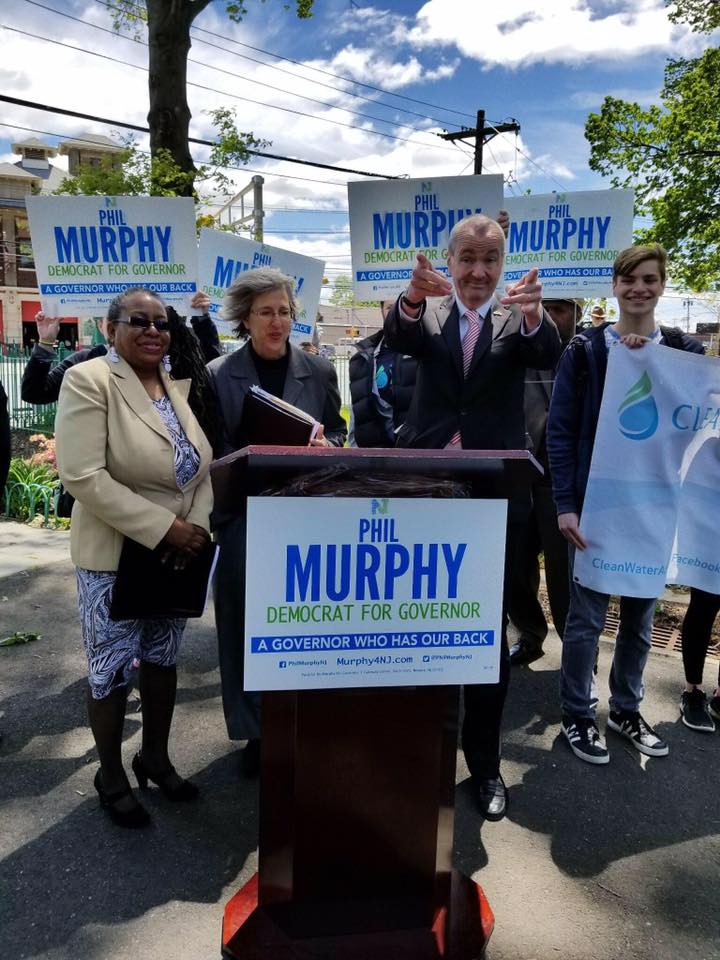
Ridgewood NJ, Murphy transition maintained a pretty low profile during Thanksgiving week, and the governor-elect himself made just one photo op feeding the down and out and less fortunate.
But there is plenty to be done behind the scenes: speeches to write, interviews to conduct, names to vet for jobs and Phil Murphy needs you to help out.
Phil Murphy rolled out his transition website, complete with a “Help Wanted ” sign and many job opportunities. Much like the official governor’s website, the transition site contains news and biography information for Murphy and his leadership team. But it was announced on Tuesday with a focus on finding people to fill out the functions of his administration.
“New Jersey’s greatest asset is its people,” Murphy said in a statement. “I call for all those interested in serving our administration to visit the Transition2018 website and submit their résumé for consideration. We will put an administration together that reflects New Jersey’s rich diversity of backgrounds and experiences, and we are committed to making those opportunities open to all.”
Trenton NJ, according to Michael Lilley in the article New Jersey Public Unions, Ascendant https://www.city-journal.org/html/new-jersey-public-unions-ascendant-15568.html ,
“New Jersey’s public-pension system currently holds less than 38 percent of what the state owes its retirees, which amounts to a $135 billion shortfall. Adding to this unfunded liability, the state also owes retirees $67 billion for future health-care payments, and has set aside no money for that obligation. That’s a combined tab of $202 billion. The entire state budget, by contrast, is $35 billion. To fund its obligations properly, the state would have to put aside $4.8 billion a year, or almost 15 percent of the budget; those costs are expected to grow to $11.3 billion by 2027. Unreformed, the cost of these benefits is unsustainable. During his campaign, Murphy promised to fix the pension system by fully funding it, though he wouldn’t give specifics.”
A very ugly reality for the governor elect , but even uglier for taxpayers is the fact that ,” Murphy’s problem, however, is that his biggest allies, especially the teachers’ union, contributed mightily to the pension mess over the years by winning plush benefits, acquiescing to accounting gimmicks that made the system look well-funded, and fighting against cost-saving reforms. Murphy has already proposed $1.3 billion in new taxes, and without making the changes to the pension system that the unions oppose, the state’s taxpayers face years of additional tax increases and spending cuts to pay the pension bill.”
Lilley goes on , “Murphy’s pledge helped win endorsements from the NJEA and other public-sector unions. By law, public school teachers must join the NJEA or, if they decline, pay a so-called agency fee to the union representing 85 percent of dues. The money is deducted from their paychecks, which are largely funded by local property taxes. Last year, the NJEA took in over $120 million in union dues and agency fees. Since 1994, the union has collected $1.85 billion, and it has invested much of this money in New Jersey politics: since 1994, the NJEA has spent $874 million on political activities, or about 56 percent of its annual operational expenditures, an average of $38 million a year.”
A beholden bought ad paid for politician and a massive pension short fall can mean only one thing ,massive new taxes .
Ridgewood NJ, both former Mayor Paul Aronsohn and Ron Simincini were selected for the Murphy transition team.
Aronsohn in Human and Children Services and Simincini in Housing .
Well Ridgewood you now know what you voted for . Murphy has made it abundantly clear that he intends to raise your taxes ,yes you . He is also aiming to pursue his social justice utopia with more forced over development .
Aronsohn may have rejuvenated his political career by failing upwards .
TRENTON NJ, Attorney Christopher S. Porrino announced that a retired police officer who formerly served as president and state delegate of New Jersey Policemen’s Benevolent Association (PBA) Local 59 in Cape May was sentenced today for embezzling large sums from the union over a period of five years. The state’s investigation revealed that he stole approximately $105,000.
John Campbell, 49, of Cape May, a retired Cape May police officer, was sentenced to six months of home detention under the county’s alternatives to incarceration program, including electronic monitoring with an ankle bracelet, and five years of probation by Superior Court Judge John Porto in Cape May County. He also was ordered to serve 300 hours of community service, pay a fine of $5,000 and provide full restitution to the union of $105,000, which was paid in full today. Campbell pleaded guilty on Aug. 10 to a charge of third-degree theft by unlawful taking. In pleading guilty, Campbell admitted that he stole tens of thousands of dollars from PBA Local 59 from 2012 through 2016, while serving as the state delegate for the union, by using the union’s checking account and a business American Express card to make unauthorized personal purchases, expenditures and withdrawals that were unrelated to union business.
Campbell was initially arrested on July 13 as a result of an investigation by the New Jersey State Police Official Corruption Bureau and the Division of Criminal Justice Corruption Bureau. Deputy Attorney General Brian Uzdavinis prosecuted the case and handled the sentencing for the Division of Criminal Justice Corruption Bureau, under the supervision of Bureau Chief Anthony Picione.
“Campbell was entrusted with access to the credit and checking accounts of his PBA local, but rather than living up to his duties as a police officer and leader of this union, he corruptly chose to embezzle over $100,000,” said Attorney General Porrino. “This was a crass betrayal by a man who took an oath to uphold the law.”
“We have zero tolerance for people who use their positions of trust to steal from the organizations and people they were appointed to serve,” said Director Elie Honig of the Division of Criminal Justice. “We will continue to work closely with the New Jersey State Police to investigate and prosecute corruption aggressively.”
“Campbell made the decision to betray the trust of not only his fellow law enforcement officers but also the community which should have benefited from the funds he absconded with,” said Colonel Patrick Callahan, Acting Superintendent of the New Jersey State Police. “The consequences of his actions should serve as reminder that no one should consider themselves above the law.”
While serving as the local PBA’s state delegate from 2012 through 2016, Campbell used credit and debit cards issued to him by the union, and paid for with union funds, for a variety of unauthorized personal expenses unrelated to union business, ranging from modest purchases at convenience stores and gas stations to more exorbitant purchases involving time shares and home improvements.
Campbell’s thefts came to light after a change in leadership of PBA Local 59 in July 2016, when an audit was conducted and suspicious credit and debit card charges were discovered. The information was referred to the Cape May County Prosecutor’s Office, which in turn referred the case to the Division of Criminal Justice and New Jersey State Police.
The investigation revealed that Campbell made more than $70,000 in unauthorized personal expenditures through the American Express account alone, including, for example:
over $30,000 for time shares in Florida, the Caribbean and Mexico;
over $16,000 for utilities and services, including gas, electric, telephone and TV services;
over $5,000 for clothing and jewelry purchases;
over $7,500 for purchases of electronics, furniture and cabinets;
approximately $5,000 on various convenience store and gas station purchases; and
a $500 designer Christmas tree.
He used the PBA debit card to make additional personal purchases and obtained approximately $9,700 for his personal use through debit and ATM withdrawals, as well as unauthorized checks.
Attorney General Porrino commended all of the members of the New Jersey State Police Official Corruption Bureau and Division of Criminal Justice Corruption Bureau who worked on the investigation.
As a result of the investigation, additional alleged thefts were discovered that led to a charge against a second official of PBA Local 59, former treasurer Kyle Grossman, 39, of Lower Township, N.J. Grossman, who also was a Cape May police officer, was charged by accusation on Oct. 12 with third-degree theft by unlawful taking for allegedly stealing approximately $5,000 in union funds for his personal use. He waived indictment on that date, agreed to pay $5,000 in restitution, and forfeited his job as a police officer. He was admitted by Judge Porto into the Pre-Trial Intervention program. The charge against him will be dismissed if he successfully completes the program. Grossman agreed to enter a consent order under which he will be permanently barred from public employment.
Attorney General Porrino and Director Honig noted that the Division of Criminal Justice has established a toll-free Corruption Tipline 1-866-TIPS-4CJ for the public to confidentially report corruption, financial crime and other illegal activities. The public also can log on to the Division’s web page at www.njdcj.org to report suspected wrongdoing confidentially.
Ridgewood NJ, New Jersey has long been the punching bag of state tax scholars. The state has the worst state business tax climate of the 50 states and the third highest overall state and local tax burden (behind only Connecticut and New York). Any New Jersey resident knows they pay the highest property taxes in the country, but other taxes are also high: income taxes (5th highest top rate), corporate taxes (6th highest in collections), sales taxes (16th highest in collections), cigarette taxes (10th highest), and gas taxes (8th highest) are all high, and New Jersey is currently one of two states with both an estate and an inheritance tax (the estate tax half is scheduled to be repealed in 2019, but we’ll see if the new Governor changes this). The state has more outbound net migration than any other. One bright spot: you can drink away your sorrows, with a mere 12-cent per gallon beer tax, lower than 40 other states.
The state and local tax deduction considerably reduces the sting of New Jersey’s tax bill, and it’s no coincidence that four of thirteen Republican nay votes on the House tax bill came from New Jersey representatives. New Jersey Senate President Steve Sweeney and newly elected Governor Phil Murphy, both Democrats, had pledged to make a higher income tax on millionaires a key early priority in 2018.
Now, however (Politico):
“We’re going to have to re-evaluate everything” if a federal bill repealing the state and local tax deduction becomes law, New Jersey Senate President Steve Sweeney said Wednesday in Atlantic City. Just days before, Sweeney had said he would make passage of a millionaires tax his chief priority in the new administration. “I’m just saying that what’s happening in Washington is concerning the hell out of me,” he added.
The changes to SALT are likely driving the reassessment. As ITEP, a group that promotes millionaires’ taxes, has explained, the state and local tax deduction “makes state income tax hikes a good deal,” since “income and property taxes are effectively less costly to state residents than are sales and excise taxes.” Take it away and New Jersey residents must pay full freight for their state and local governments. That may explain the seemingly contradictory rhetoric that millionaires taxes won’t affect the economy but eliminating the SALT deduction will be terrible.
If federal tax reform prompts New Jersey to overhaul its tax code, it’s long overdue. There are 244 townships, 265 boroughs, 49 cities, 15 towns, 3 villages, and 677 school districts. The three-member board running Tavistock, NJ, is a majority of the borough’s 5 inhabitants. A 1912 article recounted the history of New Jersey tax administration, which is a seemingly unending tale of bloated local government, corruption, and inequitable assessment. In the 1960s, railroad scholar George Hilton noted that the state’s practice of loading its property tax burden onto interstate commerce had ruined the viability of every railroad crossing the state. A 2003 state report dryly observed that state revenues had grown 1,700 percent since 1970, compared to population growth of 19 percent and inflation growth of 483 percent. The state adopted a sales tax in 1966 and an income tax in 1976, both with promises that they would be used to reduce crushing property tax burdens. Today New Jersey still has the nation’s highest property taxes, but with high income and sales taxes as well. It’s probably time for a rethink.
Trenton NJ,Attorney General Christopher S. Porrino announced today that New Jersey has filed an amended consumer fraud and false claims complaint against Insys Therapeutics, Inc. – maker of the powerful opioid-fentanyl drug Subsys – that adds as a defendant John N. Kapoor, billionaire founder of the company.
Insys and Kapoor are accused in the State’s complaint of endangering the public through a greed-driven, unlawful marketing campaign designed to exponentially increase sales of Subsys by making fraudulent claims and unlawfully incentivizing health care providers to prescribe Subsys to an inappropriately broad array of pain patients.
Subsys is only approved by the federal Food and Drug Administration (FDA) for treating breakthrough cancer pain in opioid-tolerant cancer patients.
Filed in Superior Court in Middlesex County, the State’s amended complaint notes that Kapoor not only founded Insys and is its principal shareholder, but also held executive management positions in the company including Executive Chairman of the Board of Directors, President and Chief Executive Officer.
Kapoor’s public claims that he was “not involved in day-to-day operations” concerning Subsys and that he was merely “an investor” in the company are contradicted by documentary evidence, the State’s amended lawsuit notes. The complaint charges that, in reality, Kapoor exercised “firm direction” and “close management” of the illegal push to have Subsys inappropriately – and dangerously – prescribed for patients with routine chronic pain.
“This individual (Kapoor) founded Insys and for all intents and purposes ran the company. We reject the suggestion that he had only a hands-off, observer’s role in the process of illegally expanding the off-label prescription market for his company’s flagship drug Subsys. And, as our amended complaint filed today makes plain, we believe that available evidence suggests otherwise,” Porrino said. “We allege that Mr. Kapoor was firmly at the controls as Insys coldly set aside any concerns about addiction and death, and forged full-steam ahead with a campaign to have more doctors prescribe Subsys to more patients, and to have doctors who were already prescribing the drug prescribe higher doses. Naming him as a direct defendant credits his alleged role in a calculated scheme to drive profits at the expense of human life, and allows us to look beyond the corporate veil and obtain a judgment against Mr. Kapoor and his personal assets.”
Among other things, the State’s amended complaint alleges that the greed of Kapoor and Insys put “hundreds” of lives in jeopardy and “led to the death of at least one New Jersey resident” – a 32-year-old Camden County woman who was prescribed Subsys for fibromyalgia. In addition, the suit notes that two New Jersey state employee health benefits plans paid a total of approximately $10.3 million to reimburse Subsys prescriptions between 2012 and the third-quarter of 2016, while the State Worker’s Compensation Program paid another $300,000.
The lawsuit includes three counts alleging violations of New Jersey’s Consumer Fraud Act and one count alleging violations of the New Jersey False Claims Act. The suit asks that Insys and Kapoor be assessed maximum civil penalties for each violation of the Consumer Fraud Act, and seeks three times the State’s actual damages for violations of the False Claims Act, per that statute. The suit also seeks to have Insys and Kapoor held responsible for costs and fees incurred by the State in bringing the case.
From the 2012 market launch of Subsys until the present, the drug has accounted for approximately 98 percent of net revenues for Insys, a Delaware corporation with headquarters in Chandler, AZ. Insys, which has raised the price of Subsys every year since its launch, sold $74.2 million worth of the drug in New Jersey between 2012 and the third-quarter of 2016.
The State’s complaint alleges that Insys’s corporate decision-makers – led by Kapoor – devised a strategy to expand what they recognized as a limited market for Subsys by aggressively pushing “off label” uses of the drug – even to podiatrists and other specialty practitioners who typically would have little call to treat cancer patients or prescribe powerful Schedule II painkillers. (Off-label use denotes use of a drug for purposes other than that for which it was approved by the FDA.)
photo Congressman Bill Pascrell, Jr.,Senator Bob Menendez, Nellie Pou, and Jose “Joey” Torres.
November 15,2017
the staff of the Ridgewood blog
Paterson NJ, Attorney General Christopher S. Porrino announced that Jose “Joey” Torres, the former mayor of Paterson, N.J, was sentenced to prison today for directing that city employees perform work at a private warehouse leased by his daughter and nephew while the employees were being paid by the city. Three former supervisors in the Paterson Department of Public Works also were sentenced today.
Torres, 59, of Paterson, N.J., was sentenced today to five years in state prison by Superior Court Judge Sheila Venable in Hudson County. Torres pleaded guilty on Sept. 22 to a charge of second-degree conspiracy to commit official misconduct. As a result of his guilty plea, he forfeited his position as mayor and is permanently barred from public office and public employment in New Jersey. He is jointly and severally liable with his co-defendants for paying restitution of $10,000 to the City of Paterson for payments, including overtime payments, made to city workers for the time they spent working at the private warehouse.
The following three co-defendants pleaded guilty on Sept. 22 to third-degree conspiracy charges and each was sentenced today by Judge Venable to a three-year term of probation:
Joseph Mania, 51, of Randolph, N.J., Supervisor, Paterson DPW Facilities Division;
Imad Mowaswes, 53, of Clifton, N.J., Supervisor, Paterson DPW Traffic Division; and
Timothy Hanlon, 31, of Woodland Park, N.J., Assistant Supervisor, Paterson DPW Facilities Division.
Those men also forfeited their jobs with the city and are permanently barred from public employment.
Deputy Bureau Chief Jeffrey Manis and Deputy Attorneys General Cynthia Vazquez and Peter Baker prosecuted the case and handled the sentencing for the Division of Criminal Justice Corruption Bureau. The defendants were indicted in an investigation by the Division of Criminal Justice Corruption Bureau and the New Jersey State Police Official Corruption Bureau North Squad.
“Joey Torres corruptly used his vast power as mayor of New Jersey’s third-largest city to serve his own selfish ends, when he should have been serving the residents of Paterson,” said Attorney General Porrino. “Torres thought he was above the law and is now on his way to prison. This prison sentence demonstrates that nobody is above the law, least of all public officials who brazenly abuse the authority entrusted to them.”
“By unlawfully using on-the-clock city workers to assist with a family business, Mayor Torres put his own interests ahead of the interests of city residents and compromised the integrity of his office,” said Director Elie Honig of the Division of Criminal Justice. “Public corruption takes many forms, but it always has the corrosive impact of undermining good government and public trust. We will continue to make these cases a top priority.”
“Torres betrayed many staff and colleagues who unknowingly believed in him, but his betrayal of the residents of Paterson, whom he was entrusted to serve, is by far the worst of all,” said Colonel Patrick Callahan, Acting Superintendent of the New Jersey State Police. “I commend the State Police Official Corruption North Bureau and their partners for bringing justice to the people of Paterson.”
The investigation revealed that, at Mayor Torres’ behest and under his supervision, Mania, Mowaswes and Hanlon performed work and/or assigned subordinate employees of the Department of Public Works (DPW) to perform work at a private warehouse facility at 82 East 15th St. in Paterson. The facility was leased by “Quality Beer,” a limited liability company formed by Torres’ daughter and his nephew. The tasks performed by the DPW workers included renovation, painting, carpentry, and electrical work. The work was performed on various dates between July 2014 and April 2015, while the three supervisors and other DPW workers were “on the clock” working for and being paid by the City of Paterson. The daughter and nephew intended to use the warehouse as a wholesale liquor distribution facility, but they ultimately terminated the lease after failing to obtain the necessary permits and license from the state.
The investigation further revealed that Mania, in his capacity as a DPW supervisor, caused false time-keeping records to be submitted to the city, including overtime verification forms and bi-weekly timesheets. These records falsely stated that Mania and other DPW employees were working overtime details on legitimate city projects, when, in fact, Mania knew that he and the other employees spent at least part of these overtime shifts working at the private warehouse. By submitting and signing off on these timekeeping records and authorizing the overtime details, Mania caused the city to make overtime payments to himself and other employees for hours spent performing private work for the mayor and his relatives, with no connection to any legitimate city business. Mania’s co-defendants, including the mayor, also were charged with falsifying these records as accomplices and co-conspirators.
Murray Sabrin
Professor of Finance at Ramapo College
Regarding “State senate president plans to push tax bill,” (Nov. 9, page 1A). The people of New Jersey spoke loud and clear on election night. They want state government to spend more of their money. Not really their money, just upper income folks who make up a small percentage of the population. And they want Trenton to expand its already overbearing micromanagement of the economy.
Senate president Stephen Sweeney announced that he will put a “millionaire’s tax” on the front burner when the legislature convenes after Governor-elect Phil Murphy takes office in January.
Raising taxes on millionaires is another example of why government is like Willie Sutton, the notorious bank robber who was asked why he robbed banks, he replied, “That’s where the money is.” Phil Murphy and Democrats are legal versions of Willie Sutton.
Higher taxes on upper income taxpayers will cause any out of state high-income individual, business owner, or corporate executive to think twice about relocating to New Jersey. In other words, we will never how many upper income folks will not move to New Jersey because of the highest marginal taxes Murphy is so hot to increase. In addition, how many people and businesses will leave New Jersey because of higher income taxes? We will soon find out.
The proposed tax increases on millionaires will eventually hit middle-income families, because that is how big government proponents operate—tax the smallest number of families first, then go after where the big bucks are, the middle class.
As H.L. Mencken remarked decades ago, “Democracy is the theory that the common people know what they want, and deserve to get it good and hard. “
Ridgewood NJ, Following Democrat Phil Murphy’s victory in New Jersey’s gubernatorial election on Tuesday, marijuana legalization in the state could very quickly become a reality. The incoming governor, made cannabis legalization a key part of his campaign platform. Murphy has promised to legalize pot for Garden State stoners aged 21 and older within his first 100 days in office, with an eye on raking in an estimated $300 million a year in taxes.
Murphy’s “Pot” proposal would legalize the recreational use of marijuana across the state. Democrats now have full control of the state’s legislature, and are making the issue a key part of their agenda going into 2018. New Jersey Senate President Steven Sweeney told the Washington Examiner this week that he is confident that a marijuana legalization bill will be signed into law before April.
If New Jersey legalize the recreational use of marijuana it would become the ninth state in the country to legalize the recreational use of marijuana, and the first to do so through legislation instead of a ballot initiative.
Even though a New Jersey marijuana legalization bill could be signed into law in the first few months of 2018, it would still take a while to go into effect. Legal experts claim it could take up to 18 months after the bill passes before adults 21 and older could start consuming cannabis legally.
Phil Murphy Governor-elect wants to raise $1.3 billion for state spending
November 10, 2017
the staff of the Ridgewood blog
Ridgewood NJ, A New Jersey millionaire’s tax boost will be Democrats’ top priority highest-ranking state lawmaker Senate President Steve Sweeney.Governor-elect Phil Murphy, has vowed to enact the increase. With that revenue, plus higher corporate taxes and fees from plans to legalize marijuana sales, the strapped state budget will gain $1.3 billion, Murphy has said.
The top 1 percent of earners in New Jersey about 17,000 residents provide about 40 percent of the state’s income-tax revenue, according to the New Jersey taxation division. The provision previously vetoed by Christie would have increased the tax rate on income above $1 million from 8.97 percent to 10.75 percent. That would raise approximately $615 million in annual revenue, according to the state office of legislative services.
If the increase were passed, high earners might face a second dose of pain from Washington: The tax bill under consideration in the U.S. House would eliminate an existing provision that allows for deducting state tax payments from federal taxes.
Murphy, 60, promised to reduce the nation’s highest property taxes and make full payments to the least-funded U.S. pension system ,create a sanctuary state and to bolster the middle class with more spending on education and health care.
New Jersey has led nation for the largest number of residents leaving for lower-cost places to live. Among them were Omega Advisors Inc. chairman Leon Cooperman and Appaloosa Management LP founder David Tepper, billionaires who moved to Florida. The state’s highest in the nation taxes and anti -business regulations have often been cited as the reason for its slow recovery from the national recession.
It’s a simple concept that has eluded many politicians and ideologues, especially on the left. When you raise taxes, people and businesses will leave, bringing with them those taxable incomes your government depends on. One look at the migration patterns within the United States verifies just that.
A book on the subject, How Money Walks, uses official statistics from the Census and the IRS to explore the subject. It found that, between 1995 and 2010:
• The nine states with no personal income taxes gained $146.2 billion in working wealth
• The nine states with the highest personal income tax rates lost $107.4 billion
• The 10 states with the lowest per capita state-local tax burdens gained $69.9 billion
• The 10 states with the highest per capita state-local tax burdens lost $139 billion
According to the authors, “The states that gained working wealth are growing and thriving. The states that lost working wealth lost their most precious cargo—their tax base—and the consequences are dire: stagnation, deterioration, an economic death spiral as they continue to raise taxes and lose people, businesses, and working wealth. The numbers don’t lie.”
Its website includes a fascinating interactive map that shows where people and their money moved to, on a state and even county basis, here: https://www.howmoneywalks.com/irs-tax-migration/
(Note: the interactive map doesn’t work on the Safari browser, so iOS users should view it on the Puffin app instead).
Another website by the authors includes a calculator that will tell you the tax implications of moving from your current state to a different one, here: https://www.savetaxesbymoving.com/
SOURCES: https://www.howmoneywalks.com
Trenton NJ, Attorney General Christopher S. Porrino and the New Jersey State Police announced that 676 data breaches were reported to the State Police in 2016 affecting more than 116,000 New Jersey account holders. October is National Cybersecurity Month, and the announcement – the first release of annual statistics on data breaches in the state – was made as New Jersey offered advice and resources to residents to protect their sensitive personal information. The Attorney General’s Office also highlighted legal actions taken this year by the Division of Law and Division of Consumer Affairs to address data breaches.
“Doing business online and on our devices has become so routine that it’s easy to let our guard down. But as these statistics on data breaches highlight, it’s critical that we protect our sensitive personal information from the many who seek to access it for harmful ends,” said Attorney General Christopher Porrino. “The internet touches almost all aspects of our daily life, whether we realize it or not, and Cyber Security Awareness Month is a good time to examine whether our accounts are secure. I urge everyone to take advantage of the great resources New Jersey offers in this area.”
To assist in tackling these security challenges, the New Jersey Cybersecurity & Communications Integration Cell (NJCCIC) acts as the state’s one-stop shop for cybersecurity information sharing, threat analysis, and incident reporting. Located at the State Police Regional Operations Intelligence Center (ROIC), the NJCCIC brings together analysts and engineers to promote statewide awareness of cyber threats and widespread adoption of best practices.
“Our mission is to help make NJ more resilient to cyber attacks. We encourage all NJ residents and businesses to reach out to the NJCCIC for advice, to subscribe to our alerts, and to report incidents via our website – www.cyber.nj.gov,” said Michael Geraghty, Director of the NJCCIC.
“The statistics compiled present a sobering picture of the challenges that face us when it comes to cyber security,” said Sharon Joyce, Acting Director of the Division of Consumer Affairs. “We urge citizens to use the resources available through the Division of Consumer Affairs in order to protect themselves and their loved ones from identity theft and other forms of cybercrime. In addition, the Division remains committed to protecting consumers from those companies that fail to safeguard or improperly gather personal information.”
The information released by the Attorney General’s Office and the State Police details data breaches in New Jersey occurring in 2016. Data breaches involve the unauthorized access to personal information, which may include a person’s first and last name linked with a social security number, driver’s license number, or account, debit, or credit card number. Under New Jersey law, any business that operates in New Jersey or any public entity that compiles or maintains computerized records that include personal information must disclose any breach of security to customers who are New Jersey residents and whose personal information was or believed to have been accessed by an unauthorized person.
The business sectors most often involved with breaches include finance/banking, health services followed by business services and retail trade. Other areas include education, restaurant, industrial/manufacturing, hotels, non-profits, non-medical insurance, and telecommunications, among others.
The methods used to breach security were led by phishing, a form of fraud in which the attacker tries to learn information such as login credentials or account information by masquerading as a reputable entity or person in email, instant message or other communication channels, and hacking. Website malware, employee incident, unauthorized email access and ransomware were also utilized.
The Division of Consumer Affairs offers the following Tips to Consumers:
Avoid clicking on e-mail links or attachments from unknown individuals, financial institutions, computer services or government agencies. To check out the message, go to the sender’s legitimate public website, and use the contact information provided.
Adjust device privacy settings to control sharing of data between applications, software and address books.
Choose a strong password containing letters, numbers and symbols. If a website offers two-factor authentication security, use it.
To protect your device from unauthorized access and malware software, install security software, often available from your internet provider, and ensure that firewall and anti-virus protections are updated continually.
Before disposing of any electronic device, wipe the hard drive using specialized software that will overwrite your information; or donate the device to a certified recycling facility that follows government standards for the destruction of data.
Avoid free Wi-Fi, especially for health, financial, and other personal transactions.
Before giving up your personal information to win a contest or participate in a survey, read the “Terms and Conditions” and “Privacy Policy” within the website or app. These sections should clearly lay out how the website will use and share your information.
Under federal law, consumers can get three free credit reports per year through www.annualcreditreport.com. New Jersey law entitles consumers to an additional three free credit reports annually – one from each of the national credit reporting agencies. Scrupulous checking of credit reports, bank and credit card statements, and subscription services can catch identity theft at its earliest stages.
Parents can report concerns about websites directed to children to the Division of Consumer Affairs, which enforces the federal Children’s Online Privacy Protection Act (COPPA). Parents should take advantage of parental control software offered by their internet service provider, adjust browser settings to limit children’s access, and review history logs to monitor usage.
Ridgewood NJ, in the Tax Foundation’s annual comparison of state business climates New Jersey has once again ranked at the bottom of U.S. states as it has since at least 2015.
While neighboring states Delaware 15, Pennsylvania 26, Connecticut 44 , and New York 49.
The think tank ranked New Jersey 36th in unemployment insurance tax, 42nd in corporate business taxes, 46th in sales taxes, 48th in individual income taxes and dead last in number 50 in property taxes.
Joining New Jersey at the bottom of the ranking were New York, California, Vermont, Minnesota, Ohio, Connecticut, Maryland, Louisiana and Rhode Island.
Over two million people left New Jersey between 2005 and 2014, taking billions of dollars in income and economic activity with them, according to a state business group that blames high taxes for the exodus. Is anybody listening ?
Old Bridge NJ, Democratic Chairman Mark Razzoli emphatically says no way.
“While I respect the views of many of the Democratic candidates running for office in New Jersey, our focus as a local party and my focus as a councilman will be to hold the line on property taxes, ensure good quality services for children and seniors, and protect the Old Bridge quality of life we have all come to enjoy – not address federal issues we have no power to legislate.
My 25 years in law enforcement gives me a unique understanding and perspective of the issues we face as a state and as a nation. However, I do disagree with the proposal to make New Jersey a sanctuary state and any implication to the contrary is categorically false. Thank you for all of your support!” – Mark Razzoli, Old Bridge Democratic Chairman
Ridgewood NJ, Kim Guadagno the Republican candidate for governor has proposed conducting a full state audit of New Jersey’s finances or lack there of as part of her 8 point plan to right a sinking ship . Neighbors are fleeing New Jersey because of excessive taxes and the sky high cost of living, yet Trenton dose not seem to understand how dire the situation is for New Jersey families.
1)Conduct Full-Scale Audit
On day one, Kim will order a complete audit of state government finances, operations and programs to root out waste, abuse and inefficiencies in all areas of state government. Savings realized from the “Audit Trenton” initiative will be given back to the taxpayers in the form of property tax relief.
2) Support An Independently Elected Attorney General
New Jersey is one of only a handful of states that allows the governor to appoint its top law enforcement official. A Guadagno administration would support a proposal to establish an independently-elected attorney general, or commission an independent special prosector in the event the governor or lieutenant governor is under investigation. This will ensure the state’s top law enforcement agency in the state is accountable only to the people of New Jersey to root out potential corruption and abuse.
3) Use Zero-based Budgeting
The first budget proposal presented by the Guadagno administration will utilize “zero-based budgeting” techniques, forcing all state spending to be justified based upon need and cost. Kim will also nominate Cabinet officials who understand that finding savings for taxpayers ranks second only to protecting our citizens’ health, safety, and welfare.
4) Ensure Education Dollars Get To Classrooms
New Jersey taxpayers currently spend an average of $19,600 per student, but that amount varies widely district to district and a large portion never gets to the classroom. Before we can ask taxpayers to fork over another penny for schools, we must ensure that the education funding formula is fair and our tax dollars are actually being used to improve student performance. That’s why a Guadagno administration will immediately call on the State Department of Education to conduct an audit of the state’s 586 school districts to ensure we’re spending the money on improving educational outcomes for students.
4) Fix School Procurement And Construction
School district procurement rules and practices often get in the way of getting the best product at the lowest price. We must review and change these rules and develop benchmarks for districts regarding smart purchasing practices. Like collective bargaining, we should establish a uniform, statewide procurement policy and system that will allow for the leveraging of statewide bargaining power to secure the best possible price for school goods. New Jersey must also bring fairness to school construction by requiring the SDA districts to pay the same percentage on capital improvements as they do for their entire district budget.
5) Sell Surplus State Assets
A Guadagno administration would sell buildings and other assets no longer needed by the state. This would yield the two-fold benefit of producing income that could be used to reduce debt and would put these properties back on the local tax rolls to help municipalities reduce property taxes. This proposal would not affect parks, beaches or environmentally sensitive properties owned by the state.
6) Take The Politics Out Of Road Building
In New Jersey, it is no secret that it costs too much and takes too long to build roads and other infrastructure projects. Yet instead of fixing the problems, Trenton insiders created a politically-appointed panel of four to control how our transportation dollars are spent and demand everyday New Jerseyans pay more at the pump through higher gas taxes. A Guadagno administration will demand better and work to bring efficiency and common sense to road construction. This includes auditing the Transportation Trust Fund (TTF), eliminating political appointees, disbanding the panel of four politically appointed bureaucrats and ensuring infrastructure projects are funded based upon need, congestion and economic impact.
7) Oppose New Long-Term Debt
New Jersey’s state debt is about twice the national average and threatens to further erode the state’s declining credit rating. As governor, Kim will close the loophole that allows New Jersey’s Economic Development Authority to take on new debt without voter approval. In fact, Kim will oppose any plan that adds additional long term debt to the state’s balance sheet without getting voter approval via a referendum.
8) Scrap Plans To Build ‘The Palace Of Versailles’
At a time when we have the highest foreclosure rate in the nation, New Jersey cannot afford to turn the State House into the Palace of Versailles. Instead of spending $300 million on renovating the State House, Kim believes we should set up a charitable foundation to raise funds from private sources to make any necessary repairs to the aging building. This effort can be assisted by making charitable contributions tax deductible.