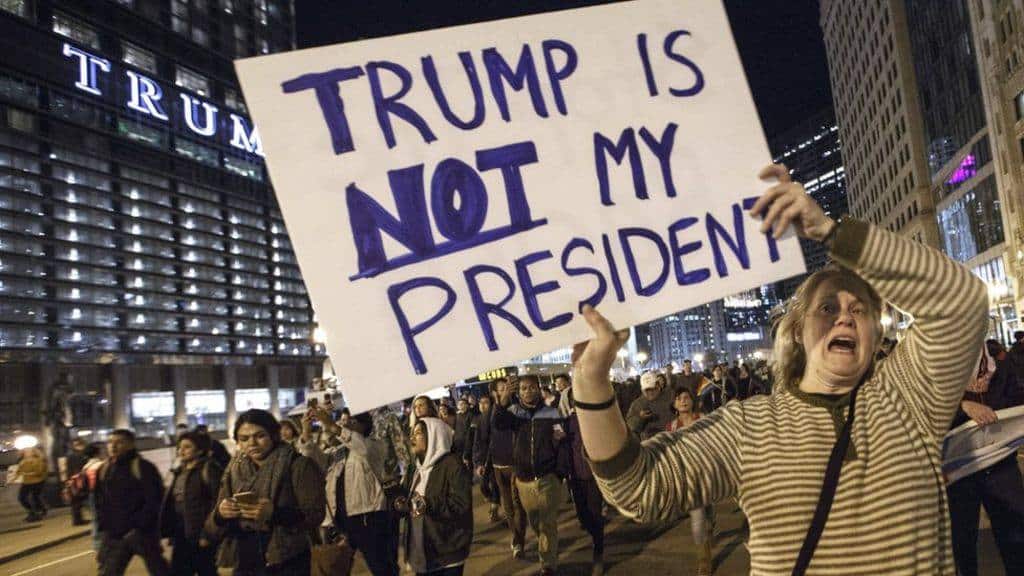
RENT A MOB :ADS OFFER PROTESTERS $2,500 TO DISRUPT INAUGURATION OF DONALD TRUMP


President-elect Donald Trump described a sting operation he says he conducted after growing frustrated at a series of leaks about his own classified briefings
He says he decided to tell no one about a particular briefing, shielding even his longtime scheduling aide, Rhoda, to rule out the possibility leaks were coming from his staff
When word got out anyway, Trump concluded it was the intelligence community who was putting out information
He described the operation he conducted after suggesting intelligence officials leaked a fake dirty dossier of information about him
Read more: https://www.dailymail.co.uk/news/article-4110654/Trump-conducts-sting-operation-ensnare-intelligence-briefers-says-caught-leaking.html#ixzz4VVMucxox

By Frank Siebelt | FRANKFURT
Deutsche Bank’s (DBKGn.DE) top economist said U.S. President-elect Donald Trump will be an improvement on “a mediocre status quo” and drive economic growth in the country higher.
“We will see a move from dogma to pragmatism,” David Folkerts-Landau said at a dinner with journalists on Monday, forecasting U.S. economic growth in 2018 would be more than double the 1.5 percent seen for 2016.
“While Trump introduces higher uncertainty, this is better than the near certainty of the continuation of a mediocre status quo,” Folkerts-Landau wrote in a presentation for the event in Deutsche Bank’s striking glass skyscraper, which is prominent on Frankfurt’s skyline.
Following a divisive election campaign, president-elect Trump has assembled a cabinet of top officials that includes business leaders and three retired generals, which Folkerts-Landau described as a “business men administration”.
“We will see a much more flexible approach to taking decisions,” he added.
https://www.reuters.com/article/us-usa-trump-deutsche-bank-idUSKBN14U1MU

On Wall Street, the rising dollar has been one of the most visible signals of growing optimism in the U.S. economy; for many other countries, it spells trouble.
By
IRA IOSEBASHVILI
Updated Jan. 1, 2017 10:03 a.m. ET
On Wall Street, the rising dollar has been one of the most visible signals of growing optimism in the U.S. economy. For many other countries, it spells trouble.
Most analysts expect the U.S. currency to strengthen in 2017, extending a gain that has boosted the value of the dollar by more than one-third since the U.S. credit downgrade in 2011.
That expectation is mostly because a strengthening economy appears likely to enable the Federal Reserve to enact its plan for multiple rate increases in 2017. Higher rates make it more attractive to hold dollar-denominated assets, attracting money into the U.S.
https://www.wsj.com/articles/re-energized-dollar-looms-over-the-rest-of-the-world-1483272003

By James Oliphant and Emily Stephenson | WASHINGTON
With more than 20 nominees now selected, Donald Trump’s cabinet appears much like the president-elect himself: mostly older, white males, many of them wealthy, who see themselves as risk-takers and deal-makers and prize action over deliberation.
Trump, who says Washington is “broken” and controlled by special interests, has largely eschewed technocrats with long government experience. Instead, he has built a team of bosses.
Trump’s roster of agency heads and advisers conspicuously lacks intellectuals, lawyers, and academics of the sort sought by some past presidents. In their place are titans of business and finance from the likes of Exxon Mobil and Goldman Sachs and no fewer than three retired generals in key positions.
https://www.reuters.com/article/us-usa-trump-bosses-analysis-idUSKBN1452PX

A morning in America moment?
by
Luke Kawa
December 15, 2016, 11:39 AM EST
It feels like another ‘Morning in America’ moment — the animal spirits are just waking up.
Following the election, a number of indexes that track confidence have jumped, with respondents citing the potential for deregulation and tax cuts once President-elect Donald Trump takes office as the cause of their increased confidence.
Homebuilders are the latest segment of the economy to testify to this surge in optimism.
The National Association of Homebuilders’ index of sentiment soared to an 11-year highin December, despite the sizable rise in bond yields since the election.
https://www.bloomberg.com/news/articles/2016-12-15/measures-of-economic-optimism-are-shooting-up-all-over-the-place-after-trump-s-win

by
Cecile Gutscher
and
Jeremy Herron
December 14, 2016, 6:15 PM EST December 15, 2016, 4:12 PM EST
The dollar rallied to its strongest level since 2003 against the euro, while gold plunged as the prospect of a steeper path for U.S. interest rates going forward filtered through markets. U.S. stocks rebounded from their worst day in two months as havens retreated.

Evan Halper and David PiersonContact Reporters
Silicon Valley’s entrepreneurs made little effort over the last year to conceal their distaste for Donald Trump, a candidate whose social media savvy belied what they saw as a staggering disregard for the innovation economy and the tech culture that has fostered it.
Now comes the reckoning.
Some of the nation’s top tech CEOs will find out how much of a grudge Trump holds when they ride the elevator up to his office in Trump Tower on Wednesday.
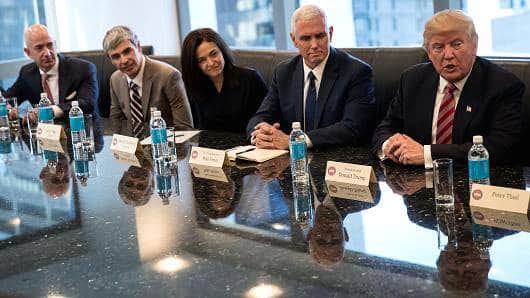
Tech titans including Apple Chief Executive Tim Cook, Sheryl Sandberg of Facebook, Elon Musk of Tesla and SpaceX and Larry Page of Alphabet, the corporate parent of Google, have been summoned by Trump as firms scramble to adjust to a reality for which they had not prepared — a potentially hostile president-elect indebted to almost no one in Silicon Valley, save for an idiosyncratic fellow billionaire they don’t particularly like.
https://www.latimes.com/politics/la-na-pol-trump-silicon-valley-20161213-story.html

pic J.P. Morgan’s Mr. Dimon
Bankers admit they love the guaranteed bailouts, lack of competition and regulated margins of Dodd-Frank
December 10, 2016
Ridgewood NJ, Big banks have an unexpected message for President-elect Donald Trump: Don’t trash the Dodd-Frank Act.“We’re not asking for wholesale throwing out Dodd-Frank,” J.P. Morgan Chase & Co. chief James Dimon said at a financial-services conference this week where he and other big-bank executives spoke, often addressing potential regulatory changes for the first time since the election.
During his presidential campaign, Republican Donald Trump said he would “get rid of” Dodd-Frank — the sweeping legislation passed in 2010 to address problems underlying the 2008-2009 financial crisis. Dodd-Frank a 2200 page monstrosity , was passed by congress like Obamacare without anyone reading the legislation , that is except for former NJ Congressmen Scott Garrett.
Dodd-Frank turned banks into utilities and did nothing to solve the ills that caused the banking crisis in 2008 ,it basically institutionalized the bad behavior that created the problem, put the bad debt in suspended animation and put taxpayers on the hook with its “too big to fail” provisions. Too big to fail also implies the corollary to big to really succeed.
Former Fed Chair Alan Greenspan called “too big to fail” legislation a “moral hazard” , giving bankers the excuse to engage in activities that would otherwise risk their livelihoods, feeling confident in ever larger government ie taxpayer bailouts.
The Trump team has talked about dismantling the law, although it has yet to state clearly whether this would involve a repeal of Dodd-Frank. Bank stocks have soared about 20% since the election, partly on the belief President-elect Donald Trump in some way will lighten banks’ regulatory load.
While banks favor a paring back of regulation, they tend to think in practical terms, rather than ideologically. And their core message seems to be: Make regulation simpler and less costly but don’t return banking to the Wild West days that preceded the financial crisis.
In many ways that is understandable. Banks have spent half a dozen years and hundreds of millions of dollars to adapt to the new landscape. This has caused them to exit businesses such as proprietary trading, rejig their corporate structures to make them safer and focus more on clients’ needs. While tearing up Dodd-Frank would seem to unshackle banks, starting with a new regulatory playbook would upend their new business models and divert management.
One of the biggest concerns for banks is that things don’t get worse. “The first thing I would ask for is nothing new, no new rules,” Citigroup Inc. finance chief John Gerspach said at the conference. “If you haven’t figured out yet how all the existing rules work together, don’t put on anything else.”
Banks acknowledge benefits to the new rules, noting they have helped improve the way firms manage risks and view their businesses. U.S. bankers have also said that having been forced to hold more capital, and build it quickly after the financial crisis, made their firms far stronger than troubled European peers.
So what would the big banks like to see changed?
Stress Tests—These annual exercises conducted by the Federal Reserve have become hugely important because they govern the amount of capital banks can return to shareholders, either through buybacks or dividends.
Banks want these to be based more on objective criteria and they want to have more of a view into the testing process and the Fed’s decision-making. And they should take less time and money to comply with, bankers say.
Bill Demchak, CEO of PNC Financial Services Group Inc., said his bank could theoretically get all the benefits of the stress-testing process with “60% of the effort.” He said that to comply with the tests, “you bring the place to a grinding halt once a year.”
The Volcker Rule— Banks say they aren’t eager to get back into the business of speculating on market moves using their own balance sheets. But they want the process around the Volcker Rule to be less burdensome and administered by fewer than five agencies.
Changes in this area could “probably make it easier to make markets” and improve liquidity, likely benefiting investors and other issuers, said Mr. Dimon.
“You have active market-marking in lumber, rebar, chicken, pork, cotton; we need it in financial instruments, it’s not different,” he said. “I do think a little more liquidity could be good.”
Mr. Gerspach said Citigroup would like less paperwork. “We don’t want to do proprietary trading,” he said. “But I also would love to work with regulators to lessen the burden of proving that we’re not engaging in proprietary trading.”
Capital and Liquidity—Banks say there are so many new rules relating to so many areas of their balance sheets that they too often run the risk of working against each other. And it isn’t clear when enough capital really is enough.
Wells Fargo chief Timothy Sloan cited differences between rules about how much capital a bank must hold and the amount of liquid assets a firm has to keep on hand. The intersections of these rules, bankers argue, hampers lending.
Bankers would also like more clarity around how much capital is enough for banks. Regulators have applied various capital surcharges to the biggest banks and these can change as regulations evolve.
“It’s getting certainty around the ability to have access to your capital return once you’ve met all the hurdles and whether those hurdles move up or down because of various people’s point of view,” said Bank of America Corp. chief Brian Moynihan.
J.P. Morgan’s Mr. Dimon said that regulators’ authority should be “cut back a little bit. It should be more prescriptive in exactly what they’re trying to accomplish.”
For all that, bankers are taking a wait-and-see stance before making any big changes to their businesses. “I think the difference going into 2017 is that we do have hope,” Citigroup’s Mr. Gerspach said. “But…we can’t build a plan on hope.”
https://onesmallvoice.blogspot.com/2016/12/banks-to-donald-trump-dont-kill-dodd.html

By Paul Mulshine | The Star Ledger
on December 08, 2016 at 6:28 AM, updated December 08, 2016 at 6:29 AM
You don’t need Wikipedia to tell you that New Jersey is the most densely populated state. Just go for a drive.
That brings up a question that hung over a joint legislative committee hearing on transportation Tuesday:
What will the effort to build transportation infrastructure look like under President Trump?
The Donald may have gotten elected with the votes from people who live in states where driving is a perfectly fine way of getting around. But he is a New Yorker and therefore congenitally inclined to understand the transportation needs of this part of the country.
The Donald’s No. 1 boast is that he knows how to get around the bureaucracy that stalls construction. In his 1987 book “The Art of the Deal,” Trump tells of how the city of New York began in 1980 to rebuild the Wollman ice-skating rink in Central Park but still had not completed it six years later.
“If it took me two and a half years to put up a major skyscraper,” he wrote, “surely it was possible to build a $2 million ice-skating rink in a matter of months.”
Trump took over the project and finished it in six months.
Compare that to the attitude of the many conflicting government entities that throttled the predecessor to Amtrak’s Gateway Project, which would add two new rail tunnels to Manhattan.
The original Access to the Region’s Core plan in the 1990s was to build two new tunnels that would be shared by NJ Transit and Amtrak trains.

By SARAH WESTWOOD 12/8/16 12:01 AM
Washington Examiner
President-elect Trump has spent the month since his election victory engaging in some distinctly presidential-style behavior, including engaging with businesses on behalf of the American people, conducting a bit of foreign policy, and delivering sweeping public addresses — all before he holds the authority of the presidency.
With weeks to go until he takes office, Trump’s moves have tested the limits of his unofficial powers as the president-in-waiting. And although his activism has drawn scrutiny from detractors, his favorability ratingshave hit new heights on the heels of several high-profile successes.
“I don’t think it’s normal for a president-elect to be out and about like this, but this is the era of Trump, and he is literally rewriting the rules,” said Ford O’Connell, a Republican strategist.
“Things always change when you actually are sworn in, but at the same time, he is taking advantage of this and throwing his weight around while he’s got the momentum,” O’Connell added.
https://www.washingtonexaminer.com/is-trump-already-president/article/2609134

President-elect met with SoftBank founder Masayoshi Son in Trump Tower
By
RYAN KNUTSON
Updated Dec. 6, 2016 3:37 p.m. ET
SoftBank Group Corp. Chairman and Chief Executive Masayoshi Son said Tuesday he would invest $50 billion in the U.S. and create 50,000 new jobs, following a 45-minute private meeting with President-elect Donald Trump.
The Japanese billionaire, whose conglomerate controls Sprint Corp., announced his investment plans in the lobby of Trump Tower, though he didn’t provide details. Mr. Trump took credit for the investment, saying his November victory spurred SoftBank’s decision.
In an interview, Mr. Son said the money will be coming from a $100 billion investment fund he is setting up with Saudi Arabia’s sovereign-wealth fund and other potential partners.

By Alexandra King, CNN
Updated 4:27 PM ET, Wed November 30, 2016
(CNN)A college student from Michigan said Wednesday that he has received death threats after being chosen to cast an Electoral College vote for his state in December.
Although the presidential election was won by Donald Trump on November 8, it’s not official until December 19, when all 538 members of the Electoral College will come together to cast their votes.
Michael Banerian, the youth vice-chairman of the Michigan Republican Party, will be one of his state’s 16 electors. The honor of being selected, a role typically bestowed to recognize a person’s service and dedication to their political party, has come at a price, Banerian told CNN’s Brianna Keilar .
“Obviously, this election cycle was pretty divisive. Unfortunately it’s bled over into the weeks following the election and I have been inundated with death threats, death wishes, generally angry messages trying to get me to change my vote to Hillary Clinton or another person, and unfortunately, it’s gotten a little out of control.” Banerian said.
Banerian said he has been threatened with violence.
https://www.cnn.com/2016/11/30/politics/banerian-death-threats-cnntv/index.html

Donald Trump’s incoming chief of staff suggests Hillary Clinton is backing away from a deal worked out between the two presidential campaigns on how the loser would concede to the winner.
Reince Priebus tells “Fox News Sunday” that Clinton’s team “cut a deal” with Trump’s team specifying that once The Associated Press called the race in favor of one candidate, the other would call within 15 minutes to concede.
Priebus says that’s just what happened election night.
But now he’s questioning whether Clinton campaign lawyer Marc Elias is backing down from that deal by announcing Clinton will participate in a recount in Wisconsin and may do the same in Michigan and Pennsylvania. The push is being led by the Green Party’s Jill Stein.
AP’s director of media relations, Lauren Easton, says AP “calls races when it is clear that one candidate has prevailed over the other. We have no knowledge of what the candidates do with that information until there is a public claim of victory or a concession.”