Ridgewood Nj,one again many have demonstrated selective anesthesia, so here is a reminder of Obamacare architect Jonathan Gruber bragging about deceiving the American people, who he thinks are stupid.
Obamacare Architect Jonathan Gruber not only twice admits fooling stupid Americans but admits the concerted effort in the to mislead what the ACA or Obamacare is all about and what it goals are .
In a report, released by the Alliance for a Just Society,in 2015 is the result of a yearlong study that included a survey of 1,200 low-income people in 10 states and was conducted in Spanish, Cantonese and English. It found that people of color, families in rural communities and those with language and cultural barriers still struggle to get health care and pay for it.
The conclusion was , “cost was a struggle even in states that expanded Medicaid, where insurance premiums paid by people every month can be high.” “While the racial barriers are significant, the biggest barrier for enrollment for people of color was premium cost,”
The Heritage foundation came up with the exact same conclusion in 2013 . Many of Obamacare’s beneficiaries have already discovered or will eventually discover that there’s a big difference between insurance coverage and access to health care services.
Today, the New York Times highlighted a report by the Department of Health and Human Services that shows access to care in the Medicaid program is very limited.
The study, conducted between July 2013 and October 2013, concludes that more than half of providers could not offer appointments to Medicaid managed care enrollees with 35 percent of providers listed under an erroneous location. Nor were those the only issues, according to the report:
Among the providers who offered appointments, the median wait time was 2 weeks. However, over a quarter had wait times of more than 1 month, and 10 percent had wait times longer than 2 months. Finally, primary care providers were less likely to offer an appointment than specialists; however, specialists tended to have longer wait times.
This is neither surprising nor a new conclusion. The Medicaid program has a long and well-documented history of limited access to care and poorer health outcomes for beneficiaries compared to those with private insurance.
Ridgewood NJ, Coverage vs. Care, Interview with Dr. Alieta Eck on Halo Health where she discuses ,why insurance coverage is not the same as access to medical care and offers some interesting ideas could help.
Dr. Alieta Eck, M.D. graduated from the Rutgers College of Pharmacy in NJ and the St. Louis School of Medicine in St. Louis, MO.
She studied Internal Medicine at Robert Wood Johnson University Hospital in New Brunswick, NJ and has been in private practice with her husband, Dr. John Eck, MD in Piscataway, NJ since 1988.
In 2003, they founded the Zarephath Health Center, a free clinic for the poor and uninsured that currently cares for 300-400 patients per month utilizing the donated services of volunteer physicians and nurses.
Dr. Alieta Eck is working to enact NJ S94 in New Jersey whereby physicians would donate their time caring for the poor and uninsured in non-government free clinics in exchange for the State providing medical malpractice protection within their private practices. She is convinced that this would relieve taxpayers of much of the Medicaid burden currently consuming 1/3 of the NJ budget.
Alieta Eck has been involved in health care reform since residency and believes that the government is a poor provider of medical care. Dr. Alieta Eck testified before the Joint Economic Committee of the US Congress in 2004 about better ways to deliver health care in the United States.
In 2013, Dr. Alieta Eck put her name forward in the Republican primary race to win the party’s nomination for a temporary seat on the U.S. Senate. Confident she could make a change in Washington she ran on a platform of shrinking the federal government and repealing ObamaCare – President Barack Obama’s Affordable Care Act.
In addition, she serves on the advisory board of Christian Care Medi-Share, a faith-based medical cost sharing Ministry and is a member of Zarephath Christian Church. She and her husband John have five children, one who is now an ophthalmology resident in St. Louis, MO.
House Ways and Means Committee Chairman Kevin Brady, left, and Energy and Commerce Committee Chairman Greg Walden, right, unveil their Obamacare replacement plan, the American Health Care Act. (Photo: Shawn Thew/EPA /Newscom)
After seven years of promises to repeal and replace Obamacare, House Republicans finally have a bill detailing how they plan to reform the health care system once the Affordable Care Act is dismantled.
The House Ways and Means and Energy and Commerce committees revealed their replacement plan, the American Health Care Act, on Monday evening. The bill repeals key provisions of Obamacare, but also implements parts of a replacement.
The 123-page bill is the culmination of weeks of discussions and negotiations—and years of calls for Obamacare to be repealed and replaced—from House Republicans on the relevant committees who worked through the weekend putting the final touches on the legislation.
The Congressional Budget Office has yet to release cost and coverage estimates for the replacement proposal.
Republicans are using a budget tool called reconciliation to fast-track the replacement plan through the Senate, where it needs 51 votes to pass.
GOP leaders in both chambers have a tough sell—so far, the replacement hasn’t been well received from Congress’ right flank, who have called on their leaders to bring a bill from 2015 unwinding the health care law before members for a vote.
>>>Conservatives Offer Solution to Repeal Obamacare, Defund Planned Parenthood: Pass 2015 Bill Again
In a memo to its members, policy staff for the Republican Study Committee detailed their concerns with the legislation, which included the Medicaid expansion and tax credits.
Additionally, members of the conservative House Freedom Caucus raised concerns about the replacement plan and said changes will need to be made to the legislation before it earns their support.
“We really need to look at some amendments to make sure we get rid of the taxes,” Freedom Caucus Chairman Mark Meadows, R-N.C., told Fox News on Monday night. “We put something on President [Barack] Obama’s desk just a few months ago, and to suggest that what we put on President [Donald] Trump’s desk sets a new entitlement, keeps some taxes, doesn’t repeal all of Obamacare, we’ve got to do better.”
“Negotiations start now,” he continued.
Republican leaders in the House and Senate have slim margins for success in getting the replacement plan across the finish line.
In the House, Republicans control 237 seats and cannot lose more than 19 votes.
In the Senate, they control 52 seats and cannot lose more than two votes.
Here is the rundown of the American Health Care Act:
What the Bill Repeals
-The penalties for the individual and employer mandates.
The American Health Care Act lessens the fines for not complying with the mandates to $0, effective Dec. 31, 2015. This provision provides retroactive relief for consumers who didn’t have coverage in 2016 and are filing their taxes now.
-Obamacare’s subsidies beginning in 2020.
-Medicaid expansion beginning in 2020.
-The “Cadillac Tax” on expensive employer-sponsored plans until 2025.
-All of Obamacare’s taxes, effective after 2017.
-Payments to insurers for cost-sharing reductions by 2020.
What the Bill Replaces
-Advanceable, refundable tax credits based on one’s age.
Under 30: $2,000
Between 30 and 39: $2,500
Between 40 and 49: $3,000
Between 50 and 59: $3,500
Over 60: $4,000
The credits are available in full to individuals making up to $75,000 and families making up to $150,000. For every $1,000 in income higher than those thresholds, the credits decrease by $100.
-Expanded health savings accounts.
The American Health Care Act increases the maximum contributions to health savings accounts, or medical savings accounts, to $6,550 for individuals and $13,100 for families beginning in 2018.
-Protections for consumers with pre-existing conditions.
-Continuous coverage requirement.
Regardless of whether they’re healthy or have a pre-existing condition, Americans must maintain continuous coverage. If there is a lapse in coverage for longer than 63 days, individuals will face a 30 percent surcharge from insurers.
-Age ratio of 5-to-1 for how much more insurers can charge elderly customers versus younger customers.
-Per-capita caps for Medicaid, which depend on each state’s number of enrollees, beginning in 2020.
-Funds for states to set up high-risk pools, reduce out-of-pocket costs, or stabilize health insurance markets.
-One-year freeze on government funding to Planned Parenthood.
What the Bill Leaves in Place
-Essential health benefits requirements.
-Letting adults remain on parents’ plans until age 26.
Ridgewood NJ, in a recent ‘U.S. News & World Report’ Best States Ranking, New Jersey ranks 14th.New Jersey beat out New York, Florida, California, Hawaii and Pennsylvania in the overall rankings.
According to the study, the Best States ranking of U.S. states draws on thousands of data points to measure how well states are performing for their citizens. In addition to health care and education, the metrics take into account a state’s economy, the opportunity it offers people, its roads, bridges, internet and other infrastructure, its public safety and the integrity and health of state government.
What’s amazing is the rankings not only consider such categories as health care(pricey in NJ ), education (forgetaboutit ) but the “state’s economy(ugh), the opportunity it offers people (live with mom), its roads, bridges (total disaster), internet and other infrastructure (public rest rooms), its public safety (cops everywhere) and the integrity and health of state government( your kidding right).”
The Top 10 states in the overall rankings include (in order):
1. Massachusetts
2. New Hampshire
3. Minnesota
4. North Dakota
5. Washington
6. Iowa
7. Utah
8. Maryland
9. Colorado
10. Vermont
The Rankings noted the state’s “world-class universities, leading technology and biological science firms and one fast turnpike,” out of 50 states, the report lists New Jersey 2nd in education, 8th in health care, and 27th in opportunity.
In other categories, you guessed it New Jersey comes in dead last in the category of government, which takes into consideration such things as “Fiscal Stability” (ranked 49th in the country), “Budget Transparency” (29th), and “State Integrity” (18th) Scary New Jersey placed 18th.
The good news in the rankings, New Jersey leads the rest of U.S. states with a zero-percent over-capacity of its State Prison System. New Jersey comes in 2nd place for “Public Transit Usage,” and its low property crime rate ranked 3rd out of all 50 states.
Meanwhile, New Jersey ranked well in overall household income (4th), low suicide rate (2nd), fewest nursing home citations (4th), and pre-school enrollment (1st).
Trenton NJ, Governor Christie unviels his final budget as governor ;
“This is the ninth time I’ve come before a joint session to address our state’s budget. Each time I’ve had specific goals in mind; guiding principles to follow. Government should get smaller. Taxes shall not be increased. Our core commitments must be met. Each time, with varying degrees of struggle, harmony and acrimony, we have reached these goals – I have stuck to those principles. Let me assure you that today will be no different.
– Governor Chris Christie, New Jersey State Budget Address, February 28, 2017
The Fiscal Year 2018 budget will be the eighth and final state budget of Governor Chris Christie’s tenure. When Governor Christie entered office in 2010, New Jersey was enduring an unprecedented fiscal crisis, with an immediate $2.2 billion mid-year fiscal deficit, as well as an unthinkably large $10.7 billion projected budget gap for Fiscal Year 2011 — more than a third of the prior year’s budget. At that time, it was uncertain whether the State would be able to meet its payroll within two months.
The staggering $13 billion two-year gap represented the culmination of years of reckless tax-and-spend policies and shortsighted budgeting practices that ignored economic realities. While state and national economies faltered, spending in Trenton under the previous administration continued unabated at unsustainable levels — increasing 58 percent from 2001 to 2008. The previous governor’s Fiscal Year 2010 budget was propped up with temporary income tax hikes, corporate surtaxes, reliance on one-time federal stimulus funds, temporary employee furloughs and other desperate gimmicks.
Today, Governor Christie is presenting his eighth consecutive balanced budget built on a foundation of fiscal restraint and responsibility. The Fiscal Year 2018 budget will fund $2 billion less in discretionary spending than was spent in Fiscal Year 2008.
The Governor’s Proposed Fiscal Year 2018 Budget:
• Calls for $35.5 billion in State appropriations, a 2.6 percent increase, largely due to non-discretionary costs.
• Contains $2 billion less in discretionary spending than the Fiscal Year 2008 budget.
• Includes the largest pension payment in New Jersey history with a $2.5 billion contribution to the State’s defined benefit funds.
o This will bring total pension contributions by the Christie Administration to $8.8 billion.
o That will be more than two and a half times the total contributions made by all governors combined during the 16-year period from Fiscal Year 1995 through Fiscal Year 2010.
• Renews the Governor’s commitment to higher education in New Jersey. Overall, higher education funding is maintained at a total of $2.2 billion in Fiscal Year 2018.
• Proposes a seventh-consecutive year of the highest amount of school aid supporting Pre-K through Grade 12 education in New Jersey history. The Fiscal Year 2018 budget proposes more than $13.8 billion for education, an increase of $523.2 million.
• Provides more than $17 billion in direct and indirect property tax relief, nearly half the total budget, including $13.8 billion in school aid and $1.5 billion in municipal aid.
• Continues more than $1 billion for direct property taxpayer relief programs:
o 423,300 seniors and citizens with disabilities will receive an average Homestead Benefit of $511, while 169,500 other homeowners earning up to $75,000 will receive an average Homestead Benefit of $397.
o 138,200 seniors and citizens with disabilities will continue receiving Property Tax Freeze benefits averaging $1,401, while 25,100 new beneficiaries will receive their first year of benefits averaging $219.
Investing In New Jersey’s Transportation Infrastructure
Today, Governor Christie proposed a $400 million supplemental appropriation in this Fiscal Year. These funds will be invested and spent quickly over the next 100 days to address bridge deficiencies and road conditions in all of New Jersey’s 21 counties. Further, these funds will be used to expedite technology enhancements and other infrastructure improvements for New Jersey Transit and will allow the New Jersey Department of Transportation to deliver the largest construction program in state history. The results will be smoother roads, safer bridges and a more technologically sound mass transit system.
In October 2016, Governor Christie signed legislation that reauthorized the New Jersey Transportation Trust Fund Authority Act. As a result of that legislation, Governor Christie’s fiscal 2018 budget provides a record $2 billion State Transportation Capital Program. The Program includes over $1.3 billion for State and local highway and bridge projects, and another $677 million for mass transportation projects.
Ensuring Access To Care While Keeping Down Costs
The NJ FamilyCare program currently provides comprehensive health care coverage to more than 1.8 million New Jersey residents at a projected $4.2 billion cost to the Fiscal Year 2018 budget. The program serves individuals eligible for both Medicaid and the Children’s Health Insurance Program (CHIP), and represents a partnership between the State and the federal government. The NJ FamilyCare program, while having some of the highest income limits in the nation, has traditionally provided health coverage exclusively to low-income families, seniors and people with disabilities. On January 1, 2014, Governor Christie expanded the program, using 100 percent federal funding, to provide health coverage to low-income childless adults.
The proposed Fiscal Year 2018 budget represents the fourth full fiscal year of the NJ FamilyCare expansion, and while a fraction of the costs associated with this eligibility group have shifted to the State budget, the expansion continues to represent a tremendous value for New Jersey. Since the Governor’s decision to expand NJ FamilyCare in 2014, an additional 487,000 uninsured New Jersey residents have gained coverage under this program. Not only did this expansion provide reliable medical coverage to many formerly uninsured residents, the infusion of federal dollars has generated meaningful savings to the State budget. Through Fiscal Year 2018, the shift of State costs to the federal government combined with the reduction in demand for Charity Care has resulted in a cumulative savings of $2 billion to the State.
Commitment To World-Class Healthcare
With the goal of ensuring a stable and accessible hospital system that provides care of the highest possible quality, the Department of Health’s budget makes significant investments in three hospital subsidy programs: Charity Care, Graduate Medical Education and Delivery System Reform Incentive Payments.
• Charity Care. Governor Christie’s expansion of NJ FamilyCare has led to a dramatic increase in NJ FamilyCare enrollment, which continues to be funded almost entirely by the federal government. The associated decrease in uninsured residents has reduced by more than half the documented claims for uncompensated care submitted by New Jersey’s hospitals. Since the expansion took effect on January 1, 2014, 487,000 low-income residents have gained health insurance through NJ FamilyCare, a 38-percent increase in program enrollment. This fundamental shift allows for a $25 million reduction in State funding for Charity Care in Fiscal Year 2018. The Fiscal Year 2018 budget provides $252 million in combined federal and State support to offset the costs hospital facilities incur in treating the uninsured.
• Graduate Medical Education (GME). The Fiscal Year 2018 budget increases support to New Jersey’s teaching hospitals by $30 million, with the total amount available through the Graduate Medical Education program now totaling $218 million. This marks the third year in a row that funding for this critical program has been increased, with the total amount available now more than triple the funding provided when Governor Christie took office. This enhanced commitment to GME will help to ensure that New Jersey residents have continued access to an adequate number of well-trained doctors.
• Delivery System Reform Incentive Payment (DSRIP). Funded at $166.6 million, the Delivery System Reform Incentive Payment (DSRIP) program was launched in Fiscal Year 2014 as a replacement for the Hospital Relief Subsidy Fund. The program continues to reward innovation and quality by distributing funds to hospitals based on measurable improvements in health outcomes.
Continued Emphasis On Community-Based Care And Services
Governor Christie is committed to fundamentally changing the way services and programs support individuals with developmental disabilities and their families, by moving away from a system that has historically focused on institutionalization to one that emphasizes home and community-based services and supports. To this end, resources have been refocused to provide people with intellectual and developmental disabilities with the ability to live as independently as possible with the proper supports.
The five-year Olmstead settlement agreement, signed February 2013, covered fiscal years 2013 to 2017 and required 600 placements over that time period. By the end of Fiscal Year 2018, the Department expects to have placed a total of 737 individuals, well exceeding the requirements of the Olmstead agreement due in large part to the acceleration of placements from the closure of North Jersey Developmental Center and Woodbridge Developmental Center in Fiscal Year 2015.
In addition to the Olmstead commitment to move individuals with developmental disabilities out of developmental centers, Governor Christie’s determination to provide services in the community includes funds to develop additional community placements and services that divert admissions to developmental centers. The Fiscal Year 2018 budget provides $89.7 million of new State and federal funding to create community placements and services, including Olmstead placements.
As a result of reforms initiated under the Medicaid Comprehensive Waiver, adults with intellectual and developmental disabilities that are living independently or with family are becoming eligible for substantially increased in-home support services for which the State will receive a federal match. When the Supports Program is fully implemented, it is expected to generate approximately $100 million in matching funding on previously State-only costs to create an estimated $200 million program, which will allow for the further expansion of services.
Family Services
The Fiscal Year 2018 budget continues and enhances the Christie Administration’s commitment to providing a wide array of services to children and families throughout New Jersey through Department of Children and Families (DCF) programs.
• Child Protection and Permanency (CP&P). The Fiscal Year 2018 budget includes a total of $986.6 million in State and federal funds for the operations and services provided by this DCF Division that is responsible for investigating allegations of child abuse and neglect
• Children’s System of Care (CSOC). This program helps more youth remain at home, in school and in their own communities, while still receiving the full scope of services they require, and provides coordinated care for more than 61,000 children and adolescents. The Fiscal Year 2018 budget includes a total of $592.5 million in State and federal funds for the operations and services provided by this Division, an increase of $24.3 million over the fiscal 2017 Appropriations Act.
• Family Success Centers. The Governor’s proposed budget protects funding for these centers which are community-based organizations that provide a wide array of services ranging from day care, resume writing and parenting classes to domestic violence prevention and substance use disorder services. The number of Family Success Centers in New Jersey will increase to a total of 58 in Fiscal Year 2018.
Lead Safety
Through continuing and increased appropriations, Governor Christie’s Fiscal Year 2018 budget continues to address lead concerns in New Jersey, ensuring the State remains a national leader on this issue. Governor Christie has added $10 million in additional State funding to effectuate the update in lead regulations to make New Jersey’s standards for identifying elevated blood-lead levels in children consistent with those of the federal Centers for Disease Control and Prevention.
The Department of Community Affairs will continue working through nonprofit organizations to remediate lead-based paint hazards affecting low- and moderate-income households in New Jersey.
The Fiscal Year 2017 budget provided $10 million to reimburse school districts for costs related to lead testing between July 13, 2016, and July 13, 2017. School districts that tested their water during that time period can continue to seek reimbursement in Fiscal Year 2018 from unexpended Fiscal Year 2017 balances.
Kean Urges NJ Senate Democrats to Spend Less Time Criticizing Washington & More Time Working to Fix New Jersey
February 19,2017
the staff of the Ridgewood blog
Trenton NJ, Senate Republican Leader Tom Kean called on New Jersey Senate Democrats to spend less time criticizing Washington and more time working to fix problems here in New Jersey:
Senate Republican Leader Tom Kean called on Senate Democrats to stop working for headlines and start working for New Jersey. (SenateNJ.com)
“With Senate Democrats so focused on federal affairs in Washington, they’ve ignored work on reforms they have the power to advance in Trenton that could have a real impact on the lives of every New Jerseyan.
“They’ve planned votes to express opposition, but they haven’t planned any votes on cutting property taxes, nor have they planned votes on creating opportunities for students and job seekers, or on ethics reforms that would help to rebuild trust in our government institutions.
“Rather than work for headlines, Senate Democrats should start working for New Jersey.”
Senate Democrats blocked efforts by Senate Republicans to bring the following three bills up for a vote that would address New Jersey’s crisis of affordability and help to rebuild residents’ trust in government.
S-1557 (Beck) – Provides full forfeiture of pension of elected or appointed official convicted of any crime touching office. S-1888 (Doherty) – Establishes State Transportation Cost Analysis Task Force. S-2554 (Kyrillos) – Sets level for health care benefits; requires employee contributions; prohibits reimbursement of Medicare Part B; adds member to SHBP/SEHBP plan design committees; requires retirees to purchase health care through exchanges.
Ridgewood NJ, Since March of 2010, the American people have had to suffer under the incredible economic burden of the Affordable Care Act—Obamacare. This legislation, passed by totally partisan votes in the House and Senate and signed into law by the most divisive and partisan President in American history, has tragically but predictably resulted in runaway costs, websites that don’t work, greater rationing of care, higher premiums, less competition and fewer choices. Obamacare has raised the economic uncertainty of every single person residing in this country. As it appears Obamacare is certain to collapse of its own weight, the damage done by the Democrats and President Obama, and abetted by the Supreme Court, will be difficult to repair unless the next President and a Republican congress lead the effort to bring much-needed free market reforms to the healthcare industry.
But none of these positive reforms can be accomplished without Obamacare repeal. On day one of the Trump Administration, we will ask Congress to immediately deliver a full repeal of Obamacare.
However, it is not enough to simply repeal this terrible legislation. We will work with Congress to make sure we have a series of reforms ready for implementation that follow free market principles and that will restore economic freedom and certainty to everyone in this country. By following free market principles and working together to create sound public policy that will broaden healthcare access, make healthcare more affordable and improve the quality of the care available to all Americans.
Any reform effort must begin with Congress. Since Obamacare became law, conservative Republicans have been offering reforms that can be delivered individually or as part of more comprehensive reform efforts. In the remaining sections of this policy paper, several reforms will be offered that should be considered by Congress so that on the first day of the Trump Administration, we can start the process of restoring faith in government and economic liberty to the people.
Congress must act. Our elected representatives in the House and Senate must:
Completely repeal Obamacare. Our elected representatives must eliminate the individual mandate. No person should be required to buy insurance unless he or she wants to.
Modify existing law that inhibits the sale of health insurance across state lines. As long as the plan purchased complies with state requirements, any vendor ought to be able to offer insurance in any state. By allowing full competition in this market, insurance costs will go down and consumer satisfaction will go up.
Allow individuals to fully deduct health insurance premium payments from their tax returns under the current tax system. Businesses are allowed to take these deductions so why wouldn’t Congress allow individuals the same exemptions? As we allow the free market to provide insurance coverage opportunities to companies and individuals, we must also make sure that no one slips through the cracks simply because they cannot afford insurance. We must review basic options for Medicaid and work with states to ensure that those who want healthcare coverage can have it.
Allow individuals to use Health Savings Accounts (HSAs). Contributions into HSAs should be tax-free and should be allowed to accumulate. These accounts would become part of the estate of the individual and could be passed on to heirs without fear of any death penalty. These plans should be particularly attractive to young people who are healthy and can afford high-deductible insurance plans. These funds can be used by any member of a family without penalty. The flexibility and security provided by HSAs will be of great benefit to all who participate.
Require price transparency from all healthcare providers, especially doctors and healthcare organizations like clinics and hospitals. Individuals should be able to shop to find the best prices for procedures, exams or any other medical-related procedure.
Block-grant Medicaid to the states. Nearly every state already offers benefits beyond what is required in the current Medicaid structure. The state governments know their people best and can manage the administration of Medicaid far better without federal overhead. States will have the incentives to seek out and eliminate fraud, waste and abuse to preserve our precious resources.
Remove barriers to entry into free markets for drug providers that offer safe, reliable and cheaper products. Congress will need the courage to step away from the special interests and do what is right for America. Though the pharmaceutical industry is in the private sector, drug companies provide a public service. Allowing consumers access to imported, safe and dependable drugs from overseas will bring more options to consumers.
The reforms outlined above will lower healthcare costs for all Americans. They are simply a place to start. There are other reforms that might be considered if they serve to lower costs, remove uncertainty and provide financial security for all Americans. And we must also take actions in other policy areas to lower healthcare costs and burdens. Enforcing immigration laws, eliminating fraud and waste and energizing our economy will relieve the economic pressures felt by every American. It is the moral responsibility of a nation’s government to do what is best for the people and what is in the interest of securing the future of the nation.
Providing healthcare to illegal immigrants costs us some $11 billion annually. If we were to simply enforce the current immigration laws and restrict the unbridled granting of visas to this country, we could relieve healthcare cost pressures on state and local governments.
To reduce the number of individuals needing access to programs like Medicaid and Children’s Health Insurance Program we will need to install programs that grow the economy and bring capital and jobs back to America. The best social program has always been a job – and taking care of our economy will go a long way towards reducing our dependence on public health programs.
Finally, we need to reform our mental health programs and institutions in this country. Families, without the ability to get the information needed to help those who are ailing, are too often not given the tools to help their loved ones. There are promising reforms being developed in Congress that should receive bi-partisan support.
To reform healthcare in America, we need a President who has the leadership skills, will and courage to engage the American people and convince Congress to do what is best for the country. These straightforward reforms, along with many others I have proposed throughout my campaign, will ensure that together we will Make America Great Again.
(CNN)President-elect Donald Trump is putting the finishing touches on an Obamacare replacement plan that aims to provide “insurance for all,” he told The Washington Post.
Also, he will demand that drug companies negotiate directly with Medicare and Medicaid and lower their prices, saying they will no longer be “politically protected.”
Trump did not reveal any details of how he’d accomplish this daunting task, noting that he is waiting for his health secretary nominee, Tom Price, to be confirmed. Price is appearing before the Senate Health, Education, Labor & Pensions Committee on Wednesday, but his hearing before the crucial Senate Finance Committee has yet to be scheduled.
Trump’s weekend interview with The Washington Post comes just after Congress took its first steps to dismantle President Barack Obama’s landmark health care reform law. The House on Friday followed the Senate in approving a budget resolution that would repeal major portions of the Affordable Care Act. Committees in both chambers will now work out the details of repealing and replacing the law.
Lindy Washburn , Staff Writer, @LindyWa5:59 p.m. EST December 5, 2016
About 224,000 New Jersey consumers can get tax credits for plans through the Affordable Care Act in 2017.
The federal government drew attention Monday to the millions of Americans, including nearly 224,000 in New Jersey, who are eligible for subsidies to buy health coverage but apparently don’t know it.
By Anjalee Khemlani, November 23, 2016 at 10:53 AM
Rutgers University’s Certified Health Care Manager program starts in February. – (NJBIZ FILE PHOTO)
Though the future of the Affordable Care Act is currently unknown following the presidential election, Rutgers University is staying the course in the rollout of a Certified Health Care Manager program — which the university is touting as the first of its kind in the country.
The 30-module course, which will only span three semesters for those interested, is geared to train health care managers to understand the ACA, as well as other changing trends in health care administration.
The Valley Hospital is the first hospital in the area to acquire the next generation in robotic surgical technology, the da Vinci® Xi Surgical System. It provides surgeons with high definition 3-D visualization and intuitive motion and ergonomic design for unmatched precision during surgical procedures.
July 21,2016
the staff of the Ridgewood blog
Ridgewood NJ, The Valley Hospital is pleased to announce it is the first hospital in the area to acquire the next generation in robotic surgical technology, the da Vinci® Xi Surgical System. This cutting-edge surgical system is the latest addition to the advancements available at The Valley Hospital’s Institute for Robotic and Minimally Invasive Surgery.
“We are proud to be the first and only hospital in Bergen County to offer the da Vinci® Xi Surgical System,” said Audrey Meyers, President and CEO of The Valley Hospital and Valley Health System. “This acquisition further establishes Valley as one of the leading robotic surgery programs in the region.”
The da Vinci® Xi Surgical System was designed with the goal of further advancing the technology used in minimally invasive surgery. It provides robotically-trained surgeons with high definition 3-D visualization and intuitive motion and ergonomic design for unmatched precision during surgical procedures. The da Vinci® Xi Surgical System can be used across a spectrum of minimally invasive surgical procedures and has been optimized for multi-quadrant surgeries in the areas of gynecology, urology, thoracic, cardiac and general surgery.
“In 2001, Valley was among the first hospitals in the country to adopt the first generation da Vinci robotic system for minimally invasive surgeries; over the years, the use of this technology has yielded excellent outcomes for our patients,” says Anusak Yiengpruksawan, M.D., Medical Director of Valley’s Institute for Robotic and Minimally Invasive Surgery. “We are pleased to continue this tradition with the most advanced da Vinci Xi® Surgical System. Our robotically-trained surgeons will be using the system to treat broad-spectrum of diseases, both benign and malignant, of gastrointestinal tract, pancreas, hepatobiliary organs, lungs, urology, and gynecology.”
For more information on minimally invasive surgical options at The Valley Hospital, contact us at 201-447-8012 or visit www.valleyroboticsurgery.com.
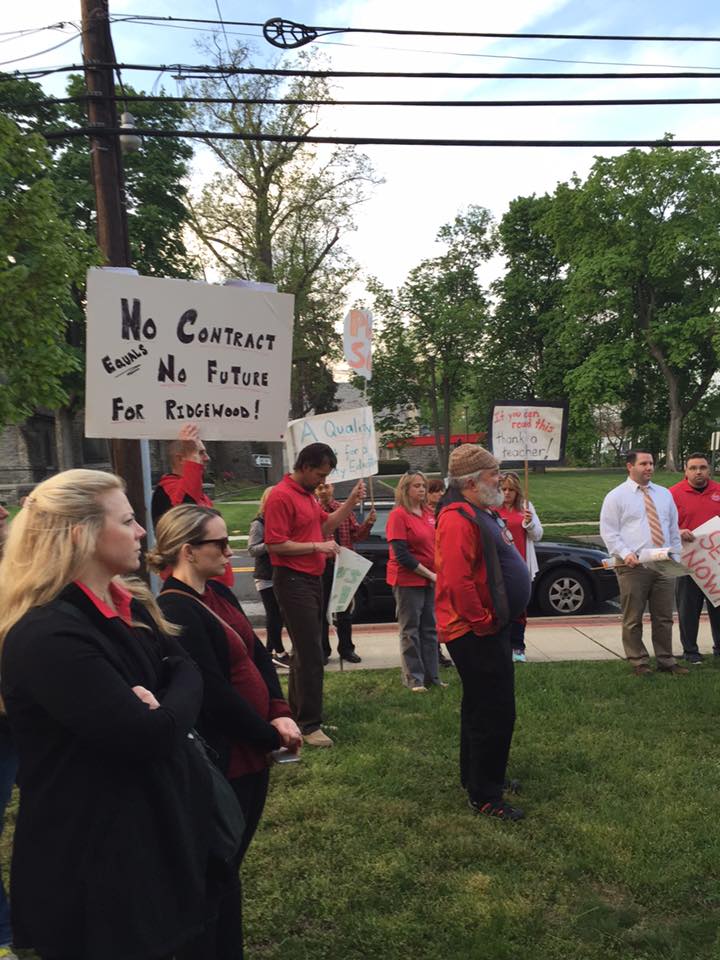
Ridgewood NJ, Ridgewood Board of Education rejects state-appointed fact finder’s recommendations for a new teachers’ contract. The BOE’s rejection sends contract negotiations, at an impasse since July 2015, back to Square One.
As we have said for some time the gravely train for public employees has come to an end and proof postive is the BOE’s rejection of the compromise .The public is just not buying paying more for healthcare for teachers than for themselves and teacher union support for “Obamacare” has left many taxpayers to feel if it good enough for us its good enough for you.
However teacher advocates in town say , that the “BOE rejected third party, neutral, unbiased fact finder recommendations and refused to settle. REA was willing to compromise on several major issues and settle the contract. Teachers have been working without a contract for a full year and still performed all of their contractual duties.”
While other readers are glad the BOE is taking a stand , “God forbid you don’t agree with the teachers’ demands. I hope the BOE takes a tough position. Agree that with the schools’ ratings sliding downwards and raises should be performance based. As for the healthcare plans – why would you think you are entitled to a better plan than the taxpayers who pay for yours? The teachers obviously do not care about the children or their profession as much as they care about the almighty dollar. They need to work a little harder and bring the school ratings up before any increases and either contribute more towards their medical insurance or agree to a less expensive plan. Yes, that means $25 co-pays and higher deductibles”
While BOE members have taken the heat say one reader , “The withering and abusive “behind the scenes” attacks on our elected BOE officials should be an embarrassment to all teachers. Why should teachers get better health benefits than the taxpayers who help subsidize them? Surely some of the things these teachers and the REA have pulled are cause for dismissals? Why not bring in some younger teachers who actually want to work with our kids and would be thrilled to teach here?”
Ridgewood NJ, More or less all lawyers in New Jersey who are both intelligent and honest will freely admit that, even though the New Jersey Supreme Court has boldly declared and decreed that our state constitution mandates the ready availability of so-called “affordable housing”, the actual text of that document mandates no such thing. In other words, the New Jersey Supreme Court made it all up based on its policy preferences.
For its part, the New Jersey legislature subsequently failed effectively to fight against the Supreme Court’s usurpation of its constitutionally-bestowed power to devise and enact generally-applicable public laws. So why has the unconstitutional Mount Laurel regime survived and become so well-ingrained in New Jersey? Because the vast majority of New Jersey attorneys have regrettably maintained decades of strict radio silence on this issue, thereby allowing the Mount Laurel regime to develop the necessary patina of legitimacy. Some have done this because they fear the professional consequences of vocal dissent. In other words, they are ruled by political correctness. However most do so because they so heartily support the underlying affordable housing POLICY that they are willing to accept however much DAMAGE the Mount Laurel regime will unavoidably wreak on the integrity of our state constitution.
This is such a brutal attack on the New Jersey State Constitution that it arguably amounts to a violation of the United States Constitution. This is because the Mount Laurel regime is both judicially-created, and judicially-enforced, and therefore deprives New Jersey residents of the small “r” republican form of government the U.S. Constitution guarantees to all U.S. citizens. As a rueful result, New Jersey is now poised to be used by political progressives as a constitutional-law-based model for imposing a similar housing policy on the rest of the country, much like Massachusettes’ all-encompassing healthcare regime (i.e., Romneycare) was used by Obama and Ridgewood’s own Jonathan Gruber as a template for foisting the Affordable Care Act (i.e., Obamacare) on every U.S. citizen that currently draws breath.
Ridgewood NJ, This past Tuesday’s vote by the planning board sent a clear message to the Village of Ridgewood residents; that healthcare trumps the health and well-being of a community. Pete McKenna of the Concerned Residents of Ridgewood said it best back in May 2014: The Village will be inextricably burdened in providing a benefit to the region. Is this fair?
The planning board majority (6 in total out of 9; Aronsohn, Nalbantian, Reilly, Joel, Abdalla, Thurston) who voted in favor of the settlement stated that the Village runs the risk of losing a further lawsuit and as well, if the Village loses the lawsuit would keep in effect the 2010 Master plan H zone, a more egregious plan. However, in the settlement that was negotiated between the planning board and Valley, the terms appeared to fall squarely in favor of Valley, with Valley reducing its size (bulk) by only 3% (and gaining most of what it wanted – to the detriment of the health and well-being of the Village). The total floor area is now going from 562,000 sq ft. (of hospital above grade structures) to over 1,024,500 square ft. of above grade structures which includes: 653,500 sq ft. for the hospital; 95,000 sq ft. for enclosed rooftop areas; 245,000 sq ft. for parking decks; and 31,400 sq ft. for atriums and courtyards. I will get back to this.
The term inherently beneficial was used frequently throughout the Whispering Woods hearings (4 in total) and was used as a “stick” by Valley in gaining the expansion approval by the Planning Board. It is unclear to many whether the concept of inherently beneficial applies to zoning or planning (including me). However, it was used generously through-out these hearings. An inherently beneficial use of land serves the public good and promotes the general welfare. As many may know, courts view hospitals under a more favorable light than other types of development (because it is an inherently beneficial use) and due to this, Village concerns about the size of the development may be discounted. However, courts also view schools as an inherently beneficial used of land. This was lost in the sauce but mentioned by Lorraine Reynolds back in May 2014. So a question becomes: Does healthcare trump
education? The negotiating team lead by Charles Nalbantian (Chairman of the Village Planning Board), who developed the terms of this agreement, thought so.
The Village’s Master Plan has suffered significantly in this process and; as well with other issues that have faced the Village including high density housing. The primary objective as stated in Ridgewood’s Master Plan is the preservation of Village residential in residential neighborhoods. Further, as defined in the Master Plan, building should continue to respect the neighborhood character and the rights of adjacent property owners. These rights (while not explicitly stated in the plan) likely include quality of life, safety, security and a sense of belonging to a community. Interestingly, these rights affect one’s health and healthcare. These rights have been violated by developers and by Valley.
John Hersperger, Village resident, at the 4/5 Whispering Woods hearing stated the following: Developers through the use of Ordinance 3066 have ripped the Ridgewood Master Plan to shreds for the purpose of their own self- interests and not the Villages. Developers as a group, petitioned the planning board at the same time and turned what should have been zoning issues into planning issues. I would agree with John. This Ordinance needs to be modified significantly or repealed. The Valley decision by the planning board could not have come at a worse time for Valley and the Village because of this.
The 3 dissenting views on the planning board by Susan Knudsen, Wendy Dockray, and Debbie Patire all concluded the same thing – the Valley decision does irreparable harm to our Master Plan; calls into question what really is beneficial and; whether a hospital interests should trump the well-being of a Village.
Wendy also stated that the Planning board on behalf of the Village should stand up and fight for what is right, despite the risks. If we go on to a lawsuit, there likely would be other opportunities to negotiate terms which would benefit both parties.
I was frankly surprised, with having several lawyers on the planning board, that no case law was cited. A recent NJ Supreme Court case in Princeton called into question the concept of an inherently beneficial use of land by a hospital and whether functions in a hospital such as administration, billing, and marketing should be considered inherently beneficial. If these are not inherently beneficial, they could be moved to other locations. If this “concept” were applied to Valley it might lessen the bulk of the Valley expansion in a meaningful way.
Here is what I would do if elected to the council: 1) Propose modification to or repeal of Ordinance 3066; 2) Work with Valley and the CRR (if possible, as there is a 5/9 court date on the second count of the lawsuit – Valley v Village Council and the council may not have any ability to negotiate based on the results of this case) in crafting a fair and equitable resolution to the Valley expansion.
A follow on blog will address the issue of how Valley might improve its image with the Village.
Just 15 percent of people say they have personally benefited from ObamaCare, although more than one-third believe it has helped the people of their state, according to a poll released Monday.
Most Americans — a total of 56 percent — say they haven’t felt directly affected by the Affordable Care Act. Among those who have felt affected, more people say the law has hurt them than helped them, according to polling by National Public Radio and the Robert Wood Johnson Foundation.
Twenty-six percent of U.S. adults say they have been personally harmed by the healthcare law since its passage — a fraction that likely reflects those in the poll who said they have noticed rising healthcare costs in the last several years.