Ridgewood NJ, Ridgewood Police report that on March 16, a Ponfield Place resident reported a theft by deception. The resident reported receiving a phone call from an individual claiming to be from the I.R.S. The caller reported the victim owed $6000 and needed to pay immediately or they would be arrested. The victim was instructed to purchase sixty iTunes gift cards to bring her account up to date. The victim then purchased sixty $100 gift cards and the caller requested the serial numbers, the victim then scratched off the back portion of the gift cards and provided all the serial numbers. The victim realized shortly thereafter the call was a scam and reported the incident to the iTunes theft department, the victim was then advised to report the incident to the Ridgewood Police Department before they would further their investigation.
The Ridgewood Police Department once again would like to remind citizens of the increased amount of scams. Always investigate communications made through postal mail, telephone, and/or the internet to prevent fraud and deceptive activity. If you have any questions or concerns, please contact the Ridgewood Police Department to ensure you’re not becoming a victim of these scams.
By Terence P. Jeffrey | March 10, 2017 | 4:15 PM EST
(CNSNews.com) – The federal government collected a record of approximately $611,318,000,000 in individual income tax revenues through the first five months of fiscal 2017 (Oct. 1, 2016 through the end of February), according to the Monthly Treasury Statement released today.
That is about $6,733,300,000 more than the $604,584,700,000 in individual income taxes (in constant 2017 dollars) that the federal government collected through the first five months of fiscal 2016.
Despite collecting a record amount in individual income taxes, the Treasury still ran a $348,984,000,000 deficit in the first five months of this fiscal year.
The New York Times reports that it has obtained pages from Trump’s 1995 state tax returns.The Times reported late Saturday night that it had received an envelope containing the first pages of Trump’s alleged 1995 state tax returns in New York, New Jersey, and Connecticut. The documents were mailed to the Times from New York City; the return address claimed it was sent from Trump Tower. Last week, the Times showed the documents to Jack Mitnick, who in the mid-1990s was Trump’s accountant and was listed on the New Jersey return as the preparer. He said the documents appeared to be authentic.
The documents indicate Trump had enormous business losses. The documents indicate Trump (and his then-wife Marla) earned wages and salaries of $6,108; interest income of $7,386,825; dividend income of $26,051; business gains of $3,427,092; real estate losses of negative $15,818,562; and “other income” of negative $915,729,293. This is almost certainly what is known as a net operating loss (NOL) carryforward, given the amount and the line of the form (although the document references an explanatory statement that remains undisclosed).
Net operating loss carryforwards are not a loophole, but a standard feature of an income tax that discourages tax avoidance. If a business makes $50 in June but loses $100 in July, we call that a $50 loss. A business that makes $50 in December but loses $100 in January is fundamentally the same thing, but straddles the tax year. Net operating losses (NOLs) allow businesses that lose money in one year and make money in another to smooth those ups and downs. We tax income (profits) not losses, and do so somewhat arbitrarily based on the calendar year. Otherwise, a taxpayer would have to pay income taxes despite not earning income, and would have an incentive to manipulate gains and losses to make them happen in the same year. Any taxpayer with business losses can take NOLs, and in 2014, 1.2 million taxpayers reported NOLs on their federal income tax form.
Why Trump had such a large net operating loss carryforward is not known from the documents made available. The documents are just the first pages so they are incomplete, and Trump’s campaign has not released any other information that can explain the $915.7 million business loss reported on the 1995 tax return. The Times notes that several Trump ventures had faltered in 1991-92 (the Trump Taj Mahal and Castle casinos in Atlantic City, the Trump Shuttle airline, and the Trump Plaza hotel), resulting in four of the six bankruptcies in Trump’s business record. As part of the bankruptcy settlements, Trump gave up stakes in these properties to creditors in return for debt write-downs. Generally cancellation of debt is taxed as income, except when discharged as part of a bankruptcy proceeding in which case any NOLs are reduced by the debt discharged. Without further documents or clarifications by the campaign, these are guesses.
The Times may face legal troubles for their article but can mount a First Amendment defense. Trump’s lawyer, contacted for comment by the Times, threatened “prompt initiation of appropriate legal action” if the Times published their article on the documents. The Trump campaign’s response referred to the document both as “alleged” and as “illegally obtained,” and in listing all the taxes Trump pays, did not list income taxes. Unauthorized disclosure of federal tax returns is prohibited by 26 U.S.C. § 7213(a)(3), punishable by a $5,000 fine and 5 years imprisonment, but in this case only state tax returns were disclosed. New York punishes unauthorized disclosure of tax return information with dismissal if the party is a state employee (N.Y. Tax § 314) and a criminal misdemeanor (N.Y. Tax § 1825); I couldn’t find information on imprisonment length for this offense. New York further authorizes civil damages of up to $1,000 or actual damages, plus punitive damages and court costs, for unauthorized disclosure of a state tax return (N.Y. Tax § 3038). Connecticut allows for punishing a state employee that violates tax return disclosure laws to be fined no more than $1,000 and imprisoned for no more than a year (Conn. Gen. Stat. § 12-15(g)). New Jersey punishes unauthorized tax return disclosure as a “crime of the fourth degree,” punishable by up to 18 months in prison and a $10,000 fine (N.J. Stat. § 54:50-8(b); N.J. Admin. Code 18:7-11.14). Criminal actions require the state governments to begin legal proceedings, not Trump or his lawyers. In mid-September, New York Times executive editor Dean Baquet said he would publish Trump’s tax returns even if it risked jail time, and I would expect them to raise a First Amendment defense to their publication. In 1971, the Times and the Washington Post won a First Amendment defense against a government order to cease publication of the Pentagon Papers, a collection of classified documents explaining how America became involved in the Vietnam War.
By DAVID BARSTOW, SUSANNE CRAIG, RUSS BUETTNER and MEGAN TWOHEY
OCT. 1, 2016
Donald J. Trump declared a $916 million loss on his 1995 income tax returns, a tax deduction so substantial it could have allowed him to legally avoid paying any federal income taxes for up to 18 years, records obtained by The New York Times show.
The 1995 tax records, never before disclosed, reveal the extraordinary tax benefits that Mr. Trump, the Republican presidential nominee, derived from the financial wreckage he left behind in the early 1990s through mismanagement of three Atlantic City casinos, his ill-fated foray into the airline business and his ill-timed purchase of the Plaza Hotel in Manhattan.
Tax experts hired by The Times to analyze Mr. Trump’s 1995 records said that tax rules especially advantageous to wealthy filers would have allowed Mr. Trump to use his $916 million loss to cancel out an equivalent amount of taxable income over an 18-year period.
Ridgewood NJ, Ridgewood police report a number of IRS Investigator scams , first a South Pleasant Avenue resident reported on 6/27/16 he received a suspicious phone call from a person who identified himself as an IRS Investigator. The caller advised the resident he owed back taxes and requested payment immediately. The resident became suspicious and contacted his accountant who informed him this was a scam and to call the police to report the incident. The resident reported he never provided personal information or banking information to the caller and requested a report as a matter of record.
On 6/24/16 a Fairway Road resident responded to headquarters to report a Fraud. The victim reported he began receiving phone calls from a person who identified himself as a Tax Agent advising the victim he had committed tax fraud. The caller persuaded the victim into purchasing and transferring $2000 in Apple Gift Cards.
The Ridgewood Police also report a victim of identity fraud; a South Irving Street resident responded to headquarters on 6/20/16 to report his personal information was used to open a fraudulent Verizon account. The victim reported the fraudulent account was opened by Verizon Wireless of New York. Verizon reported the account was opened at a Verizon Wireless store by someone utilizing his name, Social Security number, and home address. The victim’s account was not charged and Verizon Wireless is investigating.
The Ridgewood Police Department would like to remind citizens of the increased amount of scams. Always investigate communications made through postal mail, telephone, and/or the internet to prevent fraud and deceptive activity. If you have any questions or concerns, please contact the Ridgewood Police Department to ensure you’re not becoming a victim of these scams.
Ridgewood NJ, Ridgewood Police report that over the past few weeks several residents have reported being victims of identity theft. The reports indicate as they file their tax return they have discovered that someone has already filed a return using their name and social security number.
Many Americans don’t have to worry about giving Uncle Sam part of their hard-earned cash for their income taxes this year.
An estimated 45.3% of American households — roughly 77.5 million — will pay no federal individual income tax, according to data for the 2015 tax year from the Tax Policy Center, a nonpartisan Washington-based research group. (Note that this does not necessarily mean they won’t owe their states income tax.)
Roughly half pay no federal income tax because they have no taxable income, and the other roughly half get enough tax breaks to erase their tax liability, explains Roberton Williams, a senior fellow at the Tax Policy Center.
Tomorrow is April 15, which means we are approaching the deadline for filing (and paying) our federal and state income taxes (extended to April 18 this year because of Emancipation Day), and that means it’s time for my annual post at tax time to help put things in perspective.
1. Some Historical Perspective. “In the beginning” when the US federal income tax was first introduced in 1913, it used to be a lot, lot simpler and a lot easier to file taxes; so easy in fact that it was basically like filling out your federal tax return on a postcard.
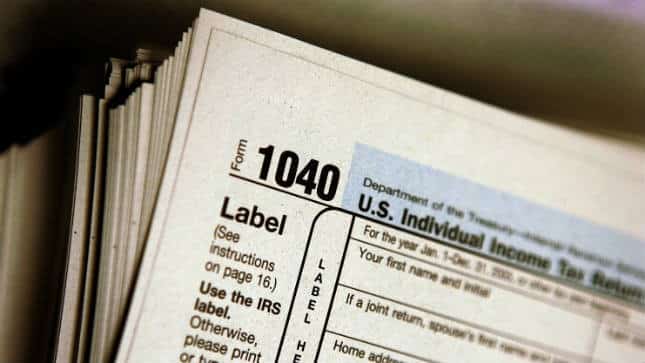
For example, page 1 of the original IRS 1040 income tax form from 1913 appears above. There were only four pages in the original 1040 form, including: two pages of worksheets, the actual one-page 1040 form above, and only one page of instructions, view all four pages here. In contrast, just the current 1040 instructions for 2014, without any forms, runs 105 pages (down from 207 pages for 2013).
Individual federal income tax rates started at 1% in 1913, and the maximum marginal income tax rate was only 7% on incomes above $500,000 ($12.02 million in today’s dollars). The personal exemption in 1913 was $3,000 for individuals ($72,000 in today’s dollars) and $4,000 for married couples ($96,000 in today’s dollars), meaning that very few Americans had to pay federal income tax since the average income in 1913 was only about $750. The Tax Foundation has historical federal income tax rates for every year between 1913 and 2013 here for tax brackets expressed in both nominal dollars and inflation-adjusted dollars.
April, 17, 2016
By Rep. Scott Garrett (New Jersey’s 5th Congressional District)
Ridgewood NJ, For too long, tax and spend politicians have used the tax code to confiscate more money from working families in New Jersey because they believe the government can spend the funds better than those that earned it. And each tax season, New Jerseyans are painfully reminded of their high tax burden.
At over 70,000 pages containing 4 million words, chances are you didn’t read the entire U.S. tax code before filing your taxes this year. In fact, the tax code is so long and complicated that you probably ended up having to pay a person or a service for their expertise — all the while hoping that they read and understood all 70,000 pages.
This is a tax code in desperate need for reform. Reform that keeps more money in New Jersey, ends the special interest loopholes, and lowers the overall tax margins for everyone.
Keep the money at home
Some politicians view tax reform and the ever-growing government as yet another opportunity to empower themselves at the expense of hardworking New Jersey taxpayers. By advocating for more programs and more benefits, big government spenders are really placing their faith in bureaucrats. So rather than send taxpayer dollars to Washington and hope bureaucrats send it back, I am fighting to keep more of your money in your own pocket.
Our overly complex tax code is the lifeblood of the biggest scam perpetuated by Washington politicians. They take your hard-earned money through a broken tax system that no one understands, and then cut backroom deals to give this money to their favored programs. And if some tiny amount actually comes home, the taxpayers are supposed to thank Washington for giving some of it back.
Think of it this way. If someone stole a $50 bill out of your pocket, would you thank that person after they brought you a happy meal from a fast food restaurant? f course not! It’s your money and you know better how it should be spent.
Even the playing field
Next, we must end the tax benefit system bestowed to Washington’s favored industries. The current tax code is a grab bag of loopholes, deductions, and escape routes for those fortunate enough to be able to hire an army of tax attorneys and lobbyists.
Every year, pinstriped lobbyists descend upon Washington to receive their tax carve outs — known as tax credits — for their industry. Not only does this arrangement let the federal government pick winners and losers, it misallocates the capital investment that so many struggling industries need. And the individual taxpayer, who has no lobbyist in Washington, is left picking up the tab.
This is not the type of economic liberty and freedom of opportunity the Founders envisioned.
New Jerseyans should no longer be expected to pay for government favors enjoyed by mega-corporations and Washington’s preferred industries. Every industry should play on the same, even playing field, not the rigged system of carve outs we have now. Additionally, the number of deductions — which allow businesses to lower their tax burden –should be significantly reduced.
If it’s broke, fix it
And on the individual level, we need a simpler, fairer, and flatter tax code free of loopholes. The average American spent 13 hours preparing their taxes last year — totaling more than 6 billion hours for all Americans. Navigating the tax code has become too complicated and time consuming. Instead, the tax code needs to be simplified so that high-powered corporate executives, who can hire expensive tax attorneys to lower their rates and find loopholes, don’t end up paying a lower percentage than a single mom working two jobs.
Thomas Jefferson once wrote, “I predict future happiness for Americans if they can prevent government from wasting the labors of the people under the pretense of taking care of them.”
New Jerseyans have been frustrated by bureaucrats in Washington who continuously waste tax dollars. Comprehensive tax reform will force the government to be more efficient, effective, and accountable to the people. Americans deserve a tax system that provides equal opportunity and economic freedom for everyone, not just those who have power and influence in Washington
Many Americans don’t have to worry about giving Uncle Sam part of their hard-earned cash for their income taxes this year.
An estimated 45.3 percent of American households — roughly 77.5 million — will pay no federal individual income tax, according to data for the 2015 tax year from the Tax Policy Center, a nonpartisan Washington-based research group. (Note that this does not necessarily mean they won’t owe their states income tax.)
Roughly half pay no federal income tax because they have no taxable income, and the other roughly half get enough tax breaks to erase their tax liability, explains Roberton Williams, a senior fellow at the Tax Policy Center.
Despite the fact that rich people paying little in the way of income taxes makes plenty of headlines, this is the exception to the rule: The top 1 percent of taxpayers pay a higher effective income tax rate than any other group (around 23 percent, according to a report released by the Tax Policy Center in 2014) — nearly seven times higher than those in the bottom 50 percent.
On average, those in the bottom 40 percent of the income spectrum end up getting money from the government. Meanwhile, the richest 20 percent of Americans, by far, pay the most in income taxes, forking over nearly 87 percent of all the income tax collected by Uncle Sam.
The top 1 percent of Americans, who have an average income of more than $2.1 million, pay 43.6 percent of all the federal individual income tax in the US; the top 0.1 percent — just 115,000 households, whose average income is more than $9.4 million — pay more than 20 percent of it.
When it comes to all federal taxes — individual income, payroll, excise, corporate income and estate taxes — the distributions of who pays what is more spread out. This is partially because nearly everyone pays excise taxes, which include taxes on gasoline, alcohol and cigarettes.
Ridgewood Nj, Congressmen Scott Garrett confirmed his offices have received some calls about this IRS fraud. Please spread this information from the U.S. Department of the Treasury to friends and family so they know to be on the lookout for these phony phone calls.
Sources tell the Ridgewood blog that scammers feel people are more vulnerable near tax time .
The IRS generally contacts people, first, by mail – not by phone – about unpaid taxes. The IRS will not ask for payment using a prepaid debit card, a money order.
“The IRS is Calling Me? Can This Be For Real?” (TIGTA PSA English) 60 seconds
Fraud is real. Just hang up on Fraud. The Treasury Inspector General for Tax Administration is warning taxpayers to be on high alert for scammers who impersonate IRS employees in aggressive phone calls that demand money. Don’t believe them; just hang up! For more information and to report a contact, visit us at www.tigta.gov.
Several residents reported having received a phone call from a man identifying himself as Dennis Gary with the treasury department, The caller requests that you call him back to avoid an enforcement action from the IRS. This is a scam do not call the number back. One of several numbers tied to the scam is 303-479-3380.
The IRS does not:
1 Call you to demand immediate payment. They will not call about taxes you owe without first mailing you a bill.
2 Demand that you pay taxes without giving you the chance to question or appeal the amount they say you owe.
3 Require you to use a certain payment method for your taxes, such as a prepaid debit card.
4 Ask for credit or debit card numbers over the phone.
5 Threaten to bring in local police or other law-enforcement to have you arrested for not paying.
If you get a phone call from someone claiming to be from the IRS and asking for money, here’s what to do:
• If you know you owe taxes or think you might owe, call the IRS at 800-829-1040 to talk about payment options. You also may be able to set up a payment plan online at IRS.gov.
• If you know you don’t owe taxes or have no reason to believe that you do, report the incident to TIGTA at 1.800.366.4484 or at www.tigta.gov.
• If phone scammers target you, also contact the Federal Trade Commission at FTC.gov. Use their “FTC Complaint Assistant” to report the scam. Please add “IRS Telephone Scam” to the comments of your complaint.
. Remember, the IRS currently does not use unsolicited email, text messages or any social media to discuss your personal tax issues. For more information on reporting tax scams, go to www.irs.gov and type “scam” in the search box.
Aug 17, 3:50 PM EDT
BY STEPHEN OHLEMACHER
ASSOCIATED PRESS
WASHINGTON (AP) — A computer breach at the IRS in which thieves stole tax information from thousands of taxpayers is much bigger than the agency originally disclosed.
An additional 220,000 potential victims had information stolen from an IRS website as part of a sophisticated scheme to use stolen identities to claim fraudulent tax refunds, the IRS said Monday. The revelation more than doubles the total number of potential victims, to 334,000.
The breach also started earlier than investigators initially thought. The tax agency first disclosed the breach in May.
The thieves accessed a system called “Get Transcript,” where taxpayers can get tax returns and other filings from previous years. In order to access the information, the thieves cleared a security screen that required knowledge about the taxpayer, including Social Security number, date of birth, tax filing status and street address, the IRS said.
The personal information was presumably stolen from other sources. The IRS believes the thieves were accessing the IRS website to get even more information about the taxpayers, which could help them claim fraudulent tax refunds in the future.
“As it did in May, the IRS is moving aggressively to protect taxpayers whose account information may have been accessed,” the IRS said in a statement. “The IRS will begin mailing letters in the next few days to about 220,000 taxpayers where there were instances of possible or potential access to `Get Transcript’ taxpayer account information.”
Posted by Alexander Hendrie on Thursday, July 30th, 2015, 7:15 AM
New documentation released by the House Oversight Committee this week again raises questions on how Lois Lerner’s hard drive was physically damaged and whether there was some kind of deliberate act to destroy data on it.
The House Oversight Committee report cites an officially transcribed interview with John Minsek, senior investigative analyst with the IRS Criminal Investigations (CI) unit. Minsek examined the Lerner hard drive in 2011. In the transcribed interview, he notes Lerner’s hard drive contained “well-defined scoring creating a concentric circle in the proximity of the center of the disk.” The Oversight Committee report states:
“Using the CI unit’s digital forensic facilities, Minsek opened the hard drive and conducted additional tests. Once he opened the hard drive, Minsek noticed “well-defined scoring creating a concentric circle in the proximity of the center of the disk.”
So how did the scoring get there?
Last month, testimony from the Treasury Inspector General for Tax Administration (TIGTA) revealed that Lois Lerner’s hard drive had “scoring on the top platter of the drive.” The testimony also noted that the IRS technician that inspected the hard drive believed that additional steps could have been taken to recover data, although this did not occur and the hard drive was later destroyed by an industrial strength AMERI-SHRED AMS-750 HD shredder.
Given these facts, it is logical to question how the “scoring” occurred and whether there was foul play involved. Here it what is known thus far:
According to TIGTA testimony submitted to the Oversight Committee on June 25, 2014, Lerner’s laptop stopped communicating with the IRS server on Saturday June 11, 2011, between 5:00 p.m. and 7:00 p.m.
According to the same testimony,the laptop was likely physically located in Lerner’s office the moment it stopped communicating with the server:
“Based on consistent network reporting for more than a week, the laptop computer was likely located in Ms. Lerner’s office.”
On Monday June 13, 2011, Lerner reported the laptop inoperable.
Lerner’s laptop was initially serviced by an IRS IT staff technician and a Hewlett-Packard contractor. Of note, the HP contractor thought the hard drive crashed due to a physical impact. According to the TIGTA testimony:
“When asked about the possible cause of the hard drive failure, the HP technician opined that heat-related failures are not seen often, and based on the information provided to him, the hard drive more than likely crashed due to an impact of some sort. However, because the HP technician did not examine the hard drive as part of his work on the laptop, it could not be determined why it crashed.”
Hans von Spakovsky / @HvonSpakovsky / Rachel S. Landsman / July 13, 2015
COMMENTARY BY
Hans von Spakovsky@HvonSpakovsky
Hans von Spakovsky is an authority on a wide range of issues—including civil rights, civil justice, the First Amendment, immigration, the rule of law and government reform—as a senior legal fellow in The Heritage Foundation’s Edwin Meese III Center for Legal and Judicial Studies and manager of the think tank’s Election Law Reform Initiative.
Rachel S. Landsman
Rachel S. Landsman is a member of the Young Leaders Program at The Heritage Foundation.
Obama’s Department of Justice may have been involved in the IRS scheme to target conservative non-profit organizations, according to newly-released documents obtained by Judicial Watch under the Freedom of Information Act.
The documents reveal that Lois Lerner met with attorneys from the Public Integrity Section (including its chief) of the Justice Department’s Criminal Division and a representative from the FBI in 2010 to discuss using campaign-finance laws to bring criminal charges against conservative non-profit organizations.
A memo prepared by Siri Buller, a tax law specialist who worked for Lerner, summarizing the meeting talks about the possibility of “a three-way partnership among the DOJ [Department of Justice], the FEC [Federal Election Commission], and the IRS” to “prevent prohibited activity by these [conservative] organizations.” Of course, the problem is that the activities that Lerner thought were “prohibited,” like expressing opinions about Obamacare, were not prohibited.
Emails between Justice Department and IRS employees also expose an attempt by the Justice Department to obtain unredacted versions of the documents IRS employees provided to Congress. One July 2013 email from a Justice Department employee to a lawyer for the IRS (the names have been redacted) says “If any of your clients have documents they are providing to Congress that you can (or would like to) provide to us before their testimony … we would like the unredacted documents.” It goes further, stating “I just know that some employees have assembled their own set [of documents], in which instance it is helpful to obtain them.”
Emails between IRS officials confirm that the IRS transmitted 21 disks containing 1.25 million pages of highly confidential tax information to the FBI. These pages included information from 2007-2010 regarding 113,000 tax returns of non-profit organizations.
The House Committee of Oversight and Government Reform was “astonished to learn…that these 21 disks contained confidential taxpayer information protected by federal law” that could not lawfully be turned over to the FBI without meeting very specific requirements for opening a criminal investigation of a particular taxpayer as outlined in 26 U.S.C. §6103. Those requirements were clearly not met by the FBI.
Judicial Watch President Tom Fitton notes “[t]hese new documents show that the Obama IRS scandal is also an Obama DOJ and FBI scandal … The FBI and Justice Department worked with Lois Lerner and the IRS to concoct some reason to put President Obama’s opponents in jail before his reelection. And this abuse resulted in the FBI’s illegally obtaining confidential taxpayer information.”
Not only did Lerner have friends in the Justice Department, it also seems she had allies in Wisconsin, where conservative non-profit groups were similarlytargeted in a secret “John Doe” investigation for publicly supporting Gov. Scott Walker’s union reforms.
Recently obtained emails show that Lerner was in contact with Kevin Kennedy, director of the Wisconsin Government Accountability Board, who was one of the government officials behind the investigations of conservative organizations in Wisconsin such as the League of American Voters, Wisconsin Family Action, Wisconsin Manufacturers & Commerce and several others. Those emails show them “sharing articles on topics including greater donor disclosure,” which, as The Wall Street Journal points out, is significant “because those were the years when the IRS increased in harassment of conservative groups and Wisconsin prosecutors gathered information” that led to the John Doe “Star Chamber.”
Wisconsin Watchdog describes the state’s John Doe procedure as “a grand jury investigation, without a jury.” These investigations allowed law enforcement to conduct abusive, paramilitary-type raids on the leaders of a number of nonprofits and their families, most of which were conducted before dawn.
In one case, a 16-year-old boy was home alone very early one morning when armed law enforcement officers raided his home as if they were closing in on a dangerous drug cartel or mob operation. Though he was terrified, the officers would not allow him to call his parents.
Several other victims of these nighttime raids came forward, even though they were ordered not to speak about the investigations. The targets of these raids were not criminals—they were Wisconsin conservatives who had supported Act 10, the “Wisconsin Budget Repair Bill,” and whose reputations and livelihoods have been severely damaged as a result of these unwarranted, heavy-handed raids.
In January, a judge blocked subpoenas against the conservative targets of the John Doe investigations. In May, U.S. District Court Judge Rudolph Randaordered that the investigations be shut down in their entirety because it was “unlawful” for the state to “target the plaintiffs for engaging in vigorous advocacy.”
These recent revelations suggest that the targeting of conservative non-profit organizations was a scheme that went far beyond the IRS and Lois Lerner alone. It was an effort that involved the coordination of several Obama administration executive agencies and supposedly non-partisan public servants.
With the discovery of the connection to the seemingly-unjustified, retaliatory investigations in Wisconsin, it seems Lerner’s efforts even extended beyond the federal government and into at least one state, threatening conservatives and chilling conservative speech at both the federal and state level.
File this one in the category of “do as we say, not as we do.”
The Internal Revenue Service over one decade tolerated “willful tax noncompliance” from 1,589 employees without consistent or clear procedures for addressing individual cases, according to a report released Wednesday by the Treasury Inspector General for Tax Administration.
In 60 percent of the cases, the watchdog found, the tax agency mitigated proposed terminations of employees found to have committed, as defined by regulation, a “voluntary intentional violation of a known legal duty (timely filing of a tax return or accurate reporting of a tax obligation) for which there is no reasonable cause.” Instead of being fired, the employees received lesser penalties such as suspensions, reprimands, or counseling.
“Given its critical role in federal tax administration, the IRS must ensure that its employees comply with the tax law in order to maintain the public’s confidence,” TIGTA J. Russell George said. “Willful violation of the law by IRS employees should not be taken lightly, and the IRS commissioner should fully document decisions made to retain employees whom management has proposed be terminated.”
The study of employee disciplinary cases from fiscal 2004-13 found that only 620 employees (39 percent) of those committing willful tax noncompliance were terminated, resigned or retired. In some case, TIGTA said, employees with similar violations received different discipline. And among cases that were mitigated, files included mitigating factors as well as evidence that violations of tax law were willful, but the documents did not make clear the basis for the commissioner’s decisions to mitigate.