HACKENSACK – The whole of New Jersey might be embroiled in casino controversy chaos, but to Bergen County Executive Jim Tedesco, the case is clear: any future North Jersey casino should be built in the Meadowlands in his own Bergen County. (Bonamo/PolitickerNJ)
If Casinos didn’t help Atlantic City what makes you think they can help North Jersey ?
No one should look to the gambling industry to revive cities, “because that’s not what casinos do.”
Baltimore is a troubled city, as you know from The Wire. Like many troubled cities, Baltimore has turned to casino gambling as its solution. On August 26, a new Caesar’s casino will open on the site of an old chemical factory, a little more than 2 miles from the famous Inner Harbor and Camden Yards baseball stadium. Yet there’s already reason to expect the casino to disappoint everyone involved: the city looking for tax revenues, the workers hoping for jobs, the investors expecting hefty returns.
Outside of Las Vegas—now home to only 20 percent of the nation’s casino industry—casino gambling has evolved into a downscale business. Affluent and educated people visit casinos less often than poorer people do for the same reasons that they smoke less and drink less and weigh less.
Unfortunately for the casino industry’s growth hopes, downscale America has less money to spend today than it did before 2007. Nor is downscale America sharing much in the post-2009 recovery. From a news report on the troubles of a recently opened Ohio casino:
Ameet Patel, general manager of the property, says the softness in casino revenue that he and other operators have seen has been driven by a key demographic: women older than 50 who used to bet $50 to $75 per visit. The weak recovery has squeezed their gambling budgets, and their trips to casinos are fewer, he says.
What’s true in Ohio applies nationwide. Casino revenues had still not recovered their 2007 peaks as of the spring of 2014, when again they went into reverse in most jurisdictions. Moody’s now projects that casino revenues will drop through the rest of 2014 and all of 2015, slicing industry earnings by as much as 7.5 percent.
There have been many labels thrust upon the Millennial generation, especially when it comes to their work ethic. The group has been called lazy, entitled, and spoiled—but at the same time the generation has also been heralded for its collective innovation and desire to work for something other than money.
While America may still not know quite how to pin down the drive and desires of this generation, it does seem that their views on jobs and careers differ from their Boomer parents and the Gen Xers who came just before them. The most recent Allstate/National Journal Heartland Monitor poll separated respondents into a younger group of those “just starting out” and an older group of participants who were more established in order to determine whether or not these groups saw things differently on a variety of issues. In many instances there are, in fact, generational differences in perspective, but on some questions, Americans aren’t quite as far apart as they might seem.
When asked what their primary concern was during their first job, about 64 percent of older Americans talked about making as much money as possible or learning new skills. When asked the same question, younger Americans were much more likely to say that their top priority was doing something that they found enjoyable or making a difference in society, with 57 percent choosing one of these options.
JUNE 10, 2015 LAST UPDATED: WEDNESDAY, JUNE 10, 2015, 11:45 AM
BY AIMEE LA FOUNTAIN
CORRESPONDENT |
THE RIDGEWOOD NEWS
A new subset of the Ridgewood Chamber of Commerce called the Brown Bag Lunch Bunch (BBLB) has formed for women business owners.
“It’s something I’ve wanted to do for a long time,” said Ridgewood Chamber Executive Director Joan Groome of the group, which started in 2013.
The idea came about when some chamber members wanted to meet during the day because they were unavailable during regular early morning or evening hours for meetings.
“I thought, ‘This is perfect for a women’s group’ and that’s how it started,” Groome said.
Meetings take place at 9 a.m. and 11 a.m. on Tuesdays.
The purpose of BBLB is to give Ridgewood small business owners a chance to network.
“It’s women helping women in business,” Groome said. “It’s a very dynamic group.”
Lena Antaramian, owner of Live Laugh Love Photography, specializing in children and family photos, has attended meetings for two years.
“Everyone’s energized and it’s great to see women achieving their objectives, making their dreams come true and building their businesses,” she said.
Groome estimated that about half of the members are new or experienced business owners and the rest work for various companies. They have backgrounds in many areas including healthcare, IT, financial advisement and marketing.
During meetings, the women give suggestions, help with referrals, plan events and offer encouragement.
“It’s about real situations and real concerns,” Groome said.
Your constant harping on “work ethic” is growing tiresome. Just because someone’s poor doesn’t mean they’re lazy. The unemployed want to work! And many of those who can’t find work today, didn’t have the benefit of growing up with parents like yours. How can you expect someone with no role model to qualify for one of your scholarships or sign your silly “Sweat Pledge?” Rather than accusing people of not having a work-ethic, why not drop the and help them develop one?
Craig P.
Hi Craig, and Happy Sunday!
I’m afraid you’ve overestimated the reach of my foundation, as well as my ability to motivate people I’ve never met. For the record, I don’t believe all poor people are lazy, any more than I believe all rich people are greedy. But I can understand why so many do.
Everyday on the news, liberal pundits and politicians portray the wealthy as greedy, while conservative pundits and politicians portray the poor as lazy. Democrats have become so good at denouncing greed, Republicans now defend it. And Republicans are so good at condemning laziness, Democrats are now denying it even exists. It’s a never ending dance that gets more contorted by the day.
A few weeks ago in Georgetown, President Obama accused Fox News of “perpetuating a false narrative” by consistently calling poor people “lazy.” Fox News denied the President’s accusation, claiming to have only criticized policies, not people. Unfortunately for Fox, The Daily Show has apparently gained access to the Internet, and after a ten-second google-search and a few minutes in the edit bay, John Stewart was on the air with a devastating montage of Fox personnel referring to the unemployed as “sponges,” “leeches,” “freeloaders,” and “mooches.” https://www.washingtonpost.com/blogs/erik-wemple/wp/2015/05/14/daily-shows-jon-stewart-buries-fox-news-on-coverage-of-poverty-president-obama/
Over the next few days, the echo chamber got very noisy. The Left howled about the bias at Fox and condemned the one-percent, while the Right shrieked about the bias at MSNBC and bemoaned the growing entitlement state. But through all the howling and shrieking, no one said a word about the millions of jobs that American companies are struggling to fill right now. No one talked the fact that most of those jobs don’t require an expensive four-year degree. And no one mentioned the 1.2 trillion dollars of outstanding student loans, or the madness of lending money we don’t have to kids who can’t pay it back, educating them for jobs that no longer exist.
I started mikeroweWORKS to talk about these issues, and shine a light on a few million good jobs that no one seems excited about. But mostly, I wanted to remind people that real opportunity still exists for those individuals who are willing to work hard, learn a skill, and make a persuasive case for themselves. Sadly, you see my efforts as “right wing propaganda.” But why? Are our differences really political? Or is it something deeper? Something philosophical?
You wrote that, “people want to work.” In my travels, I’ve met a lot of hard-working individuals, and I’ve been singing their praises for the last 12 years. But I’ve seen nothing that would lead me to agree with your generalization. From what I’ve seen of the species, and what I know of myself, most people – given the choice – would prefer NOT to work. In fact, on Dirty Jobs, I saw Help Wanted signs in every state, even at the height of the recession. Is it possible you see the existence of so many unfilled jobs as a challenge to your basic understanding of what makes people tick?
Last week at a policy conference in Mackinac, I talked to several hiring managers from a few of the largest companies in Michigan. They all told me the same thing – the biggest under reported challenge in finding good help, (aside from the inability to “piss clean,”) is an overwhelming lack of “soft skills.” That’s a polite way of saying that many applicants don’t tuck their shirts in, or pull their pants up, or look you in the eye, or say things like “please” and “thank you.” This is not a Michigan problem – this is a national crisis. We’re churning out a generation of poorly educated people with no skill, no ambition, no guidance, and no realistic expectations of what it means to go to work.
These are the people you’re talking about Craig, and their number grows everyday. I understand you would like me to help them, but how? I’m not a mentor, and my foundation doesn’t do interventions. Do you really want me to stop rewarding individual work ethic, just because I don’t have the resources to assist those who don’t have any? If I’m unable to help everyone, do you really want me to help no one?
My goals are modest, and they’ll remain that way. I don’t focus on groups. I focus on individuals who are eager to do whatever it takes to get started. People willing to retool, retrain, and relocate. That doesn’t mean I have no empathy for those less motivated. It just means I’m more inclined to subsidize the cost of training for those who are. That shouldn’t be a partisan position, but if it is, I guess I’ll just have to live with it.
Mike
PS. The Sweat Pledge wasn’t supposed to be partisan either, but it’s probably annoyed as many people as its inspired. I still sell them for $12, and the money still goes to mikeroweWORKS. You can get one here, even if you’re not applying for a scholarship. https://profoundlydisconnected.com/foundation/poster/
PPS. If you’d like Craig, I’ll autograph one for you!
Here’s an interesting take on income inequality that bucks conventional wisdom.
While President Barack Obama claims that low-income Americans work just as hard as their wealthy counterparts, that simply isn’t true, says Stephen Moore, a distinguished visiting fellow at The Heritage Foundation.
“Yes, many people in poor households heroically work very hard at low wages to take care of their families, no doubt about that,” he and Heritage Foundation research associate Joel Griffith write in The Washington Times.
Special: What the Bible Says About Investing (Shocking)
“Yet the average poor family doesn’t work nearly as much as the rich families do. And that’s a key reason why these households are poor.”
Census Bureau data show that for every hour worked by those in a low-income household, those in a wealthy household toil five hours.
“The idea that the rich are idle bondholders who play golf or go to the spa every day while the poor toil isn’t accurate,” Moore and Griffith explain.
“The finding that six out of 10 poor households have no one working at all is disturbing. Since they have no income from work, is it a surprise they are poor?”
Meanwhile, Americans are concerned about the growing inequality of income, but they don’t see the government as a solution for the most part, according to a new study by four esteemed professors for the Washington Center for Equitable Growth.
Ridgewood NJ , Assemblymen Robert Auth in February pushed for legislation to end county government in New Jersey now on Thursday, Connecticut and Rhode Island long ago abolished county government, while Massachusetts has eliminated most of its county governments.On March 26, 2015, Assemblyman Robert Auth made a motion to amend legislation, which grants Atlantic City as an Urban Enterprise Zone for 10 years (A-3920), to also extend the sales tax cut statewide.
Auth said we all live in districts that have lost jobs , which echoed what he said in February , “I’m watching businesses leave our state. A lot of it is in the district I represent,” said Auth. “I totaled up all the county budgets throughout the state. It’s like $6.5 billion a year in New Jersey. That’s a lot of money.” https://www.nj.com/politics/index.ssf/2015/02/he_end_of_county_government_in_nj_bergen_county_la.html .
One of the most immediate and clear effects of sales tax on supply and demand involves an increase in the price of consumer goods. This occurs because businesses must pay more for the products they buy, including machinery, office furnishings and computer equipment. The higher cost of doing business translates into higher prices for new products. money.https://smallbusiness.chron.com/sales-tax-effect-supply-demand-20815.html
While sales tax affects supply directly, it only has an indirect effect on consumer demand. Besides altering the equilibrium price, which takes demand into account, sales tax also impacts consumers’ buying power. When sales tax rates are high, consumers spend more money on taxes and have less to spend on additional goods. This drives down general demand, or forces businesses to reduce prices to keep demand steady. This effect holds true even for items that are not subject to sales tax, such as grocery items and prescription drugs.https://smallbusiness.chron.com/sales-tax-effect-supply-demand-20815.html
MAY 24, 2015 LAST UPDATED: SUNDAY, MAY 24, 2015, 1:21 AM
BY ELI AMDUR
SPECIAL TO NORTH JERSEY JOBS |
NORTH JERSEY JOBS
Three weeks ago, this column’s headline read, “Congratulations, graduate. Now what?” The discussion was all about being proactive in your career and in your job search. Inherent in being proactive is networking, and much was made of it in the article.
Fed up with spending the 9 to 5 in a stuffy office? Anna Hart packs her Mac and follows the trend for extreme remote working – in Bali
By Anna Hart
7:00AM BST 17 May 2015
Typing these words, my forefinger sticks sweatily to the trackpad. When I glance up from the screen, I see steam rising from the neighbouring paddy field. As with all workplaces, there’s a steady hum of white noise: coffee being brewed, group meetings peppered with jargon such as “touch base”, “reach out”, “loop back” and “incentivise”.
But Hubud, AKA “Hub-in-Ubud”, Bali, isn’t a conventional office. It is a bamboo and wood building with an outdoor organic café and a pretty garden dotted with beanbags – and monkeys, as it is just 100m from Ubud’s famous Monkey Forest. For everyone who has ever come back from holiday and wished they could have stayed, I am living the dream – and working in paradise.
• Five reasons why everyone should live abroad at least once
This is one of a rapidly increasing number of co-working spaces, where freelancers, sole traders and small companies rent desks and share printers and coffee machines. But even within that hip, fast-evolving realm, Hubud is an outlier – and its 250-strong community believes that this highly covetable office environment is the workplace of the future. The diversity of this group also signals another change: that more and more jobs are becoming portable, possible to do at a digital distance – not just web designers and freelance writers but fashion designers, photographers, models, marketers and even a remote-working GP.
This may come as bad news for parents who have spent tens of thousands of dollars sending their kids to expensive universities, but one path for young people getting a good job requires just a two-year degree or, in some cases, no college degree at all.
The fact is that our recent college graduates are already costing our country billions of dollars every year. Not long ago, the average tenure for an entry-level worker was five years. Now, that average is below two years.
U.S. companies report that the average cost of replacing a single entry-level worker is $20,000 (lost productivity, recruitment, training, and other costs). Amortized over five years, that’s an annual overhead of $4,000. Amortized over just two years, however, it soars to $10,000 per year.
Our young workers have a hair-trigger when it comes to changing jobs, or even just quitting a job without a replacement in hand. This is costing our country $6,000 more per year per new entry-level worker. That’s money that could be much better spent on creating new jobs or paying higher salaries.
Our high schools and colleges need to start paying more attention to the “soft” career skills that our young workers need to land and keep good jobs after graduation.
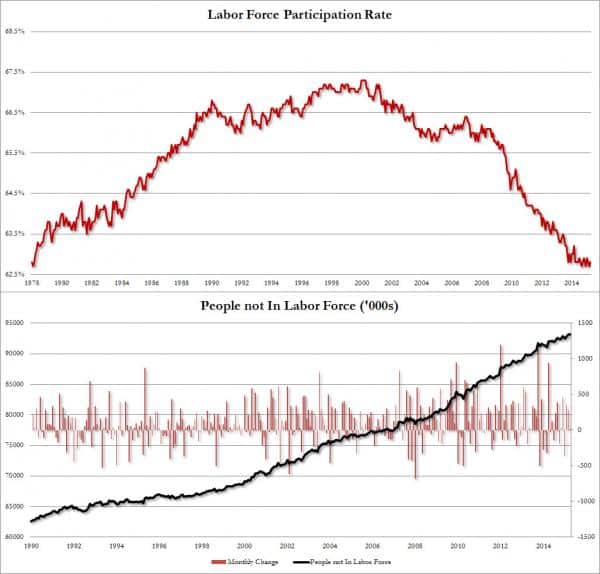
Americans Not In The Labor Force Rise To Record 93,194,000
Submitted by Tyler Durden on 05/08/2015 08:57 -0400
In what was an “unambiguously” unpleasant April jobs payrolls report, with a March revision dragging that month’s job gain to the lowest level since June of 2012, the fact that the number of Americans not in the labor force rose once again, this time to 93,194K from 93,175K, with the result being a participation rate of 69.45 or just above the lowest percentage since 1977, will merely catalyze even more upside to the so called “market” which continues to reflect nothing but central bank liquidity, and thus – the accelerating deterioration of the broader economy.
A troubling picture of clueless teenagers and frazzled parents
If I knew then what I know now
By RON LIEBER
The problem with a lot of the advice that teenagers and their families get about higher education debt is that it’s totally, utterly bloodless.The federal Department of Education takes its shot in its role as the de facto provider of advice to people borrowing their first federal student loans and repaying them. That counseling is mandatory for borrowers, but because the topic is dense and the department’s content is devoid of anecdotes, it’s tough to make the lessons stick.
So in my column last week, I asked readers to share their own stories and offer the most important thing they wish they had known before they borrowed money and began to repay it. The comments painted a troubling picture of clueless teenagers, frazzled parents and college administrators who may not always take students by the shoulders and question their debt levels.
Not one person suggested that college was a mistake (though a few regret going to law school). Borrowing too little is dangerous if it leads to dropping out or never attending in the first place, and undergraduates who borrow from the federal government without taking on additional private loans are unlikely to get in trouble if they manage the repayment process well.
There’s a BakeBot robot whipping up fresh cookies at MIT; hospitals are now employing medical robots to assist their doctors; and a robot named Baxter can beat any human at the popular logic game Connect Four, among many other tasks.
“Historically what we thought was that robots would do things that were the three D’s: dangerous, dirty, and dull,” explains Ryan Calo, professor at University of Washington School of Law with an expertise in robotics. “Over time, the range of things that robots can do has extended.”
Their abilities will only continue to expand. Ray Kurzweil, director of engineering at Google, anticipates that by 2029 robots will have reached human levels of intelligence.
Many people fear a jobless future — and their anxiety is not unwarranted: Gartner, an information technology research and advisory firm, predicts that one-third of jobs will be replaced by software, robots, and smart machines by 2025
Millennial workers have had it rough in recent years, coming of age during the Great Recession and experiencing higher levels of unemployment and underemployment than older generations.
A new study finds that Millennials, who will dominate the U.S. labor market for the next 50 years, may face another problem: They’re less prepared for today’s job market than many of their international peers, putting them (and the country) at a distinct disadvantage in an increasingly global economy.
A recent report by the Educational Testing Service (ETS) examined data from the Programme for the International Assessment of Adult Competencies (PIACC), which showed that American millennials are badly lagging behind in numeracy, literacy and problem-solving skills. Experts can only speculate on the reason for the skills gap, but the report warns that the consequences of such relatively low scores could be serious for American competiveness and could have an impact on the U.S. both socially and politically.
The study shows that even our top-performing millennials are not measuring up to their counterparts overseas. Further, the gap between America’s highest- and lowest-performing workers is among the largest. The study suggests that such a disparity can lead to dire consequences, including “mistrust in government, decreased civic engagement, increased rates of incarceration, poor health, obesity, addiction and more”
“We did not do well across the board in all three of the skills that we looked into, particularly in numeracy,” said Madeline Goodman, director of research at the ETS and one of the study’s co-authors, adding that the report presents troubling implications for the future of American competiveness.
Nearly two-thirds of millennials scored below the minimum standard in math. “If these individuals are going to be trained for jobs that have remuneration … then they need to have basic skill level” she said.
Among the 22 participating countries, U.S millennials 18 to 34 years old ranked 21st in numeracy — only Spanish millennials had lower scores. In literacy, half scored below the minimum proficiency level, ahead of only Spain and Italy. For problem solving in technology-rich environments, 56 percent of American millennials met the minimum standards, behind every other nation.
That’s a problem for U.S. employers, more than two-thirds of whom look for communication, problem-solving and quantitative skills in their new hires, according to a report last year by the National Association of Colleges and Employers.
Even so, employers expect to hire more new college grads this year than they did last year, according to a NACE report released earlier this month.
One of the central paradoxes of the ETS study is that the millennial generation is our most educated, and the study’s authors make the case that many post-secondary institutions are not adequately providing students with the skills necessary to be successful in the job market. The financial loan burden to pay for this education can also be crippling.
“These results are suggesting that a significant chunk of Americans will have trouble moving up in the labor market and getting out of lower-wage jobs,” says Harry Holzer, professor of public policy at the Georgetown University McCourt School of Public Policy.
The skills gap may be having an impact on productivity and growth, and federal educational programs such as No Child Left Behind and Race to the Top have not produced the needed results, Holzer says.
Holzer adds that Americans may need to revaluate the way they obtain these skills, and suggests that post-secondary education should not mean only a bachelor’s or associate’s degree. Upgrading America’s technical education schooling, including certificate programs in such high-demand fields as IT and health tech, may give young people entrée to high demand middle class jobs. He compares American millennials to Germans, where many high school graduates can already solve complex technical problems.
Mark Schneider, vice-president and Institute Fellow at The American Institutes for Research, is also critical of American universities, many of which he believes don’t equip students with the skills they need to function in the workplace or the wider community. He calls most college educations “too long, too expensive” and says the liberal arts skills that they provide are not marketable.