River Vale NJ, Assemblywomen Holly Schepisi comments on the Weinstein sexual harassment controversy and the Hollywood as well as Democrat double standard:
“I’ve found hypocrisy in politics fascinating as well as disgusting as it oftentimes involves women. Several months ago, in a room filled with more than 60 people, a local NJ democratic chairman made repugnant sexual based comments about a dear female professional friend of mine and yet not one person who was present said a word or spoke up. The press refused to cover the story after cowards who were present all claimed to be in the bathroom at the same time and therefore co…uldn’t confirm what had transpired.
Two years ago, another woman I know was sexually assaulted by a total piece of garbage who is prominent in NJ democratic state politics but she was convinced to remain silent by people in power as the perpetrator continues to receive promotions.
Where is the outrage one would expect against these examples? Why did people remain silent on Harvey Weinstein while accepting millions in campaign contributions? I worked in entertainment 20 years ago and stories about him were rampant back then. Why hasn’t the NJ state Democratic Party returned the monies he’s donated to them? Today, I challenge the three Democratic females running for office in my district to end their hypocrisy.
Time after time, you have launched baseless negative attacks, undertaken
hashtag politics, and fought on identity-based politics at the smallest
perceived slight or anytime you believe you can score cheap points yet you have remained silent on real issues within your own party.
Today, it is time for your games to end. The money you receive from
your Democrat Party, and from groups like Emily’s List and Emerge (which received donations of Weinstein’s money from the national Democratic Party) must be returned immediately. If it is not, and
you do not, it is clear that your words are meaningless.
The money you have taken is tainted by the very things you say you
oppose. Money from Hollywood’s Harvey Weinstein, who we now know
is an accused serial sexual assaulter has flowed into the coffers of your state
party. Millions of dollars were also raised at a state party fundraiser arm in arm with Alec Baldwin, who is well-known for calling a NY Daily News photographer a ‘nutty bi#*h,’ deriding a Starbucks barista an ‘uptight queen,’ an airline stewardess who asked him to stop playing a video game and attacking his own daughter by calling her a ‘pig’ who ‘doesn’t have brains.
When candidates stand silent because it helps them financially but then
play politics on the same issue to help their ambitions, it’s clear they only care about one things: themselves.”
Mothers Against Drunk Driving (MADD) is calling on Congress to hold hearings to address the rising number of tragedies occurring on our nation’s roadways, following today’s announcement by the National Highway Traffic Safety Administration (NHTSA) that overall traffic fatalities and those caused by drunk driving increased for the second straight year.
According to NHTSA, 37,461 people were killed in traffic crashes in 2016, and drunk driving was involved in 10,497 traffic fatalities. Drunk driving fatalities are up 1.7 percent over 2015, when 10,320 people were killed in alcohol-related crashes. The new data shows a 5.6 percent increase in overall traffic fatalities — up from 35,485 traffic fatalities in 2015. The overall traffic fatality increase of 8.4 percent in 2015 was the largest increase since 1963 to 1964, and alcohol-related fatalities increased in 2015 by 3.2 percent.
In New Jersey, the toll was 601 people, the NHTSA reported.New Jersey saw a nearly 27 percent increase in alcohol-impaired driving fatalities, the fifth highest rate in the nation.
“for the second year in a row, we are seeing increases in highway deaths — both overall and alcohol-related — after years of steady decline. We cannot stand by while more families are left to pick up the pieces after these tragedies,” said MADD National President Colleen Sheehey-Church. “Everyone needs to step up to find a solution to this national crisis.”
MADD remains laser focused on the Campaign To Eliminate Drunk Driving, launched in 2006. The Campaign supports high-visibility law enforcement, such as sobriety checkpoints and saturation patrols, state laws requiring ignition interlocks for all drunk driving offenders, development of advanced vehicle technology and public support for these initiatives. Drunk driving deaths have decreased by 22 percent since the Campaign launched, but the past two years of increases shows that more must be done.
Ignition interlock laws are a key feature of MADD’s Campaign to Eliminate Drunk Driving. The newly released NHTSA data shows a continued decline in states with ignition interlock laws. Thirty states and the District of Columbia have passed ignition interlock laws for all drunk driving offenders. MADD calls on every state to pass all-offender ignition interlock laws and improve existing laws to ensure all offenders use an ignition interlock as soon as possible after a drunk driving offense.
MADD also encourages every law enforcement agency to participate in NHTSA’s upcoming Drive Sober or Get Pulled Over campaign to increase enforcement in December.
“While vehicle safety is improving, 94 percent of all traffic deaths are caused by human error,” Sheehey-Church wrote in a letter to members of Congress. “MADD is concerned that the trending increase in highway deaths points to a public health crisis that has largely gone unnoticed.”
Washington DC, Secretary of Education Betsy DeVos recognized 342 schools as National Blue Ribbon Schools for 2017 based on their overall academic excellence or their progress in closing achievement gaps among student subgroups. These schools demonstrate that all students can achieve to high levels. The Department will formally recognize the 292 public and 50 private schools at an awards ceremony at the Omni Shoreham in Washington DC on November 6 and 7, 2017. The 2017 cohort represent public and non-public elementary, middle and high schools, including traditional, charter, magnet schools, parochial and independent schools in 44 States, the District of Colombia and Department of Defense Education Activity schools in Okinawa, Japan, Stuttgart, Germany, and West Point, New York.
The National Blue Ribbon Schools award affirms the hard work of students, educators, families, and communities in creating safe and welcoming schools where students master challenging content. The National Blue Ribbon Schools flag gracing a school’s building is a widely recognized symbol of exemplary teaching and learning. National Blue Ribbon Schools are an inspiration and a model for schools still striving for excellence. Now in its 35th year, the U. S. Department of Education has bestowed this coveted award on more than 8,500 schools.
In New Jersey 17 schools were honored as National Blue Ribbon Schools, and the list was dominated by Catholic schools . Most of which are being run by the Archdiocese of Newark.
Here are the Catholic Schools :
St. Peter Academy, Bergen County
This River Edge elementary school, under the Archdiocese of Newark, has 159 students. It was recognized as an Exemplary High Performing School.
Our Lady of the Lake School, Essex County
This Verona elementary school, operated by the Archdiocese of Newark, has 226 students and was recognized as an Exemplary High Performing School.
All Saints Catholic Academy, Hudson County
This Bayonne elementary school, under the Archdiocese of Newark, serving 404 students earned recognition as an Exemplary High Performing School.
All Saints Catholic Academy, Hudson County
This Bayonne elementary school, under the Archdiocese of Newark, serving 404 students earned recognition as an Exemplary High Performing School.
Saint Francis Cathedral School, Middlesex County
This elementary school, located in Metuchen and operated under the Metuchen Diocese, has 421 students. It was recognized as an Exemplary High Performing School.
Christian Brothers Academy, Monmouth County
This high school, located in Lincroft, and under the Diocese of Trenton, has 974 students. It was recognized as an Exemplary High Performing School.
The Academy of Our Lady of Peace, Union County
This New Providence elementary school, under the Archdiocese of Newark, has 145 students. It was recognized as an Exemplary High Performing School.
It may shock you to learn the suicide rate among middle school students is on the rise.
Data from the U.S. Centers for Disease Control and Prevention shows between 2007 and 2014, there were 50 reported suicides among middle school students in New Jersey.
This is a growing problem, according to experts, because of cyber-bullying, social and academic pressures and fear and uncertainty about the dangerous world we live in.
“The belief in the past has always been that young people just didn’t struggle with mental health issues and that belief is starting to change” said Tricia Baker, the co-founder and program director of Attitudes in Reverse, a group that talks to Jersey kids in middle and high school about suicide.
“Fifty percent of mental health disorders present before age 14, and that’s why it’s so important we talk to young people about what mental health disorder are.”
Baker’s son Kenny took his own life in 2009 when he was 19 after struggling with mental health issues from the time he was a young child.
Ridgewood NJ, Its official Ridgewood becomes the first Bee City in New Jersey! To learn more about this important and amazing program visit https://www.beecityusa.org/
Bee City USA endorses a set of commitments for creating sustainable habitats for pollinators, which are vital to feeding the planet.
Bee City USA fosters ongoing dialogue in urban areas to raise awareness of the role pollinators play in our communities and what each of us can do to provide them with healthy habitat.
Trenton NJ, Attorney General Christopher S. Porrino announced today that New Jersey has signed onto a multi-state letter calling on the credit reporting firm Equifax to disable web links for enrollment in its fee-based credit monitoring service in the wake of a massive data breach with potential to impact 143 million consumers, including nearly 4 million in New Jersey.
A multi-state investigation into the breach began last week as soon as Equifax publicly disclosed it. In the wake of the breach, Equifax has offered free credit monitoring services.
But in a letter to Equifax today, the participating attorneys general objected to Equifax “seemingly using its own data breach as an opportunity to sell services to breach victims.” Enrollment information regarding fee-based services has featured prominently on the Equifax website.
”We believe continuing to offer consumers a fee-based service in addition to Equifax’s free monitoring services will serve to only confuse consumers who are already struggling to make decisions on how to best protect themselves in the wake of this massive breach,” the letter asserts. “Selling a fee-based product that competes with Equifax’s own free offer of credit monitoring services to victims of Equifax’s own data breach is unfair, particularly if consumers are not sure if their information was compromised.”
The multi-state letter also notes that, although Equifax has agreed to waive credit freeze fees for those who would otherwise be subject to them, the other two credit bureaus — Experian and Transunion — continue to charge fees for security freezes.
The letter contends that Equifax should be taking steps to reimburse consumers who incur these fees while seeking to completely freeze their credit.
“This is one version of a consumer’s worst fear — having his or her sensitive financial and other personal information compromised by a cyber-data breach,” said Attorney General Porrino. “In New Jersey and across the nation, many people are angry, confused and stressed by the potential for harm in this breach. In our view, Equifax now has a duty to ensure that consumers don’t end up paying for credit monitoring, and Equifax also has a duty to reimburse consumers for the cost of a complete credit freeze – which will require paying fees to the other two credit reporting companies.”
“While the multi-state investigation remains active,” Porrino added, “one thing we know is that consumers aren’t at fault here. They had no hand in creating the cyber-security crisis now confronting Equifax. As such, consumers should have access – at zero cost – to the best available credit monitoring services and protections.”
In a letter sent to Equifax last week, the investigating multi-state group requested information about the circumstances leading to the breach, the reasons for a months-long delay between the breach and Equifax’s public disclosure, what protections the company had in place at the time of the breach, and how the company intends to protect consumers affected by the breach.
The attorneys general also have had communications with Equifax expressing concerns about terms of service relative to the offered free credit monitoring services, and the prominence of service enrollment information on Equifax’s Web page.
Assistant Attorney General John Falzone and Deputy Attorneys General Elliott Siebers and Russell Smith are handling the Equifax matter on behalf of the State.
Ridgewood NJ, the state of New Jersey along with the New Jersey Bicycle and Pedestrian Resource Center (BPRC) is pushing a plan to make your streets safer and more user friendly for ,pedestrians, cyclists and vehicles with a series of planning and design initiates .
According to there website , “Complete Streets are for everyone. They are designed and operated to enable safe access for all users… [so that] pedestrians, bicyclists, motorists, and public transportation users of all ages and ability are able to safely move along and across [the street].”
The Complete streets program is being spearheaded by the New Jersey Bicycle and Pedestrian Resource Center (BPRC) assists public officials, transportation and health professionals, and the public in creating a safer and more accessible walking and bicycling environment through primary research, education and dissemination of information about best practices in policy and design. The Center is supported by the New Jersey Department of Transportation through funds provided by the Federal Highway Administration.
The Village of Ridgewood signed a Complete Streets Resolution back in 2013 , ( https://njbikeped.org/wp-content/uploads/2013/01/Ridgewood-Complete-Streets-Resolution.pdf ) and while some efforts have been a success like well defined ADA compliant highly visible cross walks and curbs other attempts , like the “suicide bike lane ” and traffic easing under the trestle have been an unmitigated failure .
What are the Components of Complete Streets?
Pedestrian Component: defined as “the clear area located between the curb and the adjacent building frontage” . Key Complete Streets design elements for this component include appropriate sidewalk widths and ADA accessible curb ramps
Building and furnishing: refers to “street furniture, elements of buildings that intrude into the sidewalk, and commercial activities that occur on the sidewalk…” and includes design elements such as bicycle parking, pedestrian-scale lighting, benches/street furniture, and street trees
Bicycle: addresses “bikeways and other facilitates within the public right-of-way…” and includes design elements such as bicycle lanes (regular, buffered, contraflow, etc.), cycle tracks, share-use paths, shared lanes/sharrows, and bike route signs
Curbside Management: relates to “facilities between the cartway and the sidewalk” and includes design elements such as on-street car parking, on-street bicycle parking, loading zones, and transit shelters.
Vehicle/Cartway: describes the “portion of the public right-of-way that is intended primarily or exclusively for motor vehicle use…” [11] and includes design elements such as appropriately sized lane widths, speed humps/tables, raised medians, chicanes, and preferred/exclusive bus lanes
Urban Design: addresses “policies related to those aspects of urban form that affect Complete Streets” such as driveways, utilities, and stormwater management.
Intersection & Crossing: includes treatments that “…facilitate safe movement of all modes at intersections” [13] including high-visibility crosswalks (striped, raised, etc.), curb extensions, pedestrian refuge islands, bike boxes, and a variety of signal treatments (e.g., pedestrian countdown clocks, HAWK/RRFB signals, bicycle signals, etc.).
The only way to stem our tide of outmigration is to bring our economic policies in line with our direct regional competitors — Pennsylvania and New York
September 4,2017
written by OpportunityNJ June 26, 2017
Ridgewood NJ, New Jersey has many positive attributes. We added almost 60,000 jobs in 2016, the state’s largest gain since 2000, according to the New Jersey Department of Labor and Workforce Development. We have among the best K-12 public education systems in the nation and a highly skilled workforce including the highest concentration of scientists and engineers in the world — more than 225,000 statewide.
New Jersey also has a strong transportation network. We are home to the Port of New York and New Jersey, the third largest seaport in North America and the largest and busiest maritime cargo center on the East Coast. And we are among the national leaders in logistics and distribution. New Jersey is also a great recreation state with more than 130 miles of shoreline, beautiful parks, and mountains.
Despite these great assets, New Jersey remains a significant outlier, both nationally and regionally when comparing competitiveness and affordability including our state’s high cost of living and its heavy tax burden. New Jersey’s border states, Pennsylvania and New York, continue to be the No. 1 and No. 2 outmigration states for New Jersey residents and are challenging our competitiveness.
To reverse this trend we must examine our policies on taxation, revenue generation, and spending, and we must do so through the filter of competitiveness and affordability.
Outmigration by the numbers
In February 2016, the NJBIA issued Outmigration by the Numbers: How do we Stop the Exodus? This report found that New Jersey lost $18 billion in net-adjusted gross income over a decade. We have now updated this data to include 2015 data and have learned the loss has since grown to nearly $21 billion over 11 years (2004-2005 through 2014-2015). Further, we found the largest outmigration group continues to be millennials followed second by those nearing retirement and retirees.
Last November, New Jersey took the first step in the long road toward comprehensive tax reform by phasing out the estate tax and sharply increasing the income tax exclusion for pension and retirement income. The estate tax elimination and the pension tax reduction should help stem the outmigration of seniors and small businesses. While this is a good start, there is much more that must be done.
New Jersey ranks in the bottom six of every single tax category — income, property, sales, corporate, and inheritance. And we are in the bottom 10 of all states in combined state and local debt. Further, New Jersey residents pay the fifth-highest percentage of their household income on rent of any state and pay the fourth-highest median monthly rent of any state.
New Jersey’s top income tax rate is 8.97 percent and ranks as the sixth highest in the country. Our neighbors to the north and the west offer a better income tax rate than we do, with New York’s top income tax rate at 8.82 percent and Pennsylvania’s income tax rate flat at 3.07 percent.
Out-of-control property taxes
New Jersey has an average property tax bill of $8,549 and collects $2,924 per capita in property taxes, both of which are the highest in the nation. New York at $2,435 and Pennsylvania at $1,338 per capita are considerably lower than New Jersey, as is the national per capita of $1,300.
New Jersey has the fifth-highest corporate income tax (9 percent) in the nation. New York ranks 24th, offering a lower corporate tax rate of 6.5 percent. While Pennsylvania has a higher corporate income tax rate at 9.9 percent, it has a much more favorable personal income, property, and inheritance tax climate that offsets this tax impact.
While New Jersey is in the process of eliminating the estate tax by 2018, we still have an inheritance tax. Only five other states — Nebraska, Kentucky, Iowa, Pennsylvania, and Maryland — even have an inheritance tax. Further, while Pennsylvania has an inheritance tax, the state mitigates the impact of this tax on small businesses.
New Jersey’s debt picture is no different than its tax climate. We are near the bottom of the national rankings in every debt category. Overall, as of June 30, 2015 the state had more than $153 billion in bonded and nonbonded indebtedness according to the fiscal year 2015 state debt report.
The state’s high level of debt and the need to generate revenue to pay off the debt is a major factor that affects the ability to lower the state’s tax burden to improve the level of affordability for individuals, families, and businesses. However, we can no longer increase our tax burden in order to raise revenue to pay down this enormous debt. This would only make New Jersey even less competitive and would surely feed into an exit strategy for New Jersey businesses and residents.
The time is now to revisit and completely review our economic policies on taxation, revenue generation, and spending and we must do so with a sense of urgency. We must look at how we spend our tax dollars and be honest about the fact that our current economic paradigm is just not sustainable. Failing to do so now will compound the problem for the generations to come.
The only way to stem our tide of outmigration is to bring our economic policies in line with our direct regional competitors — Pennsylvania and New York. Becoming more competitive means becoming more affordable so that businesses will want to locate here and taxpayers will want to live here.
A sea change in New Jersey politics is coming next year, not only because Gov. Chris Christie will be leaving office, but because many prominent voices in the Legislature will be gone or are shuffling into other positions.
A string of departures announced this year in the Assembly and Senate and the death of state Sen. Jim Whelan (D-Atlantic) will take a toll on the body’s institutional knowledge. And, depending on the outcome of the November elections, even more legislative leaders and longtime hands could be headed for the exit.
Assembly Speaker Vincent Prieto (D-Hudson) likely will be ousted from the top job in the lower house by his fellow Democrats and replaced with Assemblyman Craig Coughlin (D-Middlesex), and there’s a chance Senate President Steve Sweeney (D-Gloucester) could lose re-election in his district to a Republican challenger backed by the powerful New Jersey Education Association.
When it comes to swimming spots, New Jersey isn’t lacking. We’ve got gorgeous ocean beaches all along our coast, river beaches, lake beaches, bay beaches, municipal pools, quarries, waterparks… If you’d like to take a dip, the Garden State has got you covered. Of course, there are more New Jerseyans than swimming spots, so some can get crowded. If you’re looking to discover a hidden gem, here it is.
Government spending essential to eclipse viewing … Never let a crisis, or, seemingly, an astronomical observance, go to waste. That’s the message of Emily Atkin, who wrote in the New Republic, “Trump’s budget cuts could mess up your next solar eclipse viewing.” Apparently if the government doesn’t spend money it doesn’t have on satellites, you won’t be able to see an eclipse. This is absurd, unless her audience was astrophysicists who use the equipment.
Coverage gap … As I mentioned last week, Sen. Bob Menendez, D-N.J., is scheduled for trial on corruption charges on September 6, 2017. The jury selection in that trial starts today. While local newspapers like the NY Times and local television stations have covered jury selection, cable networks have been eerily silent. American Commitment president Phil Kerpen asks an important question on Twitter: “Any networks doing stand ups outside Menendez’s jury selection this morning?” I wouldn’t hold my breath, Phil.
What bombing plot? … Yesterday, a man was arrested for allegedly trying to blow up a confederate statue in Houston. According to NewsBusters, none of the broadcast networks covered the case. If this was someone they could pin to the Right, you know it would have been covered.
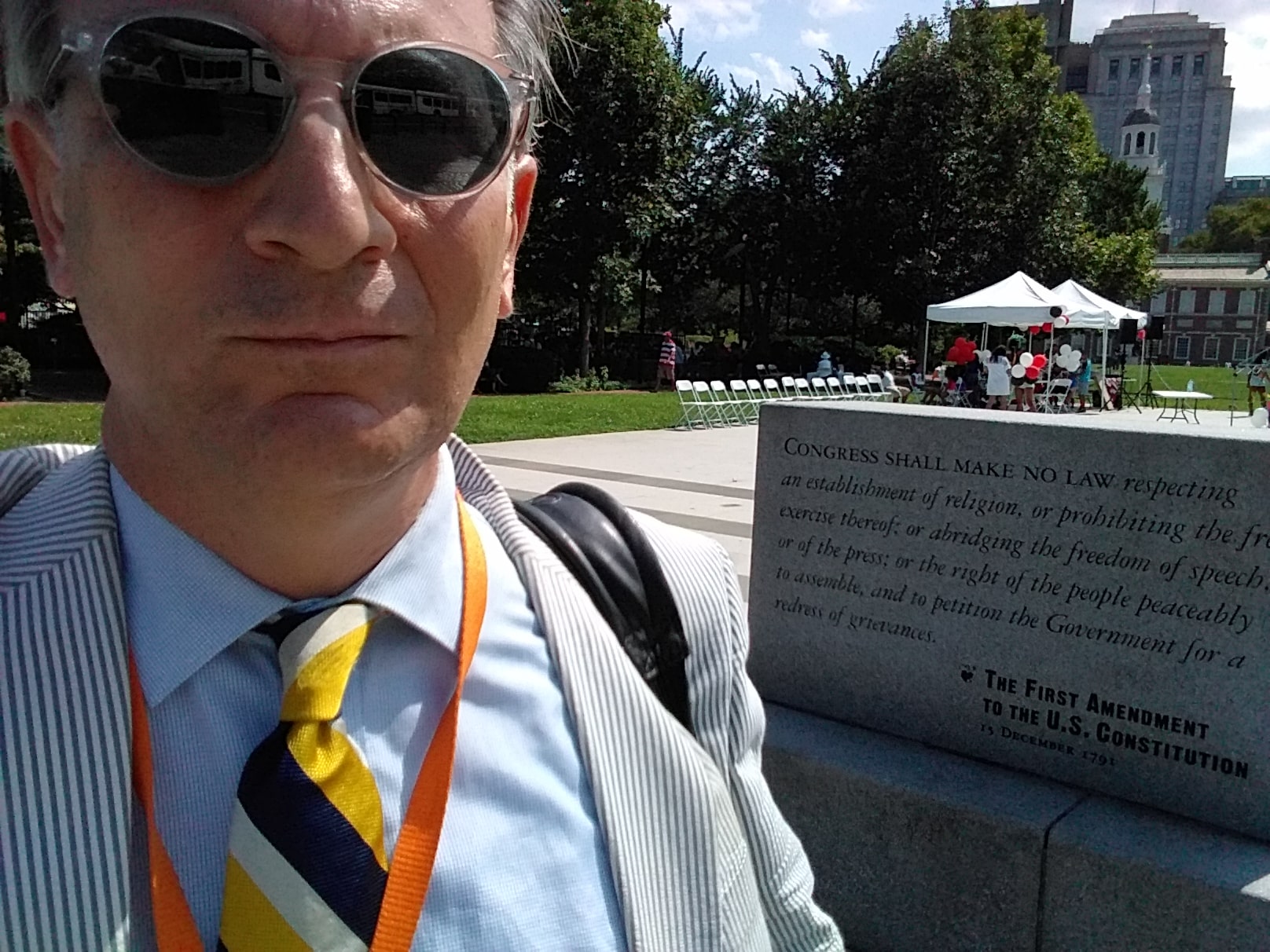
Pj Blogger at Constitution Hall at the 1st Amendment
Court: Residents Can’t Mention “Islam” or “Muslim” At Public Hearing on Mosque Construction; Thomas More Law Center Files Federal Lawsuit
August 24, 2017
the staff of the Ridgewood blog and the Thomas More Law Center
Bernards Township NJ, In a settlement agreement, which reads more like an instrument of surrender, Bernards Township (“Township”), New Jersey officials agreed that, in addition to a $3.5 million payment to Islamic Society of Basking Ridge (“ISBR”), residents and citizens of the Township are prohibited from commenting on “Islam” or “Muslims.” at the upcoming public hearing to approve the settlement. Astonishingly, a federal judge approved the prohibition as a fully enforceable Order of the Court.
As a result of this suppression of speech, the Thomas More Law Center (“TMLC”), a national public interest law firm based in Ann Arbor, Michigan, yesterday, filed a lawsuit in the New Jersey Federal District Court on behalf of Christopher and Loretta Quick. The lawsuit was filed by TMLC affiliated New Jersey attorney, Michael Hrycak. Mr. Hrycak was assisted by TMLC staff attorney, Tyler Brooks. The TMLC is representing the Quicks without charge.
TMLC’s lawsuit alleges that Bernards Township’s settlement agreement constitutes a prior restraint on speech based on content, as well as, a violation of the Establishment Clause because it prefers Islam over other religions. The lawsuit asks the court to: declare that the settlement agreement is unconstitutional; and to enter a preliminary and permanent injunction against its enforcement.
Read TMLC’s entire Federal Complaint here.
The Quicks reside within 200 feet of the proposed mosque construction in a zoned residential area. Yet, the settlement agreement prohibits them from describing the many unique features of Islamic worship which will impact design of the building, traffic density, water and sewage, traffic control problems, road construction, and parking arrangements. According to the settlement agreement, ISBR is permitted to make statements concerning Christians and Jews and their places of worship, but in contrast, the Agreement prohibits commentary relating to Islam or Muslims. In fact, ISBR has previously discussed the Christian and Jewish religions and their places of worship.
Richard Thompson, President and Chief Counsel of the Thomas More Law Center, commented: “As we have previously documented, ISBR has taken the extraordinary step of concealing significant links on their website to a radical group named by the federal government as an unindicted co-conspirator in the largest terrorism financing trial in America history, the Islamic Society of North America (“ISNA”). ISNA is claimed by the Muslim Brotherhood as one of “our organizations.” According to internal documents seized by the FBI, the Muslim Brotherhood’s strategy is to engage in a “grand Jihad in eliminating and destroying Western civilization from within . . .”
Thompson continued, “While claiming that the Township had a religious animus against Muslims, ISBR hid from the public view its animus toward Christians and Jews, by not only hiding anti-Christian and anti-Semitic verses published on its website, but also hiding its significant ties to ISNA. Instead of standing up to defend its citizens against ISBR’s hate-filled anti-Semitic and anti-Christian bias, the Township colluded with ISBR’s “Civilization Jihad” by capitulating to payment of millions of dollars to ISBR, allowing the construction of the new mosque and Islamic center in violation of zoning codes, and now even suppressing speech concerning Islam or Muslims at a public meeting.”
In March 2016, ISBR filed a lawsuit in the New Jersey Federal District Court alleging that Bernards Township had discriminated against the Islamic Society when it declined to approve the construction of a large mosque on a lot that was far too small to handle the contemplated structure. And in November 2016, the United States represented by the U. S. Justice Department filed a second lawsuit against the Township on similar grounds. The settlement agreement covers both lawsuits.
Read the entire Settlement Agreement and Court Order here.
The Thomas More Law Center defends and promotes America’s Judeo-Christian heritage and moral values, including the religious freedom of Christians, time-honored family values, and the sanctity of human life. It supports a strong national defense and an independent and sovereign United States of America. The Law Center accomplishes its mission through litigation, education, and related activities. It does not charge for its services. The Law Center is supported by contributions from individuals, corporations and foundations, and is recognized by the IRS as a section 501(c)(3) organization. You may reach the Thomas More Law Center at (734) 827-2001 or visit our website at www.thomasmore.org.
A new bipartisan legislative panel will look into addressing a shortage of middle-skilled workers in New Jersey.
Melanie Willoughby with the New Jersey Business and Industry Association said 80 percent of manufacturers in the nation have a serious shortage of qualified applicants for skilled production positions.
“This is not where we want to be with the manufacturing industry in New Jersey that is worth over $44 billion, paying an average salary of $90,450 without a BA.”
Senate President Steve Sweeney wants to put a bond act on next year’s ballot that would provide hundreds of millions of dollars to expand and equip New Jersey’s vocational-technical schools.
“Not everyone is meant to go to college and there’s nothing wrong with having a trade. We want to make sure that our vocational schools are equipped to work with businesses for the future to make sure that they have the employees that they want.
PARAMUS, N.J. — Health officials in New Jersey are warning pet owners about a deadly disease that is passed through rats.
Veterinarians in the state say they have seen a rise in the number of dogs who have contracted leptospirosis this year. The disease — known in some parts of the world as mud fever or swamp fever — is a bacterial infection that is transmitted through rat urine. Health officials say dogs may be exposed to the infection after lapping up puddle water.
CBS New York reports that at least three dogs died and two others were sickened by the disease in northern New Jersey.
The Blue Pearl Veterinary Hospital in Paramus has recently treated five dogs; three of them died. It was too late for antibiotics and the animals suffered organ failure, WCBS 880 reported.
The infection can also be hazardous for humans if they come into contact with rat urine. A Bronx man died from leptospirosis in February and two others became ill. But the New Jersey Health Department says there are currently no known human cases of leptospirosis in the state.
Even if one were to wave a magic wand and make these business-friendly changes, it’s way too late. NJ is operating in a state of virtual bankruptcy and servicing its debt is beyond anything changes like these could address. The world is changing, and location is no longer an issue. Businesses can be anywhere now and will always seek the lowest possible cost in terms of employees and real estate. It’s hard keeping anything in the USA, even in its lowest cost areas, when these businesses (or really competing businesses) can operate in places in China, the Philippines, India, etc. If NJ didn’t have such a massive debt load, it could probably ride this transition for many years, but we do have it, and the can is only kickable for so long until financial reality kicks in.