OBAMA-CASTRO MEETING OVERSHADOWS ANTI-US LINE AT SUMMIT
BY JOSHUA GOODMAN AND PETER ORSI
ASSOCIATED PRESS
PANAMA CITY (AP) — As usual when Latin America’s leftist leaders get together with U.S. officials, there were plenty of swipes at the U.S. during the seventh Summit of the Americas.
From 19th century territorial raids on Mexico to U.S. support for the overthrow of Chile’s socialist government in 1973 and the 1989 invasion of Panama that removed Gen. Manuel Noriega, Washington’s interventions in Latin America were targets of rebuke during long speeches by Venezuelan President Nicolas Maduro and his allies. That prompted President Barack Obama to retort, “I always enjoy the history lessons that I receive when I’m here.”
But the historic meeting between Obama and Cuban President Raul Castro on Saturday before the summit closed provides the U.S. and Latin America with an opportunity to move beyond a history of grievances and mistrust and set a course of closer cooperation.
There were concerns in the run-up that recent U.S. sanctions on Venezuelan officials could undermine the goodwill generated by Obama’s decision to restore diplomatic ties with Cuba, but they proved unfounded.
The conciliatory tone was set by Castro, who joked that since Cuba had been barred from the previous summits he was entitled to speak well beyond the eight minutes allotted to each of the 30-plus heads of state in attendance.
What will happen when all of the baby boomers in the U.S. retire at age 65 and the “remarkable” advances in medicine keep many of them alive into their 90s or even into triple digits?
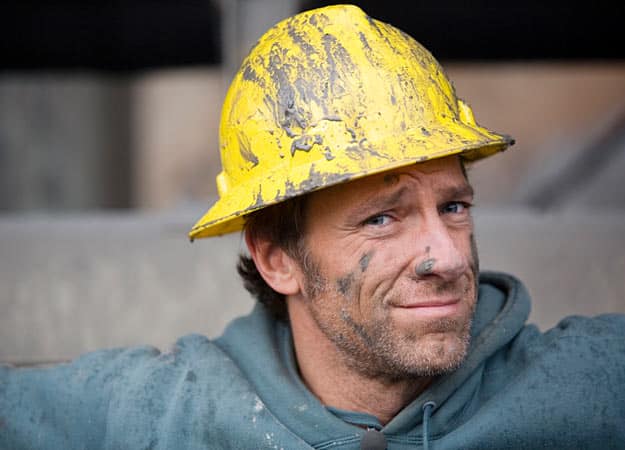
It’s a recipe for disaster and the “math is scary,” says Mike Rowe, the star of the CNN original series “Somebody’s Gotta Do It.”
“They are going to be retired for 40 years? There’s just no universe possible where you have enough money to live on if you’re an average Joe, 40 years after punching out,” he told TheBlaze. “Part of the reason, I think, we’re facing such a mess is because people are truly still clinging to the idea that, ‘OK, I worked for 30 years and now I’m done.’ That’s crazy.”
Rowe, of “Dirty Jobs” fame, also said one of the biggest problems in pop culture is the tendency to make work the “enemy,” which he said is a very dangerous concept. And though the solution to the terrifying problem is complicated, he argued putting an end to the myth that people should work as little as possible would be a big step in the right direction.
“If the key to happiness is working less, we’re in trouble,” Rowe added. “It’s that simple. Work can’t be the enemy, unless it is, and if you make it the enemy — look out.”
No one can argue that Rowe is afraid to work and get his hands dirty. He’s practically turned performing uncomfortable, unique — and sometimes dangerous — jobs into a career.
April 15 is right around the corner, and millions of Americans will find themselves paying more in taxes than ever thanks to Obamacare.
The law is more than a fundamental change to the country’s health care system. It also is a massive tax hike. As The Heritage Foundation’s Federal Budget in Pictures shows, according to the most recent scores, Obamacare will increase taxes by nearly $800 billion for the period of 2013-2022.
Obamacare contains 18 separate tax increases. A few of the biggest include a tax on “Cadillac” health insurance plans, which doesn’t take effect until 2018, long after President Obama and many in Congress who voted for the tax in 2010 have departed Washington. Also, there is a tax on health insurance premiums and a higher rate on the Hospital Insurance payroll tax for single filers with incomes above $200,000 ($250,000 for married filers) that also applies to investment income.
Ever feel like the only difference between the New York Times and Washington Post is the name? We do.
Try the Morning Bell and get the day’s most important news and commentary from a team committed to the truth in formats that respect your time…and your intelligence.
At a time when the already-onerous tax code has created a significant drag on the economy, Obamacare’s tax hikes only do more damage. Many Americans have found themselves afflicted by higher health insurance premiums, driven up, in part, by new taxes on insurers. Increased rates on capital gains and dividends from the wage and investment tax hike discourage saving and investment, resulting in fewer jobs created and lower wage growth.
Because of Obamacare, Americans are paying much higher taxes and those taxes are hurting the economy. Though some bipartisan efforts exist to repeal some of the new taxes that benefit special-interest groups, including the medical device tax, an incomplete approach won’t be sufficient to overcome the detrimental effects of this law.
Congress should repeal Obamacare and all of its tax increases.
The resurgence of Islamic terrorism and President Obama’s nuclear deal with Iran is shaking up the race for the White House, pushing national security to the forefront of the GOP primary debate.
The primacy of foreign policy could be a problem for Sen. Rand Paul (R-Ky.), the libertarian Tea-Party favorite, who is set to launch his presidential campaign next week in Louisville. He proposed steep defense cuts when he first came to the Senate and has expressed wariness about foreign military interventions.
On the other hand, the new dynamic could help Sens. Marco Rubio (R-Fla.) and Ted Cruz (R-Texas), who have touted their experience on the Foreign Relations and Armed Services committees, respectively, as they make the case for their candidacies.
WASHINGTON (AP) — For months, the U.S. economy’s strength has been flagging.
Manufacturing slowed. Fewer homes were built. Cheaper gas failed to ignite consumer spending. Yet month after month, employers kept on hiring vigorously.
In March, the economy’s slump finally overtook the job market.
Employers added just 126,000 workers — the fewest since December 2013 — snapping a 12-month streak of gains above 200,000. At the same time, the unemployment rate remained at 5.5 percent.
The slowdown reported Friday by the Labor Department posed a puzzle to economists:
Was the tepid job gain a temporary blip due mainly to a harsh winter and an economy adjusting to much lower oil prices?
Or did it mark a return to the middling performance that’s defined much of the nearly 6-year-old recovery from the Great Recession?
No one will know for sure until the government’s monthly employment reports later this spring help gauge the direction of the job market. That leaves the U.S. economy — until very recently the envy of other industrialized nations — facing a renewed sense of uncertainty.
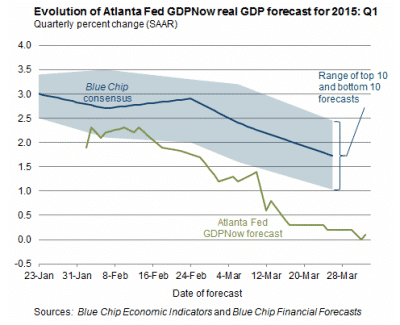
The Federal Reserve Bank of Atlanta has reported that its forecast for U.S. gross domestic product (GDP) growth dropped to zero on April 1 and ticked back up to 0.1% on April 2. The bank uses a unique model called GDPNow to prepare its forecasts, and the model typically estimates growth well below the rate projected by the Bureau of Economic Analysis (BEA).
The GDPNow model aggregates the same 13 subcomponents used by BEA to construct its estimate, but when a data point is not available, the model uses “bridge equations” to fill the gap. Other forecasters use similar “nowcast” techniques, but the Atlanta Fed notes that other forecasts are not updated more than once a month or once a quarter. Also, they are not publicly available and do not include forecasts of the subcomponents that add color to the top-line number. The GDPNow model fills those voids.
On February 2, the GDPNow model forecast GDP growth of 1.9%. At that time the change in net exports was forecast to be down $15 billion. By March 12, that total had dropped to a $40 billion negative change. Nonresidential construction spending was initially forecast to drop by 1.5% and is now forecast to be down 22.5%.
The Science Fiction Behind Paul Krugman’s Economics, Part One
Paul Krugman, a few years ago, wrote at length to extol the magnum opus of science fiction grandmaster Isaac Asimov, the Foundation Trilogy. Prof. Krugman’s reflections thereon are of keen interest.
I met Asimov once, 40+ years ago, at a world science fiction convention. I even got him to autograph my Science Fiction Book Club copy of “The Foundation Trilogy.” This compilation of three novels is an SF classic. I, then and since, found it too dull to read in full. (Asimov’s I, Robot then was much more engaging to this long-ago SF geek. But nothing Asimov wrote really rivaled Heinlein’s early, nor Arthur C. Clarke’s best, novels.)
Prof. Paul Krugman, galactically more influential than me, declares that he found the the Foundation Trilogy his formative inspiration. Therein hangs a tale: one of technocracy, which he exalts, versus mere common sense.
Washington (AFP) – Most Americans’ incomes continued to fall last year, but the richest 20 percent saw theirs rise, a new Labor Department report showed Thursday.
In fresh data that adds fire to a growing debate over income inequality, the department said that Americans on average saw income decline for the second straight year in the 12 months to June 2014.
The average pre-tax income fell 0.9 percent from the same period a year earlier, to $64,432.
But broken down into quintiles, those in the top 20 percent of incomes saw their money stream grow by 0.9 percent to $166,048 on average.
Every other group lost ground, with the bottom 20 percent losing the most: their average income dropped 3.5 percent to $9,818.
Says White House misleading Congress, American people with fact sheet
BY: Adam Kredo
April 2, 2015 5:40 pm
LAUSANNE, Switzerland — Just hours after the announcement of what the United States characterized as a historic agreement with Iran over its nuclear program, the country’s leading negotiator lashed out at the Obama administration for lying about the details of a tentative framework.
Iranian Foreign Minister Javad Zarif accused the Obama administration of misleading the American people and Congress in a fact sheet it released following the culmination of negotiations with the Islamic Republic.
Zarif bragged in an earlier press conference with reporters that the United States had tentatively agreed to let it continue the enrichment of uranium, the key component in a nuclear bomb, as well as key nuclear research.
Zarif additionally said Iran would have all nuclear-related sanctions lifted once a final deal is signed and that the country would not be forced to shut down any of its currently operating nuclear installations.
Following a subsequent press conference by Secretary of State John Kerry—and release of a administration fact sheet on Iranian concessions—Zarif lashed out on Twitter over what he dubbed lies.
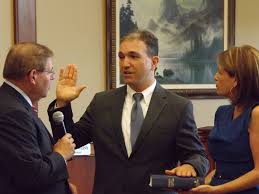
Sen. Robert Menendez (D-N.J.) slammed the Justice Department Wednesday for indicting him, saying that he believes he will be “vindicated.”
“For nearly three years, I have lived under a Justice Department cloud. Today I am outraged that this cloud has not been lifted,” Menendez said at a press conference, where he was interrupted multiple times by supports who cheered him on.
How Government-Imposed ‘Net Neutrality’ Is Recipe for Crony Capitalism
Alden Abbott / @AldenAbbott1 / March 30, 2015
The Federal Communications Commission’s Feb. 26 regulation imposing highly restrictive regulations on the Internet (“Open Internet Order”) threatens to undermine the vibrant economic growth and innovative consumer offerings that have characterized the largely unregulated Internet sector.
Unless and until the Open Internet Order is thrown out by the courts or displaced by a new law of Congress, it will place Internet Service Providers (ISPs) and firms with which they interact under a regulatory cloud, with the heavy hand of government a real threat to curb novel business practices that until now have spawned the emergence of countless new beneficial services, such as iTunes and Netflix.
As Heritage Foundation Senior Research Fellow James Gattuso recently put it:
Devised for the static monopolies, public-utility regulation will be corrosive to today’s dynamic Internet. There’s a reason the phrase “innovative public utility” doesn’t flows easily from the tongue. The hundreds of rules that come with public utility status are geared to keeping monopolies in line, not encouraging new or innovative ways of doing things. (The FCC has indicated it will refrain from enforcing the bulk of these rules, but if you believe that, I have a water-front property in Wyoming to sell you.)
Even worse, by imposing burdens on big and small carriers alike, the new rules may actually stifle chances of increasing competition among broadband providers.
The Open Internet Order is, however, more than just another Obama administration burden (admittedly a huge one) placed on the American private sector and on economic growth.
Like so many other Obama administration programs, it is an invitation to cronyism. As Heritage Foundation President Jim DeMint and Heritage Action President Mike Needham have explained, well-connected businesses use lobbying and inside influence to benefit themselves by having government enact special subsidies, bailouts and complex regulations. Those special preferences undermine competition on the merits firms that lack insider status, harming the public.
The Federal Communications Commission has a long record of shielding powerful incumbents from competition.
The Open Internet Order encourages cronyism by establishing an extremely broad “no unreasonable interference or unreasonable disadvantage” standard for Internet conduct, to be applied on a “case-by-case” basis that balances the benefits of innovation against harm to end users and “edge providers” (firms like Google, LinkedIn and Facebook that provide Internet content and related services). The Federal Communications Commission will provide guidance through “enforcement advisories” and “advisory opinions,” and the Commission’s Enforcement Bureau can request written opinions from outside organizations.
Cutting out the Washington speak and bureaucratese, the Federal Communications Commission is saying that the inherently vague and malleable language that determines whether an Internet business practice is given a thumbs up or thumbs down will turn on “opinions” that will require the input of high-priced lawyers and advisers.
Smaller and emerging firms that cannot afford to pay for influence may be out of luck. Moreover, large established companies that are experts at the “Washington game” and engage in administration-approved activities or expenditures (such as politically correct green projects or the right campaign contributions) may be given special consideration when the Federal Communications Commission sages decide whether an Internet business practice is “unreasonable” or not.
This means that firms that are willing to pay more for better Internet access to challenge such powerful firms as Netflix in video services or Google in search activities or Facebook in social networking may be out of luck, if they are less effective at playing the Washington influence game than at competing on the merits. Those who doubt this need to know that the Federal Communications Commission has a long record of shielding powerful incumbents from competition. For decades the Commission maintained AT&T’s telecom monopoly by keeping out of the market new cellular service and telephone equipment providers, and protected dominant broadcasters by preventing cable companies from providing competing video services.
In sum, the benefits to American consumers and the overall American economy generated by a regulation-free Internet—not to mention the ability of entrepreneurs to thrive, free from cronyism—may soon become a thing of the past, unless action is taken by Congress or the courts. American citizens deserve better than that from their government.
Recent college grads, and especially African-Americans, struggle to find work in a slow recovery.
ByJAMES FREEMAN
May 21, 2014 7:58 a.m. ET
The great irony of the Obama era is that the President’s base voters have disproportionately suffered from a sputtering economy, while the wealthy that Mr. Obama likes to criticize have enjoyed a booming stock market. A new study shows just how difficult this era has been for some of the President’s most loyal supporters.
Researchers at the Center for Economic and Policy Research, a left-leaning think tank, find that “The Great Recession has been hard on all recent college graduates, but it has been even harder on black recent graduates.”
In 2013, the unemployment rate for black college graduates ages 22-27 was a full 12.4%, more than double the 5.6% rate for all college grads in the same age range.
And for those African-American recent grads who did have jobs in 2013, study authors Janelle Jones and John Schmitt find that a staggering 56% were underemployed, meaning they were doing jobs that typically don’t require a four-year college degree. This compares to 45% underemployment among all recent graduates. For youngsters of all colors, these statistics describe a tragic era of lost opportunity and unrealized potential.
Even a career-friendly course of study isn’t protecting young graduates from the ravages of this historically slow recovery. The authors report that “for the years 2010 to 2012, among black recent graduates with degrees in engineering, the average unemployment rate was 10 percent and the underemployment rate was 32 percent.” Among all recent grads with engineering degrees, the average unemployment rate in those years was 6%, while 22% were underemployed.
U.S. Capital Gains Tax Rate, 6th Highest in OECD
March 25,2015
President’s budget proposal would bump rate to 5th highest
Washington, DC ,The United States currently has the 6th highest top marginal tax rate on capital gains in the OECD at 28.6 percent. President Obama’s recent budget proposal seeks to increase the top marginal tax rate on capital gains to 32.8 percent, which would give the U.S. the fifth highest rate in the industrialized world. However, this expansion of the capital gains tax could lead to slower economic growth, according to a recent report from the nonpartisan Tax Foundation.
“Increasing taxes on capital income discourages savings, which leads to lower levels of investment and slower economic growth,” explains Tax foundation Economist Kyle Pomerleau. “The expansion of this tax as suggested in the recent budget proposal would only further this bias against saving.”
The report argues that as more people prefer consumption today due to this bias, there will be less capital available in the future. For investors, this represents less available capital for factories, machines, and other investment opportunities.
“Additionally, capital gains taxes create a lock-in effect that reduces the mobility of capital,” adds Pomerleau. “People are less willing to realize capital gains from one investment in order to move to another when they face a tax on their returns. Funds will be slower to move to better investments, further reducing economic growth.”
By raising the federal top marginal capital gains tax rate, President Obama’s FY 2016 budget would compound these negative effects and make the U.S. tax code less competitive globally. On the other hand, the report finds that lowering taxes on capital gains would have the reverse effect, increasing investment and leading to greater economic growth.
The report’s key findings include:
The average combined federal, state, and local top marginal tax rate on long-term capital gains in the United States is 28.6 percent – 6th highest in the OECD.
This is more than 10 percentage points higher than the simple average across industrialized nations of 18.4 percent, and 5 percentage points higher than the weighted average.
Nine industrialized countries exempt long-term capital gains from taxation.
California has the 3rd highest top marginal capital gains tax rate in the industrialized world at 33 percent.
The taxation of capital gains places a double-tax on corporate income, increases the cost of capital, and reduces investment in the economy.
The President’s FY 2016 budget would increase capital gains tax rates in the United States from 28.6 percent to 32.8, the 5th highest rate in the OECD.
Mounting chaos in the region puts the administration on the defensive.
By Michael Crowley
3/26/15 7:40 PM EDT
Barack Obama faces a slew of Middle East crises that some call the worst in a generation, as new chaos from Yemen to Iraq — along with deteriorating U.S.-Israeli relations — is confounding the president’s efforts to stabilize the region and strike a nuclear deal with Iran.
The meltdown has Obama officials defending their management of a region that some call impossible to control, even as critics say U.S. policies there are partly to blame for the spreading anarchy.
“If there’s one lesson this administration has learned, from President Obama’s 2009 Cairo speech through the Arab Spring, it’s that when it comes to this region, nothing happens in a linear way — and precious little is actually about us, which is a hard reality to accept,” said a senior State Department official.
Obamacare Is Really Expensive for Small Businesses. Surprise!
Lousy news for growing the economy, creating jobs, and overall increasing prosperity
“Complying with the health care law is costing small businesses thousands of dollars that they didn’t have to spend before the new regulations went into effect,” reports AP business writer Joyce M. Rosenberg. This should be a surprise to exactly nobody. In general, government mandates have poor track record of making people’s lives less expensive and complicated. Specifically, businesses around the country have reported over the past year that Obamacare raised their healthcare costs and they anticipated more hikes to come. Hiring—especially of full-time employees—has taken a hit as a result.
Writes Rosenberg:
The Affordable Care Act, which as of next Jan. 1 applies to all companies with 50 or more workers, requires owners to track staffers’ hours, absences and how much they spend on health insurance. Many small businesses don’t have the human resources departments or computer systems that large companies have, making it harder to handle the paperwork. On average, complying with the law costs small businesses more than $15,000 a year, according to a survey released a year ago by the National Small Business Association.
Last summer, Federal Reserve Banks around the country surveyed businesses in their regions. In the service sector, about 82 percent of businesses told the Federal Reserve Bank of Dallas that the Affordable Care Act raised costs for them in 2014; 91 percent expected increased costs in 2015.