This is a great example of why this state is failing. The Federal government increases the pain we all feel by changing the property tax deduction which lowers our property values and the state increases the taxes on the decreasing value of our property. This in turn makes staying in NJ less viable, which again, lowers our property values. Instead of realizing that we need real structural changes in the state to bring the fiscal house in order, we are led by people that don’t know that eventually you run out of other people’s money.
Trenton NJ, This morning Governor Phil Murphy proclaimed that he can solve the budget stalemate in 30 minutes, and stated that “if folks have a reasonable, credible response,” he would be willing to “entertain” a different approach. NJGOP Chairman Steinhardt accepted the Governor’s challenge and offered a Republican alternative to raising taxes and fees.
“The GOP can offer Phil Murphy a credible solution in a lot less than 30 minutes. It starts with living within our means,” said Chairman Steinhardt. “Put taxpayers’ interests ahead of political patrons’ and special interests. Cap state spending at 2%, like the state does at the local level. Agree not to insert a new spending provision without eliminating an existing one in order to tow the budget line, and freeze new tax increases. Finally, we can save $2 billion off the bat by addressing the state’s pension crisis. We can even take these reforms right from Governor Murphy’s own, 2005 report! There are reasonable alternatives to the Governor’s tax and spend mentality, all he has to do is have the courage to reach across the aisle to find them.”
MOUNTAINSIDE NJ The Hugin for Senate campaign continued a statewide tour of roundtable events to discuss the affordability crisis gripping New Jersey and the impact of the proposed state budgets in Red Bank this morning.
Speaking to local business owners, Hugin discussed taxes, burdensome regulations, and healthcare with the group. John Dwyer, who represents the Hazlet Business Owners Association that includes more than 150 local businesses, kicked off the discussion on the impact of tax hikes on employees and employers.
“More taxes aren’t the solution, they’re only going to make things worse,” said Dwyer. “My employees are hard working folks that know how to hustle, but elected officials needs to wake up and realize they are hurting employees and employers with their pie in the sky efforts.”
“What government doesn’t understand is that we have to look at everything. Healthcare, for example, for employers is out of sight. If we can figure out that issue, it would probably solve most of the problems we as business owners have,” said Rena Levine Levy, co-owner of WindMill Restaurants, a chain that started in 1963 in Long Branch.
“Making New Jersey more affordable means seeking ways to support small businesses and encourage job creation. The fight in Trenton—over which taxes to increase—isn’t addressing the problem: the state is becoming an increasingly unaffordable place to live and operate a business,” said U.S. Senate candidate Bob Hugin.
Hugin’s affordability tour will continue tomorrow in Toms River where he will be meeting with young professionals and later in the day in Bayville where he will be meeting with seniors.
Bob Hugin, a Marine Corps Veteran and business leader who has created thousands of New Jersey jobs, is running for U.S. Senate to challenge incumbent Senator Bob Menendez. For more information visit bobhugin.com.
Let me try to put this year’s state budget insanity into perspective. Last year the Democrat Legislature shutdown the government because they were fighting over a $34.7 billion dollar spending plan, and this year they are fighting with Democrat Governor Phil Murphy over two spending plans: their plan to spend $36.5 billion and Murphy’s plan of $37.4 billion. Except this time it is over which taxes to hike to fund their irresponsible spending increase.
New Jersey’s Democrats can’t even agree on how much to increase spending and how much to raise taxes; meanwhile the state careens ever faster toward financial disaster. New Jersey has had more people move-out the past six years than any other state in the nation because housing costs and taxes are sky-high, which makes me ponder when New Jersey Democrats will stop the insanity.
Rivervale NJ, Assemblywomen Holly Schepisi had this report on the states budget negotiations, ” Fascinating conference call. I joined in the Democratic State Committee conference call with Governor Murphy 1-609-246-3298 to talk about the budget. There is a proposed spending increase of several billion dollars, tax increases on everything from Uber rides, Air BnB, gas tax increases, corporate business taxes, hospital taxes, sales tax, vape tax, internet sales tax, sports betting taxes, firearm taxes, among others but that isn’t enough. The Governor’s spending proposal is so high that even with all these tax increases there is a potential $1 BILLION deficit, with only partial school funding, partial pension payments and no reforms whatsoever. Instead there is the push to further increase the sales tax, the small business tax, the corporate business tax and a millionaire’s tax.
During this call Governor Murphy’s talking points are as follows:
1. Fiscal year ends Saturday and the Democrats are meeting but NJ needs sustainable long term revenues in place — aka permanent additional tax increases beyond those mentioned above.
2. NJ needs to stop kicking the can down the road — NJ must must move beyond that. We need to break the back of that culture.
We need to ensure “hand outs” are available. They deserve it.
I agree with the Governor that NJ needs to stop kicking the can down the road. We must make cuts. We need to reform our pension system. We must change our school funding formula. We must change our healthcare system.
3. Property Taxes – the Governor said property taxes are so high because of our public educational system and that additional taxes would help with this burden.
Unfortunately this statement is just not true. Even if our current funding formula was fully funded the average suburban community still receives virtually no funding. By way of example, River Vale currently receives $455 per student per year in school funding. In the event the school funding formula was fully funded River Vale would receive a maximum of less than $1,000 per student per year in school funding. All 70 of the Bergen County school districts combined would still receive less than Jersey City. Bergen County currently contributes more than 30 percent of the total taxes paid and receives less than 3 percent of those monies back. Under the new tax proposals we may send down more than 35-40 percent and receive back even less.
Don’t believe the hype. We need to stop being a piggy bank.
Trenton NJ, Lawmakers in New Jersey approved a bill Thursday that would slap a 5-cent fee on single-use plastic and paper bags.State lawmakers say it is a bill that both attempts to reduce waste, while bringing in revenue to the tackle specific environmental cleanup.
According to Northjersey.com, the A-3267/S-2600 bill, was first considered by legislative committees on Tuesday and approved by the full Senate and Assembly on Thursday. The votes were 23-16 in the Senate and 41-32 in the Assembly.
The New Jersey measure would impose a nickel fee on single-use plastic and paper bags at supermarkets, pharmacies, large retailers and chain restaurants. However, individuals who are over 65 years old or are using government assistance to pay for groceries are exempted from paying the fee.
Joe Sinagra chimed in , “I will guarantee you that plastic straws will be targeted next.
Either you will have to carry around a personal straw or be subject to paying a straw ‘fee’ . . . a Straw Tax.
The money collected will go towards a plastic awareness campaign.
After that the Democrats will create a Plastic Waste Commission with 6 figure salaries, and the state plastic coffers will have a ‘0’ balance . . . so naturally the fees will need to be increased.”
Trenton NJ, late afternoon meetings gave some hope that a budget deal would be reached , the Democratic controlled legislature will now move forward with its own budget.
Talks with the Governor appear to have collapsed for the moment.
“The Governor’s doing a press conference alone, that should tell you something,” a statehouse source said and at the press conference Governor Phil Murphy to blame the Christie Administration, saying ,”Unfortunately the legislature seems intent on keeping the legacy of Chris Christie intact in Trenton,”
Speaker Craig Coughlin went back to his caucus to report the news were he told his members he’s going forward with the alternative budget pushed by state Democrats .
For their part Assembly Republican Leader Jon Bramnick and Assemblyman Tony Bucco said , “Our caucus is united,We won’t vote for a tax increase. [They] can call it anything they want.
Trenton NJ, Today, the respective Senate and Assembly Budget Committees passed S-2746/A-4202, which would drastically increase the corporate business tax rate. The New Jersey legislature will consider the measures on Thursday.
Lawmakers are considering raising the corporate tax rate between 11.5 and 13 percent based on the size of the local business. These drastic tax increases would make the Garden State the seemingly proud owners of the highest business taxes in the nation. Business tax rates addressed in this proposal are currently levied at 9 percent.
AFP-NJ State Director Erica Jedynak issued the following statement:
“We want businesses to set up shop and thrive in New Jersey. Our businesses are the life-support of the economy, and these jobs help local workers provide for their families. Dramatic tax increases will hurt the families, workers, and entrepreneurs that hope to make New Jersey home. Due to the nation’s highest property taxes, New Jersey families are already being taxed into exile and raising the corporate tax rate could very well serve as the death blow to the New Jersey economy. Now is the time for lawmakers in Trenton to ensure that our job creators remain hiring and open for business. Instead of maintaining the failed status quo, New Jersey lawmakers should work toward practical solutions that decrease taxes in our state and increase prosperity.”
Background:
AFP-NJ issues Action Alert to Activists
AFP-NJ’s Tax & Spending Reforms
For further information or an interview, reach Anna McEntee at [email protected] or (703)-674-9227.
Americans for Prosperity (AFP) exists to recruit, educate, and mobilize citizens in support of the policies and goals of a free society at the local, state, and federal level, helping every American live their dream – especially the least fortunate. AFP has more than 3.2 million activists across the nation, a local infrastructure that includes 36 state chapters, and has received financial support from more than 100,000 Americans in all 50 states. For more information, visit www.AmericansForProsperity.org
(Kevin J. Rooney, a Republican, is an Assemblyman representing parts of Bergen, Essex, Morris and Passaic counties in the 40th Legislative District.)
Ridgewood NJ, A Monmouth University poll recently found the unsurprising fact that New Jerseyans are more concerned about their nation-high property taxes than any other issue in the state. The second biggest concern is all the other taxes we have to pay.
Yet, our governor has presented a budget that intends to raise taxes by $1.7 billion, with over $729 million of that tax hike being forced on the low- and middle-class by increasing the sales tax and expanding it to Uber, Lyft, AirBNB and online shoppers.
In the meantime, his budget reduces overall property tax relief by keeping state aid from municipalities and cutting rebates for low-income families, seniors and the disabled in half. But don’t worry taxpayers; the money Gov. Phil Murphy is cutting from property tax relief will be going toward raises for the public unions who got him elected.
For decades the number one issue in New Jersey has been our incredibly high property taxes. So lowering property taxes should be his number one priority.
But it’s not.
Instead, Murphy talks out of both sides of his mouth. First he talks about the state’s budget problems then proposes spending that costs a billion dollars more than his misguided tax hikes. His plan to prop-up his budget is no different than the past governors he criticizes for passing on this mess.
The plan will divert half of the money from an environmental settlement with ExxonMobil to prop-up his budget, in direct contradiction to his campaign promise to use environmental money for environmental purposes. Those New Jersey values he likes to talk about aren’t reflected, because Murphy is not only breaking a promise, he is blatantly disregarding the will of the voters who elected him. Those same voters constitutionally dedicated environmental money for environmental purposes just last year.
Murphy will also use money the state received from a settlement with Volkswagen to prop-up his budget, and he raided affordable housing funds so towns with court-ordered obligations have to put the entire cost burden on property tax payers who are unwillingly being forced to build housing that is not wanted or needed.
Lt. Gov. Sheila Oliver made it clear what the problem is while addressing the Assembly Budget Committee. She said the governor “probably had no idea” as a candidate last year just how bad the state’s budget problems really are.
He seems fine with having no idea of what the state’s budget problems are. New Jersey has been cited as being in the worst fiscal condition in the nation, with our state’s long-term finances having been referred to as “dire.” While we can’t pay for all of the programs we have now, Murphy is piling on with new unaffordable programs.
In addition to free community college, universal pre-K, financial aid for unauthorized immigrants and salary increases for his cabinet officials; Murphy has recently proposed giving science, technology, engineering and math employees, but nobody else, student debt relief. The employers will even be required to match whatever amount the state reimburses.
All of these extravagant programs are well intended, but they are very irresponsible and clearly show that his attention is on an unrealistic New Jersey utopia rather than a state in dire straits whose residents just want somebody to lower their property taxes.
Murphy and his Democrat colleagues have even become somewhat hypocritical about property taxes.
While continually complaining about the federal government capping property tax deductions at $10,000, Democrats ignore that the cap was modeled on what New Jersey already does.
The common-sense response is to eliminate New Jersey’s own $10,000 cap to help residents who get hit by the new federal cap. That would provide immediate property tax relief for our residents. Unfortunately, that idea has been voted down four times by Democrats, who have controlled the legislature since 2001.
In its place is a superficial scheme to create government charities that would give tax credits for contributions. The scheme won’t work because the IRS has to recognize a charitable organization before it becomes legitimate. That is a hard sell when there is no real charitable intent and a public campaign parading this plan as an escape from federal tax policy.
In fact, the IRS has already given notice to states that the scheme won’t work. So Murphy will just entangle the state in another costly lawsuit — there are 30 –against the federal government on the taxpayer’s dime.
Murphy is out of tune with state taxpayers. He is redirecting funds against the public will and using the same gimmicks that he claims got the state in this mess in the first place. And with three weeks left to sign a balanced budget, he still plans to raise taxes and spending and provide less relief.
Trenton NJ, State Treasurer Elizabeth Maher Muoio on Friday directed all state cabinet and agency heads to immediately freeze all hiring, promotions and discretionary spending until further notice in order to ensure General Fund resources are adequate to support essential state operations.
“I have repeatedly made it clear that we face extraordinary fiscal challenges due primarily to the structural imbalance in our General Fund. Given the uncertainty about bringing Energy Tax Receipts on budget before the close of the fiscal year, we have to reserve all available resources in order to ensure we close out the General Fund in a positive position.
“Because the General Fund accounts for roughly 55 percent of state funding, it is essential that we freeze all discretionary spending to ensure we can support the crucial functions that keep the state operating – everything from caseworkers for children in foster care to the operation of our developmental centers to the safety and protection provided by State Police.
“To that end, I have sent a letter to all cabinet and agency heads today ordering them to freeze all hiring, promotions and non-salary operating and discretionary funding,” said Muoio.
Ridgewood NJ, , In a new report, Moody’s Investors Service described New Jersey’s April income tax collections, which were down 1 percent from last year, as an outlier and “weaker than expected.” NJ Treasurer Elizabeth Muoio told the Assembly Budget Committee on Monday. “A reality check on the urgent need for new revenues.”
Both Democrat and Republican leadership in both houses of the state Legislature say they’re opposed to those tax hikes, and they’re now firmly in the position of having to come up with $1.5 billion in cash or slashing as much to keep the budget in balance.
The ugly reality is that increases taxes ill continue to erode the already shrunken tax base in New Jersey .
While the Murphy Administration has promised a wild spending spree with no visible budget cuts anywhere else and the pace of taxpayer exodus from New Jersey has quickened ,Holly Schepisi , New Jersey State Assemblywoman for District 39 , “While wanting to create programs such as free community college, expansion of financial programs and aid, raising salaries and providing retroactive pay increases may be laudable progressive goals of Governor Murphy, New Jersey is in a real financial crisis necessitating a combination of budget cuts, large scale reforms to our pension and health system and a restructuring of our entire tax code and school funding mechanisms. Our legislature must work in a bipartisan manner and have the intestinal fortitude to do what is needed in order for our State to become fiscally healthy. Then, and only then, should conversations regarding the Governor’s proposed increases in spending take place.”
Even ultra liberal NY gov Cuomo is super-pro-business…
Just look at the “START-UP NY” program implemented by some of the biggest liberals in the country…
No taxes for 10 years, other tax incentives, direct access to academic research for free, etc, etc.
.
This is typical liberal M/O/ … say one thing in public (Big Business is bad) then do something totally opposite usually to line the pockets of your friends. (See also global warming).
.
Even RW engages in this hypocrisy(see Aronsohn, et. al.)
.
But NJ politicians are too stupid to support business… they actually believe the liberal utopian lie.
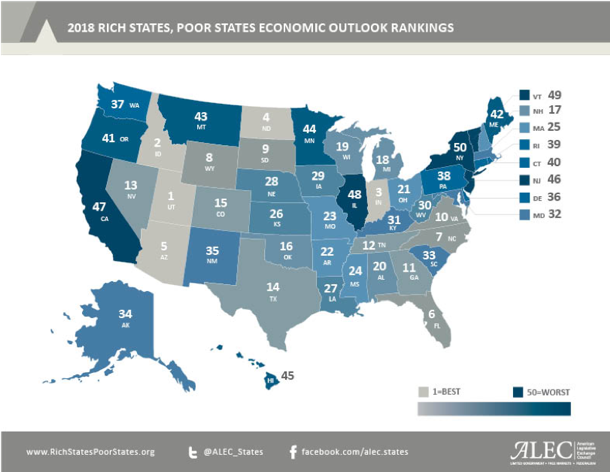
Trenton NJ, Americans for Prosperity-New Jersey (AFP-NJ) on Tuesday responded to a report released by the American Legislative Exchange Council (ALEC) that ranks New Jersey as having the fifth-worst economic outlook in the country. The 11th Edition of Rich States, Poor States: ALEC-Laffer State Economic Competitiveness Index ranks every states’ economic outlook based on fifteen policy variables like tax rates and labor policies; New Jersey is ranked 46.
“This report reaffirms what we’re reminded of every Tax Day – New Jersey residents are taxed too much and have nothing to show for it except an economy in dire straits with one of the highest out-migrations in the country,” said AFP-NJ State Director Erica Jedynak, who also serves as ALEC’s Private Sector Chair for the Garden State. “The economic situation will only worsen as more beleaguered New Jersey families scramble for the exit. If state and local leaders hope to reverse these trends we must begin to implement policies that provide tax relief and expand worker freedoms.”
“As states compete with each other for much-needed human and financial capital, there is generally a clear trend in favor of taxpayer-friendly, market-oriented reforms across the United States,” said Jonathan Williams, Chief Economist and Vice President for the Center for State Fiscal Reform at ALEC. “Unfortunately for the hardworking taxpayers of New Jersey, the Garden State is once again heading in the wrong direction with the discussion of tax increases. The new rankings show New Jersey is stuck in the bottom five in economic outlook because of high taxes, overwhelming government regulation and cronyism.”
“New Jersey’s poor ranking was well earned and is much deserved. It continues to tax and spend itself into obscurity,” said Senator Joe Pennacchio, who also serves as ALEC’s Public Sector Chair for New Jersey. “Governor Murphy’s first budget raises taxes 2 billion dollars and increased spending by 8 percent. People are fleeing our State leaving behind their families and communities. Whoever is left must shoulder an even higher tax burden. Not fair.”
Arlington VA , The American Legislative Exchange Council (ALEC) today released the much anticipated 2018 edition of Rich States, Poor States. Utah again earns the top spot for states with the best economic outlook, followed by Idaho, Indiana, North Dakota and Arizona. Several states’ success in increased rankings can be tied directly to the success of federal tax reform and the resources it gave to lawmakers to cut taxes at the state level.
The 11th edition of Rich States, Poor States is characterized by great movement in state economic performance and outlook as a result of federal tax reform and the resulting actions of certain states.
Biggest movement in rankings:
Biggest Gainers
Spots Gained
Biggest Losers
Spots Fell
Idaho
8
Tennessee
7
Georgia
6
South Carolina
6
Connecticut
6
Pennsylvania
5
Nebraska
4
Texas
5
Arizona
3
Illinois
6
The 15 economic policy variables used by the authors—top economist Jonathan Williams, White House Advisors Art Laffer and Stephen Moore—to rank the economic outlook of states have shown over time to be among the most influential variables for state growth. The top ten and bottom ten states for 2018 are:
Overall Economic Outlook for 2018
Top Ten
Bottom Ten
1. Utah
2. Idaho
3. Indiana
4. North Dakota
5. Arizona
6. Florida
7. North Carolina
8. Wyoming
9. South Dakota
10. Virginia
41. Oregon
42. Maine
43. Montana
44. Minnesota
45. Hawaii
46. New Jersey
47. California
48. Illinois
49. Vermont
50. New York
“The untold story of federal tax reform is its impact at the state level, where the vast majority of states are now enjoying unexpected revenue gains,” said Jonathan Williams, Chief Economist and Vice President of the ALEC Center for State Fiscal Reform. “This trend is empowering additional pro-growth tax reform efforts that will provide an added level of benefits for hard-working taxpayers. As states compete with each other for much-needed human and financial capital, there is a clear trend in favor of taxpayer-friendly, market-oriented reforms.”
“The shakeup in rankings is exciting and a testament to how states are always competing to offer the most pro-growth tax climate. When states compete on the merits of good public policy, ultimately the taxpayer ends up being the real winner,” said North Carolina State Rep. and National Chairman Jason Saine.
In the past five years alone, 30 states have significantly reduced their tax burdens. Those that fail to adapt to this competitive environment can fall behind by simply standing still. The facts remain clear that pro-growth policies are working and there is a clear trend in favor of market-oriented reforms.
Rich States, Poor States examines the latest trends in state economic growth. The data ranks the 2018 economic outlook of states using 15 equally weighted policy variables, including various tax rates, regulatory burdens and labor policies. The11th edition examines trends over the last few decades that have helped or hurt states’ economies.
Used by state lawmakers across America since 2008, Rich States, Poor States: ALEC-Laffer State Economic Competitiveness Index, is authored by White House Advisor and economist Dr. Arthur B. Laffer, White House Advisor and Economist Stephen Moore, and Jonathan Williams, Vice President of the American Legislative Exchange Council Center for State Fiscal Reform.
To download a copy of Rich States, Poor States and to see individual state data, visitrichstatespoorstates.org
New Jersey is currently ranked 49th in the United States for its economic performance. This rank is a backward-looking measure based on the state’s performance (equal-weighted average) in three important performance variables shown below. These variables are highly influenced by state policy.
Florham Park NJ, in what looks like the first of many, baby food giant Gerber food said Monday that it will be closing its headquarters in Florham Park and moving to Arlington, Virginia, beginning the transition in January 2019.
Gerber will move operations to the same building as its sister company Nestle USA, which also recently relocated to the Washington D.C. area, the company said in a statement.
This leaves close to 180 New Jerseyans will be out of a job mostly in corporate positions such as marketing, finance and HR. The company will offer a chance to relocate, as well as severance and outpatient support for those that can’t make the move.
A congratulations to Governor Murphy , who’s policies seem destine to produce the final mass exodus of companies and labor from the state of New Jersey.