Good luck – this hurts union jobs and so those thugs and their toadies in Trenton will say anything and everything to oppose municipal consolidation. Home rule allows for about 70% more police than we actually need, etc. But the unions lackeys will lie till their Pinocchio noses reach Pennsylvania telling us all how our safety is at risk without home rule. Look at Waldwick, Ho-Ho-Kus, Ridgewood, Glen rock and Midland Park: one police dept with one chief would suffice, but instead we have five chiefs and top heavy brass. Great for the unions, outright theft of taxpayers. It’s blue collar crime.
Yesterday’s dismissal of the Newark ‘LIFO’ case and recent decisions continue to show how the court is a force in education in Garden State
Superior Court Judge Mary Jacobson.
For all the attention on the State House in driving education policy, New Jersey’s courts yesterday continued to show their long and storied influence on some of the hottest public school issues.
In the more prominent case, state Superior Court Judge Mary Jacobson abruptly dismissed a closely watched lawsuit contesting the state’s infamous teacher seniority rules.
In a clear win for the teachers unions and a blow to the school-reform movement and the Christie administration, Jacobson spoke from the bench, saying the plaintiffs — a half-dozen Newark families, with the help of a national advocacy group — had not proven the “last in, first out” policy had harmed their children.
“I am not disputing the importance of teacher effectiveness in the classroom, but the complaint is completely devoid of facts,” Jacobson said in a lengthy and sternly worded opinion.
Senate President Steve Sweeney drew a line in the sand over school funding on Tuesday, saying his house would only pass a budget that shifts state dollars to underfunded urban and suburban districts this year.
Gov. Chris Christie has drafted a $35.5 billion spending plan for fiscal 2018 — $13.8 billion of which would go to schools — and lawmakers are reviewing his plan before the July 1 deadline to enact the budget.
Paying for the past instead of investing for the future? Explains much of why NJ’s economy is in the toilet. Will.be an interesting test case on what to do as the state spirals down into oblivion. New legislation will be needed to resolve the liabilities, many of the needed federal & state laws haven’t been written yet, but states like NJ and Illinois will provide the necessary precedents. Current employees certainly won’t have it as good as current retirees, which is why some posters above are defending paying for the past and ignoring investment in the future. This is generational warfare, and the retiring baby boomers are winning, big time
…this has been a problem for almost 4 decades. I wish there was a magic solution. Sen Moynihan was trying to figure this out and commented how convoluted and arcane the process was. I would think holding our washington reps accountable and stop re-electing them unless they work to divert more money home would be a start. Our current congressman mentioned this in his campaign and is working to get some more money home…. the other part is home rule, which is our problem to fix. No one wants to regionalize so we have 500 plus municipalities of overlapping services. Yes the pension system needs to be fixed but people have to make our reps accountable, which except in rare instances like our district, is not happening today.
By Samantha Marcus | NJ Advance Media for NJ.com
on April 20, 2017 at 6:14 PM, updated April 21, 2017 at 8:14 AM
TRENTON — Another study has found New Jersey’s public pension system is in the worst shape of any state in the nation.
The state’s pension woes helped boost how much money public pension systems across the U.S. have on hand versus how much they need to pay for future benefits to $1.1 trillion in 2015, the Pew Charitable Trusts said in its annual accounting of nationwide pension debts.
The figure, known as the unfunded liability, may hit $1.3 trillion in 2016, once the complete data for all 230 public-sector retirement plans becomes available, the study, released Thursday, found.
“Investment returns that fell short of expectations proved to be the largest contributor to the worsening fiscal position, with median overall returns of 3.6 percent,” Pew’s researchers said.
Pension plans in the 50 states added $157 billion in new unfunded liabilities from 2014 to 2015, though much of the increase was driven by the notoriously unstable pension funds in just five states — New Jersey, Illinois, Kentucky, Pennsylvania and Connecticut.
From 2014 to 2015, the year Pew reviewed, New Jersey’s pension debt rose from $113.1 billion to $135.7 billion.
The Garden State held enough assets to cover just 37.5 percent of its liabilities in 2015, enough to earn the title of worst-funded in the U.S.
It’s the second report putting New Jersey at the bottom. A Bloomberg study did the same in November. In 2014, New Jersey was No. 48 in the Pew study, with Kentucky and Illinois in worse shape.
Complexity and confusion about the law may have discouraged contractors from contributing directly to candidates and parties last year
For more than a decade, New Jersey’s pay-to-play laws have provided a check on businesses’ ability to contribute money to politicians in the hope of getting a government contract in return.
Last year, political contributions by public contractors dropped to the second-lowest level since restrictions took effect, according to a report released by the New Jersey Election Law Enforcement Commission earlier this month. The $8.1 million in contributions from businesses was 11 percent lower than in 2015 and less than half the high of $16.4 million reported in 2007.
Jeff Brindle, ELEC’s executive director, said the lack of gubernatorial or legislative elections in 2016 may account for some of the decline, but the complexity of the law is also discouraging contractors from contributing directly to candidates and parties.
Under pay-to-play laws, all businesses that have $50,000 or more in public contracts and have made political contributions must disclose both contract and contribution details to ELEC by March 30th of the previous year. There are some exceptions, but most firms with state contracts totaling $17,500 or more cannot give more than $300 to candidates, political parties, and legislative leadership committees. A business that violates the prohibitions must either ask for a refund of any excess contribution promptly or relinquish its contracts for four years.
Sick pay is for those who get sick. If you don’t get sick, you shouldn’t get sick pay. Period.
The same goes for all fringe benefits. If you’re not disabled, you don’t get disability. If you’re not unemployed, you don’t get unemployment. This is not complicated.
Until you put politics into the mix.
New Jersey, the state with the highest property taxes in the nation, still allows public workers to collect big payouts for their unused absences. It’s a perk unheard of in the private sector, but we’re all paying dearly for it.
By S.P. Sullivan | NJ Advance Media for NJ.com
on April 14, 2017 at 10:23 AM, updated April 14, 2017 at 4:51 PM
TRENTON — The New Jersey State Police does not have to reimburse state troopers for toll fares during their commute to and from work, an appeals court has ruled in a dispute between the state and the troopers’ union.
The two-judge panel found on Thursday that an arbitrator was mistaken in declaring the practice “an established term and condition of employment.”
For years, the operators of the state’s major toll roads, the New Jersey
Turnpike Authority and the South Jersey Transportation Authority, allowed troopers and other state employees to pass through their toll booths in personal vehicles free of charge.
But in 2010, Gov. Chris Christie called for an end to free rides for non-emergency vehicles. Soon after, a report from the state comptroller also flagged the practice in a report identifying $43 million in waste within the Turnpike Authority.
Senate President rejects Republican senator’s claim that new commission could politicize how projects are selected
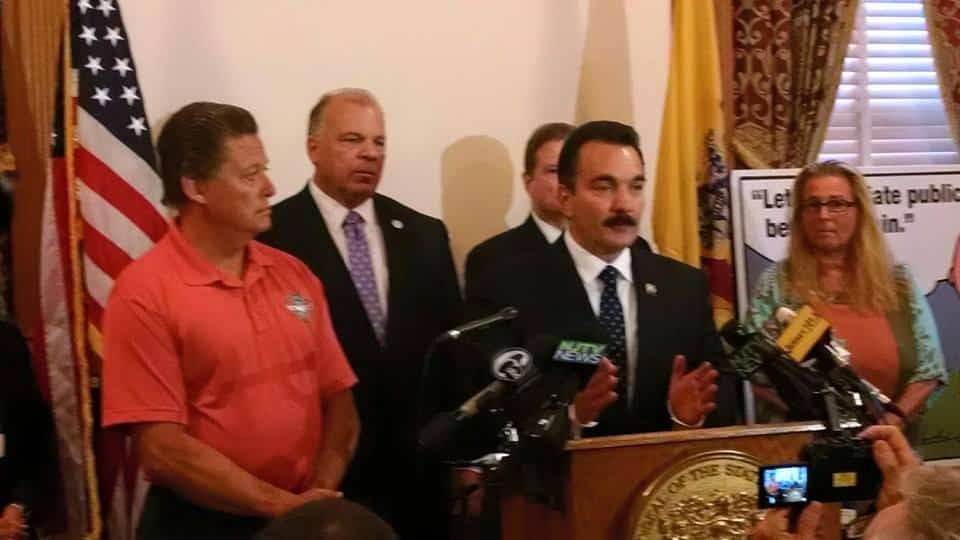
Senate President Stephen Sweeney speaks during a news conference in Linden yesterday to announce state funding for a long-planned road project.
After last year’s renewal of the Transportation Trust Fund, there’s now $2 billion in state dollars to spend on infrastructure improvements every year in New Jersey. But that has also raised the question of exactly who decides which projects deserve top priority — the governor and his administration’s transportation officials or a special four-person commission that’s been championed by lawmakers?
A measure that’s expected to make it out of the Legislature in the coming weeks will ensure the new capital-project approval commission has the final say, though not until a year from now.
The passage of what’s being called the “TTF cleanup bill” will also make sure that a planned $2 billion in spending on infrastructure improvements during the state fiscal year that begins in early July can go forward even though the new commission has yet to be assembled.
And despite complaints from some lawmakers that the new commission could politicize New Jersey’s transportation-funding process and even be unconstitutional, Senate President Stephen Sweeney (D-Gloucester) said he remains committed to establishing the new format. He also disputed claims that the new selection method could be unconstitutional.
By Samantha Marcus | NJ Advance Media for NJ.com
on April 13, 2017 at 8:15 AM, updated April 13, 2017 at 8:51 AM
TRENTON — State-run government pension funds spent $10 billion on fees and performance bonuses in 2014 to private managers of their alternative investments, a strategy that has stirred controversy in New Jersey.
The report from the Pew Charitable Trusts found that the 73 largest state and local public pension funds invested about half their assets in stocks, a quarter in bonds and cash, and a quarter in such alternative investments as hedge funds, real estate and private equity.
New Jersey’s portfolio at the time varied only slightly from that typical makeup, with 45 percent of its assets in equities, 28 percent in fixed income and 27 percent in alternatives.
Two of the 73 funds didn’t invest in alternatives, while 21 had at least 30 percent of their assets invested in them and five had at least 40 percent invested.
By Susan K. Livio | NJ Advance Media for NJ.com
on April 07, 2017 at 6:08 PM, updated April 07, 2017 at 8:32 PM
CWA Local 1039 President Lionel Leach stepped down Thursday union officials pursue an internal investigation into possible missing funds. (CWA 1039)
TRENTON — The president of a local chapter of the Communications Workers of America has stepped aside amid an investigation into the disappearance of money from the local’s coffers, a union representative confirmed Friday.
CWA spokesman Joshua Henne confirmed the local’s President Lionel Leach has stepped aside while the investigation continues.
“Recently, Executive Board members of CWA Local 1039 — one of CWA’s 30 local unions in New Jersey — notified the national union of allegations regarding the mismanagement of that local. CWA takes any allegation made by members very seriously,” Henne said in a statement.
Sick pay is for when you’re sick. If you’re not sick, and you don’t use it, you lose it.
This is the simple policy fix to one of New Jersey’s most maddening problems. Yet, again and again, we have failed to write it into law.
There is no justifiable reason. Sick pay is supposed to protect you from losing income when you’re ill – not amount to a kingly entitlement bonus. You don’t deserve a six-figure payout just for being healthy.
Jersey lawmakers just don’t get it: The state’s massive pension-fund shortfalls last week prompted Moody’s to downgrade Trenton’s credit rating for the 11th time under Gov. Chris Christie, yet the Legislature wants to make the problems worse.
Moody’s cited New Jersey’s gargantuan, and growing, unfunded pension liabilities as key to its decision to lower the state’s rating from A2 to A3 — the second downgrade in four months.
The move reflects the “negative impact of significant pension underfunding” and “a persistent structural imbalance,” wrote Moody’s analyst Baye Larsen. Despite Christie’s notable boosts in payments to the funds, state contributions “remain well below the actuarial recommended” amount.
Yet lawmakers (of both parties) want Christie to sign a bill that would hand control of one of the state’s biggest funds — for police and firefighter pensions — to their union representatives.
“Giving management to the pension beneficiaries removes political interest from the investments and places responsibility with the employees who will benefit,” says Senate President Stephen Sweeney (D).
Uh, not quite — because the employees wouldn’t face any risk. With a majority of votes on the new board, union reps could hike benefits and slice the amount members must chip in. And if that plunges the fund further underwater, Jersey’s taxpayers would be the ones on the hook.