Master of Arts, University of Edinburgh; Doctorate of Divinity, University of St. Andrews. (Clergyman, Author, Educator)
Work:
President of College of New Jersey, 1768-1792; Delegate to the Continental Congress, 1776-1782; Twice elected to State Legislature of New Jersey.
Died:
November 15, 1794
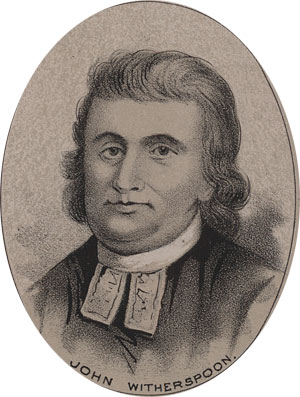
John Witherspoon brought some impressive credentials and a measure of public acclaim with him when he joined the colonies in 1768, as president of the College of New Jersey (now Princeton). Born in 1723, he received the finest education available to a bright young gentleman of that era. John attended the preparatory school in Haddington Scotland. He proceeded to Edinburgh where he attained a Master of Arts, then to four years of divinity school. At this point he was twenty. In 1743 he became a Presbyterian Minister at a parish in Beith, where he married, authored three noted works on theology. He was later awarded a Doctorate of Divinity from the University of St. Andrews, in recognition of his theological skills. It was only through a protracted effort on the part of several eminent Americans, including Richard Stockton and Benjamin Rush, that the colonies were able to acquire his service. In colonial American, the best educated men were often found in the clergy. The College of New Jersey needed a first rate scholar to serve as its first president. Witherspoon was at first unable to accept the offer, due to his wife’s great fear of crossing the sea. She later had second thoughts, and a visit from the charming Dr. Rush secured the deal. He emigrated to New Jersey in 1768. Dr. Witherspoon enjoyed great success at the College of New Jersey. He turned it into a very successful institution, and was a very popular man as a result. He also wrote frequent essays on subjects of interest to the colonies. While he at first abstained from political concerns, he came to support the revolutionary cause, accepting appointment to the committees of correspondence and safety in early 1776. Later that year he was elected to the Continental Congress in time to vote for R. H. Lee’s Resolution for Independence. He voted in favor, and shortly after voted for the Declaration of Independence. He made a notable comment on that occasion; in reply to another member who argued that the country was not yet ripe for such a declaration, that in his opinion it “was not only ripe for the measure, but in danger of rotting for the want of it.” Whitherspoon was a very active member of congress, serving on more than a hundred committees through his tenure and debating frequently on the floor. In November, 1776, he shut down and then evacuated the College of New Jersey at the approach of British forces. The British occupied the area and did much damage to the college, nearly destroyed it. Following the war, Witherspoon devoted his life to rebuilding the College. He also served twice in the state legislature. In the last years of life he suffered injuries, first to one eye then the other, becoming totally blind two years before his death. He died on his farm, “Tusculum,” just outside of Princeton in November of 1794, a man much honored and beloved by his adopted countrymen.
by Ole Erekson, Engraver, c1876, Library of Congress
Born:
1713
Birthplace:
Hopewell, New Jersey
Education:
(Farmer)
Work:
Member of the New Jersey Assembly, 1761-1771; Served on the Committee of Safety, Committee of Correspondence, 1775; Judge of the Court of Common Pleas, Member of Provincial Assembly 1775; Elected to the Continental Congress, 1776.
Died:
May 11, 1779
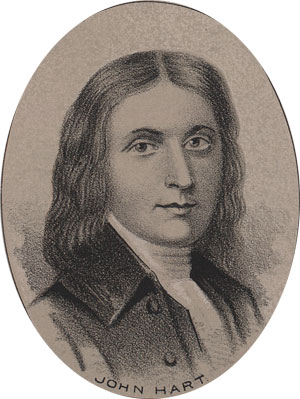
John Hart was a New Jersey farmer. His exact date of birth is not known. His father had moved from Connecticut to a farm near Hopewell New Jersey. He helped to build, and later inherited, that very successful farm and was a leading member of his community. His first public service was a justice of the peace. In 1761 he was elected the New Jersey Assembly, there annually reelected until the assembly was dissolved in 1771. In 1775 he was appointed to the local Committee of Safety, the Committee of Correspondence, and a judge to the Court of Common Pleas. He was elected to the newly formed Provincial Congress of New Jersey in 1776, and sent as a delegate for New Jersey to the Continental Congress that year. Hart’s property was looted in the course of the war. His Wife died on October 8, 1776. When the area was overrun by the British in November of that year, he was forced to hide for a time. He was engaged in public service throughout the war, twice reelected to the Congress and also serving the Commitee of Safety and as Speaker of the New Jersey assembly. On June 22nd 1778 he invited the American army to encamp on his farm. Washington had lunch with him, then had his famous Council of War at the nearby Hunt House. Twelve thousand men camped on his fields-during the growing season. After resting and preparing for battle the troops left on the 24th. On Tuesday, May 11th 1779, he died at the age of 66.
by Ole Erekson, Engraver, c1876, Library of CongressBorn: February 15, 1725 Birthplace: Elizabethtown, New Jersey Education: Self-taught, Surveying, Law (Surveyor, Lawyer, Sheriff) Work: Land attorney; High Sheriff of Essex County, NJ.; Member of New Jersey Provincial Congress; Elected to the Continental Congress, 1776 ~1784. Died: September 15, 1794
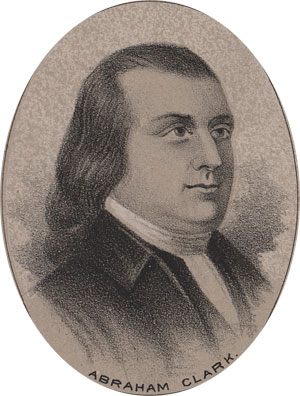
Abraham Clark was born into the life of a farmer at what is now Elizabeth, New Jersey. His father saw an aptitude for mathematics and felt that he was too frail for the farm life and so young Abraham was tutored in mathematics and surveying. He continued his own study of the Law while working as a surveyor. He later practiced as an attorney and in this role is said to have been quite popular because of his habit of serving poor farmers in the community in cases dealing with title disputes. In succeeding years he served as the clerk of the Provincial Assembly, High Sheriff of Essex (now divided into Essex and Union) County. Elected to the Provincial Congress in 1775, he then represented New Jersey at the Second Continental Congress in 1776, where he signed the Declaration of Independence. He served in the congress through the Revolutionary War as a member of the committee of Public Safety. He retired and was unable to attend the Federal Constitutional Convention in 1787, however he is said to have been active in community politics until his death in 1794. Clark Township, New Jersey, is named in his honor.
by Ole Erekson, Engraver, c1876, Library of CongressBorn: September 21, 1737 Birthplace: Philadelphia, Pennsylvania Education: Graduate of the College of Philadelphia (Lawyer, Judge, Author) Work: Delegate to the Continental Congress, 1776; Judge of admiralty for Pennsylvania, 1780; Appointed Judge to the US Court for the District of Pennsylvania, 1790 Died: May 9, 1791
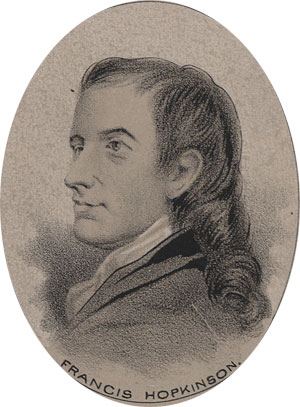
Francis Hopkinson was a man of extraordinary talent and charm. Born into a family of substance in Philadelphia, he was the first scholar and first Graduate of the College of Philadelphia, which his father, along with good friend Benjamin Franklin, played a role in chartering. He studied Law in the office of Benjamin Chew (later, Chief Justice of Pennsylvania) and then continued his education in England, two years study with the Bishop of Worcester. He was a writer of music, poetry and satire. His notable works include “A Pretty Story,” a skeptical examination of the relationship between Great Britain and the colonies, and “Battle of the Kegs,” a satiric taunting of the British. Hopkinson claimed credit for designing the American flag, but the evidence for his claim is not clear. Hopkinson was elected a delegate to the Continental Congress in 1776, where he signed the Declaration. After the War he was an active advocate, in speaking and in writing, for the New Federal constitution. He was commissioned a Judge of Admiralty in Pennsylvania in 1780, and Washington appointed him Federal District Judge for his native state in 1790. He died very suddenly of a missive epileptic seizure in 1791, at the still young age of 53.
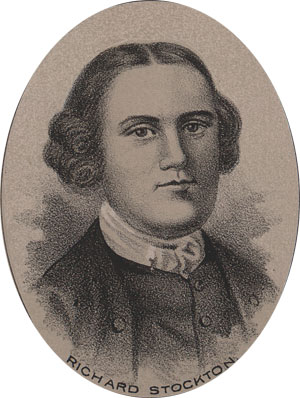
by Ole Erekson, Engraver, c1876, Library of CongressBorn: October 1, 1730 Birthplace: Near Princeton, N.J. Education: West Nottingham Academy, Graduate of College of New Jersey. (Lawyer) Work: Justice of the Supreme Court of New Jersey, 1774; Elected to Continental Congress, 1776 Died: February 28, 1781
Richard Stockton was born near Princeton, on October 1, 1730. He attended the West Nottingham Academy under Dr. Samuel Finley, and then earned his degree at the College of New Jersey (Now Princeton) in 1748. He studied law with David Ogden of Newark. Stockton became an eminent Lawyer with one of the largest practices in the colonies. He was not much concerned with politics, but applied his talents and person to the revolutionary cause when the day came. He was appointed to the royal council of New Jersey in 1765 and remained a member until the government was reformed. He was a moderate with regard to Colonial autonomy. He argued that the colonies should be represented in the Parliament. With the passage of the Stamp Act, such arguments were overcome by colonial backlash. In 1774 he was appointed Justice of the Supreme Court of New Jersey. In 1776, the New Jersey delegates to the Congress were holding out against Independence. When news of this reached the constituents, New Jersey elected Richard Stockton and Dr. Witherspoon to replace two of the five New Jersey delegates. They were sent with instructions to vote for Independence. Accounts indicate that, despite clear instruction, Justice Stockton wished to hear the arguments on either side of the issue. Once he was satisfied, the New Jersey delegates voted for Independence.
Stockton was appointed to committees supporting the war effort. He was dispatched on a fact finding tour to the northern army. New Jersey was overrun by the British in November of ’76, when he was returning from the mission. He managed to move his family to safety, but was captured and imprisoned by the British. He was not released until several years later, badly treated and in very poor condition. He lost all of his extensive library, writings, and all of his property during the British invasion. He died a pauper in Princeton at the age of 51. https://www.ushistory.org/DECLARATION/signers/stockton.htm
Virginia House of Burgesses, Representing Virginia at the Continental Congress
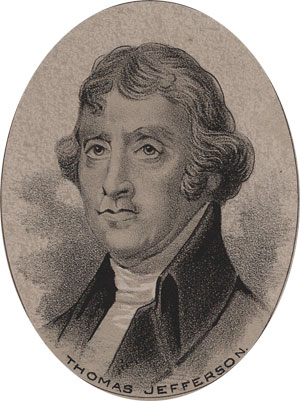
by Ole Erekson, Engraver, c1876, Library of CongressBorn: April 13, 1743 Birthplace: Shadwell, Virginia Education: William and Mary College (Lawyer) Work: Admitted to Virginia bar, 1767; Elected to Virginia House of Burgesses, 1769; Delegate to the Continental Congress, 1775-76; Virginia House of Delegates, 1776-79; Elected Governor of Virginia, 1779, 1780; Dispatched to England to treat for peace with Gr. Britain, 1782; Associate Envoy to France, 1784; Minister to the French Court, 1785; Secretary of State, 1789; Established Democratic-Republican party, 1793; Vice President of the United States, 1796; President, 1801; Established University of Virginia, 1810. Died: July 4, 1826
More than a mere renaissance man, Jefferson may actually have been a new kind of man. He was fluent in five languages and able to read two others. He wrote, over the course of his life, over sixteen thousand letters. He was acquainted with nearly every influential person in America, and a great many in Europe as well. He was a lawyer, agronomist, musician, scientist, philosopher, author, architect, inventor, and statesman. Though he never set foot outside of the American continent before adulthood, he acquired an education that rivaled the finest to be attained in Europe. He was clearly the foremost American son of the Enlightenment.
Jefferson was born at Shadwell in Albemarle county, Virginia on April 13, 1743. He was tutored by the Reverend James Maury, a learned man, in the finest classical tradition. He began the study of Latin, Greek, and French at the age of 9. He attended William and Mary College in Williamsburg at sixteen years old, then continued his education in the Law under George Wythe, the first professor of law in America (who later would sign Jefferson’s Declaration in 1776). Thomas Jefferson attended the House of Burgesses as a student in 1765 when he witnessed Patrick Henry’s defiant stand against the Stamp Act. He gained the Virginia bar and began practice in 1769, and was elected to the House of Burgesses in 1769. It was there that his involvement in revolutionary politics began. He was never a very vocal member, but his writing, his quiet work in committee, and his ability to distill large volumes of information to essence, made him an invaluable member in any deliberative body.
In 1775 when a Virginia convention selected delegates to the Continental Congress, Jefferson was selected as an alternate. It was expected that Payton Randolph, (then Speaker of the Virginia House and president of the Continental Congress too,) would be recalled by the Royal Governor. This did happen and Jefferson went in his place. Thomas Jefferson had a theory about self governance and the rights of people who established habitat in new lands. Before attending the Congress in Philadelphia he codified these thoughts in an article called A Summary View of the Rights of British America. This paper he sent on ahead of him. He fell ill on the road and was delayed for several days. By the time he arrived, his paper had been published as a pamphlet and sent throughout the colonies and on to England where Edmund Burke, sympathetic to the colonial condition, had it reprinted and circulated widely. In 1776 Jefferson, then a member of the committee to draft a declaration of independence, was chosen by the committee to write the draft. This he did, with some minor corrections from John Adams and an embellishment from Franklin, the document was offered to the Congress on the first day of July. The congress modified it somewhat, abbreviating certain wording and removing points that were outside of general agreement. The Declaration was adopted on the Fourth of July.
Jefferson returned to his home not long afterward. His wife and two of his children were very ill, he was tired of being remote from his home, and he was anxious about the development of a new government for his native state.
In June of 1779 he succeeded Patrick Henry as Governor of Virginia. The nation was still at war, and the southern colonies were under heavy attack. Jefferson’s Governorship was clouded with hesitation. He himself concluded that the state would be better served by a military man. He declined re-election after his first term and was succeeded by General Nelson of Yorktown.
In 1781 he retired to Monticello, the estate he inherited, to write, work on improved agriculture, and attend his wife. It was during this time that he wrote Notes on the State of Virginia, a work that he never completed. Martha Jefferson died in September of 1782. This event threw Jefferson into a depression that, according to his eldest daughter he might never have recovered from. Except that Washington called on him in November of 1782 to again serve his country as Minister Plenipotentiary to negotiate peace with Gr. Britain. He accepted the post, however it was aborted when the peace was secured before he could sail from Philadelphia.
In 1784 Jefferson went to France as an associate Diplomat with Franklin and Adams. It was in that year that wrote an article establishing the standard weights, measures, and currency units for the United States. He succeeded Franklin as Minister to France the following year. When he returned home in 1789, he joined the Continental Congress for a while, and was then appointed Secretary of State under George Washington. This placed him in a very difficult position. The character of the executive was being established during the first few terms. Jefferson and many others were critical of the form it was taking under the first Federalist administration. Jefferson was sharply at odds with fellow cabinet members John Adams and Alexander Hamilton, both of whom he found to be too authoritarian and too quick to assume overwhelming power for the part of the executive. He resigned from the cabinet in 1793 and formed the Democrat-republican party. Heated competition continued. Jefferson ran for president in 1796, lost to John Adams, and, most uncomfortably, this made him vice president under a man whom he could no longer abide. After a single meeting, on the street, the two never communicated directly during the whole administration.
Jefferson again ran for the presidency in 1801 and this time he won. He served for two terms and he did ultimately play a deciding role in forming the character of the American Presidency. The 12th amendment to the Constitution changed the manner in which the vice president was selected, so as to prevent arch enemies from occupying the first and second positions of the executive. Jefferson also found the State of the Union address to be too magisterial when delivered in person. He performed one and afterwards delivered them, as required by the constitution, only in writing. He also undertook the Louisiana Purchase, extending the boundaries of the country and establishing the doctrine of manifest destiny.
Thomas Jefferson retired from office in 1808. He continued the private portion of his life’s work, and sometime later re-engaged his dearest and longest friend James Madison, in the work of establishing the University of Virginia. In 1815 one of his projects, a Library of Congress, finally bore fruit, when he sold his own personal library to the congress as a basis for the collection. Shortly before his death in 1826, Jefferson told Madison that he wished to be remembered for two things only; as the Author of the Declaration of Independence, and as the founder of the University of Virginia. Jefferson died on the 4th of July, as the nation celebrated the fiftieth anniversary of his splendid Declaration.
RIDGEWOOD INDEPENDENCE DAY CELEBRATION Ridgewood July 4th Committee Ridgewood will observe Independence Day on Monday, JULY 5th…this will be Ridgewood’s 100th Celebration! For up-to-date details go to https://www.ridgewoodjuly4th.org/
Fireworks Tickets for July 4th Celebration Celebration is on Monday, July 5
Ridgewood Fourth of July Celebration Evening Activities and Fireworks Tickets Monday, July 5th, 2010 Alternate Date – Tuesday, July 6th Veteran’s Field, Ridgewood, New Jersey July 4th in Ridgewood is a very special day that our entire area looks forward to all year.
In 2010, the Ridgewood Fourth of July Celebration Committee will sponsor its 100th anniversary with our flag raising, parade and fireworks. This year’s theme is “100 Years of Supporting the Tradition.” The committee is an all-volunteer community group that coordinates the day’s events and does not receive direct funding from the Village of Ridgewood. July 4th is a Sunday this year, but the national holiday is on Monday, July 5th. Therefore, our celebration will be on Monday, July 5th. We are actively preparing for what we know will be a spectacular 100th celebration, it is vital that we have community support. Please consider helping to “Support the Tradition”. Because of generous support from the community, we have one of the best small town Independence Day celebrations. While the Parade is free, Fireworks Tickets are required for entrance to Vet’s Field. Donations for Fireworks Tickets is one of the Celebration’s largest sources of income. Tickets to the Evening Entertainment and Fireworks will be on sale June 1 at the locations below. Buy your tickets in advance for $5.00 and save 50% off the gate price of $10.00.
1. Backyard Living- 235 Franklin Avenue, Ridgewood, 201-689-9111 2. Daily Treat- 177 E. Ridgewood Avenue, Ridgewood, 201-652-9113 3. Goffle Brook Farm- 425 Goffle Road, Ridgewood, 201-652-7540 4. Harding Wines and Spirits- 305 E. Ridgewood Avenue, Ridgewood, 201-445-7122 5. Herold’s Farm & Garden Center- 909 Prospect Street, Glen Rock, 201-445-0069 6. Hillman Electric- 133 E. Ridgewood Avenue, Ridgewood, 201-652-1045 7. Hogan’s Restaurant Diner- 20 Central Avenue, Midland Park, 201-445-2849 8. Hoskins Propane, 523 Goffle Road, Ridgewood, 201-444-1950 9. Irish Eyes- 1 Cottage Place, Ridgewood, 201-445-8585 10. JT’s Wines and Spirits- 607 N. Maple Avenue, Ho-Ho-Kus, 201-652-2220
>The Planning Board’s vote was improperly conducted and there should be an investigation, not only of the proceedings, but also of the “incentives” Board members most certainly received from Valley.
In his preamble, Nicholson claimed that all deliberations were based upon “fact” and “exhaustive testimony” from experts.
Here are just some of the “facts” cited by Board members:
“…8 out of 9 Ridgewood residents support the hospital…”
This is simply made up! I’d like to see documentation that proves otherwise.
“…the State mandates single-patient rooms for all NJ hospitals…”
This is a lie.
This horrible vote should be rescinded, and Board members investigated. Obviously they were “greased” three years ago. The meeting was a true farce, and an insult to Ridgewood taxpayers.
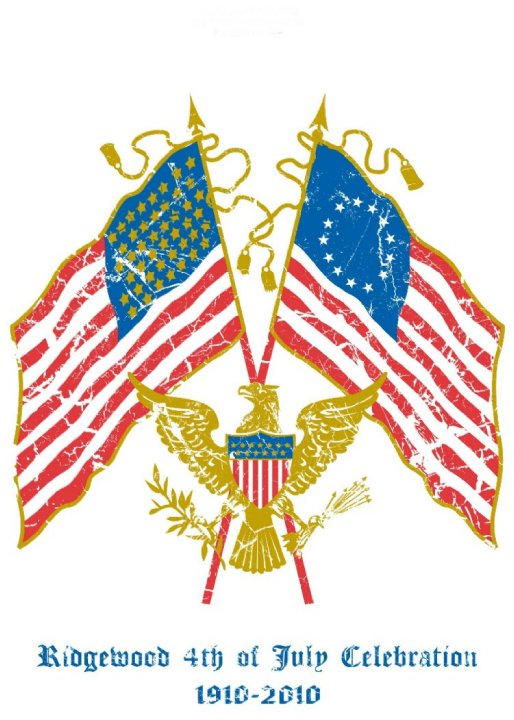
The Ridgewood Fourth of July Celebration is offering a special edition T-Shirt to commemorate it’s 100th anniversary. The shirts are imprinted with art work from the cover of the 1910 Ridgewood Independence Day program. These attractive T-Shirts also gain the wearer entrance to the 2010 Evening Entertainment and Fireworks. Proceeds from the sale of the shirts will help fund the 100th Ridgewood Fourth of July Celebration. The shirts can be purchased from our website, https://www.ridgewoodjuly4th.org/ .
>March 2, 2010, 6:35 pm Fuel Taxes Must Rise, Harvard Researchers Say By SINDYA N. BHANOO
To meet the ,Obama administration’s targets for cutting greenhouse gas emissions some researchers say, Americans may have to experience a sobering reality: gas at $7 a gallon.
To reduce carbon dioxide emissions in the transportation sector 14 percent from 2005 levels by 2020, the cost of driving must simply increase, according to a forthcoming report by researchers at Harvard’s Belfer Center for Science and International Affairs.
The 14 percent target was set in the Environmental Protection Agency’s budget for fiscal 2010.
In their study, the researchers devised several combinations of steps that United States policymakers might take in trying to address the heat-trapping emissions by the nation’s transportation sector, which consume 70 percent of the oil used in the United States.
Most of their models assumed an economy-wide carbon dioxide tax starting at $30 a ton in 2010 and escalating to $60 a ton in 2030. In some cases researchers also factored in tax credits for electric and hybrid vehicles, taxes on fuel or both.
Governor Christie’s vision of change for New Jersey could include freezing the salaries of teachers and other employees to make public education more affordable and effective.
A report prepared by Christie’s transition team members — one of 19 released by the governor on Friday –– takes on salary increases planned to start this June in “statewide contracts, as well as local district contracts.”
“If, absent a source of funds to pay these increases, the new administration must take action to freeze salaries for all public employees in FY 2011, that freeze should pertain as well to pre-K-12 employees at all levels,” the education report says.
It also recommends other cost-cutting efforts, as well major changes to existing education policy, including establishing merit pay for teachers and taking school budgets off the ballot if spending stays flat or rises only modestly.
MSNBC is reporting a change on the frequency of pap smears for 20-year-olds (emphasis added):
20-somethings can go 2 years between Paps
New guidelines say it’s enough to spot slow-growing cervical cancer
The Associated Press updated 6:23 a.m. CT, Fri., Nov . 20, 2009
WASHINGTON – Most women in their 20s can have a Pap smear every two years instead of annually, say new guidelines that conclude that’s enough to catch slow-growing cervical cancer.
The change by the American College of Obstetricians and Gynecologists comes amid a completely separate debate over when regular mammograms to detect breast cancer should begin. The timing of the Pap guidelines is coincidence, said ACOG, which began reviewing its recommendations in late 2007 and published the update Friday in the journal Obstetrics & Gynecology.
The guidelines also say:
– Routine Paps should start at age 21. Previously, ACOG had urged a first Pap either within three years of first sexual intercourse or at age 21. Women 30 and older should wait three years between Paps once they’ve had three consecutive clear tests. Other national guidelines have long recommended the three-year interval; ACOG had previously backed a two- to three-year wait.
– Women 30 and older should wait three years between Paps once they’ve had three consecutive clear tests. Other national guidelines have long recommended the three-year interval; ACOG had previously backed a two- to three-year wait.
– Women with HIV, other immune-weakening conditions or previous cervical abnormalities may need more frequent screening.
Paps can spot pre-cancerous changes in the cervix in time to prevent invasive cancer, and widespread use has halved cervical cancer rates in the U.S. in recent decades. About 11,270 new cases will be diagnosed this year, and about 4,070 women will die from it, according to American Cancer Society estimates. Half of women diagnosed with cervical cancer have never had a Pap, and another 10 percent haven’t had one in five years. … As someone who personally had a “bad” pap smear in her early 20’s and was fortunate enough to get treatment immediately, I worry about the adoption of this decision possibly leading to more incidences of cervical cancer that could have been prevented. Is this another example of health care rationing coming our way, should ObamaCare get shoved down our throats? Less quality health care for more money? Posted by KMacGinn at 7:28 AM Labels: health care, ObamaCare
> Mammography outcry points to trouble for healthcare reform
Some Republicans say the new recommendations are an example of ‘rationing’ that would take place under Obama’s plan to save money by basing treatment on experts’ advice. By Noam N. Levey
>War criminals should not get civilian trials nor receive US constitutional rights unless they are citizens.
Despite the obstructionist tactics used by the Left, the Bush administration should have moved to begin war tribunals faster.
Were I arguing for the defense, I don’t see how these guys can get a fair trial, especially being blocks from the scene of an American tragedy.
If it took four years to prosecute Zacarias Moussaoui. This circus will take years, cost tens of millions of dollars and give a forum to these bastards as they are paraded in and out of court. The families and friends of the 3,000 will be forced to relive this over and over.
This Obama Administration and AG Holder have set a catastrophic precedent for years to come.