
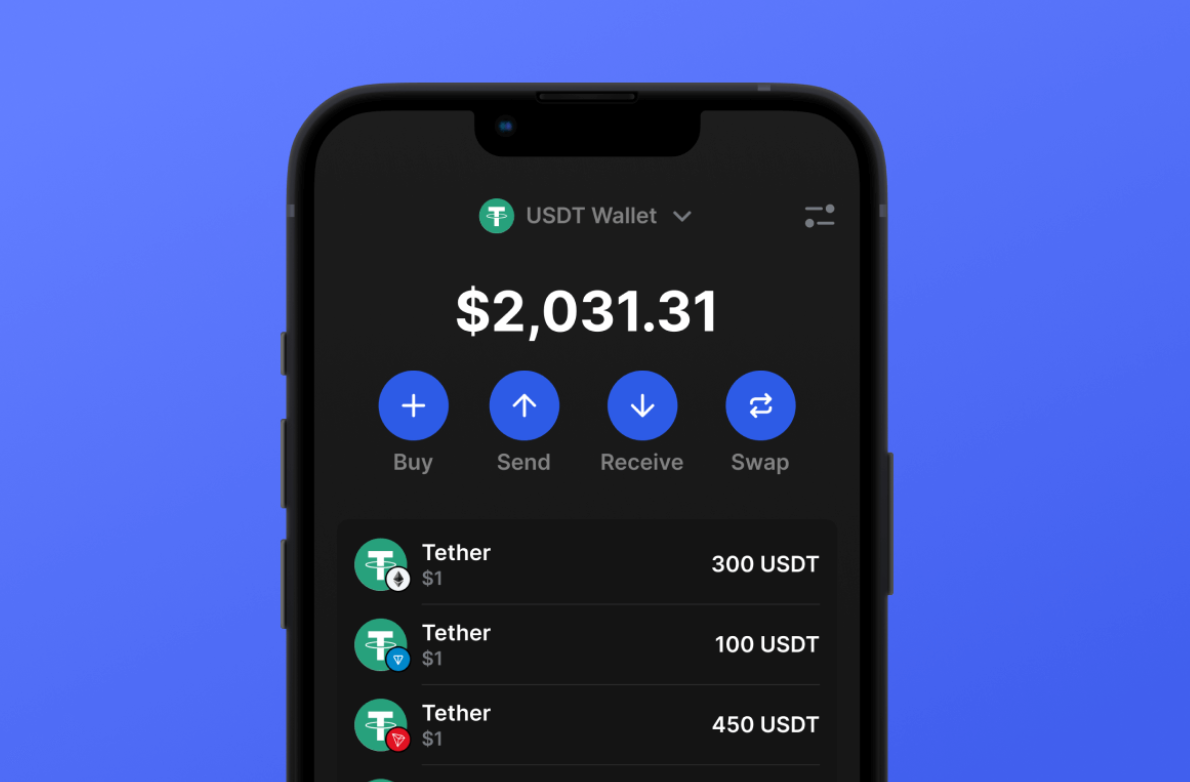
What is a USDT wallet?
A USDT wallet is a crypto wallet or platform account that allows users to store, receive, send and manage Tether USD, one of the most widely used stablecoins in the crypto market. If you are choosing a usdt wallet, the most important thing is not only whether the wallet supports USDT, but also which blockchain networks it supports, who controls the private keys and what fees apply when you send tokens.
USDT is available on multiple blockchain networks. This means that USDT on Ethereum, USDT on Tron and USDT on BNB Chain are not technically the same token inside the same network. They all aim to represent the same dollar-linked asset, but they move through different blockchains and require different addresses, fees and network rules.
That is why choosing a USDT wallet is not as simple as downloading any crypto app. A good wallet should support the network you need, show balances clearly, protect access to funds and reduce the risk of sending USDT to the wrong chain.
Quick answer
A USDT wallet is a wallet that supports Tether USD on one or more blockchain networks, such as Ethereum ERC-20, Tron TRC-20, BNB Chain BEP-20 or other supported networks. The best USDT wallet depends on your use case. For frequent transfers, users often prefer low-fee networks such as TRC-20. For DeFi, ERC-20 may be more useful. For long-term storage, a non-custodial or hardware wallet may be safer. For simple platform use, a custodial wallet or internal balance may be more convenient.
Key points in 30 seconds
- USDT is a stablecoin linked to the US dollar.
- A USDT wallet lets users store, receive and send Tether.
- USDT exists on different blockchain networks.
- ERC-20, TRC-20 and BEP-20 USDT are not interchangeable in one transfer.
- The sender and receiver must use the same network.
- TRC-20 is often used for cheaper USDT transfers.
- ERC-20 is common in Ethereum-based DeFi and exchange flows.
- A custodial wallet is easier, but the platform controls the keys.
- A non-custodial wallet gives more control, but the user must protect the seed phrase.
- A hardware wallet is often better for long-term storage.
- Always test large transfers with a small amount first.
- Never share your seed phrase or private key.
What is USDT?
USDT, also known as Tether USD, is a stablecoin designed to track the value of the US dollar. In normal market conditions, 1 USDT is intended to stay close to 1 USD.
People use USDT for:
- crypto trading;
- moving funds between exchanges;
- storing value inside the crypto market;
- cross-border transfers;
- P2P transactions;
- DeFi operations;
- payments;
- fast settlement between wallets.
USDT is popular because it combines the price logic of the US dollar with the speed and flexibility of blockchain transfers. But it is still a crypto asset, not a bank dollar. Users need a compatible wallet and the correct network to use it safely.
Why USDT wallets are different from Bitcoin wallets
A Bitcoin wallet stores and sends BTC on the Bitcoin network. A USDT wallet may support USDT on several different blockchains.
For example, USDT can exist as:
| USDT version | Network | Token standard |
| USDT ERC-20 | Ethereum | ERC-20 |
| USDT TRC-20 | Tron | TRC-20 |
| USDT BEP-20 | BNB Chain | BEP-20 |
| USDT on Solana | Solana | SPL token |
| USDT on Polygon | Polygon | ERC-20-compatible token |
This matters because sending USDT through the wrong network can cause delays, failed transfers or even loss of funds if the recipient does not support that network.
How a USDT wallet works
A USDT wallet works by giving the user access to an address on a blockchain network. That address can receive USDT if the token and network are supported.
A basic USDT transfer works like this:
- The sender opens a wallet or exchange account.
- The sender chooses USDT.
- The sender selects the correct network.
- The sender enters the recipient address.
- The wallet calculates the network fee.
- The transaction is submitted to the blockchain.
- The recipient sees the USDT after confirmation.
The critical step is network selection. If the recipient gives a TRC-20 address, the sender should use the Tron network. If the recipient gives an ERC-20 address, the sender should use Ethereum.
Custodial vs non-custodial USDT wallets
USDT wallets can be custodial or non-custodial.
| Wallet type | Who controls the keys? | Best for | Main risk |
| Custodial wallet | Platform or exchange | Beginners, trading, simple transfers | Platform risk |
| Non-custodial wallet | User | Self-custody and control | User mistakes |
| Hardware wallet | User, offline device | Long-term storage | Device and seed phrase management |
| Internal platform balance | Platform | Simple use inside one ecosystem | Limited external control |
A custodial wallet is convenient because the platform manages the technical side. But if the platform freezes withdrawals, has problems or is hacked, the user may lose access.
A non-custodial wallet gives more control, but it also gives more responsibility. If the user loses the seed phrase, sends to the wrong address or signs a malicious transaction, recovery may be impossible.
Hot wallets vs cold wallets
Another important distinction is hot wallet vs cold wallet.
| Wallet type | What it means | Pros | Cons |
| Hot wallet | Connected to the internet | Convenient for frequent use | Higher online risk |
| Cold wallet | Offline or hardware-based | Better for long-term storage | Less convenient |
| Exchange wallet | Managed by an exchange | Easy for trading | Custody risk |
| Mobile wallet | App on smartphone | Easy daily access | Phone security risk |
| Desktop wallet | App on computer | More control | Malware risk |
| Hardware wallet | Physical device | Stronger protection | Costs money and needs setup |
For daily transfers, a hot wallet may be enough. For larger USDT balances, cold storage or a hardware wallet may be safer.
Which networks can USDT use?
USDT is available on multiple networks. The exact networks supported depend on the wallet, exchange or platform.
Common USDT networks include:
| Network | Common use case | Key point |
| Ethereum ERC-20 | DeFi, exchanges, institutional flows | Wide support, but higher fees |
| Tron TRC-20 | Frequent transfers | Often cheaper and fast |
| BNB Chain BEP-20 | Low-cost transfers and apps | Requires BNB for gas |
| Polygon | Lower-cost EVM transfers | Requires MATIC for gas |
| Solana | Fast transfers | Requires SOL for fees |
| Avalanche | DeFi and EVM-compatible flows | Requires AVAX for gas |
The wallet must support both USDT and the chosen network. A wallet that supports ERC-20 USDT does not automatically support TRC-20 USDT.
ERC-20 vs TRC-20 USDT
ERC-20 and TRC-20 are two of the most common USDT formats.
| Feature | USDT ERC-20 | USDT TRC-20 |
| Network | Ethereum | Tron |
| Fee token | ETH | TRX |
| Common use | DeFi, exchanges, Ethereum apps | Fast and cheaper transfers |
| Fees | Often higher | Often lower |
| Address style | Usually starts with 0x | Usually starts with T |
| Compatibility | Ethereum ecosystem | Tron ecosystem |
TRC-20 is often popular for simple transfers because fees are usually lower. ERC-20 is common when users need Ethereum-based DeFi, exchanges or smart contract compatibility.
The best choice depends on the recipient, exchange, fees and intended use.
Why network selection matters
Network selection is one of the most important parts of using a USDT wallet.
If you send USDT on the wrong network, several things can happen:
- the transfer may fail;
- the recipient may not see funds;
- recovery may require exchange support;
- recovery may be impossible;
- fees may be lost;
- funds may be stuck.
Before every transfer, check:
- which network the sender is using;
- which network the recipient supports;
- whether the wallet address matches the selected network;
- what fee token is needed;
- whether the amount is correct;
- whether a test transfer is needed.
For large transfers, sending a small test amount first is a smart habit.
What fees apply to USDT transfers?
USDT transfer fees depend on the network.
For example:
| Network | Fee paid in | Typical logic |
| Ethereum | ETH | Can be expensive during congestion |
| Tron | TRX | Often cheaper for USDT transfers |
| BNB Chain | BNB | Usually lower than Ethereum |
| Polygon | MATIC | Usually low-cost |
| Solana | SOL | Usually low-cost |
The fee is not usually paid in USDT itself. It is paid in the native coin of the network. For example, to send USDT TRC-20, a wallet may need TRX. To send USDT ERC-20, it needs ETH.
This is a common beginner mistake: users may have USDT in a wallet but cannot send it because they do not have the native token for gas fees.
What should a good USDT wallet support?
A good USDT wallet should match the user’s needs.
Important features include:
| Feature | Why it matters |
| Network support | Must support the USDT chain you need |
| Clear address display | Reduces transfer mistakes |
| Fee visibility | Helps estimate cost before sending |
| Security settings | Protects access to funds |
| Backup options | Helps avoid loss of access |
| Transaction history | Useful for tracking and taxes |
| Multi-chain support | Useful for users with several networks |
| Hardware wallet support | Better for larger balances |
| Customer support | Important for custodial wallets |
| Reputation | Reduces platform and software risk |
The “best” USDT wallet is not the same for everyone. A trader, a long-term holder and a business may need different wallet types.
Best USDT wallet by use case
| Use case | Suitable wallet type |
| Beginner using small amounts | Custodial wallet or simple mobile wallet |
| Frequent transfers | Wallet with TRC-20 support |
| DeFi user | Non-custodial EVM wallet |
| Long-term storage | Hardware wallet |
| Exchange trading | Exchange wallet |
| Business payments | Platform or wallet with reporting and controls |
| Multi-chain user | Wallet with broad network support |
| Large balances | Hardware wallet plus strong backup process |
The right wallet depends on whether you value convenience, control, low fees or security most.
Exchange wallets for USDT
An exchange wallet is a custodial wallet inside a crypto exchange. It is convenient for buying, selling and trading USDT.
Pros:
- easy to use;
- good for beginners;
- supports trading;
- may support several USDT networks;
- simple deposit and withdrawal interface.
Cons:
- the exchange controls the private keys;
- withdrawals can be paused;
- accounts can be restricted;
- KYC may be required;
- platform risk exists.
Exchange wallets are useful for active trading but may not be ideal for storing large amounts long term.
Mobile USDT wallets
Mobile wallets are popular because they are easy to use from a smartphone.
Pros:
- convenient;
- fast access;
- good for daily transfers;
- often supports QR codes;
- easy balance checking.
Cons:
- phone can be lost or stolen;
- malware and phishing risks exist;
- seed phrase must be protected;
- users may approve malicious transactions.
A mobile wallet is useful for small and medium amounts, but security habits matter.
Hardware wallets for USDT
A hardware wallet stores private keys on a physical device. It is often used for long-term crypto storage.
Pros:
- private keys stay offline;
- stronger protection from online attacks;
- useful for larger balances;
- can support multiple networks.
Cons:
- costs money;
- requires careful setup;
- seed phrase backup is critical;
- less convenient for frequent transfers;
- not all networks may be supported equally.
For large USDT balances, hardware wallets are often safer than keeping funds on a phone or exchange.
Platform wallets and internal balances
Some platforms support USDT as an internal balance. This means users can hold and use USDT inside the platform’s own system rather than managing every blockchain detail directly.
This can be convenient for:
- simple storage;
- transfers inside the platform;
- mining payouts;
- payment flows;
- users who do not want to manage networks manually.
The trade-off is that internal balances are usually custodial. The platform controls the infrastructure, and the user depends on its rules, limits and withdrawal options.
How to create a USDT wallet
The exact process depends on wallet type, but the general steps are similar.
Step 1. Choose wallet type
Decide whether you need:
- exchange wallet;
- mobile wallet;
- desktop wallet;
- hardware wallet;
- platform wallet;
- multi-chain wallet.
Step 2. Check USDT network support
Make sure the wallet supports the USDT network you need.
For example:
- ERC-20 for Ethereum;
- TRC-20 for Tron;
- BEP-20 for BNB Chain;
- SPL for Solana;
- Polygon for Polygon.
Step 3. Set up security
Use:
- strong password;
- two-factor authentication where available;
- biometric protection if appropriate;
- backup phrase storage;
- anti-phishing checks.
Step 4. Save backup information
If the wallet is non-custodial, write down the seed phrase and store it offline. Do not save it in screenshots, cloud notes, email or messengers.
Step 5. Receive a small test transfer
Before sending a large amount, test the wallet with a small USDT transfer on the correct network.
How to receive USDT
To receive USDT:
- Open your wallet.
- Choose USDT.
- Select the correct network.
- Copy your deposit address.
- Send the address to the sender.
- Confirm that the sender selected the same network.
- Wait for confirmations.
Never send only the address without checking the network. Some wallets show separate deposit addresses for different networks.
How to send USDT
To send USDT:
- Open the wallet.
- Choose USDT.
- Select the correct network.
- Paste the recipient address.
- Enter the amount.
- Check the fee.
- Confirm the transaction.
- Save the transaction hash if needed.
Before confirming, check the address carefully. Crypto transactions are usually irreversible.
Common USDT wallet mistakes
Common mistakes include:
- Sending USDT on the wrong network.
- Choosing ERC-20 when the recipient needs TRC-20.
- Not having ETH, TRX, BNB or another gas token for fees.
- Using an unsupported wallet.
- Sending large amounts without a test transaction.
- Sharing a seed phrase.
- Saving private keys in cloud storage.
- Clicking phishing links.
- Keeping all funds on one exchange.
- Ignoring withdrawal limits.
- Not checking wallet reputation.
- Forgetting which network was used.
Most USDT losses happen because of simple operational mistakes, not because the stablecoin itself fails.
How to store USDT safely
Basic safety rules:
- use reputable wallets;
- enable 2FA on custodial platforms;
- never share your seed phrase;
- keep backups offline;
- verify wallet addresses;
- use the correct network;
- test large transfers with a small amount;
- avoid suspicious links;
- do not connect wallets to unknown websites;
- keep software updated;
- separate daily-use funds from long-term storage;
- consider a hardware wallet for large balances.
Security is not one action. It is a set of habits.
USDT wallet for beginners
For beginners, the easiest option is often a custodial exchange wallet or a simple mobile wallet. These tools hide some technical complexity and make sending and receiving USDT easier.
However, beginners should still understand:
- which network they are using;
- what fees apply;
- who controls the private keys;
- how to secure the account;
- what happens if the platform blocks withdrawals;
- how to avoid phishing.
Convenience is useful, but it should not replace basic crypto safety.
USDT wallet for long-term storage
For long-term storage, users usually need stronger security.
Better options may include:
- hardware wallet;
- non-custodial wallet with offline seed backup;
- separate wallet for savings;
- limited interaction with DeFi sites;
- small hot wallet for daily transfers;
- multisig setup for advanced users or businesses.
The main goal is to reduce online exposure. The more often a wallet connects to websites and signs transactions, the higher the risk.
USDT wallet for businesses
Businesses may need more than a normal personal wallet.
A business USDT wallet setup may require:
- role-based access;
- approval workflows;
- transaction limits;
- compliance checks;
- accounting exports;
- wallet monitoring;
- address whitelisting;
- reporting;
- audit logs;
- custody policies;
- separation between operating funds and reserves.
For businesses, wallet selection is not only about security. It is also about operations, accounting and compliance.
USDT wallet checklist
Before choosing a wallet, ask:
- Does it support USDT?
- Which USDT networks does it support?
- Do I need ERC-20, TRC-20, BEP-20 or another network?
- Who controls the private keys?
- What fees apply?
- Does the wallet show network clearly?
- Can I export transaction history?
- Is the wallet reputable?
- Is 2FA available?
- Is hardware wallet support needed?
- Can I recover access if I lose my device?
- Is customer support available?
- Do I need it for personal or business use?
A good wallet should match the user’s real behavior, not just look popular.
FAQ
What is a USDT wallet?
A USDT wallet is a crypto wallet or platform account that supports Tether USD and allows users to store, receive and send USDT on supported blockchain networks.
Which wallets support USDT?
Many exchanges, mobile wallets, desktop wallets, hardware wallets and platform wallets support USDT. The key is to check which USDT networks they support, such as ERC-20, TRC-20, BEP-20, Solana or Polygon.
What is the best USDT wallet?
There is no single best USDT wallet for everyone. For frequent transfers, a wallet with TRC-20 support may be convenient. For DeFi, ERC-20 support may matter more. For long-term storage, a hardware wallet is usually safer.
What is a USDT TRC-20 wallet?
A USDT TRC-20 wallet is a wallet that supports Tether on the Tron blockchain. It is commonly used for faster and lower-cost USDT transfers.
What is a USDT ERC-20 wallet?
A USDT ERC-20 wallet is a wallet that supports Tether on Ethereum. It is useful for Ethereum-based exchanges, DeFi apps and smart contract interactions.
Can I send USDT from TRC-20 to ERC-20?
Not directly as a normal wallet transfer. The sender and receiver must use the same network. To move between networks, users usually need an exchange, bridge or platform that supports conversion.
Why do I need TRX, ETH or BNB to send USDT?
Blockchain transactions require gas fees. USDT TRC-20 usually needs TRX for fees, USDT ERC-20 needs ETH, and USDT BEP-20 needs BNB.
Is a USDT wallet free?
Most wallets are free to create, but transfers require network fees. Some platforms may also charge withdrawal or service fees.
Is it safe to store USDT on an exchange?
It is convenient, but it has platform risk. For long-term storage or large balances, many users prefer non-custodial or hardware wallets.
Can I lose USDT by choosing the wrong network?
Yes. If you send USDT through a network that the recipient does not support, funds may be delayed, stuck or lost. Always confirm the network before sending.
Should I use a hardware wallet for USDT?
A hardware wallet is a good option for larger balances and long-term storage because private keys stay offline.
What is the safest way to send USDT?
Use a reputable wallet, choose the correct network, verify the address, keep enough native coin for fees and send a small test transaction before large transfers.
Quick summary
A USDT wallet is used to store, receive and send Tether USD. The most important factor is network support. USDT can exist on Ethereum, Tron, BNB Chain, Polygon, Solana and other networks, and transfers must be made on the correct chain.
Custodial wallets are convenient, but users depend on the platform. Non-custodial wallets give more control, but the user is responsible for seed phrase security. Hardware wallets are often better for long-term storage.
Before choosing a wallet, check supported networks, fees, security features, backup options, reputation and whether the wallet fits your use case.
Conclusion
Choosing a USDT wallet is not only about finding an app that displays a Tether balance. The real question is whether the wallet supports the right network, protects access to funds and fits the way you plan to use USDT.
For simple transfers, low-fee networks such as TRC-20 may be convenient. For Ethereum-based DeFi, ERC-20 support may be necessary. For long-term storage, a hardware wallet or carefully managed non-custodial wallet may be safer. For platform use, an internal balance or custodial wallet may be easier.
The main rule is simple: check the network before every transaction. Most USDT mistakes happen because users confuse ERC-20, TRC-20, BEP-20 or other networks. With the right wallet, careful backups and basic security habits, USDT can be stored and transferred much more safely.





