BY ALEXANDRA HOEY
STAFF WRITER |
THE RIDGEWOOD NEWS
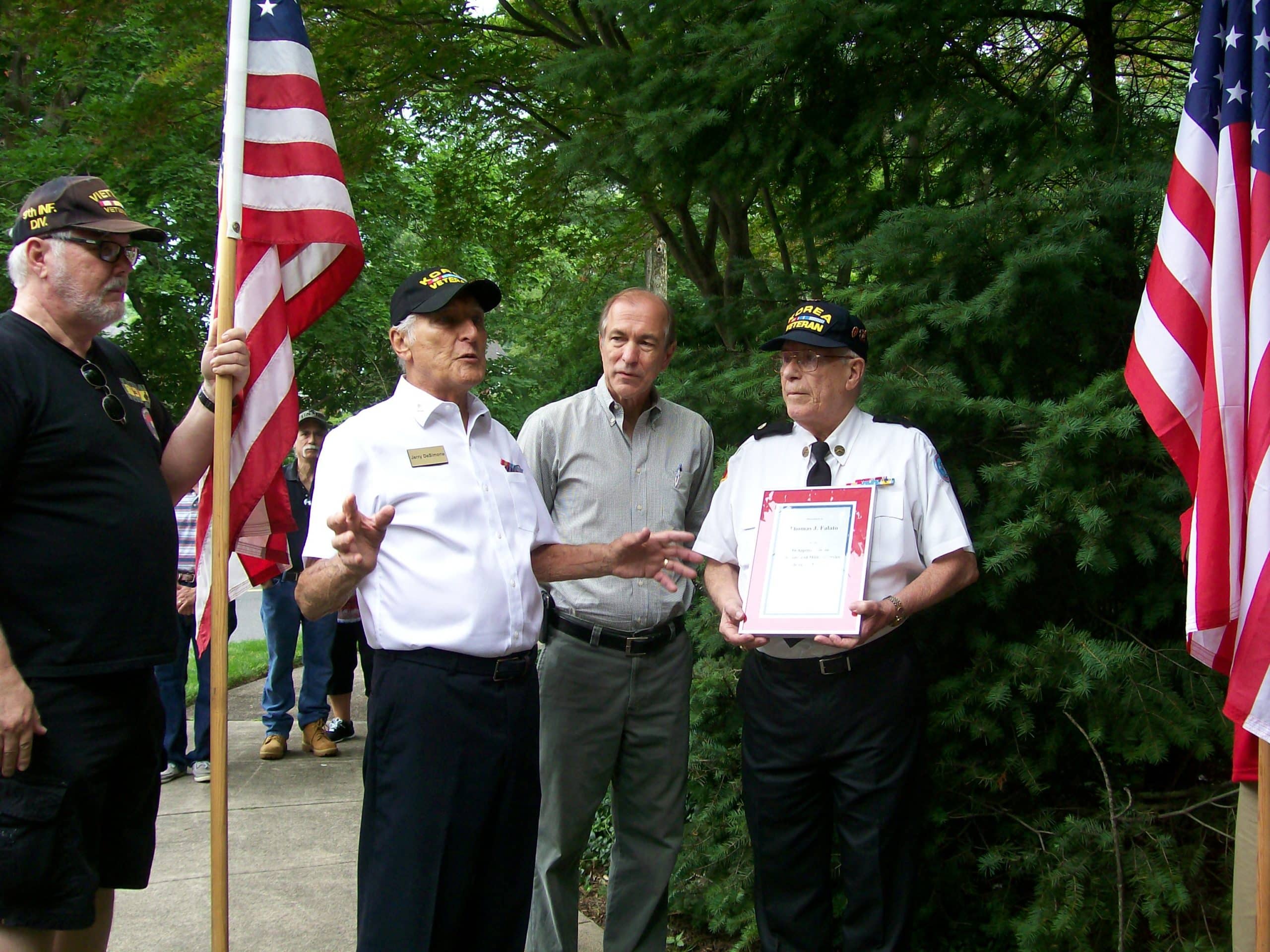
RIDGEWOOD – Ridgewood’s July Fourth Parade would not be nearly as remarkable or prominent throughout the state if it weren’t for Jerry DeSimone. Committee President for at least 15 years, DeSimone transformed the festivity into a public-funded event with entertainment, fireworks and big name guests, including Buzz Aldrin, Bobby Thomson and Ken Taylor.
We all appreciate the uphill battle against a major business and the law that Corzine pushed through that eliminates any sort of evaluation of whether an institution with an “inherently beneficial ” usage is necessary.
Previously, it was a factor but not THE factor in zoning decisions. Clearly in this case it doesn’t make sense. There are multiple fine hospitals within 10 miles of here. There is clearly no lack of need.
Valley is a tough adversary. Clearly money is of no object to them. They buy up millions of dollars of languishing real estate and then they complain they are struggling.
Come on.
They have the real estate they need in Paramus now They should use it. It makes more sense for a “regional” hospital to build between two major highways in a commercial zone rather than on a small lot in a residential neighborhood. Princeton is the best example of what a good neighbor hospital would do- move to the highway when they outgrew their lot a few years ago.
Let’s bring this fight to the next level. Maybe now we can get Hackensack to chip in some more money, if they haven’t already.
I sat at the top of East Ridgewood Avenue this beautiful Sunday morning enjoying some time on a bench with my granddaughter, drinking iced coffee and a blueberry coolatta. She noticed that cars were not stopping at the stop sign heading south on Broad Street at the Ridgewood Avenue “T” by the train station parking lot. She is 6 years old and was disturbed by this. So we counted 40 cars passing through. Out of 40 cars, 28 of them rolled through the stop sign without stopping. Only 12 actually stopped. And all the while people were crossing on foot, pushing strollers, on bicycles, etc. So dangerous. And mind you, this was on a Sunday morning from about 9:00 – 9:15. What must this be like on a busy weekday when the trains are coming and going, when commuters are rushing about, when people are trying to get their kids to school, and so on. I suggested that we tell a police officer but she was afraid to get the police in trouble for not doing their job of ticketing these drivers.
Ridgewood NJ, despite over cast weather the Ridgewood Fireworks went off without a hitch. Patrons enjoyed a great evening filled with music and fun. The Entertainment consisted of Illumination Twirlers, Patriot Brass Ensemble and Eugene Thomas & No Big Deal.The National Anthem by Sherma Andrews was followed by a firework extravaganza.Traffic was a bit of a problem getting out after the show when several choke points closed up.
Ridgewood NJ, It takes a lot of effort to host a parade and fireworks ,the Ridgewood Fourth of July Committee who oversees yesterdays 106th annual Independence Day celebration in Ridgewood had its first meeting way back in September.
The Ridgewood Fourth of July Celebration is organized by the Ridgewood Fourth of July Committee, a private all-volunteer group. The Committee is not part of the Village government and receives no funding from the Village.The Committee, was originally called the Ridgewood Independence Day Association, was formed in 1910.
The Ridgewood Fourth of July Committee was up at the crack of dawn to deliver water to the parade route, put markers at the staging area and set up for a volunteers’ breakfast that starts at 7 a.m. Groups lineup around 8am .
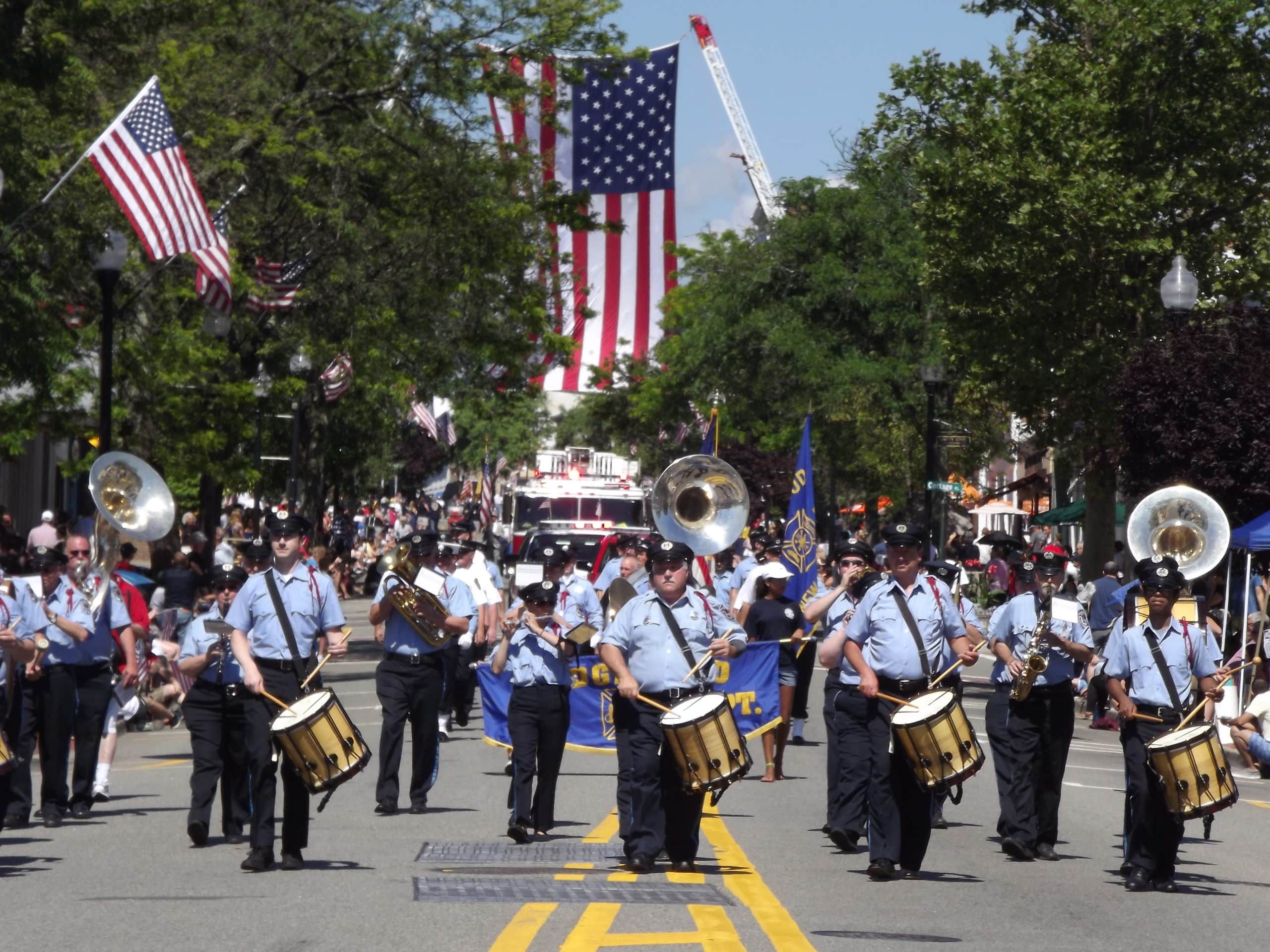
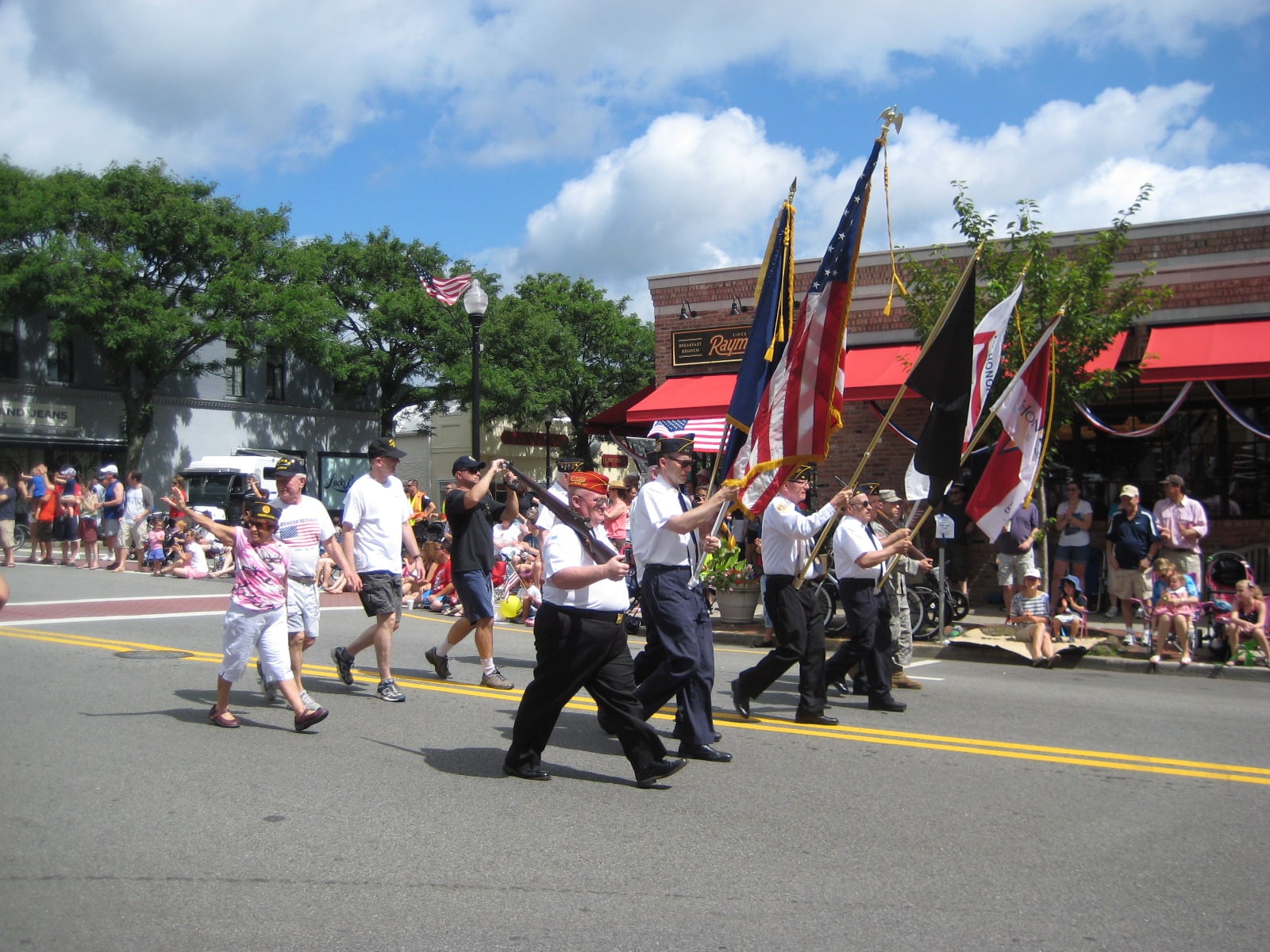
Ridgewood’s parade has over 100 groups that march in it and, together with a fireworks display in Veterans Memorial Field later that night, and can cost over $100,000 . Security and the fireworks themselves are some of the biggest costs, with all of the money for the celebration coming from ticket sales, business sponsorships and private donations.
And of coarse in Ridgewood in time honored tradition , eager residents begin reserving spots along the parade route weeks in advance marking their spots with folding lawn chairs.
Ridgewood NJ, Thousands lined the down town streets as pride and patriotism were on display in Ridgewood on Monday.
The 106th annual Ridgewood Fourth of July parade,was once again a star-spangled extravaganza , officially kicked off at 10 a.m. With the new Ridgewood council well represented .
A patriotic procession of marching bands and flag wavers wound their way trough the village before a crowd that had been eager to see the parade.
As previously reported people had begun putting out chairs nearly two weeks ago , but some were slowed down do to some strange weather conditions that preceded the parade. Many residents would not be deterred and tied down chairs and locked them up nearly two weeks before the big event, lining the street with seats. It is a fun eccentric tradition in Ridgewood some say it gone on for more than 50 years and people determined to sit in the exact same spot, their spot, year after year.Residents in Ridgewood often say it is but one of the many things that gives the parade its unusual charm and a very small town feel.
Of course, everyone in town is looking forward, to the Village’s fireworks display at 9 p.m.
By Anna Merriman | For NJ.com
on July 01, 2016 at 4:40 PM
PRINCETON – A man accused of breaking into a Birch Avenue home and sexually assaulting a woman in her sleep Wednesday, also broke into another home on the same street weeks earlier, police said Friday.
Pedro Arias-Santiago, 26, of Princeton, was initially arrested just after midnight Wednesday after a 28-year-old woman said she woke up to find him sexually assaulting her in her sleep. She ran from the house and called police, who quickly arrested Arias-Santiago outside.
The news of the assault was widely published and on Thursday, another woman came forward.
The second woman – a 19-year-old from Illinois – told police she was staying at the home on Birch Avenue around 5 a.m. on June 14 when Arias-Santiago came in through an unlocked door. She heard Arias-Santiago inside and confronted him, police said. Arias-Santiago fled the house but the woman did not file a report until this week.
She was not sexually assaulted in the burglary, police said.
Rystad Energy estimates US has 264bn barrels of recoverable oil
YESTERDAY
by: Anjli Raval, Oil and Gas Correspondent
The US holds more oil reserves than Saudi Arabia and Russia, the first time it has surpassed those held by the world’s biggest exporting nations, according to a new study.
Rystad Energy estimates recoverable oil in the US from existing fields, discoveries and yet undiscovered areas amounts to 264bn barrels. The figure surpasses Saudi Arabia’s 212bn and Russia’s 256bn in reserves.
The analysis of 60,000 fields worldwide, conducted over a three-year period by the Oslo-based group, shows total global oil reserves at 2.1tn barrels. This is 70 times the current production rate of about 30bn barrels of crude oil a year, Rystad Energy said on Monday.
Every Fourth of July our country comes together to celebrate the signing of the Declaration that would enshrine the principles of what it means to live as free people. But the signing of the Declaration of Independence was not the end of the pursuit for freedom and liberty—it was just the start.
The Revolutionary War was a long, bloody affair that endangered the property, family, and very lives of the Patriots who knew that they had no choice but to fight to defend their rights. And the subsequent years after the American Revolution were filled with many questions for this new fledgling country. It would be 11 years after July 4, 1776 until the United States Constitution was finally adopted to guarantee the rights of all Americans.
The lesson of Independence Day is that freedom is not something you declare one time and hope for the best. It’s a commitment we must, as Americans, fight for just as diligently in 2016 as the revolutionaries in 1776.
Freedom is fought for by the brave members of our armed forces who put their lives on the line to defend us. It’s fought for by our first responders who risk everything to serve their communities right here at home. And it’s fought for by everyone who is proud to live in a country that fights to end tyranny and oppression both here and abroad.
Herein lies the beauty of America. Few of us can trace our heritage in this country back to the colonial days, yet we continue to celebrate the achievements of early America. That’s because the Founders’ cries for freedom and liberty have been adopted by everyone who has made this country their home. This is the American Dream.
Our dream is about more than a place on a map or any specific of group of people. Our dream is a promise that the government is beholden to the people, and it’s a promise that every person is born free and deserves to pursue their own happiness.
Evening Entertainment & Fireworks
Gates Open Monday July 4, 2016 at 6:00 pm – Veterans Field
Patrons and belongings will be subject to security checks by Police Department personnel when entering Veterans Field. No alcoholic beverages are allowed are on the field. There will be 2 lines at the gates, one for those with bags and one for those without bags. Expect delays. Gates will close at 9:00 PM.
Schedule:
Gates open – 6:00 PM
Entertainment-
Illumination Twirlers
Patriot Brass Ensemble
Eugene Thomas & No Big Deal
Gates close – 9:00 PM
National Anthem by Sherma Andrews
Fireworks by Fireworks Extravaganza
Grand Finale: Sponsored by Dorehty Enterprises
Food and beverages are available for purchase on the field.
No dogs are permitted on the field per town ordinance.
No refunds or exchanges will be given.
For directions to the Evening Entertainment use your favorite map website and enter 131 N. Maple Avenue.
Fire protection for the fireworks display is by The Ridgewood Fire Department.
Security is by the Ridgewood Police Department.
Limited handicap parking is available for the Evening Entertainment and Fireworks in the northern Graydon Pool parking lot located on Northern Parkway.
Independence Day, or the Fourth of July, celebrates the adoption by the Continental Congress of the Declaration of Independence on July 4, 1776. On the 236th birthday of the United States, explore nine surprising facts about one of America’s most important founding documents
Editors Note its the same thing that makes Ridgewood Great it’s you the individual
By John Podhoretz
July 3, 2016 | 9:43am
Forty years ago tomorrow — on July 4, 1976 — the largest armada in human history sailed into New York Harbor to celebrate the bicentennial of the United States of America. It was composed of 281 large vessels and small crafts numbering in the thousands, all led by 17 magnificent “tall ships.”
President Gerald Ford sat aboard the USS Forrestal as the watercraft paraded before him along with more than half a million people.
And everywhere you looked, there was an American flag.
The parade Begins 10AM (Rain or Shine) at South Monroe Street and Godwin Avenue
The theme of our 106th annual celebration is:
“America the Beautiful – Celebrating 100 Years of our National Parks”
This years theme honors the creation of the National Park Service through the Organic Act of 1916 signed by President Woodrow Wilson and originated by President Theodore Roosevelt. Each year, the Fourth of July Celebration Committee chooses a theme that celebrates a certain aspect of American history or culture. The theme also serves as the basis for the float competition held during the parade.
Although national parks have existed since 1872, the creation of the National Park Service established a unified organization to oversee the natural and historic treasures of the United States and ensure their continued preservation and enjoyment for future generations. According to the National Park Service, there are more than 400 parks, monuments, recreation areas and other federal sites under its management. Other notable facts include:
The first national park was Yellowstone National Park founded March 1, 1872
292 million people enjoyed the nation’s national parks in 2014
The National Park System covers more 84 million acres across US States and territories
President Theodore Roosevelt said, “It is not what we have that will make us a great nation; it is the way in which we use it”
When reading the Declaration of Independence, it is easy to focus only on the sweeping language of the second paragraph and skip over the names and mutual pledge of the signers at its conclusion.
Though the principles enunciated in its opening paragraphs, such as the self-evident truth that all men are created equal, provide the moral and philosophical foundation on which the American regime rests, it is important to acknowledge that declaring principles alone secures nothing.
Principles need to be enforced by individuals who have the habits of character necessary to fight for them, and perhaps even die for them, if need be. In a time where talk of rights dominates our political discourse, a focus on duties is indispensable in order to teach citizens the responsibilities they owe toward each other and their posterity.
The signers’ mutual pledge to themselves to sacrifice their lives, fortunes, and sacred honor for the cause of independence shows that these men took seriously their duties to the people of the new nation.
A look at the historical record will show this to be beyond dispute.
Of the 56 men who signed the declaration, 12 fought in battles as members of state militias, five were captured and imprisoned during the Revolutionary War, 17 lost property as a result of British raids, and five lost their fortunes in helping fund the Continental Army and state militias battle the redcoats.
Below we will explore the sacrifices the signers made on behalf of the American cause.
Thomas Heyward Jr., Edward Rutledge, and Arthur Middleton
Thomas Heyward Jr. of South Carolina was a signer of both the declaration and the Articles of Confederation. Heyward drew the ire of the British when, as a circuit court judge, he presided over the trial of several loyalists who were found guilty of treason. The prisoners were summarily executed in full view of British troops. In 1779, he joined the South Carolina militia as a captain of artillery.
Heyward’s compatriot in the South Carolina delegation, Edward Rutledge, also served in the state militia. At age 26, Rutledge was the youngest signer of the Declaration of Independence. After returning home from attending the Second Continental Congress in 1777, he joined the militia as captain of an artillery battalion.
Both Heyward and Rutledge aided their country in the battle at Port Royal Island, where they helped Gen. Moultrie defeat British Maj. William Gardiner and his troops.
Arthur Middleton, the last of the South Carolina delegation who served in the militia, took up arms against the British during the siege of Charleston in 1780. His fellow signers, Heyward and Rutledge, fought in that battle as well.
Upon the surrender of Charleston, all three men were captured by the British and were sent to a prison in St. Augustine, Florida, which was reserved for people the British thought were particularly dangerous. They were held there for almost a year before being released. On route to Philadelphia for a prisoner exchange in July 1781, Heyward almost drowned. He survived his fall overboard by clinging to the ship’s rudder until he could be rescued.
During the British occupation of Charleston, Commandant Nisbet Balfour ordered the seizure of many estates in Charleston, including those owned by Heyward and Middleton.
During his imprisonment, Heyward’s wife died at home, and his estate and property were heavily damaged. Rutledge’s estate was left intact, but his family had to sell many of their belongings in order to make the trip to Philadelphia to reunite with him after his release. Middleton’s estate was left relatively untouched, but his collection of rare paintings was destroyed during the British occupation of his home.
Thomas Nelson Jr.
Thomas Nelson Jr. of the Commonwealth of Virginia was appointed to the position of brigadier general and commander-in-chief of the Virginia militia by Gov. Patrick Henry in August 1777. At that time it was thought that the British would be making a full scale invasion of the state. Nelson was able to muster only a few hundred men to defend Virginia, but the British instead decided to attack Philadelphia.
Nelson inherited a vast family fortune, much of which he used to support the American effort. He personally paid for the return journey home of 70 troops he had led to meet the British in Philadelphia during the summer of 1778. In the spring of 1780, Nelson signed his name to a loan for $2 million that was needed to purchase provisions for the French fleet that was coming to America’s aid in the war.
As then-governor of Virginia, during the Battle of Yorktown he ordered American troops to fire upon his mansion, which had been commandeered by Gen. Cornwallis and his men.
Richard Stockton
A member of the New Jersey delegation, Richard Stockton, had his estate commandeered by the British for use as a headquarters. As they left, British troops burned all his personal effects—including his library, private papers, furniture, and clothes.
Though Stockton was in hiding at the time, he ultimately did not escape capture; a traitor led the British to his position in November 1776. He was held captive in Amboy, New Jersey, and was then sent to New York City where he was imprisoned in a jail reserved for common criminals. Incensed by his treatment, Congress worked with British Gen. William Howe to obtain his release.
George Walton
Because of his small build and stature, George Walton was thought to be the youngest of the signers of the declaration (he was actually in his mid-30s). He hailed from Georgia and served as colonel in the first regiment of the state militia in 1778. During the siege of Savannah, a cannonball broke Walton’s leg, which led to his being captured. He was held captive for nine months and was released in the early fall of 1779 in a prisoner exchange for a British navy captain.
At the same time Walton was held prisoner, his wife Dorothy was captured by the British. She was imprisoned on an island in the West Indies and was eventually freed after a prisoner exchange. During the Waltons’ confinement, the British ransacked their home.
George Clymer
British troops destroyed the home of George Clymer of Pennsylvania in September 1777 when they captured Philadelphia. Though his home was outside of the city, it was right in the middle of the path of the British march. American loyalists pointed out to the British homes belonging to patriots, which of course included Clymer’s estate.
Clymer also contributed to the war monetarily. He converted his entire fortune into continental currency, a risky move considering the likelihood that the currency would be rendered worthless. He also told wealthy friends to contribute to the American cause.
Robert Morris
A delegate from Pennsylvania, Robert Morris helped insure Washington’s victory at Yorktown by using his own credit to obtain the supplies necessary to defeat the British. He spent more than $1 million (not adjusted for inflation) of his own money to accomplish this.
While serving as superintendent of finance of the United States, Morris regularly used his own financial resources to obtain much needed supplies. Using his own funds, for example, he purchased one thousand barrels of flour for Washington’s men in late spring of 1778.
Lewis Morris
Lewis Morris of New York served as a major general in the state militia. Morris devoted himself to recruiting men to serve in the militia and to help keep supplies up, which was a constant problem. For almost the entire length of the war, the British occupied his home, Morrisania, and used it as their headquarters. This forced Morris to live off of his close friends and associates until the war ended in 1783.
John Hancock
John Hancock of Massachusetts, the man with the largest signature on the declaration, served in the militia as major general in 1778. Hancock was put in command of approximately 6,000 men during the Rhode Island campaign. That campaign was ultimately unsuccessful because the French failed to carry out their end of the bargain.
Caesar Rodney
Caesar Rodney served in the Delaware militia as well, attaining the rank of brigadier general. Rodney famously road on horseback straight from Dover to Philadelphia to cast his vote in favor of declaring independence (the Delaware delegation was split). He was with his men in the field during the brutal winter of 1776, helped quash an uprising in Delaware (there were a large number of loyalists within the state), and helped in George Washington’s effort to defend Philadelphia from being taken by the British.
Carter Braxton
Carter Braxton of the Virginia delegation accumulated massive personal debts helping the American effort in the war. He loaned 10,000 pounds sterling to Congress, which was never repaid. He also spent much of his wealth outfitting American ships so that they could carry more cargo. Due to the British capturing some of his vessels and others being lost out on the high seas, he suffered great financial calamity. These accumulated losses left him bankrupt by war’s end.
Oliver Wolcott
A delegate from Connecticut, Oliver Wolcott served as captain and then major general in the state militia. In 1776, he was appointed to lead 14 regiments in defense of New York City. He also commanded thousands of men in the Battle of Saratoga. Wolcott worked tirelessly to recruit for the Connecticut militia, which, like the army in general, was sorely lacking in numbers within its ranks.
William Whipple
William Whipple of New Hampshire served as brigadier general in the state militia. He fought against Gen. Burgoyne at the battles of Stillwater and Saratoga (commonly pointed to as the turning point for Americans in the war) in 1777. The following year, Whipple participated in the retaking of Rhode Island.
Thomas McKean
Thomas McKean of Delaware served as colonel in the Delaware state militia. Once McKean was appointed to the office of President of Delaware in 1777, he was targeted by the British (the British captured John McKinley, the previous president). He had to move his family on five occasions because of raids by both the British and local Indian tribes.
Francis Lewis
Francis Lewis of New York signed the declaration on August 2, 1776. Although he was present when independence was declared a month earlier, the New York delegation did not get permission from the state’s legislature to sign the document. A few months after affixing his signature on the declaration, British troops destroyed the Long Island estate of Lewis. They took Lewis’ wife and put her in prison where she was tortured on a regular basis. Under the direction of George Washington, she was finally returned in a prisoner exchange two years later.
Benjamin Franklin
Known as the sage of Philadelphia, Benjamin Franklin of Pennsylvania was the oldest of the signers of the declaration. Prior to setting sail for France in late 1776 to ask the French for assistance in the war, Franklin gave his entire fortune to Congress to help fund the war.
John Hart
Hessian mercenaries plundered signer John Hart’s 400-acre farm outside of Hopewell, New Jersey. Prior to his farm being captured, Hart was forced to leave his family because of advancing British troops. During his absence, his wife died, and his children were sent to live with neighbors.
William Ellery
The estate of William Ellery of Delaware was burned down during the British occupation of Newport, Rhode Island. Ellery served in the Second Continental Congress until the British left Newport, which they held for three years. He returned home in order to salvage what was left of his property.
Joseph Hewes
With his fortunes built on trade, Joseph Hewes of North Carolina was a vigorous proponent of the decision of the First Continental Congress to cut off all imports and exports with the British. This of course had the effect of drying up his wealth. Interestingly, Hewes also renounced his Quaker religion in order to support the war.
James Smith
A delegate from Pennsylvania, James Smith served in the Pennsylvania militia as captain, colonel, and then as brigadier general. He was one of the first to raise men for the possibility of defending his home state, a duty he took up beginning as early as 1774.
Benjamin Harrison
Benjamin Harrison of Virginia, whose son and grandson both served as U.S. presidents, complained in a letter to Gov. William Livingston of New Jersey that his debts had accumulated substantially because of the “ravages” and “plunderings” of the British.
William Floyd
While William Floyd of New York served as a delegate in the Second Continental Congress, the British sacked his estate, forcing his family to flee. Though they made it safely to Connecticut, his family was left without a home for the duration of the war.
William Hooper
William Hooper of North Carolina outlasted British raiders who were looking to capture him and his family. In 1782, he and his family fled Wilmington after it fell to the British. Though much of his property was destroyed, he and his family were reunited at the conclusion of the war.
Lyman Hall
The British destroyed the home and plantation of Lyman Hall of Georgia. Luckily, his family escaped before the British arrived and moved up North to be with him.
While America’s birthday has always been “solemnized with pomp and parade, with shews, games, sports, guns, bells, bonfires and illuminations from one end of this continent to the other” as John Adams anticipated, these revelries were once paired with other traditions that kept the cause for celebration front of mind.
Independence Day orations, often lasting an hour or more, were once delivered in town squares and fraternal halls across the country. Politicians like Daniel Webster and Charles Sumner, activists like William Lloyd Garrison, prominent local attorneys, even defeated Native American warriors gave speeches that were well attended and widely disseminated thereafter.
These speeches delved deeply into the principles expressed in our declaration, often summarizing the major works of the Enlightenment that shaped our founders’ view of government.
An 1824 oration delivered by a local reverend to a gathering of New York City firemen referenced Hume, Voltaire, Paine, Bolingbroke, Shaftsbury, Locke, and Bacon all in the space of about two minutes.
Patriotic toasts were also common during the 19th century. After the day’s festivities concluded, revelers would raise their glasses for 13 toasts, one for each of the original states.
The topics of these toasts were wide ranging. Participants drank to everything from “the American Revolution: founded upon principle, its origin the source of lasting happiness to millions left unborn” to “kingcraft, on its last legs on the Western continent.”
Dramatic readings of the Declaration of Independence were also a staple of Fourth of July celebrations in most cities and towns around the country. These readings took place before the day’s parade kicked off, preceding the evening’s fireworks, or any point in between. Like the oration, the reading of the declaration was often conducted by a town notable, but occasionally the honor was bestowed upon a local young person.
Some of these traditions have faded completely. While fraternal organizations like the Knights of Columbus and the Elks still hold Fourth of July cookouts in many towns, few begin with the once-customary 13 patriotic toasts.
Others still exist if in much diminished form. For instance, today presidents still typically give a short oration on the Fourth of July though these speeches are not widely watched or read. Nor do they deserve to be. Typically the president takes a moment to thank members of the military for their service, praises the founding generation for their courage, and wraps things up before the flies get to the potato salad.
At least one tradition of the past is making a comeback. This Independence Day, towns like Gadsden, Alabama; Dover, Delaware; and Bell Buckle, Tennessee will hold recitations of the declaration in town squares and local parks.
This is a good sign. Americans should work to ground pageantry in principle. True, attending an hour-long lecture on Enlightenment philosophy might be a little much to ask.
Instead, read the Declaration of Independence just as the first fireworks ignite overhead. Give a toast to those who pledged their lives, fortunes, and sacred honor to our new nation. Say a short prayer to the God who granted our founding generation one of the most improbable victories in military history.