By Bob Woodward and Robert Costa April 2 at 6:51 PM
Donald Trump said in an interview that economic conditions are so perilous that the country is headed for a “very massive recession” and that “it’s a terrible time right now” to invest in the stock market, embracing a distinctly gloomy view of the economy that counters mainstream economic forecasts.
The New York billionaire dismissed concern that his comments — which are exceedingly unusual, if not unprecedented, for a major party front-runner — could potentially affect financial markets.
“I know the Wall Street people probably better than anybody knows them,” said Trump, who has misfired on such predictions in the past. “I don’t need them.”
Religious institutions in New Jersey are no longer allowed to sell grave markers, thanks to a new state law that took effect this week.
Signed into law a year ago by Republican Gov. Chris Christie, the new regulations target the Roman Catholic Archdiocese of Newark, which in 2013 began selling grave markers for burial plots within the archdiocese’s cemeteries. The Monument Builders Association of New Jersey sued the archdiocese and then successfully lobbied for the passage of a law to protect their members from competition.
GRAVE MATTERS: Religious institutions in New Jersey, like the Archdiocese of Newark, headquartered in the Cathedral of the Sacred Heart, are no longer allowed to sell grave markers, thanks to a new state law that took effect this week.
Christie signed the bill in March 2015 but delayed its implementation for one year.
“We have dreaded this day for a year,” said Andrew P. Schafer, executive director of the Newark Archdiocese Office of Catholic Cemeteries.
But the courts will likely get the final say in the matter.
The grave marker business is a lucrative one. The archdiocese made about $500,000 in the first year after it started marketing headstones directly to consumers, and the MBA argued that its members lost more than one-third of their business.
The archdiocese’s business model differed from that of the for-profit memorialists. While the businesses simply sell headstones to consumers, the archdiocese sells “inscription rights,” retaining ownership of the headstone while allowing the bereaved to engrave a message on it. This means maintenance of the headstones in the archdiocese’s 11 Catholic cemeteries will be at the Church’s expense in perpetuity.
With the threat of losing more business to the Catholics, the Monument Builders Association sued the archdiocese in 2013, but the lawsuit failed because it was not illegal for religious institutions to sell grave markers.
Stopped by the courts, the MBA turned to the state legislature. A bill banning religious institutions from selling grave markers sailed through the state legislature in December 2014 with bipartisan support.
Lawmakers who backed the bill said they were worried about the nonprofit archdiocese taking business away from monument dealers.
“We’re not millionaires. We are small businesses trying to survive,” said John Burns Jr., president of the Monument Builders Association of New Jersey, told lawmakers.
Now the issue is back in court. The Archdiocese of Newark, along with two of its constituents and the Institute For Justice, a libertarian law firm, is challenging the banon religious institutions selling grave markers.
The state of New Jersey has asked the U.S. District Court in New Jersey to dismiss the complaint, but the case is still pending.
The Institute For Justice says the case could be a model for attacking similar protectionist regulations in other areas of the economy, an issue on which federal courts have established no settled rules.
Until that gets resolved, consumers in New Jersey will have fewer options when it comes time to purchase a grave marker for a family member or loved one. The state is one of just three in the country to ban religious institutions from selling gravestones.
“This new law protects only the interests of funeral directors and monument dealers while eliminating the rights of families we serve and our ministry,” Schafer said Wednesday.
the staff of the Ridgewood blog Point: Manmade climate change is a real phenomenon.
Counterpoint: No, it’s not. Climate has been changing since before humankind existed.
And so the conversation has circled for decades. But what if there was an alternative way of understanding what’s happening to our planet?
For scientist William Goodenough, we are wasting resources barking up the wrong tree. He agrees the planet is in a natural warming cycle, but suggests a shift in Earth’s magnetic poles is a primary cause of climate change.
“Our politicians are diverting $22 billion in annual research that tries to connect climate change to our use of carbon,” says Goodenough, author of “The Three Concepts of Climate Change: Is AGW Politics or Science?” (www.whyclimatechange.net).
“That research proves inconclusive year after year. Many people suggest completely reorganizing our economy to meet a radical energy policy, to the tune of an unquantifiable amount of money and a great economic burden on the average American.”
Here’s how Goodenough explains key concepts of his alternative theory.
• No scientific instrument connects human activity to climate change. If there was direct evidence tying humanity’s activity to climate change, we would have heard of it by now. Nonetheless, the message in the media has continuously reinforced the connection. Advocates for manmade climate change have successfully linked the issue to environmental problems associated with humans, including air pollution. The result has been public confusion. • How the magnetic poles come into play. Earth’s magnetic poles are relocating by 3,000 miles. This shift is having a significant impact onrealized in computerized aircraft-control navigational systems, and that’s a clue it’s likely affecting Earth’s climate, too. The magnetic pole alters the direction of the enormous current flow through the Earth, causing magnetic chaos in our planet’s core. This weakens the magnetic shield that protects the planet from damaging solar particles. Pole shifting changes the direction of the interaction between the geophysical and the magnetic North Poles by moving the coldest area of the Arctic toward Asia, thereby significantly altering the climate while not changing total Earth temperature. • A multi-disciplined approach to understanding climate change is necessary. “AGW climate science” is a gross oversimplification of terms. The issue includes perpetual changes in total Earth temperature, the direction of the sun’s activity, and the planet’s distance and orientation to the sun during orbit. Also in need of consideration is how the sun’s activity, Earth’s core and magnetic forcing interact with Earth’s atmosphere. In most of today’s climate research, all necessary fields of study aren’t taken into account, including meteorology, climatology, geophysics, geomagnetism, archaeology, paleoclimatology and history.
“If you respect sufficient evidence,” Goodenough says, “you aren’t satisfied with mainstream theories on this problem and should be open to compelling new data.”
About William Goodenough
William Goodenough is author of “The Three Concepts of Climate Change: Is AGW Politics or Science?” (www.whyclimatechange.net). He is a technical analyst with decades of experience in scientific analysis of computer systems, control systems, pneumatic systems, power distributions systems, automated processes, hydraulic systems and fuel systems related to aerospace certification.
Ridgewood Nj , Business can lead to cutthroat competition – in more ways than one – but Tom Nix learned that the darkest moments also can lead to the greatest triumphs.
“It’s the worst experiences that sometimes teach us the most important lessons,” says Nix, a successful businessman and author of “Nixland: My Wild Ride in the Inner City Check Cashing Industry” (nixland.net).
The incredible rise of his multimillion-dollar enterprise, Nix Check Cashing, is a case in point. Nix encountered turbulent times in the inner city of Los Angeles as he built his company into a trusted institution among underserved communities.
He and his employees faced harrowing experiences, such as armed robberies and threats from the mob, which hoped to block some of his expansion plans.
The 1992 riots that erupted after a jury acquitted police officers in the beating of Rodney King proved especially distressing. Many businesses were looted or burned to the ground, and Nix scrambled to protect his check-cashing locations.
He was gratified to learn that loyal customers prevented some branches from being torched.
“We even had a gang member call us,” Nix says. “He said he had always been treated with respect at Nix, and his gang decided not to burn Nix because we were part of the community.”
Nix says his experiences taught him valuable lessons that relate both to business and life, such as:
• Take responsibility. This applies to everything that happens, including things you can’t control. Once when an economic downturn left him unable to pay bills, Nix contacted each creditor to explain his predicament and work out a plan. That upfront approach helped the business avoid bankruptcy. • Never play the victim role or blame game. Avoid replaying misfortunes over and over in your mind. Accept setbacks gracefully and concentrate on getting back on track. In the 1990s, a business deal that went awry nearly forced Nix to sell his company, but he focused on solving the problem and persevered. • Be courageous. The most debilitating human emotion is fear. Learn to keep it in perspective, minimize it when applicable and harness it to your benefit when need be. Nix says standing up to bullies as a child set the stage for standing up to the mob. • Maintain integrity. Operating with fair play and compassion is important in building trust. “The way community members protected some of our branches during the riots was a reflection of this,” Nix says.
“Treating people fairly and supporting community programs paid off.”
Good times may be more enjoyable, but challenging times provide more opportunity for growth, he says.
“Realize that bad people, tough times and mistakes are your teachers,” Nix says. “Always ask yourself, ‘What do I need to do to capitalize on these events?’ ”
About Tom Nix
Tom Nix, author of the memoir “Nixland” (Nixland.net), is a pioneer of the check-cashing industry. He built Nix Check Cashing into a multimillion-dollar operation before selling it in 2007. Recently, Nix has turned to public speaking and writing with the goal of helping people overcome obstacles and have similar success.
By Noah Cohen | NJ Advance Media for NJ.com
on April 01, 2016 at 2:04 PM, updated April 01, 2016 at 2:18 PM
HACKENSACK — A 36-year-old Florida man was accused of sexually assaulting a girl when she was approximately 11-years-old in Ridgewood, authorities said Friday.
Joseph McCain, of Orlando, was charged with child endangerment and aggravated sexual assault after his arrest in Florida on Thursday, Acting Bergen County Prosecutor Gurbir Grewal said.
photo courtesy of Actress ?director Jennifer Linch
April 2,2016
the staff of the Ridgewood blog Ridgewood NJ, If your teen or 20-something thinks it would be amazing to work someday on the kind of films they love – don’t let anything or anyone stop them, says filmmaker Doug Vermeeren.
Often, budding filmmakers are discouraged by advice such as, “You have be realistic and get a real job.”
“But what’s ‘realistic’ about denying a deep passion that may give others the same joy that you’ve received from movies?” asks Vermeeren, whose documentaries have been translated into 23 languages worldwide. He is of the director of the new Calgary Smartphone Film Festival.
“What if Spielberg or Scorsese – or anyone who has ever done anything great – took the ‘realistic’ advice and accepted a safe career? We wouldn’t have great things.”
Your son or daughter can do what they love for a career, says Vermeeren, whose latest film project is “Creepy Zombies” (www.creepyzombies.com). He offers pointers for parents who want to help their child realize their dream as a filmmaker.
• Help them polish their people skills. It’s all about relationships. How do you get people to work for you before you have money? How do you convince people to do you favors, such as loaning you a vintage car or allowing filming to take place on private property, essentially for free? Again, your kid will need to sell people on their vision, and show them they’re worth rooting for. Make your passion infectious! • Make sure they monetize! Films are expensive, but so are medical and law schools. Does that mean aspiring lawyers and doctors shouldn’t make the investment? If they believe in their vision, there are various ways for your son or daughter to raise money for the project, including through Vimeo and YouTube. • Have them seek education wherever they can find it. Film classes are great, but don’t stop there. They should read books about their favorite directors, and enter every film festival they can. Festivals often offer cash prizes. More importantly, judges will critique the project. Their criticisms may be difficult to endure, but they can also greatly improve a young filmmaker’s efforts.
“There are many obstacles in the way of a film’s completion, so confidence is a must,” Vermeeren says. “The first film is the hardest because figuring out the initial logistics is complicated. The filmmaker needs to get people – actors and anyone with the necessary resources – to commit before there is enough money – and there’s never enough money. People, however, are drawn to passion and determination. They need to put their full heart into it and, eventually, they’ll succeed.”
About Doug Vermeeren
Doug Vermeeren is an internationally renowned public speaker, author, movie producer and director whose latest film project is “Creepy Zombies” (www.creepyzombies.com). He began his career in film as a background extra, actor, photo double and stunt performer on a variety of films, and his documentaries have been translated into 23 languages worldwide.
Ridgewood NJ, This April, Kings Food Markets is finding ways to give back to the community.
WHAT: Starting today, Kings Food Markets (Kings) launches its “Buy Two, Donate One” Program to support the Salvation Army. Through its Act Against Hunger initiative, Kings continues to make an impact on hunger relief in the area, and since 2013, has donated over 100,000 pounds of food throughout the community to those in need – and will continue its efforts over the next two weeks.
Shoppers who purchase our Kings Own products, which will be sold at discounted rates, have the option to “Buy Two” products, and “Donate One” to the Salvation Army.
Additionally, to extend our support and gratitude for all of the Salvation Army’s endless work, Kings also made a monetary donation to the organization.
Ridgewood NJ, The Orpheus Club Men’s Chorus will present its annual Spring Concerts on Saturday, April 16, 2016 at 7:30 pm, and on Sunday, April 17, 2016 at 4:00 pm at the Ridgewood United Methodist Church, 100 Dayton Street, in downtown Ridgewood, NJ.
The concerts feature a diverse selection songs ranging from Beethoven to the Beach Boys to delight every age and interest. Among the choral offerings are Auf Dem Meere from the Brahms concerto, Rinaldo; a medley of songs from the hit Broadway show Jersey Boys; Palestrina’s O Bone Jesu; Blackbird by Lennon and McCartney; Hallelujah from Beethoven’s Mount of Olives; and A Nightingale Sang in Berkeley Square by Maschwitz and Sherman. Rounding out the program, the Orpheus Doo Woppers will perform their rendition of Kokomo, and so much more.
Tickets for the concert are $15 in advance and $25 at the door. Advance purchase may be made online at the Orpheus Club Men’s Chorus website www.ridgewoodorpheusclub.org and at any of the following local businesses: Daily Treat Restaurant, Wine Seller and Town and Country Apothecary in Ridgewood; Lewis Drug in Westwood; Perry’s Florist and Rock Ridge Pharmacy in Glen Rock; Wine and Spirit World in Ho-Ho-Kus; and Benny’s Luncheonette in Fair Lawn. Seniors and students under 17 years of age may purchase tickets at the door for $18.
The Orpheus Club Men’s Chorus has been a keystone of the cultural life of the tri-state region for 110 years. Founded in 1905, it is the oldest cultural institution in all of Bergen County. Now over 50 voices strong, it is directed by John Palatucci and accompanied by pianist Ron Levy.
Well, it’s not our government, so it’s on us to Take Back Ridegwood!! Go Monday night to the Valley meeting. Sign the garage petition, talk to your neighbors and friends!! We have a choice we can roll over and do nothing, or get vocal, participate and give it all we got! I know it’s not easy… Exhausting, irritating but we are near a positive change…. The election. Stay strong people, we are near the end of a long and terrible reign.
REGISTER TO VOTE IN THE MUNICIPAL ELECTION
Final voting registration for the May 10th Municipal Election is April 19th. To register to vote, individuals may register in the Village Clerk’s office from 8:30 AM to 4:30 PM or in the Ridgewood Library Lobby on April 19th from 4:30 PM to 9:00 PM.
From our attorneys regarding the referendum petition to repeal Ordinance #3521:
“We are confident that the bond counsel is wrong. Bond ordinances are NOT controlled by the Faulkner Act or Walsh Act
or any other general act that gives NJ residents the right of referendum. The right to repeal a bond is a right shared by ALL
New Jersey residents under the Local Home Rule Act, not just Faulkner Act towns.”
New Jersey Statutes Annotated. N.J.S.A. 40A:49-10 reads as follows:“Any proposition submitted to the voters of any municipality under the provisions of section 40:49-9 or of section 40:49-27 of this title shall be voted upon at the next general election held in
the municipality at least thirty days after the filing of the protest or protests herein provided for, unless the governing body thereof
shall call a special election therefor.”
If a special election is called, and $40-45,000.00 of municipal funds are used, that will be a choice that the Council alone makes, and for which
the Council alone will be held accountable.
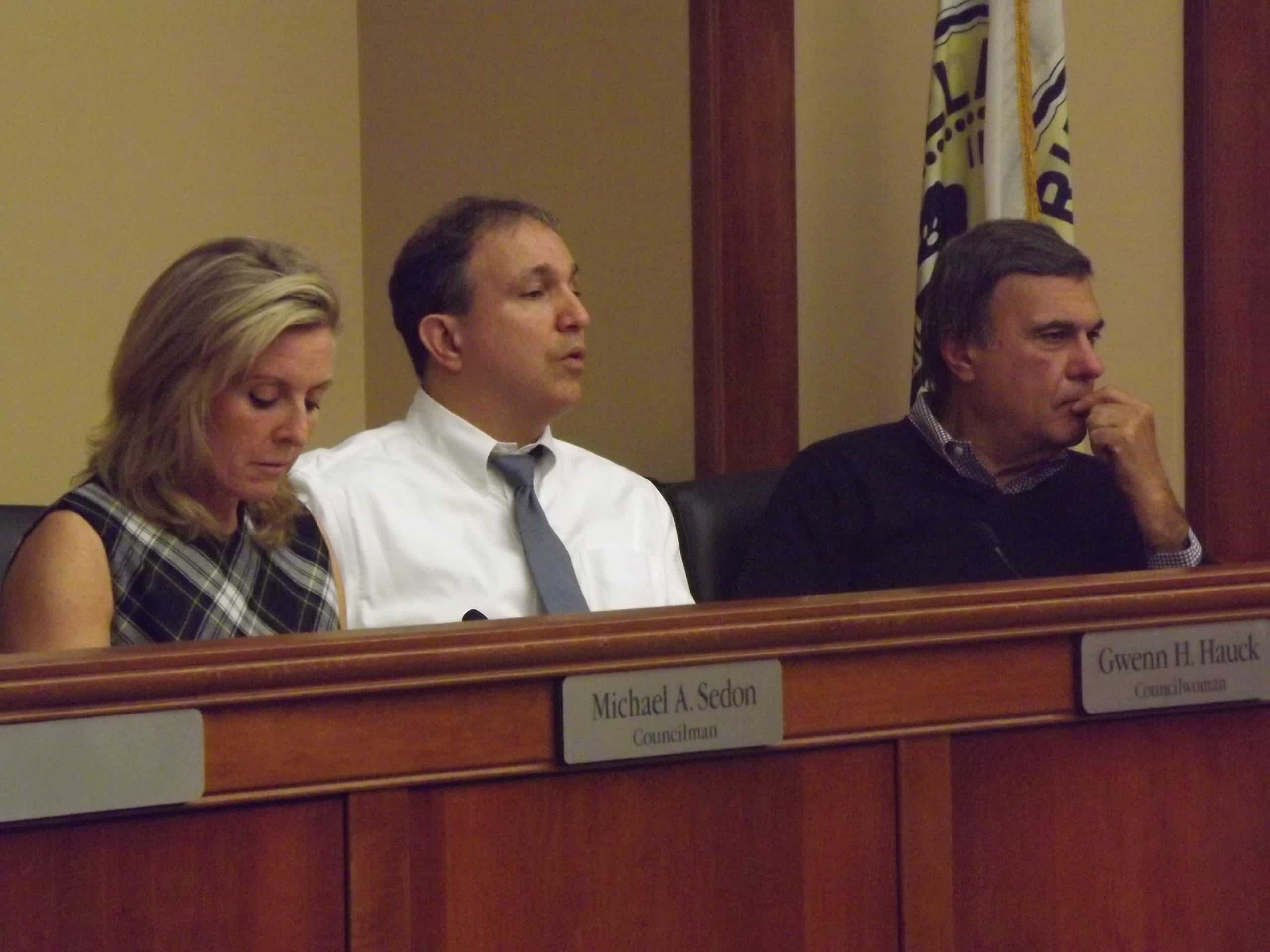
Reader says , “I think that Mrs. Hauck is the most egregious example of Ridgewood’s poor representation. While negotiating the Village’s settlement of the Hospital’s lawsuit against us, she gave Valley virtually everything they’ve ever asked for – even after Valley acknowledged that their expansion will be detrimental to Ridgewood (but good for the region – yay!). I understand that Mrs. Hauck has deep affection for and a long affiliation with Valley, but as a Council person she should be looking out for the people she was elected to represent. It’s a shame that the Village will be changed forever over the handful of votes that she won by.”
Peace out, fools! Obama plays the clown by flashing the peace sign for nuclear security summit ‘team photo’… and gets a very unimpressed look from David Cameron and bemused world leaders
President Barack Obama is meeting dozens of world leaders for a nuclear summit in Washington, DC, today
He gave the peace sign as the group stood together for a ‘team photo’ – bemusing dozens of the world’s politicians
Prime Minister David Cameron looked less than impressed by Obama’s behavior amid a strained special relationship
Obama recently slammed Cameron for being ‘distracted’ during the crisis in Libya and turning it into a ‘s**t show’
World leaders discussed nuclear terrorist threats as well as the controversial Iran deal at the summit
By OLLIE GILLMAN FOR DAILYMAIL.COM
PUBLISHED: 13:55 EST, 1 April 2016 | UPDATED: 19:23 EST, 1 April 2016
Surrounded by world leaders, President Barack Obama gave the peace sign as they gathered for a ‘team photo’ during a two-day nuclear summit.
All eyes were on Obama as 54 other presidents and prime ministers joined him in Washington, DC, for crunch talks on Iran and terrorist threats involving nuclear weapons.
There was one set of eyes, however, that was particularly focused on the President – those of Prime Minister David Cameron.
Relations between Cameron and Obama have been strained since the President criticized the Prime Minister for getting ‘distracted’ during the crisis in Libya and turning it into a ‘s**t show’.
There was more than metaphorical distance between the pair at today’s summit, with Cameron only able to glare at Obama from across the podium as he was elbowed out to the edge of the stage.
The White House website has censored a video of French Pres. Francois Hollande saying that “Islamist terrorism” is at the “roots of terrorism.”
The White House briefly pulled video of a press event on terrorism with Pres. Obama, and when it reappeared on the WhiteHouse.gov website and YouTube, the audio of Hollande’s translator goes silent, beginning with the words “Islamist terrorism,” then begins again at the end of his sentence.
Even the audio of Hollande saying the words “Islamist terrorism” in French have, apparently, been edited from the video.
According to the official White House transcript of Hollande’s remarks, Hollande refers to “Islamist terrorism.” The audio of the bold text in brackets is missing from the video – the only point in the video were the audio is absent:
“We are also making sure that between Europe and the United States there can be a very high level coordination.
“But we’re also well aware that the roots of terrorism, [Islamist terrorism, is in Syria and in Iraq. We therefore have to act both in Syria and in Iraq, and this is what we’re doing within the framework of the coalition.] And we note that Daesh is losing ground thanks to the strikes we’ve been able to launch with the coalition.”
Ridgewood NJ, The last thing dedicated teachers want to think is that they’re fulfilling all the duties of a babysitter and not much else, says educator Mac Bogert.
“I’m often reminded of Mark Twain’s quote: ‘I never let my schooling interfere with my education,’ ” Bogert says. “Learning is among the most exciting and enjoyable experiences we have in life, yet many students and teachers herded into our school systems view school as something to be endured, as if the school day is one long detention.”
Recent findings illustrate the problem. In 2015, the National Assessment of Educational Progress (NAEP) showed a decline in math comprehension from fourth- and eighth-graders for the first time since 1990.
“If you want to know how effective schools are, ask a teenager,” Bogert says. “Why do smart kids who enjoy reading and learning find school boring? We don’t need to make people learn, we need to free them to learn.”
Bogert, author of “Learning Chaos: How Disorder Can Save Education,” (www.learningchaos.net),and president of AZA Learning, which encourages an open-learning process for all participants, says our educational system is outdated. He proposes new methods parents can use to resurrect a love of learning from their kids.
• Ban rote learning. When preparing to teach within a traditional framework, we aren’t stimulating a child’s curiosity. Rather, we’re serving the framework of control. This sort of top-down, listen-without-interrupting teaching is limiting and alienates many types of learning personalities. Instead, foster engagement, which means an open environment where kids feel free to participate. • Encourage children to sound off. Ever see an interesting news discussion on television? If no one is saying what you want to say, you can become frustrated to the point of turning off the conversation. Students who are shy or otherwise discouraged from engaging can shut down in a similar way. But when they’re included and encouraged to participate in a lesson, their minds stay focused. They feel they have a stake in the lesson. • Take a cue from the Internet. We’re not starved for information; we’re starved for stories, which have lessons embedded within them. Simply sharing a story invites learning. That’s why you should allow a child’s narrative of inquiry to be more democratic than controlled. Allow him or her to pursue a line of thought wherever it may go, rather than controlled, assigned resources.
“Ideally, your child will be a participant within a hotbed of ideas, rather than a passive listener in an intellectually sterile environment,” Bogert says. “That may not always be possible at school, but this kind of encouragement at home will help them later in life.”
About Mac Bogert
Mac Bogert founded AZA Learning to encourage teachers and students to become equal partners in the learning process, which he details in his book “Learning Chaos: How Disorder Can Save Education,” (www.learningchaos.net). He served as education coordinator at Maryland Hall for the Creative Arts and is still active in the arts for his community.