BOE-REA Negotiations
Click here to read a Letter to the Editor of The Ridgewood News, which appeared in the paper on February 12, 2016.Click here to read the Ridgewood Board of Education’s Fact-Finding Presentation with the The Ridgewood Education Association.
Click here to view the backup for the Ridgewood Board of Education’s Fact-Finding Presentation with The Ridgewood Education Association.
BOE Meets on March 7 at 7:30 p.m.
The Ridgewood Board of Education will hold a Regular Public Meeting on Monday, March 7, 2016 at 7:30 p.m.
The public is invited to attend the meeting at the Ed Center, 49 Cottage Place, Floor 3. The meeting may also be viewed on FiOS channel 33, Optimum channel 77 or from computers via the “Live BOE Meeting” tab on the district website.FiOS channel 33, Optimum channel 77 or from computers via the “Live BOE Meeting” tab on the district website.
Click here to view the agenda for the February 22, 2016 Regular Public Meeting.
Click here to view the minutes of the February 8, 2016 Regular Public Meeting.
Ridgewood NJ , correct me if I am wrong is this not a violation of the Faulkner Act, the Village of Ridgewood was established as a non partisan town . Why is the mayor promoting partisan politics?
The Optional Municipal Charter Law or Faulkner Act (N.J.S.A. § 40:69A-1, et seq.) provides New Jersey municipalities with a variety of models of local government. This legislation is called the Faulkner Act in honor of the late Bayard H. Faulkner, former mayor of Montclair, New Jersey and chairman of the Commission on Municipal Government.
The Faulkner Act offers four basic plans (mayor–council, council–manager, small municipality, and mayor–council–administrator) and two procedures by which the voters of a municipality can adopt one of these plans. The Act provides many choices for communities with a preference for a strong executive and professional management of municipal affairs. Twenty-one percent of the municipalities in New Jersey, including the six most populous cities (Newark, Jersey City, Camden, Trenton, Paterson and Elizabeth) all govern under the provisions of the Faulkner Act. More than half of all New Jersey residents reside in municipalities with Faulkner Act charters. ( https://en.wikipedia.org/wiki/Faulkner_Act )
Ridgewood is governed within the Faulkner Act (formally known as the Optional Municipal Charter Law) under Council-Manager plan B, as implemented on July 1, 1970, by direct petition.[46] Under this form, the governing body consists of five council members who are responsible to hire and oversee a professional Village Manager who has full executive power for all departments. The government consists of five council members, with all positions elected at-large in nonpartisan elections to serve four-year terms on a staggered basis, with either two or three seats coming up for election in even-numbered years on the second Tuesday in May. At a reorganization meeting held on July 1 after newly elected council members take office, the council chooses a mayor and deputy mayor from among its members, with the mayor presiding over Council meetings, but without any executive authority.[6] The Village Council appoints a Village Manager to oversee the day to day operations of the Village, to handle personnel, citizen inquiries and complaints, and to handle the administrative duties of the Village. The Village Council passes local laws, makes appointments to various Boards and Committees, and awards various contracts for purchases of goods and services used by the Village. They also review, amend, and adopt the annual budget for the Village prepared by the Village Manager and Chief Financial Officer. (https://en.wikipedia.org/wiki/Ridgewood,_New_Jersey )
COUNTY COMMITTEE PETITIONS AVAILABLE
Petitions for County Committee are available in the Village Clerk’s Office. County Committee members represent their political party in each voting district, and they vote at the convention for the County Officials. There are two County Committee members for the Democratic party and two County Committee members for the Republican party from each voting district, one male and one female. The candidates running for County Committee must run to represent the voting district in which they reside. The petitions must be signed by voters in the same voting district and be of the same political party as the candidates. County Committee members are voted on in the Primary Election. The deadline to submit completed County Committee petitions to the Village Clerk’s Office is April 4, 2016 at 4:00 P.M. (https://www.ridgewoodnj.net/news/672-county-committee-petitions-available )
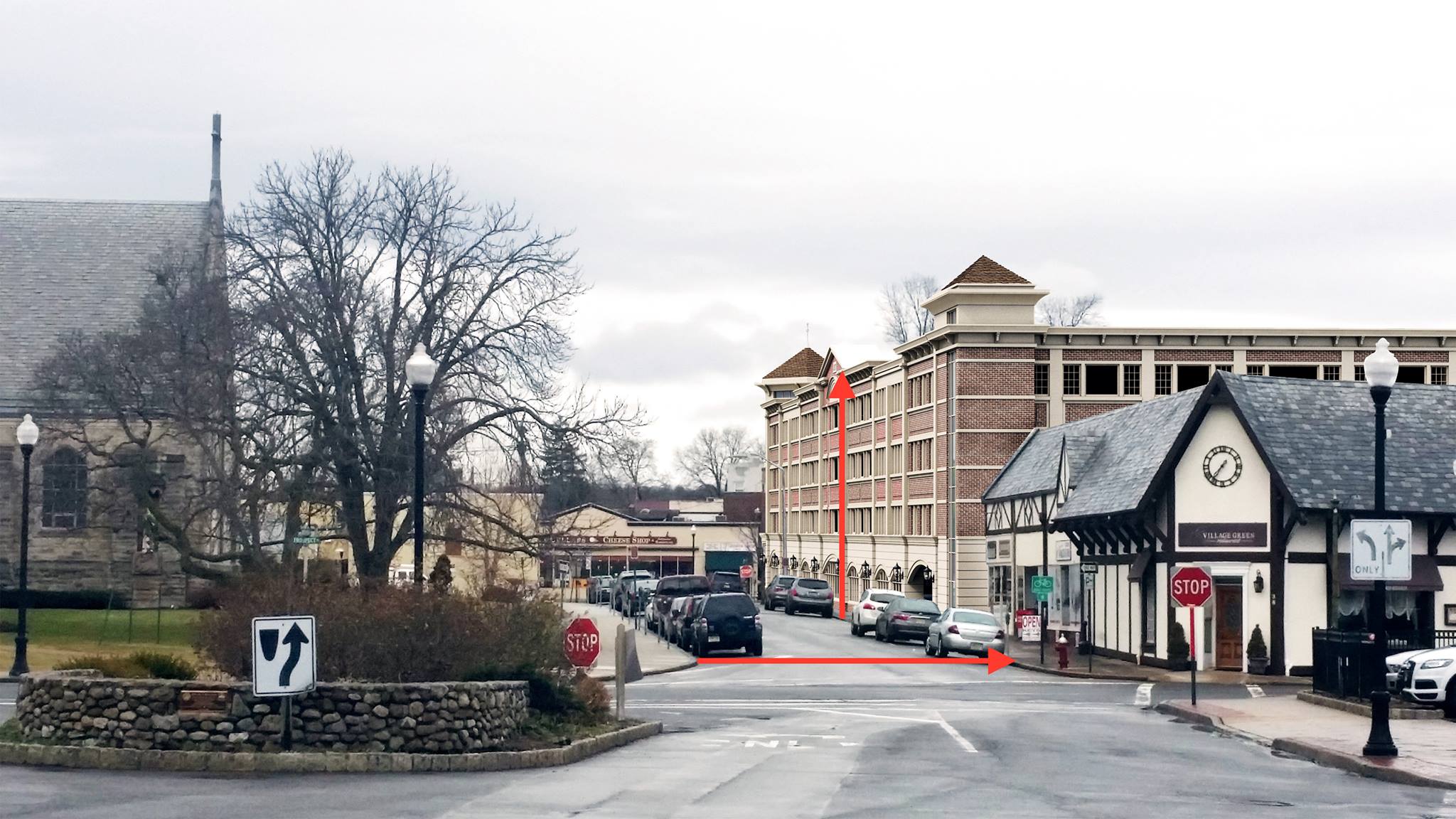
New math rule: 40+ feet is about 80% of 30 feet. Here is the proof:
Reader say rendering is out of scale
Print the attached image and then measure the two red arrows. The building which is supposed to be 40+ feet high has an arrow which is 80% in length of the street width’s red arrow. Hence Proved (that 40+ is shorter than 30)!!.
Just 15 percent of people say they have personally benefited from ObamaCare, although more than one-third believe it has helped the people of their state, according to a poll released Monday.
Most Americans — a total of 56 percent — say they haven’t felt directly affected by the Affordable Care Act. Among those who have felt affected, more people say the law has hurt them than helped them, according to polling by National Public Radio and the Robert Wood Johnson Foundation.
Twenty-six percent of U.S. adults say they have been personally harmed by the healthcare law since its passage — a fraction that likely reflects those in the poll who said they have noticed rising healthcare costs in the last several years.
Main Street speaks out: Top candidate for small biz
Elaine Pofeldt, special to CNBC.com
As Americans go to the polls for Super Tuesday, one big contingent that may wield tremendous influence is the small-business rank and file. The nation’s 28 million small businesses represent 54 percent of all U.S. sales and have provided 55 percent of all jobs since the 1970s,according to the Small Business Administration.
This should be a day of reckoning for the candidates as Main Street tries to get its voice heard. According to a recent Manta survey, a stunning 60 percent of small-business owners plan to vote in their state primaries and caucuses. Tuesday is the biggest single day for the seven presidential candidates in both parties to receive delegates, with voting taking place in 12 states, including Alabama, Georgia, Massachusetts, Texas and Virginia.
What’s driving small-business owners to the voting booths? According to John Swanciger, CEO of Manta, a social network for small-business owners, “there are issues squeezing small-business owners from every side — the economy, taxes and health care. They are looking for a candidate who understands how their sector is being impacted.”
Who comes out on top? So far, small-business owners said their No.1 pick is Republican candidate and business mogul Donald Trump in Manta’s poll. Thirty-eight percent of small-business owners said the businessman would be the best president for small business, while 21 percent said Democratic candidate Clinton would be.
Leap Year 2016: Why does February have 29 days every four years?
When is it, why does it happen and everything else you need to know about the leap year in 2016
Why do we have leap years?
A leap year, where an extra day is added to the end of February every four years, is down to the Gregorian calendar’s disparity with the solar system.
A complete orbit of the earth around the sun takes exactly 365.2422 days to complete, but the Gregorian calendar uses 365 days.
So leap seconds – and leap years – are added as means of keeping our clocks (and calendars) in sync with the Earth and its seasons.
Julius Caesar vs Pope Gregory
The Roman calendar used to have 355 days with an extra 22-day month every two years until Julius Caesar became emperor in the 1st Century and ordered his Alexandrian astronomer Sosigenes to devise something better.
Sosigenes decided on a 365-day year with an extra day every four years to incorportate the extra hours, and so February 29th was born.
In 46 BC, Julius Caesar, featured here in a self-decreed minted coin, created a calendar system that added one leap day every four years.
The system was tweaked, however, about 500 years later.
As an earth year is not exactly 365.25 days long Pope Gregory XIII’s astronomers decided to lose three days every 400 years when they introduced the Gregorian calendar in 1582.
The maths has worked ever since but the system will need to be rethought in about 10,000 years’ time. Perhaps mankind’s robot overlords will think of something.
Why does the extra day fall in February?
All the other months in the Julian calendar have 30 or 31 days, but February lost out to the ego of Roman Emperor Caesar Augustus.
Under his predecessor Julius Caesar, Feb had 30 days and the month named after him – July – had 31. August had only 29 days.
When Caesar Augustus became Emperor he added two days to ‘his’ month to make August the same as July.
So February lost out to August in the battle of the extra days.
Chris Rock came out swinging in one of the most anticipated opening monologues in years and took on the diversity controversy from the get-go at the 88th Academy Awards. Last night also saw Brie Larson win Best Actress, Leonardo DiCaprio snag Best Actor in his sixth nomination, Alejandro G. Iñárritu was named Best Directorand Spotlight won Best Picture. With all that, the Oscars themselves did not have a great night ratings-wise with a 23.1/37 in metered market results.
Declining to an 8-year low, that’s down 6% from the 24.6/39 that the ceremony got last year in early results from the 56 markets across the country. That 2015 Neil Patrick Harris-hosted Oscars were matched with the 2011 Oscars for the third worst the Academy Awards has done in MM ratings since the last time Rock fronted the gig in 2005 – only 2009’s Hugh Jackman-hosted 23.3 and 2008’s Jon Stewart-hosted 21.9 were lower. Obviously, in the early results, last night’s show dipped below 2009 and close to 2008 numbers.
The 2005 Oscars were the best the show has done in the past decade with a 30.1/43 MM rating. That high has also remained true in later numbers for the show. WithMillion Dollar Baby winning Best Picture, the 2005 Oscars ended up with a massive 42.14 million viewers and 19.6 million among adults 18-49. In both categories, that was a dip from 2004’s results. Compared to the last time Rock hosted 11-years ago, last night’s 8:30 – midnight show was down 23% in metered market results – much more than a dip.
Confidential polling data shows Hillary Clinton could lose the presidential election in heavily Democratic New York to Donald Trump as the GOP front-runner’s support grows to the point of being “surprisingly strong,” The Post has learned.
The poll results, from Democratic and Republican legislative races, have surprised many leading Dems, virtually all of whom have endorsed Clinton, while confounding and energizing GOP leaders, many of whom until recently have been opposed to Trump.
“There are some Democrats who think that Hillary can be taken if Trump mounts a strong campaign,’’ one of the state’s most prominent Democrats said.
The scene is hypothetical, but it has to be taken seriously: A water fountain at busy Newark Liberty International Airport has been spiked with the nerve agent Sarin. Doctors at University Hospital try to puzzle what is happening as victims arrive, some dizzy, others vomiting.
Could it be food poisoning? Now one is dead and more people have become exposed before it becomes apparent that some sort of biological attack has taken place.
With terrorism an increasingly possible occurrence on U.S. soil, doctors and first responders need to be prepared, says the creator of a class now offered at Rutgers’ New Jersey Medical School. While there are courses in disaster medicine around the country, Rutgers claims its two-week elective is unique in the breadth and depth of its exploration of the topic.
“This type of training is standard fare in emergency medicine residency programs, but I’m not sure that it’s too common at the medical student level,” said Mike Baldyga, public relations manager for the American College of Emergency Physicians.
“New Jersey has good reason to be concerned about terrorism,” said the developer of the course, Dr. Leonard Cole, noting that the FBI has deemed the area around Newark — with its ports, chemical plants and population density — as one of the prime terror targets in the nation. “Part of what this course does is to alert these physicians that you’ve got to pay attention to this kind of threat.”
The fourth-year medical students taking the Terror Medicine elective this week participated in the mock exercise involving airport contamination and were asked to make decisions — through the whirring of air-filters attached to the masks they donned — in responding to the emergency
Dr. Miriam Kilkarni, an assistant professor of Emergency Medicine, asked the students where in the hospital they would find the antidote for Sarin. “The time to worry about the availability of Atropine is when you start dosing the first patient!”
Protective gear was needed, as were quarantines and communication with emergency personnel on the scene — all while triage and treatment of the victims proceeded in a chaotic environment.
Ridgewood NJ , New phone scam making the rounds . Several residents report receiving curious calls from someone asking questions about there home alarm system. The “salesperson” on the other line tries to pretend like they already have information about your home alarm system or tells you you’re eligible for an upgrade. Residents have tried to call the number back, and it would not go through.
Please do not give out any information! 201-211-0822 is the number that calls . Ridgewood Police have been contacted about it, and sources say this is the first time they’re hearing of this kind of call but took the information.
N.J. public employee unions irked by Christie call to cut health benefits
Gov. Chris Christie’s budget address came with a public challenge to cut $250 million from state employees’ health benefits. Samantha Marcus, NJ.com Read more
US Supreme Court declines to hear case about NJ pensions
BY SALVADOR RIZZO
STATE HOUSE BUREAU |
THE RECORD
The U.S. Supreme Court has declined to rule on a major case involving payments to New Jersey’s pension system for public employees.
The case concerned Governor Christie’s decision to cut billions of dollars in payments he had once promised for the retirement system.
Christie began to cut those payments in 2014 despite signing laws in his first term that pledged more than $16 billion over seven years for the troubled retirement system.
Public worker unions sued, arguing that Christie and the state Legislature could not skip the higher payments. The New Jersey Supreme Court disagreed, ruling 5-2 in June that the seven-year plan was not legally binding.
BY RICHARD COWEN AND STEVE JANOSKI
STAFF WRITERS |
THE RECORD
Some parts of North Jersey are a lot like Flint, Mich.: old, industrial and poor, with many people living in houses built before World War II, drinking tap water that streams through pipes and fixtures made of lead.
Flint’s belated discovery of dangerously high levels of lead in tap water prompted a health emergency that has made national headlines. Lead in water has long been a problem in North Jersey and elsewhere, but aside from precautions utilities take to guard the water, they most often urge people to live with it by flushing their lines.
That may be changing. The U.S. Environmental Protection Agency is considering requiring the removal of lead service lines — the pipes that deliver drinking water leading into peoples’ homes. The lines are considered the main culprit in depositing lead sediment in the drinking glass.
Removing these old lead lines and replacing them with copper or plastic was one of the recommendations made by the National Drinking Water Advisory Council to the EPA in December. The council has also recommended expanding lead testing to include a broader cross-section of homes.
Now it’s up to the environmental agency, which is fashioning a new lead and copper rule, with an eye toward adoption by 2018.
Lynn Thorp, the national campaigns director for Clean Water Action, said removing service lines is expensive and complicated. But it’s the surest way to keep drinking water safe from lead, she said.
“If there’s no safe level of lead, and our efforts to control and monitor lead in the water will never be perfect, then there’s only one solution,” she said. “And that’s to get the lead out of contact with the drinking water.”
Flint plans to remove all 15,000 of its lead service lines, estimated to cost $55 million. But as a poor city, it needs to find a funding source and is looking for help from both Congress and the Michigan state legislature.
Service lines connect the home to the water main at the curb and generally are the homeowners’ responsibility. In structures that were built before 1940, these pipes were made of lead. Since then, these service lines have been made of copper or plastic, but in many older neighborhoods, the lead lines are still being used.
United Water, which serves much of Bergen County, estimates there are 9,500 lead service lines still in use, about 5 percent of the utility’s 202,000 customers.
Ridgewood NJ, In the desire to fit maximum spots on the Hudson St lot the current proposed design still proposed 5 stories (including roof level parking) while the height of the building has been reduced. This was achieved by reducing the height of every story. Residents hope the council does the right thing and does not compromise on safety in their attempt to fit maximum cars at one spot. Here is what happened at Short hills mall: Quote from the article:
“Then, more time passed because the ambulance was unable to fit under the parking deck’s ceiling, forcing first responders to roll a stretcher up an entrance ramp to Friedland.”
Mayor was FORCED to introduce this new ordinance for local bonding. He has no other option to build the garage with the petition in place. The petition has essentially killed the BCIA option.
Once again Aronsohn wrote the article for today’s Record. The petition initiative got less than one sentence. Aronsohn takes full credit for introducing the ordinance to bond in Ridgewood. Who is worse – our liar Mayor or his puppy dog reporter Janoski. They both stink.
the referendum was non-binding
Yes it was for a “parking garage on the Hudson street lot”, but the size and shape of the parking garage was not defined. It also was to be built and financed “by bonding up to $15 million in public funds, which will be paid for principally — if not entirely — with parking revenues.”
It was non-binding so it does not have to be built on the Hudson Street lot (or built at all), in the same way that it does not have to built for $15 million dollars or less nor be paid for principally (nor entirely) by parking revenues.
We all know that it will cost > $15 million dollars and will not be principally paid for by parking revenues so it also does not need to be built on the Hudson street lot – or at all.
The residents agreed by voting on the non-binding referendum to move ahead with the continued planning and funding of a deck at Hudson St. Lots of people who voted for it are now strongly opposed to what is being proposed. The non-binding referendum was put forth without alot of thought and people were not thinking about alternatives. Well, they are now and they are saying “Heck NO”. This garage just does not make sense and does not address the average Ridgewooodians needs. More centralized parking would better suit MOST of the businesses in the CBD. This deck makes sense only a few at the western end of Ridgewood Ave. The shopkeepers west of the train tracks have indicated it will do NOTHING to improve their situation and do NOT want this garage (contrary to the ad the Chamber of Commerce ran . . . not all business support this).