Posted by Scott St Clair On May 04, 2015 0 Comment
By Scott St. Clair | The Save Jersey Blog
When I was a kid, I drank out of the garden hose but didn’t die. I did it because I was hot and thirsty after having roamed all by myself on my bike throughout the neighborhood and a goodly portion of Phoenix, where I spent my pre-teen years. We all did – kids drank out of hoses and roamed, and they still do because it’s in their nature to explore and take risks.
But God forbid they do so these days or some nosy busybody will call the cops on them and they’ll be forced to sit in the back of a squad car for three hours while their parents are subjected to an inquisition-style interrogation without regard for their rights or common sense, which isexactly what happened to the Meitiv family in Maryland recently.
As if it was the crime of the century, the police apprehended a dangerous 10-year-old boy and his 6-year-old partner-in-crime sister as they walked a few blocks from a local park to their home.
Now, because they let their kids play outside without a leash or surrounded by a barbed wire fence, their parents have been tagged by the state as guilty of “unsubstantiated” child neglect, whatever that is.
MAY 4, 2015 LAST UPDATED: MONDAY, MAY 4, 2015, 1:21 AM
BY KATHLEEN LYNN
STAFF WRITER |
THE RECORD
Home construction in New Jersey has gotten off to a slower start this year, with builders starting 5,352 units in the first quarter, down 8.3 percent from a year earlier.
But Patrick O’Keefe, an economist with CohnReznick in New York and Roseland, expects builders to rev up construction later this year, giving the homebuilding sector “its best performance since 2006.” O’Keefe is forecasting that about 30,000 housing units will be started in the Garden State in 2015, compared with 28,119 in 2014.
Multifamily activity will continue to provide momentum for home construction in the state, O’Keefe said. In the first quarter, multifamily construction made up 59 percent of the building permits issued in New Jersey.
“We will be looking at multifamily as the dominant driver,” he said. For the past several years, well over half the construction in the state has been in multifamily projects — especially rentals, concentrated in Bergen, Hudson and other northeastern New Jersey counties.
One example is Hudson Lights in Fort Lee, a mixed-use project being built just south of the George Washington Bridge. Its first stage, expected to be finished at the end of this year, will include 276 rental units. A second stage, expected to be completed in 2018, will include 201 housing units.
The developer, Chicago-based Tucker Development Corp., sees continuing demand for rentals, especially in neighborhoods where stores, restaurants and transit are within walking distance.
Young people starting out in their careers want “the ability to be more mobile,” said CEO Richard Tucker.
Economists also note that many younger adults are renting, rather than buying, because it’s difficult to qualify for mortgages and because they are wary about investing in a home after seeing values crater during the housing crash.
Adding to the demand for rentals, Tucker said, are empty nesters who decide they don’t need large houses anymore.
The national homeownership rate is 63.7 percent, the lowest level since 1993. The rate had exceeded 69 percent in 2004 as mortgage lenders loosened their credit standards and lent to many people who couldn’t afford the payments and ended up losing their homes.
Homebuilders’ slow start this year is only temporary, O’Keefe said, citing the complex planning and approval process involved in multifamily projects.
RIDGEWOOD — Imagine you’re strolling down the congested hallway of a hospital, barely paying any mind to strangers passing by, when shots ring out just feet in front of you.
Do you find the nearest room and take cover? Do you run from the deafening noise, looking for an exit?
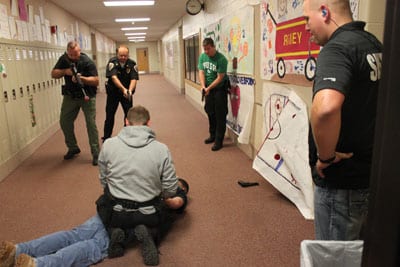
A group of 40 people were forced to make that split-second decision Friday morning as part of a training exercise that was staged inside The Valley Hospital in Ridgewood.
Representatives from the Ohio-based ALICE Training Institute promoted a more proactive response in these situations than just hiding and waiting for police to arrive.
People scattered when a blond woman, armed with a gun, emerged from an auditorium Friday recklessly firing off shots in the form of yellow plastic pellets. The screech of an air horn accompanied each of her shots.
Men and women darted out of sight. Some disappeared down adjacent corridors while others ducked into conference rooms where, within seconds, they had the lights turned off and the doors barricaded.
MAY 4, 2015 LAST UPDATED: MONDAY, MAY 4, 2015, 1:21 AM
BY CHRIS HARRIS
STAFF WRITER |
THE RECORD
RIDGEWOOD — Restoration work will soon begin on an 80-year-old Gaetano Federici sculpture that was discovered last year in the woods behind the village’s water treatment plant.
It will take about three weeks for a restorer to clean and refurbish the renowned Paterson artist’s cast stone statue, said Ridgewood Councilwoman Susan Knudsen.
“It is a rather stately piece that everyone can appreciate,” Knudsen said.
The sculpture depicts an earlier version of New Jersey’s state seal. The 1927 piece features two female figures — Liberty and Ceres — with three plows, representing agriculture’s importance to the state. As with the state seal, the head of a horse — New Jersey’s official animal — tops the statue.
Until last week, the statue had remained in the same spot it occupied for the four decades before it was unearthed: atop two old tires, covered with a tarp.
But last Friday, Ridgewood workers gingerly moved the sculpture onto a wooden pallet. A forklift was then brought in to transport it to a safer location, Knudsen said.
The statue now sits on a table specifically constructed for it, awaiting fine-art restorer and Ridgewood resident Ornella Muth’s magic touch, Knudsen said.
05/05/15 7:30PM Planning Board Public Meeting – Village Hall Court Room
Please join us on Tuesday, May 5th at Village Hall at 7:30 pm
Agenda: Public Hearing on the Revised Amendment to the Master Plan that was put forth on April 21st
We need your attendance at the next Planning Board meeting on Tuesday. We are close to the end, but we must still attend the meetings and continue to urge our Planning Board to act cautiously when altering our Master Plan.
At the last Planning Board meeting on April 21st, the Village Planner, Blais Brancheau, presented a NEW Amendment that takes a one-size-fits-all approach to increasing density — a risky approach that we do not support. In our opinion, Mr. Brancheau continues to plan for profit, not for the people of Ridgewood. The revised amendment is VERY different from the amendment that was proposed in November of 2013 and in our opinion, is looking more and more like spot zoning. (The revised amendment is attached.)
Thoughts:
Blais Brancheau, the Village planner, stated that the zones he identified as suitable for high-density housing in the first amendment were being considered because housing at these locations would be beneficial to the public at large. Why then, in the 11th hour, did the planner eliminate several properties (West Bergen Mental Healthcare and neighboring properties) that have been in consideration for more than two years? We never, not even once, heard any Planning Board member suggest this change. Yet this was one of the biggest changes in the revised amendment. We don’t get it.
In another significant change, the much larger Ken Smith property has been lumped into the same zone as the smaller Enclave (Sealfon’s) site. This move makes a bold statement. By combining these two sites into one zone, the Village planner has thrown all of the initial criteria he specified when identifying zones for high-density housing out the window. These are two very unique properties and their zoning benefits should differ. By lumping them together and labeling them as one in the same, Mr. Brancheau has basically set up every property in between these two sites to argue for the same zoning benefits. In our opinion, this is a reckless approach.
The new Amendment allows for up to 35 units an acre, with affordable for rent units included. While this is indeed an improvement from the 40-50 units put forth in the initial Amendment, in our opinion, this is still too big of a jump from the 12 units per acre that is permitted now and the 22 units per acre average that currently exists in our down town. Instead of establishing a maximum density up to 35 units per acre, why not raise the minimum and allow our village to examine each new development on a case by case basis? We recommend raising the baseline density to 24 units an acre, doubling the permitted allowance. Our Planning Board could then work to establish criteria that would allow for density bonuses, beyond the baseline. For example, if developers can provide for more parking, affordable housing units, open space, greater set backs, green building practices, etc… they would be allowed a bonus of more units per acre than the baseline. This cautious approach would be preferable to a one size fits all zoning change that could have irreversible repercussions.
Mr. Brancheau is capable of crafting this amendment differently, yet he continues to offer the same benefits across the board to all zones, regardless of the context or the surrounding location. We don’t understand why. From our vantage point, many Planning Board members seemed flustered by the changes to the Amendment and some even expressed question or concern. The only Planning Board member who seemed to embrace these changes was Mayor Aronsohn. He seems very eager to move forward and get this done.
CBR wants this process resolved as well, but we want it done RIGHT. We don’t want the Planning Board to rush to a decision. We just received a copy of the new Amendmenton Friday, and the Public Hearing is TUESDAY! We live here and we care about the future of our town. Long after politicians are out of office and eager developers have reaped their profits, we will still be left here, living with the consequences. Please join us on TUESDAY, May 5th at Village Hall at 7:30 pm. Let’s continue to urge our Planning Board to get it right!
Here are two links to Letters to the Editor that provide more detail about our position:
MAY 3, 2015, 10:59 PM LAST UPDATED: SUNDAY, MAY 3, 2015, 11:09 PM
BY CHRISTOPHER MAAG
STAFF WRITER |
THE RECORD
More buses. More trains. Big improvements, like a new tunnel under the Hudson River, and small ones, like better Internet connections. Getting home in time to tuck the kids into bed.
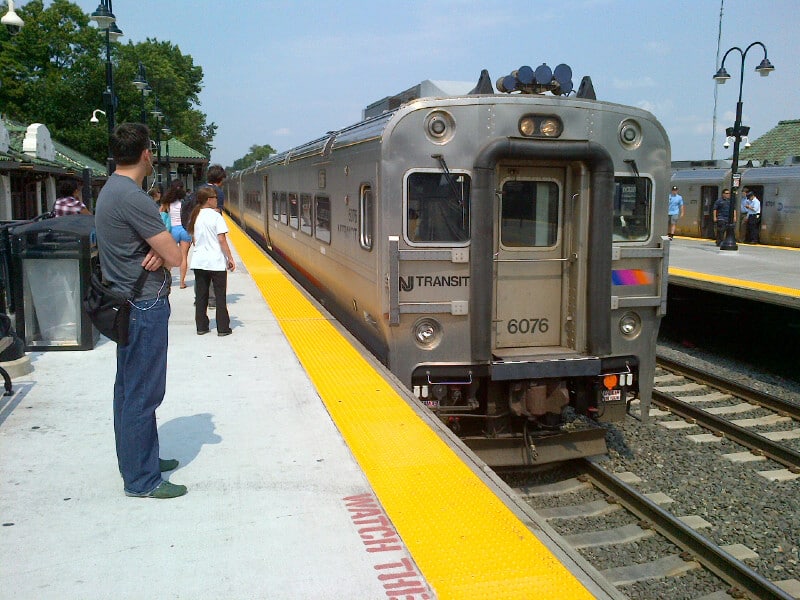
That’s what commuters say a proposed 9 percent jump in NJ Transit fares should help fund.
Oh, and spare riders the middle seat on trains.
“I loathe the middle seat. Who doesn’t?” said Tara Allerton, 41, an advertising executive and frequent NJ Transit commuter who wants more double-decker trains between New York City and her home in Ridgewood “to spend more time at home with my family.”
But NJ Transit officials say that the money — and some service cuts — are needed to close the agency’s $60 million budget gap.
Most transit riders said they understand that NJ Transit is not considering any service improvements, a fact confirmed by Nancy Snyder, an NJ Transit spokeswoman. Instead the proposed fare increase — the first one since a 2010 fare increase of 25 percent — is intended only to pay for basic operating expenses. But that alone won’t be enough. Late-night service cuts will be felt on the Pascack Valley and Montclair-Boonton rail lines.
“It’s a fare hike to keep the lights on, but it’s worse than that because there are service cuts,” said Janna Cherwitz, New Jersey policy analyst for Tri-State Transportation Campaign, which advocates for better mass transit.
Commuters will get their say this month, in a series of 10 hearings and public information sessions held at sites throughout the state, including Secaucus, Hackensack and Paterson. And it’s likely NJ Transit officials could get an earful.
Officials already know the agency has a problem with the on-time performance of its buses, and they know how riders feel about it. Only 69 percent of NJ Transit’s buses left on time during the first three months of 2015, according to a report presented to the agency’s customer service committee late last month. The agency received 3,459 complaints in March, according to the report. The most common problems included delayed and canceled trips, missed connections and no-show buses.
Train riders fare much better. During the 12 months that ended in March, 94 percent of trains left on time, according to NJ Transit.
Meanwhile, ridership continues to grow, increasing by 2.3 percent over the last year to 271.3 million passenger trips, a record, according to the agency’s latest financial report.
That has only increased the cries for better service, it seems.
“If they’re going to ask for more money, they should give us more trains,” said Randy Pernicone, who commutes from River Edge to his job in Manhattan as a finance executive for Anthem Insurance. “It’s frustrating.”
Michael McDaid of Ho-Ho-Kus echoed that sentiment.
“I would like to see more trains in the evenings and weekends,” said the 42-year-old, who rides the train to his job in Hoboken. “I guess they’re not really talking about that. But still, it would be nice.”
U.S. Split Along Racial Lines on Backlash Against Police, Poll Finds
By JANET HOOK
Americans are bracing for a summer of racial disturbances around the country, such as those that have wracked Baltimore, with African Americans and whites deeply divided about why the urban violence has occurred, a new Wall Street Journal/NBC News poll has found.
A resounding 96% of adults surveyed said it was likely there would be additional racial disturbances this summer, a signal that Americans believe Baltimore’s recent problems aren’t a local phenomenon but instead are symptomatic of broader national problems.
When asked to explain recent events in Baltimore and other cities that have seen confrontations between police and members of the African-American community, blacks and whites viewed the situation differently.
Asked to choose between two possible explanations for recent events, 60% of blacks said they reflected “long-standing frustrations about police mistreatment of African Americans.” Some 27% of black respondents said the disturbances were caused by people who used protests over an African American man dying in police custody “as an excused to engage in looting and violence.”
But among whites, the balance of opinion flipped: 58% said people were seizing an excuse to loot, while 32% said the events reflected long-standing frustrations with police.
While most people in the survey predicted further racial disturbances this summer, a smaller share expected them to hit close to home. The poll found that 53% of whites and 46% of African Americans said it was likely there would be a racial disturbance in the metropolitan area nearest to them.
Full results of the new Wall Street Journal/NBC News poll, including public opinion of the 2016 presidential contenders, will be released on Monday evening.
Garrett Calls on DOT and OMB to Finalize Hazardous Materials Rule for DOT-111 Tank Cars
Apr 29, 2015
WASHINGTON, D.C. – Rep. Scott Garrett (NJ-05) yesterday called on Transportation Secretary Anthony Foxx and OMB Director Shaun Donovan to complete their final review of a rule regarding DOT-111 tank cars by their May 2015 deadline. This rule could protect New Jersey from a potential hazardous materials disaster by ensuring freight cars have adequate safety standards.
Since 2011, the Pipeline and Hazardous Materials Safety Administration (PHMSA) has been working on a proposed rule, the Enhanced Tank Car Standards and Operational Controls for High-Hazard Flammable Trains, to determine the safety of DOT-111 tanks cars. DOT-111 tank cars are used for the transportation of hazardous materials, including crude oil and ethanol. They have been identified by the National Transportation Safety Board (NTSB) as having design elements that pose a clear, demonstrated risk that hazardous materials could be released during a rail accident.
“The American public entrusts the DOT with the responsibility of ensuring that hazardous materials are transported safely by rail, making any further delays of this proposed rule completely unacceptable,” said Garrett. “A timely review of the DOT’s final rule will allow the rail industry to begin to make the necessary changes to their existing rail cars, budget for new costs, and protect New Jersey from a potential disaster. My constituents need assurance that adequate protections are in place when hazardous materials are being transported through our communities.”
In 2013, nearly half a million carloads of crude oil were transported by rail in the United States. In New Jersey alone, there are approximately 2,400 miles of rail freight lines. Reps. Frank LoBiondo (NJ-02), Chris Smith (NJ-04), Leonard Lance (NJ-07), and Rodney Frelinghuysen (NJ-11) signed Rep. Garrett’s letter.
Buffett Affirms Junk Food, Citing Lack of Smiles at Whole Foods
by Noah Buhayar ,Sonali Basak
Warren Buffett, whose Berkshire Hathaway Inc. is the largest investor in Coca-Cola Co. and owns See’s Candies, affirmed his confidence in the market for sugary treats, even as the health costs of sweets become better known.
Buffett, 84, told shareholders at Berkshire’s annual meeting Saturday in Omaha, Nebraska, that happiness is important to longevity and that consumers enjoy Coke products.
“I don’t see smiles on the faces of people at Whole Foods,” he said, citing a grocery chain known for offerings such as almond butter and organic frozen blue curled kale.
We are so excited to announce our 4th annual Mary Therese Rose Run. It will be held on Saturday May 9, 2015 at the beautiful Darlington County Park in Mahwah NJ. This will be a morning of family fun activities, 5K, prizes, and food. Online registration is available at
A new poll from Harvard University’s Institute of Politics has some alarming findings about the trustworthiness of the American media. Among adults aged 18-29, the poll found that just 12 percent believe the media “do the right thing.”
An even more startling 88 percent said they “sometimes” or “never” trust the media and just 2 percent of 18-29 year olds said they trust the media to do the right thing “all of the time.” 39 percent said the media “never” do the right thing.
The Washington Examiner’s Paul Bedard called this poll “the latest nail in the media’s coffin, a downward spiral that has resulted in fewer younger Americans reading traditional media and especially traditional platforms such as newspapers and magazines.”
The poll also found that the public’s view of the media’s ability to “do the right thing” ranked the lowest when compared to other organizations. Media ranked 12th with scientists coming in as number 1 followed by the United States military, local police, the Supreme Court, the United Nations, President Obama, local government, state government, federal government, Congress, and Wall Street.
Not only is the media consistently ranked as untrustworthy by the American public, a recent Quinnipiac poll found that among the different media outlets, MSNBC is the least trusted source of news in the United States, while Fox News was the most trusted.
According the poll, just 7 percent of Americans trust MSNBC, with NBC News and CBS news each considered trustworthy by 10 percent. ABC News garnering just 8 percent of the American public’s trust. Fox News ranked first, earning the trust of 29% of Americans.
The city got the full brunt of state coercion, decade after decade
JEFFREY A. TUCKER
April 29, 2015
If you have seen The Wire, you know the score. There are consequences to state management of any social order. Baltimore is a paradigmatic case. How long can people continue to evade the obvious lessons?
It began more than 100 years ago with the imposition of state segregation. This was the original sin that created a second-class of citizenship and racial ghettos for the first time since the end of the Civil War. Every policy response follows from there, with one coercive mistake following another. This town became the backyard playground for the ruling-class planners in Washington, DC. The intellectuals and lawmakers behind these policies cannot reasonably claim to escape responsibility.
Baltimore blew up in riots and fires in the days following the astonishinglycruel death of Freddie Gray (and the stonewalling of the police department about how and why he was killed). But it is a mistake to focus the blame on this incident alone.
What happened in Baltimore is the product of the drug war, a racially punitive policing system, failed public services, segregated public housing, urban renewal, endless rounds of progressive education reform, a highly regulated labor market that cuts off economic opportunity, occupational licensure, gun control, and permanent martial law that makes everyone feel like prisoners.
Baltimore got the full brunt of it all, at every stage, decade after decade.
What do all these policies have in common? They represent the fatal error, common for the better part of a century, of believing that policy elites can manage the social order better than the social order can manage itself. Only the ruling class can decide where and how people should live, how they will be educated, what they can buy and sell, the terms of labor contracts, what businesses come and go, and who gets to enter into certain occupations and the terms under which they may do so. The government would do it all: build and maintain the housing, provide the education, make the jobs, set the pay, enable the security, and administer the justice.
by JOEL GEHRKE May 2, 2015 3:24 PM
Carly Fiorina made the case for her prospective presidential candidacy on Saturday, just days before she’s expected to officially jump into the race, telling a room full of conservative activists and writers that she has the policy background and the political skills to beat Hillary Clinton in a general election. “Hillary Clinton may be a vulnerable candidate, in many ways, but we should not underestimate her,” Fiorina said at the National Review Institute Ideas Summit. “We have to have a nominee who can take punches, but we [also] have to have a nominee who will throw punches.”
Fiorina’s political ambitions have met with derision among political experts, given that the only people to serve as president without holding prior elected office were war heroes. Fiorina argued that her experience rising from the secretarial pool to CEO at Hewlett Packard makes her a true outsider who can direct the general disgust voters feel toward Washington, D.C. — and toward crony capitalism in particular — at Hillary Clinton.
Sen. Ted Cruz (R-Texas) said Saturday that the culture wars show off the cozy relationship between Democrats and corporate America.
Speaking in South Carolina, Cruz bemoaned the “perfect storm of the Democratic Party and big business coming together,” according to Bloomberg.
The Texas Republican was specifically referencing the recent fight over Indiana’s law on religious freedom. But Cruz noted that there’d been similar spats in Houston and elsewhere in the U.S., and insisted conservatives needed to gear up for the battle to defeat gay marriage.
“Just because you’re paranoid doesn’t mean they’re not out to get you,” Cruz said.
Former Maryland Gov. Bob Ehrlich (R) said Saturday better parenting from fathers may have prevented riots earlier this week in Baltimore.
“If more fathers would have been in those homes the first day those kids congregated and all the trouble started, and said, ‘You know what? There’s a way to do this, let’s do it right, let’s not go torch things, we need to protest, we need to dissent, we need to do what we do, but not this,’ maybe we wouldn’t be in the jam we are right now,” Ehrlich told the Boston Globe.
Ehrlich was reacting to Friday’s announcement that six Baltimore police officers will face criminal charges in the death of Freddie Gray. He added that “the timing” of that decision was “somewhat surprising.”
“The thought was that the prosecutor would take time … to do her investigation, determine the facts, look at this report and determine how to proceed,” he said of Baltimore State’s Attorney Marilyn Mosby’s handling of the Gray case.
Friday’s ruling that Gray’s death was a homicide calmed Baltimore after periodic riots launched earlier this week. The fact Gray was black, Ehrlich argued, had shifted debate over his passing from police brutality to race.
“It shouldn’t be about race but it is, because this is America,” he said. “Race is just there. It’s just there.”
“It’s frustrating,” Ehrlich added. “It should be about the police practices in this city and not about race.”