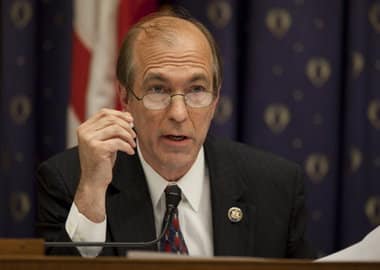
Garrett Gets off to a fast Start in 114th Congress by Introducing Nine Bills
Jan 9, 2015
WASHINGTON, D.C. – Rep. Scott Garrett (NJ-05) issued the following statement after introducing nine bills on the first day of the 114th Congress:
“The American people deserve leadership and fresh ideas to fix the problems facing our country. I’m looking forward to working with my colleagues on both sides of the aisle and the new Senate majority to send these bills to President Obama’s desk, so we can get our country moving again.”
Below is a list of the bills that were introduced:
H.R. 113 – The Federal Reserve Accountability and Transparency Act of 2014 (FRAT) Act
The FRAT Act would ensure greater accountability and transparency at the Fed and re-establish Congress’ robust oversight over the agency’s rulemaking functions. In particular, the FRAT Act would require the Fed to increase its responsiveness to Congress, increase the transparency of its regulatory activities, and foster accountability in its international negotiations.
H.R. 114 – The Jerusalem Embassy and Recognition Act
The Jerusalem Embassy and Recognition Act would recognize Jerusalem as the undivided capital of Israel and require that the U.S. Embassy in Israel be moved from Tel Aviv to Jerusalem.
H.R. 115 – The Freedom of Travel Act
The Freedom of Travel Act would protect Americans’ Fourth Amendment rights by denying the TSA the authority to conduct unreasonable and intrusive searches of individuals outside of airports.
H.R. 116 – The Small Business Freedom of Commerce Act
The Small Business Freedom of Commerce Act would allow a small business operating in the United States to elect to be exempt from any federal rule or regulation issued on or after January 20, 2009. The small business would be required to notify the federal agency that issued the rule or regulation that it has elected such exemption, and makes the exemption effective 30 days after such notification.
H.R. 117 – The Reclaiming Individual Liberty Act
The Reclaiming Individual Liberty Act would strip the unconstitutional individual mandate contained in the president’s health care bill.
H.R. 118 – The Surface Transportation and Taxation Equity (STATE) Act
The STATE Act would return primary responsibility for transportation and infrastructure projects back to the states without increasing taxes. This legislation would increase the revenue available to states while enabling them to prioritize projects based on safety, traffic needs, and improved commerce without being subject to federal mandates.
H.R. 119 – The Budget and Accounting Transparency Act
The Budget and Accounting Transparency Act would increase transparency in federal budgeting by ensuring the full costs of federal credit programs are included in the budget and in cost estimates for legislation.
H.R. 120 – The War Powers Repeal Resolution
The War Powers Repeal Resolution would repeal the War Powers Resolution and return the power to go to war to its rightful place—the United States Congress.
H.R. 121 – The Local Education Authority Returns Now (LEARN) Act
The LEARN Act would give states the option to opt out of No Child Left Behind. In return, the federal government would provide taxpayers of the opt-out state a tax credit, thereby keeping money in the pockets of taxpayers instead of sending it to Washington, D.C. This method immediately cuts the authoritative and financial strings of the federal government so that state and local governments can set their own educational standards while ensuring maximum parental involvement.
TRENTON – Several bills centered on hunting, including two controversial proposed measures, were released by the state Senate Environment and Energy Committee on Monday.
The two most controversial bills, both passed by a slim 3-2 margin, centered on where and how hunting should be allowed in New Jersey, particularly on Sunday.
One of the Senate bills (S1683) released authorizes Sunday bow hunting on federal military installations. (Bonamo/PolitickerNJ)
More expected to flee New Jersey as baby boomers age
For Raymond Francisco, landing a job at the General Motors auto plant in Linden at 25 years old was like winning the lottery.
The New Brunswick native was a welder by trade, and enjoyed working hard for the good money he made at the plant. But when GM announced in 2002 it would close the factory — about six years after he started — Francisco decided he had to go where the jobs were.
That meant packing up his wife, two small children and moving to Lordstown, Ohio, where GM offered him another job at an assembly plant.
People are leaving New Jersey at a higher rate than 47 other states, just behind New York, which is No. 1, and Illinois, according to James Hughes, a demographer and dean of the Edward J. Bloustein School of Planning and Public Policy at Rutgers University, New Brunswick. (Kachmar/Asbury Park Press)
Poll: NJ voters feel state headed in wrong direction
JANUARY 13, 2015, 6:47 AM LAST UPDATED: TUESDAY, JANUARY 13, 2015, 6:48 AM
BY HERB JACKSON
WASHINGTON CORRESPONDENT |
THE RECORD
As Governor Christie goes before the Legislature to deliver his annual State of the State speech today, residents are skeptical about his motives and increasingly pessimistic about New Jersey’s direction, a new poll says.
Just 36 percent of the state’s voters believe New Jersey is headed in the right direction, while 49 percent say it’s on the wrong track, according to the new PublicMind poll released today by Fairleigh Dickinson University. That’s a decline from last March, when 41 percent said right direction and 45 percent said wrong track.
The poll also found those who disapprove of the job Christie is doing exceed those who approve by 47 percent to 39 percent. In January 2014, those numbers were almost reversed, with 48 percent approving and 39 percent disapproving.
Entering his sixth year as governor, Christie will deliver the annual address required by the state constitution at 2 p.m. in the state Assembly chamber.
“This is the first time Governor Christie faces a public with numbers like these in regard to his leadership,” said the poll’s director, FDU political science professor Krista Jenkins.
Many New Jerseyans believe Christie has his sights set beyond Trenton.
U.S. military social media accounts apparently hacked by Islamic State sympathizers
Hackers claiming allegiance to the Islamic State took control of the social media accounts of the U.S. military’s Central Command on Monday, posting threatening messages and propaganda videos, along with some military documents.
The command’s Twitter and YouTube accounts were eventually taken offline, but not before a string of tweets and the release of military documents, some of which listed contact information for senior military personnel. A Centcom spokesman confirmed their accounts were “compromised,” and said later that the accounts have been taken offline while the incident is investigated more.
“CENTCOM’s operation military networks were not compromised and there was no operational impact to U.S. Central Command,” a military statement said. “CENTCOM will restore service to its Twitter and YouTube accounts as quickly as possible. We are viewing this purely as a case of cybervandalism.”
Pension reform talk may heat up as Christie readies State of the State address
TRENTON — When Gov. Chris Christie delivers his 2015 State of the State address Tuesday, lawmakers and public workers will no doubt be listening for remarks on pension reform.
On the eve of that speech, and months after a commission’s report on recommendations for the ailing pension system was expected to be released, legislators, union leaders and lobbyists say they are expecting to hear from the governor on one of the biggest issues facing Trenton. Christie’s office has not yet provided any details about his annual address to the state Legislature.
The governor made mention of the ailing public employee pension system nine times in his 2014 address, proposing to crack down on pension fraud and engage on pension reform.
Ron Paul: “Reality Is Now Setting In For America… It Was All Based On Lies & Ignorance”
Submitted by Ron Paul via The Ron Paul Institute for Peace and Prosperity,
If Americans were honest with themselves they would acknowledge that the Republic is no more. We now live in a police state. If we do not recognize and resist this development, freedom and prosperity for all Americans will continue to deteriorate. All liberties in America today are under siege.
It didn’t happen overnight. It took many years of neglect for our liberties to be given away so casually for a promise of security from the politicians. The tragic part is that the more security was promised — physical and economic — the less liberty was protected.
With cradle-to-grave welfare protecting all citizens from any mistakes and a perpetual global war on terrorism, which a majority of Americans were convinced was absolutely necessary for our survival, our security and prosperity has been sacrificed.
It was all based on lies and ignorance. Many came to believe that their best interests were served by giving up a little freedom now and then to gain a better life.
The trap was set. At the beginning of a cycle that systematically undermines liberty with delusions of easy prosperity, the change may actually seem to be beneficial to a few. But to me that’s like excusing embezzlement as a road to leisure and wealth — eventually payment and punishment always come due. One cannot escape the fact that a society’s wealth cannot be sustained or increased without work and productive effort. Yes, some criminal elements can benefit for a while, but reality always sets in.
Reality is now setting in for America and for that matter for most of the world.The piper will get his due even if “the children” have to suffer. The deception of promising “success” has lasted for quite a while. It was accomplished by ever-increasing taxes, deficits, borrowing, and printing press money. In the meantime the policing powers of the federal government were systematically and significantly expanded. No one cared much, as there seemed to be enough “gravy” for the rich, the poor, the politicians, and the bureaucrats.
Ridgewood Chamber of Commerce presents RIDGEWOOD YOUNG PROFESSIONALS EXCHANGE *RYPE*
let’s get to business!
with great success, we invite you to attend our upcoming event!
Young Professionals
Networking meeting
Thursday,
Thursday, January 29, 2015
6:00pm-7:30pm
27 Chestnut Street
Ridgewood, NJ 07450
walk through LaPiazza restaurant patio, go through glass doors, take elevator to first floor.
Bring your business cards and enjoy our casual networking atmosphere while promoting for
your business.
***************************
R.Y.P.E. is a group for those 40 years of age and younger, and affiliated with the Ridgewood Chamber of Commerce. We give young professionals an opportunity to get involved with like minded individuals to help create new business relationships!
Do you feel the large networking events seem overbearing because it might be your first time or you are relatively young and/or inexperienced compared to your peers?
R.Y.P.E. is your solution!
This is your opportunity to really get to know others with a similar age who may be potential referral sources.
Not a young professional?
Feel free to send a colleague on behalf of your business!
THE GROUP’S GOALS will be to:
– provide a forum in which
to discuss your business.
– share your business mission and highlight what distinguishes it from other businesses.
-Grow your business and develop networking skills.
RYPE will give you the opportunity to get to know other business owners in a non-formal setting so that you will feel comfortable providing referrals to and receiving referrals from, other young Chamber Members.
We hope you join us!
RSVP
Allison Beer
201-345-1893 [email protected]
We look foward to seeing you there!
Your Hosts:
Allison Beer
YWCA of Bergen County
Stewart G. Einwohner, Esq.
Stewart G. Einwohner, P.C.
White House: ‘It’s fair to say’ we were wrong on Paris unity rally
By Justin Sink – 01/12/15 01:54 PM EST
The White House erred in not sending a higher profile representative to this weekend’s solidarity march in France following a terrorist attack on a satirical newspaper, press secretary Josh Earnest said Monday.
“It’s fair to say we should have sent someone with a higher profile to be there,” Earnest told reporters at the White House.
“Had the circumstances been a little bit different, I think the president himself would have liked to be there,” Earnest added.
The White House said planning for the march had begun only 36 hours before the event, and that the security required for the president to visit would have been “onerous and significant.”
Still, Earnest said, there should be no doubt that the administration and the American people stood in solidarity with France, nor that the United States was “committed to a strong relationship. The United States is with France and committed to the same kind of values they are.”
The White House would not discuss whether it considered sending the president at any point.
Earnest said he did not know why Attorney General Eric Holder, who was in Paris earlier Sunday for a series of high-level counterterrorism meetings, was unable to stay to attend the march. He also said he did not know what the president, who remained at the White House throughout the day, did with his time.
How to Live a Good, Happy Life (and Not Be Tranquilized by Drugs, Sex and Mass Media)
Lee Edwards / January 11, 2015
These are troubling times for many Americans. The economic recovery since the Great Recession of 2008 has been the slowest in U.S. history, with millions of out-of-work Americans so discouraged they are no longer even trying to find a job. Forbes puts the real unemployment rate at 12.5 percent.
Consumer confidence about the future, according to the University of Michigan, stands at a limp 73.7, similar to past recession lows. The national exit poll taken after the November elections found that 78 percent of the people feel that you can only “sometimes” (60 percent) or “never” (18 percent) trust Washington “to do what is right.”
You can hardly blame people for being so negative about their government, given the actions of the anti–Tea Party IRS, the grievously ineffective Department of Veterans Affairs, and the overly inquisitive National Security Agency.
Most important of all, there is our culture. George Orwell was wrong, and Aldous Huxley was right: The true danger is not a totalitarian government ruled by Big Brother, but a hedonistic society tranquilized by drugs, sex, and mass media.
Subscribe to updates and alerts
We are bombarded on all sides by pernicious messages. The Ten Commandments and the Golden Rule are fusty and old-fashioned and should be cast aside. Smoking a cigarette is banned, but smoking a joint is celebrated. “Pot entrepreneurs” are pushing to make Washington the Pot Capital of the World. Same-sex marriage is protected by our legal system, while traditional brides and grooms are patronized.
Cohabitation is the new norm for young couples. In the past decade, the percentage of children born outside of marriage grew by almost 7 percent; the unwed birth rate for African Americans is over 70 percent. The proportion of twelfth-graders admitting to drug use — ranging from marijuana to cocaine to heroin — is more than 25 percent.
The number of movies that offer death and destruction tops those concerned with life and love. TV programs such as House of Cards and Scandal, whose protagonists are corrupt, violent public officials, win awards. George Clooney is more famous than George Washington among our schoolchildren.
Jon Stewart has replaced Walter Cronkite as the most trusted newsman in America. As the head of the Parents Television Council said, “In order to watch cable news, ESPN, Disney, or the History Channel, every family in America must now also pay for pornography on FX.” The smartphone is turning us into dummies, able to communicate only with our thumbs.
If that were all there was to our society, many citizens, intent only on self-gratification, might not even bother to answer the question, “Is life worth living?” They would simply keep on surrendering to the impulse of the moment. But we are not yet at such a state of mindless, endless pleasure-seeking. A solid majority of Americans believe in God and go to church. Americans remain the most charitable and connected people on earth. They belong to countless voluntary associations — social, religious, educational, racial — that solve problems without government prodding or regulation.
So the bothersome question, “Is life worth living?” is bothersome because it forces us to consider not only our own life but the lives of others.
Aristotle, described by St. Thomas Aquinas as simply “The Philosopher,” said that happiness is the purpose of human existence. But happiness is not simply pleasure or self-gratification — it is the daily exercise of the classical virtues, led by prudence. Happiness, Aristotle said, is the sum of our whole life, “for as it is not one swallow or one fine day that makes a spring, so it is not one day or a short time that makes a man blessed and happy.” And since man is a rational animal, Aristotle said, human happiness depends on exercising reason, not being ruled by fleeting passions.
But Aristotle was a Greek philosopher who lived some 2,300 years ago. What do modern American thinkers say about what constitutes a good life, a worthwhile life?
Mary Rice Hasson of the Ethics & Public Policy Center counsels against despair. We have not yet lost the culture wars, she insists. For example, only 7 percent of Americans say that abortion is morally acceptable, only 4 percent say extramarital affairs are morally acceptable, and 50 percent think that homosexual activity is a sin. Overall, 72 percent of adults are still married to their first spouse. The sinews of a good society are there, if atrophied.
According to the conservatives’ favorite president, Ronald Reagan, “Every individual is unique, but we all want freedom and liberty, peace, love and security, a good home, and a chance to worship God in our own way; we all want the chance to get ahead and make our children’s lives better than our own.” Above all other places, Reagan wrote, America “gives us the freedom to reach out and make our dreams come true.” Note there is no mention of the government guaranteeing a job or a minimum wage or first place at the finishing line.
Best known for his political writing, William F. Buckley Jr. suggested in his book “Nearer, My God,” that work and prayer were the real stuff of a good life. “However routine,” he wrote, “work is a fortifying experience, your intimate sense of your own productivity.” Of his visit to the French town of Lourdes, the site of a thousand miracles, the Roman Catholic Buckley said that the pilgrims who visited Lourdes did so out of a conviction that “the Lord God loves his creatures, healthy or infirm; that they — we — must understand the nature of love, which is salvific in its powers.”
The Jewish psychiatrist Viktor Frankl, a survivor of the Holocaust, reflected on how his experience in the concentration camps shaped his understanding of a meaningful life. “The more [someone] forgets himself,” he wrote, “giving himself to a cause or another person — the more human he is . . . the more he really becomes himself.”
An enduring memory from the camps, he said, was the men who walked through the huts comforting others, giving away their last piece of bread. While few in number, they offered “sufficient proof that everything can be taken from a man but one thing: the last of the human freedoms . . . to choose one’s own way.”
In his 1985 message to the youth of the world, Pope John Paul II addressed directly the many temptations surrounding young people, such as “the fantasy worlds of alcohol and drugs . . . short-lived sexual relationships without commitment to marriage and family,” cynicism, and even violence. The secular consumer-dominated world suggested that man would find fulfillment in such fantasies, a suggestion firmly rejected by John Paul, who quoted Christ: “You will know the truth, and the truth will make you free.”
And what does it mean to be free? the pope asked. It does not mean “doing everything that pleases me, or doing what I want to do. . . . To be truly free means to use one’s own freedom for what is a true good . . . to be a person of upright conscience, to be responsible, to be a person ‘for others.’”
On a less elevated plane, the social scientist Charles Murray offered five rules for a happy life, ranging from marrying young to not worrying about fame and fortune, and he included this arresting advice: Watch the movie “Groundhog Day” repeatedly. Without preaching, Murray wrote, “the movie shows the bumpy, unplanned evolution of [the] protagonist from a jerk to a fully realized human being — a person who has learned to experience deep, lasting and justified satisfaction with life even though he has only one day to work with.”
In the final pages of his autobiography, “The Sword of Imagination,” the historian and man of letters Russell Kirk reflected that he had sought during his lifetime three ends: (1) to conserve a patrimony of order, justice, and freedom, a tolerable moral order, and an inheritance of culture; (2) to lead a life of decent independence; and (3) to marry for love and rear children (he and his wife, Annette, raised four daughters) who would come to know that the service of God is perfect freedom. Through the grace of God and his own talents, Kirk achieved all three goals and provided a raison d’être for those who reject the modern existential argument that life is without meaning.
Rather than surrender to despair, we should strive to enlighten those around us, to live as best we can a life of ora et labora, to further conservatism as the philosophy most consistent with the American founding and the idea of ordered liberty. And we must love not only those who love us but also those who do not, and be prepared to go gentle into the night, believing in the permanent things of faith, hope, and charity.
Rotisserie chicken has become something of a food-world darling over the last few years, with renowned chefs like Marcus Samuelsson taking an interest in the once-humble weeknight dinner staple. Some trendy restaurants are even stuffing their birds with foie gras.
The restaurant Le Bon Choix, which means the “the right choice” in French, opts for keeping things simple, and affordable. Regretfully, the service is not as streamlined.
The 1,100-square-foot restaurant, which opened last April, is situated among a string of other businesses along the car-heavy Godwin Avenue in downtown Ridgewood. The décor is charming, featuring dark wood floors and furniture. The rotisserie oven, containing five skewers, is viewable from the dining room and can hold up to 30 birds as they rotate to a golden finish. The tables, 16 in all (19 on the weekends), are set with rolls of paper towels in lieu of napkins. Two overhead fans evoke a French bistro ambience.
The diverse background music, ranging from the Beatles to heavy metal, ensures that the room always feels lively even when it’s not full of the families with children who tend to be the most frequent diners. Children even get a complimentary gluten-free sugar cookie to decorate with colorful sprinkles as soon as they sit down (the cookies are then whisked away to the oven during the meal and are presented afterward as desserts). And while there is an especially friendly staff, there are some lapses in the dining.
POLITICO’s list of Top 100 donors of disclosed money tilts leftward.
By Kenneth P. Vogel
1/11/15 8:04 AM EST
Democrats spent much of the 2014 campaign castigating Republican big money, but, it turns out, their side actually finished ahead among the biggest donors of 2014 – at least among those whose contributions were disclosed.
The 100 biggest donors of 2014 gave nearly $174 million to Democrats, compared to more than $140 million to Republicans, according to a POLITICO analysis of reports filed with the Federal Election Commission and Internal Revenue Service.
Donors who gave mostly or exclusively to Democrats held down 52 of the top 100 spots, including that of the biggest by far – retired San Francisco hedge fund billionaire Tom Steyer, who spent $74 million helping Democratic candidates and groups.
Of course, that edge doesn’t take into account contributions to deep-pocketed non-profit groups that don’t disclose their donors. They heavily favored Republicans, with reports showing conservative secret money non-profits outspending liberal ones $127 million to $33 million. While that’s just a fraction of the overall undisclosed money spent in 2014, it’s indicative of a dramatic imbalance in a type of big money spending that likely would close the gap between Democratic and Republican top donors, if not put Republicans ahead.
For instance, the network of mostly secret-money non-profit groups helmed by the billionaire industrialist Koch brothers was on pace to spend $290 million in 2014. Yet David and Charles Koch, who Democrats worked to vilify as the very personifications of the corrupting effect of big money in politics, ranked as only the 10th and 29th biggest givers of disclosed cash in POLITICO’s analysis.
Nonetheless, the analysis suggests that rich liberals have gotten over any lingering qualms about writing huge checks to unlimited-money groups like those made legal under a pair of 2010 federal court decisions – including Citizens United vs. FEC – that liberals including President Barack Obama had blasted asundermining American democracy.
POLITICO’s analysis is the most comprehensive assessment to date of elite donor spending in the first full midterm election cycle following Citizens United. The analysis relies on FEC data processed by the Center for Responsive Politics (a non-partisan non-profit group), supplemented by IRS data aggregated and made available for downloading by Political Moneyline, covering donations made during the 2014 cycle, including reports filed last month that detail contributions through the final days of the race. The analysis incorporates checks written by donors, their spouses and closely controlled corporations to federal candidates’ campaigns and national party committees, as well as to political action committees and super PACs registered with the FEC. The analysis also covers donations to national non-profit groups established under a section of the tax code – 527 – that allows organizations like the Democratic and Republican governors associations and EMILY’s List to accept unlimited contributions for political spending, provided they disclose their donors to the IRS.
The list contains some familiar names in the world of big political spending from across the political spectrum, including the hawkish Las Vegas casino mogul Sheldon Adelson (who ranked No. 3; with $13.2 million in disclosed donations, but who also donated another $10 million or more in undisclosed money), as well as the liberal financier George Soros and his son Jonathan Soros (Nos. 16 and 38, respectively, giving a combined $5.6 million).
The Union-Driven Crisis That Could Be Coming to a City Near You
Stephen Moore / @StephenMoore / January 11, 2015
For “Outrageous Government Scam of 2014,” it’s hard to compete with the news of the supersized public employee pensions in California. If you haven’t already heard: In 2013, an assistant fire chief in Southern California collected a $983,319 pension. A police captain in Los Angeles received nearly $753,861.
Talk about a golden parachute. And the report on Golden State government pensions contains a list of hundreds of “public servants” who have hit the jackpot with annual pensions of a half million dollars a year. It’s like they’re playing the game “Who Wants to Be a Millionaire?” with taxpayer money.
By some estimates, the unfunded public-sector pension liabilities in California have eclipsed $750 billion, which means in a few years residents will be paying their already-highest-in-the-nation income and sales taxes not for roads, bridges, schools and public safety, but for retired employees living like Daddy Warbucks.
This same scandal – only on a slightly smaller scale – is happening in most states. The crisis dates back 20 to 30 years ago, when public employee unions negotiated fat pension deals with state and local politicians that were like ticking time bombs in municipal budgets. The politicians who bought union votes didn’t care much. They’d be long gone when these grenades detonated, and the fiscal carnage began.
Americans know instinctively that this is no way to run a city or state, and that the enormous pensions border on larceny from public treasuries. This will eventually cause rip roaring problems for state and local budgets. But now we have a story from middle America of what happens when the crisis hits a financial boiling point. Look no further than Scranton, Pa.
Scranton is a middle-class, blue-collar town of 76,000 with severe financial problems. The city recently raised its property taxes for 2014 by more than 50 percent, and those taxes are expected to rise by another 20 percent in 2015. The city had to also raise various fees, such as the charge for garbage collection, by two-thirds. It’s becoming a tax hell.
These taxpayer costs are skyrocketing because the city’s auditors calculate that the police and fire pension funds will be completely depleted in three to five years. The local Times-Tribune newspaper reported last week that “pensions increased by as much as 80 percent” after a court order in 2011 awarded millions of dollars of added pensions to firefighters and police officers.
This is a town that has already been struggling for years to pay its bills. The Times-Tribune reports: “The increased pensions come at a time when Scranton, in distressed status since 1992, is struggling to survive [and faces] a $20 million deficit.” City officials admit that to pay these lucrative pensions will mean less money for school children, public safety and infrastructure needs.
Finances are so tight in this town that, late last year, the city auditor put out an advisory memo to city agencies: “Only in the event of an extreme emergency can a purchase be made. … This is a serious matter and your cooperation is expected.”
So, now, homeowners are getting squeezed on basic city services as they pay ever escalating property taxes. What a deal. Don’t be surprised as more leave Scranton, further depleting the tax base. And who would want to move there now?
When the mayor requested that the unions help keep the city afloat by renegotiating these soaring pension costs, the answer from these militant “public service” union leaders was, Hell no.
One option is for Scranton to take the Detroit route and declare bankruptcy. This is also what several California cities – such San Bernardino and Stockton – have had to do.
The California Policy Center notes that this option has the virtue of “forcing the unions to renegotiate and take a haircut.” If that doesn’t happen, cities like Scranton, and many more working-class towns, will continue to raise taxes at a time when families are already walking a financial tight rope.
The Left loves to talk about “fairness” and “inequality,” but where the inequities really exist are in towns like Scranton. Middle-class private-sector workers pay higher and higher taxes to fund public-sector pensions that, as the Manhattan Institute has shown, are often twice as generous as what most workers will receive themselves. The money for supersized pensions isn’t going to come from millionaires and billionaires like Bill Gates or Warren Buffett. It is coming right out of the paychecks of working-class America.
The crisis isn’t going away. Nationwide, public employee pensions are running $1 trillion to $5 trillion in the red, depending on the rate of return expected on stocks and bonds. This could be the next housing bubble to burst. Some states like Utah have smartly moved to head off this crisis by closing down open-ended pensions and putting public sector union members in 401(k) plans that won’t bankrupt the state or municipalities. The unions are fighting this reform everywhere.
If something isn’t done quickly, the crisis in Scranton will soon be coming to a town near you.
Originally appeared in the Orange County Register.