They don’t hold their kids back because they are young, small or not ready.
They hold them back because they want their kid to be the oldest, largest, and most socially and athletically dominant child in their class. They want to make sure their kid is always the Louisville Slugger, and never the ball.
Nothing like setting your kid up to hit their peak in life sometime in middle school!
The teachers are pushing for it because their union sees full-day K as a boondoggle and a chance to have more full-time REA members who will push for above 2% wage increases, and additional cuts to healthcare and pension contributions in 2018 when the new contract expires. It’s all a REA/NJEA plot. Has NOTHING to do with our kids. Also remember, it’s not just extra salaries for all-day K… its pensions, platinum healthcare, tenure, etc. It’s a bit like how the police union vehemently defends the RPD’s “extra duty” practice for PSE&G and Verizon as no added cost to rate payers and taxpayers… of course it shows up in your monthly statement and in the RPD budget for both fueling and depreciating their vehicles. Really folks, when the union wants it, it’s BAD for taxpayers.
Ridgewood NJ, in an effort to provide more freedoms to New Jersey’s charter schools, the Christie administration has proposed new regulations for the alternative schools that would include essentially waiving many of the state’s certification rules for educators in the highest-performing Charter Schools.
According to Education chief Kimberley Harrington a former classroom teacher and school administrator ,easing certification rules for teachers would be five-year pilot program.
Some practices are already taking place , but others, like a proposal to offer a new, wide-open “alternate route” for educators will only be available to the top-performing charters.
There would be some requirements in experience and knowledge, but under the new proposed regulations, these schools could hire teachers and administrators without the same Certification demands for coursework or other training.
The new regulations would also provide greater freedom for charter schools to using operating funds to secure facilities and also to grant access to closed local district buildings.
Harrington claimed that the moves are meant to provide more leeway for innovation while maintaining the state’s oversight of the schools.
The new rules come in conjunction with Governor Christies new education funding push called the “Fairness Formula ”
On October 4th the Governor said ,” On every level this is an obscenity. We’re paying a king’s ransom for a lousy education. We’re lying to families that in the main are underprivileged, and we’re denying these children a chance at a better life, to a better education, and at the same time we are absolutely fleecing you. Because you’re sending more of your income tax dollars to failing school districts, and because you’re getting less to your school district, you’re having to pay even more in property taxes than you otherwise should. And, by the way, the bloated governments in these Abbott districts aren’t saving money for their districts because we’re sending them so much. No, remember, they’re only paying 25% of their property taxes towards education, where’s the other 75% going? 75% is going to local and county government, you aren’t even saving them money in the process. For 30 years, the Supreme Court has foisted upon us a failed theory, which is more money equals better results. Well everybody, we don’t have to theorize about this anymore. We’ve had 30 years of evidence, and the education in the main with the exception of 4 of the 31 districts is just as bad or worse today than it was 30 years ago. Only 4 of the 31 districts have graduation rates at or above the state average, the other 27 are below, and often, as in Asbury Park, well below the state average. This experiment has failed, yet we have been conditioned by the educational establishment in this state to believe that if we ever talk about less money rather than more, new rules, new ways of teaching, new ways of approaching this rather than the old ways, that we are anti-teacher, that we’re anti-student. What could be more anti-student than this system?”
In New Jersey ,Abbott districts are school districts in the state that are provided remedies to ensure that their students receive public education in accordance with the state constitution. They were created in 1985 as a result of the first ruling of Abbott v. Burke, a case filed by the Education Law Center. The ruling asserted that public primary and secondary education in poor communities throughout the state was unconstitutionally substandard. The Abbott II ruling in 1990 had the most far-reaching effects, of ordering out sized funding to the(then) 28 Abbott districts at the average level of the state’s wealthiest districts.
On average, 52% of property taxes statewide are spent on the school tax and in many districts it is as high as two-thirds. Consider some of these most-successful school districts that spend exponentially less per pupil, despite their local residents being burdened by higher property taxes and little return from their state taxes.
Clearly more school choice is going to be one of corner stones of the new education formula . The Governor’s proposal is an attempt to solve New Jersey’s two most pressing issues, failure of urban education and unsustainable property taxes. Both of which continue to drive middle-class tax payers and businesses out of the state .
New Jersey property taxes are currently the highest in the nation, predominantly caused by billions in tax dollars being poured into perennially failing urban school or Abbott districts.
The Governor’s Fairness Formula is an equal per-pupil funding plan that would provide tax fairness for all residents and better public education opportunities for every New Jersey student, no longer condemning certain students to failure due to their zip codes.
Graduation rates prove that educational success cannot be bought with excessive spending for chronically failing school districts. Abbott districts, receiving five times more per pupil than non-Abbott districts, have graduation rates that have been consistently 10 percentage points below the state average, according to New Jersey Department of Education data
There’s a reason kids are more anxious and depressed than ever.
Posted Jan 26, 2010
Rates of depression and anxiety among young people in America have been increasing steadily for the past 50 to 70 years. Today, by at least some estimates, five to eight times as many high school and college students meet the criteria for diagnosis of major depression and/or anxiety disorder as was true half a century or more ago. This increased psychopathology is not the result of changed diagnostic criteria; it holds even when the measures and criteria are constant.
The most recent evidence for the sharp generational rise in young people’s depression, anxiety, and other mental disorders comes from a just-released study headed by Jean Twenge at San Diego State University.[1] Twenge and her colleagues took advantage of the fact that the Minnesota Multiphasic Personality Inventory (MMPI), a questionnaire used to assess a variety of mental disorders, has been given to large samples of college students throughout the United States going as far back as 1938, and the MMPI-A (the version used with younger adolescents) has been given to samples of high school students going as far back as 1951. The results are consistent with other studies, using a variety of indices, which also point to dramatic increases in anxiety and depression—in children as well as adolescents and young adults—over the last five or more decades.
By Spencer Kent | NJ Advance Media for NJ.com
on October 16, 2016 at 1:24 PM, updated October 16, 2016 at 1:31 PM
EDISON — After a felon had made it on this year’s township school board ballot, lawmakers introduced bills that would require all board of education candidates to “certify under oath they have never been convicted of crimes that would disqualify them from campaigning for school boards.”
State Sen. Patrick Diegnan (D-Middlesex) and Assemblyman Robert Karabinchak (D-Middlesex) have introduced identical bills in the state Senate and state Assembly.
Currently, felons convicted offirst- and second-degree crimes cannot serve in school district positions, according to state Department of Education regulations. But those felons can serve as candidates and have their names on the ballot since criminal background checks are not conducted until after the election.
If enacted, the bills would “require school board candidates to file a formal certification — along with their nominating petition — affirming they were never convicted of any disqualifying crimes,” according to a statement from Karabinchak’s office.
So many people hold their kids back that they are ready for all day K because they are six years old.
Can’t have it both ways, hold them back and then demand full day K.
Lets be honest about this. Too many parents hold their kids back because they are “young”, “small” or “not ready”. I do not want all day K because it rewards this type of behavior. Some delusional parents see their kids as geniuses when they are really 6 year olds in kindergarten. Not gifted just at a different developmental stage. It used to be over aged boys, but now the parents og girls are getting into it.
Stop letting parents hold their kids back. When they come for registeation place them in the grade according to their cut off birthdate. No more gaming the system.
Let the 5 year olds have developmentally appropriate half day kindergarten and put the 6 year olds in first grade where they belong.
Posted: 09/25/2013 12:29 pm EDT Updated: 11/25/2013 5:12 am EST
Does six hours of school a day instil a love of learning in four-year-olds?
Most people would probably scoff at a parent who forces their young child to practise piano or dance for six hours a day. Ditto when it comes to gymnastics or swimming or even Canada’s sentimental favourite, hockey. Thankfully, most moms and dads realize that for little kids, an hour or so is more than enough for most activities and any longer will only result in your child loathing the sport or hobby you hoped they would love.
So why the push for full-day kindergarten?
As a mother to three small children, one would think that I would be an ardent cheerleader for full-day kindergarten. In reality, I’m actually booing from the sidelines.
We are fooling ourselves if we think that full-day kindergarten is anything more than a glorified babysitting service. A four- or five-year-old child may benefit from a few hours of schooling each day, but six hours straight? Most kids that age have trouble staying focused more than 20 minutes. And this doesn’t even take into account the before and after school programs. Some of these kids are spending eight or 10 hours per day at school.
Ridgewood NJ, in his study on Full day vs Half day Kindergarten Philip DeCicca from the Department of Economics at McMaster University in Hamilton, Ont. concludes ,”Academic gains for children who attend full-day kindergarten programs compared to those who attend half-day programs are so short-lived that policymakers should take a hard look at whether the additional cost of full-day programs is worthwhile,
DeCicca explained ,“My findings suggest that, on average, the academic returns associated with full-day kindergarten are quite low or non-existent,”
In the study, DeCicca analyzed kindergarten and 1st grade reading and math test scores for children from 714 schools who attended half-day or full day kindergarten programs.
While children in full-day programs did score higher in reading and math than their half-day counterparts at the end of kindergarten, those gains had evaporated by the end of 1st grade, the researcher reports. This was true for both girls and boys and black and Hispanic children. In fact, Hispanic children who attended full-day kindergarten programs performed worse at the end of 1st grade than children who attended half-day kindergarten.
“The estimated pattern of results suggests that full-day kindergarten substantially raises the math and reading achievement of children of all races,” DeCicca writes. “However, these gains are much smaller in magnitude when measured via similar tests just one year later. In other words, the short-run impact of full-day kindergarten has depreciated considerably by the end of first grade.”
Ridgewood NJ, The Board of Education and Superintendent Dr. Daniel Fishbein will host residents for coffee and casual conversation on three separate occasions this school year. The first date for Coffee and Conversation is Wednesday, October 19 from 7-8:30 p.m. at the Education Center, 49 Cottage Place, Ridgewood. Future dates will follow on Tuesday, March 28, 2017 and Wednesday, May 17, 2017. All residents are invited to drop in to share their thoughts, questions, suggestions and concerns.
Tonight the Board of Education (Board) formally approved the three- year contract with the Ridgewood Education Association (REA) that was ratified by the REA on September 28th.
Highlights of the contract include the following:
•Term:3 Years: July 1, 2015 through June 30, 2018.
•Salaries: A 1% increase for the first year of the contract (2015-16). For 2016-17 and 2017-18, salary increases of 2.7% per year, inclusive of the cost of the incremental movement (vertical step movement) on the salary guides. That is equivalent to a compound annual growth rate of 2.13% over the life of the contract. Importantly, the approved contract assures that our salaries will continue to be competitive, allowing our district to attract and retain highly qualified teachers.
•Health Benefits: Current REA members may continue to enroll in NJ Direct 10 or in any of the 20 plans offered by the state under the School Employee Health Benefit Plans (SEHBP). Employees hired on or after September 12, 2016 may not enroll in NJ Direct 10 before reaching tenure, but instead shall enroll in the NJ Direct 15 or any other state-offered school employee medical plan.
•Chapter 78 Health Benefit Employee Contributions : The rates by which Ridgewood teachers contribute to their individual healthcare premiums is determined by a graduated structure, with employees at higher end of salary grades paying a greater percentage of their individual premiums than those at the lower end.
Effective January 1, 2017, full-time teachers will pay between 14% and 26% of the premium cost for their medical, prescription and dental benefits; full-time secretaries will pay between 10% and 14% of the total premium cost.As an
example, using an 8.6% increase for the 2017 NJ Direct 10 premiums, teachers enrolling in single coverage would contribute between $1,635(14%) and $3,036 (26%) for the year. Teachers choosing family coverage would contribute between $4,676 (14%) and $8,684 (26%). According to the latest Kaiser Family 2016 survey, the average U.S. worker pays $1,129 peryear for single (employee-only) medical coverage and $5,277 for dependent/family medical coverage.
Last May, the state -appointed fact finder recommended a settlement that would have cost the District $4.4 million over the 2% cap during the life of the three- year contract. The Board rejected this recommendation, believing that the fact finder ignored the district’s ability to fund his suggested settlement.
The contract approved today reduced this excess by almost half to $2.5 million over the 2% cap.The Board and administration are now tasked with the challenge of funding the contract, which will require budgetary reductions next year that will result in changes to staffing and programming. While it would be unrealistic to expect that a spending reduction of this magnitude will be without consequences to the district, when preparing the 2017- 18 budget the Board will work closely with Dr.Fishbein to identify reductions that will have the least impact on the instructional programs and extra-curricular offerings. Notwithstanding the upcoming challenges, we are pleased to be moving forward and are confident that the 2016- 17 school year will be successful as we all focus on what unites us as a community, the education of our children and our excellent schools.
Ridgewood Board of Education
Sheila Brogan, President
Vince Loncto, Vice President
Christina Krauss
Jim Morgan
Jennie Smith Wilson
“Those who protest that children need more unscheduled time are using a half-baked argument.”
Not according to, The Creative Spirit, written by Goleman, Kaufman and Ray, companion book to PBS series by the same name.
According to these experts and Gardner, children develop their ability to be creative by the age of eight years of age. Unscheduled free time to explore and play as the child chooses,especially time to focus on one activity as long as he wants to, determines a child’s ability to solve all kinds of problems for the rest of his life.
Not only must a half-day kindergarten schedule remain, but learning to read in kindergarten, forcing a developing brain that wants to be free to explore all day is destructive. At least coming home after a half day gives the child time to explore without being exhausted after a full day.
If I were a parent with a young child nowadays, I would home school for kindergarten or send to, only a half-day Montessori type education. I would enter the child in the first grade. And believe me, folks , he would learn to read and understand what he read.
Even if their attorney told them it’s okay, as was reported on Facebook, I still think it’s a bad idea. It serves to alienate a significant number of taxpayers for no reason. The sign isn’t going to result in a significant number of yes votes. They seemed to have learned nothing from what happened with the parking garage fiasco. Take the sign down now Dan.
Either someone should go take the damn sign Down, or then its ok to put up a Vote NO to full day kindergarten sign also in the same spot – taxpayer funded public property. Equal voice on public funded property. My voice should count too!
BOE members seem to be clueless/out of touch (i.e., parking garage issue). This will cost them more votes than they’ll gain by the stupid little sign. Arrogance continues to reign at 49 Cottage Place
Ridgewood NJ, The Ridgewood Board of Education will hold a Regular Public Meeting on Monday, October 10, 2016 at 7:30 p.m.The meeting will be held in the Board Room at the Education Center, 49 Cottage Place. The public is invited to attend the meeting or view it live via the district website at www.ridgewood.k12.nj.us using the “Live BOE Meeting” tab on the district website, or on Fios tv channel 33 or Optimum 77.
Click here to view the agenda for the October 10, 2016 Regular Public Meeting.
Click here to view the minutes of the September 12, 2016 Regular Public Meeting.
.
Click here to view the 2016-2017 Budget presented at the May 2, 2016 Regular Public Meeting.
Click here to view the Full Day Kindergarten Recommendation presented to the Board at their March 7, 2016 Regular Public Meeting.
LSHSA events : MeetingMonday, October 10 9:30 a.m. Education Center, 49 Cottage Place
Hear Dr. Fishbein talk about full-day Kindergarten, learn about new initiatives, review enrichment grant proposals
CoffeeThursday, October 20 9:30 a.m. Learn about LSHSA, local resources and support; meet other parents; become a member.
I am completely in support of Ridgewood finally moving to All-Day Kindergarten. It is an embarrassment that we do not have it yet. Are we the only town left with half-day K? If you look online, the internet explodes with studies supporting the extended day. Let’s face it, if a child gets to kindergarten at 8:30, then coats are hung up and everyone settles in for morning circle time on the rug….by the time they get down to any actual learning it might be 9:00. Add to that art, recess, snack, all wholly worthwhile activities but time-consuming nonetheless, and all of a sudden it is time for pick-up from school. Meanwhile in every town surrounding us, in fact probably most towns in the entire country, the 5 and 6 year olds are getting three more hours a day. This means that they get the socialization, the art, music, snack, recess and so on…..but they also get significant time to learn some basics of reading, writing, and “rithmetic.”
Parents who want their children home for the afternoon (or morning) instead of having them at school for 3 extra hours protest that the time with family (mom?, nanny? younger siblings?) is of more value than the time in school. Really? I am going out on a limb here, but not much of a limb, in wagering that many of those kids are spending some of that time on an ipad, or watching mommy (or nanny) texting to God-knows-who. Or maybe they are being rushed right from kindergarten to karate or ballet. Staying at school would not be a bad alternative; far from it, staying at school would be infinitely preferable.
Non-parents who argue that those in favor just want free day care are living in another universe. For parents who work, full-day K does not include sufficient hours to occupy their children while they are on the job. Not even close.
Those who protest that children need more unscheduled time are using a half-baked argument. I am a big fan of down-time, but most kids of that age are up and awake for 13 or 14 hours a day. Surely adding a half-day more of school for the 180 days a year that they go to school would not preclude plenty of down-time.
The cost? Well, I for one would rather have my tax money going to the children, the future, than having it go to some of the ridiculous projects that have come up in recent years in Ridgewood. This would be money well spent.
Come on Ridgewood, let’s vote YES for all-day-K, and catch up with the rest of the country. Do it for the kids!
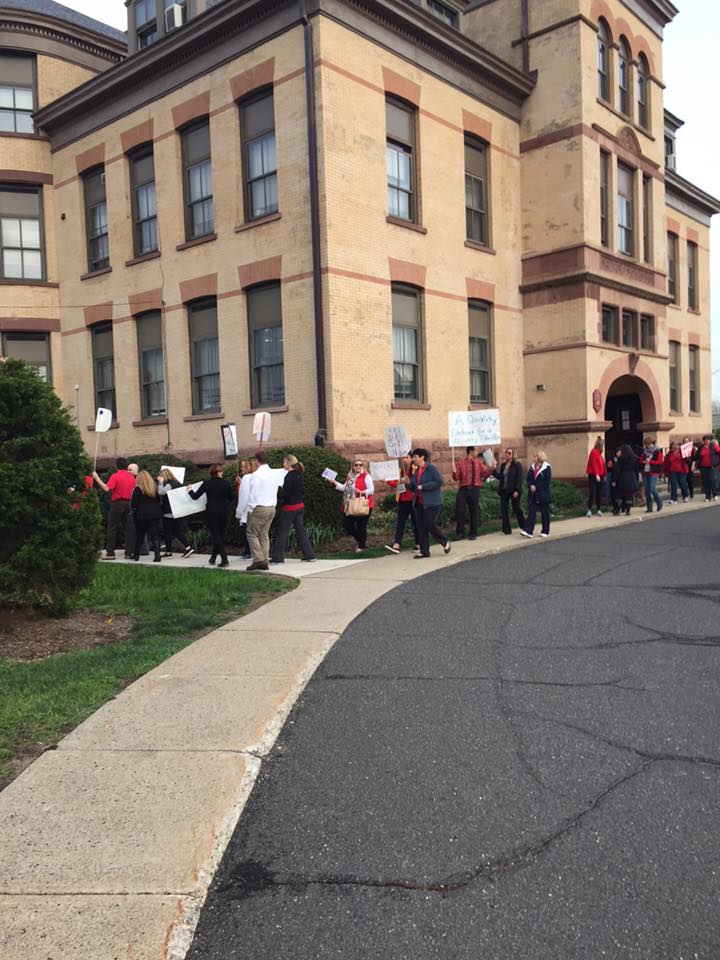
Ridgewood NJ, Does the placement of this sign (vote yes for all day K) on public property violate New Jersey state election laws? Didn’t we just go through this in Ridgewood?