Posted on 2 Comments

NJ Attorney General Asks IRS to Withdraw Proposal that Would Upend New Jersey’s Charitable Deduction Tax Credit Law

Roadsaltimage

AG Grewal to IRS: Stop “Playing Politics” with SALT Tax Guidance—or Face a Legal Challenge

May 27,2018

the staff of the Ridgewood blog

Trenton NJ,  Attorney General Gurbir S. Grewal today urged the U.S. Internal Revenue Service (IRS) to drop its “misguided” plan to enact a new rule designed to undermine a recent New Jersey law. That law – signed by Governor Phil Murphy earlier this month – allows residents to receive property tax credits when they make charitable contributions to their local governments.

The Trump Administration enacted a tax overhaul in December 2017 that placed, for the first time, a $10,000 cap on the federal deduction for state and local taxes (SALT). In response, New Jersey, New York and other states passed laws allowing residents to instead make deductible charitable contributions to their local governments, and to receive partial tax credits when they do so. “But in an unprecedented move,” Attorney General Grewal explained, the IRS just yesterday “announced plans to end the deductibility of such contributions.”

In a letter to IRS Commissioner David J. Kautter, Attorney General Grewal points out that the New Jersey tax credit law is similar to 100 laws enacted in more than 30 other states, and is consistent with longstanding IRS guidance and numerous court decisions that such contributions remain deductible. So “the IRS’s plan will upend over 100 state programs in a single rule—a nightmare for both states and the IRS.” Yet the IRS has given “no reason for [its] sudden about-face.”

“The IRS should not play politics. Instead, it must confirm its longstanding interpretation of federal law,” Grewal explains in his letter. “Should the IRS and Treasury Department continue down this path, New Jersey will have no choice but to challenge the new rule in court.”

Attorney General Grewal’s letter notes that the New Jersey law authorizes municipal and county governments and local school districts to establish “charitable funds for specific purposes” and to permit residents to gain partial property tax credits for donating to those funds. Across the states with similar programs, charitable funds “run the gamut” from those designed to aid natural resource preservation efforts to funds that help provide financial aid for college-bound children, support shelters for the victims of domestic violence and many other programs.

The Attorney General contends that the IRS’s decision runs counter to the federal Tax Code, which makes plain that deductions are permissible for “any charitable contribution … payment of which is made within the taxable year.”
“The statute is explicit that such contributions include gifts given to state governments and their political subdivisions,” Grewal notes. “The only remaining issue is whether such gifts are deductible if the contributor gets a tax credit in return.” While the IRS has previously “answered that question resoundingly in favor of laws” like New Jersey’s, the latest guidance “suggests that the IRS plans to tell states and taxpayers alike the answer is no.”
“I ask you to think twice before going down that misguided road,” Grewal warns the IRS Commissioner. “The IRS’s longstanding approach, supported by precedent and policy, supports what New Jersey has done.”

Posted on 6 Comments

New Jersey’s Fiscal Apocalypses May Finally Be Here

Phill Murphy -Sara Medina del Castillo

May 22,2018

the staff of the Ridgewood blog

Ridgewood NJ, , In a new report, Moody’s Investors Service described New Jersey’s April income tax collections, which were down 1 percent from last year, as an outlier and “weaker than expected.” NJ Treasurer Elizabeth Muoio told the Assembly Budget Committee on Monday. “A reality check on the urgent need for new revenues.”

Both Democrat and Republican leadership in both houses of the state Legislature say they’re opposed to those tax hikes, and they’re now firmly in the position of having to come up with $1.5 billion in cash or slashing as much to keep the budget in balance.

The ugly reality is that increases taxes ill continue to erode the already shrunken tax base in New Jersey .

While the Murphy Administration has promised a wild spending spree with no visible budget cuts anywhere else and the pace of taxpayer exodus from New Jersey has quickened ,Holly Schepisi , New Jersey State Assemblywoman for District 39 , “While wanting to create programs such as free community college, expansion of financial programs and aid, raising salaries and providing retroactive pay increases may be laudable progressive goals of Governor Murphy, New Jersey is in a real financial crisis necessitating a combination of budget cuts, large scale reforms to our pension and health system and a restructuring of our entire tax code and school funding mechanisms. Our legislature must work in a bipartisan manner and have the intestinal fortitude to do what is needed in order for our State to become fiscally healthy. Then, and only then, should conversations regarding the Governor’s proposed increases in spending take place.”

Posted on Leave a comment

New Jersey is dead last in fiscal health based on its fiscal solvency

Phill Murphy -Sara Medina del Castillo

May 11,2018

the staff of the Ridewood blog

Ridgewood NJ, according to the The Mercatus Center at George Mason University ,New Jersey is dead last in fiscal health based on its fiscal solvency. At the end of the year, it is a toss up to whether or not New Jersey has enough money to pay its bills. These high costs are unsustainable and we need reform to get New Jersey back on a better path.

#50 | Ranking the States by Fiscal Condition: New Jersey

Eileen Norcross , Vice President of Policy Research

Olivia Gonzalez ,Research Associate

Summary

On the basis of its fiscal solvency in five separate categories, New Jersey is ranked 50th among the US states for its fiscal health. On a short-run basis, New Jersey has between 84 percent and 211 percent of the cash needed to cover short-term obligations. Revenues cover 91 percent of expenses, and net position decreased by $678 per capita in FY 2015. On a long-run basis, New Jersey’s metrics are dire. A net asset ratio of −2.92 points to a heavy reliance on debt and large unfunded obligations. Long-term liabilities are 360 percent of total assets, or $16,821 per capita, which is the highest among the states. Total primary government debt is $44.23 billion, or 8.3 percent of state personal income, far above the average for the US states. Unfunded pension liabilities, on a guaranteed-to-be-paid basis, are $224 billion, or 42 percent of state personal income. OPEB is 15 percent of state personal income, the highest ratio in the states.

Key Terms

Cash solvency measures whether a state has enough cash to cover its short-term bills, which include accounts payable, vouchers, warrants, and short-term debt. (New Jersey ranks 37th.)
Budget solvency measures whether a state can cover its fiscal year spending using current revenues. Did it run a shortfall during the year? (New Jersey ranks 49th.)
Long-run solvency measures whether a state has a hedge against large long-term liabilities. Are enough assets available to cushion the state from potential shocks or long-term fiscal risks? (New Jersey ranks 50th.)
Service-level solvency measures how high taxes, revenues, and spending are when compared to state personal income. Do states have enough “fiscal slack”? If spending commitments demand more revenues, are states in a good position to increase taxes without harming the economy? Is spending high or low relative to the tax base? (New Jersey ranks 24th.)
Trust fund solvency measures how much debt a state has. How large are unfunded pension liabilities and OPEB liabilities compared to the state personal income? (New Jersey ranks 39th.)

For a complete explanation of the methodology used to calculate New Jersey’s fiscal health rankings, download the full paper and the dataset at mercatus.org/statefiscalrankings.

To read all our work on New Jersey, go to mercatus.org/states/newjersey.

Posted on Leave a comment

Governor Comes Clean on Cost of State Raises

Phill Murphy -Sara Medina del Castillo

May 9,2018

the staff of the Ridgewood blog

Trenton NJ, while you been buy on the local election campaign Governor Murphy just handed out a nice payback to the unions that got him elected .Governor Phil Murphy said at the time he doesn’t know the cost to taxpayers of raises he gave to 35,000 New Jersey state workers, members of a union that supported his candidacy.

Assemblywomen Holly Schepisi  said , “Maybe these raises are warranted, maybe they aren’t, but how could our Governor authorize them without having some idea of what they would cost the taxpayers of New Jersey???
P.S. it’s over $148 million ”

UPDATE: Below please find today’s press release from the Governor’s office which discusses preliminary increased costs of $149 million.
State of New Jersey
Murphy Administration Releases Total State Cost of Contract Settlement with the Communication Workers of America, AFL-CIO
Trenton – Today, the Murphy Administration released the total projected state cost of its recent contract settlement with the Communication Workers of America, AFL-CIO:
The total projected state cost of the contract is approximately $148.9 million.
Of this total, $78 million is related to the unprecedented suspension of step increments and clothing allowances by the Christie Administration dating back to FY 2016.
A fiscal year breakdown of the projected costs may be found below. Retroactive payouts for FY 2016 and FY 2017 are assumed in the Fiscal Year 2018 adjusted appropriation:
FY Payout Total
FY16 Retro $24.0 million
FY17 Retro $34.7 million
FY18 Retro $41.4 million
FY 19 Projected $48.8 million
Grand Total $148.9 million
Because of the duration of the retroactivity and the details of the contract negotiations, final totals will not be available until programming is completed.

https://www.bloomberg.com/news/articles/2018-05-02/murphy-says-he-doesn-t-know-cost-of-raises-he-just-gave-workers

Posted on 2 Comments

Lawyer and Elder Law Radio Host Indicted on Charges He Stole $1.9 Million from Elderly Clients

robert novy1

May 8,2018

the staff of the Ridgewood blog

Trenton NJ,  Attorney General Gurbir S. Grewal announced that a prominent Ocean County attorney who hosted a radio show and taught seminars on elder law was indicted today on charges that he stole approximately $1.9 million from elderly clients. The victims generally did not have close relatives to guard their interests and in some cases suffered from dementia.

The Division of Criminal Justice Financial & Computer Crimes Bureau obtained a 10-count state grand jury indictment charging Robert Novy, 66, of Brick, N.J., with the following crimes:
Theft by Unlawful Taking (2nd Degree – Two Counts)
Misapplication of Entrusted Property (2nd Degree – Three Counts)
Theft by Deception (2nd Degree – One Count)
Money Laundering (1st Degree – Two Counts)
Money Laundering (2nd Degree – Two Counts)

The charges are the result of an ongoing investigation by the Division of Criminal Justice Financial & Computer Crimes Bureau, assisted by the New Jersey Division of Taxation Office of Criminal Investigation. The case was referred to the Division of Criminal Justice by Ocean County Surrogate Jeffrey W. Moran. Novy also was investigated by the New Jersey Office of Attorney Ethics, which issued an ethics complaint against him on Jan. 26, 2016, and assisted the Division of Criminal Justice.

As an expert in elder law, Novy hosted a bi-monthly radio program “Inside the Law,” which focused on topics of concern to senior citizens. He was arrested on Oct. 18, 2016. Detectives executed a search warrant at his firm, Novy & Associates, on Ridgeway Avenue in Manchester, seizing billing records and other evidence. The Attorney General’s Office obtained court orders freezing over $3.5 million in assets held by Novy and his firm and appointing a trustee to oversee the firm’s business operations.

“Novy allegedly stole nearly $2 million from vulnerable clients, preying on seniors who were frail and isolated and who trusted him as their attorney to guard their life savings,” said Attorney General Grewal. “It is hard to imagine a more callous personal and professional betrayal.”

“We allege that Novy systematically drained his clients’ assets, laundering funds through various bank accounts and charging unauthorized fees to enrich himself and his firm,” said Director Elie Honig of the Division of Criminal Justice. “We urge anyone with relevant information about Novy and his handling of client funds to contact our office.”

The indictment alleges that from 2009 through 2016, Novy stole approximately $1.9 million from six elderly clients. The investigation is ongoing, and the Division of Criminal Justice is looking at numerous additional suspicious financial transactions involving funds of other clients of Novy.

The investigation revealed that Novy allegedly stole funds from elderly and deceased clients who often did not have a close relative to claim their estate or challenge Novy’s actions. He allegedly used the stolen funds for his own benefit, paying personal and business expenses. Novy gained control through wills, powers of attorney, and trust documents, making himself the sole financial decision-maker for the clients. When clients had sizeable assets in the form of an annuity or life insurance policy, Novy allegedly directed insurance companies to redeem the policies and send the money directly to him. In some cases, when challenged by trustees or relatives about particular funds that had been withdrawn from client accounts, Novy claimed they were “administrative errors” and repaid the funds.
The indictment alleges that Novy engaged in three different schemes by which he stole funds from the six clients:
In one scheme, Novy is alleged to have simply transferred funds from his clients’ personal bank accounts or from his clients’ liquidated personal assets into his own bank account. Novy allegedly stole $322,342 from four of the six victims through this criminal scheme.

In the second scheme, Novy allegedly transferred funds from his clients’ personal accounts or liquidated assets into IOLTA (Interest on Lawyer Trust Account) sub-accounts that he controlled. The powers of attorney executed by the victims legally required Novy to place their assets into independent trust funds selected by the victims that would manage their assets, so the act of placing the funds into accounts that he controlled constituted a theft by Novy. It is alleged that Novy stole $929,026 from three of the six victims through this criminal scheme.

In the third scheme, Novy allegedly transferred client funds from various accounts – including the clients’ personal accounts, the clients’ IOLTA sub-accounts, or the firm’s attorney trust account – into the firm’s operating and disbursement accounts. Novy allegedly excessively billed the clients for power of attorney fees without any supporting invoices. Novy allegedly stole $659,457 from three of the six victims through this criminal scheme.
The money laundering counts allege that Novy engaged in transactions involving the stolen funds and the various accounts – primarily his attorney trust accounts and/or attorney business accounts – through which he concealed the source of the stolen funds and used them to promote his criminal activities.

Novy allegedly stole $1.9 million from the following six victims – all residents of Ocean County, N.J. – and/or their estates:
Brick Township woman who died in 2015 at age 88. Alleged theft: approximately $738,457.
Manchester Township woman who suffered from dementia and died in 2014 at age 87. Alleged theft: approximately $650,700.
Brick Township woman who suffered from Alzheimer’s disease and died in 2013 at age 85. Alleged theft: approximately $242,305.
Manchester Township woman who currently is 98. Alleged theft: approximately $130,000.
Point Pleasant woman who suffered from dementia and died in 2015 at age 87. Alleged theft: approximately $103,843.
Waretown woman who died in 2013 at age 85 (and her husband who died in 2011 at age 92). Alleged theft: approximately $45,520.

The indictment was handed up to Superior Court Judge Mary C. Jacobson in Mercer County, who assigned the case to Ocean County, where Novy will be ordered to appear in court at a later date for arraignment.

Posted on Leave a comment

NJBIA Analysis Shows New Jersey Dead Last in Regional Business Climate Competitiveness

for sale Ridgewood_Real_Estate_theRodgewopodblog

file photo by Boyd Loving

May 3,2018

the staff of the Ridgewood blog

Trenton NJ, With New Jersey’s legislature weighing new tax hikes during budget season, the New Jersey Business & Industry Association released an analysis today that finds the Garden State already ranked last in the region for business climate competitiveness.

“This analysis should serve as an opportunity to reclaim our competitiveness and to improve the state’s economy through comprehensive planning, not excessive taxation,” said NJBIA President and CEO Michele Siekerka. “There is no better time than now to recognize the growing challenges of doing business in New Jersey and our competitive disadvantage with neighboring states.”

NJBIA tracked six individual business costs—minimum wage rate, top income tax rate, top corporate tax rate, sales tax rate, property taxes as a percentage of home value, and the top unemployment tax rate – and compared New Jersey’s rates with those of Connecticut, Delaware, Maryland, Massachusetts, New York and Pennsylvania.

Applying a scoring system to the most and least competitive regional rates, New Jersey finished last of the seven states by a considerable margin.

New Jersey currently ranks last out of all states in the region in top income tax rate (8.97 percent), sales tax rate (6.625 percent) and property tax paid as a percentage of home value (2.16 percent). New Jersey is also sixth out of seven states in top corporate tax rate (9 percent). The Garden State has the third lowest minimum wage rate in the region at $8.60 per hour and, more positively, has the lowest top unemployment tax rate in the region of 5.8 percent.

However, it’s foreseeable that New Jersey’s overall regional business climate could further decline with discussions of a minimum wage increase to $15 per hour, proposals to raise the top income tax rate for those making more than $1 million, and consideration of a Corporate Business Tax increase. These are in addition to the added costs brought on by the mandatory paid sick leave bill signed into law and the proposed sales tax increase to 7 percent.

“It’s important to recognize that New Jersey businesses are already paying their fair share when it comes to tax rates and the additional cumulative costs that are being discussed and proposed could result in stagnation of our businesses, reduced staffing and hours or automation, according to our members,” Siekerka said. “We need tax and regulatory reform to address structural deficits in our economy, such as public pension and health benefits costs, and school funding. We cannot tax our way out of these challenges.”

Using data compiled by NJBIA policy analyst Nicole Sandelier, NJBIA scored the regional rates from 1 (most competitive in the region) to 7 (least competitive). New Jersey’s cumulative regional business climate score was 31 after totaling the six rates. Delaware has the best regional score at 17, followed closely by Maryland at 20. Pennsylvania (23) and New York (24), New Jersey’s largest outmigration states, finished third and fourth, respectively.

Posted on Leave a comment

CDC : Autism Prevalence Highest in New Jersey

CDC

April 28,2018

the staff of the Ridgewood blog

Washington DC, according to the CDC ,about 1 in 59 eight -year-old children in 11 communities across the United States were identified as having autism in 2014, according to a report published today in CDC’s Morbidity and Mortality Weekly Report (MMWR) Surveillance Summary.

The data in this report come from CDC’s Autism and Developmental Disabilities Monitoring (ADDM) Network – a tracking system that provides estimates of the prevalence and characteristics of autism spectrum disorder among more than 300,000 8-year-old children. ADDM is the largest population-based program to monitor autism and the only autism tracking system that examines health and education records.

The latest estimate of 1.7 percent (1 in 59) is higher than the previous ADDM estimate released in 2016, which found a prevalence of 1.5 percent or 1 in 68 children. Some of the change in prevalence could be due to improved autism identification in minority populations – although autism is still more likely to be identified in white children than in black or Hispanic children. This identification is important, because children identified early with autism and connected to services are more likely to reach their fullest potential.

“Autism prevalence among black and Hispanic children is approaching that of white children,” said Stuart Shapira, M.D., Ph.D., associate director for science at CDC’s National Center on Birth Defects and Developmental Disabilities. “The higher number of black and Hispanic children now being identified with autism could be due to more effective outreach in minority communities and increased efforts to have all children screened for autism so they can get the services they need.”

The Autism and Developmental Disabilities Monitoring Network estimates are combined from 11 communities within Arizona, Arkansas, Colorado, Georgia, Maryland, Minnesota, Missouri, New Jersey, North Carolina, Tennessee, and Wisconsin. The 11 communities surveyed in this report represent about 8 percent of 8-year-old children in the United States.

Estimates of autism varied widely among the 11 communities in this report, although five reported similar estimates of 1.3 percent to 1.4 percent. The highest prevalence estimate of 2.9 percent came from a community in New Jersey. Some of the regional differences in autism prevalence estimates among the 11 communities might be due to differences in how autism is being diagnosed and documented.

More work needed to identify autism early in life

The data demonstrate that more work needs to be done to identify children with autism at a younger age and refer them to early intervention:
Fewer than half of the children identified in the Autism and Developmental Disabilities Monitoring Network received their first autism diagnosis by the time they were 4 years old.

Although 85 percent of children with autism had concerns about their development noted in their health records by the time they were 3 years old, only 42 percent received a developmental evaluation by that age.
This lag between first concern and first evaluation may affect when children with autism can begin getting the services they need.

“Parents can track their child’s development and act early if there is a concern. Healthcare providers can acknowledge and help parents act on those concerns. And those who work with or on behalf of children can join forces to ensure that all children with autism get identified and connected to the services they need as early as possible,” said Dr. Shapira. “Together we can improve a child’s future.”

CDC’s efforts to track autism and promote early identification

The next ADDM report will add data for children who were 8 years old in 2016 and help us better understand whether autism prevalence is changing and whether improvements are being made in early identification of autism. The Autism and Developmental Disabilities Monitoring Network is not a representative sample of the United States, but is a detailed look at autism in these specific communities. For more information about CDC’s autism activities visit www.cdc.gov/Autism.

CDC’s Learn the Signs. Act Early program provides parents, childcare professionals, and healthcare providers free resources, in English and Spanish, for monitoring children’s development. The program offers parent-friendly, research-based milestone checklists for children as young as 2 months of age. CDC’s Milestone Tracker Mobile App can help parents track their child’s development and share the information with their healthcare providers. For more information visit www.cdc.gov/ActEarly.

Posted on 1 Comment

ICE arrests 60 during public safety operation in New Jersey

ICE : U

April 28,2018

the staff of the Ridgewood blog

Newark NJ,  Officers from U.S. Immigration and Customs Enforcement’s (ICE) Enforcement and Removal Operations (ERO) arrested 60 individuals throughout New Jersey during a 5-day public safety operation ending April 20.
The operation focused on individuals illegally present in the U.S. that had been convicted of serious criminal activity, to include sexual assault, child abuse, domestic violence, and Driving Under the Influence (DUI). Of those arrested, 80 percent were convicted criminals, more than 20 had been issued a final order of removal and failed to depart the United States, or had been previously removed from the United States and returned illegally. Several had prior felony convictions for serious or violent offenses, such as aggravated assault, child abuse, child sex crimes, and assault, or had past convictions for significant or multiple misdemeanors. U.S. Customs and Border Protection and the U.S. Marshals Service assisted ICE during this operation.

“The success of this operation is a direct result of the full commitment of the dedicated men and women of ICE.” said John Tsoukaris, field office director for ERO Newark. “We will continue to devote the full efforts of our agency to protecting citizens and enforcing federal immigration law despite challenges being pursued by politically motivated individuals.”
Arrests include:
In Passaic, a 24 year-old Mexican national, who has convictions of aggravated assault with bodily injury and domestic violence assault;
In Edgewater, a 32 year-old, Colombian national, who has convictions of domestic violence/aggravated assault, contempt – violate domestic violence restraining order, and possession of controlled dangerous substance;
In South Bound Brook, a 47 year-old previously removed Honduran national, who has convictions of felony forgery and hindering apprehension;
In Rockaway, a 38 year-old Jamaican national, who has convictions of child abuse and domestic violence assault;
In East Orange, a 51 year-old previously removed Guatemalan national, who has convictions of distribution of controlled substance and multiple domestic violence assaults;
In Lodi, a 54 year-old Italian national, and registered sexual offender, who has convictions of sexual assault of a minor, aggravated assault on a law enforcement officer, burglary and resisting arrest by force;
In West Long Branch, a 32 year-old El Salvadorian national with a warrant of removal, who has convictions of evading law enforcement officer causing serious bodily injury and pending charges of possession of marijuana;
Criminal histories of those arrested during the operation are as follows: DUI, domestic violence assault & abuse, child abuse, distribution of cds, sexual assault on a minor, harassment, burglary, possession of a weapon, aggravated assault, shoplifting, theft, forgery, larceny, eluding and illegal entry.
The arrestees include nationals from Brazil, China, Colombia, Cuba, Dominican Republic, Ecuador, El Salvador, Guatemala, Honduras, Italy, Jamaica, Mexico, Peru, and Ukraine.
ERO deportation officers made arrests throughout New Jersey, specifically in the counties of Bergen, Burlington, Camden, Cumberland, Essex, Hudson, Mercer, Middlesex, Monmouth, Morris, Ocean, Passaic, Somerset and Union.

ICE focuses its enforcement resources on individuals who pose a threat to national security, public safety and border security. However, ICE no longer exempts classes or categories of removable aliens from potential enforcement. All of those in violation of immigration laws may be subject to immigration arrest, detention and, if found removable by final order, removal from the United States.
Some of the individuals arrested during this operation may face federal criminal prosecution for illegal re-entry after deportation. The arrestees who are not being federally prosecuted will be processed administratively for removal from the United States. Those who have outstanding orders of deportation, or who returned to the United States illegally after being deported, are subject to immediate removal from the country. The remaining individuals are in ICE custody awaiting a hearing before an immigration judge.

Despite politically driven challenges that certain local jurisdictions have created, ICE remains committed to its public safety mission and will continue to seek out dangerous criminal aliens and other immigration violators. ICE seeks cooperation with all local law enforcement and elected officials when carrying out the enforcement of federal immigration law.
ICE deportation officers carry out targeted enforcement operations every day in locations around the country as part of the agency’s ongoing efforts to protect the nation, uphold public safety, and protect the integrity of our immigration laws and border controls. These operations involve existing, established Fugitive Operations Teams.

Posted on 1 Comment

How High Are Recreational Marijuana Taxes in Your State?

MarijuanaTaxes 011

April 26, 2018
the staff of the Ridgewood blog

According to Katherine Loughead and Morgan Scarboro of the Tax Foundation public opinion increasingly favors the legalization of recreational marijuana, a growing number of states must determine how to tax legal sales of cannabis.

Will New Jersey Be next? One of the biggest signals of change has been the election of Democrat Phil Murphy, a former Goldman Sachs executive, and the incumbent Governor of New Jersey. He’s has already instilled a belief that New Jersey will embrace the plant recreationally.

To date, nine states (Alaska, California, Colorado, Maine, Massachusetts, Nevada, Oregon, Vermont, and Washington) and the District of Columbia have legalized recreational marijuana, but only eight of these jurisdictions have legal markets. The table below highlights the states that have implemented legal markets and levy taxes on recreational marijuana.

Of the states with legal markets, Alaska is the only state that does not impose some form of sales tax on end-users. In each of the other states, taxes levied on the sale of marijuana far exceed the general sales tax rate levied by that state:

In Alaska, which has no states sales tax, marijuana growers pay a tax of $50 per ounce when selling the product to marijuana dispensaries or retailers. While the cost of taxes paid is passed on to customers in the form of higher prices, end-users do not pay a sales tax when purchasing marijuana.

In California, cultivators pay a per ounce of product tax at a rate of $9.25 per ounce of marijuana flowers and $2.75 per ounce of leaves. In addition, retailers collect from customers a 15 percent excise tax on the average market price of the product.

Colorado imposes a 15 percent excise tax on the sale of marijuana from a cultivator to a retailer. In addition, the state levies a 15 percent sales tax (up from 10 percent in 2017) on retail sales to customers.

Maine legalized recreational marijuana in 2016 by ballot initiative but has not yet established a legal market. Pending legislation would tax sales of marijuana at a rate of 10 percent and levy an excise tax on cultivators at a rate of $335 per pound of flower, $94 per pound of marijuana trim, $1.50 per immature plant or seedling, and $0.30 per seed. Governor LePage, however, has vowed to veto the legislation.

Massachusetts, concerned its previous ballot initiative approved rate of 3.75 percent was too low, raised the excise tax rate to 10.75 percent in 2017.

Nevada imposes an excise tax on the sale of marijuana by a cultivator to a distributor. This rate is set at 15 percent of the Fair Market Value as determined by the Nevada Department of Taxation. In 2017, Nevada created a new 10 percent sales tax paid by consumers.

Oregon, which does not have a general sales tax, levies a 17 percent sales tax on marijuana.
Washington levies a 37 percent sales tax on recreational marijuana.

Vermont legalized the possession of marijuana this year but did not create a legal market. D.C. also allows for possessing and growing of marijuana but does not allow for sales in a legal market.

Posted on 3 Comments

Sierra Club: Murphy Admin Steals Half of Volkswagen Settlement for Budget

Phill Murphy -Sara Medina del Castillo

April 23, 2018, 11:48 am | in

Trenton NJ, The Murphy Administration is taking $69 million of the $141 million the state will receive from settlements with Volkswagen involving air-pollution violations and cheating on emissions tests will go into the general fund for the state budget. This is funding that is supposed to be going to clean air initiatives, including electric vehicles programs.

“New Jersey is supposed to move forward with electric vehicles. Instead of helping to jumpstart our goals, the Murphy Administration is stealing $69 million, the entire state portion, of the Volkswagen settlement to balance the budget. Volkswagen is paying for the damage they did to communities by increasing and failing to report on air pollution. We received the settlement money because of Volkswagen’s pollution and it should all go toward mitigating those affects and cleaning New Jersey’s air. Instead, Murphy is letting the air our of our tired by taking the money for the general fund,” said Jeff Tittel, Director of the New Jersey Sierra Club. “The Governor campaigned against taking environmental settlement monies for plugging budget holes the way Christie did. Now, he’s doing so. This goes against the spirit of the constitutional amendment.”

New Jersey accepted $72 million settlement from the Volkswagen Mitigation Trust on top of the $69 million previously awarded by the Volkswagen Group of America. The funds settle allegations that Volkswagen “violated New Jersey’s clean air statutes and defrauded consumers by selling diesel vehicles equipped with “cheat” software that deactivated their on-board emission controls except during emissions testing.” The New Jersey Department of Environmental Protection (DEP) has been named lead agency in administering the funds. The state must submit a “Beneficiary Mitigation Plan” that explains how the funds will be used.

“We desperately need the $69 million that they want to divert to make our economy greener with electric vehicles. This could jumpstart our clean transportation system. We need to make sure that that funds go to the right places including to plug-ins and helping urban areas where air pollution is worst. This will help create jobs and move our state forward with an automobile that has zero emissions and decrease fossil fuels. The biggest source of air pollution and greenhouse gases in our state comes from automobiles, which is why we need to increase electric vehicles to clean our air. We need to install plug-in stations along with providing things like zip cars, ride shares, and taxis to encourage EV’s that everyone can afford,” said Jeff Tittel. “We should be using the entirety of the $141 million to move New Jersey forward on electric vehicles.”

Last Fall, New Jersey voters approved Ballot Question #2 to dedicate environmental settlement funds to environmental clean-ups. This will block future administrations from robbing the money meant for repairing, preserving, or restoring natural resources. In NJ, these resources are held in the Public Trust. If you spill chemicals and destroy them, you not only have to clean-up your mess, but also compensate the public for their loss. The ballot language is as follows:

9. There shall be credited annually to a special account in the General Fund an amount equivalent to the revenue annually derived from all settlements and judicial and administrative awards relating to natural resource damages collected by the State in connection with claims based on environmental contamination.

“The voters overwhelmingly decided that environmental settlement money such as that from the Volkswagen settlement should be used only for non-environmental purposes. Isn’t air pollution an environmental contaminate as well? The Murphy Administration is going against these wishes by taking half of the funds for plugging budget holes. Volkswagen illegally added air pollution, creating increased health impacts and climate impacts. The entirety of the settlement funds should be used to mitigate those affects by improving our air quality and reducing greenhouse gasses,” said Jeff Tittel. “Even if it we believed it was legal to take the funds, we would recommend against doing so because it hurts the people and environment of New Jersey.”

The Clean Energy Fund is being raided once again; this time by $136 million or even higher. This includes $80 million for NJ Transit, $50 million for lights in government buildings, $2 million to the BPU and $5 million to implement RGGI. This Fund is meant to support projects that make our homes more resilient such as weatherization, along with energy efficiency and green jobs. The DEP is also suffering from budget raids and money being redirected.

“The Clean Energy Fund has become the state’s ATM. Christie consistently used the money to balance the budget and the Murphy Administration is continuing that pattern. This has become a hidden energy tax on consumers. Instead of using this money for the environment and creating jobs, it is used to plug budget holes. On top of the clean energy fund raids, $80 million dollars are being diverted from the DEP. This is funding for important programs that would go towards cleaning up toxic sites, brownfield redevelopment, and watershed protection. This will have a real impact on the agency because by diverting those funds, they are not hiring enough staff for DEP to do its job,” said Jeff Tittel.

We should be using these funds for things such as promoting electric vehicles in New Jersey. We can electrify our ports, especially in urban areas, with electric busses to reduce air pollution in areas already highly affected. We can use electric vehicles for transportation in and around the ports including moving goods and containers. We can implement clean transportation programs so that our school children can ride in cleaner, quieter, and healthier school buses that are powered by electricity. This is especially important for children who live in urban areas already overburdened by air pollution. Electric busses will benefit all mass transit riders, as well as anyone living in the city where they run without released air toxins.

“Stealing half of the Volkswagen funds for plugging budget holes is wrong and unfair to the people of New Jersey. We need to take advantage of the full $141 million to create more in-state jobs, better vehicles, less carbon pollution, and cleaner, healthier air. We believe that these funds can ideally be used to move New Jersey forward with electric vehicles. We can see the benefits of clean air and clean jobs if we put this money to good use. We can build a state-wide network of charging stations, create green jobs, save people money on gas, and reduce air pollution,” said Jeff Tittel, Director of the New Jersey Sierra Club.

Posted on Leave a comment

The Organization For Economic Development Urges Paterson Voters to Support Pedro Rodriguez In May Mayoral Election

Organization For Economic Growth

April 24,2018

the staff of the Ridgewood blog

Paterson NJ, The Organization for Economic Growth endorses Pedro Rodriguez for mayor and his at large council team of Mohammed Akhtaruzzaman and Mitch Santiago in the May 8th election, announced OEG Chairman Joseph Caruso

“We believe the Rodriguez team has the most well rounded and realistic approach to economic revitalization to one of New Jersey’s most impoverished, but important cities,” said Caruso. The endorsement is based on responses to a questionnaire on economic issues given to all the Paterson candidates

“The Rodriguez Team responded with a sensible and detailed approach to restoring the city’s economic vitality rather than the general pie-in-the sky objectives that lead nowhere,” added Caruso. “His willingness to embrace public/private partnerships and tax incentives was a major factor for our support of Mr. Rodriguez.”

The city’s next mayor will inherit a city with many economic problems, including a 7.5 percent unemployment rate, a severe lacking of economic investment in the central city and significant problems in housing and crime. Previous administrations, dating back decades have failed to attract notable development to the city.

Caruso said Rodriquez is on the right track saying he will overhaul the building department to insure that it is business friendly; hire a professional to oversee economic development and will employ the use of PILOTs (Payments in Lieu of Taxes) and encourage public private partnerships.

“The city desperately needs to be more cooperative with those willing to invest in Paterson and it needs an outside economic development professional – not a political patron – with real world experience to guide the next administration in developing a vision for where the city wants to be in a decade.” said Caruso.

Noting that PILOTs are sometimes criticized as sops to businesses, Caruso said they are a necessary tool to incentivize developers to invest in areas that offer marginal return and significant risk. Rodriguez also said he wants to develop a grant application program to help spur redevelopment and embrace incentives for mixed use development to encourage construction of new housing. Paterson’s housing conditions, particularly in the North and Central wards, are in bad shape and must be addressed, says the OEG executive.

In his responses to the OEG questionnaire, Rodriguez said: “I have a comprehensive plan to place vacant and dilapidated properties into the hands of Patersonians. I vow to reduce the number of abandoned properties by introducing programs such as the 203K loan which will ease the ability for our residents to not only purchase a home but also renovate it. We must provide easier pathways for our residents to achieve the American dream of owning a home which has been statistically proven to ensure proper maintenance and upkeep.”

Rodriguez also recognized the city’s crime problem as a major stumbling block to investment and to attracting people to shop in and visit the city. To help combat crime, Rodriguez said he will commission an independent audit of the city’s budget to identify wasteful spending and redirect those resources into hiring more police officers and to take more cops from behind desks and put them out on the street. He also said he wants to invest in repairing existing — and installing — new surveillance cameras to protect the city’s residents.

“Mr. Rodriguez and his running mates Mohammed Akhtaruzzaman and Mitch Santiago provided thoughtful, well rounded responses to our questionnaire, showing that they have put in the time to consider the problems Paterson must overcome and formulated a way to overcome them,” said Caruso.

“Paterson doesn’t need a cheerleader for mayor; it needs someone who will roll up his sleeves and provide the hands on, serious leadership that will lead to investments, jobs and better housing. We are hopeful that Mr. Rodriguez may be that person.” added Caruso.

The NJOEG was founded to support candidates and policies that improve the state and regional economies. To learn more about the NJ OEG visit our website www.NJOEG.com; or visit us on Facebook https://www.facebook.com/StrengthThroughIndustry/

Posted on Leave a comment

Jersey Super trooper has all the Wrong Moves

f1ab57d5d1929f013092b2b4417c2c5f1

April 23,2018

the staff of the Ridgewood blog

Trenton NJ,  A New Jersey state trooper was indicted today for allegedly conducting improper stops of two female drivers for the purpose of pressuring them to begin a personal relationship with him. The trooper allegedly falsified records to cover up his actions.

The Division of Criminal Justice Corruption Bureau today obtained a six-count state grand jury indictment charging Trooper Eric Richardson, 32, of Camden, N.J., with the following offenses:
Official Misconduct (2nd degree),
Criminal Coercion (3rd degree),
Tampering with Public Records or Information (3rd degree),
Falsifying or Tampering with Records (4th degree),
Wrongful Access/Disclosure of Information (2nd degree), and
Obtaining Information from a Motor Vehicle Record (4th degree).

Richardson was investigated by the New Jersey State Police Office of Professional Standards, which uncovered incidents involving two women whom Richardson allegedly pulled over and harassed about initiating an intimate relationship. He allegedly stopped each woman repeatedly and deactivated the dashboard camera in his car during some of the stops.

Richardson initially pulled over the first woman on Nov. 22, 2016, warning her that her windows were illegally tinted. Although her registration was expired, Richardson allegedly attempted to win favor with her by not towing the vehicle and letting her drive away. He allegedly followed her, however, and activated his lights to stop her a second time. He then allegedly pressured her to give him a phone number, persisting even after she said she was in a relationship. Later, Richardson sent numerous texts to the woman using the number he obtained. On Jan. 3, 2017, Richardson allegedly pulled the woman over again in Atlantic City. He allegedly falsely reported in the official computer dispatch log that he stopped to aid a motorist, when in fact he allegedly stopped the woman to ask if she still had the same number and was receiving his texts.

On Dec. 23, 2016, Richardson allegedly pulled over the second woman in Gloucester Township and threatened to arrest her if she did not give him her phone number. This is the basis for the criminal coercion charge. He allegedly pulled out his handcuffs and threatened to handcuff her. The woman’s license and registration were suspended, and there was a warrant for her arrest. After obtaining her phone number, Richardson released her, despite the active warrant. He allegedly told dispatchers and reported in the dispatch log that the driver he stopped on that occasion was a man. He allegedly communicated with the second woman via texts using the phone number he obtained.
The charges of wrongful access/disclosure of information and obtaining information from a motor vehicle record relate to an incident on May 8, 2017 when Richardson allegedly illegally accessed the FBI—Criminal Justice Information Services database on behalf of a male friend to do a “driver inquiry” on a woman the friend employed to determine if her driver history reflected any warrants or drug activity. Richardson allegedly photographed her driver history and texted it to his friend.

“Police are given great authority and are rightly held to the highest standards of integrity,” said Attorney General Grewal. “When officers abuse their authority, as alleged in this case, they must be held accountable. Public trust and public safety demand it.”

“We allege that the defendant used his authority as a police officer to harass two women and he then falsified official records to cover up his misconduct,” said Director Elie Honig of the Division of Criminal Justice. “These are serious charges.”

Richardson was suspended by the New Jersey State Police after being charged by complaint in this case on May 31, 2017. He remains suspended.

Second-degree charges carry a sentence of five to 10 years in state prison and a fine of up to $150,000, while third-degree charges carry a sentence of three to five years in state prison and a fine of up to $15,000. Fourth degree charges carry a sentence of up to 18 months in state prison and a fine of up to $10,000.
The charges are merely accusations and the defendant is presumed innocent until proven guilty.

Posted on Leave a comment

New Report Ranks New Jersey Bottom Five in Economic Outlook

for sale Ridgewood_Real_Estate_theRodgewopodblog

file photo by Boyd Loving

Apr 17, 2018

by AFP

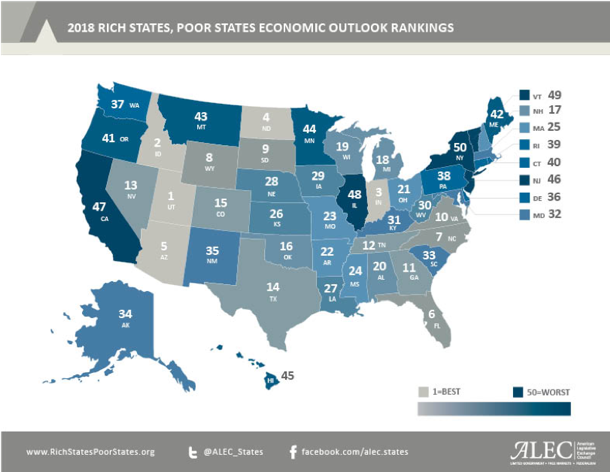
Trenton NJ, Americans for Prosperity-New Jersey (AFP-NJ) on Tuesday responded to a report released by the American Legislative Exchange Council (ALEC) that ranks New Jersey as having the fifth-worst economic outlook in the country. The 11th Edition of Rich States, Poor States: ALEC-Laffer State Economic Competitiveness Index ranks every states’ economic outlook based on fifteen policy variables like tax rates and labor policies; New Jersey is ranked 46.

“This report reaffirms what we’re reminded of every Tax Day – New Jersey residents are taxed too much and have nothing to show for it except an economy in dire straits with one of the highest out-migrations in the country,” said AFP-NJ State Director Erica Jedynak, who also serves as ALEC’s Private Sector Chair for the Garden State. “The economic situation will only worsen as more beleaguered New Jersey families scramble for the exit. If state and local leaders hope to reverse these trends we must begin to implement policies that provide tax relief and expand worker freedoms.”

“As states compete with each other for much-needed human and financial capital, there is generally a clear trend in favor of taxpayer-friendly, market-oriented reforms across the United States,” said Jonathan Williams, Chief Economist and Vice President for the Center for State Fiscal Reform at ALEC. “Unfortunately for the hardworking taxpayers of New Jersey, the Garden State is once again heading in the wrong direction with the discussion of tax increases. The new rankings show New Jersey is stuck in the bottom five in economic outlook because of high taxes, overwhelming government regulation and cronyism.”

“New Jersey’s poor ranking was well earned and is much deserved. It continues to tax and spend itself into obscurity,” said Senator Joe Pennacchio, who also serves as ALEC’s Public Sector Chair for New Jersey. “Governor Murphy’s first budget raises taxes 2 billion dollars and increased spending by 8 percent. People are fleeing our State leaving behind their families and communities. Whoever is left must shoulder an even higher tax burden. Not fair.”


Posted on Leave a comment

New Jersey is currently ranked 49th in the United States for its economic performance

Phill Murphy -Sara Medina del Castillo

April 18,2018

the staff of the Ridgewood blog

Arlington VA , The American Legislative Exchange Council (ALEC) today released the much anticipated 2018 edition of Rich States, Poor States. Utah again earns the top spot for states with the best economic outlook, followed by Idaho, Indiana, North Dakota and Arizona. Several states’ success in increased rankings can be tied directly to the success of federal tax reform and the resources it gave to lawmakers to cut taxes at the state level.

The 11th edition of Rich States, Poor States is characterized by great movement in state economic performance and outlook as a result of federal tax reform and the resulting actions of certain states.

Biggest movement in rankings: 

Biggest Gainers
Spots Gained
Biggest Losers
Spots Fell
Idaho
8
Tennessee
7
Georgia
6
South Carolina
6
Connecticut
6
Pennsylvania
5
Nebraska
4
Texas
5
Arizona
3
Illinois
6

The 15 economic policy variables used by the authors—top economist Jonathan Williams, White House Advisors Art Laffer and Stephen Moore—to  rank the economic outlook of states have shown over time to be among the most influential variables for state growth. The top ten and bottom ten states for 2018 are:

Overall Economic Outlook for 2018

Top Ten
Bottom Ten
1. Utah
2. Idaho
3. Indiana
4. North Dakota
5. Arizona
6. Florida
7. North Carolina
8. Wyoming
9. South Dakota
10. Virginia
41. Oregon
42. Maine
43. Montana
44. Minnesota
45. Hawaii
46. New Jersey
47. California
48. Illinois
49. Vermont
50. New York

“The untold story of federal tax reform is its impact at the state level, where the vast majority of states are now enjoying unexpected revenue gains,” said Jonathan Williams, Chief Economist and Vice President of the ALEC Center for State Fiscal Reform. “This trend is empowering additional pro-growth tax reform efforts that will provide an added level of benefits for hard-working taxpayers. As states compete with each other for much-needed human and financial capital, there is a clear trend in favor of taxpayer-friendly, market-oriented reforms.”

“The shakeup in rankings is exciting and a testament to how states are always competing to offer the most pro-growth tax climate. When states compete on the merits of good public policy, ultimately the taxpayer ends up being the real winner,” said North Carolina State Rep. and National Chairman Jason Saine.

Cision Image .png

In the past five years alone, 30 states have significantly reduced their tax burdens. Those that fail to adapt to this competitive environment can fall behind by simply standing still. The facts remain clear that pro-growth policies are working and there is a clear trend in favor of market-oriented reforms.

Rich States, Poor States examines the latest trends in state economic growth. The data ranks the 2018 economic outlook of states using 15 equally weighted policy variables, including various tax rates, regulatory burdens and labor policies. The 11th edition examines trends over the last few decades that have helped or hurt states’ economies.

Used by state lawmakers across America since 2008, Rich States, Poor States: ALEC-Laffer State Economic Competitiveness Index, is authored by White House Advisor and economist Dr. Arthur B. Laffer, White House Advisor and Economist Stephen Moore, and Jonathan Williams, Vice President of the American Legislative Exchange Council Center for State Fiscal Reform.

To download a copy of Rich States, Poor States and to see individual state data, visitrichstatespoorstates.org

      Overview (2018 Edition)
METRIC VALUE RANK
Cumulative GDP Growth, 2006 – 2016 23.7% 41st
Cumulative Domestic Migration, 2007 – 2016 -516,326 46th
Non-Farm Employment Growth, 2006 – 2016 0.54% 42nd
Posted on 1 Comment

Governor Murphy Signs “Motor Voter” Legislation ,ending Graveyard Shifts

VOTE_theridgewoodblog

April 18,2018
the staff of the Ridgewood blog

Trenton NJ, Right on the heels of a former New Jersey Motor Vehicle Commission clerk pleading guilty to operating a scheme in which he accepted tens of thousands of dollars in payments in return for allowing over 200 people to obtain permits and licenses without passing required exams.
https://theridgewoodblog.net/ex-motor-vehicle-commission-clerk-pleads-guilty-and-faces-prison-for-selling-drivers-licenses-from-lodi-mvc/

Governor Phil Murphy signed into law one of the most expansive Automatic Voter Registration policies in the nation, claiming to be strengthening and enhancing voting rights for eligible New Jersey residents, illegal aliens ,criminals and con artists.

In a press release Murphy claimed , “Today, New Jersey proudly joins a select group of states – 11 plus the District of Columbia – that have enacted automatic voter registration to expand and protect the voting rights of their citizens,” said Governor Murphy. “This stands in stark contrast to those whose only interest lays in restricting voting rights and suppressing voters’ voices. In New Jersey, we recognize our democracy is stronger when more people are given the opportunity to participate and when the residents of our state are empowered to be part of the democratic process.”

The irony is that no ID is required to vote , but getting and ID now makes you eligible to vote.

The legislation, A2014, or Motor Voter ,requires the Motor Vehicle Commission (MVC) to automatically register to vote any eligible person who applies for a permit, license, or ID card unless the applicant declines the automatic voter registration. The MVC’s chief administrator is required to ensure that all information necessary for voter registration is collected and promptly transmitted electronically to the Secretary of State, with an exception if a person declined to register to vote.

Additionally, the bill expands automatic voter registration to any other state agency that collects proof of voter eligibility, as verified by the Secretary of State. Upon the Secretary’s approval, the agency may implement automatic voter registration for eligible individuals. The agency must comply to the extent applicable, as determined by the Secretary, with the procedures for automatic voter registration established in the bill for the MVC. New Jersey is now only the fourth state to take this additional step.

So no more hanging around grave yards and cemeteries to register voters in New Jersey.

old parmaus church