Following the revelation that the Environmental Protection Agency plans to garnish wages without a court order to collect non-tax debts (i.e. misused grant funds, unrepaid loans or “fines, penalties or fees assessed by federal agencies”), the EPA has sought to defend its proposed rules.
The agency cites The Debt Collection Improvement Act of 1996 (DCIA) as its authority for these rules and called it proposed rule “noncontroversial.” It is curious that the agency tucked these rules into the Federal Register as everyone was headed out for the July 4thvacation.
In a Politico story, part of defense offered by EPA was that it had to put these rules forward as “the same Treasury guidelines apply to all federal agencies that refer delinquent non-tax debts to Treasury for Collection.” This is not reassuring. If correct, this means we can soon expect similar rules to garnish wages without a court order from other agencies that have the power to fine citizens. Are such rules in the pipeline for the U.S. Fish and Wildlife Service, Occupational Health and Safety Administration, and the Bureau of Land Management?
No matter what the EPA says, it is just wrong for an agency to allege violations, impose fines and then garnish wages without a court order. The whole process is stacked against citizens and ripe for abuse. There are, however, a variety of simple fixes:
First, Congress could use its power of the purse and simply prohibit the use of any funds for garnishing wages without a court order as regards fines or penalties imposed by an agency. Given EPA’s warning that other agencies are likely to follow, it could be widely applied.
Second, Congress could overturn the EPA regulation or the underlying 1998 Treasury regulation.
o It could do so by adding due process requirements to the DCIA, crafting procedures that would not be so stilted in favor of the agency.
o More directly, it could simply require that, in the case of fines or penalties, an agency obtain a court order for wage garnishment.
o It could even amend the DCIA to limit garnishment to non-regulatory debts.
There are other possible fixes, but the point is this: This is a problem that Congress should be easily able to analyze and fix in a bipartisan manner.
An EPA spokesperson tried to assuage fears stating that, before wages could be garnished for fines, alleged violators are given prior notice and the opportunity to “review, contest or enter into a payment agreement.”
When one reads regulations’ fine print that opportunity is not so encouraging. Under EPA’s proposed system, the agency gets to unilaterally decide whether there is an oral hearing or whether it will decide the case based on the paper record. If there is an oral hearing, EPA has unbridled discretion to choose where. So, if you are from Alaska for example, the EPA could decide the oral hearing for your alleged violations will be in Washington DC. Tough luck.
Also, according to EPA’s proposed system, when you arrive your hearing official will be someone picked by the very agency that has sought to impose the fine. EPA gets to designate any individual the agency considers “qualified” for that job. Could EPA’s view of “qualified” include the official who imposed the fines in the first place? Who knows? Finally the standards basically put the burden of proving one’s self innocent on the citizen. While most see this as ridiculously stacked, this is the EPA’s notion of“adopting hearing procedures that … provide due process.”
There is no reason to tolerate this behavior. It is regulators gone wild and should be nipped in the bud.
The Ten Supreme Court Decisions This Year That Will Change America Andrew Kloster / @ARKloster / July 12, 2014
Andrew R. Kloster is a legal fellow in the Edwin Meese III Center for Legal and Judicial Studies at The Heritage Foundation, focusing on civil rights, the role of the federal courts and other constitutional issues.
With the Supreme Court on summer recess, it’s time to review the biggest cases of the October 2013 docket. SCOTUSblog’s “Stat Pack” notes that the Court this term had a high degree of unanimity and a relative lack of 5-4 decisions. But by margins both large and small, the court issued a number of important cases.
Reasonable people can, of course, disagree about the importance of any case. In compiling my own list, I generally ranked them with two criteria in mind. First, does the case affect constitutional doctrine, either by clarifying a murky area of law or by raising or lowering a legal bar? Second, will the case have practical consequences, either by shifting billions of dollars in legal rights, or by changing standard operating procedure for government agencies or law enforcement? If a case does either or both of these things, it appears higher on the list.
Here, in reverse order, are my top ten:
10. Utility Air Regulatory Group v. EPA
This complicated set of cases dealt with the EPA’s attempt to regulate greenhouse gases such as carbon dioxide as “air pollutants” under the Clean Air Act. In a 9-0 decision (at least with respect to the result), the Court held that part of what the EPA was trying to do was not permissible under the Clean Air Act, and part of it was. The Court ruled that the EPA went too far in terms of asserting statutory authority to regulate greenhouse gases and in attempting to “tailor” the statute to regulate only “major emitters” of greenhouse gases. However, the Court said that the EPA could impose carbon limits on facilities that already fall under permitting programs pursuant to other parts of the Clean Air Act. Even though the case didn’t deal with any constitutional rights, it is hugely important, because it involves billions of dollars of regulated activity and the fight over global warming (or global climate change, as it is now called). The decision ensures that industry and the EPA will continue to fight in federal court for years to come. At least the lawyers will be happy.
9. Bond v. US
When Carol Bond smeared dangerous chemicals on the mailbox of her former best friend (who, in the spirit of a Maury episode, was pregnant by Bond’s husband), the feds got involved. Assault is a state-law crime, but a law enacted under the Treaty Power gave the federal government an opening. Many observers expected the Court would take the case as an opportunity to opine on the scope of the Treaty Power. Instead, the Court ducked the issue. Writing for a majority of six (although the judgment on the result was 9-0), Chief Justice Roberts held that the federal law, as a matter of statutory interpretation, simply didn’t cover Bond’s conduct. Still, it’s an important case, because, in sussing out the meaning of the law’s text, the Court made clear that it will interpret treaties — and legislation implementing treaties — with an eye toward preserving “traditional state authority.”
8. Burwell v. Hobby Lobby
In one of the most anticipated decisions of the term, the Court ruled that closely held corporations that have sincerely held religious objections cannot be required to provide contraception coverage. While the 5-4 opinion was littered with constitutional language, it’s important to remember that this case involved the Religious Freedom Restoration Act (RFRA), a federal law that can be repealed or modified at any time (and which Congress can override in a subsequent statute). Indeed, Senate Democrats immediately proposed amending the law in various ways. In other words, it’s an open question whether this case will have big consequences going forward. There is no doubt, however, that it will change the public discourse about the proper role of religious freedom in our society and about the rights of corporations. Lower-court litigation over which corporations are covered underHobby Lobby is quite likely. But the Court made two things clear. First, whether a corporation is “for-profit” or “non-profit” doesn’t matter for RFRA purposes. Second, corporations are “persons” for RFRA purposes.
7. Susan B. Anthony List v. Driehaus
Justice Thomas penned the unanimous decision in this First Amendment case coming out of Ohio. Ohio has a convoluted scheme that criminalizes “false” statements made during a political campaign. A pro-life organization, Susan B. Anthony List (SBA), put up billboards stating that a former congressman had voted for “taxpayer funded abortion” when he voted for Obamacare. He filed a complaint with the Ohio agency responsible for investigating “false” statements. The agency voted to move forward with the investigation, but put it on hold until after the election. Driehaus lost the election, and dropped the complaint, but not before SBA sued in federal court to have the law declared unconstitutional. The Supreme Court held that the SBA could maintain its suit, because even though the complaint had been dropped, it still faced a substantial threat of enforcement of a law that burdened electoral speech. This merely sent the case back to a lower court, butthe holding could make it easier to stop the actions of administrative agencies, perhaps beyond simply those that threaten to sanction controversial speech. Particularly amusing was the friend-of-the-court brief by humorist P.J. O’Rourke and the Cato Institute, a libertarian think-tank, arguing that “truthiness” is “a key part of political discourse.”
6. Town of Greece v. Galloway
Like many towns across America, the Town of Greece, N.Y., opens its city meetings with a prayer given by local clergy. The prayer is open to all comers, but while Jewish and Baha’i invocations were given (and a Wiccan was invited to offer the prayer), most of the invocations were Christian in nature. When two citizens sued, claiming that this practice violated the Establishment Clause of the First Amendment, many thought it would be a slam dunk, because the Supreme Court had held in 1983 that “legislative prayer” did not violate the First Amendment. But some questioned the specific, sectarian nature of the prayers — many of which invoked Jesus. In upholding the practice by a 5-4 margin, the Court limited the so-called “endorsement” test and held that prayers which endorse “values that count as universal and that are embodied not only in religious traditions, but in our founding documents and laws” cannot possibly be unconstitutional. In other words, rather than applying one legal test or another, the Court simply stated that the traditional practice of legislative prayer is beyond constitutional debate. This case will almost certainly be used in a wide variety of Establishment Clause cases going forward, to uphold traditional intersections of religion and government.
5. Daimler AG v. Bauman
When Argentine residents sued a German car maker for allegedly collaborating with the Argentine government to kidnap, torture, and kill certain workers back in the 1970s, the question was this: Why was the suit filed in an American court? In a 9-0 decision written by Justice Ginsburg, the Court tossed out the case as violating the Due Process Clause of the Fourteenth Amendment. It looks like a technical case, butDaimler AG is another nail in the coffin for creative lawyers seeking to bring international human-rights claims (and other international tort claims) in U.S. courts.
4. McCullen v. Coakley
The judges — liberal and conservative alike — all agreed that the Massachusetts law creating a 35-foot “no speech zone” around abortion clinics violated the First Amendment. The Court reiterated that state governments can pass laws to protect the health and safety of abortion-clinic staff and patrons, but ruled that there are many less restrictive ways to protect these people than placing a 35-foot no-go zone around a clinic. While four conservative justices on the Court would have gone further and held that the buffer zone was created to target pro-life speech and was therefore not “content neutral,” the entire Court agreed that the law was an “extreme step” that was unnecessary to protect the safety of those entering and exiting clinics. While the narrow issue itself is of limited importance, the case represents broad agreement among the justices both that the First Amendment is alive and well and that the Court will take the purported policy justifications for such laws with a grain of salt absent a strong evidentiary showing to back them up.
3. Harris v. Quinn
Many states provide reimbursements to Medicaid home-care providers. Often it is a family member who will take care of a sick relative and apply for money from the state. After the State of Illinois authorized unionization, a majority of home-care providers designated the Service Employees International Union to be the exclusive representative of these “employees.” Illinois subsequently entered into a contract with the union that would require all home-care providers to pay the union a fee, even if they didn’t want to join. In a ruling that could have sweeping implications for public-sector unions across the country, the Court held that this scheme violated the First Amendment rights of the home-care providers, because it required them to pay money out of their own pockets to fund speech, including political speech,that they might not support. Other “forced unionization” schemes are now suspect, including unionization of day care providers and full-fledged public employees.
2. McCutcheon v. FEC
Campaign finance was an esoteric subject until the 2010 Citizens Unitedcase, which overturned certain statutory constraints on corporate campaign contributions. This term, some were touting McCutcheon as “the next Citizens United.” In this case, the Court struck down aggregate contribution limits to campaigns. In a bizarre scheme, federal law limited not only how much someone could contribute to individual campaigns, but also how much someone could contribute overall. While the individual limits are still in place (for now anyway), the Court held that the government’s justification for the law — preventing corruption or the appearance of corruption — wasn’t served by the aggregate limits, and that the law affected a lot of innocent speech. Going forward, this case will be of significant practical impact: Wealthy donors will be able to contribute to more campaigns. But it also demonstrates that the Supreme Court is taking First Amendment concerns very seriously, and will continue to scrutinize sham justifications for laws.
1. Riley v. California
This hugely important case establishes a blanket rule for cell-phone searches by police: Get a warrant. Previously, police had argued (and some courts had agreed) that the Fourth Amendment allowed cell-phone searches without a warrant when the cell phone was seized “incident to arrest.” In other words, during a standard pat-down after arresting someone, if an officer came across a cell phone, he could search it then and there. No longer. In a 9-0 opinion by the chief justice, the Court held that, as a general matter, police need a warrant to search a cell phone seized during an arrest. This case should immediately have huge implications across the country as police are forced to change their standard procedures. Furthermore, the case indicates that the Supreme Court is capable of grappling with the legal implications of rapidly changing technology. As a practical matter, if an officer has evidence that a cell phone has been used as a part of a business selling illegal narcotics, it shouldn’t be too difficult to quickly get a warrant. Honorable Mentions:
Schuette v. BAMN: Activists sued the State of Michigan to invalidate a ban on affirmative action that had been enacted via a statewide referendum, arguing that banning racial preferences through this process violated the Equal Protection Clause of the Fourteenth Amendment. In a complicated ruling (3-2-1-2 or 6-2, depending on how you count the concurrences), the Court upheld the referendum and the citizens’ right to enact statewide affirmative-action bans if they so choose.
NLRB v. Noel Canning: President Obama decided to “go it alone” in January 2012 and appoint various officials to positions without the advice and consent of the Senate, asserting his authority to do so under the Recess Appointments Clause in Article II of the Constitution. The problem was that the Senate had not declared itself to be in recess and was holding pro forma sessions every three days. The Supreme Court unanimously threw out the appointments, holding that if the Senate says it’s in session, it’s in session, even if the president doesn’t get his way. The ruling assures that recess appointments will proceed more or less the way they did for all of the 20th century.
The Patent Docket: In a variety of cases, the Supreme Court continued to clarify patent law doctrine and litigation practices. Though Congress failed to pass “patent troll” legislation this summer, it might not need to if the Court continues to scrutinize this area of the law.
States That Adopt This Policy Have Much Better Economies
Stephen Moore
July 12, 2014
Right-to-work is back in the spotlight, thanks to the recent Supreme Court decision in Harris v. Quinn.
The court ruled that Illinois home care workers cannot be compelled to pay union dues to the Service Employees International Union if those workers are not union members.
This was a limited victory for worker rights against coercive unionization and forced payment of union dues of all employees. Most Americans would probably be surprised to learn that in 2014 this is not already a protected right in most states.
In 26 states, workers can be compelled to join a union and pay dues at a union shop whether they wish to or not. Under the 1935 National Labor Relations Act, workers can even be forced to pay union dues for partisan political activities with which they don’t agree.
The one exception is that under the Taft-Hartley Act of 1947, states may pass right-to-work laws that protect workers from being required to join the union as a condition of employment. With the recent passage of right-to-work laws in Michigan and Indiana, there are now 24 states with this workplace freedom, while the other 26 states still allow forced unionization.
In our new book, An Inquiry into the Nature and Causes of the Wealth of States, (with Arthur Laffer, Travis Brown, and Rex Sinquefield), we find that these right-to-work states are performing much better economically than the non-right-to-work states.
Many businesses refuse to locate a new plant in a state that doesn’t offer this worker and employer protection against coercive powers of unions. It was no geographical accident that Boeing built its new assembly plant in South Carolina and not in its home state of Washington and why the unions and the Obama administration tried to block the move. South Carolina is a right-to-work state, Washington isn’t.
The nearby charts show what a difference a right-to-work law can make for jobs and economic development. Population growth over the last decade was 13 percent in right-to-work states versus only 6.5 percent in the others.
Nearly five million Americans left forced-union states for right-to-work states, no doubt because right-to-work states are where the jobs are. Total income growth was about 10 percent higher in right-to-work states.
This refutes the argument by the Left that union power makes a state richer. If union power is such a positive force for the middle class and blue-collar workers, why are workers voting with their feet against these policies?
The answer is that Americans go to where the jobs are. And job creation is happening at twice the pace over the last decade in right-to-work states. This is a lesson that Indiana and Michigan have learned.
Both states have seen healthy job growth above the national average (even with the bankruptcy of Detroit) since workplace freedom was extended to workers.
In researching our book, we discovered that the two most important policy variables influencing the prosperity of particular states are whether a state has a right-to-work law and its income tax rate (the lower the better). These two factors help explain the flow of jobs and people from the Midwest and Northeast to the South and Southeast.
In our interviews with CEOs of major companies over the years, many told me they wouldn’t even consider moving a new plant or facility to a state unless the state has a right-to-work law. Forced-union states like Maryland aren’t even in the game.
If every state had such a law, the competitiveness of the entire nation would improve and fewer jobs would go overseas. In the spirit of 1776, I would love to see Congress amend the NLRA defining a nationally protected right to work and extend to all Americans a First Amendment right not to associate with a union.
Given the union power hold in Washington, however, that isn’t likely to happen any time soon. Until it does, every state should improve its competitive climate domestically and internationally by enacting a right-to-work law. This is one of those wonderful rare instances where states can do good and do well at the same time.
NEA Teachers unions turn on Obama
By Peter Sullivan – 07/12/14 01:49 PM EDT
Teachers unions have turned on Secretary of Education Arne Duncan and the Obama administration, creating a major divide in the Democratic Party coalition.
The largest teachers union in the country, the National Education Association (NEA), called for Duncan to resign at its convention on July 4, arguing his policies on testing have failed the nation’s schools.
Tensions between Duncan and the unions had been building for some time.
The administration’s Race to the Top program, which has provided $4.35 billion to states, incentivized changes that unions strongly oppose. One of the most controversial policies backed by Duncan is using students’ improvement on standardized tests to help evaluate teachers and make pay and tenure decisions.
“Our members are frustrated and angry,” said NEA president Dennis Van Roekel. “Number one is the toxic testing. There is too much.”
An added spark came on June 10, when a California judge ruled the state’s teacher tenure laws are unconstitutional because they keep ineffective teachers in the classroom and deprive poor and minority students of their right to an equal education.
Teachers unions, which are strong defenders of tenure, expressed outrage when Duncan said the plaintiffs in the case were just some of millions of students disadvantaged by tenure laws. He called the decision “a mandate to fix these problems.”
With the teachers unions at loggerheads with the administration, Democrats are suddenly at risk of losing one of their most reliable allies and fundraising sources.
Henry David Thoreau was born on this day in 1817 “that government is best which governs least”.
Henry David Thoreau was born on this day in 1817.He was a firm believer in the power of the individual, writing “There will never be a really free and enlightened State, until the State comes to recognize the individual as a higher and independent power”.
His refusal to pay poll tax as a statement against the Mexican-American War and slavery landed him in jail in 1846. This was the catalyst for writing “Civil Disobedience,” an essay that focuses on a non-violent approach to political and social resistance, which opens with the famous words: “that government is best which governs least”.
Rep. Garrett Calls for Retraction from White House Over Recent Comments about Israel’s Commitment to Peace
Jul 10, 2014
Co-Sponsors Resolution Supporting Israel’s Right to Defend Itself
WASHINGTON, D.C. – Rep. Scott Garrett (NJ-05) is calling for a retraction of comments by top White House official Philip Gordon, Special Assistant to the President and White House Coordinator for the Middle East, North Africa, and the Gulf Region. In a recent foreign policy address, Gordon questioned Israel’s commitment to peace by saying: “How can Israel have peace if it’s unwilling to delineate a border [and] end the occupation…?”
“The Obama administration should immediately repudiate Mr. Gordon’s comments. As Israel defends itself against countless rocket attacks from Hamas, it shouldn’t also have to defend itself against those in the White House. While the Obama administration says it supports Israel, these comments obviously stand in stark contrast to that commitment and must be retracted. My heart goes out to those who have been the victims of these attacks. I wholeheartedly support our greatest friend and ally in the Middle East as they seek to eliminate those who are perpetrating this violence.”
This week, Congressman Garrett co-sponsored H. Res. 657, a resolution that reaffirms the United States’ support for Israel’s right to defend its citizens and ensure the survival of the State of Israel, condemns the unprovoked rocket fire at Israel, and calls on Hamas to immediately cease all rocket and other attacks against Israel.
The next Regular Public Meeting of the Ridgewood Board of Education will be held on Monday, July 21, 2014 at 5 p.m. The public is invited to attend the meeting at the Ed Center, 49 Cottage Place, Floor 3. The meeting will be aired live on FiOS channel 33 and Optimum channel 77. Or it may be viewed live via the district website atwww.ridgewood.k12.nj.us using the “Link in Live” tab.
Click here to view the agenda and addendum for the June 23, 2014 Regular Public Meeting.
Click here to view the webcast of the June 23, 2014 Regular Public Meeting..
American Red Cross Waterfront Lifeguard Training Blended Learning Course at the YWCA YWCA Bergen County now offers an American Red Cross Waterfront Lifeguard Training blended learning course. Including an online learning section, this blended course will prepare students with the CPR, First Aid and lifeguard techniques necessary for employment as a professional lifeguard. After passing the prerequisite swim skills test, students will be provided a link to begin online training. This course will be offered on July 14, 15, 17, 22 and 24 at 112 Oak Street in Ridgewood from 6:00pm to 9:00pm. Prerequisite swim test will be held in Ridgewood on Saturday, July 12th at 10:00am. The online learning section of this course must be completed by July 16. Participants in these courses must be 15 years of age or older. A $10 swim test fee is due at registration and the course fee is $400. For more information or to register call the YWCA Aquatics Department at 201-444-5600, x349, or visit www.ywcabergencounty.org
PSE&G Project to modernize low pressure cast iron gas mains in or near flood zones
PSE&G – Energy Strong Gas Project in Ridgewood – Starts July 21
Below are details of gas replacement project that will start in Ridgewood on July 21, 2014.
Click Here for Maps of work locations..
Click Here for FAQ’s
Click Here for a Fact Sheet.
PSE&G Press Release:
New Jersey’s gas and electric infrastructure is on its way to becoming stronger and more resilient thanks to approval of PSE&G’s Energy Strong Program. This $1.22 billion program will allow the utility to proactively protect and strengthen its electric and gas systems against severe weather damage like the state experienced during Hurricane Irene and Superstorm Sandy.
As part of the Energy Strong program, PSE&G will make the following investments during the next few years:
• $620 million to protect, raise or relocate 29 switching and substations that were damaged by water in recent storms.
• $350 million to replace and modernize 250 miles of low-pressure cast iron gas mains in or near flood areas.
• $100 million to create redundancy in the system, reducing outages when damage occurs.
• $100 million to deploy smart grid technologies to better monitor system operations to increase our ability to more swiftly deploy repair teams.
• $50 million to protect five natural gas metering stations and a liquefied natural gas station affected by Sandy or located in flood zones.
JULY 11, 2014 LAST UPDATED: FRIDAY, JULY 11, 2014, 8:04 AM Deputy Mayor Albert Pucciarelli
to the editor:
I had the privilege of serving as a member of the Zoning Board of Adjustment and Planning Board for almost 24 years. I enjoyed that service. I am grateful for the opportunity. I was, however, disappointed in one aspect of the work, particularly on the Planning Board.
The Planning Board is not a forum where our community-at-large can engage in a discussion of a broad vision for our Central Business District (CBD). The “planning” role has become buried in a mountain of complex applications, including applications to amend the Master Plan by applicants who pursue this route rather than trying to obtain hard-to-get variances. That has placed the Planning Board in a reactive mode. Its generous and very capable volunteer members have no choice but to devote the time required to deal with these applications.
As a quasi-judicial body, in the best of times the Planning Board is not suited for an open exchange of ideas. Instead, our citizens who desire to be heard typically are allowed only to react to testimony of an applicant or an expert. Citizen remarks during the comments period are brief monologues that are respectfully listened to, but unfortunately, this is not an opportunity for open dialogue with our Planning Board.
I was elected on a promise to seek a new vision for our CBD, insisting the status quo is not an option. Lack of parking, poor traffic flow and traffic volume, underutilized parcels, haphazard signage, few desirable residences and the shabby appearance of Franklin Avenue and Chestnut Street. Surely we can do better. Even with these issues, our CBD is the pride of residents and a magnet for new residents. Our business community enhances village life not only by the quality of goods and services, but also by many programs sponsored by the Chamber and Guild. Our home values are dependent in part upon the CBD’s vibrancy.
(Editor’s note: A forum on the CBD will be held from 7:30-9 p.m. on Wednesday, July 23 in the Village Hall courtroom. A follow-up session will be announced at the July 23 forum).
Late night Ridgewood collision results in 3 summonses issued
July 11,2014
Boyd A. Loving
11:58 PMRidgewood NJ, Three (3) summonses were issued by Ridgewood PD to one of the drivers involved in a 11 PM, Friday, 07/11 collision at the intersection of North Maple and East Ridgewood Avenues. Two (2) injuries were reported – one victim complained of a head injury and the other experienced chest pains – neither victim was willing to be transported by ambulance. Both vehicles involved, a 2-door Pontiac and a 4-door Honda, were heavily damaged and had to be removed from the scene by a tow truck. Ridgewood PD and EMS responded to the scene.
Millennials Opt for Meritocracy Over Egalitarian Society
Emily Ekins|Jul. 10, 2014 1:00 pm
Reason-Rupe has a new survey and report out on millennials—find the report here.
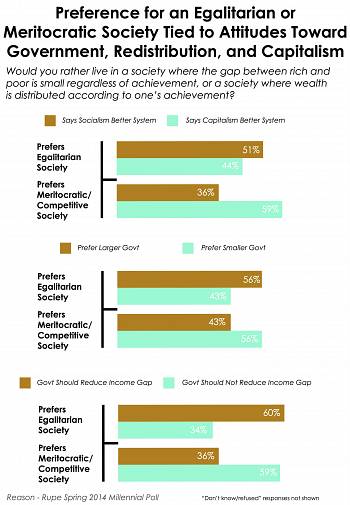
If millennials had to choose, 57 percent would rather live in a society where “wealth is distributed according to achievement” while 40 percent would prefer a “society where the gap between rich and poor is small regardless of achievement.”
The World Values Survey has asked this same question on surveys across the globe, to measure people’s preferences for a competitive/meritocratic society or an egalitarian society where incomes are more equal. American millennials are solidly in the competitive, meritocratic camp.
Economic conservatism is strongly tied to a preference for a competitive, meritocratic society and economic liberalism tied to preference for an egalitarian society. Economically conservative millennials, 79 percent prefer a competitive society, compared to 45 percent of strong economic liberals. Conversely, 53 percent of strong economic liberals prefer an egalitarian society compared to 20 percent of strong economic conservatives.
There are not many significant differences across demographic groups, but political groups do vary.
Egalitarian preferences correlate highly with attitudes toward government and the economic system. Egalitarian millennials say government should redistribute wealth (60%), say socialism is better than capitalism (51%), and prefer a larger government with more services (56%). Millennials who prefer a competitive/meritocratic system are essentially a mirror image, and say government does not have a responsibility to reduce income differences (59%), prefer capitalism over socialism (59%), and favor a smaller government (56%).
Conservatives (72%) and libertarians (83%) strongly favor a competitive/merit-based society, as do 57 percent of moderates, 49 percent of liberals, and 44 percent of progressives. Progressives and liberals are more likely to favor an egalitarian society, 54 and 50 percent respectively, as are 40 percent of moderates, 27 percent of conservatives, and 16 percent of libertarians.
Bloggers, Surveillance and Obama’s Orwellian State Justin Lynch July 11, 2014 U.S. President Barack Obama (R) arrives to make a statement to the news media about the recent problems at the Veterans Affairs Department with White House Press Secretary Jay Carney in the Brady Press Briefing Room at the White House May 21, 2014 in Washington, DC.Chip Somodevilla—Getty Images
Advancements in technology have fueled this White House’s obsession with controlling the message.
Jay Carney is free. But not loose – at least so far. After resigning as the press secretary for President Obama on June 20, Carney gave insight into the Obama administration’s handling of classified documents, and responded to criticism that this administration has been the most Orwellian in recent history.
“I know — because I covered them — that this was said of Clinton and Bush, and it will probably be said of the next White House,” said Carney in a recent New York Times Magazine interview. “I think a little perspective is useful…It is a serious, serious matter to leak classified information. Some of the debate around this kind of forgets how serious that is.”
But, it could also be the changing nature of the relationship between the media and the White House. At a recent event at the New America Foundation, journalists and historians challenged Carney, arguing that this White House has been more secret than previous occupants.
“Increasingly, the Obama White House has become so brittle, and so controlling of the message, that people are afraid to respond to me,” said Kimberly Dozier, a former Associated Press reporter. She was one of the journalists whose phone records were obtained by the Department of Justice last spring during its investigation into a leak of classified information about a failed Al-Qaeda plot. The scope of that investigation, some critics said, was unprecedented overreach.
Restaurant review:The Park West Tavern
July 11, 2014 Last updated: Friday, July 11, 2014, 1:12 PM
By Elisa Ung
The Record
Surprise! Some of Ridgewood’s most satisfying fine-dining fare can now be found in a place that calls itself a tavern.
The Park West Tavern is a place where you can expect more that just a bucket of Buffalo wings with your beer.
OK, maybe it’s not a total surprise. When Park West Tavern opened three years ago, serving up its flavorful burgers with house-made ketchup, it was clear that it was not your average bar. The owners, who are also behind the well-regarded Park Steakhouse in Park Ridge, thought Ridgewood needed a restaurant with an upscale but still laid-back atmosphere, a benchmark bar and a familiar American menu with chef touches: I rated it 2.5 stars.
Park West Tavern ***
30 Oak St., Ridgewood
201-445-5400
parkwesttavern.com
Ridgewood Junior Police Academy cadets bond with first responders
July 10, 2014 Last updated: Thursday, July 10, 2014, 3:21 PM
By Laura Herzog
Staff Writer
They led the Ridgewood Fourth of July parade, put out fires, saw a helicopter landing and a mock crime scene and went to a firing range. They heard lectures from village officials, made friends with Ridgewood’s finest and even got to see ammunition up close.
Not a bad start to the summer for a bunch of Ridgewood’s aspiring emergency responders.
After several days of fun, from June 26 through July 2, 44 cadets ages 10 to 14 are now graduates of Ridgewood’s first annual Michael Feeney Junior Police Academy.
The program was a success, and, according to police officials, it will be returning next year.
“I have not stopped getting compliments from the parents of the kids, the kids themselves,” said Lt. Glenn Ender, the academy’s coordinator. “It was better than we thought it would be.”
Three such positive reviews came from 11-year-olds Jimin Kong, Paul Gillan and Ashli Hamilton.
“It’s really fun. We get to try new things. There’s a lot of new people you meet, like the officers. They’re really nice,” Kong noted.