The sun is shining the birds are chirping and the class of 2017 is about to graduate, which means going out and looking for a job.
According to Kim Barberich, executive director of the Rider University Career Development & Success Department, this year’s job outlook for new graduates is looking better than last year.
“The landscape looks like there’s going to be, for 2017, about a 6 percent increase in hiring, I think that’s really exciting,” she said.
Dora Onyschak, the New Jersey metro market manager and vice president at Robert Half, a staffing and employment agency, said 74 percent of employers are hiring new grads this year.
The top degrees that employers are looking for are business, engineering and communication technologies.
Barberich adds that “healthcare is also a really strong domain right now, especially because New Jersey has so many pharmaceutical companies.”
Even though he has spent much of his career writing songs about the working man, Bruce Springsteen will be the first to tell you he hasn’t done much in the way of hard work himself.
As part of the 2017 Tribeca Film Festival, the Boss sat down with actor Tom Hanks for a conversation about his life and music. “The only honest work I’ve ever done in my entire life was at 14 or 15 when I was a lawn boy,” he told the crowd at the Beacon Theatre. “I painted houses and tarred roofs in the summertime – that was to get the money to buy my first guitar.”
But the fans still love him all the same, and over the course of the hour, Hanks attempted to get to the bottom of that long-held affection. Here are some the highlights from their discussion.
Does the fall-off in solar installations and loss of jobs indicate a slowdown in the sector?
What’s going on: Mostly business as usual: The unanswered question is whether that portends well for New Jersey’s solar sector, which has been prone to boom-and-bust cycles. The state’s solar industry is continuing to install new systems at a fairly good pace, although last month the number of deployments fell off dramatically from the rate of a year ago. In March, 889 residential systems were put in, roughly half the number installed 12 months earlier, according to the Office of Clean Energy. The number of nonresidential systems put also fell. That is only one month’s tally, but there are other signs the sector may be slowing. An industry survey of the sector nationwide released early this year found New Jersey lost 1,000 solar jobs in 2016 — at the same time the industry was growing at 25 percent nationwide.
Millenials watch a video calling on the millennial generation to help end the problem of extreme poverty around the globe at the IMF/World Bank Group’s Spring summit on April 10, 2014. Miguel Juarez Lugo / Zuma Press file
By his twenties, Kyle Kaylor imagined he would be living on his own, nearing a college degree, and on his way to a job that fulfilled him.
Instead, at 21, he found himself out of school, living with his parents, and “stuck” working as a manager at a fast food restaurant scraping to make hand-to-mouth.
Launching into adulthood has been tricky, he said.
“It became too difficult financially to be in school and not working,” says Kaylor, who dropped out of Lincoln Christian University, in Illinois, after one semester because of a money crunch. “And without schooling, you can’t get a job that you can survive on, so I had to move back home,” he said.
Millions of Americans don’t want to work part-time.
The U.S. economy added just 98,000 jobs in March, the smallest gain in nearly a year, after adding more than 200,000 jobs in January and February. Economists predicted that the number of jobs created in March would hit 180,000, so the actual figures fell far short of that. Unemployment fell to a 10-year-low of 4.5% in March from 4.7% in February, but the “real” unemployment rate that includes part-time workers who would rather work full-time and job hunters who gave up searching for work was 8.9%, although this was also down from 9.2% in February.
Part-time work is still a contentious alternative for many workers. On Thursday, Amazon said it will create 30,000 part-time jobs in the U.S. over the next year, nearly double the current number. Of those, 25,000 will be in warehouses and 5,000 will be home-based customer service positions. Amazon AMZN, -0.38% said in January it would create 100,000 full-time jobs over the next 18 months, according to a separate announcement made in January. Last year, Amazon’s world-wide workforce grew by 48% to 341,400 employees. In the U.S., it has over 70 “fulfillment centers” and 90,000 full-time employees. (Amazon did not respond to request for comment.)
There were some 5.6 million involuntary part-time workers in March 2017, little changed from the month before, but down from 6.4 million a year earlier, according to the Bureau of Labor Statistics. That number is up from 4.5 million in November 2007, but way off a peak of 8.6 million in September 2012. These figures are almost entirely due to the inability of workers to find full-time jobs, leaving many workers to take or keep lower-paying jobs, according to the Economic Policy Institute, a nonprofit think-tank in Washington, D.C. And 54% of the growth in these involuntary part-time jobs between 2007 and 2015 were in retail, leisure and hospitality industries, the EPI said.
Ridgewood NJ, Small business owners probably think they have enough headaches already, what with meeting payroll, dealing with government regulations and pleasing customers.
Setting up a retirement plan for their employees is just extra red tape – and possibly expense – they can do without.
But creating such a plan is more doable than they may realize and even comes with benefits for the small business and its owner, says Andrew Denney, founder and CEO of Prosperity Financial Group (www.pfgmidwest.com).
“I’ve worked with some employee retirement plans where there was in excess of $500 million in the plan,” Denney says. “At the other end, I’ve seen businesses with as few as 10 employees set up a plan.”
Yet as a group, small businesses tend to forgo retirement plans.
For example, only 22 percent of workers at firms with fewer than 10 employees report having access to a workplace savings plan or pension, compared with 74 percent at firms with 500 or more, according to a Pew Charitable Trusts report.
Employee-sponsored 401(k) and IRA plans are among the more popular options for businesses that do offer a retirement benefit. Those savings plans allow the employees to deposit money routinely in the accounts with a deduction taken out of their paychecks.
Since these are tax-deferred retirement plans, the employees see a lower income-tax bill at the end of the year. Some employers also offer a company match, providing an even heftier balance to the accounts.
But employees aren’t the only ones who benefit. Denney says there’s also an upside for the small business owner, including:
• Employee recruiting and retention. Any business wants to hang onto good employees and offering a retirement plan helps do that. They’ll be happier knowing they’re more likely to have some financial security in retirement. A retirement benefit also serves as a recruiting tool. Imagine a job candidate who’s weighing similar offers from two businesses, but one has a retirement plan and the other doesn’t. “It separates you from the pack,” Denney says. • A lower tax bill. The business potentially can reduce its tax burden because a company’s contributions to the retirement plan are tax deductible. In some cases, the businesses also may qualify for a tax credit to help offset the cost of starting the plan, according to the IRS. • An opportunity to invest in your own retirement. Like their employees, small business owners may not want to work forever and need to set aside money for their own retirements. They’ll enjoy the same tax-deferred benefits the employees do as they build that nest egg.
“It’s worthwhile for a small business owner to investigate whether an employee retirement plan is more attainable than they might realize,” Denney says. “A financial professional with experience in setting up such plans can explain to them the advantages and disadvantages, and suggest which plan would work best for their situation.”
About Andrew Denney
Andrew Denney, founder and CEO of Prosperity Financial Group (www.pfgmidwest.com), has more than 13 years’ experience in the finance industry, where he advises clients in such areas as retirement planning, asset protection, estate planning and wealth management. Denney holds Series 7 and Series 66 securities registrations with LPL Financial, in addition to a life insurance license. He has a degree in finance from Missouri State University.
Securities offered through LPL Financial member FINRA and SIPC
Investment advisory services offered through Independent Financial Partners, a Registered Investment Adviser
Independent Financial Partners and LPL are separate entities
the staff of the Ridgewood blog
Ridgewood NJ, There’s a new generation in town and it’s one that employers better get ready for, because it’s 23 million strong and will be flooding the workforce by the end of the decade.
Ladies and gentlemen, meet Generation Z; a confidence-filled group that doesn’t want to miss a thing, has the shortest attention span of any generation and isn’t quite as open as its predecessors – the millennials – from whom they learned that not everything needs to be shared online.
“If you try to treat those in Generation Z (born in the mid to late ‘90s, mostly to Generation X parents) like you treated Millennials (born in the early ‘80s to mid ‘90s, mostly to Baby Boomer parents), it will backfire on you,” says Matt Stewart, co-founder of College Works Painting (www.collegeworks.com). “This generation is unique. And now they are starting to enter the workforce.”
Thanks to his role at College Works Painting, which offers internships that help undergraduate students gain real-life business management experience, Stewart has gained a first-hand look at both the Millennials and Generation Z. And there certainly are differences between the two:
• According to best selling author and generations expert David Stillman, you won’t find those in Generation Z frequenting Facebook or Twitter as much as their predecessors. Keenly aware of software monitoring, they are more likely to share their worlds on apps such as Snapchat or Instagram. Often dubbed Digital Natives, Millennials are much more likely to share their lives in the open on platforms such as Facebook.
• Being culturally connected is more important to those in Generation Z than to Millennials, with many more Gen Zers suffering from FOMO (Fear of Missing Out) than Millennials.
• Stewart doesn’t see this as a hard and fast rule and says the experience Generation Z employees have at College Works Painting – and the impact they pride themselves on having – is much the opposite of FOMO. An example that Stewart says other companies can follow.
• Those in Generation Z have grown up with smart phones, tablets, 3-D, 4-D and 360-degree photography just to name a few of their norms. According to Stillman, keeping the attention of a Gen Zer is harder than ever. Their average attention span is eight seconds, compared to the 12-second attention span of Millennials.
• Millennials are driven to succeed by helicopter parents who watch their every move, while Generation Z finds encouragement from parents who encourage independent thinking, want them to achieve on their own and are fed up with not receiving equal pay for equal success at work.
• According to Forbes, social entrepreneurship is important to Generation Z, a group that is driven to volunteer and choose a career in which they can make a difference. On the other hand, there are those who hope the Millennials will become more civic-minded as they grow older, but it’s something that hasn’t been witnessed as of yet.
• Generation Z children were raised in classrooms that focused on diversity and collaboration. Despite this fact, they tend to be more private than Millennials, perhaps as a result of seeing many of the downfalls of previous generations in the Great Recession.
• Because those who are part of Generation Z feel pressure to gain corporate experience early, they are competing with Millennials who are more likely to wait to gain that same type of experience. The good news for Millennials, who are more likely to chase jobs in the corporate world, is that 72 percent of those in Generation Z wish to take what they learn and apply it to their own business, versus 64 percent of Millennials who have the same goal.
About Matt Stewart
Matt Stewart is co-founder of College Works Painting (www.collegeworks.com), which provides real-world business experience for thousands of college students each year. The award-winning program also offers high-quality house-painting services for homeowners.
The approach of Memorial Day means it’s summer jobs season at the New Jersey shore.
OCEAN CITY, N.J. (AP) — With Memorial Day soon approaching, it’s summer jobs season at the New Jersey shore.
Business owners tell The Philadelphia Inquirer (https://bit.ly/2oNZd6i) fewer international students have been applying for the seasonal positions in recent years, opening the door for more locals to get in on the action.
Businesses in Ocean City such as Gillian’s Wonderland Pier and numerous eateries hire hundreds of workers between the ages of 14 and 21 to start around mid-June. Most get paid a little more than minimum wage.
Above all, the business owners say, intelligence and an outgoing attitude is a must.
John Kavchok, personnel director for the Wonderland Pier, said most summer employees work six days a week and start at $8.50 an hour. Among the fringe benefits are a 25 percent discount on pizza and free rides.
Speaking of rides — ride operators must be 16 or older under state law, and Kavchok said the pier chooses employees for those jobs who are responsible and attentive.
Ridgewood NJ, NJ TRANSIT is partnering with the U.S. Army on a program to help provide soldiers with career opportunities following their military service. In a signing ceremony held today at the Frank R. Lautenberg Station at Secaucus Junction, NJ TRANSIT became the newest member of the U.S. Army’s Partnership for Youth Success (PaYS).
The PaYS program is designed to help soldiers prepare for a career after the Army by connecting them with employers who understand the skill, discipline and work ethic that military service members can bring to an agency. Since PaYS began in 2000, more than 500 employers have partnered with the program.
“We are pleased to join the U.S. Army’s program which benefits both NJ TRANSIT and soldiers in many ways,’’ said NJ TRANSIT Executive Director Steven H. Santoro. “As an agency that proudly employs veterans throughout all levels of our organization, we know firsthand the tremendous value they bring to our agency. The leadership skills that veterans possess are true assets to our transportation system.’’
PaYS matches soldiers with participating businesses most in need of their particular skill set. During the enlistment process, soldiers can choose to participate in PaYS and select the job and company they are most qualified for. By participating in PaYS, NJ TRANSIT will provide qualified PaYS participants the opportunity to be assessed and to possibly interview with a representative of the company when a job opening is available. The program does not guarantee employment, but it does help a soldier clear the first hurdle to starting a career.
“The Army PaYS program is a win-win opportunity. The Army helps soldiers find employment with companies who value the skill and discipline that comes with an Army career, and companies can draw from an endless pool of qualified talent to fulfill their needs,’’ said Lieutenant Colonel Ed Croot, U.S. Army Mid-Atlantic Recruiting Battalion.
As Manufacturers Meet President Trump to Talk Regulations, Taxes and Infrastructure, Industry Is More Confident in Improving Business Climate
by Jennifer Drogus
March 31, 2017
Washington, D.C., Fresh off the heels of the third straight month of manufacturing job growth, the National Association of Manufacturers (NAM) today released the first Manufacturers’ Outlook Survey since President Donald Trump took office. The survey shows a dramatic shift in sentiment, with more than 93 percent of manufacturers feeling positive about their economic outlook. This is the highest in the survey’s 20-year history, up from 56.6 percent one year ago and 77.8 percent in December.
The NAM’s release of the survey coincided with a meeting of small and medium-sized manufacturers at the White House today.
“Across America, manufacturers’ optimism is soaring, in no small part because of President Trump’s laser-like focus on pursuing bold action, particularly on rethinking red tape to address regulatory reform, to accelerate a jobs surge in America,” said NAM President and CEO Jay Timmons.
“As the survey shows, manufacturers of all sizes are now less concerned about the business climate going forward because they are counting on President Trump to deliver results. Small manufacturers—more than 90 percent of our membership—are among the hardest hit by regulatory obstacles. Regulatory costs for small manufacturers with fewer than 50 employees total almost $35,000 per employee per year—money that could otherwise go to creating jobs. It’s encouraging to see an administration so focused on providing regulatory relief to spur manufacturing growth.
“We are grateful for the chance to meet with the president today as we continue to tell the White House directly which regulations are still the biggest obstacles to a manufacturing surge. There is much work to be done, and manufacturers have the solutions on regulatory reform as well as on infrastructure investment, workforce development, bold comprehensive tax reform and a host of other issues.”
The survey shows not only a positive outlook but also that concerns about the business environment have dropped. When manufacturers were asked to identify top challenges to their business, concerns about the business environment fell to third place. This had previously been respondents’ top concern since the question was added to the survey in 2011.
For the past 20 years, the NAM has surveyed its membership of more than 14,000 large and small manufacturers to gain insight into their economic outlook, hiring and investment decisions and business concerns. The NAM releases these results to the public each quarter.
“Any regulation that is outdated, unnecessary, bad for workers, or contrary to the national interest will be scrapped.”– Donald J. Trump
YEARS OF GOVERNMENT OVERREACH: President Donald J. Trump has inherited the bloated regulatory regime of the past Administration.
According to the American Action Forum, the regulations from the Obama Administration cost United States taxpayers a total of $873 billion.
The Obama Administration issued 3,037 finalized regulations.
GETTING GOVERNMENT OUT OF THE WAY: Today, President Trump signed legislation to help eliminate unnecessary, harmful, and job-killing regulations.
Earlier today, President Trump signed four bills under the Congressional Review Act (CRA), in one of the few times the CRA has been used to cancel Federal regulations.
House Joint Resolution 37 will roll back the “blacklisting” rule that empowers big law firms to get rich by suing American companies and workers who contract with the Federal Government.
House Joint Resolution 44 removes the Bureau of Land Management’s “Planning 2.0” rule to prevent further centralization of Federal land management decisions at the expense of local citizens.
House Joint Resolutions 57 and 58 eliminate layers of bureaucracy that could have cost State and local school systems millions of dollars, while encouraging freedom and innovation in our schools.
CUTTING RED TAPE ACROSS THE GOVERNMENT: President Trump has signed Executive Orders and legislation to cut regulations that get in the way of Americans.
President Trump has required that for every new Federal regulation, two existing regulations be eliminated.
President Trump ordered agencies to create Regulatory Reform Task Forces to identify costly and unnecessary regulations.
President Trump signed an Executive Order instructing Federal agencies to minimize the burden of the Affordable Care Act on Americans while he works to repeal and replace it.
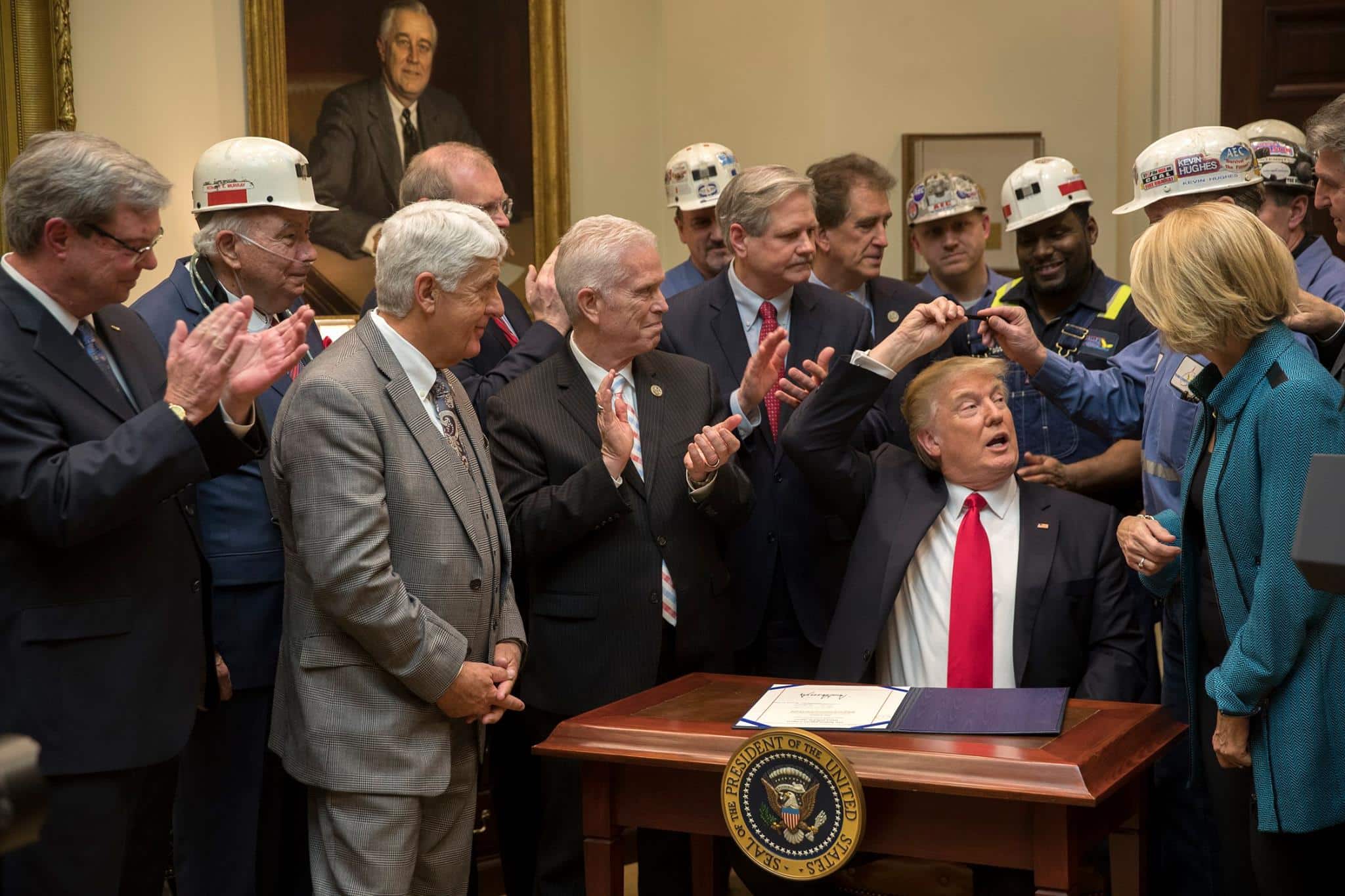
President Trump signed legislation, House Joint Resolution 38, to prevent the burdensome “Stream Protection Rule” from causing further harm to the coal industry.
President Trump signed legislation, House Joint Resolution 41, to eliminate a costly regulation that threatened to put American mining and energy companies and their employees at an unfair disadvantage.
President Trump directed the Secretary of Commerce to develop a plan to streamline Federal permitting processes for domestic manufacturers.
President Trump signed an Executive Order expediting the environmental review and approval processes for domestic infrastructure projects.
President Trump directed the Secretary of the Treasury to conduct a full review of the burdensome regulations required by the Dodd-Frank Act.
President Trump ordered a re-examination of the Department of Labor’s “fiduciary rule,” to make certain that it does not harm Americans as they save for retirement.
KEEPING HIS PROMISES TO THE AMERICAN PEOPLE: President Donald J. Trump has promised the country he would cut needless regulation.
While campaigning for President, Donald Trump promised to cut regulations massively.
While campaigning for President, Donald Trump vowed to cut any regulation that is outdated, unnecessary, bad for workers, or contrary to the national interest.
You might love watching reruns of Law & Order, but just because you get a kick out of watching people duke it out in a courtroom on TV doesn’t mean you should go to law school. Yet 25% of high-school students choose their future career based on something they saw on TV or in a movie, according to research from CareerBuilder.
Choosing a college major or career because it seems cool can backfire. A third of full-time workers come to regret their college major, CareerBuilder found. But by the time they realize they’ve made a mistake, doing a career reset is costly and complicated. Better to pick right the first time than have to start all over again in your 20s or 30s once you realize you’re not really cut out to be (or can’t make it as) a software engineer, salesperson, or screenwriter. But how to choose?
“There is a world of opportunity open to younger workers in business, technical and creative fields,” Rosemary Haefner, chief human resources officer at CareerBuilder, said in a statement. To narrow down the choices, you need to consider both your own passions and the potential salary and available job opportunities, Haefner added. “The more informed you are about your options and what it takes to get to where you want to be, the better the outcome,” she said.
“I’m a liberal-arts major, and it feels like there’s no clear line of work for me to pursue. How can I use my degree to get a job when I graduate?”
The older I get, the more fiercely I defend unduly maligned liberal arts majors. I’m the proud recipient of an English degree. Some people thought that studying literature was an endearing quirk, not a career path, but it led me to a fulfilling career in journalism.
Now that I’m out in the real world, I’ve seen how desperate companies are for good writers, communicators and researchers. According to a National Association of Colleges and Employers spring 2016 survey, employers rated critical thinking, professionalism and teamwork as the most important career-readiness traits of college graduates — all achievable through liberal arts studies.
“In many cases in job interviews, it’s those other applied experiences that students have had that help them stand out,”Paul Timmins, director of career services for the College of Liberal Arts at the University of Minnesota in Minneapolis
It’s true that PayScale’s list of bachelor degrees with high income potential is dominated by science and engineering. But a humanities background can give you the foundation to solve problems, lead and collaborate with others, which can help you rise through the ranks in any industry. You never know where your liberal arts background may take you. Late-night talk show host Conan O’Brien majored in history and literature. Howard Schultz, chairman and chief executive of Starbucks, majored in communications.
Follow these steps to gain confidence in your formidable knowledge, relay it to employers and land a job you love.
“We’re actually now over-performing the rest of the country, and I would suggest to you that the reason that there is that lag is because New Jersey is still a very expensive place to work and do business, and if the legislature had been willing to do other tax cuts and other measures that I put and recommended on property taxes and income taxes, perhaps we’d be in even better shape and it would’ve happened even faster. But, we’re certainly better off than we were from 2001 to 2009, when there was zero net private-sector job growth during a time” Governor Chris Christie
By KATHERINE LANDERGAN
03/13/17 03:08 PM EDT
Gov. Chris Christie on Monday heralded the state’s fiscal health as new figures showed New Jersey last year experienced the largest spike in private sector job growth since 2000.
The Bureau of Labor Statistics reported the state gained 60,800 private sector jobs last year, meaning New Jersey recovered all of the jobs it lost during the recession, and then added another 65,000 jobs.
“This didn’t happen by accident,” Christie, a Republican, said at a press conference in Englewood Cliffs. “The tax cuts we put in place, holding the line on other taxes, the 2 percent property tax cap — all of these things are bearing fruit.”
Christie also said the state has shown strong gains in construction, the tourism industry, and the number of new businesses filings, and has seen a decline in foreclosures.
“It’s great news for the state and we should stop the drumbeat that somehow New Jersey is underperforming from a jobs perspective,” he said.
The facts speak for themselves once you get past the hysteria.
Do your homework: Each Wal-Mart superstore can employee several hundred (or more) employees, Save Jerseyans, depending upon its size. These stores provide employment opportunities and affordable goods particularly in areas where the population is struggling and/or lacks sufficient levels of education or skilled training. It’s a win-win for the local community and the overall economy.