Ridgewood NJ, Despite the overwhelming negative feedback about the “Option A” ($12.3 million, cantilevered over Hudson Street) parking garage Village Council members received on Wednesday night, by a 4-1 vote, Council members introduced Ordinance 3519, which gives authorization for Village officials to begin negotiations with the County of Bergen to bond $12.3 million for a “Village of Ridgewood Parking Deck Project.”
I ask you; why would we be asking the County to bond $12.3 million if it was agreed that a MASSIVE garage isn’t suitable for Hudson Street? Am I the only one who heard a big “NO WAY” vote cast by the public in attendance at Wednesday’s meeting? What will it take to get those who sit on the dais to listen?
JANUARY 4, 2016 LAST UPDATED: MONDAY, JANUARY 4, 2016, 1:20 AM
THE RECORD
Keep school out of county park
Why do the Hudson County freeholders believe giving away part of Braddock Park to North Bergen for a school is a good idea? Many residents want to save this park for what it was intended: open space and recreation, not development.
Soon the decision will be up to the state, as the freeholders have applied to the state Green Acres program for a diversion that would allow this school to remain in the park.
This school was moved into the park 15 years ago in violation of Green Acres regulations, and it has remained there even though, in my opinion as a retired safety investigator, the public’s health has been jeopardized. A recent traffic engineering safety study at the school’s location recommended widening the school’s too-narrow roadway and installing a sidewalk.
Why was this study never conducted before the school was moved into the park? And why were the school trailers never tested for formaldehyde (a cancer-causing chemical used in trailer construction), when it was well known after Hurricane Katrina that this is an important safety concern? After Katrina came Sandy, which caused two of the trailers to be destroyed by fire after trees fell onto electric wires during the storm.
New Jersey officials should enforce state regulations and safeguard the public. This school should be moved out of the park and into the community, where it belongs. Affordable alternative sites are available. If the state rewards North Bergen and Hudson County with this diversion, no park is safe from similar municipal expansion. For 15 years North Bergen has disregarded state regulations, and it should not be rewarded by a loophole in the same regulations.
JANUARY 8, 2016 LAST UPDATED: FRIDAY, JANUARY 8, 2016, 12:31 AM
BY MATTHEW SCHNEIDER
STAFF WRITER |
THE RIDGEWOOD NEWS
In response to numerous concerns raised by residents, the date for a special public meeting featuring interviews with consultants for multi-family housing impact studies has been changed.
The meeting, which was to take place in the Ridgewood Village Hall Court Room at 5 p.m. this afternoon, was moved to 7:30 p.m. on Tuesday, Jan. 12 in Benjamin Franklin Middle School’s auditorium.
Residents raised concerns that they would be forced to miss the meeting because they would be commuting, eating dinner with their families or practicing their religion.
Deputy Mayor Albert Pucciarelli explained that the meeting was not intentionally scheduled for such a difficult time.
“Fridays are generally a good time to spend with family and start the weekend,” he said.
Pucciarelli said that the time and date were chosen purely based on scheduling availability, though he noted that the council agreed on Friday “with great reluctance.”
Pucciarelli said it was agreed upon that the date be changed to one that worked better for residents. Village Manager Roberta Sonenfeld’s office polled residents to figure out the best time.
Pucciarelli said council members received numerous emails asking them to reconsider the original date. A separate meeting is required for this topic due to the expected length of the interviews, he added.
The Tuesday meeting will not be streamed live because consultants will be in separate rooms during each presentation.
The meeting will be videotaped for subsequent viewing, according to the village manager’s office.
JANUARY 8, 2016 LAST UPDATED: FRIDAY, JANUARY 8, 2016, 12:31 AM
BY MATTHEW SCHNEIDER
STAFF WRITER |
THE RIDGEWOOD NEWS
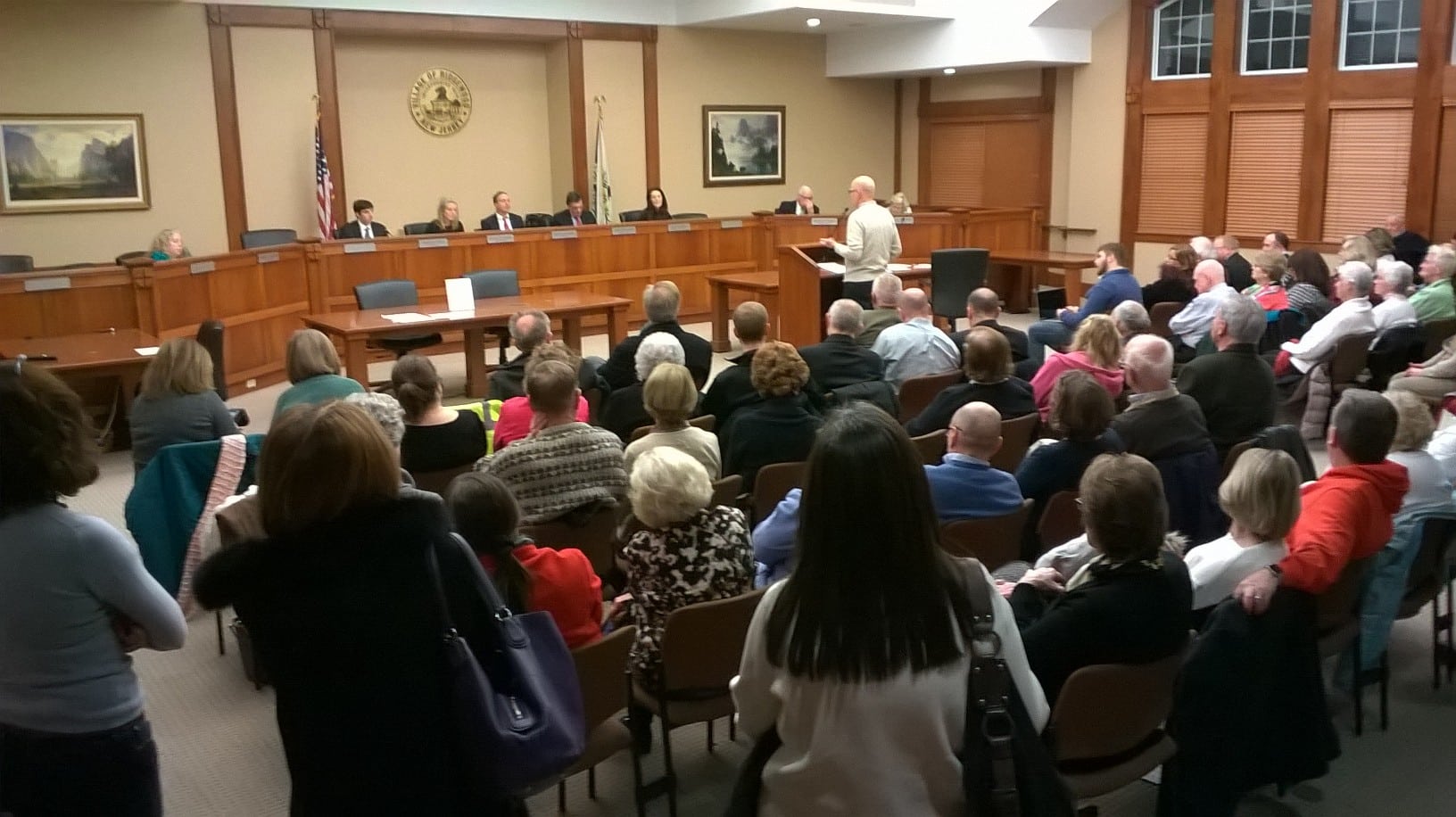
Residents listen to public comments on a proposed parking garage during Wednesday’s council meeting.
Wednesday’s marathon Village Council meeting ended with the governing body voting 3-2 on a $12.3 million bond ordinance to build a parking garage on Hudson Street.
Because the ordinance requires a supermajority vote (four out of five council members), it was defeated.
Following that vote, a second ordinance was introduced that would enter Ridgewood into an agreement with the Bergen County Improvement Authority (BCIA) for a garage. The ordinance, introduced with a 4-1 vote on Wednesday, would require three votes for final approval.
Council vote
Prior to the meeting, which went until almost 3 a.m. Thursday, Mayor Paul Aronsohn sent out a statement explaining that while he is still in favor of the largest garage option (option A), he was willing to compromise.
He lent his support on Wednesday to the smallest option (option C) in the hopes of approving the bond ordinance.
“The idea of building a garage is an idea that has been discussed and debated for decades,” he said at Wednesday’s meeting. “While I still think that building a larger garage is the way to go, in the spirit of compromise … maybe at the end of the night, we can come to an agreement.”
Deputy Mayor Albert Pucciarelli and Councilwoman Gwenn Hauck, who had both been strong proponents of option A, also agreed to support option C if it meant moving forward in the process.
“We clearly need to think about this opportunity very carefully,” Hauck said. “I would like to work together in the spirit of cooperation to see this parking deck built.”
Though he noted that he is still in favor of plan A, Pucciarelli said that he understands that there is “objection on the part of plan A,” causing him to reconsider.
“It is clearly time to get going on this garage,” he said, adding that “studies in this town have become a mantra for not making tough decisions,”
While he had initially been in favor of bonding the ordinance for plan C, Councilman Michael Sedon expressed reservations with the idea due to new information about the proposed plan.
He opined that the public did not really have a true view of what the garage would look like before voting in the non-binding referendum in November that started the entire process. Sedon also said that he thinks the process was not made very clear to the public before they voted, which caused him some consternation.
Sedon said that instead of voting to bond option C, he is in favor of looking at less expensive alternatives for adding parking.
“We could do this, and it wouldn’t cost nearly $12 million,” he said. “If it’s decided that it doesn’t work, it’s easily reversed. I can’t support this bond at this time, and I’m voting no.”
“Simply stated, I am not convinced that we need a large, potentially expensive garage in our downtown area, and I am not convinced that we need additional commercial space. In fact, the more I learn about the situation, the more I believe that a garage now would be a big mistake.”
Dec 19, 2008 • 10:11 pm
Paul Aronsohn
Too few parking spaces. Too many parking tickets. And too many excuses about why nothing meaningful has been done about either situation.
Parking problems in the Village are nothing new. We all know that. In fact, if you listen to some of the old timers,such problems reportedly predated the advent of the automobile! But regardless, the fact remains — we have some serious parking issues that demand some serious answers … now.
A PARKING GARAGE?
In this context, much of the discussion over the past year has been about the possibility of constructing a large garage on the corner of Franklin and North Walnut – a garage that would be a few stories tall and include commercial space. And much of the focus has been on three proposals submitted by three companies – all
different but all seemingly trying to address the perceived needs of the Village.
I, however, remain skeptical. Simply stated, I am not convinced that we need a large, potentially expensive garage in our downtown area, and I am not convinced that we need additional commercial space. In fact, the more I learn about the situation, the more I believe that a garage now would be a big mistake.
Granted, downtown Ridgewood is often congested and finding a parking space in front of your favorite restaurant or store can be near impossible at times. But there are always – repeat, always – empty parking spaces in the central business district. You just have to walk a block or two to find them. And if you are unwilling or unable to walk a couple of blocks, then a garage – situated on the edge of the business district – would not likely help you.
And as for commercial space, our focus should be on trying to fill the many vacancies that already exist throughout the downtown area. The possibility of adding stores – even a “big box” store – may be attractive to some, but now does not seem to be the time to take such a gamble. In addition to our own vacancies, one only has to drive down Route 17 and in neighboring towns to see that the recession is taking a very real toll on our local economy.
A PARKING COMMITTEE?
Alongside conversations about a possible garage, the Village Council recently established a committee to“undertake a comprehensive review of the parking and pedestrian issues in the Central Business District and train station….” A good idea in theory – one that I initially supported, but one that may be undermined by some of those involved in the process. Specifically, I have been told – in no uncertain terms – that the committee should not address the garage proposal and should not even seek to increase the number of parking spaces in the downtown area.
This, to me, is a real shame and a real mistake. In my mind, it defies logic and good, common sense to establish a parking committee – give it a broad, three month mandate – but not let it deal with one of the biggest perceived parking issues: scarcity of spaces. Sure, there are other issues that can and will be addressed, but how – in good conscience – can we call this a “parking committee” when it is not allowed to deal with the Village’s central parking issue?
Needless to say, I hope the new committee will see fit to revisit the garage proposal and take a broad, meaningful look at the parking situation. Comprised of some really bright, thoughtful members of our community I am hopeful that the Committee will do the right thing.
QUICK, SMART FIXES?
Nonetheless, some of the answers to our parking problem seem obvious as well as easy and cheap to achieve.Here are a few ideas, some of which are already under consideration:
Stop the meterfeeding on East Ridgewood Avenue – a regular practice of some of those who work in the central business district. The police should crack down on this practice. People who work in the downtown area should park in the many longterm spaces that have been designated for their use – spaces that are on the margins of the downtown area.
Reduce the period of time that meters are enforced in the central business district. Currently, the meters run from 9am to 8pm. That should be changed to 10am to 6pm. This would be good for our restaurant owners as well as our restaurant goers. And the lost revenue for the Village could be made up with a system of tiered parking rates.
Implement a more efficient system for commuter parking – one that provides additional spaces as well as an easier way of paying for them. Our commuters should not have to carry a pocket full of quarters, hunt for parking spaces, or worry about getting home from work on time. Consideration should be given to using the parking lot on the east side of the train station for commuters and to using new individualizedmeter technology, as suggested by the Village Manager.
Repaint the parking spaces – and the boxes between them – in the downtown area. According to a friend of mine, who happens to be a traffic engineer, we could add 30 to 50 spaces in the downtown area by just repainting some lines and adding some meters. And while I don’t know this to be true, it certainly seems well worth exploring.
Increase the number of parking spaces for people with disabilities. With the help of the Village Manager’s office, this process has already begun. The idea is to make our downtown more accessible to people with mobility issues.
Enhance the signage for parking lots. Letting people know – through better signage, the Village website, etc. –about the location and availability of parking lots would certainly increase their utilization.
My overall point is this: We have some significant parking challenges in the Village – all of which could and should be addressed in a smart, timely, and costeffective manner. And with New Jersey Transit getting ready to begin a 3year project at the train station, it is incumbent upon us to move swiftly to offset what will be a temporary loss of commuter parking spaces.
I would therefore suggest that we (1) halt the garage proposal, (2) light a fire under the parking committee, and (3)work together – as a community — to address one of the most pressing quality of life issues in our Village.
The bad news is that it has taken us so long to get to this point. The good news, however, is that we are here now,and we have five Council Members genuinely committed to addressing this issue in a serious way.
Ridgewood NJ, For those of us who have lived many years in Ridgewood, we sit and wonder what has happened to the Village we once loved. The walls of the courtroom in Village hall are covered with the photos of those man and women who cared for the Village’s business. Some were great, some were good and some not so. To a great extent most of them thought only of their Village and guided Village government on a course set by those who came before them. They were selfless, caring and kind to the residents who duly elected them and place their trust in them. Today we have a sad situation where Paul, Al and Gwenn clearly are only interested in what THEY want and dismiss the concerns of residents as they would swat away a fly. They are self-serving, nasty, untruthful and full of venom for those who disagree with them. For those who have served with and around them and have disagreed with them, they attack, belittle and create personal and economic hardship. The walls in Village hall that will eventually hold their photos will be stained with their disgusting legacy. Many of those who voted for them now understand that they were taken in by their smooth talk and promises of a better Village. What they got was a Village with employee morale at its lowest, diminished services and a management staff who writes their own rules to fit their personal needs. Residents have always expected and deserve better. As does our country, Ridgewood needs and feels change coming. We will need to wipe the slate clean in the upcoming May election and rid the Village of this angry, nasty belittling trio and the minions they have surrounded themselves with.
JANUARY 5, 2016, 12:40 PM LAST UPDATED: TUESDAY, JANUARY 5, 2016, 1:09 PM
BY ESTHER DAVIDOWITZ
FOOD EDITOR |
THE RECORD
Longtime Ridgewood restaurateurs Natalie and Frank Trent have closed their beloved casual restaurant Natalie’s after 25 years, and Due Bistro, the well-received modern Italian restaurant just a few doors down, is set to take over the space next month.
“It will almost triple the size of Due,” said executive chef Adam Weiss, who received 3 1/2 stars for his cooking for guests at the bistro’s small (42-seat) dining room.
Weiss said that Due will probably close its doors at the end of this month at its present location – 13 E. Ridgewood Avenue —and move sometime in February into its new location — 16-18 S. Broad St. Currently, he is “redoing the menu, updating things.” He said that the new Due will be a little more casual but with an “elegant upscale feel.”
mémoire in Ridgewood has announced they have closed. The restaurant opened back in 2013.
Below is the full statement from owner/chef Tom Finnelli:
“This was probably one of the toughest decisions that I’ve ever had to make. I love the restaurant business and opening mémoire was the realization of a childhood dream. It pains me to close it. But it comes down to risk versus reward. There is the obvious financial and emotional burden that comes with owning and operating a small business; but more importantly, there is a quality of life burden. I have a wife and two young children whom I love very dearly. As Executive Chef and Owner, it wasn’t uncommon to work 75 to 90 hours a week. In fact, it was often the norm. I have no problem working hard, but there has to be a balance. And I think working as an Executive Chef for a place that I don’t own will likely create the balance that I’m looking for.
We have so many wonderful guests that will be missed. They were not only huge supporters of our restaurant, but were like family to us. Thank you for your loyalty. It was a pleasure to serve you.
Maybe one of the hardest parts of closing the restaurant was saying goodbye to my team. Everyone on our team worked very hard. They were loyal and helped to make the restaurant the best that it could be. Especially Frank, our Maître d’, whom many of guests assumed was my partner because of his passion and love for hospitality. He treated the restaurant as his own and always went above and beyond to make our guests feel welcome.”
Where’s America Moving? Oregon Named Top Moving Destination of 2015United Van Lines’ Annual National Movers Study Shows Americans Continue to Move West and South
January 7,2015
the staff of the Rmidgewood blog
Ridgewood NJ , For the third consecutive year, Oregon holds on to the No. 1 spot as “Top Moving Destination,” as Americans continue to pack up and head West and South. Those are the results of United Van Lines’ 39th Annual National Movers Study, which tracks customers’ state-to-state migration patterns over the past year.
Oregon is the most popular moving destination of 2015 with 69 percent of moves to and from the state being inbound. The state has continued to climb the ranks, increasing inbound migration by 10 percent over the past six years. New to the 2015 top inbound list is another Pacific West state, Washington, which came in at No. 10 with 56 percent inbound moves.
The Southern states also saw a high number of people moving in with 53 percent of total moves being inbound. In a separate survey of its customers, United Van Lines found the top reasons for moving South included company transfer/new job, retirement and proximity to family.
The Northeast continues to experience a moving deficit with New Jersey (67 percent outbound) and New York (65 percent) making the list of top outbound states for the fourth consecutive year. Two other states in the region — Connecticut (63 percent) andMassachusetts (57 percent) — also joined the top outbound list this year. The exception to this trend is Vermont (62 percent inbound), which moved up two spots on the list of top inbound states to No. 3.
“For nearly 40 years, we’ve been tracking which states people are moving to and from, and we’ve also recently started surveying our customers to understand why they are making these moves across state lines,” said Melissa Sullivan, director of marketing communications at United Van Lines. “Because of United Van Lines’ position as the nation’s largest household goods mover, our data is reflective of national migration trends.”
“This year’s data reflects longer-term trends of people moving to the Pacific West, where cities such as Portland and Seattle are seeing the combination of a boom in the technology and creative marketing industry, as well as a growing ‘want’ for outdoor activity and green space,” said Michael Stoll, economist, professor and chair of the Department of Public Policy at the University of California, Los Angeles. “The aging Boomer population is driving relocation from the Northeast and Midwest to the West and South, as more and more people retire to warmer regions.”
United has tracked migration patterns annually on a state-by-state basis since 1977. For 2015, the study is based on household moves handled by United within the 48 contiguous states and Washington, D.C. United classifies states as “high inbound” if 55 percent or more of the moves are going into a state, “high outbound” if 55 percent or more moves were coming out of a state or “balanced” if the difference between inbound and outbound is negligible.
Moving In
The top inbound states of 2015 were:
Oregon
South Carolina
Vermont
Idaho
North Carolina
Florida
Nevada
District of Columbia
Texas
Washington
The Western U.S. is represented on the high-inbound list by Oregon (69 percent), Nevada (57 percent) and Washington (56 percent). Of moves to Oregon, a new job or company transfer (53 percent) and wanting to be closer to family (20 percent) led the reasons for most inbound moves. Nevada remained on the high inbound list for the fifth consecutive year.
Moving Out
The top outbound states for 2015 were:
New Jersey
New York
Illinois
Connecticut
Ohio
Kansas
Massachusetts
West Virginia
Mississippi
Maryland
In addition to the Northeast, Illinois (63 percent) held steady at the No. 3 spot, ranking in the top five for the last seven years.
New additions to the 2014 top outbound list include Connecticut (63 percent), Massachusetts (57 percent) and Mississippi (56 percent).
Balanced
Several states gained approximately the same number of residents as those that left. This list of “balanced” states includes Alabama,North Dakota, Delaware and Louisiana.
Ridgewood NJ, Registration for the Winter 2016 session will be held on Tuesday, January 19th, 5:30 to 6:30 p.m., at the Community Center, Village Hall, 131 North Maple Avenue, Ridgewood
This program, for boys and girls age 5 to 15, is designed to enhance self-esteem, self-discipline and safety awareness! Students are placed into classes according to age and ability. This is an ongoing program.
Classes will be held at Community Center, Village Hall, 131 North Maple Avenue on Tuesdays after school for a 10-week session, January 26 through April 5 (no class Feb 16). The cost is $100.00. Uniforms are highly recommended and are not included in the registration fee. Click on details below. Call KidSafe at 973-284-5650 for more information.
DECEMBER 31, 2015 LAST UPDATED: THURSDAY, DECEMBER 31, 2015, 10:51 AM
BY CAITLYN BAHRENBURG AND ROBERT CHRISTIE
STAFF WRITER |
NORTHERN VALLEY SUBURBANITE
Teachers were tired of being insulted, Old Tappan Education Association President Matt Capilli said.
So, residents, students and faculty members gathered up their signs and congregated outside of the Charles De Wolf Middle School to picket in act of solidarity with the union.
The Old Tappan teachers’ union, like many others across the state, entered the new academic year without a contract.
According to statistics provided by the New Jersey School Boards Association, which “provides training, advocacy and support to advance public education and the achievement of all students through effective governance” according to its website, almost one-third of the 579 public school districts in New Jersey started the year in the same position as Old Tappan. In Bergen County, 12 district started the year without a contract.
“Negotiations are difficult everywhere right now, so I think it’s really important to show support for our brother and sister school districts,” said Jim McGuire, president of the Northern Valley Education Association, the union that represents the educators at the regional high schools in Demarest and Old Tappan.
McGuire was one of many supporters at an Old Tappan Rally Nov. 17 to show support for the teachers and urge the local board of education to reach a deal with its unionized staff.
But, McGuire’s comment was visible in several districts in the region that did not have contracts for its unionized teachers.
Before reaching an agreement in November, the Tenafly Education Association boycotted the district’s annual Back to School Nights in September.
The nights give parents a chance to meet wit their children’s teachers.
Tenafly Education Association president, Jackie Wellman, said the boycott was meant to send a message to the district.
“A program is rendered useless when quality staff is missing,” said Wellman, who is a teacher at the Stillman Elementary School in Tenafly, in a previous interview with the Northern Valley Suburbanite explaining the reasons behind the boycotts.
Unions took other steps to highlight its memberships’ displeasure with not having a contract.
These job action tactics, said Ridgewood Education Association President Michael Yannone, are the result of a change in options teachers or districts have to reach a new deal when working under an expired contract.
“Back in the day, the threat of a strike for both sides was a good thing,” Yannone said.
Strikes by public employees, including teachers, have been illegal in New Jersey since the 1960s, though, private employees can strike, with the understanding that their actions remain legal.
JANUARY 5, 2016 LAST UPDATED: TUESDAY, JANUARY 5, 2016, 1:21 AM
BY MATTHEW MCGRATH
STAFF WRITER |
THE RECORD
Local officials reacted cautiously to a proposal to charge hospitals a “community service” fee intended to offset, in part, property tax revenue that municipalities lose out on because of the non-profit status of most medical centers.
The proposed bill, which has cleared the state Senate but has not been posted for a vote in the General Assembly, would require hospitals to pay the towns in which they are built $2.50 per bed each day. If the bill becomes law, the fees would infuse about $2.7 million a year into six North Jersey communities that host the medical centers.
Not-for-profits are exempt from paying property taxes for certain uses. The proposal has been endorsed by the New Jersey Hospital Association, which hopes the payments will head off potential lawsuits from towns, but it is opposed by the League of Municipalities, whose members generally think they deserve more from the hospitals than the proposed law would allow.
Parking Utility Revenue – 01/01/15 – 11/30/15
January 5,2015
Boyd A. Loving
Ridgewood NJ, This data was obtained via a formal Open Public Records Act request.
As you can see, discounting the insurance company settlement received in connection with the theft of funds by Thomas Rica, the largest source of line item revenue for the Parking Utility during the noted time period is cash from on street parking meters.
Other significant revenue sources include: Fees for annual parking permits, rental fees for dedicated parking at the Route 17 Park & Ride, CBD employee parking at the former Ken Smith Motors facility, metered parking at lots on Cottage Place, North Walnut Street, Prospect Street, Station Plaza, Hudson Street, and the Route 17 Park & Ride, and revenue generated from the Park Mobile smart phone application.
This data should enable you to understand why a proposed increase in metered parking rates, coupled with a extension of the time metered parking is in effect, could significantly boost overall Parking Utility revenues.
It would not be an exaggeration to say that the setting of Fish Urban Dining is striking. Situated in a former Bank of America branch on East Ridgewood Avenue, the restaurant has 30-foot-high ceilings with six huge chandeliers, and its sleek dining room extends into what was the bank’s vault, complete with a five-ton steel door.
Jim and Karen DeGilio, the married couple who own the restaurant and a second Fish Urban Dining, in Asbury Park, opened their Ridgewood place in July. It has been packed ever since. It has high-quality seafood, attentive service and some excellent nonaquatic dishes, too.
“We pride ourselves on serving fresh, uncomplicated seafood with fair prices in a comfortable, fun setting,” Mr. DeGilio said in a phone interview following my visits.
Dave Symniuk, the executive chef at both locations, has worked with the couple for over a decade and oversees a team of cooks that handles day-to-day preparations.
RIDGEWOOD NJ ,Yesterday more than 500 PSE&G customers in the Village of Ridgewood lost power on Sunday due to an outage.
The outage was first reported by PSE&G at 11 a.m. The area effected was around Linwood Avenue and Oak Street . The Village website reported that
“Between 10 am & 12 pm there was a localized power outage that effected small areas by Linwood Ave. Village Hall was effected and lost communications for Website/Email. All system where back online by 2pm.”
Questions remain as to why the Village failed to use the emergency generators . The emergency generator would provide lights and some power to the computers. So why isn’t it used to supply the website ? If they are going to use the excuse that their e mail was down because of the power outage what would have happened if it were a real emergency ?