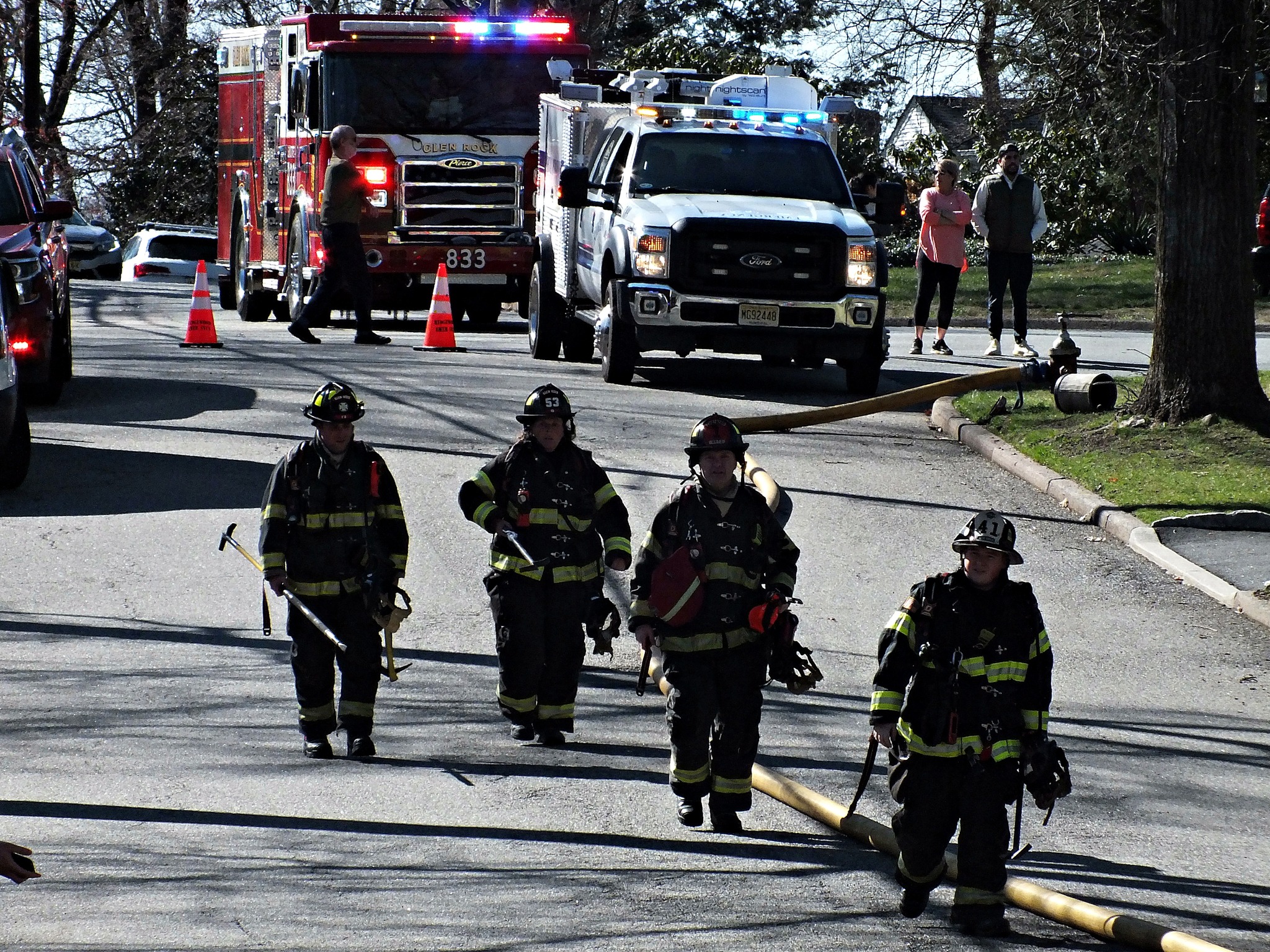
Ridgewood NJ, a devastating house fire on Norgate Drive left one victim hospitalized after emergency crews pulled them from the burning home on Tuesday afternoon, April 1.
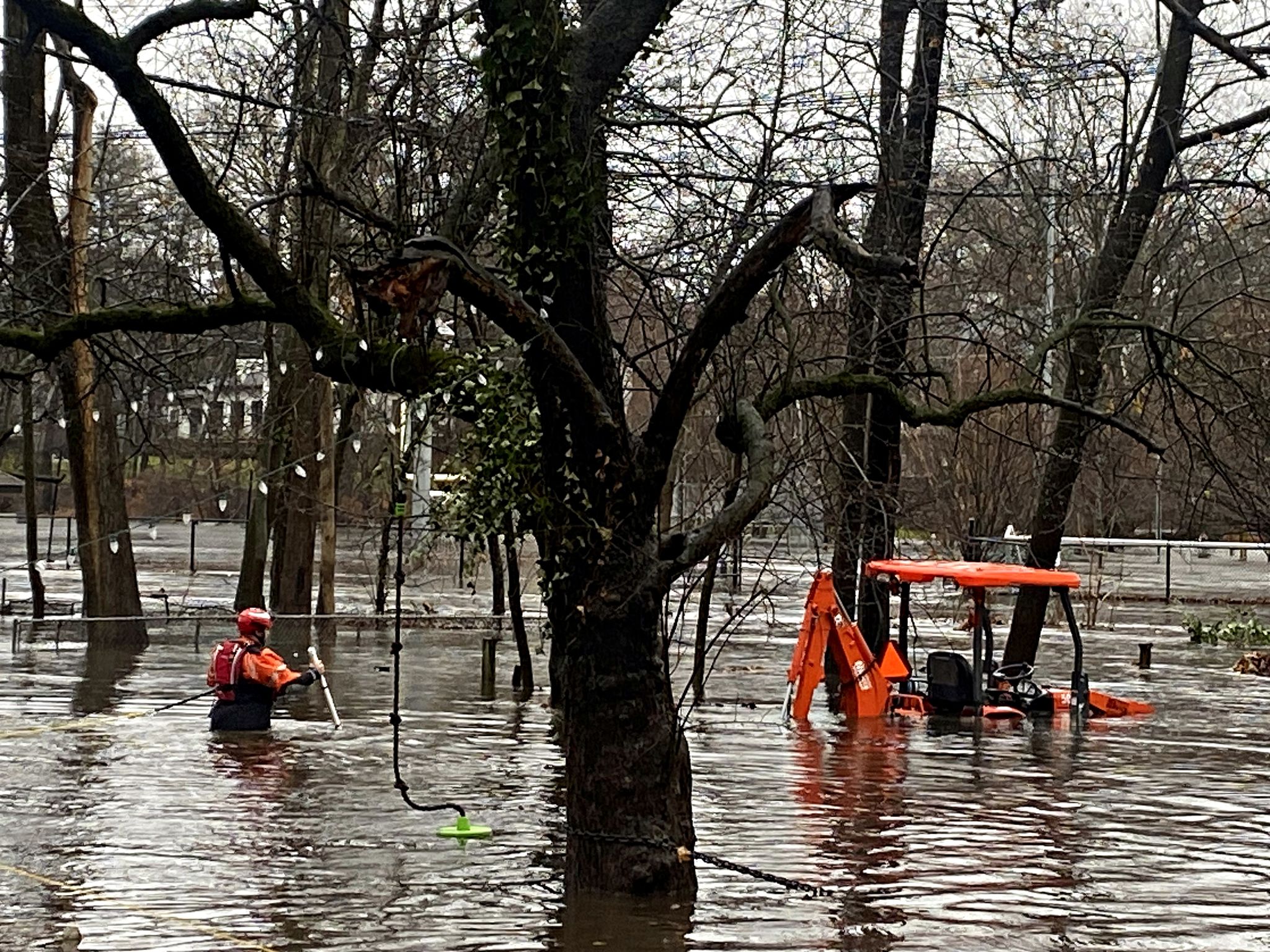
Ridgewood NJ, Ridgewood Police, Ridgewood Fire Department, Ridgewood Emergency Services, and Ridgewood OEM personnel were all kept very busy handling flooding related requests for service on Monday, 12/18. One (1) such request came from the owner of a black colored SUV whose vehicle began floating out of her driveway, which is immediately adjacent to the Ho-Ho-Kus Brook. A small excavator parked in the same area was also affected. Ridgewood firefighters secured both vehicles to nearby tree trunks. As of 1100 hours on Monday, no storm related injuries had been reported.
Ridgewood NJ, Ridgewood firefighters received numerous telephoned reports of a house fire in the 400 block of George Street, Ridgewood shortly after 0945 hours on Monday morning, 04/17. Arriving firefighters observed heavy black smoke emanating from the single family house and immediately began fire suppression operations. No injuries were reported in the blaze, which rendered the house uninhabitable. Ho-Ho-Kus firefighters assisted at the scene. Ridgewood Police, Ridgewood Emergency Services, and Ridgewood OEM personnel also responded to the incident.
Ridgewood NJ, Ridgewood Fire Department personnel quickly extinguished a smokey kitchen fire in a single family, split level home located within the 400 block of Lucille Court, Ridgewood on Friday afternoon, 08/05. No injuries were reported by either the lone adult female occupant or any firefighters. Damage to the home was light. Ridgewood Fire Department, Ridgewood Police Department, and Ridgewood OEM representatives were on the scene. The cause appears to be a toaster oven .
Ridgewood NJ, A multiple alarm fire destroyed a 3-story mixed use (commercial/residential) structure located at Bagelicious 19-23 North Broad Street, Ridgewood on Sunday night, 04/05. Numerous fire departments from Bergen and Passaic Counties assisted Ridgewood Fire Department in extinguishing the conflagration. At least one (1) residential occupant of the building was rescued by firefighters and transported to a nearby hospital by ambulance. Ridgewood Police, Ridgewood EMS, Ridgewood Emergency Services, and Ridgewood OEM were all represented by personnel at the scene.
Ridgewood NJ , some very important reminders from the Village of Ridgewood :
Please reserve calls to 911 for emergencies only. For other than emergencies, you may call the non-emergency number for the Ridgewood Police Department 201-652-3900.
If you do need to call 911 for any Emergency Services from the Police, Fire or Emergency Medical Services/Ambulance, in addition to providing your name, address and nature of the emergency. PLEASE notify the dispatcher if ANYONE in your home has travelled from Europe or Asia recently or may have been exposed to COVID-19 or is exhibiting flu like symptoms. This notification will lead our First Responders to taking the proper precautions, prior to arrival at your home.
Ridgewood NJ. Notice to the Public Concerning Public Safety Responses During the COVID-19 outbreak:
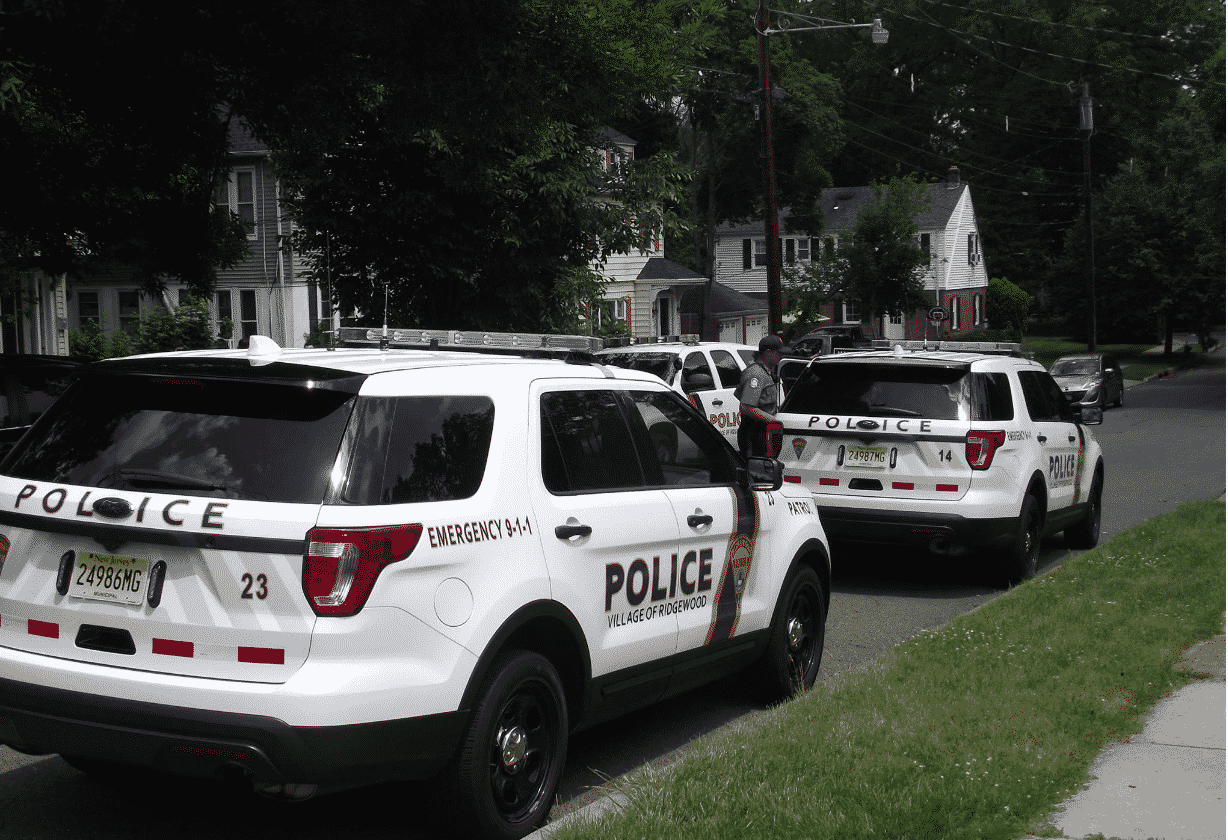
Members of the Ridgewood Police Department, as well as our paid and volunteer emergency services (Fire, EMS and OEM), continue to be here for the community 24/7 in responding to public safety emergencies and criminal acts in progress. However, due to the national, state and county declarations of a state of emergency certain secondary, non-emergent operations will be suspended until further notice.
If you are quarantined (mandatory or self-imposed) in your home due to possible or confirmed COVID-19 exposure, PLEASE notify 911 when you call and advise the dispatcher. We also ask that you place a sign/note on your front door to alert our personnel to take infection-prevention precautions before entering your home or business. Officers will be asking questions before they enter your home. Please respect this procedure and recognize that it also protects you and your family. Please keep Social Distance (six (6) feet) from our Officers when you interact with them.
Ridgewood Emergency Management Advisory: Flood Watch in effect for Bergen Co. area Tues. AM thru Late Tues. Night.
National Weather Service has issued a Flood Watch for Bergen Co. from Tues. morning through late Tues. night.
A slow moving Nor’Easter will pass through the area Tuesday. Rain will be heavy at times with 2 to 3 inches possible by the time the event ends Tues. night . . . with localized higher amounts.
High winds are also likely . . . 20 to 35 mph sustained winds with max. gusts 40 to 60 mph.
The main impact will be urban and poor drainage flooding . . . but some small rivers and streams across Northeast New Jersey and the Lower Hudson Valley may reach or exceed bankfull. This same region received 1 to 2 inches of rainfall just a couple of days ago.
A Flood Watch means there is a potential for flooding based on current forecasts. You should monitor later forecasts and be alert for possible Flood Warnings. Those living in areas prone to flooding should be prepared to take action should flooding develop.
While you can’t change the weather, you can minimize some of winter’s biggest threats to your home.
Heavy snow accumulation can pose a threat to your home or business — both as it builds up and as it melts. The three most important precautions to take:
• Watch for snow accumulation on the leeward (downwind) side of a higher-level roof, where blowing snow will collect. For safe removal that won’t endanger you or damage your roof, consult a roofing contractor for a referral.
• Remove snow from basement stairwells, window wells and all walls. Melting snow can lead to water damage and moisture intrusion.
• Keep your attic well-ventilated to maintain a temperature close to that of the outdoors to minimize the risk of ice dams forming. A warm attic melts snow on the roof, causing water to run down and refreeze at the roof’s edge, where it’s much cooler. If ice builds up and blocks water from draining, water is forced under the roof covering and into your attic or down the inside walls of your house.
Water intrusion and flood damage from melting snow and ice can threaten homes and businesses, but you can take these steps to help minimize the potential damage.
Immediately after the threat of physical danger has passed:
• Make sure the building is structurally safe to enter or reoccupy.
• Turn off electrical power. Do not use electricity until it is safe to do so.
• Ensure that natural gas sources are safely secured.
• Secure the exterior to prevent further water intrusion. This can include boarding up broken windows, making temporary roof repairs, sealing cracks or tacking down plastic sheeting against open gaps in walls or roofs.
When it’s safe to begin cleanup:
• Disconnect all electronics and electrical equipment and move them to a safe, dry location.
• Remove as much standing water as possible from inside the building.
• Begin to remove water-damaged materials immediately.
• Ventilate the home as best you can with fans and/or dehumidifiers.
• Contact a water extraction company, if necessary, for assistance.
By taking immediate action, you will reduce the amount of damage and increase the chance of salvaging usable materials. You’ll also reduce the amount of rust, rot, mold and mildew that may develop, and lower the likelihood that the water will lead to structural problems.
Ice dams are an accumulation of ice at the lower edge of a sloped roof. When interior heat melts the snow, water can run down and refreeze at the roof’s edge, where it’s much cooler. If the ice builds up and blocks water from draining off the roof, water is forced under the roof covering and into your attic or down the inside walls of your house.
To help reduce the risk of ice dams:
• Make sure your gutters are clear of leaves and debris.
• Keep the attic well-ventilated so snow doesn’t melt and refreeze on the roof’s edge.
• Make sure the attic floor is well insulated to minimize the amount of heat rising through the attic from within the house.
Bursting pipes occur when frozen water causes a pressure buildup between the ice blockage and the closed faucet. Pipes in attics, crawl spaces and outside walls are particularly vulnerable to extreme cold. To keep water in your pipes from freezing:
• Fit exposed pipes with insulation sleeves or wrapping to slow heat transfer.
• Seal cracks and holes in outside walls and foundations near water pipes with caulking.
• Keep cabinet doors open to allow warm air to circulate around pipes.
• Keep a slow trickle of water flowing through faucets connected to pipes that run through an unheated or unprotected space.
file photo Boyd Loving Information from Ridgewood OEM -Power Outage – Useful Tips
PSE&G Contact Number 1-800-436-7734
BEFORE A BLACKOUT
To prepare for a blackout you should do the following:
• To begin preparing, you should build an emergency kit and make a family communications plan.
• Follow energy conservation measures to keep the use of electricity as low as possible, which can help power companies avoid imposing rolling blackouts.
• Fill plastic containers with water and place them in the refrigerator and freezer if there’s room. Leave about an inch of space inside each one, because water expands as it freezes. This chilled or frozen water will help keep food cold during a temporary power outage, by displacing air that can warm up quickly with water or ice that keeps cold for several hours without additional refrigeration.
• Be aware that most medication that requires refrigeration can be kept in a closed refrigerator for several hours without a problem. If unsure, check with your physician or pharmacist.
• Keep your car tank at least half full because gas stations rely on electricity to power their pumps.
• Know where the manual release lever of your electric garage door opener is located and how to operate it. Garage doors can be heavy, so know that you may need help to lift it.
• Keep a key to your house with you if you regularly use the garage as the primary means of entering your home, in case the garage door will not open.
DURING A BLACKOUT
• Use only flashlights for emergency lighting. NEVER use candles during a blackout or power outage due to extreme risk of fire.
• Keep refrigerator and freezer doors closed to keep your food as fresh as possible. If you must eat food that was refrigerated or frozen, check it carefully for signs of spoilage. •Turn off or disconnect appliances, equipment (like air conditioners) or electronics in use when the power went out. Power may return with momentary “surges” or “spikes” that can damage computers as well as motors in appliances like the air conditioner, refrigerator, washer or furnace.
• Do not run a generator inside a home or garage.
• Do not connect a generator to a home’s electrical system. If you use a generator, connect the equipment you want to run directly to the outlets on the generator.
• Listen to local radio and to a battery- or generator-powered television for updated information.
• Leave on one light so that you’ll know when your power returns.
• Use a standard telephone handset, cellular phone, radio or pager if your phone requires electricity to work, as do cordless phones and answering machines. Use the phone for emergencies only. Listen to a portable radio for the latest information.
• Do not call 9-1-1 for information—call only to report a life-threatening emergency. Use the phone for life-threatening emergencies only.
• Take steps to remain cool if it is hot outside. In intense heat when the power may be off for a long time, consider going to a movie theater, shopping mall or “cooling shelter” that may be open in your community. If you remain at home, move to the lowest level of your home, since cool air falls. Wear lightweight, light-colored clothing. Drink plenty of water, even if you do not feel thirsty.
• Put on layers of warm clothing if it is cold outside. Never burn charcoal for heating or cooking indoors. Never use your oven as a source of heat. If the power may be out for a prolonged period, plan to go to another location (the home of a relative or friend, or a public facility) that has heat to keep warm.
• Provide plenty of fresh, cool water for your pets.
• Eliminate unnecessary travel, especially by car. Traffic signals will stop working during an outage, creating traffic congestion.
• Remember that equipment such as automated teller machines (ATMs) and elevators may not work during a power outage.
AFTER A BLACKOUT
Throw out unsafe food:
• Throw away any food that has been exposed to temperatures 40° F (4° C) for 2 hours or more or that has an unusual odor, color or texture. When in doubt, throw it out!
• Never taste food or rely on appearance or odor to determine its safety. Some foods may look and smell fine, but if they have been at room temperature too long, bacteria causing food-borne illnesses can start growing quickly. Some types of bacteria produce toxins that cannot be destroyed by cooking.
• If food in the freezer is colder than 40° F and has ice crystals on it, you can refreeze it.
• If you are not sure food is cold enough, take its temperature with the food thermometer. Throw out any foods (meat, poultry, fish, eggs and leftovers) that have been exposed to temperatures higher than 40° F (4° C) for 2 hours or more, and any food that has an unusual odor, color or texture, or feels warm to touch.