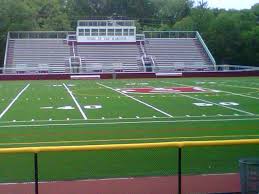
Tickets on sale for Ridgewood H.S. Athletic Hall of Fame banquet
SEPTEMBER 5, 2014 LAST UPDATED: FRIDAY, SEPTEMBER 5, 2014, 12:31 AM BY BRIAN FARRELL SPECIAL TO THE RIDGEWOOD NEWS
Ridgewood High School Athletic Hall of Fame chairman Jeff Yearing is encouraging people who are intending to purchase a reservation to the Ridgewood High School Athletic Hall of Fame’s Class of 2014 induction ceremony to do so as soon as possible.
Thirteen new inductees will be recognized for their accomplishments on Saturday, Oct. 25 at the Brick House on Godwin Avenue in Wyckoff. The celebration begins at 6:30 p.m. with a social hour. Appetizers will be served along with a cash bar. Induction festivities along with dinner are scheduled to begin at 7:30 p.m.
“The Ridgewood High School Athletic Hall of Fame wishes to recognize athletes, coaches and special contributors from all eras of the interscholastic athletic program,” Yearing said, “emphasizing their accomplishments, so that others may clearly see, and be inspired by, lives lived in the pursuit of excellence.”
The RHS Athletic Hall of Fame is self-supporting. It is sanctioned by the Ridgewood Board of Education and the Ridgewood Public Schools but receives no supporting funds from the district.
Since inductions began in 2004, the RHS Athletic Hall of Fame has welcomed 58 individual athletes, eight coaches, four special contributors and one team. This year’s class will add 10 individuals, one coach, one athletic team and one special achievement (multi-year group of teams).
SEPTEMBER 4, 2014 LAST UPDATED: THURSDAY, SEPTEMBER 4, 2014, 3:26 PM BY JODI WEINBERGER STAFF WRITER
At the annual all-staff convocation event at Benjamin Franklin Middle School on Tuesday, the theme of “Celebrating Change” was given a bittersweet embrace.
A backdrop on the stage used the metaphor of a caterpillar transitioning to a butterfly to highlight the theme, but those at the event seemed less convinced that the transformation of curriculum to meet the new state standards would end as beautifully.
Each person who spoke had something to say about the three biggest changes in the district: the one-to-one Chromebook initiative, Common Core and standardized tests.
“This year’s convocation theme is ‘Celebrating Change,’ and to be perfectly frank, this is not something that comes naturally to me,” said Michael Yannone, president of the Ridgewood Education Association (REA). “I am a bit of a traditionalist; I am a history teacher after all. If it has worked successfully in the past, why change?”
His speech gave a scathing criticism of the way education reform happens in America.
“The current educational reform movement is not about spending money to address the needs of schools and students, it is about making money,” Yannone said. “Perhaps I am too cynical, but the playbook seems obvious to me. Step one: Make Americans believe that their public schools are bad by bashing teachers and cherry picking faulty data. Politicians then get involved and support costly one-size-fits-all solutions that their donors stand to make a nice profit from.”
Yannone said the REA plans to partner with a new parent-led advocacy group, Ridgewood Cares About Schools, whose members have urged the district not to adopt the Common Core curriculum and oppose the increase in standardized testing for students.
Ridgewood elementary schools using new world language program
SEPTEMBER 3, 2014 LAST UPDATED: WEDNESDAY, SEPTEMBER 3, 2014, 5:59 PM BY JODI WEINBERGER STAFF WRITER
The world language program in the elementary schools will look a bit foreign this year.
Ridgewood educators are piloting what they call an “exploratory immersion” Spanish program for Grades K-5 after being unhappy with the results from language learning software Rosetta Stone.
The software was purchased by the district in 2010 after three world language elementary teachers were eliminated in response to $6 million in budget cuts in 2009.
“[Teachers] felt [Rosetta Stone] was ineffective to teach children the information,” said assistant superintendent Cheryl Best. “They didn’t really feel that students were effectively learning.”
Best called the program “a little glitchy” and said students would work on a section of the program only to return to it and find that their progress had been lost.
“It was very hard for students to make headway in the program,” she said.
As a result, teachers were barely meeting the minimum usage of 30 minutes a week with their classes.
1.4 million New Jersey students return to school this year
SEPTEMBER 3, 2014, 12:24 PM LAST UPDATED: WEDNESDAY, SEPTEMBER 3, 2014, 7:58 PM BY HANNAN ADELY STAFF WRITER THE RECORD
HACKENSACK — Around 1.4 million New Jersey students returned to school this week in what is expected to be a year of transition for both students and staff.
Schools continue to apply academic standards in the classroom that the state adopted in 2010 and to prepare for new tests based on those standards. They are also using new methods to evaluate teachers.
Photos: First day of school in Bergen, Passaic counties
While schools braced for changes by training teachers, upgrading technology and writing lesson plans, students were making their own choices for the first day: what to wear to school and pack in their bags.
Priyansh Saha, a third grader at the Nellie K. Parker School in Hackensack, chose his clothes and school supplies on his own and had everything ready for school days ago, said his mother, Priyanka Saha.
“We’re very excited,” Priyanka Saha said. “We hope he will learn a lot through the year.”
Saha said she expected this year to be more challenging for her son. “If he works hard he will get better in everything, whatever challenges he faces,” she said.
Maribel Breton said she also expected her son, Adonis, will have to study more in third grade. “He has to learn to read and write perfectly,” she said.
Apple offers full suite of Common Core apps sure to indoctrinate
September 2, 2014
LOS ANGELES — Expanding from its previous partnership with Pearson Education to provide fact and quality deficient curriculum resources, Apple now offers even more — a full range of Common Core aligned curriculum and assessment tools for iPad.
A recent document published by Apple outlining several “amazing curriculum products for iPad” reveals that Apple is not concerned with providing quality education material to America’s students and teachers, but rather with competing for a share of the pot of gold at the end of the nationally leveraged Common Core rainbow.
Although Apple has offered iBook textbooks from Pearson, McGraw Hill, Houghton Mifflin Harcourt, and DK Publishing since 2012, it recently upgraded its current offerings and added new products specifically aligned with Common Core, some of which are unique to iPad.
Aiming to be a one-stop-shop for all things Common Core, the iPad suite offers core curriculum content in English, Math, Science, and Social Studies, as well as assessments, learning systems, and teacher tools.
In addition to Pearson Education, who employs progressive indoctrinators to lead its Common Core Initiative, Apple’s menu of core curriculum apps includes lessons from other equally skewed publishers/providers like Houghton Mifflin Harcourt, McGraw Hill, Discovery Education, and The Choices Program.
By: Diane Weaver | March, 2013 | 11,282 views | No Comments | Posted in: Common Core State Standards, Technology in the Classroom
Digital literacy is integral component to the Common Core Standards. The skill of critically navigating, consuming, and producing digital text and media has increasingly significant influence on a student’s success as an adult. In fact, it is even mentioned in the Standard’s portrait of students who are college and career ready, which states,
“Students employ technology thoughtfully to enhance their reading, writing, speaking, listening, and language use. They tailor their searches online to acquire useful information efficiently, and they integrate what they learn using technology with what they learn offline. They are familiar with the strengths and limitations of various technological tools and mediums and can select and use those best suited to their communication goals.”
Sen. Mike Lee: ‘Common Core standards will be the ObamaCare of education’
September 2, 2014
WASHINGTON, D.C. – U.S. Sen. Mike Lee and Louisiana Gov. Bobby Jindal have a message for Big Government: stop meddling in local education decisions.
“As a U.S. Senator, I’ve seen the federal government make a mess of everything it touches,” Lee, a Republican from Utah, wrote in a recent email sent to supporters through the free market group FreedomWorks.
“And if they’re allowed to stay, Common Core standards will be the ObamaCare of education,” Lee wrote, according toNewsmax. “Common Core is the DC takeover of our school system. It will dumb down standards and cheapen the education our children receive.”
Newsmax reports Lee’s comments come just days after Louisiana Gov. Bobby Jindal filed a lawsuit last week alleging the Obama administration “is using grant money and regulations to manipulate states into adopting the federal education standards.”
Obama, through his Race to the Top education initiative, convinced most states to adopt Common Core standards as a means of competing for billions in additional federal grant funding for education, though very few states actually received the funds.
The competitive Race to the Top grants, however, are only one of several ways the federal government is incentivizing states to implement the national learning standards. The U.S. Education Department has also awarded states a waiver from former president George W. Bush’s No Child Left Behind education standards – and the penalties for not making the grade – if they agree to move forward with Common Core.
Concerns on Common Core presented to Ridgewood school board
SEPTEMBER 2, 2014 LAST UPDATED: TUESDAY, SEPTEMBER 2, 2014, 11:09 AM BY BY JODI WEINBERGER STAFF WRITER
An apple core that has become the sign for the opposition to new state standards for school curriculum was featured prominently on buttons of many of the two dozen parents who came to speak at the Ridgewood Board of Education (BOE) meeting Aug. 25.
The public outcry against the Common Core and standardized testing is growing in Ridgewood with the help of a group named Ridgewood Cares About Schools, which has formed online on Facebook and drawn many to in-person meetings this summer.
The parents (and many grandparents) raised issues of concern during the public comment portion of the meeting, including that the testing is done on computers, the lack of transparency of where and what test data is shared, and that there are too many instructional hours devoted to testing. They also said that the Common Core standards for math and other subjects are confusing and urged the BOE to reject them in fear that the standards and focus on test preparation will create bad curricula.
Anne Burton Walsh, one of the founders of Ridgewood Cares About Schools, said the increase in the use of technology in the younger grades is “unnecessarily expensive and potentially harmful.” Ridgewood is currently implementing its one-to-one initiative with Google Chromebooks at the high school and plans to give one to every student in Grades K-8 in the coming years, with one reason being that the students must take the new standardized tests on computers.
Inexpensive Device Keeps Students Safe In Classroom
POSTED 7:48 AM, AUGUST 29, 2014, BY ANGELICA SPANOS
A Connecticut made safety device could keep students safe in their classrooms. It was built here and tested in a local elementary school and now the creator wants it in schools across the state.
The device is called the Life Bolt. It is a simple metal device, that requires no training, and is inexpensive. It has been tested by engineers and teachers and is what many are backing as a creative and safe solution to secure classroom.
It works by drilling two receivers to a door; one on the jam and one on the door itself. A metal ‘U’ shaped bar then slides down into them. “It doesn’t change the environment,” said created Bill Letson of Armof Solutions. “It’s non obtrusive, it doesn’t show like it’s a lock device, it’s real simple to use teachers don’t have to read a manual they don’t have to know they have to push a button.”
Letson created the device and has gone through many phases of the Life Bolt. Now, he said this device is ready for classrooms during a code red active threat situation. The metal bar is light weight, strong, and it can hold closed against hundreds of pounds of pull pressure.
It has been tested by first responders including fire officials on a state and local level as well as teachers and school administrators. “Parents are sending children here, they are putting their lives in our hands while they’re at school, and we will do anything in our power to make sure we keep them as safe as possible,” said Alycia Trakas, a principal at a Connecticut elementary school.
Reader , Thank heavens for the eminently qualified and blessedly plain-spoken Stanford professor James Milgram, who places the blame for this recurring nightmare right where it belongs: the ossified, math-allergic minds of this country’s education school faculties. If the husband-wife reform math zealots had safely touched down in the Ridgewood district’s superintendent’s office, as had been the plan before local parents merely suggested a conflict of interest with similarly off-kilter textbook publishers like Pearson, Ridgewood would now be a Botsford-powered Mecca for Common Core adherents looking for leadership in how to deprive high-potential students of decent foundations in math achievement.
__________
COMMON CORE BLOCKBUSTER: MATHEMATICIAN DR. JIM MILGRAM WARNS COMMON CORE WILL DESTROY AMERICA’S STANDING IN TECHNOLOGY
During a Friday conference call sponsored by Texas-based Women on the Wall, Stanford mathematician and former member of the Common Core Validation Committee Dr. James Milgram, told listeners that if the controversial standards are not repealed, America’s place as a competitor in the technology industry will ultimately be severely undermined.
“In the future, if we want to work with the top level people, we’re going to have to go to China or Japan or Korea… and that’s the future we’re looking at,” Milgram said during the call that was part of a day-long Twitter campaign to target Indiana Gov. Mike Pence’s (R) decision merely to “rebrand” the Common Core standards in his state, even though he has a Republican supermajority in the legislature and an appointed state board of education.
Pence was in Dallas Friday for Americans for Prosperity’s Defending the American Dream summit, considered to be an essential stop for presidential hopefuls.
In less than 40 minutes, Milgram floored listeners with information about the Common Core standards, how they will affect the nation’s students and, ultimately, the country itself, and what parents and citizens can do to try to stop them. Listen to the podcast in full below:
Milgram began by addressing the reason why he was on the call: to let Pence know that his “rebrand” of the Common Core was a betrayal of Indiana’s citizens.
Born and raised in Indiana himself, Milgram that it was important to him as a fellow Hoosier that the state do a decent job with replacement standards after repealing the Common Core.
“The state actually paid me to evaluate new standards,” he said about his involvement in the review process.
The Stanford professor then explained to listeners a key reason why the Common Core standards will prevent students from moving into STEM careers.
Milgram said he was “incredibly disappointed that the drafts I was reading [of Indiana’s new standards] looked so much like the Common Core,” but was nevertheless happy to see that advanced math classes like pre-calculus, calculus, and trigonometry were left into the replacement standards.
“These were very well-done and absolutely impossible to teach if all these kids had were Core standards,” Milgram explained. “It was a complete disaster because even the things that they added—that were of high quality—were added to standards that couldn’t support them.”
Milgram described his experience in the 1990s when he was asked to assist with a project that would replace California’s “disastrous” education standards. The mathematician said he strongly recommended that students in the 8th grade take Algebra and that his recommendation was heeded.
From the time the new standards were put in place and until the time of the adoption of Common Core standards in California in 2010, Milgram said two-thirds of the students in the state were taking Algebra in the 8th grade and doing well, with over half of them at least proficient or above.
Milgram said this piece of information is critical because it showed that it was possible for almost every student to handle Algebra in the 8th grade.
“The group that made by far the most progress were the minorities – blacks and Hispanics – who had essentially been written off by the system,” Milgram explained, and then went on to reveal how the fact that challenging minority students – resulting in their increased performance – was a threat to faculty in universities.
“So, their numbers were increasing dramatically and I frankly think that the… faculty in the education schools throughout the country actually got extremely scared by this,” he continued, “because it contradicted everything that they’ve been telling us for the past hundred years about how education works and what one can expect and how one should train teachers.”
Milgram asserted that a strong education in mathematics is essential for success.
“If you don’t have a strong background in mathematics then your most likely career path is into places like McDonald’s,” he said. “In today’s world… the most critical component of opening doors for students is without any question some expertise in mathematics.”
Milgram explained that in the high-achieving countries, where about a third of the population of the world outside the United States is located, about 90 percent of citizens have a high school degree for which the requirements include at least one course in calculus.
“That’s what they [sic] know,” he said. “If we’re lucky, we [sic] know Algebra II. With Algebra II as background, only one in 50 people will ever get a college degree in STEM.”
Milgram warned that with the Common Core standards, unless U.S. students are able to afford exclusive private high school educations that are more challenging, they will be disadvantaged.
“This shows that, from my perspective, Common Core does not come close to the rhetoric that surrounds it,” he continued. “It doesn’t even begin to approach the issues that it was supposedly designed to attack. The things it does are completely distinct from what needs to be done.”
Milgram said, in California, they were able to deal with the problem of their poor academic standards in the 1990s because the curriculum was controlled by the state and the high-tech industry in Silicon Valley threatened to move all its research and manufacturing elsewhere if the problem was not addressed.
“The curricula we were fighting then… they’re back!” he announced. “We are hearing exactly the same kind of things now with Common Core as we heard back in the ’90s!”
“How can you have mathematics problems that don’t have a single answer or correct answer – any answer is correct?” Milgram asked. “Well, of course the answer is mathematically you can’t, and all of this is just a repeat of what went on 20 years ago in California – but this time, it’s national.”
“This time I don’t see any uniform or systematic way of getting rid of it,” Milgram said. “The only way you’re going to get rid of it is state by state and parent group by parent group. And if you’re lucky, industry will join you because high tech is ever a more important part of our economy.”
The bad news, according to Milgram, is that, returning to his experience in California in the ’90s, if students had been in that system with the older, poor standards for three or four years, “the damage couldn’t be undone,” he said.
“All of this should really make you angry at the people who are responsible,” Milgram said, directing himself squarely to the parents listening to him. “And the people who are responsible – I’m going to be blunt about it – are the people in the education schools – they’re the ones who had the ultimate say about all of this and they’re the ones whose beliefs are driving it.”
Milgram explained that a uniform perspective exists on issues in education and what is important to achieve among a vast majority of the faculty in schools of education. Because of this, he said, the same types of standards always come back.
“You must go after the schools of education and the faculty of these schools,” Milgram urged.
Asked about the fact that many industrial giants and the U.S. Chamber of Commerce actually support the Common Core standards, Milgram responded that in the ’90s, research centers in this country were still very much needed. Now, however, he noted that most of the research in top-level firms has moved out of the U.S. IBM’s main research center, he observed, is in India, and other companies have moved their research centers to Russia, Korea, and China.
“Even Microsoft has moved its software development to Beijing,” Milgram noted. The founder of Microsoft, Bill Gates, is the primary source of private funding of the Common Core standards.
“Production and manufacturing has also moved out of this country,” Milgram added. “The longer this continues, the more we’ll see our major industry move over to other countries and the jobs they generate will go with them.” Send
AUGUST 31, 2014 LAST UPDATED: SUNDAY, AUGUST 31, 2014, 1:21 AM BY KARA YORIO STAFF WRITER THE RECORD
The child’s eyes well up and lip starts to quiver. The worried “what ifs” start almost immediately.
What if my teacher is mean?
What if Joey teases me?
What if the work is too hard?
What if nobody sits with me at lunch?
As a parent, instinct kicks in.
“Don’t be nervous, there’s nothing to worry about,” you tell her. “Everything’s going to be OK.”
For an anxious kid that’s exactly the wrong thing to say, according to licensed clinical social worker and psychotherapist Lynn Lyons, who co-wrote the book, “Anxious Parents, Anxious Kids: 7 Ways to Stop the Worry Cycle and Raise Courageous and Independent Children.”
“The external reassurance is a quick fix but it doesn’t last,” said Lyons, who practices in New Hampshire. “The error that parents make is trying to tell kids that everything will be OK rather than equipping them with the skill to handle things when they’re not OK.”
This time of year, a lot of kids are getting nervous. The approach of Labor Day in North Jersey brings worried faces and frequent complaints of stomachaches.
“It is completely normal and expected for children to have a little bit of anxiety when starting the school year,” Pompton Plains licensed clinical psychologist Peter Berzins wrote in an email.
For some children, however, anxiety can be overwhelming. If a child consistently doesn’t want to go to school, can’t concentrate while there, avoids normal activities like birthday parties or the school bus, won’t sleep in his own bed, if there is a lot of distress, crying, stomachaches and headaches, it is time to seek professional help, according to Lyons and Berzins.
“Too much anxiety can lead to a slew of problems including trouble focusing at school and downright refusal to go to school,” wrote Berzins, founder of Birch Tree Psychology, who is an expert in treating anxiety disorder.
He agrees that downplaying a child’s concerns and telling them everything will be fine is the wrong way to deal with an anxious child — as is ignoring a kid’s issues with anxiety.
“Basically parents unknowingly lie to their kids because they wish everything would be all right,” he wrote. “But being honest with your kids and seeing them for who they are … anxious … worried … is the best strategy.”
– See more at: https://www.northjersey.com/news/education/professional-advice-on-kids-and-back-to-school-anxiety-1.1078626#sthash.57g0YSqv.dpuf
US schools fight `boundary hoppers’
By Jane Han
korea times
DALLAS — As back-to-school season arrives in the United States, school districts popular among Koreans are on high alert as authorities start to clamp down on “boundary hopping,” an illegal trick where parents fake home addresses to send their children to better schools.
Public school officials of competitive districts in California, New York, New Jersey, Virginia and Maryland are aggressively trying to weed out students who don’t belong in their school systems by requiring parents to prove residency in a variety of ways and, in some cases, making surprise home visits to confirm that students actually live at the addresses they say.
In the U.S., boundary hoppers could end up behind bars for theft of educational services or face fines of up to $5,000, as well as paying extra tuition and local taxes. The crime is taken seriously here as taxpaying residents argue that they are educating boundary hoppers, who don’t pay the same taxes, at their own expense.
“Boundary hopping is a huge headache for some schools and we know that many Koreans are at the center of the problem,” says Lee, a Korean education official in Ridgewood, N.J., who didn’t want to be fully named.
“I heard that several Korean students in the Ridgewood district wouldn’t go directly home after school. They would go to the library, spend a few hours there until a van picks them up, stop by a few other places and then finally take them home, which is not located in Ridgewood,” she said. “Someone from the Board of Education got a hold of this information and followed the van. I don’t know what happened next, but people should learn from this. Authorities are watching.”
Despite being a criminal activity, discussing boundary hopping isn’t uncommon in the Korean community. Many say Korean parents who are fresh from South Korea are often unafraid to ask acquaintances to do them the “favor” of lending their address.
“I was asked at least three times last year alone if they could use my home address. These parents all had children in middle and high school. They didn’t seem to know what kind of consequences boundary hopping would bring to me, them and their kids,” says Kim Yoo-eun, who lives in Plano, Texas, a district with one of the best public schools in the state.
Education experts say boundary hopping can not only lead to monetary penalties and criminal charges, but could ruin a student’s chances of entering college.
Labor Day stems from deadly labor strike, but few Americans know the history
A labor movement in Chicago in 1894 left 30 Pullman workers dead, and later spurred Congress and President Grover Cleveland to pass a bill creating Labor Day. But the history of this holiday is rarely taught in schools, and there are few full-time labor journalists to write about working class communities.
NEW YORK DAILY NEWS Sunday, August 31, 2014, 7:31 PM
WASHINGTON — Monday is the day to celebrate the American worker and his sacrifices and economic and social achievements.
You do know that, right?
If you don’t, you’re not alone.
Few recall the bloodstained origins of this holiday as we fire up the grill, throw on the burgers and dogs and turn on the U.S. Open tennis or maybe the Yanks, Mets or another ballgame.
And, in a sign of the times, the Sunday morning network news shows didn’t even offer their usual, token pre-Labor Day weekend spot for the head of the nation’s labor movement.
“No,” said AFL-CIO President Richard Trumka when I asked him. “No invitations this year.”
I told the former mine worker-turned-lawyer that there seems to be a precious lack of understanding of the holiday’s origins.
In fact, it stems from an awful confrontation in Chicago in 1894 that saw federal marshals and the Army kill 30 striking Pullman railroad strikers.
Road Warrior: How to make your teen a near-perfect driver
AUGUST 31, 2014 LAST UPDATED: SUNDAY, AUGUST 31, 2014, 1:21 AM BY JOHN CICHOWSKI THE RECORD
If you’re a parent who pounds your foot on an imaginary brake while teaching your teen to drive, you might be happy to know that your frantic mentoring will likely pay huge personal dividends — assuming you’re a good role model behind the wheel.
With schools getting ready to open any day, that was the message delivered last week when a New Jersey highway safety official presented preliminary findings in a slide show that detailed near-perfect road records for teens whose parents learn about Graduated Driver License laws, then follow up by closely monitoring their kids’ driving behavior.
When parents got involved in their training, 98 percent of these young people didn’t get traffic tickets and 92 percent didn’t crash their cars in their first year behind the wheel, said Violet Marrero of the state Division of Highway Traffic Safety. Past national studies have suggested that parental involvement can cut teen crash risk in half — not by 92 percent, a figure Marrero called “phenomenal.”
“We lost about 800 teens in car crashes in New Jersey over the last 10 years,” she told a crowd at Westfield High School on Tuesday. “Imagine the impact on the community if all parents got involved and we could spare the grief of at least half that number of families.”
The audience, composed of more than 100 high school driver-education instructors, gave the division’s special project manager a warm hand. For more than a decade, many of New Jersey’s 3,000 instructors have been complaining about steadily eroding resources for equipment like the driving simulators that are needed to train young people for an activity that takes the lives of more 16-to-20-year-olds than any disease.
The teachers are familiar with the grisly statistics: Although young drivers represent only 6 percent of the state’s population, they accounted for 14 percent of all road deaths from 2003 to 2012, mainly due to inexperience.
Teachers also know of an effective treatment: Graduated Driver License mandates that protect novices for at least one year while they learn the road’s hard lessons. Under New Jersey’s 13-year-old program, that means an 11 p.m. driving curfew, a limit of one teen passenger if a licensed adult is not in the car, a ban on plea-bargaining when sentenced for driving offenses, and a ban on all wireless devices in the car. New Jersey is also the only state to require display of a tiny red license-plate decal to identify permit holders and first-year probationary licensees.
“We’re finally seeing some meaningful change,” said Maureen Nussman, a former Kinnelon High School teacher who organized the event with the New Jersey Teen Safe Driving Coalition, New Jersey Manufacturers Insurance and the New Jersey Association for Health, Physical Education, Recreation and Dance (njahperd.org).
Statistically, New Jersey’s Graduated Driver License requirements appear to be working, especially after the decal, curfew and passenger requirements were tightened in a law that took effect in 2010. Fatalities involving drivers 20 years old or younger have fallen every year but two in the last 10 years — from 103 in 2004, to 46 in 2013, according to a Highway Traffic Safety Division analysis. This 55 percent drop is three times greater than the decline for all other age groups combined.
– See more at: https://www.northjersey.com/news/nj-state-news/parents-are-key-to-safe-teen-driving-1.1078605#sthash.d4LTH5yP.dpuf
One giant leap: Whale sightings off Jersey Shore up dramatically
AUGUST 29, 2014, 7:26 PM LAST UPDATED: FRIDAY, AUGUST 29, 2014, 10:34 PM BY SCOTT FALLON STAFF WRITER THE RECORD
While it hasn’t become Cape Cod just yet, the number of whale sightings around New Jersey has increased substantially this year, suggesting that the state’s coastal waters are now clean enough to sustain humpbacks, finbacks and other species during their feeding season.
Since April, dozens of whales have been spotted from Sandy Hook to Cape May chasing down schools of small fish sometimes within a mile of New Jersey’s shoreline.
“They seem to be staying in the same area all season long, which is something we haven’t really seen before,” said Amy Bergeron, a marine biologist with the Cape May Whale Watch and Research Center, which runs tours along New Jersey’s southern coast. “Some are not even a mile out. We know they come here for the food, and you’re seeing huge batches of bait fish close to the shore.”
As of last week, the Cape May center had 37 whale sightings, compared with 15 through October last year. And Gotham Whale Watch, a group of “citizen scientists” who catalog marine mammals in New York and as far south as Monmouth County, has reported 57 whale sightings so far up from 43 in 2013.
The news has drawn thousands onto whale-watching boats hoping to see the majestic mammals gliding through the ocean and perhaps even glimpse a humpback leaping out of the water. It has also prompted authorities to issue alerts to boaters fearing whales are coming too close to shore.
Academics are treating the reports cautiously, since most of the sightings come from groups associated with local whale-watching boats. But some environmental officials and marine biologists say the reports should be taken seriously.
“It’s tough to definitively say there are more whales in an area without more baseline information,” said Jackie Toth Sullivan, a marine mammal scientist and adjunct professor at Richard Stockton College. “That being said, an increase certainly seems plausible given the amount of anecdotal reports coming in from boaters, whale-watching boats and beachgoers alike this season.”
Beginning in April, thousands of humpback whales usually pass New Jersey dozens of miles off the coast during their annual migration up the East Coast from their winter mating and birthing grounds in the West Indies. Many congregate around Cape Cod to feed on the abundant sea life near a large underwater plateau in Massachusetts Bay or head farther into the North Atlantic for food.
Cleaner waters affect the bottom of the food chain allowing plankton to flourish closer to shore. That in turn provides a food source for small bait fish like menhaden. And whales like nothing more than to scoop a school of menhaden into their mouths for lunch.
Even though an estimated 23 billion gallons of raw sewage spills from hundreds of outfall pipes into New Jersey’s rivers and bays each year, the state’s coastal waters are considered the cleanest they have been in decades.
New Jersey ranked third in best water quality out of 30 states last year with 3 percent of water samples exceeding pollution standards, according to a report by the National Resource Defense Council, an environmental advocacy group.
– See more at: https://www.northjersey.com/news/one-giant-leap-whale-sightings-off-jersey-shore-up-dramatically-1.1078310#sthash.SJTBWb7q.dpuf
Ridgweood school board names new business administrators
AUGUST 29, 2014 LAST UPDATED: FRIDAY, AUGUST 29, 2014, 12:31 AM BY JODI WEINBERGER STAFF WRITER
A former school district employee will return to the Ridgewood Board of Education (BOE) as its business administrator in the coming months.
On Aug. 25, the BOE approved the hire of Alfredo Aguilar as the district’s business administrator, with a contract lasting through June 30, 2015. Aguilar will be paid an annual salary of $168,000.
Although Aguilar was unanimously approved to hire, he will remain in his current position, as the business administrator for the Pascack Valley Regional High School District, for 90 days or until a replacement is found.
In the interim, assistant business administrator Gertrude Engle has been named acting business administrator and will receive a stipend of $250 per day.
Aguilar previously served as the business administrator for the Oradell Board of Education and from 2009 to 2012 was the assistant business administrator in Ridgewood.
From 2004 to 2009, Aguilar was a middle school math teacher in Paterson Public Schools and from 2001 to 2004 was a financial services officer in the U.S. Air Force.