MAY 13, 2015, 8:18 PM LAST UPDATED: WEDNESDAY, MAY 13, 2015, 8:24 PM
BY LINDY WASHBURN
STAFF WRITER |
THE RECORD
Consumers would be protected from surprise medical bills when they go to the hospital under a measure to be unveiled Thursday in Trenton by a group of powerful Democratic lawmakers.
Out-of-network charges to insurers would be capped. And in an unprecedented push for transparency, the state would publish a list of the average prices for almost every service, based on data the insurers would be required to submit. When hospitals or doctors and insurers disagree on the appropriate amount for an out-of-network bill, the measure calls for “baseball arbitration” — a state-appointed arbitrator to choose one side’s final offer.
The financial stakes are enormous, and a high-powered offensive from those whose revenues or income would be diminished by the measure is expected, including specialist physicians and hospitals.
“I think it’s going to be a fight,” for passage, said Assemblyman Gary S. Schaer, a Passaic Democrat who chairs the Assembly Budget committee and helped draft the “The Out-of Network Consumer Protection, Transparency, Cost Containment and Accountability Act,” to be introduced today at a noon news conference.
But he pointed to the high-ranking Democrats who drafted the legislation, including state Sen. Joseph Vitale, chairman of the Senate Health Committee, and Assemblyman Craig Coughlin, chairman of the Assembly committee in charge of health insurance, both Wood-bridge Democrats — as well as Assemblyman Troy Singleton of Mount Laurel. Schaer is chairman of the Assembly Budget Committee.
Most lawmakers are expected to agree, he said, that “significant remedial action needs to be undertaken to tackle this issue, which contributes a lot to the rise in health-care costs,” as well as bankruptcies among state residents.
An important way insurance companies control costs is by negotiating contracts with hospitals, doctors, and other health-care providers who agree to accept their reimbursement and become part of their network. Some health plans include coverage for care received from providers who are not part of the insurer’s network.
The out-of-network charges billed by some New Jersey hospitals are among the highest in the country, and insurers say that they drive up premiums for everyone. In addition, patients who receive care from hospital-based physicians – over whom they have no choice – often are surprised to learn that they were out-of-network providers and charge much more than expected.
MAY 13, 2015, 9:57 PM LAST UPDATED: WEDNESDAY, MAY 13, 2015, 10:00 PM
BY CHRIS HARRIS
STAFF WRITER |
THE RECORD
GLEN ROCK — The Borough Council moved Wednesday night to appoint an independent investigator to examine “the general culture within the police department” and the circumstances leading to the recent suspensions of two officers.
A resolution adopted by the council calls for a special “investigation of police department operations” by retired state Superior Court Judge Alexander H. Carver III.
Carver presided over the recent disciplinary hearing for Officer Bryan Scott, one of two officers suspended from the force back in late December.
The suspensions of Scott and Sgt. Christopher McInerney were approved by Chief of Police Fred Stahman following an internal affairs investigation into allegations the officers deleted two pictures from the Police Department’s computer server. In addition, Stahman recommended termination for both officers.
In late March, Scott and McInerney were reinstated by the council.
Accusations of hate speech are so mainstream, they scare or force opponents into silence
Christina Hoff Sommers has been speaking on college campuses for two decades challenging students to embrace what she calls “equity feminism” over “gender feminism.” In her view, the former is focused on legal equality between men and women, the latter on disempowering women by portraying them as perpetual victims of the patriarchy.
This heretical view now requires campus security.
Prior to a mid-April lecture at Georgetown University, the American Enterprise Institutescholar was deemed a “rape apologist” by campus feminists for challenging statistics that she says overstate the rate of rape on campus. “The postings were so frantic that Georgetown sent undercover security into the audience,” Sommers told me.
An Oberlin College lecture a few days later met the same fate. The Oberlin Reviewpublished an open letter, “In Response to Christina Sommers’ Talk: A Love Letter to Ourselves” two days before Sommers’ visit. Usually people wait to offer a “response” until after an event has occurred, but not so in our Brave New World. The students wrote that Sommers’ presence on campus was “harmful,” and lamented that “her talk is happening, so let’s pull together in the face of this violence.”
In case you missed that: A differing viewpoint is an act of violence.
A sign outside the lecture read “Rape Culture Hall of Fame” with the names of past and present members of the libertarian and Republican student group that invited Sommers. The Oberlin Review reported that “activists organized a safe space … (that) was attended by approximately 35 students and one dog” as Sommers spoke.”The irony is (the complaining students) postings were so extreme that the administration provided me with security,” Sommers said.
March 27, 2015
By Martin D. Brown and Rachel Sheffield
In 1965, Assistant Secretary of Labor Daniel Patrick Moynihan, who later served as a U.S. Senator from New York, introduced what has come to be known as the Moynihan Report.[1] His report focused on the increases in disparities between white and black Americans in terms of income, standard of living, and education. Moynihan boldly asserted that the root cause of these disparities was the breakdown of marriage in the black community. “The fundamental problem,” he assessed, “is that of family structure.” In his report, Moynihan called for a national effort to strengthen the black family in America.
While the report was denounced by activists at the time, Moynihan’s observations were valid and the problems he identified have worsened over the past 50 years. Family breakdown among all Americans is a far greater problem today than it was five decades ago. To advance opportunity for all in America, policymakers and other leaders must promote marriage and the intact family in policy and culture.
Where We Were in 1965
The following statistics illustrate the state of the American family when Moynihan released his report:
Marriage. Overall, in 1965, only about 7 percent of men and women had never married by age 35. The percentage of whites who never married by age 35 was just about 7 percent. For black women, it was roughly 6 percent; for black men, the percentage was just below 10 percent.[2]
Single-Mother Households. Overall, about 11 percent of children lived in homes headed by a single mother (1968 data). About 6 percent of white children and 29 percent of black children lived in homes headed by a single mother.[3]
Unwed Childbearing. In 1965, 7.7 percent of all children in the United States were born to single mothers. Roughly one-quarter (approximately 26 percent) of black children and about 4 percent of white children were born outside marriage.[4]
Divorce. In 1960, just 2 percent of all men ages 15 and older had ever been divorced and 2.5 percent of all women had ever been divorced. Among white Americans, 2 percent of men and 2.5 percent of women had ever been divorced. Among black Americans, 2 percent of men and 4 percent of women had ever been divorced.[5]
Poverty. In 1965, the poverty rate had been steadily declining for more than a decade and was at 17.3 percent.[6]
Where We Are 50 Years Later
Since Moynihan’s report 50 years ago, marital breakdown and unwed childbearing in the United States have reached far greater levels among all Americans.
Marriage. Overall, the percentage of never-married Americans has increased significantly since 1965. About 10 percent of women and 14 percent of men have never married by age 35, according to 2010 data. Among black men and women, the percent never married was substantially higher, at about 25 percent for both men and women in 2010.[7]
Single-Mother Households. In 2014, about 24 percent of children in the United States were living in a household headed by a single mother, over twice the amount in 1965. Among white children, the percentage had more than tripled, from 6 percent to about 19 percent, and for black children had increased by 42 percent such that over 50 percent of black children were living in a single-mother household last year.[8]
Unwed Childbearing. The number of children born to single mothers has also skyrocketed since the 1960s. More than 40 percent of children in the United States are born outside marriage. About 29 percent of white children, 72 percent of black children, and over half of Hispanic children were born to single mothers in 2014.[9]
Divorce. In 2014, the percentage of individuals ever divorced had increased dramatically from the 1960s. Overall, about 9 percent of men and 11 percent of women had been divorced. These percentages were roughly the same by gender for both white and black Americans.[10]
Poverty. In 2014, the poverty in the United States was slightly lower than it was in 1968, at about 14.5 percent.[11]
Family Structure Matters for Opportunity
Tragically, family breakdown, including the decline in marriage and the rise in unwed childbearing and divorce, leave children in fragmented families and at significantly greater risk for poverty and other negative outcomes that can hinder their opportunity to thrive.
First, children in single-parent homes are at a much greater risk for poverty. Compared to their peers in married-parent homes, children in single-parent homes are more than five times as likely to be poor.[12]
Children in single-parent families also experience diminished educational opportunities. They are less likely to graduate from high school and to attend and graduate from college.[13]
Furthermore, marriage protects children against delinquent activity. Teens in father-absent households are significantly more likely to engage in criminal activity and are also more likely to be incarcerated.[14]Teens from single-parent households are also at greater risk for abusing alcohol and drugs.[15]
Teens in non-intact families are also at a greater risk for engaging in early sexual activity and of becoming a teen parent.[16]
Moynihan’s Report and Opportunity for All
The need to strengthen the family is even more urgent today than it was 50 years ago. While Moynihan’s report focused on the black family, and while the concern today is all the greater for this original group, trends in marriage and family breakdown are a concern among Americans of all races. In order for all families in America to have the greatest opportunity to thrive in the 21st century, it is crucial that America heed Moynihan’s original warning and seek to reestablish the stability of the family.
In 1965, the generations of injustice and racial oppression that had contributed to the weakness of the family in the African American community were poignant. While it is still necessary today to fight systemic injustice where it exists, it is crucial to strengthen the institutions that nurture opportunity and protect against the many adverse outcomes that are associated with family breakdown. Without addressing these issues, far too many children will be left with diminished opportunities to reach their potential.
Conclusion
Policymakers and other leaders must find ways to strengthen marriage. They can start by ensuring that policy does not undermine marriage. This can be accomplished by reducing marriage penalties prevalent in the nation’s means-tested welfare system.
Furthermore, policymakers should send a clear message about the crucial importance of marriage and the intact family, particularly with regard to how strong families protect children from poverty and other risks. They can do this through a public advertising campaign, following the model of anti-smoking campaigns and campaigns that have encouraged youth to “stay in school.”
Leaders in all sectors should utilize their resources to strengthen and nurture healthy marriages. Churches and nonprofit and community-based organizations must also make the strengthening of marriage and family a priority.
It will require great courage from leaders to push back against the prevailing cultural trend of family breakdown, particularly since America is now seeing second-generation and third-generation fragmented families. However, these efforts are necessary if America hopes to restore and expand opportunity for all Americans.
—Martin D. Brown is a Visiting Fellow in the Richard and Helen DeVos Center for Religion and Civil Society, of the Institute for Family, Community, and Opportunity, at The Heritage Foundation. Rachel Sheffield is a Policy Analyst in the Institute for Family, Community, and Opportunity.
Susquehanna-Roseland transmission line now fully operational
Significant infrastructure investments will maintain reliability
(Newark, N.J. – May 11, 2015) With the new Susquehanna-Roseland transmission line now entirely operational, Public Service Electric and Gas Co. (PSE&G), New Jersey’s largest utility, is fully equipped to meet customer demand for safe, reliable electricity this summer.
The 500-kilovolt line was fully energized today by PPL Electric Utilities from the Susquehanna station in Berwick, Pa., to PSE&G’s Hopatcong switching station. PSE&G energized the portion of the line from Hopatcong to its Roseland switching station in April 2014. PSE&G has spent more than $775 million on the project to date. The PJM Interconnection, the regional grid operator, determined that Susquehanna-Roseland was needed to maintain reliability by relieving congestion on other regional transmission lines.
PSE&G constructed 45 miles of the line in New Jersey and PPL built the 101-mile Pennsylvania portion. The two companies worked together to build a four-mile segment through National Park Service lands along the borders of the two states.
“In addition to maintaining electric capacity and reliability, the energizing of this line marks the completion of a major project that has created thousands of New Jersey jobs and has benefitted the state’s economy,” said Kim Hanemann, senior vice president of delivery projects and construction for PSE&G. “We could not have completed this critical project without the cooperative relationship between PSE&G and PPL. Working together, we successfully navigated the lengthy permitting and licensing process at both the state and federal levels. The S-R line is one of a number of substantial infrastructure upgrades we are making to keep the lights on and New Jersey’s residents cool when temperatures climb.”
PSE&G customers are benefiting from $2.6 billion in electric and gas investments the utility is making this year. Equipment has been replaced, facilities have been upgraded and additional redundancies have been added system-wide in order to maintain reliability.
Notable investments that will be in service for the first time this year, ensuring that energy is delivered safely and reliably to customers, include:
$435 million for the Mickleton-Gloucester-Camden 230kV reinforcement consisting of 20 miles of new and upgraded overhead transmission, installing 16 miles of new 230kV underground circuits, and upgrades at five existing stations expected in-service for June. This project maintains electric service reliability for customers in Burlington, Camden and Gloucester counties.
$77 million for the Aldene-Springfield Rd-West Orange 230kV Conversion Network reinforcement consisting of rewiring from Cranford to West Orange to replace underground circuits with high-rated conductors, and upgrades at two stations. This project maintains electric service reliability for customers in Union and Essex counties.
$76 million to replace 14 aging transformers to maintain electric service reliability for customers in Bergen, Union, Middlesex, Somerset, Mercer, Gloucester and Burlington counties.
$63 million for rewiring projects from Ridgefield to Saddle Brook to Fair Lawn in Bergen County to replace underground circuits with high-rated conductors to maintain reliability.
$66 million for the Branchburg-Bridgewater reconfiguration of the switchyards at four existing stations and rewiring two overhead transmission lines. This project maintains electric service reliability for customers in Middlesex and Somerset counties.
$41 million to install a 69,000-volt upgraded substation, providing increased local transmission supply capacity to customers in south Bergen and north Hudson counties. Additionally, $63 million for 69,000-volt upgrades to switching station equipment and lines in the East Rutherford, Fair Lawn and Paterson areas.
$35 million invested in tree trimming across PSE&G’s service territory to ensure adequate clearance and prevent tree contacts along transmission and distribution lines.
“These investments, along with our highly skilled and dedicated workforce, play a big role in making us one of the most reliable utilities in the country, and the most reliable in the Mid-Atlantic region year after year,” said John Latka, senior vice president of electric operations for PSE&G. “Customers can rest assured that when temperatures spike and they turn on their air conditioners, we’ll be ready.”
The forecasted summer peak for this year is 10,306 megawatts. Last year’s peak was 9,474 megawatts, set on July 2, and PSE&G’s all-time summer peak was 11,108 megawatts, set on Aug. 2, 2006.
PSE&G expects to have no problem delivering the additional power required during the summer months, but utility crews will be ready to respond to service interruptions should they occur. The utility’s rigorous, year-round preparedness program for summer includes conducting employee training; developing emergency summer operating plans; performing summer peak reliability analysis; inspecting transmission lines using helicopters and infrared cameras; and reinforcing lines and other equipment.
Two economic research papers published this month show that where children live can have an impact on their prospects for success later in life. Parents already know that—and it is why houses in good neighborhoods often cost three or four times as much as houses in bad neighborhoods.
The new studies have garnered outsized attention,[1] but the results are neither as clear nor as firm as reported. One paper finds both benefits and costs to relocating families with children. The other paper finds that children who moved had different outcomes in different places—but does not prove that their success or failure would be replicated by others who made the same moves.
Disruption and Opportunity
The first study is straightforward and finds that the experimental Moving to Opportunity housing-voucher program in the 1990s had positive effects for young children and negative effects for teenagers.[2] In their new neighborhoods, the younger kids benefited from growing up with safer streets, better schools, fewer gangs, more neighbors with intact families, more prosperity, harder-working adults, and the rest of the characteristics that define a “good neighborhood.” It confirms what families already know: Sometimes the path to opportunity involves a new location.
However, moving to a better neighborhood hurt teenagers’ future earnings, possibly because the move disrupted social networks. The disruption cost confirms the importance of place: Social networks are valuable even in very poor neighborhoods. The paper indicates that the disruption cost is large—equal to about five years of living in a better neighborhood[3]—although it is statistically imprecise. The disruption cost affects young children as well as teens; the authors did not test whether it affects adults.
Families who participated in the Moving to Opportunity experiment understood the potential costs of moving: About half of those who were offered a subsidy turned down the chance to move. Presumably, the families who opted out were those for which the disruption costs would have been larger and the benefits smaller.
The paper makes a contribution by emphasizing that moving has up-front costs as well as long-term benefits for children. It implicitly cautions against housing policies that move families around and recommends targeting existing relocation opportunities to families with young children.
Moving to Opportunity has been widely studied. Previous studies found no effect on most income, health, and academic outcomes for both adults and children.[4] Although the present study finds some positive income effects for young children, the experiment failed to achieve most of its objectives.
It would be unwise to turn the Moving to Opportunity experiment into a widespread feature of housing policy. An earlier generation of urban social planners also believed that geography caused poverty and moved thousands of poor families from their old tenements to brand-new government housing projects. The projects often became much worse neighborhoods and stand today as a symbol of governmental hubris and failure.
“Potentially Misleading”
The second study is much harder to understand and economists are still debating what the results mean.[5] Regrettably, the paper is ripe for misinterpretation. The authors call the study “The Impact of Neighborhoods on Intergenerational Mobility,” but the “neighborhoods” in question are counties or entire metropolitan and rural areas. Unlike the Moving to Opportunity study, the second study has almost nothing to say about neighborhoods in the sense of Plymouth-Exchange, Jamaica Plain, or Petworth.[6]
The study primarily uses data gathered from families moving at least 100 miles, not families remaining within the same metro area. When a family moves, the authors compare the outcomes for younger children to the outcomes of older children. They do find that the effects of a move (positive or negative) have more influence on outcomes for siblings who are young at the time of the move than for those who are teenagers. They also find that geography matters more for boys than for girls.
However, unlike the first study, the second lacks experimental rigor. Families who move are dissimilar to families who stay put. The study also tries to remove the effects of parental income, so that a parent who earns $60,000 a year in Santa Clara County, California (median household income: $92,000[7]), is directly compared to a parent who earns $60,000 a year in Colusa County, California (median household income: $52,000[8]). But a parent capable of earning $60,000 a year in Colusa is likely more skilled or more motivated than one earning $60,000 in high-wage Santa Clara. Even more concerning is that the life events (such as job loss, divorce, or graduation) that spark a move to Santa Clara are likely to indicate a different trajectory in family fortunes than the life events that spark a move to rural Colusa.
The authors recognize this shortcoming, admitting that “the availability of jobs is another important factor in a location decision, [so] it is potentially misleading to consider the negative correlation with rent and house prices as an indication that it is cheaper on net to move to a [region] with a higher causal effect.”[9]
The same caution can be extended to most of the paper. One of the primary benefits of living in Santa Clara County is the availability of well-paid work. So when The New York Times reports that Colusa County is “better than about 85 percent of [U.S.] counties”—including Santa Clara—for low-income children’s economic prospects, it is assuming that their parents make the same amount of money living in Colusa as they would in Santa Clara or anywhere else.[10] For most prospective movers, ignoring the job market would be foolhardy.
Technically speaking, the effects that the authors estimate are analogous to the “treatment on the treated.”[11] That is not the same as estimating the marginal treatment effect, which would be of vastly more interest to parents and policymakers.
The paper is so easily misinterpreted because it answers a question that no one is asking[12] while sounding similar to questions that many people do ask: “Where should I move to maximize my children’s opportunities? Should I move at all?” The study does not answer those questions.
Local Policy
Research on neighborhood effects may tempt policymakers to play real estate agent, subsidizing moves from one place to another. A better approach is to use the research as a reminder of the importance of local policies.
Municipalities can improve children’s outcomes by promoting public safety and using competition and parental choice to offer better and more diverse schools. Counties with high wages and low unemployment, like Santa Clara, should permit denser residential construction, allowing more families to afford access to their job markets.
Many, perhaps most, American families will move to a better neighborhood or more prosperous city at some point in their lives. But American families need new opportunities, not just a shuffling around of existing ones. The response to failing schools, shuttered factories, and gang-haunted playgrounds can—and should—be much more innovative than a moving truck.
—Salim Furth, PhD, is Research Fellow in Macroeconomics in the Center for Data Analysis, of the Institute for Economic Freedom and Opportunity, at The Heritage Foundation.
MAY 11, 2015 LAST UPDATED: MONDAY, MAY 11, 2015, 12:24 AM
BY DARIUS AMOS
STAFF WRITER |
THE RIDGEWOOD NEWS
Ridgewood district administrators informally assessed enrollment numbers of the village’s six elementary schools since 2009, a response to the public’s mounting concerns over anticipated class sizes next year.
In its search for a trend, the administration determined that a definitive conclusion could not be identified.
What the research did do, however, was provide a baseline for the district as it continues to monitor overall enrollment heading into the next academic year.
Board of Education (BOE) members said for the past several weeks that they have engaged in numerous conversations and fielded emails from parents alarmed with increasing class sizes. Two dozen parents publicly expressed related concerns at a school board meeting last month.
Those speakers, most with children attending Willard and Hawes schools, noted that high enrollment in the lower grades is adversely impacting the educational environment for the students. The rising student-to-teacher ratio also places a burden on the staff, parents contend.
The Village of Ridgewood has partnered with Parkmobile the leading provider for on-demand and prepaid mobile payments for on- and off-street parking pay by phone. There will now be an easier effortless and innovative way of paying for parking transactions by mobile phone. The new partnership will allow pay by phone transactions so residents businesses and visitors will be able to conduct their parking transactions by mobile phone throughout Ridgewood.
Ridgewood NJ May 11 2015 – Parkmobile LLC announced today a new partnership with the Village of Ridgewood that will allow customers to use their mobile phones to pay for parking at all Village owned lots. This is the first step in expanding mobile payment transactions throughout the Village of Ridgewood. Parkmobile will be available for the on-street meters in the near future as well. Customers will be able to utilize their smartphones to pay for parking using Parkmobile’s mobile applications for iPhone Android Windows Blackberry and Amazon phones. After an exhaustive search Parkmobile was selected. Patrons may register in advance at www.parkmobile.com or download the mobile app in their phone’s app store.
“We are excited to work with Parkmobile pay by phone industry leader and implement a Village-wide pay by phone option. This partnership will expand current payment options and revolutionize the current parking operation as it has done for Glen Rock Summit Chatham and Montclair.”
“We are very happy to launch our mobile payment parking service in the Village of Ridgewood” said Cherie Fuzzell CEO of Parkmobile LLC. “This technology offers customers a new and better way to pay for parking and is truly beneficial to them as well as the city. Our service eliminates the need to swipe a card or feed coins to a meter and can make our lives easier and more efficient.”
Once registered customers may use the mobile app internet or call a toll free number to pay for parking. After setting up their account they can immediately start using the system with their registered mobile phone. This convenient service also provides customers the ability to receive alerts when their meter time is about to expire and use credit cards in locations that do not offer manual credit card payments. Meters accepting coins are still available except at the Chestnut Street Lot and some parking spaces at the Rt. 17 Park & Ride Lot.
“This was a bad progressive idea,” said Assemblyman Michael Carroll, a Republican in Morris Plains, N.J. “The U.S. Senate was much more responsive and accountable prior to the amendment because it had to answer to the states.”
Without the 17th Amendment, said Assemblyman Jay Webber, a Republican in Parsippany, N.J., local party officials could exert influence at the national level.
“In a state like New Jersey, where the county party structure is so strong, you could expect to see influence shift to county chairs and other power brokers,” he said. “What they now do at the state level, they could have been in a position to do nationally.”
Although it might change the priorities of New Jersey’s U.S. senators, repeal of the 17th Amendment probably would not significantly change who served, according to Kim Guadagno, the state’s lieutenant governor.
“The Democrats have a significant registration advantage in the state,” she said. “I’m not sure you would see any kind of major change in who became the U.S. senators. But I am glad to see Justice Scalia focus attention on the amendment and what it meant for the country as a whole.”
Scalia said the trend toward using constitutions as lawmaking documents has increased in recent years as special interests have learned to insert “pet projects” into constitutions.
“A constitution is about setting structure; it is not about writing the preferences of special-interest groups,” he said.
In fact, he said, the less done to the Constitution, the better. During the question-and-answer session, someone asked if a constitutional convention would be in the nation’s interests.
“A constitutional convention is a horrible idea,” he said. “This is not a good century to write a constitution.”
An expose published on Sunday alleges that President Obama deceived Americans with his narrative of the 2011 assassination of Osama bin Laden.
Author Seymour M. Hersh accuses Obama of rushing to take credit for the al Qaeda leader’s death.
This decision, Hersh argues in the London Review of Books, forced the military and intelligence communities to scramble and then corroborate the president’s version of events.
“High-level lying nonetheless remains the modus operandi of U.S. policy, along with secret prisons, drone attacks, Special Forces night raids, bypassing the chain of command, and cutting out those who might say no,” Hersh wrote of the Obama administration’s counterterrorism policies.
Hersh based his report on a single, anonymous source. This individual, he said, is a “retired senior intelligence official who was knowledgeable about the initial intelligence about bin Laden’s presence in Abottabad.”
Hersh’s source alleged that the Pakistani government had an active role in approving and implementing the raid on bin Laden’s compound.
In addition, the source said that the Obama administration originally agreed to announce bin Laden had been killed in a drone strike rather than shot during an active Special Forces mission.
“Obama’s speech was put together in a rush,” Hersh wrote of Obama’s announcement of Operation Neptune Spear to Americans.
“This series of self-serving and inaccurate statements would create chaos in the weeks following,” he added.
“This was not the fog of war,” Hersh quoted his anonymous source as saying.
MAY 9, 2015, 11:30 PM LAST UPDATED: SATURDAY, MAY 9, 2015, 11:41 PM
BY KATHLEEN LYNN AND DAVE SHEINGOLD
STAFF WRITERS |
THE RECORD
Andrea and Joe Buccino bought their first home, a Cape Cod in Wallington, for $385,000 in 2005. A decade later, they put it on the market for $299,000 — one of many examples of how home values in North Jersey, like much of the nation, have struggled to recover since being slashed in the Great Recession.
An analysis of 2014 property sales data by The Record found that prices across most of Bergen and Passaic counties saw virtually no change last year. Overall in Bergen County, the median price of $405,000 remains 14.7 percent below the 2006 median peak of $475,000; Passaic County’s median is still off 25 percent, at $285,000. (Nationally, prices are about 16 percent below their peaks.)
And the slow recovery is most dramatic in the region’s lower-income, lower-priced housing markets.
At the top end of the market, in towns where the median value was at least $700,000 in 2006, prices are about 11 percent below their peaks. Homes in the middle range of values are about 17 percent off their peaks.
But at the lower end — in towns like Hackensack, Wallington, Garfield and Paterson — values held down by a greater concentration of foreclosures and distressed sales have barely recovered. They continue to languish 30 percent below their peaks — 26 percent if you take out Paterson and Passaic, where housing distress has been especially acute.
In actual dollars and cents, the housing troubles translate into median prices that are down in Paterson from $340,000 in 2006, to $185,000 in 2014; from $330,000, to $205,000 in Hackensack; $410,000, to $281,000 in Garfield; $380,000, to $250,000 in the city of Passaic; $423,000, to $260,000 in Wallington; and $410,000, to $300,000 in Elmwood Park.
At the high end of the market, the numbers tell a much different story. The median price in Ridgewood, for example, has climbed back to $685,000, near the 2006 peak of $710,000. In Ho-Ho-Kus, the median price in 2014 was $725,000, compared with $750,000 in 2006. While in Englewood Cliffs, the 2014 median of $1.1 million surpassed the $1.09 million median in 2006. Saddle River’s 2014 median of $1.5 million is approaching 2006’s $1.71 million. And agents in those towns describe the market as hot.
The picture is similar statewide, though there’s less gap between the low and the high ends of the market.
Comparisons with the peak of the market can be tricky. Prices in the years before the crash shot up annually, often by double digits, fueled by loose lending standards that led many households to borrow more than they could afford, leading to foreclosures and short sales, in which lenders accept less than is owed on the mortgage. The collapse, according to some experts, merely brought prices back to more realistic levels.
While the relatively stagnant prices at the lower end are good news for some buyers, homeowners who bought at or near the peak and are looking to move up, face being stuck with a big loss, or just stuck.
Ridgewood Nj , Happy Mothers day to all the moms . before the all the flowers , chocolate and brunch ;Mother’s Day as it’s known today in the United States dates back to the late 19th and early 20th centuries. It started in 1868 to allow mothers of Union and Confederate soldiers to get together .
Here re five interesting facts about “Mothers day” :
1. Mother’s Day probably started as a way for mourning women to honor fallen soldiers. “Mother’s Friendship Day” was organized in 1868 to allow mothers of Union and Confederate soldiers to get together.
2. The earliest iterations of Mother’s Day in the U.S. were organized for several reasons, but celebrating mothers wasn’t among them. U.S. women’s groups in the late 1800s came together in West Virginia to tackle everything from infant mortality to disease and milk contamination. In 1870, a composer by the name of Julia Ward Howe issued a “Mother’s Day Proclamation,” urging women to become politically active and to promote peace following the U.S. Civil War, according to National Geographic.
3. The official holiday’s founder Anna Jarvis boycotted the holiday. Jarvis, a native of West Virginia, organized the first Mother’s Day celebration at a church in Grafton, West Virginia, in 1908 in memory of her own mother, who died three years earlier. She successfully campaigned to have the day adopted nationally, but by the time of her death in 1948, Jarvis had spent most of her personal wealth fighting the holiday she helped conceive. She apparently found the commercialization of Mother’s Day deplorable and sued groups that used the name “Mother’s Day” name to promote consumerism. She even lobbied the government to remove it from the U.S.’ official calendar.
4. Jarvis never married and was childless. In many ways, Jarvis’ unwavering devotion to preserving what she thought was the true origin of the holiday was more about her ego than anything else. “Everything she signed was Anna Jarvis, Founder of Mother’s Day. It was who she was,” historian Katharine Antolini, author of “Memorializing Motherhood: Anna Jarvis and the Struggle for Control of Mother’s Day,” told National Geographic.
5. The carnation was the original Mother’s Day flower. Some groups sold carnations every year to fundraise for their causes, something Jarvis vehemently opposed.
McClatchy Washington BureauMay 9, 2015 Updated 15 minutes ago
LYNCHBURG, VA. — Looking to win over skeptical evangelical voters, Jeb Bush pushed back Saturday against what he said are modern intrusions on religion as he lauded graduates and their families at Liberty University, a Christian college popular on the path to the Republican presidential nomination.
“Fashionable ideas and opinions – which these days can be a religion all by itself – have got a problem with Christians and their right of conscience,” Bush told an audience of 34,000 in the school’s football stadium.
“That makes it our problem, and the proper response is a forthright defense of the first freedom in our Constitution.”
Some evangelicals view Bush warily, questioning whether the former Florida governor and likely candidate for the Republican presidential nomination would provide a suitable bulwark against gay marriage, illegal immigration and other issues key to conservatives.
Ridgewood NJ, Bridgegate : “The Fort Lee lane closure scandal, also known as the George Washington Bridge lane closure scandal or Bridgegate,[1][2] is a U.S.political scandal in which a staff member and political appointees of New Jersey Governor Chris Christie collaborated to create traffic jams in Fort Lee, New Jersey by closing lanes at the toll plaza” https://en.wikipedia.org/wiki/Fort_Lee_lane_closure_scandal
Ever since the Bridgegate or Bridgeapoolza scandal broke in September 2013 , North Jersey Media has lead a non stop crusade of attacks on Governor Chris Christie . Lets put a side the silliness of making a scandal out of a “traffic jam” at the George Washington Bridge …snore.
A scandal in scandal plagued New Jersey isn’t really much news , the selective coverage and attacks on Chris Christie are . Its funny how the same media ignores criticism of Senator Bob Menedez , Former Governor Florio, “Jim” McGreevey and the king of ineptitude Jon Corzine ,while turing a blind eye to the total destruction of the state once vibrant economy , pension short falls and government waste .All the sins of the last 20 years have now all been laid squarely at the foot of Chris Christie .
All they attacks on Christie have amounted to no more than the shocking revelation that he is a Dallas Cowboys fan and yes like ALL NEW JERSEY POLITICIANS he appoints his friends to state jobs (shocker) .
Meanwhile one of the largest financial fiasco’s in Bergen County history the American Dream Mall formerly know as Jim McGreevey’s , Bob Menendez and Boss Joe Ferriero’s Xanadu lies as a grim monument to vulgarity. Xanadu is nothing more than a great white elephant and reminder of the abject greed and stupidity that motivates our public officials .
Once again we ask “who is the idiot that thought the state needed to build a mall in Bergen County ?”
Xanadu ie..American Dream Meadowlands (ADM) is a retail and entertainment complex located in the Meadowlands Sports Complex in East Rutherford, New Jersey. It was first proposed in 2003 by the Mills Corporation as the Meadowlands Xanadu. After the bankruptcy of that company in 2007, the project was taken over by Colony Capital. In May 2009, construction stalled due to the bankruptcy of Lehman Brothers. https://en.wikipedia.org/wiki/American_Dream_Meadowlands.
In the last 20 years the New Jersey media in general and North Jersey media in particular have supported and misrepresented every issue in the favor of its big government friends never questioning the claims , the cost or the consequences.
Now the the states economic resources have fled ,the roads are crumbling , pensions are underfunded and taxes continue to raise making this state an economic white elephant .
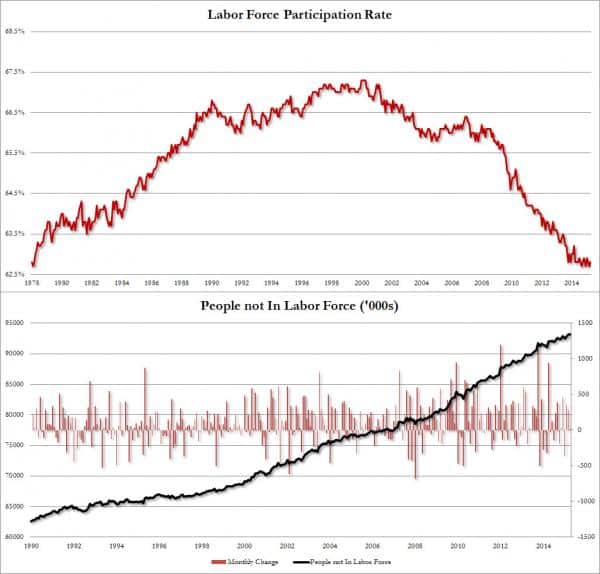
Americans Not In The Labor Force Rise To Record 93,194,000
Submitted by Tyler Durden on 05/08/2015 08:57 -0400
In what was an “unambiguously” unpleasant April jobs payrolls report, with a March revision dragging that month’s job gain to the lowest level since June of 2012, the fact that the number of Americans not in the labor force rose once again, this time to 93,194K from 93,175K, with the result being a participation rate of 69.45 or just above the lowest percentage since 1977, will merely catalyze even more upside to the so called “market” which continues to reflect nothing but central bank liquidity, and thus – the accelerating deterioration of the broader economy.