
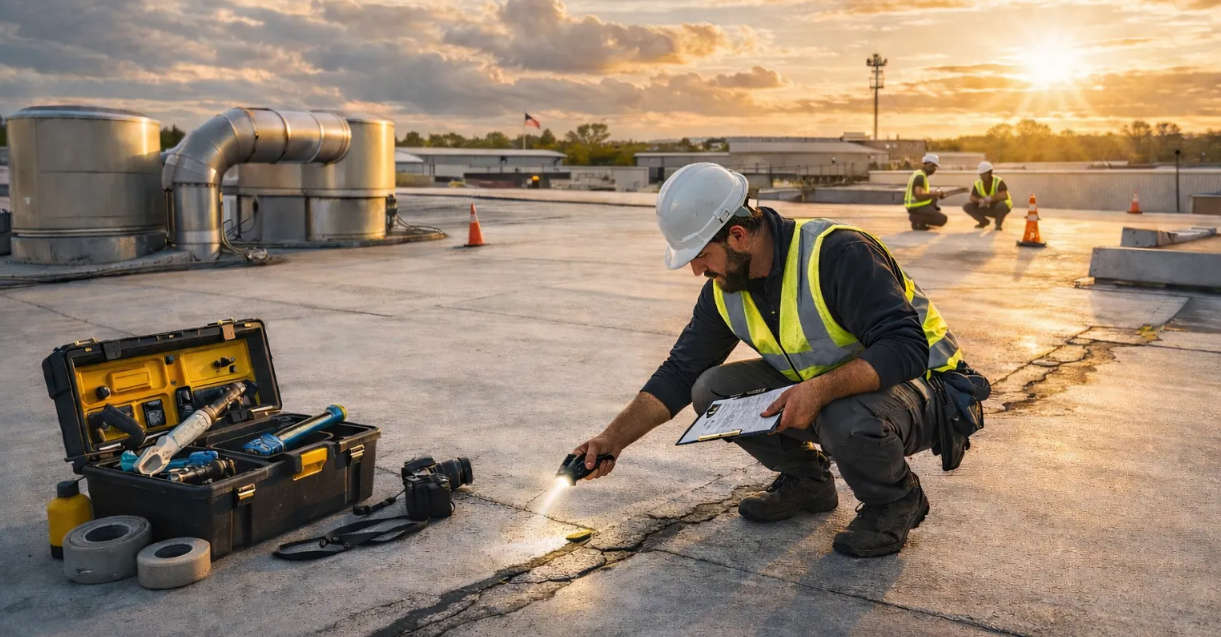
Forty percent of all building-related problems trace back to water infiltration. And water’s favorite entry point? The roof. For business owners and property managers, a failing commercial roof rarely announces itself with a single dramatic collapse. It whispers first, through small leaks, creeping energy bills, and bubbling membrane seams that most people chalk up to “normal wear.” By the time those whispers get loud, the damage is already expensive. This guide walks you through the clearest warning signs that your commercial roof is past its prime, so you can make a smart call before a maintenance issue becomes a capital crisis.
How Long Should a Commercial Roof Actually Last?
Most building owners wildly overestimate their roof’s lifespan. The number stuck in people’s heads is “20 to 30 years,” and that’s roughly right for well-maintained systems. But the real answer depends heavily on the material type, local weather exposure, and how consistently the roof has been inspected and serviced.
| Roof System Type | Typical Lifespan | Key Vulnerability
|
|---|---|---|
| TPO / PVC Membrane | 15 to 25 years | Seam separation under UV exposure |
| EPDM (Rubber) | 20 to 30 years | Shrinkage and flashing failures |
| Built-Up Roofing (BUR) | 20 to 30 years | Alligatoring and moisture intrusion |
| Modified Bitumen | 15 to 25 years | Granule loss and thermal cracking |
| Standing Seam Metal | 40 to 60 years | Corrosion at fastener points |
Those ranges assume the roof gets at least one professional inspection per year and repairs happen promptly. Skip the maintenance cycle, and you can easily shave five to ten years off any of those estimates. If your building is running a 22-year-old EPDM system that’s never had a formal inspection, the safe assumption is that replacement is overdue, not optional.
The TRACE Method: A Simple Self-Inspection Framework
Before calling a contractor, do a walk-through of your own building using TRACE: Thermal anomalies, Roof surface damage, Attachment failures, Ceiling stains, Energy bill spikes. No special equipment required. No ladder needed for the interior checks. This five-point scan gives you enough information to know whether you’re looking at routine repair territory or a full replacement conversation.
Start inside, on the top floor. Walk every square foot of ceiling tile. Dark rings, soft spots, and bubbling paint are ceiling stains doing their job as early warning systems. One or two isolated spots often mean a flashing repair. Staining across multiple zones? That’s moisture traveling, which points to widespread membrane failure.
Then check your recent utility bills. Compare your cooling costs from June and July against the same months three years ago. A 15 percent or greater uptick in cooling load, absent any major equipment changes, is a strong signal that your roof’s insulation layer has been compromised by moisture. Wet insulation loses its R-value almost entirely.
What the Roof Surface Is Telling You
If you have safe roof access, the surface itself tells the clearest story. Here’s what to look for, in order of severity:
- Ponding water that sits for more than 48 hours after rain. Flat and low-slope roofs are designed to drain. Water that sticks around is compressing the membrane and feeding leak pathways.
- Alligatoring, the cracked, scaly pattern on asphalt and BUR surfaces that looks exactly like its name. It means the material has lost its oils and elasticity. You can patch alligatored sections temporarily, but the clock is running.
- Membrane blistering or bubbling, which signals trapped moisture or air beneath the surface. Pop a blister, and you’ll find wet insulation. That scenario calls for replacement in the affected zones at minimum.
- Displaced or rusted flashing around HVAC units, vents, and parapet walls. Flashing is where most leaks start. Deteriorated flashing on an otherwise serviceable roof can often be replaced without a full tear-off, but only if caught early.
If you’re finding three or more of these conditions in a single walkthrough, repair economics stop making sense. At that point, every dollar spent patching is buying you months, not years.
The Repair vs. Replace Math for Business Owners
Here’s the calculation that most property managers get wrong. They look at the cost of a full replacement and compare it to a single repair bill. That’s not the right comparison. The right question is: what will you spend on repairs over the next five years, and how does that total compare to replacing the roof now?
Take a real scenario: a 15,000 square foot office building in Northern Virginia with a 20-year-old TPO roof. The owner has spent about $8,000 on repairs over the last three years. The membrane is showing significant ponding zones, blistering near two HVAC penetrations, and ceiling stains have appeared in the second-floor conference room. A contractor quotes $12,000 to patch the current damage. But if the underlying membrane is at year 20 of a 20-to-25-year system, that $12,000 buys maybe two to four more years before the next round of failures. A full replacement, meanwhile, resets the clock to zero and eliminates the carrying risk.
Trusted commercial roofing contractors in Alexandria can provide a full membrane assessment that separates patchable zones from failed zones, giving you a real repair-versus-replace number, not a gut feeling. That assessment is worth getting in writing before you commit to either path.
Energy Efficiency: The Hidden Argument for Replacement
Replacing an aging commercial roof with a modern energy-efficient system is not just about stopping leaks. It’s a legitimate utility cost play. According to the EPA’s ENERGY STAR program, ENERGY STAR certified buildings use 35 percent less energy than typical buildings nationwide, with the roof assembly playing a significant role in that performance gap. A new TPO or PVC membrane with upgraded insulation board can meaningfully cut your cooling load compared to a degraded 20-year-old system with compromised R-values.
If your building sits in a region with hot summers and mixed winters, like Northern Virginia, the thermal performance of your roof matters year-round. Cool roof membranes reflect solar heat during summer months and retain conditioned air more effectively when the insulation layer is intact. An aging roof with moisture-saturated insulation does neither.
When to Call a Professional Immediately
The TRACE self-check is a good starting filter. But four conditions should bypass the checklist entirely and go straight to a professional assessment:
- Active interior leaks during or after rain, anywhere in the building.
- Roof surface that visibly sags or shows any structural deflection.
- Evidence of mold or mildew in interior ceiling cavities or wall assemblies adjacent to the roof line.
- Any roof that has exceeded its material type’s maximum expected lifespan without a recent professional condition report.
The roofing trade is a growing field. The U.S. Bureau of Labor Statistics projects roofing employment to grow 6 percent from 2024 to 2034, faster than the average for all occupations, driven by the large volume of aging commercial and residential roofing systems coming due for replacement across the country. Demand for assessments and crews is rising. Scheduling a professional inspection now, before you’re in emergency mode, is the practical move.
Making the Final Call
No checklist decides for you, but a pattern of evidence does. If your roof is past its expected lifespan, you’re seeing multiple surface failure signs, your energy bills are climbing without explanation, and repairs are becoming a recurring budget line item, you’re looking at a replacement conversation, not a repair quote.
The worst outcome isn’t replacing a roof. It’s delaying the decision until water damage has spread into your walls, ceiling assemblies, and electrical systems, turning a roofing project into a full building remediation. Get the professional assessment, get it in writing, and make the call from data rather than wishful thinking. Your balance sheet will thank you later.





