
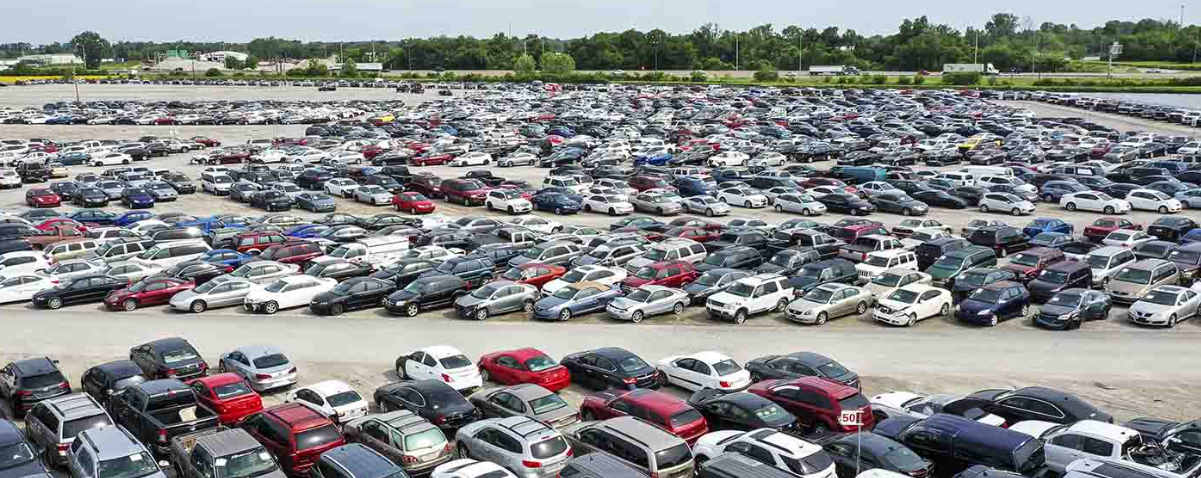
Walk the Keffi road lots on a Saturday morning, and the windscreen prices run twelve to twenty million naira on the sedans, higher on the SUVs, and none of the stickers mention that the car once carried a salvage title in Texas or Florida. Accident free tokunbo, the salesman says, came off a ship at Apapa clean, paperwork all good. Last February, I copied down the chassis number from the firewall plate on one of those sedans. Ran it through NMVTIS. That’s the federal title database every US insurer, salvage yard, and junkyard has to file into at least monthly under the Anti Car Theft Act, with the DOJ pushing insurers to submit within a day of writing a vehicle off. The result came back showing an American insurer had written that car off eight months before it turned up on the Keffi road.
NICB put US vehicle thefts at 850708 in 2024, and the III said they dropped another 23 per cent in 2025 to 659880. Good news for America. Not so good for Abuja, because the ones that do get recovered with structural damage still end up at salvage auction. From there, they go on a ship. Collisions generate far more total loss inventory than theft ever did. Then spring comes, and the hurricane season refills the whole pipeline again. Harvey and Irma alone put 637000 vehicles into the salvage system in 2017, according to NICB. Every major storm year since then has done the same thing on a smaller scale. The South Florida flooding in mid 2024 ran into hundreds of millions in insured auto losses. Those cars take twelve to eighteen months to work through the auction system. They started showing up at West African ports in late 2025. Some are still arriving now.
Nigerian Customs applies a 35 per cent duty and a 15 per cent National Automotive Council levy against the declared CIF, and everyone involved knows the CIF is kept low. Punch put the three year figure at N4.31 trillion through 2025. American cars led the supply in every quarter of that period, N93bn in Q1 2025 and nearly N198bn by Q4. A clearing agent I know at Apapa has been processing these shipments for nine years. I bought him lunch and asked whether customs ever flags a US salvage brand. He said no. He said the word no and then went back to eating. The counter agent checks the year and runs the duty values against the PAAR, the Form M, the bill of lading, and the commercial invoice. Clean title, stamp, next file. What that title looked like a year ago in Alabama or Georgia is not a question that exists at the counter. Exporters know this. A title still branded rebuilt or reconstructed would hold up clearance, so they route through US states where a state mandated repair inspection lets you clear the salvage brand off the physical document. By the time that title reaches Apapa, it reads clean, and the Nigerian system takes it at face value.
Federal law covers the reporting side. Salvage yards, junkyards, and insurers all have to file with NMVTIS. Once it is in there, it does not come off. The state that issues a cleaned up title cannot remove the federal designation. A query against the VIN returns the salvage history indefinitely, and every subsequent owner who bothers to run that query will see it. The problem is that nobody on the Mararaba forecourt is running the query. Any VIN checker with access to NMVTIS returns the salvage brand immediately. The lookup costs may be thirty or forty dollars. The car costs ten or fifteen million naira. You would think that ratio alone would settle it. I have not met one buyer on the Keffi road who ran the check before paying. The way Abuja’s lots work, the question simply does not come up.
The money arithmetic explains why the cars keep coming. Say a car gets written off at 7000 dollars book value. It clears the US auction at roughly half that. East coast roll on roll off freight runs another 1500 or so. Add duty, port handling, and the drive up to Abuja. The importer is in for maybe 4000 to 5000 dollars total. Then the car sits on a Mararaba forecourt at seventeen million naira. At current rates, that is about 11000 dollars. The margin on one unit covers the whole operation, and it gets fatter when the salvage brand that depressed the auction price never reaches the buyer. Tekedia reported in March 2025 that diesel Tokunbo imports crashed 65.8 per cent in 2024 to N354.8bn from over a trillion the year before. Dealers who made it through that squeeze did not get more transparent. They got more creative with margins on whatever they had left.

These are not naive buyers. I met a permanent secretary last month who spent an hour arguing trim levels before settling at seventeen million naira. He knew the gearbox history of every model year going back to 2015. Did not ask about the title. A woman who came back from London after twelve years, works in oil and gas consultancy, talked to me for twenty minutes about suspension setups and then paid fifteen and a half million without requesting a single document beyond the customs receipt. The salesman is not going to raise the topic. Why would he? His cut depends on that car leaving the lot before the buyer has time to reconsider. One man I spoke to found out about the salvage record three weeks after closing. His mechanic pulled a door panel in Wuse and found flood residue behind it. He called the lot. They said they would get back to him. That was in January.
Rebuild quality is the one thing people in the supply chain will actually talk about. I saw a job done by a panel beater on Old Ojo Road, a man who has been doing this since 2004, and it was solid. Proper structural welds. Original spec parts. Paint match you could not argue with. Then, two lots over in Mararaba, I pressed my thumb into a rear quarter panel, and the filler gave. The car had cleared Apapa maybe ten days earlier. Emeka, a mechanic in Nyanya who does post purchase inspections, told me he opens three or four cars a week. About half the time, he finds welding or structural patches behind the panels. He showed me his phone. Photos from the last month. Two of the cars had shock tower bolts that did not match the chassis at all.





