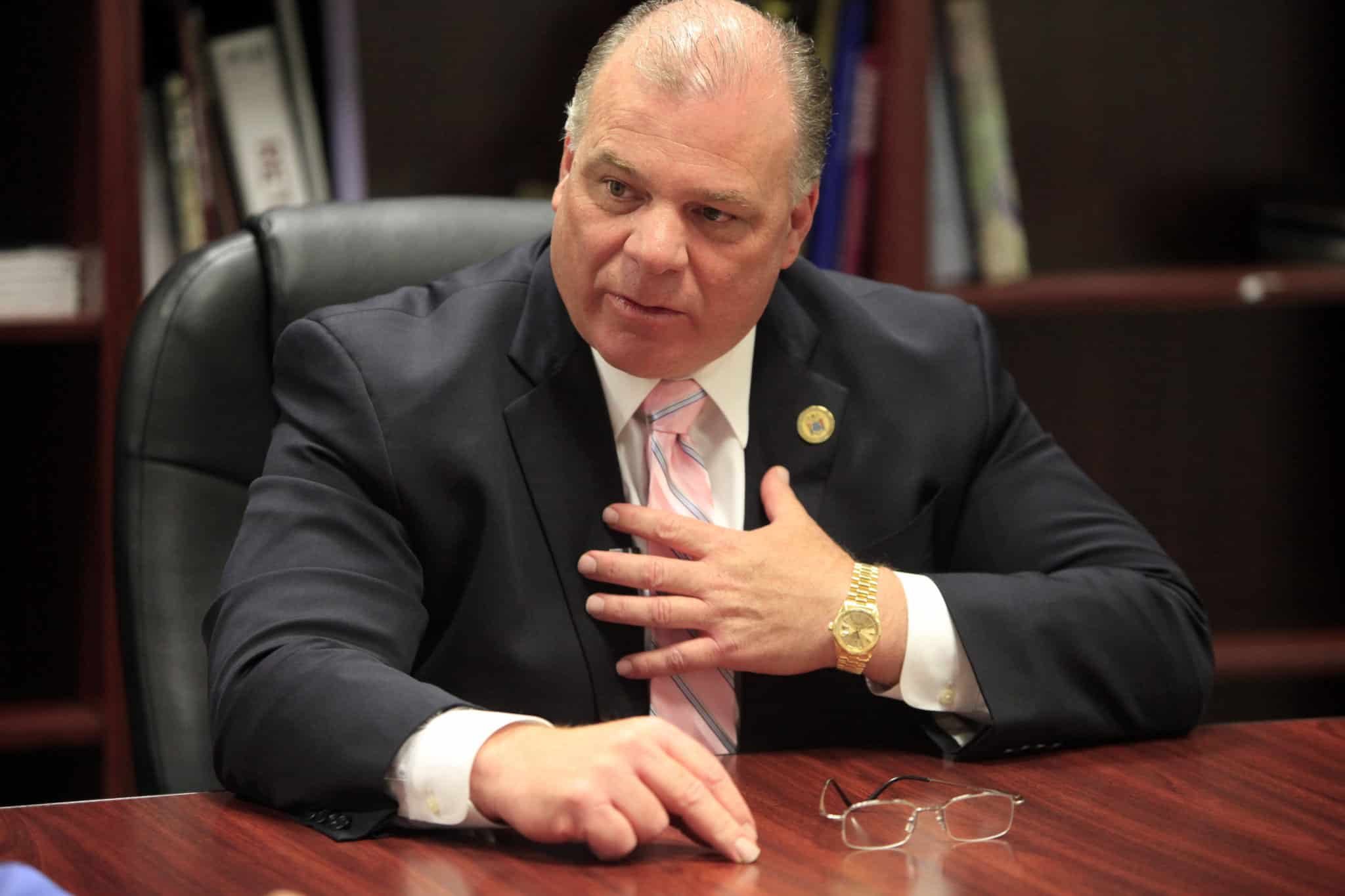
Following Friday morning’s release of Senate President Steve Sweeney’s (D-3) proposal to amend the state constitution and allow the expansion of casino gaming into North Jersey, the New Jersey State Building and Construction Trades Council has announced its official support for Sweeney’s amendment. JT Aregood, PolitickerNJ Read more
Senate President Steve Sweeney just proposed a Constitutional amendment that would give public workers unions all they want on pensions, and ask nothing in return. Star-Ledger Editorial Board, The Star-Ledger Read more
One of the myths that always needs bursting is that Big Business hates big government’ regulations, and supposedly prefers small-government Republicans to keep Uncle Sam off its back.
In reality, Big Business loves Big Government because mega-corporations can use their lobbying clout to get subsidies for themselves and regulatory burdens on their rivals.
But it is a basic reality that heavy regulations hurt smaller companies more, even when they are, in theory, applied evenly. Big companies can absorb expenses and compliance costs more easily, they tend to be more adaptable, and they can afford the analytical firepower to find profit opportunities hidden in complex regulatory mazes.
The latest demonstration of the principle is ObamaCare, which is absolutely devastating small insurance companies, and driving those fabled insurance co-ops out of business like lemmings marching off the edge of a cliff… but the biggest of the big players are doing fine.
In fact, as The Economist notes, even though the biggest of the big five companies, UnitedHealthcare, is having serious second thoughts about losing money on the Affordable Care Act exchanges, the share prices of those top five companies – also including Aetna, Humana, Cigna, and Anthem – “have all roughly tripled over the past five years,” as these companies have remained “consistently and highly profitable.” All of them are expected to report record profits over the next few years.
Ridgewood NJ, parking is the issue in the Village ,but one issue that no seems to be talking about is if the increase in parking fees has been driving away business from Ridgewood’s Central Business District (CBD)?
In January of 2015 the Village increase parking fees across the board . While lack of parking has been often cited as an issue by local merchants ,what about the parking fees themselves ?
For added convenience the Park Mobil App was introduced but as of this date there have been little or no updates as to the overall numbers of people using the app and the amount of revenue it has been generating ?
Perhaps we should analyze out current parking situation to see how either Park Mobil increased parking fees have impacted or not impacted down town shopping, before we assume increased parking fees will finance the Hudson Garage Project .
January 2015 : New Hours and Fees
In response to concerns of the business community and residents, the Cottage Place lot now allows parking for 8 hours, Monday through Saturday from 10am to 6pm. The hourly rate for the meters is 75 cents/hour.
Hourly rates in all Village lots and in streets are now $.50 per hour for a maximum of 3 hours. Street and Lot meters are regulated from 10AM to 6PM, Monday through Saturday. Vehicles parking for more than 3 hours will be in violation and subject to a ticket. Repeat parking is also prohibited
DECEMBER 11, 2015 LAST UPDATED: FRIDAY, DECEMBER 11, 2015, 12:31 AM
THE RIDGEWOOD NEWS
Any solutions should benefit entire village
To the Editor:
The “Officials face open space shortage” article on the Schedler property (The Ridgewood News, Dec. 4, page A1), exposes the perennial “zero sum” thinking that plagues village politics. It concludes: “…an unpopular decision in the eyes of one [or the other] group of people will have to be made.” The absence of a community-wide vision for our village perpetuates endless acrimonious interpersonal and intergroup relationships. Rather than focusing on special interest groups’ differences, we need a holistic approach that compares our community to surrounding ones, to North Jersey, and to our nation as a whole.
The obvious characteristics of our town are stark and too often ignored: 1) As this article states, we have the largest school system in Bergen County; 2) Ridgewood is one of the wealthiest communities in New Jersey with the one of the highest tax burdens; 3) We are universally [yes, the Internet] seen as a schooling magnet community so families move here; and 4) We have zero public policies designed to retain empty nesters, zero availability of over-55 housing, and zero assisted living facilities in the Central Business District.
We may want to believe we are “Lake Wobegon … where the men are strong, the women good-looking, and that all our children are above average,” but our denial of aging results in social engineering that ignores life stages and destroys a multigenerational family community.
Saying Ridgewood is exclusively a nuclear family-child raising community, lacks both a historical perspective and a desire to imagine the future. Well into the 1930s, smaller New England towns practiced “home relief” where aging homeowners unable to support themselves in retirement were maintained at the town’s expense, and when they died the sale of their homes reimbursed the town’s costs. Into the 21st century, Ridgewood is a powerful draw for upper middle class families from world cultures in which multigenerational families are the norm. Furthermore, a slower growth economy means all of our children will carry elder care obligations which are outside the range of what Social Security or Medicare can provide.
The Open Space worries reported here pale in the face of wider community concerns. Where 2,000 youths get to play baseball in a community of 25,000 is a valid special interest concern. Saving a complete forest as a barrier between a quiet neighborhood and Route 17 is also a valid special interest concern.
In reality, all the wooded areas closer to residential properties could be preserved while limited commercial development could take place preserving older growth trees. Taking up opportunities for commercial development that bring down taxes for all residents and help reverse the “aged cleansing” social engineering practice that characterize our town is the right thing to do for the majority of Ridgewood families. This is what leadership in a democracy should be all about.
DECEMBER 13, 2015, 11:01 PM LAST UPDATED: SUNDAY, DECEMBER 13, 2015, 11:20 PM
BY CHRISTOPHER MAAG
STAFF WRITER |
THE RECORD
When the AirTrain monorail opened at Newark International Airport in 1996, it was viewed as an engineering marvel. Finally, the airport’s old fleet of bouncy, slow, diesel-fuming jitney buses had been replaced by a sleek train passing silently overhead.
“There will be no more people saying, ‘I got to the airport in 10 minutes but it took me 30 minutes to travel around the terminals,’Ÿ” said John J. Haley Jr., deputy executive director of the Port Authority of New York and New Jersey. “The system is absolutely safe and reliable.”
Safe, maybe. But AirTrain Newark was never reliable. And that should have come as no surprise to the people responsible for bringing it to the airport.
They knew because they were told by the man who sold it to them.
“It was a system that had not been run previously in the snow,” said Paul H. Wyss, now 80 and retired for 20 years. He conceived the project in the early 1990s when he was chief of American operations for Von Roll Transport. “Everybody knew ahead of time that there would be issues with snow and snow removal,” he said.
That proved to be an understatement. Even before AirTrain was finished, the Port Authority had serious problems clearing snow and ice, which delayed the monorail’s opening. Those issues — plus a half-dozen more — grew worse over the next two decades.
Finally, 19 years after it went into service, Port Authority Executive Director Pat Foye announced in May that AirTrain Newark must be scrapped.
In the journal entry, the co-authors wrote: “We cannot help but judge others on the basis of their speech.”
Ashley Cowburn
@ashcowburn
Saturday 12 December 2015
Those who are liberal in their use of swear words are not the lazy and uneducated individuals they are often made out to be, a new study claims.
In fact, a well-stocked vocabulary of swear words is actually a healthy indicator of other verbal abilities.
Writing in the Language Sciences journal, US-based psychologists Kristin Jay and Timothy Jay, dismiss the long-held belief that swearing is a sign of inarticulateness.
Working with the “poverty of vocabulary” concept (the assumption that people swear because they lack the intellectual capacity to find another way to express themselves) their experiment aimed to find out whether those more fluent in the art of swearing are less fluent in other forms of vocabulary.
The specter of a destabilizing run on debt is haunting markets
By
JOHN CARNEY
Updated Dec. 13, 2015 3:22 p.m. ET
The debt world is haunted by a specter—of a destabilizing run on markets
Last week, this took on more form even if there weren’t concrete signs of panic. Only one mutual fund manager, Third Avenue Management, has said it would halt redemptions to forestall having to dispose of assets in a fire sale. The rest of the industry has been quick to say that while redemptions are elevated, particularly in high-yield bond funds, there doesn’t seem to be a rush to for the exits.
Still, growing angst comes as the oil-price rout continues and the U.S. Federal Reserve appears ready to raise rates. This has investors worried—and starting to ask the fearful question: “Who’s next?”
Goldman Sachs, for one, put out a note Friday warning Franklin Resources “is most at risk” given the large high-yield holdings of its funds, poor performance and large outflows. On Friday, its shares fell sharply. Meanwhile, there were unusually large declines Friday in the value of exchange-traded funds that track high-yield debt.
The idea of a “run” on mutual funds might sound strange. Typically, runs are associated with highly leveraged banks engaged in maturity transformation, funding long-term loans with short-term debt. Nearly all the programs designed to avoid destabilizing runs—from deposit insurance to the Fed’s discount window to liquidity requirements—are built for banks.
Ridgewood NJ, the Ridgewood blog is the lone independent voice of headline news in North Jersey . While much larger competitors have
come and gone the Ridgewood blog has persevered with your help. The Ridgewood blog is a unique social experiment were readers have the ability to create and determine what news matters most to them. With your support the blog has been mindbogglingly successful and its because of reader participation that has made it so .It is a unique interaction experiment in community dialogue .
We appreciate and are grateful for all the contributions made by readers and from the suggestion of several readers would like to
extend readers an opportunity to become patrons . The patron program is open to all . For as little as $25 you can become a patron .Patrons
will be listed d on the side bar or like always chose to remain anonymous. Contributions of $250 or more receive a special gift ,which
will be sent out in January . Every little bit helps , from contributions to content.
The response to our recent email was very gratifying !
or if you prefer checks can be sent James Foytlin PO Box 227 Ridgewood NJ 07451
The funds will be used to offset IT services which have been a bit
staggering the last couple of years .
Founders Day : the History of the Ridgewood blog
the History of the Ridgewood blog
Monday, October 26, 2009
The Ridgewood blog ( https://theridgewoodblog.blogspot.com/ ) was founded in March of 2006 by James J Foytlin aka PJ Blogger .[1] Mr.
Foytlin was born and raised in Ridgewood ,New Jersey and is a graduate of Ridgewood High School .[2] [3]
After many years living in New York City[4] Mr Foytlin returned to Ridgewood after a divorce and the tragic events of 9/11 . Once he
settled in he noticed a lack of sufficient news coverage of local events . One day a friend from Brazil[5] showed him her home town on
the internet and to Mr. Foytlin’s great surprise when he tried to reciprocate he was utterly dismayed at the absolute lack of coverage
of his home town. After all Ridgewood is only 18 miles from midtown Manhattan[6] the media capital of world and there was not a single
picture of Ridgewood to be found . How could this be? Ridgewood is a picturesque upper middle class village of around 25,000 located in
Bergen county in northern New Jersey[7] . Founded by Dutch settlers before it became an English colony[8] . The town or village as its
called is steeped in rich history and tradition .Known for a large amount of Victorian era housing , a quality school system and a family
friendly atmosphere.
Though busy getting reacquainted with his home town the fact that the Village of Ridgewood was so under represented on the internet
continued to disturb Mr. Foytlin. Mr. Foytlin had been writing news letters for his job in financial services since the mid 1990’s . The
popular flip, off beat investment strategy news letters had become email blasts with the advent of readily accessible internet.[9] By
2004 the email blasts were converted into blog format for the One Small Voice blog ( https://onesmallvoice.blogspot.com/ ). [10]
Around that time the Village of Ridgewood had finally completed it’s much anticipated and long delayed renovation of the Village hall which
has been flooded out due to Hurricane Floyd.[11] The renovation was marred by huge cost over runs and lengthy delays. In 2005 it opened
with great fan fare , was once again flooded with the very first rain . Mr. Foytlin was more shocked by the abject lack of responsibilitytaken by elected officials than the fact that the $9 million dollar renovation had to some extent been a failure . That was the breaking
point and Mr. Foytlin had had enough so he decided to give , citizen journalism a go and created the Ridgewood blog in March of 2006. [12]
The birth of PJ Blogger .By this time Blogging its seems had become quite the rage and mainstream news anchors such as Dan Rather had
questioned the validity of information from non professionals sitting around in their Pajama’s blogging.[13] Mr. Foytlin not a fan of Dan
Rather or any of the mainstream media decided to blog under the name PJ Blogger as a play on words and to plant himself firmly in the camp
of the new digital media.
Innovations by the Ridgewood blog to citizen journalism.
“The Fly” is a column on the Ridgewood blog the originates from the expression ,”I’d like to be a fly on the wall “ . The idea is that
every citizen has both a unique perspective and experience and these two factors can be used to gather news and opinions about local
issues. Originally only of handful of people in town participated but with time the Ridgewood blog can now count on 20–40 semi regular
contributors. These post are both anonymous and signed and are largely opinion as well a breaking news.[14]
The Ridgewood blog brings a free market lassie fare point of view to local issues . Mr. Foytlin aka PJ Blogger has stated that for local
issues there are only two kinds of people ;the ones who say spend what every you want because I will not be around to pay the bill and the
second group which are more focused on the ,”be careful this is my money your spending” . The Ridgewood blog is dedicated to the
interplay of there two groups.[15]
[1][12] the Ridgewood blog website https://theridgewoodblog.blogspot.com/
[2] Birth Certificate born in Valley Hospital , Ridgewood 04/09/1962
[3] Ridgewood High School Class 1980
[4] 444 East 86th street ,530 East 72nd
[5] Monica Rocha
[6] Mapquest
[7] United States 2000 Census, the village population was 24,936.
[8] https://www.americantowns.com/nj/ridgewood/organization/village-of-ridgewood
[9] Fahnestock & Co. now Oppenheimer & Co.
[10] https://onesmallvoice.blogspot.com/
[11] https://www.ridgewoodlibrary.org/localhistory/lh_vh_pease.htm
[13] https://www.opinionjournal.com/diary/?id=110005611
[14] [15] James J Foytlin
skills learned on the field translate in fast delivery
December 13,2015
the staff of the Ridgewood blog
Ridgewood NJ, It seems that Amazon has nothing on the efficiency that is the Ridgewood Poinsettia Sale.#TakeThatBezos
“Some of the secrets behind Amazon’s phenomenal success as an online retailer can be discovered inside a million-square-foot warehouse that sits amid bucolic scenery in the town of Robbinsville, New Jersey. The building is one of Amazon’s most advanced fulfillment centers, and it houses technologies that allow the company to deliver products to customers at amazing speed. Goods are identified, sorted, and packaged with computer-assisted precision, while employees work in tight collaboration with the plant’s automated systems in shifts that run around the clock.” https://www.technologyreview.com/photoessay/539511/inside-amazon/
It is all very similar to the Ridgewood High School Band drilling on the practice field.
It is has been well documented the Jeff Bezos’ Chairmen of Amazon has an obsessive focus on the customer.So when the Ridgewood High School Marching band thru down the challenge the #TakesThatBezos and you can bet Bezos took it seriously .
While the total numbers are still being complied the Ridgewood Marching band moved out the entire order of Poinsettias and Amaryllis in a matter of hours .
All and all it was a well orchestrated effort, with years or drilling on the practice field being put to good use.
Bezos remarked , “that perhaps Amazon can use the band practice idea to script its time new motion studies.” While sources at Ridgewood High School suggested that band practice was instrumental in the ability to compose , direct and coordinate a large group in a course of action.
Bezos again said “band practice for Amazon employees could create an on key composition for on time delivery”
“With the Affordable Care Act crumbling, progressive activists are all but guaranteed to grab the opportunity that this single-payer ballot measure represents. But if Coloradans truly want better health care at a lower cost for more people, they shouldn’t vote for another one-size-fits-all government program. They should vote for proposals—and politicians—that will give patients more choices.”
Make no mistake. The government meddling into private insurance is the essence of ObamaCare–removing competition, mandating coverages that many don’t need, and forcing people to choose from a roster of compliant doctors. The government completely taking over health care will only make things more impersonal and bureaucratic. It SOUNDS compassionate, but will be anything but.
Don’t Let ObamaCare’s Failures Snowball Into Single Payer
Coloradans, hit hard by the law, are being pushed toward a state takeover of their health insurance.
By
NATHAN NASCIMENTO
Dec. 11, 2015 6:25 p.m. ET
Like an avalanche, the Affordable Care Act has swept through the Rocky Mountain State, leaving a trail of destruction in its wake. At the end of 2013, 335,000 cancellation notices went out to customers whose plans were now deemed illegal by federal regulators. Nearly 200,000 cancellations for the same reason will come at the end of this year. As for Colorado HealthOP, the state’s co-op, which was the largest insurer on the ObamaCare exchange, it shut down in October, leaving more than 80,000 members without coverage. Huge premium increases loom for the remaining exchange plans: an average of 11.7%, according to the state’s calculation.
It shouldn’t be a surprise that many Coloradans want to abandon ObamaCare and replace it with something new. What’s worrying is that the state’s liberals and progressives have been mobilizing to replace it with a single-payer system, like the ones in Canada or the United Kingdom. On Nov. 9, after more than 100,000 voters had signed a petition in support of the idea, the secretary of state’s office announced that a single-payer proposal will appear on the 2016 ballot. “ColoradoCare,” as it is being called, would replace private insurance with health care funded completely by the government, substituting higher taxes for premiums.
But one state has already tried, and failed, to implement such a scheme. In 2010 Vermont voters elected Democratic Gov. Peter Shumlin, who promised to institute single payer in lieu of ObamaCare. Helping design the system were advisers such as Jonathan Gruber,the MIT economist often described as the architect of ObamaCare, and William Hsiao,the Harvard economist who developed the Medicare price controls that are driving up prices around the country.
She has a plan that she claims will reform Wall Street—but she’s deflecting responsibility from old friends and donors in the industry.
By
William Greider
DECEMBER 11, 2015
Hillary Clinton’s recent op-ed in The New York Times, “How I’d Rein In Wall Street,” was intended to reassure nervous Democrats who fear she is still in thrall to those mega-bankers of New York who crashed the American economy. Clinton’s brisk recital of plausible reform ideas might convince wishful thinkers who are not familiar with the complexities of banking. But informed skeptics, myself included, see a disturbing message in her argument that ought to alarm innocent supporters.
Candidate Clinton is essentially whitewashing the financial catastrophe. She has produced a clumsy rewrite of what caused the 2008 collapse, one that conveniently leaves her husband out of the story. He was the president who legislated the predicate for Wall Street’s meltdown. Hillary Clinton’s redefinition of the reform problem deflects the blame from Wall Street’s most powerful institutions, like JPMorgan Chase and Goldman Sachs, and instead fingers less celebrated players that failed. In roundabout fashion, Hillary Clinton sounds like she is assuring old friends and donors in the financial sector that, if she becomes president, she will not come after them.
The seminal event that sowed financial disaster was the repeal of the New Deal’s Glass-Steagall Act of 1933, which had separated banking into different realms: investment banks, which organize capital investors for risk-taking ventures; and deposit-holding banks, which serve people as borrowers and lenders. That law’s repeal, a great victory for Wall Street, was delivered by Bill Clinton in 1999, assisted by the Federal Reserve and the financial sector’s armies of lobbyists. The “universal banking model” was saluted as a modernizing reform that liberated traditional banks to participate directly and indirectly in long-prohibited and vastly more profitable risk-taking.
Exotic financial instruments like derivatives and credit-default swaps flourished, enabling old-line bankers to share in the fun and profit on an awesome scale. The banks invented “guarantees” against loss and sold them to both companies and market players. The fast-expanding financial sector claimed a larger and larger share of the economy (and still does) at the expense of the real economy of producers and consumers. The interconnectedness across market sectors created the illusion of safety. When illusions failed, these connected guarantees became the dragnet that drove panic in every direction. Ultimately, the federal government had to rescue everyone, foreign and domestic, to stop the bleeding.
DECEMBER 11, 2015 LAST UPDATED: FRIDAY, DECEMBER 11, 2015, 12:31 AM
THE RIDGEWOOD NEWS
Editor’s Note – The third event of Parlance Chamber Concerts’ ninth season will take place this coming Sunday afternoon, Dec. 13, at 3 p.m. at West Side Presbyterian Church in Ridgewood. Here concert founder Michael Parloff gives us some background to the musicians and the program.
The concert will feature three spectacular virtuosi, violinist Kristin Lee, pianist Gilles Vonsattel (both winners of the coveted Avery Fisher Career Grant) and the celebrated cellist Paul Watkins of the Emerson String Quartet.
In honor of Beethoven’s 245th birthday next Wednesday, Sunday afternoon’s concert will be devoted to three highlights of his chamber repertoire: the heroic A-major violin sonata (“Kreutzer”), the intimate cello sonata in C, and the ever-popular D-major piano trio (“The Ghost”).
Parlance Chamber Concerts
All Beethoven Program – Sunday, December 13 at 3pm – West Side Presbyterian Church, 6 S. Monroe Street, Ridgewood Free parking and Childcare Tickets at the Door – Adults $40; Seniors $30; Young Adults $20; Students $10
(FOX 11) – A collective of Muslim-American leaders have raised more than $194,000 for the families of those killed in the San Bernardino terrorist attack.
The initiative, called Muslims United for San Bernardino, was launched by Faisal Qazi, president of family-centered organization MiNDS Network and Tarek El-Messidi, founder of Islamic nonprofit CelebrateMercy.
“We wish to respond to evil with good, as our faith instructs us, and send a powerful message of compassion through action,” the founders said in a press release. “Our Prophet Muhammad, peace be upon him, said: ‘Have mercy to those on earth, and the One in the Heavens (God) will have mercy upon you.’ And the Quran teaches to ‘Repel evil by that which is better’ (41:34).”
The group initially hoped to raise $50,000, but exceeded that goal within 48 hours. As of Friday evening, $194,273 had been raised.
DECEMBER 12, 2015, 2:12 PM LAST UPDATED: SATURDAY, DECEMBER 12, 2015, 6:47 PM
BY JOHN C. ENSSLIN AND HANNAN ADELY
STAFF WRITERS |
THE RECORD
A false bomb threat led to the three-hour evacuation of The Shops at Riverside mall in Hackensack on the penultimate Saturday in the holiday shopping season.
As authorities investigated the threat — scrawled on a bathroom wall, graffiti-style — hundreds of jittery shoppers had to abandon their meals and purchases, and were forced out of the complex and into the parking lot, alongside mall workers.
Hackensack Police summoned the Bergen County bomb squad and ordered the evacuation after a security officer discovered the message written with a marker near a urinal in a lower-level men’s room at around 1 p.m., said Hackensack Police Capt. Timothy Lloyd.
Witnesses said several hundred customers and employees emptied out of the mall in an urgent but orderly fashion as both sound and light alarms went off.
A search by bomb-sniffing dogs and bomb-squad officers found no explosives and the mall — at the intersection of Route 4 and Hackensack Avenue — re-opened around 4 p.m., Lloyd said.
The evacuation also led police to divert traffic on Hackensack Avenue onto Route 4, said Anthony Cureton, a spokesman for the Bergen County Sheriff’s Office.
Some two hours into the evacuation, most people had cleared out of the area. On the grass at the outskirts of the complex’s parking lot, though, small groups of employees lingered waiting for their stores and restaurants to reopen. And some shoppers also stayed behind, forced to wait because, they said, authorities wouldn’t allow them to retrieve their vehicles from the mall’s multi-tiered parking garage before the all-clear was given.