Ridgewood NJ, In the United States, Flag Day is celebrated on June 14. It commemorates the adoption of the flag of the United States on June 14, 1777 by resolution of the Second Continental Congress. The United States Army also celebrates the U.S. Army birthday on this date; Congress adopted “the American continental army” after reaching a consensus position in the Committee of the Whole on June 14, 1775.
Sidney Spiegel was with General Dwight D. Eisenhower in England in the early spring of 1944. Eisenhower was at a D-Day planning meeting and awaiting the arrival of top-secret film of the French Coast.
The courier who was to deliver the film had a hole in his satchel. When he arrived at the meeting, they discovered that he had lost it somewhere along the way.
“I’ll bet they’re asleep in New York,” muses Rick in “Casablanca” as he realizes there’s no sitting this war out. “I’ll bet they’re asleep all over America.”
It’s an important line to recall as we prepare to mark the 70th anniversary of D-Day. Rick’s conversion from pacifist to patriot in the classic 1942 film mirrored America’s transformation after Pearl Harbor from isolationism to taking its fights to the frontier of freedom.
Washington DC, President Trump’s threat to invoke the Insurrection Act of 1807 means the statute could be used for the first time in the 21st century.
The U.S. federal law allows the president to deploy military troops within the nation to suppress civil disorder, insurrection and rebellion, among other threats. It allows the president to federalize the National Guard and use U.S. armed forces to combat insurrections against states and the federal government.
New Bridge Landing NJ, As we continue on this Memorial Day we mourn not only the absence of each other’s company but in the true spirit of the day, the honored war dead from our nation’s past. From the founding of the United States through today, thousands of Bergen County residents have answered their nation’s call to arms in defense of liberty and freedom, at home and abroad. Many never returned to enjoy their homes and families. Each Memorial Day in the recent past, we in the Bergen County Historical Society have chosen to gather at the Hackensack grave of Brigadier General Enoch Poor, as representative of those in the American Revolution who gave their lives during the fight to establish what the Declaration of Independence proclaimed.
We do not know the names of all of those from Bergen County who fell during the American Revolution, though we do know some, particularly the ones named below, all of whom served as captains in the Bergen County Militia:
Ridgewood NJ, May is dedicated to National Preservation Month. Also known as Historic Preservation Month, the month celebrates the nation’s heritage through historic places. Organizations across the country promote a variety of activities on the local, state and national levels.
In the Village, Zabriskie-Schedler House restoration is finally moving along . We must admit we had our doubts . The home has officially been added to the New Jersey Register of Historic Places. Built in 1823 by John A. L. Zabriskie, the house sits on a triangle of land between Route 17 and Saddle River Road, part of Bergen County’s dwindling stock of 19th-century Dutch wood-frame homes. This area play a significant roll as a cross roads during the American Revolution .
Good Day Bergen County! To all appearances, it is a beautiful day outside. The sun is shining and green is finally the color that has bloomed. Not all things are as they appear though, as the temperature is still brisk and certainly colder than we are used to by this date, not to mention virus that still effects our countryside. In time of war, often things are not as they appear, and there is our lead-in for today’s tale from the Revolutionary War…
Roxbury NJ, New Jersey is called the diner capital, mostly because of the sheer number of diners in the state. New Jersey has the most diners in the world and is sometimes referred to as the diner capital of the world. The state didn’t invent the diner, but New Jersey did popularize it. New Jersey had all the right ingredients for diners to flourish and proliferate.
Ridgewood NJ, from the Bolger Heritage Center, at the Ridgewood Public Library , by now, you should know it’s 2020 “census time.” We at Bolger Heritage Center thought we’d start a new feature—occasionally looking back at the 1920 census to see who lived in Ridgewood at the time of that century-old census.
Ridgewood NJ, from the Bergen County Historical Society ,anyone driving along Route 17 in Ridgewood recognizes Old Paramus Church on the west side of the highway, just above Paramus Road. This iconic structure is one of a number of stone churches scattered throughout the county, the buildings today being just post-Revolutionary, but having their roots earlier than the present buildings. Old Paramus Church that stands today was built in 1800, but its history and founding go back three quarters of a century before that. Did you know that the church and environs were used as a post of one sort or another by militia and continental troops off and on between 1776 and 1780?
New Bridge Landing NJ, the Bergen County Historical Society plans to loan their rare tavern sign to the Museum of the American Revolution in Philadelphia.
Currently still on exhibit at the Steuben House. The portrait of Jefferson was done in his lifetime while he was president.
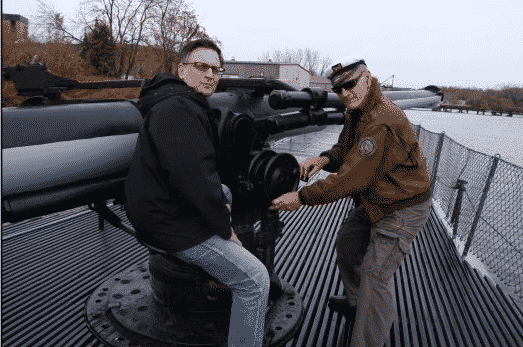
Hackensack NJ, Louisville Naval Museum bails out the USS Ling in the Hackensack river. According to the Louisville Naval Museum the Louisville Naval Museum Fundraiser effort is in Phase 1 of our capital campaign with the goal to raise $100,000. “Phase 1: Ready the USS Ling” will finance the preparation of the USS Ling for transport to the Louisville area. This includes necessary mechanical, legal and logistical expenses. We will focus on raising $10K from Facebook donations through the months of December and January. This initial infusion of much-needed funds will allow us to do critical work to launch this campaign. Any donation is greatly appreciated, and sharing is encouraged. Thank you for your commitment and support in this effort!
Paterson NJ, The New Jersey Housing and Mortgage Finance Agency (NJHMFA) board to advance the comprehensive community redevelopment of the Hinchliffe Stadium neighborhood in Paterson by approving funding to build a $29.1 million, 75-unit affordable senior housing development, the Murphy Administration announced.
Hinchliffe Stadium stands as a relic of a working-class city proud of its baseball heritage and teeters on the precipice of revival. Paterson, New Jersey, lays claim to this storied facility, once the renowned site of Negro League games, but it is hardly the only visual hallmark for the metropolis known as “Silk City” because of its bygone silk industry.
Ridgewood NJ, Each year, the Ridgewood Historical Society invites Ridgewood High School students to write a one-page letter choosing an artifact from our annual exhibit. This year the exhibit was “Here Comes the Bride—Two-hundred years of wedding customs & traditions.” Students were asked to write from the point of view of a fictionalized person to a friend/relative in Ridgewood. Winners were chosen based on their ability to relate common human experiences in the context of a specific historical moment.