
The annual online Skyward re-registration is open. Parents and guardians, to update your information, please log on to Skyward Family Access via the district website at www.ridgewood.k12.nj.us. Click here for details.
School Starts on September 6
Students will return to school on Tuesday, September 6 (minimum day schedule). Opening Day for teachers and support staff is Thursday, September 1.
Back-to-School Night Schedule
Click here to view the schedule.
The Ridgewood Board of Education will hold a Regular Public Meeting on Monday, September 12, 2016 at 7:30 p.m. The meeting will be held in the Board Room at the Education Center, 49 Cottage Place. The public is invited to attend the meeting or view it live via the district website at www.ridgewood.k12.nj.us using the “Live BOE Meeting” tab on the district website, or on Fios tv channel 33 or Optimum 77
Coffee and Conversation Dates Are Announced
The Board of Education and Superintendent Dr. Daniel Fishbein will host residents for coffee and casual conversation on three separate occasions this school year. The first date for Coffee and Conversation is Wednesday, October 19 from 7-8:30 p.m. at the Education Center, 49 Cottage Place, Ridgewood. Future dates will follow on Tuesday, March 28, 2017 and Wednesday, May 17, 2017. All residents are invited to drop in to share their thoughts, questions, suggestions and concerns.
FAQ on Full-Day Kindergarten: Vote is November 8
The November 8 election ballot will include a question for residents about implementing full-day Kindergarten in Ridgewood. To learn more about full-day Kindergarten, please click here for a FAQ sheet, updated on August 23, 2016. Please click here to go to other Full-Day K documents that are located in the Full-day Kindergarten Exploratory Committee folder on the Curriculum web page.
2016-2017 Community Outreach Program Series Starts October 18
The Curriculum, Instruction & Assessment Department will again offer free presentations for parents and guardians throughout the 2016-2017 school year. The topic is Well-being. Click here for information on the series, which is co-sponsored by The Valley Hospital with support from The Foundation and the Home and School Associations.


Rutgers: to avoid microaggressions, only speak when ‘necessary’
Amber Athey
Students in at least one Rutgers University residence hall are being encouraged to use only language that is “helpful” and “necessary” to avoid committing microaggressions.
The display, which is part of the school’s “Language Matters” campaign, also includes hand-written definitions of the three types of microaggressions, as well as a flyer listing potentially-offensive words and phrases.
Students in at least one Rutgers University residence hall are being encouraged to use only language that is “helpful” and “necessary” to avoid committing microaggressions.
The display, photos of which were obtained by Campus Reform, is titled “Language Matters: Think,” and was placed in the College Avenue Apartments by a resident assistant, according to a current resident of the building who does not wish to be identified.
The Dumbing Down of College Curriculums

Charles Sykes / @SykesCharlie / August 29, 2016
The dumbing down of elementary and secondary education has made its way to the collegiate level; too many unprepared students are admitted despite their inability to do college-level work.
COMMENTARY BY
Charles Sykes@SykesCharlie
Charles J. Sykes is senior fellow at the Wisconsin Policy Research Institute and a talk show host at WTMJ radio in Milwaukee, Wisconsin. He has written for The New York Times, The Wall Street Journal, and USA Today and is the author of “A Nation of Victims,” “Dumbing Down Our Kids,” “Profscam,” “The Hollow Men,” “The End of Privacy,” and “50 Rules Kids Won’t Learn in School.”
Let’s concede at the outset that many students find their college years enlightening and enriching. But something is rotten in the state of academia, and it is increasingly hard not to notice.
There once was a time when employers could be reasonably certain that college graduates had a basic sense of the world and, as a minimum, could write a coherent business letter. That is simply no longer the case, as some academic leaders appear ready to admit.
Harvard’s former president, Derek Bok, mildly broke ranks with the academic cheerleaders when he noted that, for all their many benefits, colleges and universities “accomplish far less for their students than they should.” Too many graduates, he admitted, leave school with the coveted and expensive credential “without being able to write well enough to satisfy employers … [or] reason clearly or perform competently in analyzing complex, nontechnical problems.”
Bok noted that few undergraduates can understand or speak a foreign language; most never take courses in quantitative reasoning or acquire “the knowledge needed to be a reasonably informed citizen in a democracy.” Despite the massive spending on the infrastructure of higher education, he conceded, it was not at all clear that students actually learned any more than they did 50 years ago.
This knowledge deficit has been a long time coming.
Indeed, a recent survey of the nation’s top-ranked public universities by the American Council of Trustees and Alumni found that only nine of them required an economics course for graduation; just five required a survey course in American history; and only 10 required that students take a literature course. Despite the lip service given to “multiculturalism” on campus, the study found that: “Fewer than half required even intermediate study of a foreign language.”
This knowledge deficit has been a long time coming.
By 1990, the cost of four years at an elite private college had passed the median price of a house in the United States. But a survey sponsored by the National Endowment for the Humanities in 1989 found that a majority of college seniors would flunk even a basic test on Western cultural and historical literacy: 25 percent could not distinguish between the thoughts of Karl Marx and the United States Constitution (or between the words of Winston Churchill and those of Joseph Stalin), 58 percent did not know Shakespeare wrote “The Tempest,” and 42 percent could not place the Civil War in the correct half-century.
Most seniors were unable to identify the Magna Carta, Reconstruction, or the Missouri Compromise; they were “clearly unfamiliar” with Jane Austen’s “Pride and Prejudice,” Fyodor Dostoevsky’s “Crime and Punishment,” and Martin Luther King Jr.’s “Letter From a Birmingham Jail.”
The question is no longer whether students have learned specific bodies of knowledge; it is whether they are learning anything at all.
These concerns now seem almost—quaint. The fact that college students had huge gaps in their knowledge was old news by the early 1990s. But today the question is no longer whether students have learned specific bodies of knowledge; it is whether they are learning anything at all.
>>Purchase Charles Sykes’ Book: “Fail U.: The False Promise of Higher Education“
In their widely cited book “Academically Adrift,” Richard Arum and Josipa Roksa concluded that 45 percent of students “did not demonstrate any significant improvement in learning” during their first two years of college. More than a third (36 percent) “did not demonstrate any significant improvement in learning over four years of college.”
Traditionally, the authors wrote, “teaching students to think critically and communicate effectively” have been claimed as the “principal goals” of higher education. But “commitment to these skills appears more a matter of principle than practice,” Arum and Roksa found.
“An astounding proportion of students are progressing through higher education today without measurable gains in general skills,” they wrote. “While they may be acquiring subject-specific knowledge, or greater self-awareness on their journeys through college, many students are not improving their skills in critical thinking, complex reasoning, and writing.”
But those are precisely the skills that employers increasingly expect from college graduates. A 2013 survey of employers on behalf of the Association of American Colleges and Universities found that 93 percent of employers say that a demonstrated capacity to think critically, communicate clearly, and solve complex problems is more important than a candidate’s undergraduate major.
More than three-quarters of the prospective employers of new college graduates said they wanted colleges to put more emphasis on such basic skills as “critical thinking, complex problem solving, written and oral communication, and applied knowledge.”
Trashing the Curriculum
So how could we spend so much for so little? The most obvious answer is that colleges and universities frankly don’t care whether students learn much of anything.
Once again, Harvard’s Bok is willing to admit that administrators have few incentives to worry about something as irrelevant as student achievement because student learning can’t be monetized and doesn’t do anything to advance academic careers. “After all,” he writes, “success in increasing student learning is seldom rewarded, and its benefits are usually hard to demonstrate, far more so than success in lifting the SAT scores of the entering class or in raising the money to build new laboratories or libraries.”
The dumbing down of elementary and secondary education has made its way to the collegiate level.
There are, of course, other factors at work. The dumbing down of elementary and secondary education has made its way to the collegiate level; too many unprepared students are admitted despite their inability to do college-level work. Nearly four out of 10 college faculty now agree with the statement “Most of the students I teach lack the basic skills for college-level work.” This inevitably contributes to the flight from teaching (few professors want to teach remedial courses) and the overall lowering of standards.
This general indifference to what, if anything, students learn is embodied in the modern curriculum that enables students to study just about anything, without necessarily learning much at all.
This is an excerpt from “Fail U.: The False Promise of Higher Education” by Charles Sykes. Copyright © 2016 by the author and reprinted with permission of St. Martin’s Press, LLC.
Reader say Hold The Line Ridgewood Board of Education
I sincerely hope our Board of Education can remain strong against these union boss Thugs. ( I hate to say it because many teachers don’t want to picket and would be happy to sign what is offered. Their top officers have nothing better to do than prove how superior they are to other leaders and would gladly use “Sticks and stones” since it appears “names will never hurt our RBA.”) And students, you will get better recommendations from people who actually know you than a teacher who has lots of students.
Teachers in Ridgewood complain about being paid less than other “professionals” or similarly educated folks – just a crock! (Really do not consider their behavior “professional” in any respect.) They have it made in our town and are holding the taxpayers hostage. Most of us are tired of your whining and livid at how you are taking this out on the kids and most of us do not speak up because we know you will retaliate against our children. Shame on you!
My vote is “NO” until the BOE settles the teacher contract. I have a feeling I am not alone in my thinking. My kids are in High School now. I am in NEED of teacher recommendations, etc……. I’ll be darned if I will support a tax increase for 5/6 year olds to socialize.
Reader says Ridgewood had a full day kindergarten at Hawes school 25 years ago

Ridgewood had a full day kindergarten at Hawes school 25 years ago. Were records kept as to how successfully that worked out? They had to quit when class sizes became too big. All our elementary schools have an extra classroom to be used for kindergarten? And extra teachers and aides must be hired (and provided with benefits for life.) This is a very costly endeavor.
Ridgewood students have very little free time to participate in all the activities this town offers. We did not have all these options years ago, but my child was still cranky and tired when he came home from a full day of kindergarten.
Reader says Ridgewood Teachers Kids and Parents Hostage

Hint to all the seniors looking for letters: go visit your bosses, intern employers, faith leaders, volunteer leaders. They speak more about your true character than these union hacks. I always write letters of recommendation for friends, associates, employees, etc. because I’ve see the subject in action – not just in theory
Ridgewood Board of Education Meeting Tonight August 29th 5pm
BOE-REA Negotiations
Click here to read an updated statement on REA – BOE contract negotiations, issued by the Ridgewood Board of Education on July 22, 2016.
Click here to read a prepared statement by the Ridgewood Board of Education, which was read at the Board’s Regular Public Meeting on July 18, 2016.
Click here to view the powerpoint presentation regarding the Fact Finder’s report and recommendations, presented at the June 6, 2016 Regular Public Meeting.Click here to view the presentation by Ms. Brogan and Mr. Morgan.
In accordance with New Jersey P.L. 2003, c. 126, the Board has made the May 16th Fact-finding Report and Recommendations public and has posted it to the District’s website. At the June 6th Board of Education Public Meeting, the Board will discuss the report and the recommendations. The Board will accept or reject the Fact-finder’s recommendations at that time. Click here to read the Fact Finders Report and Recommendations dated May 16, 2016.
Click here to read a Letter to the Editor of The Ridgewood News, published on April 8, 2016.
Click here to view the Ridgewood Board of Education’s Post Hearing Fact Finding Brief and attachments.
Click here to view an analysis of “Unused Funds’ identified by the REA during Fact Finding Proceedings, presented at the March 7, 2016 Regular Public Meeting.
Click here to read a Letter to the Editor of The Ridgewood News, which appeared in the paper on March 4, 2016.
Click here to read the Ridgewood Board of Education’s Fact-Finding Presentation with The Ridgewood Education Association.
Click here to view the backup for the Ridgewood Board of Education’s Fact-Finding Presentation with The Ridgewood Education Association.
BOE Meets on August 29 at 5 p.m.
The Ridgewood Board of Education will hold a Regular Public Meeting on Monday, August 29, 2016 at 5:00 p.m. The meeting will be held in the Board Room at the Education Center, 49 Cottage Place. The public is invited to attend the meeting or view it live via the district website at www.ridgewood.k12.nj.us using the “Live BOE Meeting” tab on the district website, or on Fios tv channel 33 or Optimum 77.
Click here to view the agenda for the August 29, 2016 Regular Public Meeting.
Click here to view the 2016-2017 Budget presented at the May 2, 2016 Regular Public Meeting.
Click here to view the Full Day Kindergarten Recommendation presented to the Board at their March 7, 2016 Regular Public Meeting.
Shifting to a Full-Day Kindergarten Program in Ridgewood
FAQ: Shifting to a Full-Day Kindergarten Program in Ridgewood
● Why is the District considering a full-day program after years of a successful half-day program?
○ The definition of success has shifted with the times, and although Ridgewood has a high-quality Kindergarten program, it is rushed and lacks adequate time for structured socialization and free play. Students who encounter more structured play around learning will better internalize that learning because at this age, play is how children learn. Additionally, social skills such as executive functioning and self-regulation of behavior are learned through play, often which is unstructured. A half-day program does not allow time for these essential learning opportunities for our students.
● How will the curriculum of a full-day program differ from that of the half-day program?
○ A full-time program will include more time for learning centers, which are essentially structured play experiences designed to reinforce conceptual learning. Additionally, more time will be dedicated to free-play centers, in which students make up rules to self-created games and make-believe. This free-play socialization will be supervised by, not structured by, adults. Another change to the day is that students will remain in school for lunch and will have snack and extended time for key content such as shared reading and writing.
● What would be the daily schedule and hours of a full-day program?
○ Kindergarten will run on the same schedule as the other grades in the school (8:30 a.m. – 3 p.m.). A daily schedule for the full-day program was shared with the Board of Education and the public at the June 28, 2016 Board meeting. That presentation can be found in the Board of Education Presentations folder on the Curriculum page of the district website at www.ridgewood.k12.nj.us.
● How many other districts still have half-day Kindergarten programs?
○ Ridgewood is the only half-day program left in Bergen County. There are very few districts left in the state with a half-day program. The most common Kindergarten programs offer five full-days of school. Those districts which were half-day have mostly moved to full-day programs in the last five years. In 2014, 73% of programs statewide were full-day. The percentage was even higher in Bergen County, where 65 out of 72 districts (about 90%) offered full day programs. Since 2014, Glen Rock, Fairlawn, Rutherford, Mahwah, Waldwick and Midland Park have moved to fullday Kindergarten. The Ramsey Kindergarten program consists of an optional, fee-based enrichment extended-day program, which the vast majority of children attend. Allendale, Franklin Lakes and Wyckoff have programs consisting of two halfdays / three full days, a model that is not very popular and the implementation cost is equal to that of a traditional full-day program.
● Would parents be required to enroll their children for the entire day if Ridgewood moved to full-day Kindergarten?
○ Yes, if the Ridgewood Public School district shifts to a full-day Kindergarten program, all enrolled students will be registered for five full days each week.
● Where will Kindergarten children eat lunch?
○ This will be a building-by-building decision, based on space and what the principal deems best for the program in their building.
● Will Kindergarten students have recess with all other students and how will their recess be supervised? ○ Kindergarten students would have more than one “recess” play time in their schedule. The schedule, location, and supervision of that recess would depend on individual building schedules. However, in all buildings the recess/lunch period of 45 minutes would be extended to one hour for Kindergarten students. Classroom teachers would supervise the additional 15 minutes at the end of recess to settle students down and prepare them for afternoon learning sessions.
● What are the anticipated class sizes for a full-day program? ○ Kindergarten class sizes would follow the Ridgewood Board of Education guidelines of 18 to 22 children per classroom.
● Can the district facilities / physical spaces accommodate full-day Kindergarten?
○ In November 2015 demographic consultant Ross Haber presented to the Board of Education the results of an enrollment and facility utilization study in which all of the Ridgewood elementary principals participated by discussing their buildings and classroom space. The report shows that over the last three years the district has seen a decrease in enrollment and indicates that our elementary schools can accommodate full-day Kindergarten. The demographer’s report is available for reading in the Fullday Kindergarten Exploratory Committee folder on the Curriculum, Instruction and Assessment page of the district website at www.ridgewood.k12.nj.us.
● How will the decision be made to move to full-day Kindergarten in Ridgewood?
○ On General Election Day, Tuesday, November 8, Ridgewood voters will be asked to approve full-day Kindergarten in the District. This vote will be done in the form of a “second question” on the ballot. All residents who are registered voters may participate. Voter registration forms may be found at on the Bergen County website at https://www.co.bergen.nj.us/DocumentCenter/View/1224.
● What is the purpose of a second question on a ballot?
○ A second question can only be placed on the ballot when a school district is asking for something new, such as full-day Kindergarten or a new program. Since the costs of these additional services and associated personnel can exceed the state-imposed two percent cap on budget increases, the public must vote on them.
● What would be the tax impact on a “yes” vote for the second question on full-day Kindergarten?
○ If full-day Kindergarten is passed by the voters, the average Village assessed home of $693,904 would have taxes increased by approximately $111.
● Is there any possibility that the State will require districts to provide full-day Kindergarten?
○ This is not known at this time.
● Where can I go for more information on full-day Kindergarten in Ridgewood?
○ The Full-day Kindergarten Exploratory folder may be found on the Curriculum, Instruction and Assessment page of the district website at www.ridgewood.k12.nj.us.
Revised August 23, 2016
Atlantic City Gambles on School Choice

the staff of the Ridgewood blog
The City Council of Atlantic City is empowered with the authority to submit nonbinding referendum questions to the public in order to ascertain the sentiment of legal voters; and NOW, THEREFORE, BE IT RESOLVED that the Council of the City of Atlantic City hereby submits the following questions to be printed upon the official ballots to be used at the next ensuing General Election as follows: “Shall the State of New Jersey designate the City to begin offering vouchers to families with children ages 6-16 so they can select the school they want their children to attend?” “Shall the State of New Jersey designate the City of Atlantic City to begin offering property tax credits to families with children ages 6-16 who choose to home school?”
The non binding Atlantic City school resolution was passed unanimously by the Democrat controlled governing body . The resolution is the creation of home schooled freshman GOP Councilman Jesse Kurtz, who is also a teachers union (NJEA) member .
Amazingly if the proposal is enacted, Atlantic City would become the first municipality in New Jersey to provide school vouchers. There is currently no law in New Jersey that would allow the city to give out vouchers to parents.
Kutz told the Atlantic City Impact a local paper ,”The vouchers would be redeemable at both private and public schools, pending space, and could save the city money if more students choose to attend private schools, Kurtz said. Students leaving the Atlantic City School District for private schools would reduce the district’s budget, therefore lowering the city’s budget as council tries to stave off a state takeover”
According to their website the Atlantic City teachers union the Atlantic City Education Association
(ACEA) clearly sees school choice as a threat ,and assures its members it “is vigorously fighting against these proposals.”
The Urban Institute a Washington DC think tank takes a different tact , “Evidence indicates that school choice programs can improve the educational and life outcomes of low-income students, but not all programs are equally effective. Charter schools such as KIPP and the Harlem Children’s Zone Promise Academy have large positive effects on the academic achievement of their (mostly disadvantaged) students.”
The Institute goes on to say , “School choice policy, like most education policy, is largely made at the state and local levels. But the federal government could allow states to enact funding systems where federal, state, and local dollars follow students to the public schools of their choice”.
Ridgewood teachers supported Obamacare and now they want taxpayers to pay for more of the annual “platinum” health benefit premiums?
These teachers supported Obamacare and now they want taxpayers to pay for more of the annual “platinum” health benefit premiums? Maybe the teachers should read today’s WSJ article looking at growth in middle-class families’ share of overall healthcare spending, which is growing larger, and squeezing households already feeling stretched financially. The article notes that by 2014, middle-income households’ healthcare spend was 25% higher than what they were spending before the recession, with these households cutting back sharply on more discretionary categories such as dining out and clothing. It adds that rising out-of-pocket costs combined with slow economic growth and years of tepid wage growth in the private sector pose risks for an economy in which consumer spending accounts for more than two-thirds of overall output. So why do the teachers expect that taxpayers in Ridgewood will just forever subsidizing more of their health benefits, which are already better than the deal in the private sector?
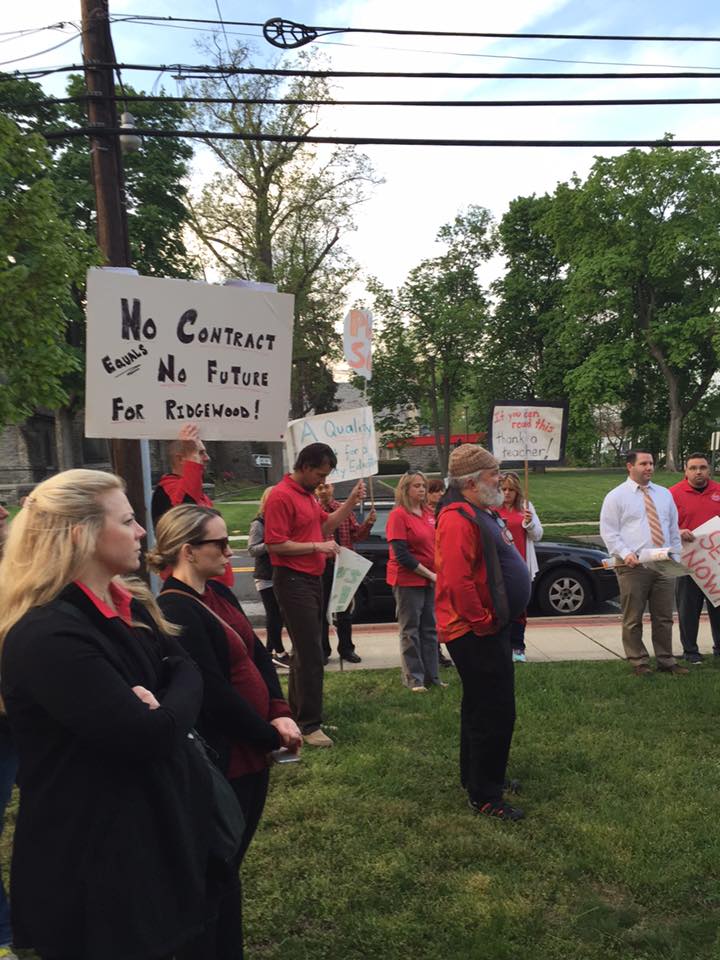
Ridgewood trustees, teachers remain at odds as school year looms
BY STEVE JANOSKI
STAFF WRITER |
THE RECORD
RIDGEWOOD — The failure of a state-appointed super-conciliator to resolve a 19-month-long labor dispute between the Board of Education and district teachers union has left local officials and union heads considering their next move.
Disagreements over several issues — including salaries, proposed changes in the union insurance plan and how much the Ridgewood Education Association’s 547 members should contribute toward their health insurance premiums — have contributed to a breakdown in the negotiations, which began five months before the last contract expired on June 30, 2015.
https://www.northjersey.com/news/ridgewood-trustees-teachers-remain-at-odds-as-school-year-looms-1.1651097
NJ Monthly rankings for 2016 – Ridgewood Schools are not in top 30
August 27,2016
the staff of the Ridgewood blog
Ridgewood NJ, NJ Monthly rankings for 2016 – Ridgewood isn’t in top 30 – Why the hell should we pay these teachers more money?
https://scontent.fewr1-1.fna.fbcdn.net/v/t1.0-9/14117892_10210070329289863_8195586293092428623_n.jpg?oh=6c1cddeaddf98d029b96414b73ce90a3&oe=5859C561
Reader says ,” High school teachers are now unaccountably sabotaging their own students’ grades. As in, the grades of every student in the class. This has been plenty nasty for a while now and the upcoming school year promises fresh outrage from teachers and administrators, adults chronologically, behaving like children.”
A Recommended Reading List – from C.S. Lewis

August 26,2016
the staff of the Ridgewood blog
Ridgewood NJ, this is a Recommended Reading List from C.S. Lewis ,looks like it time to hit the Ridgewood library.
Clive Staples Lewis (1898–1963) was one of the intellectual giants of the twentieth century and arguably one of the most influential writers of his day. He was a Fellow and Tutor in English Literature at Oxford University until 1954, when he was unanimously elected to the Chair of Medieval and Renaissance Literature at Cambridge University, a position he held until his retirement.
Lewis wrote more than thirty books, allowing him to reach a vast audience, and his works continue to attract thousands of new readers every year. C. S. Lewis’s most distinguished and popular accomplishments include Mere Christianity, Out of the Silent Planet, The Great Divorce, The Screwtape Letters, and the universally acknowledged classics in The Chronicles of Narnia. To date, the Narnia books have sold over 100 million copies and been transformed into three major motion pictures.
A Canon List from An Experiment in Criticism
Homer
Iliad (c. 8th BCE)
Odyssey (c. 8th BCE)
Unknown, Book of Jonah (8th-4th BCE)
Pindar
Olympian Odes (early 5th BCE)
Pythian Odes (early 5th BCE)
Fragments (early 5th BCE)
Aeschylus, The Eumenides (5th BCE)
Sophocles, Oedipus Rex (c. 429 BCE)
Aristotle, Poetics (335 BCE)
Virgil
The Georgics (29 BCE)
The Aeneid (29-19 BCE)
Lucian, Vera Historia (2nd)
Apuleius, Metamorphoses/The Golden Ass (late 2nd)
Unknown, Beowulf (8th-11th)
Unknown, The Song of Roland (11th-12th)
Laȝamon, Brut (c. 1190-1215)
Unknown, Huon of Bordeaux (c. 1216-1268)
Snorri Sturluson, The Prose Edda (early 13th)
Dante, Divine Comedy (1308-20)
Geoffrey Chaucer
The Canterbury Tales (late 14th)
Troilus and Criseyde (1380s)
Unknown, Sir Gawain and the Green Knight (late 14th)
Sir Thomas Malory, Le Morte Darthur (1485)
Ludovico Ariosto, Orlando Furioso (c. 1516)
Arthur Brooke, The Tragical History of Romeus and Juliet (1562)
Sir Philip Sidney, Arcadia (late 16th)
Edmund Spenser, The Faerie Queene (1590s)
William Shakespeare
Romeo & Juliet (1591-5)
Twelfth Night (1601-2)
The Winter’s Tale (1611)
A Midsummer Night’s Dream (1590-7)
Henry V (c. 1599)
John Donne, “The Apparition” (early 17th)
Michael Drayton, “The Shepherds Sirena” (1627)
Thomas Browne, Urn Burial (1658)
Jean Racine
Andromaque (1667)
Phèdre (c. 1677)
John Milton
Paradise Lost (1667-74)
Samson Agonistes (1671)
Alexander Pope, The Rape of the Lock (1712-4)
Jonathan Swift, Gulliver’s Travels (1726, 1735)
Voltaire
“Micromégas” (1752)
Candide (1759)
Samuel Johnson, The History of Rasselas, Prince of Abissinia (1759)
William Beckford, Vathek, an Arabian Tale (1782)
James Boswell, Life of Johnson (1791)
Samuel Taylor Coleridge, The Rime of the Ancient Mariner (1798)
William Wordsworth
“Michael” (1800)
The Excursion (1814)
Jane Austen, Pride & Prejudice (1813)
Walter Scott, Guy Mannering (1815)
Benjamin Constant, Adolphe (1816)
John Keats, “Ode on a Grecian Urn” (1819)
James Hogg, The Private Memoirs and Confessions of a Justified Sinner (1824)
Percy Bysshe Shelley, The Witch of Atlas (1824)
Elias Lönnrot, The Kalevala (1835-49)
Alexandre Dumas, The Count of Monte Cristo (1844)
Charles Dickens
The Pickwick Papers (1836)
Great Expectations (1861)
William Makepeace Thackeray, Vanity Fair (1848)
Edward Fitzgerald, Rubaiyat of Omar Khayyam (1859-89)
Anthony Trollope, Barchester Towers (1857)
Leo Tolstoy, War and Peace (1869)
George Eliot, Middlemarch, A Study of Provincial Life (1871-2)
Samuel Butler, Erewhon (1872)
Lewis Carroll, “The Hunting of the Snark” (1874-6)
Fyodor Dostoyevsky, The Brothers Karamazov (1880)
Robert Louis Stevenson
Treasure Island (1883)
Strange Case of Dr Jekyll and Mr Hyde (1886)
Edwin Abbott, Flatland: A Romance of Many Dimensions (1884)
John Ruskin, Praeterita (1885)
Henry James, The Turn of the Screw (1898)
H.G. Wells
First Men in the Moon (1901)
“The Door in the Wall” (1911)
Beatrix Potter, Tales (1902-1930)
Joseph Conrad, Nostromo (1904)
E.R. Burroughs, Tarzan (1912-1965)
Kenneth Grahame, The Wind in the Willows (1908)
Arnold Bennett, The Old Wives’ Tale (1908)
James Stephens, The Crock of Gold (1912)
D.H. Lawrence, Sons and Lovers (1913)
Gertrude Stein, “Sacred Emily” (1913)
James Branch Cabell, Jurgen, A Comedy of Justice (1919)
Kafka, The Castle (1926)
Mervyn Peake, Titus Groan (1946)
J.R.R. Tolkien, Lord of the Rings (1954-5)
Academic freedom means no ‘trigger warnings,’ or creation of intellectual ‘safe spaces’

Ridgewood NJ, its that time of the year again and that time is back to school . While the new trend in “education” is to limit free speech , “coddle and protect the innocent victims” and create “safe spaces” . Some schools thankfully will have none of this .
This is Not a Day Care. It’s a University!’
This past week, I actually had a student come forward after a university chapel service and complain because he felt “victimized” by a sermon on the topic of 1 Corinthians 13. It appears that this young scholar felt offended because a homily on love made him feel bad for not showing love. In his mind, the speaker was wrong for making him, and his peers, feel uncomfortable.
I’m not making this up. Our culture has actually taught our kids to be this self-absorbed and narcissistic. Any time their feelings are hurt, they are the victims. Anyone who dares challenge them and, thus, makes them “feel bad” about themselves, is a “hater,” a “bigot,” an “oppressor,” and a “victimizer.”
I have a message for this young man and all others who care to listen. That feeling of discomfort you have after listening to a sermon is called a conscience. An altar call is supposed to make you feel bad. It is supposed to make you feel guilty. The goal of many a good sermon is to get you to confess your sins—not coddle you in your selfishness. The primary objective of the Church and the Christian faith is your confession, not your self-actualization.
So here’s my advice:
If you want the chaplain to tell you you’re a victim rather than tell you that you need virtue, this may not be the university you’re looking for. If you want to complain about a sermon that makes you feel less than loving for not showing love, this might be the wrong place.
If you’re more interested in playing the “hater” card than you are in confessing your own hate; if you want to arrogantly lecture, rather than humbly learn; if you don’t want to feel guilt in your soul when you are guilty of sin; if you want to be enabled rather than confronted, there are many universities across the land (in Missouri and elsewhere) that will give you exactly what you want, but Oklahoma Wesleyan isn’t one of them.
At OKWU, we teach you to be selfless rather than self-centered. We are more interested in you practicing personal forgiveness than political revenge. We want you to model interpersonal reconciliation rather than foment personal conflict. We believe the content of your character is more important than the color of your skin. We don’t believe that you have been victimized every time you feel guilty and we don’t issue “trigger warnings” before altar calls.
Oklahoma Wesleyan is not a “safe place”, but rather, a place to learn: to learn that life isn’t about you, but about others; that the bad feeling you have while listening to a sermon is called guilt; that the way to address it is to repent of everything that’s wrong with you rather than blame others for everything that’s wrong with them. This is a place where you will quickly learn that you need to grow up.
This is not a day care. This is a university!
and the University of Chicago
Dear class of 2020
Welcome and congratulations on your acceptance to the college at the University of Chicago. Earning a place in our community of scholars is no small achievement and we are delighted that you selected Chicago to continue your intellectual journey.
Once here you will discover that one of the University of Chicago’s defining characteristics is our commitment to freedom of inquiry and expression. … Members of our community are encouraged to speak, write, listen, challenge, and learn, without fear of censorship. Civility and mutual respect are vital to all of us, and freedom of expression does not mean the freedom to harass or threaten others. You will find that we expect members of our community to be engaged in rigorous debate, discussion, and even disagreement. At times this may challenge you and even cause discomfort.
And then, the coup de grace:
Our commitment to academic freedom means that we do not support so called ‘trigger warnings,’ we do not cancel invited speakers because their topics might prove controversial, and we do not condone the creation of intellectual ‘safe spaces’ where individuals can retreat from ideas and perspectives at odds with their own.
Governor Christie The Fairness Formula will Lower Property Taxes and Force Education Reform
file photo by ArtChick
August 25,2016
the staff of the Ridgewood blog
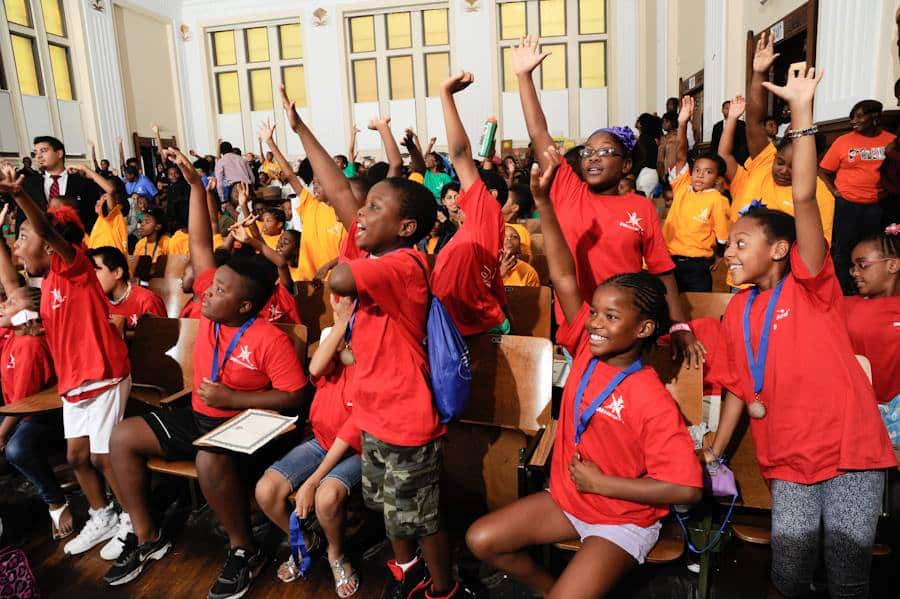
Ridgewood NJ, Earlier this summer, Governor Christie proposed a solution to New Jersey’s two most pressing issues; the failure of urban education and high property taxes.
In 1985 Abbott Districts were created as a result of the first ruling of Abbott v. Burke, a case filed by the Education Law Center. The ruling asserted that public primary and secondary education in poor communities throughout the state was unconstitutionally substandard.
The Abbott II ruling in 1990 had the most far-reaching effects, ordering the state to fund the (then) 28 Abbott districts at the average level of the state’s wealthiest districts.
The low-income districts began to receive the extra aid .The Abbott ruling led to the current school funding formula crisis allowing failing school districts to spend as much as $33,699 per pupil in tax dollars, while high‐performing school districts spend less than half of that per student.
In what could be one of the largest failures in social engineering ,leading to excessive spending by a select few and chronically failing school districts,who have received billions more in state taxpayer dollars over the past three decades than hundreds of successful school districts.
According to the Mercatus Center at George Mason University,”While it is difficult to compare academic achievement across time periods, evidence indicates that Abbott money has had little effect on improving student performance. ”
Mercatus Center went on , “The lackluster performance of these schools is also related to the fractured relationship between beneficiaries and providers. Abbott districts receive the majority of their funding from state aid rather than local tax revenues. The incentive to make optimal use of this funding and to monitor school performance is minimal. In addition, taxpayers in districts receiving state aid may not be benefiting from lower property taxes, because officials in local government prefer to work the increased revenue into their budgets, rather than returning it to taxpayers via a municipal tax cut.”
That’s where Governor Christie steps in with his Fairness Formula. The Fairness Formula will provide equal education funding for every pupil throughout the state, valuing every child equally. Under the Fairness Formula, all public school districts would receive $6,599 for every enrolled student, plus continued funding for special education. This will give every child an equal chance at success.
With this new formula, 75% of all New Jersey districts would get more state aid than they do today. The biggest driver of New Jersey’s nation‐high property taxes is the ineffective and unfair state school funding formula. The Fairness Formula will not only be equal for students it may also provide hundreds or even thousands of dollars in annual property tax savings for New Jerseyans in most communities. The potential property tax savings that would be realized under the Fairness Formula is a strong benefit to New Jersey’s economy as a whole. Business owners are burdened by New Jersey’s highest in the nation property taxes and chased to more affordable states due to New Jersey’s many other non‐competitive taxes that have been enacted by Democrats.
A byproduct of the Fairness Formula is a renewed interest in alternative options for educational choice.
Recently Atlantic City passed a resolution unanimously by the Democrat-dominated body for a non-binding referendum in time for the November ballot : REGARDING SCHOOL VOUCHERS AND TAX CREDITS.
WHEREAS, The City Council of Atlantic City is empowered with the authority to submit nonbinding referendum questions to the public in order to ascertain the sentiment of legal voters; and NOW, THEREFORE, BE IT RESOLVED that the Council of the City of Atlantic City hereby submits the following questions to be printed upon the official ballots to be used at the next ensuing General Election as follows: “Shall the State of New Jersey designate the City to begin offering vouchers to families with children ages 6-16 so they can select the school they want their children to attend?” “Shall the State of New Jersey designate the City of Atlantic City to begin offering property tax credits to families with children ages 6-16 who choose to homeschool?
The revolutionary resolution was created by freshman GOP Councilman Jesse Kurtz, who is himself an NJEA member, New Jersey’s largest teachers union.
According to Matthew Chingos of the Urban Institute ,”School choice policies aim to break the link between where children live and where they go to school. They seek to interrupt the cycle of poverty by providing low-income children with access to high-quality educational options that will boost their chances of long-term success. Choice programs come in several flavors, including charter schools, which are publicly funded but independently operated; private school vouchers, which cover all or part of private school tuition; and open enrollment plans (sometimes called public school vouchers) that allow parents to send their child to any public school in the district. When done right, school choice programs can be powerful tools in the fight against poverty.”





