Posted on 11 Comments

Raymond’s in Ridgewood, Montclair to pay $345K in back wages

gallery-1

gallery-1

Raymond’s in Ridgewood, Montclair to pay $345K in back wages

March 30, 2015    Last updated: Monday, March 30, 2015, 2:50 PM
By MELANIE ANZIDEI

A Ridgewood restaurant chain and its owners must pay $325,534 in back wages to 160 workers for overtime and minimum wage violations, the U.S. Department of Labor said Monday.

Raymond’s Ridgewood LLC did not pay members of its kitchen staff for overtime and failed to pay tipped workers the proper wage rate, an investigation by the department’s Northern New Jersey Wage and Hour District Office found.

Employees at two locations were affected. At Raymond’s in Ridgewood, 84 employees are due $100,048 in back wages, said the department. This includes overtime back wages to its kitchen staff and tipped employees. The employer also failed to pay tipped workers in Ridgewood the proper wage rate from the beginning of their employment, the department said. At Raymond’s in Montclair, 76 workers are due $225,486 in overtime back wages, the agency said.

The restaurant chain agreed to make the payments, which are in the process of being paid, according to Department of Labor spokeswoman Leni Uddyback-Fortson. The back wages cover employee compensations from April 1, 2012 to March 31, 2014.

Raymond Badach and Joanne Ricci, owners of the restaurant chain, did not immediately respond to requests for comment.

https://www.northjersey.com/news/business/raymond-s-in-ridgewood-montclair-to-pay-345k-in-back-wages-1.1298939

Posted on 1 Comment

Northern Bergen office vacancies skyrocket as companies flee New Jersey’s Anti Business Climate

bilde

bilde

Northern Bergen office vacancies skyrocket as companies flee New Jersey’s Anti Business Climate

MARCH 29, 2015    LAST UPDATED: SUNDAY, MARCH 29, 2015, 1:21 AM
BY LINDA MOSS
STAFF WRITER |
THE RECORD

* Shifting preferences are likely to alter the look of many now-empty large corporate campuses

Northern Bergen County, once a magnet for corporations, has lost some of its luster as a number of companies leave the area, sending its office vacancy rate soaring to nearly 40 percent, according to one real estate firm.

In the first quarter so far, the northern corridor of the county, including towns like Montvale and Park Ridge, had 2.25 million square feet of its total 5.8 million square feet of office space unoccupied, according to JLL, a real estate firm with offices in East Rutherford.

That translates to a 39 percent vacancy rate in the quarter, up 70 percent from the year-ago period’s 23 percent, JLL reported.

The Hertz Corp.’s former headquarters in Park Ridge, a 226,000-square-foot property, is on the block after the auto-rental giant’s relocation to Estero, Fla. And Pearson Education’s exit a few months ago from its leafy campus in Upper Saddle River added 475,000 square feet of vacant office space.

“You’ve got almost a million square feet just in Montvale,” said JLL Managing Director Tom Reilly.

Vacancy rates could rise even higher when Mercedes-Benz USA moves its U.S. headquarters from Montvale, where it has three buildings, to Atlanta over the next couple of years. That relocation, announced in January, would add as much as 310,300 square feet of vacant space in the region.

https://www.northjersey.com/news/business/the-wide-open-office-spaces-1.1298328

Posted on 1 Comment

Ben & Jerry’s Helps You with Employee Appreciation

images

images

Ben & Jerry’s Helps You with Employee Appreciation

Office Event, Employee Appreciation, Just Because…

Ben & Jerry’s helps your business boost morale and increase productivity.

Call us today to book your April event featuring one of our Moo-Euphoric parties 201-867-1111 and we will waive the set up fee ($125) when you book before March 31, 2015.

Your employees will love the delicious toppings like fresh baked cookies and brownies, hot fudge, hot caramel and of course their favorite Ben & Jerry’s flavors.

Call Now: 201-867-1111

Posted on Leave a comment

Hard Times for Obama Voters

USA-OBAMA_2567264b

USA-OBAMA_2567264b

Hard Times for Obama Voters

Recent college grads, and especially African-Americans, struggle to find work in a slow recovery.
ByJAMES FREEMAN
May 21, 2014 7:58 a.m. ET

The great irony of the Obama era is that the President’s base voters have disproportionately suffered from a sputtering economy, while the wealthy that Mr. Obama likes to criticize have enjoyed a booming stock market. A new study shows just how difficult this era has been for some of the President’s most loyal supporters.

Researchers at the Center for Economic and Policy Research, a left-leaning think tank, find that “The Great Recession has been hard on all recent college graduates, but it has been even harder on black recent graduates.”

In 2013, the unemployment rate for black college graduates ages 22-27 was a full 12.4%, more than double the 5.6% rate for all college grads in the same age range.

And for those African-American recent grads who did have jobs in 2013, study authors Janelle Jones and John Schmitt find that a staggering 56% were underemployed, meaning they were doing jobs that typically don’t require a four-year college degree. This compares to 45% underemployment among all recent graduates. For youngsters of all colors, these statistics describe a tragic era of lost opportunity and unrealized potential.

Even a career-friendly course of study isn’t protecting young graduates from the ravages of this historically slow recovery. The authors report that “for the years 2010 to 2012, among black recent graduates with degrees in engineering, the average unemployment rate was 10 percent and the underemployment rate was 32 percent.” Among all recent grads with engineering degrees, the average unemployment rate in those years was 6%, while 22% were underemployed.

https://www.wsj.com/articles/SB10001424052702303480304579575560207738956

Posted on Leave a comment

U.S. Capital Gains Tax Rate, 6th Highest in OECD

Obama-Golf

Obama-Golf

U.S. Capital Gains Tax Rate, 6th Highest in OECD
March 25,2015

President’s budget proposal would bump rate to 5th highest

Washington, DC ,The United States currently has the 6th highest top marginal tax rate on capital gains in the OECD at 28.6 percent. President Obama’s recent budget proposal seeks to increase the top marginal tax rate on capital gains to 32.8 percent, which would give the U.S. the fifth highest rate in the industrialized world. However, this expansion of the capital gains tax could lead to slower economic growth, according to a recent report from the nonpartisan Tax Foundation.

“Increasing taxes on capital income discourages savings, which leads to lower levels of investment and slower economic growth,” explains Tax foundation Economist Kyle Pomerleau. “The expansion of this tax as suggested in the recent budget proposal would only further this bias against saving.”

The report argues that as more people prefer consumption today due to this bias, there will be less capital available in the future. For investors, this represents less available capital for factories, machines, and other investment opportunities.

“Additionally, capital gains taxes create a lock-in effect that reduces the mobility of capital,” adds Pomerleau. “People are less willing to realize capital gains from one investment in order to move to another when they face a tax on their returns. Funds will be slower to move to better investments, further reducing economic growth.”

By raising the federal top marginal capital gains tax rate, President Obama’s FY 2016 budget would compound these negative effects and make the U.S. tax code less competitive globally. On the other hand, the report finds that lowering taxes on capital gains would have the reverse effect, increasing investment and leading to greater economic growth.

The report’s key findings include:

The average combined federal, state, and local top marginal tax rate on long-term capital gains in the United States is 28.6 percent – 6th highest in the OECD.
This is more than 10 percentage points higher than the simple average across industrialized nations of 18.4 percent, and 5 percentage points higher than the weighted average.
Nine industrialized countries exempt long-term capital gains from taxation.
California has the 3rd highest top marginal capital gains tax rate in the industrialized world at 33 percent.
The taxation of capital gains places a double-tax on corporate income, increases the cost of capital, and reduces investment in the economy.
The President’s FY 2016 budget would increase capital gains tax rates in the United States from 28.6 percent to 32.8, the 5th highest rate in the OECD.

Posted on Leave a comment

Obamacare Is Really Expensive for Small Businesses. Surprise!

imgres-15

imgres-15

Obamacare Is Really Expensive for Small Businesses. Surprise!

Lousy news for growing the economy, creating jobs, and overall increasing prosperity

“Complying with the health care law is costing small businesses thousands of dollars that they didn’t have to spend before the new regulations went into effect,” reports AP business writer Joyce M. Rosenberg. This should be a surprise to exactly nobody. In general, government mandates have poor track record of making people’s lives less expensive and complicated. Specifically, businesses around the country have reported over the past year that Obamacare raised their healthcare costs and they anticipated more hikes to come. Hiring—especially of full-time employees—has taken a hit as a result.

Writes Rosenberg:

The Affordable Care Act, which as of next Jan. 1 applies to all companies with 50 or more workers, requires owners to track staffers’ hours, absences and how much they spend on health insurance. Many small businesses don’t have the human resources departments or computer systems that large companies have, making it harder to handle the paperwork. On average, complying with the law costs small businesses more than $15,000 a year, according to a survey released a year ago by the National Small Business Association.

Last summer, Federal Reserve Banks around the country surveyed businesses in their regions. In the service sector, about 82 percent of businesses told the Federal Reserve Bank of Dallas that the Affordable Care Act raised costs for them in 2014; 91 percent expected increased costs in 2015.

https://reason.com/blog/2015/03/23/obamacare-is-really-expensive-for-small

Posted on Leave a comment

How an ‘expensive’ N.J. community might handle town-by-town minimum wage proposal

McDonalds-Machines

McDonalds-Machines

How an ‘expensive’ N.J. community might handle town-by-town minimum wage proposal

MONTCLAIR — A township official says an Assembly proposal that would allow municipalities in New Jersey to set their own minimum wages would be plausible, and likely passable, in Montclair. But, he says he’s not convinced that it’s the most effective way to increase the minimum wage in New Jersey. (Mazolla/NJ.com)

https://www.nj.com/essex/index.ssf/2015/03/how_an_expensive_nj_community_might_handle_town-by.html#incart_river

Posted on Leave a comment

Congressman Leonard Lance (NJ-07) Calls FCC Release of Depression-Era Net Neutrality Regulations regulatory overreach and job-killing

Lance

Lance

Congressman Leonard Lance (NJ-07) Calls FCC Release of Depression-Era Net Neutrality Regulations regulatory overreach and job-killing
Mar 12, 2015
the staff of the Ridgewood blog

WESTFIELD, N.J. — Congressman Leonard Lance (NJ-07), New Jersey’s only Republican member of the House Energy and Commerce Communications and Technology Subcommittee, commented on the Federal Communications Commission’s release of its Depression-era rules to regulate the Internet.

In January  Lance  stated ,the obvious to everyone except the Obama administration, “The Internet is a medium that continues to experience tremendous technological growth and today’s action by the D.C. Circuit Court striking down the FCC’s efforts to regulate the Internet protects consumers, increases competition and encourages new investment and innovation in broadband.  As a member of the House Communications and Technology Subcommittee I will continue to work with my colleagues to ensure that the FCC does not overstep its authority on the issue of network neutrality.”

Lance continued his attack on Net Neutrality in February , “The Federal Communications Commission has voted in favor of a net neutrality plan that is the most dramatic government intervention in the Internet in two decades.  The FCC’s proposal to regulate the Internet will hurt consumers and discourage new investment and innovation in broadband.  It is Congress, not an unelected federal commission, that is tasked with modernizing our Nation’s telecommunications laws and today’s action is a blatant overstep of authority that threatens to stifle one of the Nation’s most important economic engines.”

The FCC’s Release of the Net Neutrality regs on Thursday, Rep. Leonard Lance (NJ-07), seized on the opportunity to condemn what he views as “Depression-era” rules.“The Federal Communications Commission (FCC) has finally released its sweeping proposal following weeks of secrecy and stonewalling.  The American People now have an opportunity to read the FCC’s 300-plus page plan to regulate the Internet as a utility — a plan I believe will hurt consumers, discourage new investment and innovation in broadband, and lead to billions of dollars in new fees and taxes.  That’s why I have joined many of my colleagues on the House Communications and Technology Subcommittee and introduced H.R. 1212, the Internet Freedom Act, that will put the brakes on this FCC overreach and protect our innovators from these job-killing regulations.”

show?id=mjvuF8ceKoQ&bids=355335
Warm Up Winter with a Smile! Save up to 40% on Flowers & Gifts at 1800flowers.com.show?id=mjvuF8ceKoQ&bids=216823
Coffee.clubshow?id=mjvuF8ceKoQ&bids=363195
Microsoft Store
Hotwire US

Posted on Leave a comment

Surprise: U.S. Economic Data Have Been the World’s Most Disappointing

-1x-1

-1x-1

Surprise: U.S. Economic Data Have Been the World’s Most Disappointing

Is this a sign of unanticipated weakness in the economy?

It’s not only the just-released University of Michigan consumer confidence report and February retail sales on Thursday that surprised economists and investors with another dose of underwhelming news. Overall, U.S. economic data have been falling short of prognosticators’ expectations by the most in six years.

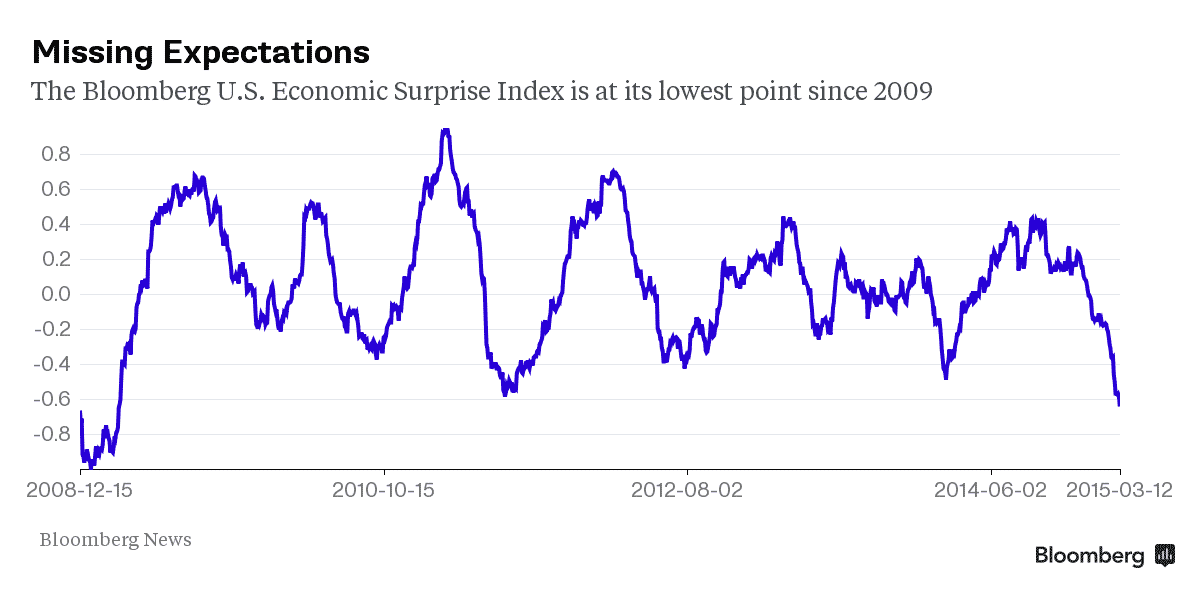
The Bloomberg ECO U.S. Surprise Index, which measures whether data beat or miss forecasts, fell to the lowest since 2009, when the nation was in the deepest recession since the Great Depression.

There’s been one notable exception to the gloom, and it’s a big one: payrolls. The economy added 295,000 jobs in February and 1.3 million over four months, a reflection of a healthier labor market in which the unemployment rate has fallen to the lowest in almost seven years.

-1x-1

Most everything else? Blah.

This month alone, personal income and spending, manufacturing as measured by the Institute for Supply Management, auto sales, factory orders, and retail sales have all come in a bit weak.

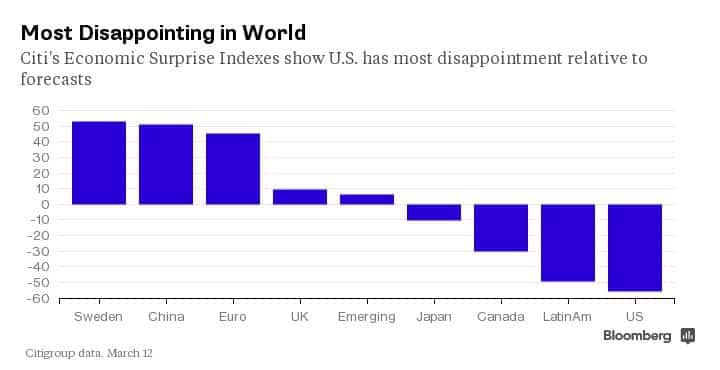
Citigroup keeps economic surprise indexes for the world, and its scoreboard shows the U.S. is most disappointing relative to consensus forecasts, with Latin America and Canada next, as of March 12. Emerging markets were supposed to be hurt by falling oil prices but are now delivering positive surprises. U.S. policymakers frequently talk about weakness in Europe and China, though both are exceeding expectations.

And there’s one rub. The surprise shortfall in the U.S. doesn’t necessarily mean the world’s largest economy is in dire straights. It’s just falling short of some perhaps overly elevated expectations.

https://www.bloomberg.com/news/articles/2015-03-13/surprise-u-s-economic-data-most-disappointing-in-the-world

Posted on 6 Comments

U.S. Millennials Come Up Short in Global Skills Study

21milenials-c1s

21milenials-c1s

Americans between the ages of 16 and 34 fared poorly on tests designed to measure their grasp of the literacy, numeracy, and computer-age problem-solving skills needed to compete in the international labor market. Even the youngest of U.S. millenials lag behind peers in other Organization for Economic Cooperation and Development countries.

U.S. Millennials Come Up Short in Global Skills Study

Shortfalls affect all segments of American society

By Sarah D. Sparks

America’s wealthiest and best-educated young adults still lag behind their peers in other countries in the literacy, numeracy, and computer-age problem-solving skills needed to compete in the global labor market.

That, coupled with yawning racial and socioeconomic achievement gaps and even grimmer skills levels for students with less than a college degree, could lead to long-term difficulty for the country, according to a new study by the Education Testing ServiceCenter for Research on Human Capital and Education in Lawrenceville, N.J.

It’s far from the first study to suggest American students are falling behind their international peers. But the analysis of U.S. millennials—those born after 1980, ages 16 to 34 during the study—specifically highlights that the skills gap goes beyond young people who are typically seen as more “at-risk,” like immigrants and high school dropouts.

“We’ve often looked at these as disconnected, only looking at the problems of individual parts,” said Martha J. Kanter, a visiting professor of higher education at New York University and former assistant education secretary under President Barack Obama. She was not associated with the study.

https://www.edweek.org/ew/articles/2015/02/18/us-millennials-come-up-short-in-global.html

Posted on 4 Comments

Crowdfunding bill passes Assembly

article-2690564-1F9B7A5000000578-293_634x767

article-2690564-1F9B7A5000000578-293_634x767

Crowdfunding bill passes Assembly

MARCH 11, 2015    LAST UPDATED: WEDNESDAY, MARCH 11, 2015, 1:21 AM
BY MELANIE ANZIDEI
STAFF WRITER |
THE RECORD

* Up to $1 million could be raised for a start-up through small pledges

Small businesses and start-ups in New Jersey soon may have another avenue for reaching investors.

Legislation approved by the Assembly on Monday would enable emerging small businesses and start-ups to find investors through crowdfunding, a technique very much like an online fundraiser. The bill defines the process as the financing of a business venture using the Internet to raise small amounts of money from a larger number of investors.

The legislation, which passed 75-0 with one abstention, would allow businesses to invite small investors to offer capital through a pledge. Once pledges for a project reached a predetermined limit, the businesses would move forward with the funding. The funds will be released only if the target amount is reached.

To Mario Casabona, founder and chief executive officer of Tech Launch — a technology start-up accelerator in Clifton — crowdfunding offers an alternative way for start-ups to gain access to capital.

“It’s a good thing for entrepreneurs,” enabling more investors to fund a business, he said in a phone interview Tuesday. But, he added, “it doesn’t make it easier.”

https://www.northjersey.com/news/business/assembly-votes-for-crowdfunding-1.1286379

Posted on Leave a comment

Walker Hits Back at Obama

GOP 2016 Perfect Candidate

GOP 2016 Perfect Candidate

Walker Hits Back at Obama

by JOEL GEHRKE March 10, 2015 10:15 AM

Governor Scott Walker (R., Wis.) wasted no time in mocking President Obama’s performance with respect to the economy after the president picked a fight with him for signing a right-to-work bill into law.
“On the heels of vetoing Keystone Pipeline legislation, which would have paved the way to create thousands of quality, middle-class jobs, the President should be looking to states, like Wisconsin, as an example for how to grow our economy,” Walker said in a statement to National Review Online. “Despite a stagnant national economy and a lack of leadership in Washington, since we took office, Wisconsin’s unemployment rate is down to 5.0 percent, and more than 100,000 jobs and 30,000 businesses have been created.”

Read more at: https://www.nationalreview.com/corner/415158/walker-hits-back-obama-joel-gehrke

Posted on 7 Comments

N.J. Senate committee backs Tesla Motors bill

model-s-photo-gallery-10

model-s-photo-gallery-10

N.J. Senate committee backs Tesla Motors bill

March 9, 2015    Last updated: Monday, March 9, 2015, 5:32 PM
By HUGH R. MORLEY

Tesla Motors moved a step closer Monday to resuming selling its electric cars in New Jersey when a Senate committee backed a bill that would allow the car company to operate four outlets in the state.

Tesla’s three existing showrooms, at Garden State Plaza and on Route 17 West in Paramus, and in Short Hills, have been prohibited from selling cars directly to consumers since last spring, when the state motor vehicle commission enacted rules requiring all new vehicle sales to be completed through a franchise dealership.

Tesla has no franchises, and so customers can see the vehicles in the New Jersey outlets – called “galleries” – but purchase them only either online or in another state.

The bill approved by the Senate committee does not mention Tesla by name, but would allow a maker of so called “zero emissions vehicles” to open four outlets and a retail service center in the state.

In December, the company opened a 25,000-square-foot Paramus center, in a former Sixth Avenue Electronics store, with room to display about a half-dozen cars, and operate a service center.

The committee voted unanimously for the bill after a brief hearing with no opposition.

https://www.northjersey.com/news/business/n-j-senate-committee-backs-tesla-motors-bill-1.1285465

Posted on Leave a comment

62.8%: Labor Force Participation Has Hovered Near 37-Year-Low for 11 Months

aaa4_727

aaa4_727

62.8%: Labor Force Participation Has Hovered Near 37-Year-Low for 11 Months
March 6, 2015 – 10:01 AM
By Ali Meyer

(CNSNews.com) – The labor force participation rate hovered between 62.9 percent and 62.7 percent in the eleven months from April 2014 through February, and has been 62.9 percent or lower in 13 of the 17 months since October 2013.

Prior to that, the last time the rate was below 63 percent was 37 years ago, in March 1978 when it was 62.8 percent, the same rate it was in February.

“The civilian labor force participation rate, at 62.8 percent, changed little in February and has remained within the narrow range of 62.7 to 62.9 percent since April 2014,” the BLS said in its release on the February employment data.

92,898,000 Americans were not in the labor force in February, according to data released from the Bureau of Labor Statistics (BLS) on Friday.

The labor force participation rate is the percentage of the civilian noninstitutional population who participated in the labor force by either having a job during the month or actively seeking one.

In February, according to BLS, the nation’s civilian noninstitutional population, consisting of all people 16 or older who were not in the military or an institution, reached 249,899,000. Of those, 157,002,000 participated in the labor force by either holding a job or actively seeking one.

The 157,002,000 who participated in the labor force was 62.8 percent of the 249,899,000 civilian noninsttutional population, which matches the 62.8 percent rate in April, May, June, and October of 2014 as well as the participation rate in March of 1978. The participation rate hit its lowest level since February 1978 (62.7 percent) in September and December of 2014.

https://cnsnews.com/news/article/ali-meyer/628-labor-force-participation-has-hovered-near-37-year-low-11-months

Posted on Leave a comment

Obama’s 2016 Budget: Analysis shows plan would result in reduced GDP and the loss of upwards of 809,000 jobs

Obama-Golf

Obama-Golf

Obama’s 2016 Budget: Analysis shows plan would result in reduced GDP and the loss of upwards of 809,000 jobs
March 3,2015

Washington, DC ,In his 2016 budget, President Obama proposes a variety of tax increases on saving and investment as well as the creation or expansion of a number of tax credits. Some economists are concerned about the impact these changes could have on the U.S. economy, and according to the latest numbers, many of their concerns are warranted. A new analysis from the nonpartisan Tax Foundation indicates that the president’s budget would cost the U.S. a significant amount of full time jobs and result in the reduction of GDP and workers’ wages.The report’s key findings include:

The Taxes and Growth (TAG) Model finds the plan would shrink the economy by 3 percent, lower the level of investment by 8 percent, reduce wages by 2.4 percent, eliminate 809,000 jobs, and lose $12 billion in federal revenue over the long run due to lower growth.

If the revenue available for business tax reform were used to lower the corporate tax rate, it would result in a 3 percentage point cut in the rate—far less than a cut to a 28 percent rate as hoped for by the president’s budget.
With the lower corporate tax rate, the plan would still shrink the economy by 2.4 percent, decrease investment by 6.2 percent, reduce wages by 1.8 percent, eliminate 679,000 jobs, and lose $4 billion in revenue over the long run.

“The thrust of the individual income tax changes is to raise taxes on upper income taxpayers, primarily through higher taxes on income from savings and investment. The additional revenue would then be used to increase credits for families with young children, workers with low earnings, and two-earner couples,” said Tax Foundation Senior Fellow Stephen J. Entin, PhD. “However, the plan focuses only on redistribution, ignoring economic growth, and the resulting reduction in growth would hurt many of the people the plan is meant to help.”

This plan highlights a century-old debate over whether to tax income or consumption. The focus of the broad-based income tax (which taxes income when it is earned and again when investment earnings are realized) is to aid in wealth redistribution. On the other hand, the focus of a consumption based tax (one that falls equally on income used for consumption or saving and investment) is to avoid penalizing saving relative to consumption as to not discourage economic growth.

The 2016 budget aligns with the income based approach. Historically, reforms that have moved towards the broad-based income tax—like the 1986 Reagan tax reform and the Obama 2012 budget agreement and the tax elements of the Affordable Care Act—have generally reduced wages and employment and discouraged capital formation. Alternatively, reforms that moved away from this approach—such as the 1961-1963 Kennedy tax cuts, the 1981 Reagan tax cut, and the 2001-2003 Bush tax cuts—have helped to raise productivity, wages, and employment.

Chemistry.com

Esurance