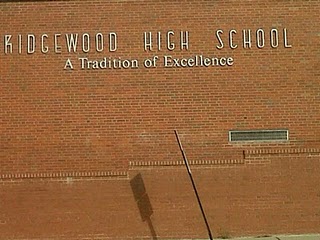
Ridgewood NJ, in Newsweek’s annual ranking of public high schools 51 in N.J. made the cut. Noticeable absent was Ridgewood High School and Tenafly High School.
Ridgewood’s slip has not gone unnoticed, as many long time residents have commented ,” Years ago it was ranked highly in the nation. It fell from that to being ranked highly in the state, then down to County level and now basically is ranked no where. ”
Newsweek looked at six measurements and weighted them to come up with a “college readiness index.” The rankings are meant to show how well high schools do at preparing students for college.
Those measurements and their weight are:
Holding power: 10 percent
Ratio of counselor/full-time equivalent to student enrollment: 10 percent
Weighted SAT/ACT: 17.5 percent
Weighted AP/IB/dual enrollment composite: 17.5 percent
Graduation rate: 20 percent
College enrollment rate: 25 percent
Here’s a look at all of the New Jersey high schools that made Newsweek’s list and where they came in on the national list (in parentheses):
(2) Academy for Math, Science and Engineering, Rockaway
(4) Union County Magnet High School, Scotch Plains
(10) Middlesex Cty Acad. for Sci,, Math, & Engineering Tech., Edison
(11) Bergen County Academies, Hackensack
(12) Academy of Allied Health and Science, Neptune
(14) Biotechnology High School, Freehold
(20) High Technology High School, Lincroft
(21) Academy for Allied Health Sciences, Scotch Plains
(23) Academy for Information Technology, Scotch Plains
(27) Communications High School, Wall
(31) Middlesex County Academy for Allied Health & Biomedical Sciences, Woodbridge
(40) Chatham High School, Chatham
(41) Bergen County Technical High School – Teterboro, Teterboro
(67) Westfield High School, Westfield
(71) Ridge High School, Basking Ridge
(76) Summit High School, Summit
(84) Marine Academy of Technology and Environmental Science, Manahawkin
(88) Bernards High School, Bernardsville
(91) Holmdel High School, Holmdel
(108) Bridgewater-Raritan Regional High School, Bridgewater
(112) Moorestown High School, Moorestown
(115) Madison High School, Madison
(127) John P Stevens High School, Edison
(131) Watchung Hills Regional High School, Warren
(137) Glen Rock High School, Glen Rock
(144) Rumson-Fair Haven Regional HS, Rumson
(158) Morris County School of Technology, Denville
(181) Marine Academy of Science and Technology, Highlands
(189) Union County Vocational Technical High School, Scotch Plains
(192) Governor Livingston High School, Berkeley Heights
(198) Montville Township High School, Montville
(203) Academy for Performing Arts, Scotch Plains
(210) Scotch Plains-Fanwood High School, Scotch Plains
(217) Hillsborough High School, Hillsborough
(222 Wayne Hills High School, Wayne
(226) Allentown High School, Allentown
(227) Northern Valley Regional High School Old Tappan, Old Tappan
(233) North Hunterdon-Voorhees, Annandale
(234) Northern Valley Regional High School at Demarest, Demarest
(237) Pequannock Township High School, Pompton Plains
(365) Hanover Park High School, East Hanover
(366) Mahwah High School, Mahwah
(377) Cranford High School, Cranford
(383) Livingston High School, Livingston
(417) Wayne Valley High School, Wayne
(421) Marlboro High School, Marlboro
(425) Cresskill High School, Cresskill
(429) Whippany Park High School, Whippany
(473) Kinnelon High School, Kinnelon
(482) Mount Olive High School, Flanders
(497) Middletown HS South, Middletown
“Hi everyone! I wanted to share a “good news” story about one of Ridgewood’s graduates, Ashley Eapen, who was recently interviewed by FORBES about her In/Spree App, which is changing how people can shop (since “it takes a village”, I thought our village would like to know about the good one of our own is doing). She managed to juggle starting this up while finishing her senior year of high school (I was her teacher, and she asked me to share this :). PLEASE take a moment to share and support our local girl! So proud of this talented, driven, creative, gifted young woman!” Kristine
How Two Entrepreneurs Leveraged Their Youth As A Strength, Not A WeaknessMatt Hunckler
CONTRIBUTOR
For many young founders, youth works against them. Seasoned investors want to work with entrepreneurs who have started and sold numerous businesses. Entrepreneurs who have been in the startup trenches. Entrepreneurs who know how to ride out the troughs and crests of the entrepreneurial journey. Young founders often find it difficult to secure funding.
This harsh reality makes the success of young Brendan and Ashley Eapen all the more surprising. The entrepreneurial duo recently made news by raising $250,000 to fund their new app In/Spree, which makes it possible for users to follow their favorite fashion influencers and then purchase clothes directly within the app.
Ridgewood High School students Mitchell Saron and Roscoe Swartz earned gold and bronze medals, respectively, competing for the Bergen Fencing Club in the Cadets (16-year-old) saber division of the USA Fencing National Championships & July Challenge, in Dallas on July 2.
Swartz, who had placed third during the Junior Olympics event held in February 2016, bested California fencer Jared Smith to achieve a Top 8 showing at 15-12.
Mary Clare ReimResearch Associate
Domestic Policy Studies
College students understandably bemoan the costs of higher education. During the 2015–2016 school year, annual costs[1] at four-year public universities reached $19,548 for in-state students and $34,031 for out-of-state students. Annual costs at private institutions reached $43,921.[2] Federal student aid has likely exacerbated the college cost problem, providing short-term relief to students in the form of loans and grants, while enabling universities to increase tuition across the board.[3]
There is an additional consequence to taxpayer-subsidized federal student loans. The average full-time college student spends only 2.76 hours per day on all education-related activities. This helps explain why most full-time students today do not graduate in four years and rack up increasingly high loan debt during their extended enrollment. Taxpayers, who are increasingly on the hook for borrower defaults and loan forgiveness programs, deserve to know what their tax dollars subsidize.
Full-Time College Is Typically a Part-Time Endeavor
Based on data from the Bureau of Labor Statistics’s American Time Use Survey from 2003–2014, during the academic year, the average full-time college student spent only 2.76 hours per day on all education-related activities, including 1.18 hours in class and 1.53 hours of research and homework, for a total of 19.3 hours per week.[4]
Full-time high school students, in comparison, spent 4.32 hours per day on all education-related activities, including 3.42 hours in class and 0.80 hours of research and homework, for a total of 30.2 hours per week. Thus, full-time college students spend 10.9 fewer hours per week on educational activities than full-time high school students.
Employment eliminates this gap between college and high school students.
Full-time college students work an average of 16.3 hours per week.
Full-time high school students work an average of 4.0 hours per week.
Full-time college students, then, spend 35.6 hours per week on education-related and work-related activities, while full-time high school students spend 34.2 hours per week.
However, full-time college students spend significantly less combined time on education and work than do full-time employees. The average full-time employee works 41.7 hours per week. To match that, the typical college student would need 22.4 work hours per week, in addition to the 19.3 educational hours.
Non-employed full-time college students spend more time per week on educational activities than part-time or full-time employed students.
Non-employed and full-time student: 24.9 hours;
Employed part-time and full-time student: 19.9; and
Employed full-time and full-time student: 8.5.
In combined education and work hours, however, there remains a deficit between non-employed and employed students:
Non-employed and full-time student: 25.8 hours;
Employed part-time and full-time student: 36.8; and
Employed full-time and full-time student: 47.7 hours per week.
The combined education and work effort of the average non-employed, full-time college student (25.8 hours per week) most closely matches that of a non-student, part-time employee (22.9 hours per week), but remains substantially less than that of a high school student (34.0 hours per week) or even a part-time employee, part-time college student (33.8 hours per week).
In order to match the combined work and education effort of the average full-time employee, the average non-employed, full-time college student would need to work 16.9 hours per week, in addition to the 24.9 hours spent on educational activities.
Although expectations undoubtedly vary across institutions and fields of study, on average, full-time college demands substantially less time commitment than do high school or regular full-time employment. 60.5 percent of full-time students and 79.9 percent of part-time students work at least part-time while in school, suggesting many students recognize the merits of minimizing the debt incurred to finance their degrees. However, nearly 40 percent of full-time students do not work at all while in college.
Subsidizing Low Education-Work Efforts
The average 17-year-old, who is generally in high school, spends 31.2 hours per week on education and work activities. For 19-year-olds, total hours per week for education and work activities decrease to 26.0, and do not exceed the efforts of a 17-year-old again until age 23, after the end of the traditional college years. Total hours of education and work activities per week peak at 34.8 among 29-year-olds.
On average, Americans will not work as little as they did at age 19 until they reach age 59, when significant numbers cut back on their work hours or enter retirement. With outstanding student loan debt currently at more than $1.2 trillion, these findings raise an important question: Why are taxpayers heavily subsidizing a period in some people’s lives when combined education and work efforts are at their lowest?
Loan Forgiveness Programs Leave Taxpayers on the Hook for Generous Leisure Hours
Among the 39.5 percent of full-time college students who are not employed, the average time spent engaged in education-related activities (both class and studying) is only 24.9 hours per week, or 3.56 hours per day.
In the context of a student loan system in which students borrowed primarily through private lenders and paid back their loans themselves, evaluation of time use would largely only be an issue for the individual student, who would accrue higher levels of debt the longer it took him to complete college.
Today, however, the federal government originates and manages 93 percent of all student loans, and taxpayers underwrite generous loan forgiveness programs along with the cost of defaulted student loans.[5]
In 2016, 43 percent of individuals with federal student loans (or about 9.3 million borrowers) were either in default, were delinquent, or had postponed payments, owing more than $200 billion.[6] A long and more expensive path to the bachelor’s degree may seem relatively harmless to the individual student, but federal subsidies put taxpayers on the hook for this more expensive route if students default on their debt or enter loan forgiveness. Nationwide, fewer than 19 percent of full-time students attending non-flagship public universities earn a bachelor’s degree within four years; meanwhile, just 36 percent of students attending selective public research-based institutions will earn their degrees within four years.[7]
A study by researchers from Northwestern University suggests that, among other reasons such as lost transfer credits and remedial coursework, “most full-time students do not take the credits necessary to graduate on schedule (15 credits per semester or 30 credits per year), opting instead for lighter course loads that put them on five- and six-year plans.”[8]
Many colleges charge students based on whether a student is full-time or part-time, and in-state or out-of-state, so a full-time student who does not optimize the amount of credits he is taking would spend substantially more over a five- or six-year period in pursuit of a bachelor’s degree than the student who acquires the degree in four years, particularly if the student is paying room and board. The per-credit cost for a full-time student is typically lower than that of a part-time student. Further, at many universities, tuition for a full-time student is a fixed rate that then allows a student to enroll in a chosen number of credit hours, typically ranging from 12 to 18 per semester. With full-time tuition typically set as a flat rate, students minimize their per-credit cost as a full time student the more hours they take. Not maximizing credit hours can translate into considerable additional spending and debt for students. Estimates show that every extra year a student spends at a public four-year college costs an additional $22,826.[9]
Burden of Student Loan Costs on the Shoulders of Taxpayers
Students are accruing more debt to earn a bachelor’s degree, and the burden of loan repayment is increasingly being shifted to taxpayers. Not only do taxpayers bear the burden of defaults, but thanks to an expansion of federal loan forgiveness programs, they are also responsible for an increasing number of student loans that now qualify for forgiveness.[10] In 2015, the Obama Administration promulgated regulations expanding the income-based repayment program, which caps at 10 percent of discretionary income the amount borrowers can be required to repay per month, to all individuals with federal Direct Loans. All borrowers with undergraduate loans also have any remaining debt forgiven after 20 years. For graduates entering public-sector work upon college completion, loans are eligible for forgiveness after just 10 years. Some parent borrowers qualify for loan forgiveness of their Parent PLUS loan after 10 years if they work in the public sector.[11]
Loan forgiveness and repayment caps increase the likelihood that taxpayers will bear responsibility for a portion of students’ extended time taken to earn a degree. Loan forgiveness is bad policy in general, further enabling colleges to increase tuition and fees and shifting the burden of paying for college from the student who benefits from the education they receive to the taxpayers.
The limited amount of time spent engaged in education-related activities on average suggests that, for some students, the amount of debt accumulated finances a significant amount of non-education hours. When loans are forgiven, then, both education and non-education time is financed by taxpayers. Although numerous exogenous factors play into time to degree, such as when courses are offered and the mitigating circumstances of individual students, time-use data suggest that taxpayers end up generously subsidizing the non-education time of many college students.
Conclusion
An examination of the typical college student’s day reveals that the average full-time college student spends only 2.76 hours per day on all education-related activities. With the federal government today originating and managing 93 percent of all student loans, these data add to questions about the type of time use federal assistance is subsidizing. Taxpayers deserve to know.
Lindsey M. Burke is the Will Skillman Fellow in Education Policy in Domestic Policy Studies, of the Institute for Family, Community, and Opportunity, at The Heritage Foundation. Jamie Bryan Hallis Senior Policy Analyst in the Center for Data Analysis, of the Institute for Economic Freedom and Opportunity, at The Heritage Foundation. Mary Clare Reim is Research Associate in Education Policy in Domestic Policy Studies.
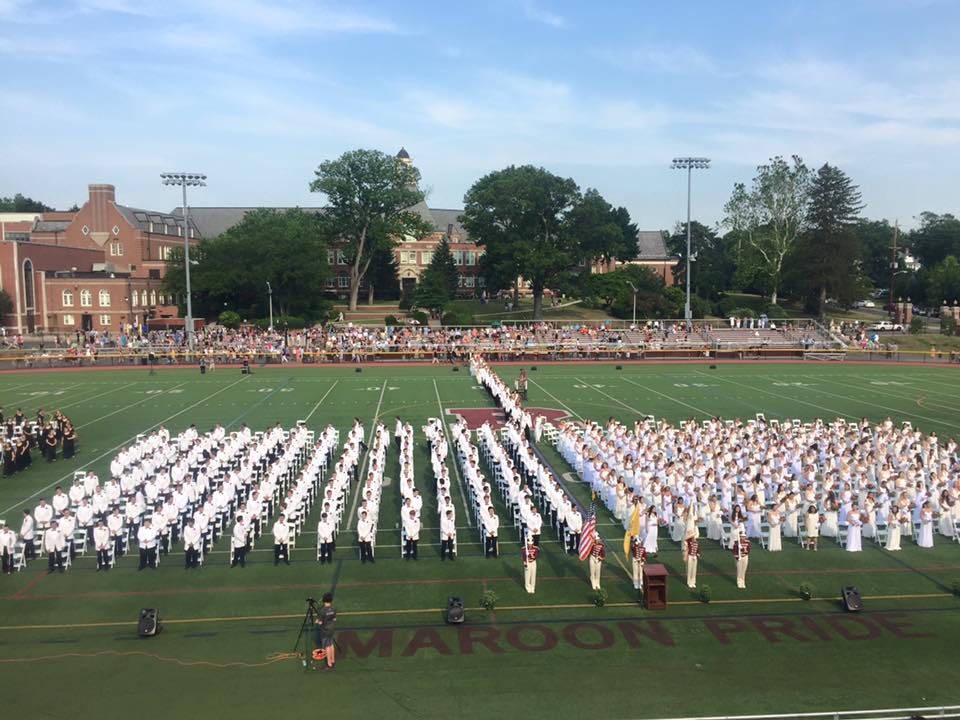
photo courtesy of the Ridgewood High School Alumni Association
Dear RHS Alumni,
On June 20, 2016, Ridgewood High School graduates 424
seniors. As members of the Ridgewood High School Alumni Association (RHSAA), we are thrilled to have them join our ranks. We would like to wish our graduates the best of luck and good fortune in their ongoing pursuit of a “tradition of excellence” in college or their choice of post-graduation endeavors.
We would like to take this opportunity to fill you in on some of the steps the RHSAA has taken since our inception in 2014.
The RHSAA is now a 501(c)(3) nonprofit recognized by the state
of New Jersey. We are an active and dynamic board of alumni spanning graduating classes from the 1950s to the 2000s.
Since our website launched, we have had thousands visit the site and many alumni have registered via our online portal.
The reunion subcommittee has connected with dozens of class
years to help them plan alumni events, including campus tours. If you have an upcoming reunion, please let us know.
Our apparel team has created t-shirts (which will be featured
as Project Graduation’s Gift to all seniors). We have also added
umbrellas, blankets and hats. We are working on version 2.0 of apparel for the upcoming 2016-2017 academic year.
This past March, the RHSAA revitalized the Distinguished Alumni
program and introduced five new inductees who represent some of the best and brightest of RHS graduates. They joined the twelve previously inducted in 2008.
We will also be launching a brick buying campaign in an effort
to beautify our already lovely RHS campus and to celebrate our 125th anniversary in 2017.
If you are interested in supporting any of these programs or
otherwise supporting the RHSAA, please make a donation via our website.
If you would like to volunteer to help the current and future students of RHS, we would love for you to join our team.
Ridgewood NJ, Ridgewood Police report that Ridgewood High School was the target of vandalism. The Ridgewood Board of Education reported criminal mischief at the Ridgewood High School occurred over the weekend. A rock was thrown through a window causing property damage.
All actors are presumed innocent unless proven guilty beyond a reasonable doubt in a court of law
Ridgewood NJ, The Ridgewood High School girls’ lacrosse team lost in a heart breaker to Summit 11-10 in the Tournament of Champions Saturday. The Maroons (20-3) lost, 11-10, to Summit (24-1) in double-overtime in the final round of NJSIAA’s Tournament of Champions on Saturday at Kean University.
The Ridgewood High School Athletic Department encouraged the young ladies on Twitter to hold their “heads high.” .
“You left it all on the field and had an incredible season,” the tweet said.
Ridgewood NJ,as previously reported a Ridgewood High School sophomore LAX player is recovering well from a Friday procedure at Hackensack University Medical Center after being hit in the neck with a lacrosse ball. Ridgewood High School’s Jack Kennedy was in the ICU after a procedure that repaired his cracked Adam’s apple and three other fractures in his throat, according to his aunt, Laurie Alessi of Ridgewood.
Laurie Alessi gave this update on Facebook : “Dr was in and although he is progressing he is still very internally swollen and bruised. Drainage tube is out. Vocal chord still not moving but his voice is actually ok. Time will tell on that. Not much can be done about that right now . He can talk but isn’t supposed to for at least a week preferably 2 to aid in the swelling coming down. Imagine a 16 year old not talking! He isn’t where he needs to be in order to come home safely. So we are looking at Wednesday now. Not what we were hoping for but better to be here and be safe than sorry. Keep those prayers coming thank u for the outpouring of love we have received this past week. We truly appreciate everything everyone has done for our family ! Way to many names to list!”
As the New Jersey Board of Education deliberates whether high school students should have to pass certain math and English exams to graduate, one state lawmaker wants to throw another subject into the mix.
Assemblyman Jay Webber, a Republican from Morris County, is sponsoring legislation to require students to pass a civics test, using the same set of questions asked of immigrants applying for U.S. citizenship.
His bill (A3894) is nearly identical to one introduced during the last legislative session by then-Assemblyman Charles Mainor, a Democrat. Mainor’s bill (A4226) never made it out of committee.
Under the latest proposal, students would have to correctly answer at least 60 of 100 questions. Students would be asked, for example, what the first 10 amendments to the U.S. Constitution are called (answer: Bill of Rights), who becomes president if both the president and vice president can no longer serve (answer: Speaker of the House) or what stops one branch of government from becoming too powerful (answer: checks and balances).
Students would first take the test in ninth grade. Those who don’t pass would retake the exam each year until they passed. Local school boards would decide the method and manner in which the test is administered.
Ridgewood NJ, for the second time in as many weeks a Senior prank strikes again,hitting a home 15 Maynard Court , filling the front lawn with Village council elections signs of losing candidates .
RIDGEWOOD, N.J. , The Ridgewood High School Boys and Girls track teams each won state sectional titles this Saturday.
This was the first sectional title for the RHS Girls since 2006, ending a seven-year run for Randolph; the RHS Boys win puts the squad back on top of the group after losing to Randolph last year. Before that loss, they had won five consecutive sectional titles.The RHS Boys team ended the season posting a perfect record.
Outstanding efforts were made ; senior Sam Halvorsen won the girls 1,600 meters in 5:03.12 and placed third in the 3,200 in 11:09.04 behind teammate Olympia Martin (10:58.62) and Bergen Tech’s Abigail McLaughlin.
Halvorsen was also part of the 4×800 relay team along with Leah Rosenfeld,Meghan Adams, and Evelyn Kotch, which set the meet record with a winning time of 9:32.84.
Olympia Martin won the 3,200 meters in 10:58.62 coming from behind to do it. Never leading until the final lap when she passed McLaughlin.
Michael Thurston won the 800 for the boys with a time of 1:54.45. He also anchored the victorious 4×400 relay team (3:20.97) which held off Paterson Eastside by about a mere half a second .
Kobi Grant won an exciting 100 in 11.09 for Ridgewood in which the top four sprinters were all separated by a half-second. Grant finished fourth in the 200-meter run with a time of 22.43, and anchored the 4×100 relay team to victory in a season-best 43.90 ,finishing second behind Mount Olive (43.32).
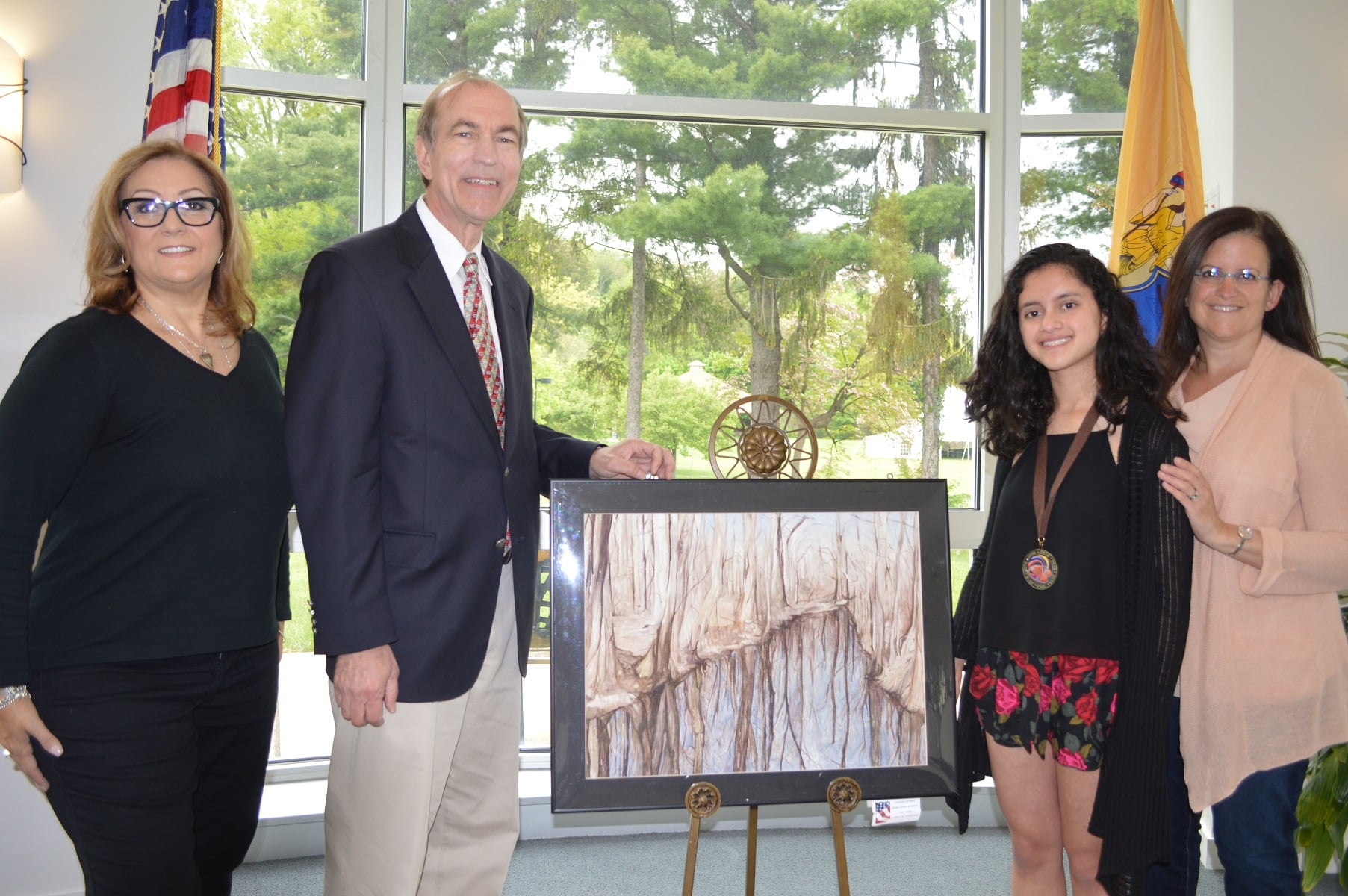
1st Place winner, Alexandra Gutierrez with Scott Garrett
May 26,2016
the staff of the Ridgewood blog
Ridgewood NJ, Rep. Scott Garrett (NJ-05) announced the winners of the 2016 Congressional Art Competition at Sussex County Community College in Newton this Saturday. The Congressional Art Competition is open to all 9th-12th graders from New Jersey’s Fifth District, and this year’s competition featured 90 pieces of artwork from New Jersey high schools in Bergen, Passaic, Sussex, and Warren Counties (full list below).
This year the winners were: 1st Place, Alexandra Gutierrez, “Split Vision,” Bergen County Academies; 2nd Place, Grant Brewster, “Forgotten,” Delbarton School; 3rd Place, Nicole Spangenburg, “Doug,” Wallkill Valley Regional High School; 4th Place, Nicole Spangenburg, “Rasta Man Dan,” Wallkill Valley Regional High School; 5th Place, Sophia Bevacqua, “Landscape,” Northern Highlands Regional High School; 6th Place, Nicolina Kanapinski, “Take Me For a Ride,” High Point Regional High School; 7th Place, Maansi Srivastava, “The Afternoon Glow,” Bergen County Academies; 8th Place, Sarah Vargas, “The Dreamer,” Bergen County Academies.
Each spring, the Congressional Institute sponsors a nationwide high school visual art competition to recognize and encourage artistic talent in the nation and in each congressional district. Since the Artistic Discovery competition began in 1982, more than 650,000 high school students have participated. Students submit entries to their representative’s office, and panels of district artists select the winning entries. The first-place winner from each congressional district is invited to attend a reception in Washington, D.C., and the winning artwork is displayed in the U.S. Capitol for a year. Read more here.
Students from the following schools will be participating (by county):
Bergen County Academies
Bergen County Technical High School (Student lives in district)
Ridgewood NJ, On Thursday, June 2, Ridgewood High School’s Symphonic Band, Concert Band and Wind Ensemble will officially open the Kasschau Memorial Shell’s 2016Summer Season with “Tunes in June,” a concert of light and popular music. The concert will begin at 8PM and will also feature a ceremony to honor graduating seniors from the band program.
The Symphonic Band’s program will include Michael Story’s To Honor, Thank and Remember, “dedicated to the men and women who won World War II,” as well as Meet the Beatles, a medley of early Beatles hits, and The Marches of John Williams. The Concert Band will perform several pieces; including music from the animated features How to Train Your Dragon and The Lion King as well as an original work entitled Bright Lights. The Symphonic Band and Concert Band will be co-conducted by directors John Luckenbill and Jeffrey Haas.
Having just performed as part of Ridgewood’s Memorial Day observance, the Wind Ensemble, under the direction of Jeffrey Haas, will focus on celebrating the contributions of graduating senior band members. Senior Brooke Maskin will lead the band in The Stars and Stripes Forever, as she continues the tradition of having the outgoing Drum Major conduct the band for the final time, while senior flutist, Stephanie Pizza will be the featured soloist, performing the Carmen Fantasie while accompanied by the band. Seniors Erin Gioia, Helen Cho, Robert Schablik and Connor Haycock will all play solo parts in the world premiere of Under the Stars, a new work by Chris Bernotas commissioned by the RHS Band Association written to highlight some of the band’s most outstanding senior musicians.
The traditional highlight of “Tunes in June,” will come when all 30 seniors are brought to the front of the band shell stage to be recognized for their four years of service and outstanding contribution to musical life at Ridgewood High School.
The Ridgewood High School Band Program is Bergen County’s largest, comprised of more than 230 students who participate in no fewer than 15 varied musical ensembles. The curricular bands, marching band, jazz ensembles, chamber ensembles, winter color guard and twirlers have been acclaimed locally, regionally, and nationally for superior performance. Individually, members of the Ridgewood High School bands are chosen annually to perform in honor ensembles at the county, regional and state levels. Graduates of the RHS Bands have participated in music programs at the most prestigious conservatories and universities in the country, and many have gone on to successful professional musical careers.
“Tunes in June” begins at 8PM and admission is free. In the event of rain, the concert will be held at the Ridgewood High School Campus Center. This concert is sponsored by the Kasschau Memorial Shell Committee. For more information, contact Jeffrey Haas at (201) 670-2800 x20639, via email at [email protected] or visit the band’s website athttps://rhsbands.org.