There has to be a point where homeowners taxpayers say enough is enough,12 13000 dollars a year taxes for a postage stamp house in the average ridgewood home district like Somerville or BF DISTRICTS is too much already ..111 per year will be 10000 dollars more in Ten years.
Is not 102 million a year plus taxes for schools and pensions enough..have you no ends to the reaching into my bank accounts ..red flag ..enough is enough,Private options are available for those who look for me and you to pay for
an additional three to four hours of K afternoon class and lunch time,While parents are at yoga or starbucks with errands or at Daddy or Mommy time .
Ridgewood NJ, the Ridgewood Board of Education Answers Questions on Full-Day Kindergarten Program. Full-Day Kindergarten will run 8:30am -3pm, the average tax increase is $111 per home and there will be 22 students per class.
FAQ: Shifting to a Full-Day Kindergarten Program in Ridgewood
● Why is the District considering a full-day program after years of a successful half-day program? ○ The definition of success has shifted with the times, and although Ridgewood has a high-quality Kindergarten program, it is rushed and lacks adequate time for structured socialization and free play. Students who encounter more structured play around learning will better internalize that learning because at this age, play is how children learn. Additionally, social skills such as executive functioning and self-regulation of behavior are learned through play, often which is unstructured. A half-day program does not allow time for these essential learning opportunities for our students.
● How will the curriculum of a full-day program differ from that of the half-day program? ○ A full-time program will include more time for learning centers, which are essentially structured play experiences designed to reinforce conceptual learning. Additionally, more time will be dedicated to free-play centers, in which students make up rules to self-created games and make-believe. This free-play socialization will be supervised by, not structured by, adults. Another change to the day is that students will remain in school for lunch and will have snack and extended time for key content such as shared reading and writing.
● What would be the daily schedule and hours of a full-day program? ○ Kindergarten will run on the same schedule as the other grades in the school (8:30 a.m. – 3 p.m.). A daily schedule is currently under development with the goal of sharing it with the public at an upcoming Board of Education meeting.
● How many other districts still have half-day Kindergarten programs? ○ Ridgewood is the only half-day program left in Bergen County. There are very few districts left in the state with a half-day program. The most common Kindergarten programs offer five full-days of school.
■ Those districts which were half-day have mostly moved to full-day programs in the last five years.
● In 2014, 73% of programs statewide were full-day. The percentage was even higher in Bergen County, where 65 out of 72 districts (about 90%) offered full day programs. Since 2014, Glen Rock, Fairlawn, Rutherford, Mahwah, Waldwick and Midland Park have moved to full-day.
● Currently, Ramsey offers a kindergarten enrichment extended day program and both Allendale and Wyckoff offer a modified half/full day program with two half-days in combination with three full days, but this model is also not very popular. ● Would parents be required to enroll their children for the entire day if Ridgewood moved to full-day Kindergarten? ○ Yes, if the Ridgewood Public School district shifts to a full-day Kindergarten program, all enrolled students will be registered for 5 full days each week.
● Where will Kindergarten children eat lunch? ○ This will be a building-by-building decision, based on space and what the principal deems best for the program in their building.
● Will Kindergarten students have recess with all other students and how will their recess be supervised? ○ Kindergarten students would have more than one “recess” play time in their schedule. The schedule, location, and supervision of that recess would depend on individual building schedules. However, in all buildings the recess/lunch period of 45 minutes would be extended to one hour for Kindergarten students. Classroom teachers would supervise the additional 15 minutes at the end of recess to settle students down and prepare them for afternoon learning sessions.
● What are the anticipated class sizes for a full-day program? ○ The Ridgewood Board of Education guidelines for Kindergarten are 22 children per classroom.
● How will the decision be made to move to full-day Kindergarten in Ridgewood? ○ On Election Day, Tuesday, November 3, Ridgewood voters will be asked to approve full-day K in the District. This vote will be done in the form of a “second question” on the ballot. All residents who are registered voters may participate. Voter registration forms may be found at on the Bergen Count website at https://www.co.bergen.nj.us/DocumentCenter/View/1224.
● What is the purpose of a second question on a ballot? ○ A second question can only be placed on the ballot when a school district is asking for something new, such as full-day Kindergarten or a new program. Since the costs of these additional services and associated personnel can exceed the state-imposed 2% cap on budget increases, the public must vote on them.
● What would be the tax impact on a “yes” vote for the second question on full-day Kindergarten? ○ The average Village assessed home of $693,904 would have taxes increase by approximately $111 if FDK were passed.
● Is there any possibility that the State will require Districts to provide full-day Kindergarten? ○ This is not known at this time.
● Where can I go for more information on Full-Day K in Ridgewood? ○ Full-Day K information may be found on the Curriculum page of the District website at www.ridgewood.k12.nj.us.
Fair Lawn NJ, Governor Chris Christie took his #fairschoolfunding message to Fair Lawn in Bergen County on Thursday, making the case for a new K-12 state aid formula to a town hall audience .
Governor Chris Christie proposed drastic changes to New Jersey’s school-aid formula that would distribute an equal amount for each student regardless of income, a move that would redirect money from cities to suburbs.
Over the past 30 years, New Jersey taxpayers have sent $97 billion to those 31 systems, while the other 546 have received $9 billion less. Worse yet by all standards the Abbott Schools have been a complete failure and are in violation of the very law that requires them to exist.
The average Ridgewood homeowner would save the second most at $4209 in Bergen County after Tenafly at $4478 .
Even Steve Sweeney’s home town, a leading opponent of the plan, way down in South Jersey would receive 58% more funding per student in addition to average net property tax decreases.
The REA just wants more money taken from the students and extracurricular’s to pay for their average annual above inflation (and above 2% property tax cap) wage increases and “platinum” health plan benefits covering 96% of all medical benefits with $10 co-pays. Why are Ridgewood residents paying above average property taxes in Bergen County for schools to only cut spending on students to pay even more for teachers who already earn the highest average salaries in Bergen? Does this make any sense? Won’t our property values decline if our schools keep declining like they have?
Ridgewood NJ, Kennedy Odede knows a thing or two about falling into the clutches of a terror group.
Raised in devastating poverty in Africa’s largest urban slum, Kibera, Odede fell into a violent street gang as a child, drawn by the sense of belonging to a community united in its struggle for survival.
Now founder and CEO of the acclaimed nonprofit Shining Hope for Communities (SHOFCO) and co-author of the New York Times bestselling book Find Me Unafraid:Love, Loss and Hope in an African Slum, Odede understands that similar to street gangs, terrorism is fueled by emptiness, despair and a lack of meaning.
Messages such as “Join the fight for freedom,” and “The western world is ruining us,” resonate with and attract people when their own communities, government, parents and social networks have nothing to offer.
The only viable solution, Odede says, is to attack the root cause — social disconnection — by engaging vulnerable individuals in their communities through activities such as sports, clean-up projects and education.
This is exactly what Odede and his wife Jessica Posner Odede did in founding SHOFCO, which transforms poor, urban communities in Kenya through tuition-free education for girls and holistic social services for all, filling the dangerous void created by despair with supportiveness and hope.
There’s much more on SHOFCO’s story and the outcome in Find Me Unafraid:Love, Loss and Hope in an African Slum, which Odede and Posner wrote together. It releases in paperback on July 26 (Ecco / Harper Collins). The book has received glowing praise from Chelsea Clinton, Gloria Steinem and several Nobel Prize Winners.
About Kennedy Odede
One of Africa’s best-known community organizers and social entrepreneurs, Kennedy Odede the co-author with Jessica Posner Odede of the New York Times bestselling book Find Me Unafraid:Love, Loss and Hope in an African Slum. Founder and CEO of the nonprofit Shining Hope for Communities (SHOFCO) based in Kenya, he is a member of the Clinton Global Initiative and was awarded the 2010 Echoing Green Fellowship, which is given to the world’s top emerging social entrepreneurs. He also won the 2010 Dell Social Innovation Competition and was named one of Forbes’ 2014 30 Under 30: Social Entrepreneurs.
Kennedy speaks six languages, is a senior fellow with Humanity in Action, and an Aspen Institute New Voices Fellow. His work has been featured in the PBS documentary Half the Sky, by Chelsea Clinton and Maria Menounos on NBC, by President Bill Clinton, and on multiple occasions by Nicholas Kristof in The New York Times.
SHOFCO combats extreme poverty and gender inequality by linking schools for girls to a set of high-value, holistic community services for all. In 2016 it will reach 100,000 people.
BY HILLSDALE COLLEGE ONLINE COURSES APRIL 24, 2015
According to Professor Kenneth Calvert, Common Core, well-intentioned from the beginning, will utterly fail its students. Rather than raising the educational standard in the United States, it codifies and federally enforces mediocrity. Worse yet, in regulating education the federal government has overstepped its constitutional boundaries, by attempting to control teaching methods, preventing teachers from exercising their craft effectively.
The following video is a clip from Q&A 5 of Hillsdale’s Online Course: “A Proper Understanding of K-12 Education: Theory and Practice,” featuring Kenneth Calvert, Associate Professor of History and Headmaster of Hillsdale Academy, and John J. Miller, Director of the Dow Journalism Program.
Transcript:
John J. Miller:
What do you think of Common Core?
Kenneth Calvert:
Common Core is one of these well-intentioned pieces of legislation in which the federal government is trying to do something for children. They’ve perceived that children are behind the rest of the world and so let’s create a national legislation that’s not going to be forced on states, but we’ll give them money, and the states will take it. It’s just wrong-headed in so many ways. Number one, it’s unconstitutional. From the get-go there is nothing constitutional about the federal government getting its hand into education. Number two, it doesn’t do what they want it to do.
[The Federal Government] wanted to raise standards in their minds commensurate with, equal with, world standards. Neither the literature nor the science or the math standards come anywhere near that. What Common Core has ended up doing is creating, basically, what they considered to be, the lowest common denominator, the average point which students can be expected to reach. In our school and from the Hillsdale perspective it’s our belief that if you hold the bar high, very few kids are going to get there, but most of these kids are going to get beyond anywhere they ever thought they would get, that they would actually achieve higher goals than they thought they could.
By keeping the bar low, by keeping it at this kind of average, you have doomed [students] to a low level of education. They never know how far they can go. We think that it lowers the bar. It lowers the expectations.
It also does not allow teachers to be teachers. Teachers in the Common Core are teaching to tests. Much of the curriculum more and more is becoming scripted so that can’t have a Socratic dialogue, a give and take where most of the real education actually takes place.
Teachers are being robbed of their calling, of their discipline. What you begin to create here in a number of these efforts of the Federal Government to create new educational legislation, what you’ve done is begin to create bureaucrats in the classroom rather than real teachers. I’ve met teachers in public and private and charter schools who are looking at what’s coming down the pike, and they are not happy. More and more, especially some of the older teachers, they will tell me that what they used to be able to do twenty years ago, which was exciting, enlivening, and drawing out a love of the life of the mind in their students—all of that is beginning to disappear.
It’s well-intentioned legislation, right? We know what good intentions lead to. It is not to the right place. We need to give our teachers, our schools–public, private, charter–greater freedom to be what they need to be. This also demands that our teachers be highly educated, learned, true experts in their areas. They need to be the ones in the classrooms really bringing out this love of learning and love of the life of the mind in these young ones. Honestly, we’re not doing a lot of that right now either.
Residents of Ridgewood , for the past 4 years I’ve proposed an amendment to our State’s constitution to end the patently unfair school funding formula. Under a new school funding plan which follows my proposal, the average home in Ramsey would see a reduction in property taxes of $2,411 per year. Call your Mayor, Council and Board of Education. Tell them to support the Fairness Formula! We can’t afford not to.
Join The Movement
The Fairness Formula: Equal Funding for Every Child, Our Path to Lower Property Taxes
Join Governor Christie’s Fairness Formula solution to New Jersey’s two most pressing crises that are hurting all New Jerseyans: the failure of urban education and property taxes. The Governor’s monumental Fairness Formula will provide equal education funding for every pupil throughout the state, valuing every child equally.
75% of all New Jersey districts would get more state aid than they do today. The biggest driver of New Jersey’s nation-high property taxes is the ineffective and unfair state school funding formula. The Fairness Formula will not only be equal for students it may also provide hundreds or even thousands of dollars in annual property tax savings for New Jerseyans in most communities. Join the movement today to being your path to lower property taxes.
JOIN THE MOVEMENT: It’s time for your voices to be heard. It’s time for the people to take back control of this issue and apply common sense to it. Sign up to join the movement and begin your path to lower property taxes.
For every resident of Bergen County, this is the MOST IMPORTANT issue that directly impacts your property taxes. Bergen County residents on average contribute the MOST money to the State of New Jersey and receive the least school aid in the State. Under the Governor’s proposal, the average school district in Bergen County would see an increase in school aid from the State of over 1000%. Every representative from Bergen County who cares about his or her residents needs to support this proposal. Real numbers of increased aid would be:
Governor Chris Christie’s Speech On The Fairness Formula As Prepared For Delivery (Full text)
Hillsborough, New Jersey
June 21, 2016
We have two separate, but completely intertwined crises in New Jersey that must be dealt with. They must be dealt with honestly and directly. We cannot wait any longer to do it. Property taxes and the failure of urban education.
Both of these crises are hurting all New Jerseyans, those affected both directly and indirectly.
Property taxes are the highest in America and the majority of those taxes are for local school taxes.
Urban education, despite 30 years of Supreme Court required intervention by the state, is still failing students and their parents at an alarming rate. The theory from the Supreme Court was that money would solve the problem.
They were wrong. Very wrong. And the results prove it. They have not solved our failures in urban education and, in the process, have led to New Jersey to be amongst the highest taxed states in America. They have required the legislature and Governors to craft ridiculous school funding formulas that cheat thousands of families out of funding and thousands more from a valuable education. Those days must end. It is time to change the failed school funding formulas and replace it with one that will force the end of these two crises—the property tax scandal and the disgrace of failed urban education.
New Jersey spends the 3rd most in the nation per pupil on K-12 education. For the upcoming fiscal year we spend 13.3 billion dollars on aid to K-12 education. How do we spend it? $9.1 billion goes back to school districts in direct aid. $3.25 billion is to pay for the pensions and health benefits for retired teachers. $936 million goes to pay the debt on schools, mostly in urban districts, to build new schools. $13.3 billion—and that does not count the money paid in local property taxes.
Who gets the $9.1 billion? Well, that begins to tell the story. By order of the Supreme Court, and coerced acquiescence by the elected branches of government, this coming year $5.1 billion goes to the 31 urban or SDA districts. $4 billion goes to the remaining 546 districts. That’s right. 58% of the aid from the state’s taxpayers goes to 5% of the state’s school districts. 42% of the aid goes to the remaining 95% of our districts. This is absurd. This is unfair. This is not working. And it hasn’t been working for 30 years.
Over the last 30 years, New Jersey taxpayers have sent $97 billion to the 31 SDA school districts. The other 546 districts in the state received $9 billion less over the same 30 years. $97 billion divided among only 31 SDA districts while the families in 546 other districts had to divide $9 billion less. The inequity is appalling and it has only gotten worse as the years have passed.
In 1990, 23% of the state’s students, representing the SDA districts, got 41% of the state aid. Today, while still representing only 23% of the state’s students, they receive 59% of the state aid.
Has that enormous differential in state aid brought greater achievement in the 31 districts? No. Absolutely not. Tragically so for the families in those districts and for the taxpayers all across New Jersey who have been footing the bill for the last 30 years.
Just take a sample of graduation rates. The statewide graduation rate is 90%. How have we done in the 31 districts where we have invested $97 billion over the last 30 years? Asbury Park—66%. Camden—63%. New Brunswick—68%. Newark—69%. Trenton—68%. 27 of the 31 districts are below the state average, despite the exorbitant spending over the last 30 years. Spending does not equal achievement—never has and never will. There are exceptions and those should be noted right here. In Harrison, Long Branch, Millville and Pemberton they have exceeded the statewide graduation rate. In Union City, the have seen extraordinary growth under very trying circumstances and the leadership in those districts deserve great credit. But despite nearly $100 billion to those 31 districts in the last 30 years from taxpayers all over New Jersey, failure is still the rule, not the exception. That is an unacceptable, immoral waste of the hard earned money of the people of New Jersey.
Worse than the wasted money is the lives that were not given the chance to reach their full potential. We accept that subpar performance and pay a fortune for it.
Do not let anyone tell you that failure is inevitable for children in those 31 districts or that money is the answer. The Academy Charter High School in Asbury Park had an 89% graduation rate compared to 66% in Asbury Park; Academy spends $17,000 per pupil while the traditional public schools spend $33,000 per pupil. The LEAP Academy Charter School has a 98% graduation rate in Camden, while the district has a 63% rate; LEAP spends 16,000 per pupil while the school district spends $25,000 per pupil. In Newark, the North Star Academy Charter has an 87% graduation compared to the citywide rate of 69%; North Star spends $13,000 per pupil compared to $22,000 per pupil district wide.
Over and over again we see the same issue: money spent without results for the families we are meant to serve. It is a false claim and always has been. It is failing families and their children. It is bankrupting our state. It is driving families from their homes and New Jersey.
The failure of the educational system in those 31 districts is the first tragedy. The second tragedy is this system has caused us to have the highest property taxes in the nation.
New Jerseyans regularly say that the issue that is their number one concern is property taxes. The highest in the nation and a burden on families in every corner of New Jersey. What drives these taxes? 52% of property taxes statewide are spent on the school tax and in many districts it is as high as two-thirds. But here is the unintended consequence of the unfair school funding formula: in those 31 SDA districts, they spend a fraction of their property taxes on schools as compared to the rest of the state. That’s right—the statewide average percentage of property taxes spent on schools is 52%; in the 31 SDA districts it is half that—only 26%. Are they taxing less? Oh no, they are just growing the size of their municipal government. The statewide average percentage spent on municipal government is 30%; in the 31 SDA districts it is nearly double—a whopping 54%! When you look at some of the individual districts, it is appalling. Asbury Park spends 60% less of their property tax dollars on schools than the state average, while their city spends 64% more than the state average on their municipal government. Trenton spends 18% less of their property taxes than the state average on schools but spends an enormous 387% more than the state average on their municipal government. In Paterson, 49% less on schools; 251% more on their city government. East Orange, 39% less on schools; 379% more on city government. It is outrageous. It is unacceptable. But it is perfectly predictable.
If you require the state to pay the overwhelming percentage of the school costs in these 31 districts, they are left with the choice: do we tax less or just spend more on the growth of government? The answer is resounding in most of the 31 SDA districts—the people of the rest of the state pay over 80% of the costs of our schools and we will spend our money to build oversized municipal governments—with no relief for local or state taxpayers. The abuses abound. Take Trenton for example. The Presidents of both the PBA and AFSCME locals receive full municipal pay to work only for the unions. No time working for the people; only for the unions. No wonder it costs so much.
How do we fix these problems? First, we must fix the tax problem because that is the one that affects each and every New Jerseyan and threatens the future of the affordability of our state. I propose we do this by changing the school funding formula. I propose the Fairness Formula; equal funding for every child in New Jersey.
If we were to take the amount of aid we send directly to the school districts today (in excess of $9.1 billion) and send it equally to every K-12 student in New Jersey, each student would receive $6,599 from the State of New Jersey and its taxpayers. Every child has potential. Every child has goals. Every child has dreams. No child’s dreams are less worthy than any others. No child deserves less funding from the state’s taxpayers. That goal must be reached, especially after watching the last 30 years of failed governmental engineering which has failed families in the 31 SDA districts and taxpayers all across New Jersey.
What would the effect of this change be for school aid in New Jersey? 75% of all New Jersey would get more state aid under the Fairness Formula. That is how fundamentally unfair the current formula is to students and taxpayers. And it is unfair in every part of this state.
In Margate, they would receive 428% more in aid. In Fairlawn, 815% more in aid. In that town, when combined with our 2% property tax cap, this new aid would result in average drop in their school property tax of over 2,200 per household. In Teaneck, 389% more in aid and an average drop in property taxes of nearly $1,600. In Wood-Ridge, an 801% increase in aid and a drop in property taxes of over $1,800. How about South Jersey? In Cherry Hill, an increase in aid of 411% and a drop in property taxes of over $1,700. In Haddonfield, an increase in aid of 1705% and a drop in property taxes of nearly $3,600.
The pattern is repeated everywhere. South Orange aid up 912%, taxes down over $3,700. In Readington Township, aid up 410%, taxes down nearly $2,000. In Robbinsville, aid up 666%, taxes down over $2,600. In Freehold Township, aid up 153%, taxes down over $1,500. In Chatham Township, aid up 1271%, taxes down $3,800. In Wayne, aid up 1181%, taxes down over $2,100. All over the state, we slay the dragon of property taxes by implementing the Fairness Formula. For the first time in anyone’s memory, property taxes plummeting not rising. And all through valuing each child and their hopes, dreams and potential the same.
Of course, we will make sure that we have the aid for special needs students so that they may reach their potential too. They are the exception though; the overwhelming majority of students deserve the Fairness Formula and we intend to pursue it for them.
We want to see major changes to the failed model of education in so many of these 31 SDA districts. We now see definitively that money has not made the difference over these 30 years but reforms have made the difference. We will continue to advocate for those reforms and we will insist that this new funding formula reward our successful charter schools with funding that comports with their success.
It is fundamentally wrong that students in the SDA districts receive 5 times more in state aid than students in non-SDA districts; it is unfair to those students and unfair to the residents of those towns who have been forced for more than three decades to foot the cost of that failure and unfairness.
A funding formula that puts a higher value on one child over another is morally wrong and it has been economically destructive. We cannot let it continue.
I will travel across the state this summer to talk about this plan to, for the first time in my lifetime, lower property taxes for the people of New Jersey and bring fairness to the funding of our schools.
We can do better and we must—in educating all of our children and in bringing fairness to our taxpayers. No one should be denied an education because of where they call home—an no one should have to sell their home because they can any longer afford the property taxes caused by a perverse school funding formula that devalues their children in the eyes of the state budget. After all, it is their tax dollars that, in part, fund that aid itself.
I have 18 months left in office and I will not permit these fundamental truths to not be spoken and acted upon. I will demand that the Legislature try defend the indefensible—that one child is worth more than another in the eyes of the state depending upon their zip code; or they can come along with me to fix this issue and put an end to the misery of our property taxpayers and make history in New Jersey. I am ready for the fight and I know the taxpayers of New Jersey are looking for us to finally solve this problem.
Thank you for your attention and, now, lets get to work.
Ridgewood NJ, Registration is open for the 2016 SUMMER MUSIC ACADEMY, which provides exciting performing opportunities and lesson groups for young musicians. Under the direction of BFMS Orchestras Director Carol Sharar, new offerings include guitar lessons and drum set lessons. Visit the Ridgewood Community School website for more information and a link to online registration: https://ridgewood.rcs.schoolfusion.us/ or click here.
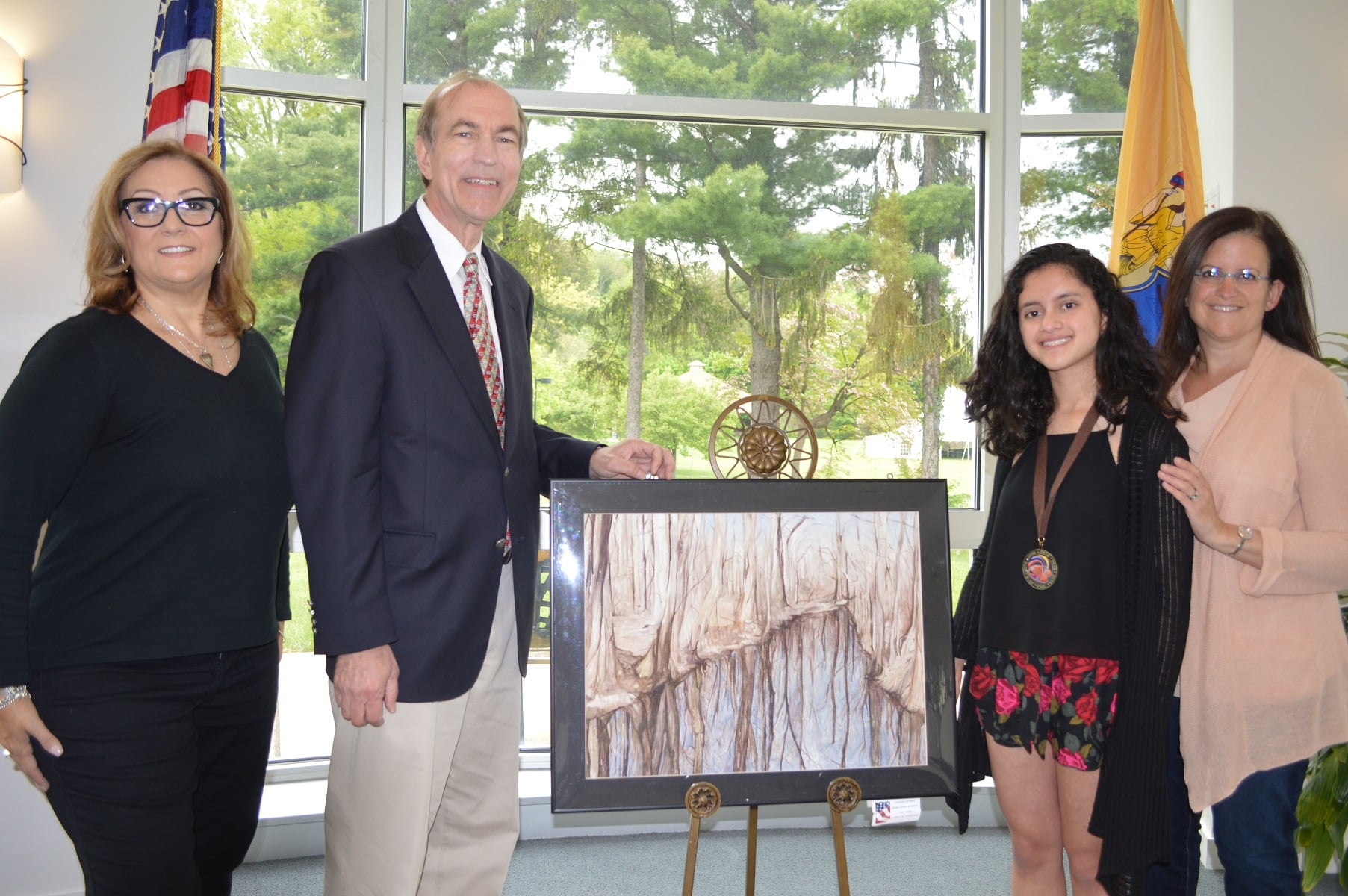
1st Place winner, Alexandra Gutierrez with Scott Garrett
May 26,2016
the staff of the Ridgewood blog
Ridgewood NJ, Rep. Scott Garrett (NJ-05) announced the winners of the 2016 Congressional Art Competition at Sussex County Community College in Newton this Saturday. The Congressional Art Competition is open to all 9th-12th graders from New Jersey’s Fifth District, and this year’s competition featured 90 pieces of artwork from New Jersey high schools in Bergen, Passaic, Sussex, and Warren Counties (full list below).
This year the winners were: 1st Place, Alexandra Gutierrez, “Split Vision,” Bergen County Academies; 2nd Place, Grant Brewster, “Forgotten,” Delbarton School; 3rd Place, Nicole Spangenburg, “Doug,” Wallkill Valley Regional High School; 4th Place, Nicole Spangenburg, “Rasta Man Dan,” Wallkill Valley Regional High School; 5th Place, Sophia Bevacqua, “Landscape,” Northern Highlands Regional High School; 6th Place, Nicolina Kanapinski, “Take Me For a Ride,” High Point Regional High School; 7th Place, Maansi Srivastava, “The Afternoon Glow,” Bergen County Academies; 8th Place, Sarah Vargas, “The Dreamer,” Bergen County Academies.
Each spring, the Congressional Institute sponsors a nationwide high school visual art competition to recognize and encourage artistic talent in the nation and in each congressional district. Since the Artistic Discovery competition began in 1982, more than 650,000 high school students have participated. Students submit entries to their representative’s office, and panels of district artists select the winning entries. The first-place winner from each congressional district is invited to attend a reception in Washington, D.C., and the winning artwork is displayed in the U.S. Capitol for a year. Read more here.
Students from the following schools will be participating (by county):
Bergen County Academies
Bergen County Technical High School (Student lives in district)
Ridgewood NJ, When it comes time to apply to colleges, we may not be serving our children well.
That’s according to a growing chorus of voices who work with youth and their academic endeavors. For example, Malcolm Gladwell, one of the most recognizable public intellects, regularly asserts that brand prestige from an Ivy League name doesn’t necessarily suit the needs of individual students.
Jeffrey Leiken, CEO of Evolution Mentoring International, agrees. He provides mentoring for teens and young adults, going beyond the typical work of a therapist by building a relationship so that they come to see Leiken as a trusted confidant who answers their late-night text messages and isn’t quick to label them.
“We continue to be obsessed with being associated with the top 1 percent of anything, whether it’s wealth, looks, social media followers or achieving that Ivy League status,” says Leiken, author of “Adolescence is Not a Disease: Beyond Drinking, Drugs and Dangerous Friends – The Journey to Adulthood” (www.Leiken.com).
“Far more important is not the school’s brand and our cultural obsession with it. Rather, it’s helping to ensure that every student who attends any school gets closer to reaching their potential.”
What criteria should students and parents look for when determining where to apply for college? Leiken offers some crucial guidelines to keep in mind.
• Seek a college with programs that may help with lifelong skills. Self-awareness, self-leadership, self-actualization – those qualities are often overlooked when considering higher education. Learning the tangible skills for a future job is important. However, those requirements change over time. Coursework, professors and other programs that speak to a student’s ethical intuition, however, make up the educational gold that is enduring. • Look beyond the typical menu of schools. There is a common denominator among millions of 17-year-olds: an anxious balance between their “reach” schools and their “safety” schools. It turns out that many college counselors guide these kids to a similar list of “reach” and “safety” schools – about 50 of them. Between public and private institutions, there arethousands of other schools to choose from! • Ask yourself, “Where will I flourish?” Learn more about the culture of these institutions. There are two distinct stages for young adults in college life: the time where students adjust to a new environment and, later, when students realize they are becoming independent adults. A name-brand school isn’t necessarily the best place for millions of kids to best reach maturity.
“Just as we don’t all wear the same size clothing,” Leiken says, “the intellectual development of young adults doesn’t always fit into the same small box of name-brand schools.”
About Jeffrey Leiken
Jeffery Leiken (www.Leiken.com) is the CEO of Evolution Mentoring International and is co-founder of HeroPath International. Leiken also is author of “Adolescence is Not a Disease: Beyond Drinking, Drugs and Dangerous Friends – The Journey to Adulthood.” He has presented at TED in Athens, Greece; guest lectured at Stanford University; and facilitated programs for teenagers on three continents and in seven countries, among other accomplishments. He has a master’s degree in educational counseling.
TRENTON NJ, Under a proposed bill customers would be required to pay 5 cents for every plastic or paper bag they use to carry their purchases .
An previous version of the bill (A3671) called for a bag ban by 2025, but sponsors discarded that idea. Efforts to curb plastic bag use have been under consideration since 2008 in the state legislature, including in 2012, although each time they have stalled.
California is the state that has a statewide ban on plastic bags and Hawaii has a de facto state ban because every county has adopted the policy.
If the bill becomes law, retail operators in New Jersey would begin charging 5-cent fee for each single-use carryout bag on June 1, 2017. Stores would keep a penny, as would the state Division of Taxation to administer the program.
The remaining 3 cents would be used to create the “Healthy Schools and Community Lead Abatement Fund” to support the testing of homes and schools’ water supply – a major cause of concern in the state.
While proponents of the ban claim “Plastic bags are a source of numerous environmental concerns,” We are still not sure how an additional tax is going to fix any environmental problems . Seems more to be another Trenton money grab using a “Feel good” ruse . Opponents say better yet to send the bags to Trenton so law makers can place them over their heads saving the taxpayers money and improving the quality of life in the state .
RIDGEWOOD, N.J. ,On Friday, May 13, Ridgewood High School’s award winning jazz ensembles will present an evening of big band jazz at their annual “Jazz in the Wood” dinner-concert to be held at the Woman’s Club of Ridgewood. The bands will be joined by special guest artist Mark Friedman, a renowned jazz saxophonist and Wyckoff resident, and longtime friend to the Ridgewood Music Program. Friedman will be the featured soloist with the RHS Big Band and Jazz Lab, playing music ranging from swing to bebop and Latin to funk. This gala event marks the culmination of Friedman’s three-month collaboration with the RHS jazz bands.
The dinner portion of the program will feature a three-course meal catered by Dawn’s Catering of Ridgewood, and will include a menu of salad, pasta, chicken and dessert with gluten-free and vegetarian options available. For children 12 and under, a kid’s menu option includes chicken tenders, and fries.
Having taught private lessons to flute, clarinet and saxophone students in the area for more than three decades, Mark Friedman has gained a reputation as one of the premier teachers in Bergen County. His students have been accepted to the most prestigious conservatories and universities in the country and are regularly selected to perform in honors ensembles at the County, Region, All-State and All-Eastern levels.
Mr. Friedman received his Bachelor of Arts degree in Music Education and Jazz Performance from Jersey City State College (now New Jersey City University.) His teachers include Dick Volkart, Walt Levinsky, Dr. Richard Scott, Dan Trimbole, Dr. Alvin Fossner, Emile DeCosmo, and the great jazz legend, Phil Woods, whom he considered his mentor.
Mr. Friedman is the director of the Indian Hills High School Band, and is on the music faculty at Ramapo High School.
The RHS Big Band and Jazz Lab are directed by Gary Fink and Jeffrey Haas, respectively, and feature many talented student musicians, including six who recently performed with the New Jersey Region I Jazz Ensembles. The bands will present songs in a variety of styles, including swing, bebop, New Orleans, Latin, rock and funk. Well known songs such as Earl Hagan’s Harlem Nocturne, Duke Ellington’s Perdido, Sonny Rollins’ St. Thomas, Joe Zawinul’s Birdland, and Phil Woods’ Randi will all be performed, and will feature Friedman along with several RHS soloists.
Dating back to the mid-20th century when such legendary jazz artists as Nelson Riddle, Sonny Igoe, and Red Mitchell could be heard in the music rooms, Ridgewood High School has enjoyed a long and distinguished history of excellence in jazz performance. With two big bands, a vocal jazz ensemble and various combos, the jazz program at RHS introduces students to music of different styles within the jazz genre. The Big Band and Jazz Lab have both been recognized with awards for excellent or superior performance at the NJAJE state jazz ensemble festivals, and have performed at venues around the country including Ryles Jazz Club in Cambridge, MA, Steamers Jazz Club and Café in Fullerton, CA, Bohemian Caverns in Washington, DC, the Town Centre in Virginia Beach, VA and Catalina Jazz Club in Hollywood, CA. Guest artists who have worked or performed with the jazz program include: Darmon Meader, Byron Stripling, Conrad Herwig, Wayne Bergeron, Jeff Jarvis, Marvin Stamm, Ingrid Jensen, Dave Bargeron, Dave Stryker, Don Braden, Tom “Bones” Malone, Michael Philip Mossman, Andy Martin and many others.
There will be a seatings at 6PM and 8:30PM for “Jazz in the Wood,” and tickets are $40 per adult/$20 for children 12 and under. Tickets for the event are only available in advance, and can be purchased online at https://jazzinthewood2016.brownpapertickets.com. For more information, contact Nick Trent at (201) 805-8789 or via email at [email protected].
Ridgewood NJ , picked this up off of the It takes a Village Facebook page in a post by Marty Smith, In a post to Ann Loving today, Gwenn Hauck wrote “$50,000 of Independent Studies approved by all five council members confirmed (confidently) that the multi-family housing will significantly augment our tax base and will help our schools decreasing enrollment. Class sizes are diminishing so much that teachers are actually being laid off causing (ironically) higher class sizes!”
I thought the proponents of higher density housing were saying don’t worry, the apartments won’t be attracting a lot of new students. Now it seems they will be, and that the additional enrollments are what we need. Did I miss something? Dare we say vote of Hache, Walsh and Voigt .Poles are open till 8pm!