Jamboree 2016 Auditions are Here
All auditions are held at Ridgewood High School Campus Center.
Dates/Times (just need to attend one) are:
October 21, 7 p.m.
October 27, 7 p.m.
Fill out the registration form here to save some time on audition night, and get the latest news and updates: https://rhsjamboree.org/wp/
A NOTE FROM THE JAMBOREE COMMITTEE: All RHS parents and guardians invited to participate in the 70th Annual Jamboree . Since 1947, Jamboree has presented an original musical revue raising funds for need-based college scholarships for graduating RHS seniors” and how, over $1.2million raised and distributed to hundreds of worthy applicants. (All students , not just with Parents/Guardians on or back stage, with a FAFSA, may apply)
LAST NIGHT TO Show up is October 27, 7 p.m. at Ridgewood High School Campus Center to learn more and show your enthusiasm for higher education for all.
Producers for this Feb 2016 run are the amazing duo of Rachel and Paul Ainasworth , Leigh Warren and Fred Jubitz , and RHS grad. The stellar Director is Rosie Gunther McCooe. We are a 501 (c) (3) non-profit organization and Trustees include Dotti Fucito, President.
“Rewind” the years in song , dance on stage as we honor our Village in a show to delight the 2500 who fill our Village Theatre at BFMS every year.
While corporate income taxes are often mistaken for the totality of business tax burdens, in reality they are just one of many taxes paid by businesses, and often a relatively small percentage of overall corporate tax burdens. Nationwide, corporate income taxes only account for 3.5 percent of state and local tax revenue. That figure will continue to decline as more businesses organize as pass-throughs (S corps, partnerships, sole proprietorships, etc.), which are liable under the individual income tax code, and as more C corporations receive incentives and abatements which erode the corporate income tax base.
Today’s map shows how much each state collects in corporate income taxes per capita. Unsurprisingly, states like New York ($539 per capita) collect a great deal, due to a heavy concentration of corporate payers. Alaska has the highest collections per capita ($912), the result of a large presence from extractive industries combined with relatively low population. A similar dynamic is at play in fourth-ranked North Dakota, while third-ranked New Hampshire leans more heavily on corporate taxes (and property taxes) due to the lack of an individual income tax (except on interest and dividends) or a sales tax.
At the other end of the spectrum, Nevada, Ohio, South Dakota, Texas, Washington, and Wyoming do not levy corporate income taxes, though four of these states (Nevada, Ohio, Texas, and Washington) instead impose economically distortive gross receipts taxes, and some states that forego a traditional corporate income tax still show a small amount of corporate income tax due to taxes on the corporate net income of special kinds of corporations (e.g., financial institutions). As such, only Nevada, Texas, and Wyoming show no revenue whatsoever from corporate income taxes, though all three of these states levy other business taxes, including, inter alia, Nevada’s Commerce Tax (a gross receipts tax) and Modified Business Tax (a payroll tax) and Texas’s Margin Tax (a gross receipts tax).
There are several reasons why the corporate income tax share is so low on average:
The number of businesses organized as traditional C corporations has decreased over time. Between 1980 and 2010, the number of pass-through businesses nearly tripled, while the number of C corps actually declined.
States hand out generous corporate tax incentive packages to entice businesses to move into (or remain in) their states. Jobs credits, investment credits, and other targeted incentives lower tax liability for certain businesses and industries, but they are distortionary and non-neutral, picking winners and losers while carving away at the tax base.
States further reduce corporate tax bills by adjusting income apportionment formulas, reducing the in-state taxable income of corporations within their borders. Our Location Matters study helps explain the effect of apportionment in each state.
Beyond their limited capacity to raise revenue in most states, corporate income taxes are also highly volatile, as many corporations post losses during economic downturns and thus have no liability under the corporate income tax.
How much does your state collect in corporate income taxes per capita?
Ridgewood NJ, Ridgewood Restaurants! We want your restaurant’s favorite recipe for the culinary arts section of Ridgewood Art Council’s exciting new installation:
“Ridgewood Art at Village Hall”
More than 70 wonderful paintings, photographs and pieces of sculpture have already been generously donated by Ridgewood artists in support of this effort. The Ridgewood Arts Council (RAC) additionally wants to insure that the Culinary Arts, which are so important to our community, are represented in the Ridgewood Art at Village Hall collection as well.
So…we are asking all Ridgewood eateries to provide a framed recipe of one of your signature dishes. We ask that the recipe (and photo of dish if you wish) fit on a single 8×10 page, and be submitted in a frame ready to hang. The choice of paper, font and type of frame is at your discretion. Be sure to include restaurant name, name of chef or proprietor, and name of dish as well.
Please acknowledge your participation by emailing [email protected] and we will advise of drop information by return email. Or call 917-734-0756 with any questions. We will accept framed recipes until December 15, 2015.
To honor this wonderful celebration of the arts in Ridgewood, our entire community will be invited to a ribbon-cutting gala for the Ridgewood Arts Council, featuring the Ridgewood Art at Village Hall installation, in January 2016. We will hope to see you there!
OCTOBER 23, 2015, 7:23 PM LAST UPDATED: FRIDAY, OCTOBER 23, 2015, 11:07 PM
BY DUSTIN RACIOPPI
STATE HOUSE BUREAU |
THE RECORD
Now that the Senate has voted to override Christie’s veto of that Madden bill on mental health records, sending it to the Assembly for consideration, the details of both proposals are at the center of a dispute between Democrats and Republicans over what is sound policy and what is political theatrics. The arguments show how powerful Christie’s pen stroke can be in Trenton, turning a bipartisan agreement into a pitched debate over mental illness and guns — plus all the other pressing matters facing the state.
Republicans in the Assembly now face the same choice as their colleagues in the Senate: Either switch their votes or defy Christie and hand him the first complete override of his tenure. Republican leader Jon Bramnick, a prime sponsor of the Assembly version of Madden’s bill, said his party expects Democrats to work toward solving New Jersey’s most vexing challenges first.
“If you’re willing to post and get passed in both houses serious tax reform and serious policy changes, I’m happy to talk about overriding the governor,” Bramnick said. “But my sense is that if you just want to override the governor for political purposes, I’m not with you.”
Sharing information
The bill at the heart of the dispute was sponsored by Bramnick, of Union County, and Madden, D-Gloucester, and was requested by the Administrative Office of the Courts. It would provide for local law enforcement to be notified when someone with a history of mental illness — like being committed to an institution or determined by the state to be a danger — applies to have a mental health record expunged for the purpose of obtaining a firearm.
While nothing stops judges from contacting law enforcement to get more details about an applicant that may weigh on their decision, the bill would automatically notify authorities to give them an opportunity to share information with the courts such as pending charges or “aberrant” behavior of the individuals.
The bill unanimously passed the Legislature in June. But Christie, who is running for the Republican nomination for president, conditionally vetoed the legislation in August because, he said, it didn’t comprehensively address mental health reform. Instead, he urged the Legislature to act on his recommendations found in the bill sponsored by Thompson, R-Middlesex.
Hybrid proposal
Christie’s reforms included a new standard for involuntary commitment for someone with mental illness; new training programs for first responders to identify and deal with people “in crisis”; and a requirement that someone who has been involuntarily committed for mental health treatment demonstrate “adequate medical evidence of suitability” in order to get a firearms purchaser card. None of his recommendations dealt with expunging mental health records.
Planning Board Meeting – Cancelled November 17 – Scheduled November 9
PLANNING BOARD
AMENDMENT TO MEETING SCHEDULE
Cancelled: November 17, 2015, Public Meeting
Scheduled: Work Session & Special Public Meeting: Monday, November 9, 2015
In accordance with the provisions of the “Open Public Meetings Act,” please be advised that the Ridgewood Planning Board has scheduled a special public meeting and work session for Monday, November 9, 2015 at 6:30 p.m. in the Annie Zusy Room on the ground floor at the Village Hall, at 131 North Maple Avenue, Ridgewood. Formal action may or may not be taken. The meeting scheduled for November 17, 2015 has been cancelled.
The agenda for the meeting includes the following, subject to change:
1. An executive session to discuss pending litigation, beginning at 6:30 p.m. and concluding at approximately 7:30 p.m.
2. Continued discussion of the reexamination of the Master Plan and development regulations, pertaining to the topics of circulation and community facilities.
3. Discussion of the preparation of the housing element of the master plan.
4. Adoption of minutes.
With the exception of Executive Sessions, all meetings of the Ridgewood Planning Board (i.e., official public meetings, work session meetings, pre-meeting assemblies and special meetings) are public meetings which are always open to members of the general public.
Scott Garrett with Franklin Lakes residents at their annual town fair.
Oct 22, 2015
the staff of the Ridgewood blog
WASHINGTON, D.C. – Rep. Scott Garrett (NJ-05), Chairman of the Financial Services Subcommittee on Capital Markets and Government-Sponsored Enterprises, today introduced H.R. 3798, the Due Process Restoration Act. This legislation will rein-in the Securities and Exchange Commission’s (SEC) controversial overuse of in-house administrative law judges (ALJs) and ensure that all Americans are given due process by allowing defendants the option of having their case heard before a federal court.
“Strong enforcement of the securities laws is an essential part of the SEC’s mission to protect investors and maintain a fair and efficient marketplace, but in recent years the agency has transformed into a veritable judge, jury, and executioner with its blatant overuse of their in-house courts,” said Garrett. “Every American has the constitutional right to defend themselves before a fair and impartial court, and the Due Process Restoration Act will go a long way towards protecting the rights of the innocent while maintaining the ability of the SEC to punish wrongdoers.”
The Due Process Restoration Act will:
Provide a mandatory right of removal allowing the defendant to request that the case be moved to a district court
Grant a right of removal to defendants who are subject to a cease and desist order and monetary penalty that the commission is seeking
Raise the burden of proof for cases that remain in the ALJ to a higher “clear and convincing evidence” standard
Background:
In the wake of the 2010 Dodd-Frank Act, which granted the SEC expanded administrative enforcement powers, the SEC started trying an increasing number of alleged wrongdoers before its in-house administrative panels rather than in the federal courts established by Article III of the Constitution.
The Wall Street Journal reported that from October 2010 through March of this year, the SEC won 90 percent of cases that came before SEC judges. In contrast, the SEC achieved less than a 70 percent outcome when the case is held in federal court. In addition to its success rate, the overall number of cases before the Commission’s in-house panels has increased nearly 75 percent over the past ten years.
The SEC has heard repeated criticism of these in-house panels from defendants who feel they weren’t given due process, former SEC judges who felt pressure to rule in favor of the Commission, and U.S. District Judges who find the panels unconstitutional.
The Commission recently announced that it will be giving more legal safeguards to defendants that come before its in-house administrative panels. Unfortunately, the SEC’s proposed changes fall well short of addressing many of these concerns and its enforcement practices continue to violate the separation of powers guaranteed by the Constitution.
OCTOBER 23, 2015 LAST UPDATED: FRIDAY, OCTOBER 23, 2015, 12:31 AM
THE RIDGEWOOD NEWS
Print
Is technology helping or hurting in the classroom?
To the Editor:
As a district, we have enthusiastically embraced technology in our schools. And it is certainly understandable why. With technology came the promise of improved educational outcomes for our children, and a greater chance for success competing in the 21st century global economy.
But parents are beginning to question the validity of this promise: Are children really learning more? Is their reading comprehension improving? What about their math ability?
Now, the Organization for Economic Cooperation and Development (OECD) has published a 200-page study, concluding that investing heavily in classroom technology does not improve student performance, and, in fact, frequent use of computers is more likely to be associated with lower results. For math, the study found that almost any time spent on the computer leads to poorer performance.
Internationally, the best-performing education systems, such as those in East Asia, have been very cautious about using technology in the classroom. Countries with the highest level of Internet use in schools either experienced significant declines in reading performance or stagnated.
Because of my earlier career developing software for IBM, I am acutely aware of the limitations of technology and certainly not bedazzled by it. Now I tutor math for the SAT, so I get to hear unfiltered reports of students’ experiences with technology.
Some teachers, apparently, require students take notes on their Chromebooks, even though some prefer to take notes by hand, because they believe they learn better that way. Research supports these students’ preferences; taking notes by hand results in deeper learning.
Chromebooks in the classroom frequently cause distractions because some students play games during class.
Textbooks are increasingly online, even though many students would prefer to have good paper textbooks, because they are easier to read.
There also appears to be a tendency on the part of some teachers to delegate to the computer the task of teaching, so there’s less interaction between student and teacher. Students do best in close human-to-human contact. The research supports this.
It’s interesting: the students who complain most about technology in the schools are strong students, those most interested in learning.
I think we might want to consider why the executives and employees of the top Silicon Valley firms send their kids to schools that have no technology in the early grades, absolutely none, and when it is introduced in eighth grade, it is used sparingly. It should give us pause to hear that the innovators developing these products refuse to expose their own children’s minds to them. Their thinking is that technology interferes with creativity, and young minds learn best through movement, hands-on tasks and human-to-human interaction.
The OECD report now gives us solid data linking frequent computer use in school to declining academic performance. In September, we learned that – nationally – students in the high school class of 2015 turned in the lowest critical reading score on the SAT in more than 40 years. The average score on the math portion of the SAT was the lowest since 1999.
Sportsmanship or being a good sport
October 22,2015
the staff of the Ridgewood blog
“Yogi’s core beliefs – beliefs that grew out of a time when we weren’t reading about showboating, pampered athletes, abusive, unethical coaches, and overzealous, over-indulgent parents – so that the benefits of amateur sports can be maximized. We can’t change today’s culture, its pace too fast, its reach too global. However, we can and must change the culture of sports, at least on the amateur level. To do so will require cooperation among athletes, coaches, and parents. This book, divided into three sections, is filled with specific suggestions for each part of the sports triumvirate to get us back on track. It is not meant to be read selectively by section, but rather in total, so that everyone has the same information. For too long athletes, coaches, and parents have been spoken to, or targeted in writing, as separate entities. My goal is to get them on the same page, literally. By pointing out common threads running through their respective experiences, my hope is that everyone will have a better understanding of the necessary alliances that need to be formed. It strikes me that relationships among the three parties have become increasingly adversarial, so much so that many coaches, good ones, are walking away from the profession they once cherished because they don’t feel it’s worth the hassle. Playing time, once regarded as something to be earned, has come to be regarded as an entitlement, and the battle lines have been drawn. We’ve lost the sense that we’re all in this together. The outcome has become much more important than the process. External forces-the skyrocketing cost of a college education, the saturation of sports on TV, sports talk radio and internet blogs, and social media – have eroded the once highly respected relationship between an athlete, his/her coach, and his/her parents. That distresses Yogi, and it distresses me as well. That’s why I wrote this book.” John McCarthy
Ridgewood Nj, Last night Professor John McCarthy spoke to the Community Relations Advisory Board of Ridgewood and Glen Rock providing some specific strategies to get athletes, coaches and parents on the same page. Referring to the three entities of sports as co-dependent parties, McCarthy uses Yogi Berra’s career and his own life experiences to illustrate how sports done the right way can enhance everyone’s life.
John McCarthy is an adjunct Professor at Montclair State teaching, “Coaching Principles and Problems,” in addition to, “Sports Psychology,” and “Social Problems in Sports.” McCarthy is a former two-sport, first team, nonpublic All-State athlete. He is co-founder of the Institute for Coaching.
After many recent issues involving coaches and parents Ridgewood is in the process of rewriting the Athletic Fields and Recreational Facilities Use Policy . This includes an attempt to create a standardized grievance policy for all sports.
Current (non updated)Athletic Fields and Recreational Facilities Use Policy
This policy has been developed by the Parks, Recreation, and Conservation Board with input from the Ridgewood Sports Council and its members, the Parks and Recreation Department staff, Ridgewood High School (RHS) Athletic Director, RHS Coaches Association and its members, Board of Education staff, Ridgewood Community School (RCS) staff, additional regular field and facility users and the public.
This policy has been adopted by the Village Council and by the Board of Education as a uniform policy governing use and users of municipal and school recreational facilities. This policy is subject to ordinances of the Village of Ridgewood, Policies and Procedures of the Board of Education (in particular 3515.2 and 3515.3) and the laws of the State of New Jersey.
The policy is a comprehensive re-evaluation and re-statement of a policy originally adopted in the early 1980’s and modified in part over the years. Current demand for use and availability of programs has more than doubled.
Athletic Fields and Recreational Facilities Use Policy
OCTOBER 22, 2015 LAST UPDATED: THURSDAY, OCTOBER 22, 2015, 12:31 AM
THE RIDGEWOOD NEWS
Village officials must steer clear of conflicts
To the Editor:
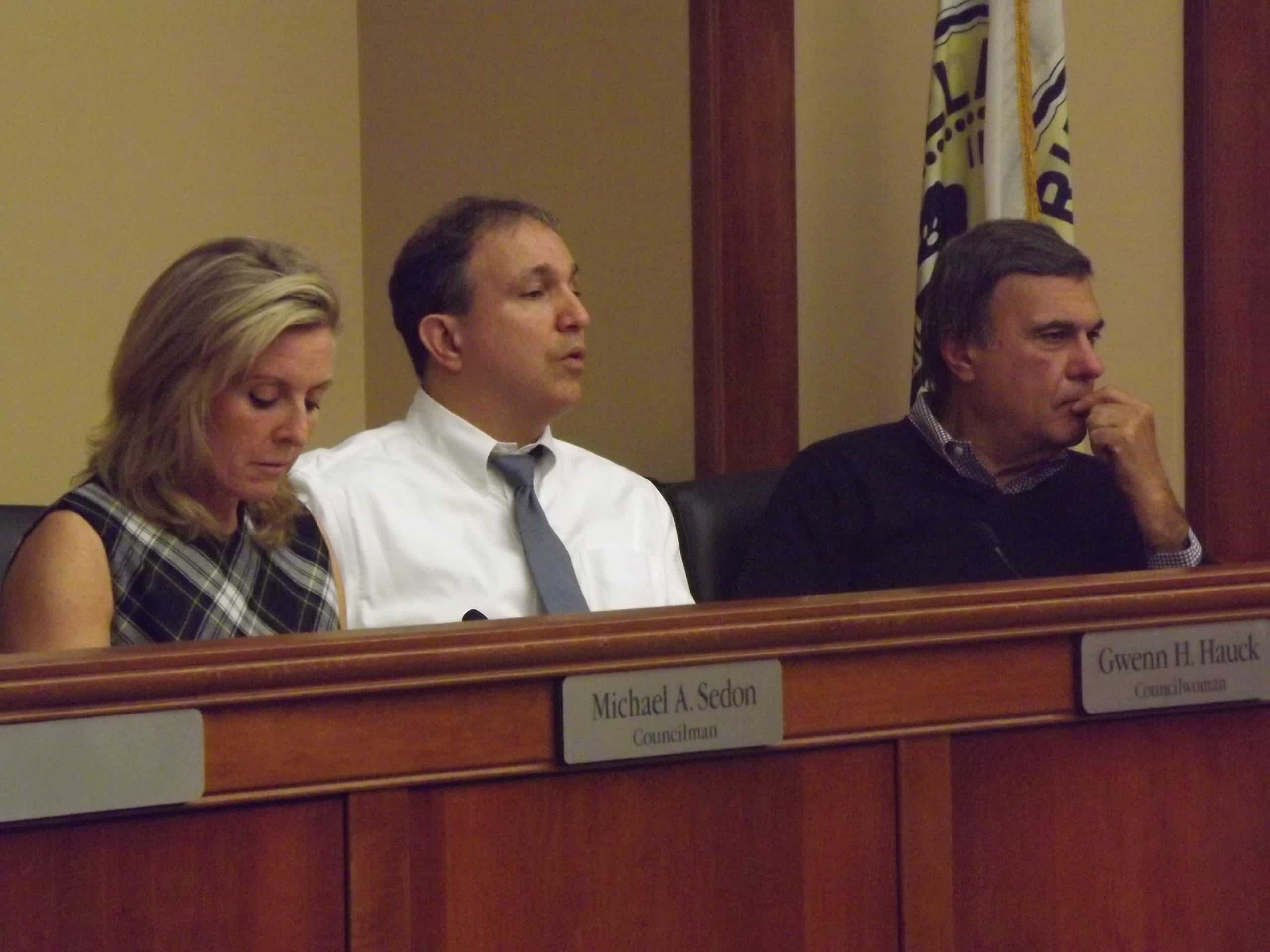
On July 3, 2013, Paul Aronsohn and his wife, Gwenn Hauck, and Albert Puciarelli and a guest, attended a fundraiser for Chris Christie at the Bank of America building. Each was comped at least $1,000/person (an item of value) by an event host, John Saraceno, who also happened to have an application before the Planning Board — The Enclave — now being voted on by the council as part of B-3-R rezoning.
Chapter 3; Section 53 of the Village Code, entitled conflicts of interest and penalties, states:
An elected official:
Shall not: Accept or solicit anything of value as consideration for or in connection with the discharge of his official duties.
Shall not: Accept any gift or gratuity, whether in the form of service, loan or promise or in any other form, from any person, firm or corporation which would tend to influence them in the discharge of their official duties.
Penalties for violating the ordinance include: suspension, removal from office, jail, fine or community service.
At a meeting on July 10, 2013 (per the minutes), Mayor Aronsohn asked Village Attorney Matt Rogers to look into the gift law related to the comped tickets. On July 11, 2013, Rogers was quoted in The Ridgewood News: Attending the fundraiser “falls outside the village’s gift ordinance” and was “completely appropriate” for the elected officials to attend. “It would have been a disservice if they did not attend.” There appears to have been no further discussion in the public record thereafter.
In his Ridgewood News reply, Rogers did not address the conflict of interest ordinance, which is Chapter 3, choosing only to focus on the appropriateness of attending the fundraiser (attending the event and accepting an item of value are separate issues). He is correct that it would have been a disservice for the council not to attend – provided they paid for it. Since it appears they did not pay, “accepting an item of value” becomes the issue; falling under the conflict of interest ordinance. Prima facie this looks to be a conflict of interest.
Of further concern is there may be other “business relationships” which may affect council member’s impartiality. These include a working relationship that Mayor Aronsohn and Pucciarelli have with Saraceno — as members of the Ridgewood Library Board of Trustees.
At a July 2015 council meeting, Aronsohn, Pucciarelli and Hauck voted in favor of introducing an ordinance for the B-3-R zone (where the Enclave is situated).
As a member of the zoning board, in order to steer clear of any conflicts of interest, we are requested by legal counsel to recuse ourselves from any personal or business relationships we might have with applicants. The council should be held to the same standards that other village sanctioned boards are held to.
The people of Ridgewood deserve an answer from the village attorney as to whether council members have a conflict of interest in this important issue facing us. If the attorney is unwilling to examine this, have an independent third party do so.
“A just-released inspector general report found that the Consumer Financial Protection Bureau, is conducting a massive consumer data-mining operation without the security safeguards to protect the sensitive data from cyberattacks.” Rep. Mia Love, R-Utah
10/13/2015 05:25 PM
Privacy: The most powerful unaccountable agency in Washington is mining and amassing all your personal financial data. While that’s bad enough, it also isn’t adequately protecting them from hackers and identity thieves.A just-released inspector general report found that the Consumer Financial Protection Bureau, is conducting a massive consumer data-mining operation without the security safeguards to protect the sensitive data from cyberattacks.
The CFPB is collecting and stockpiling more than 600 million credit card accounts, along with personal data from millions of mortgage loans, but “has not yet fully implemented a number of privacy control steps and information security practices,” warned CFPB Inspector General Mark Bialek in a 10-page memo to CFPB Director Richard Cordray.
More alarming, the agency is sharing the massive databases with outside contractors and storing sensitive private information on unsecured clouds, making the data extra vulnerable to cyberattacks “from outside governments and organized groups.”
American consumers have no idea that the government is doing this. They’re not being alerted about the sharing of data from their private financial accounts, and they’re not being given the right to opt out of the government programs to gather and retain their most sensitive personal information.
The Big Brother operation is being done surreptitiously, with the reluctant cooperation of banks. It’s an unprecedented invasion of privacy, even for the feds — and the Obama administration has no good answers for why it’s amassing this information on private citizens.
In a recent House banking committee hearing, Rep. Mia Love, R-Utah, tried to get answers from Cordray, who explained, unconvincingly, “I’m just looking at overall patterns in the market.”
Read More At Investor’s Business Daily: https://news.investors.com/ibd-editorials/101315-775415-ig-warns-cfpb-not-protecting-millions-credit-card-accounts-from-hackers.htm#ixzz3p7Gh92F8
“This administration views the Internet as a threat.” Senator Ted Cruz
Oct. 19, 2015 9:57pm Oliver Darcy
Ted Cruz said Sunday evening that the “threats to Internet freedom” have “never been greater” and could have the potential of affecting independent online news outlets like the Drudge Report.
Speaking to TheBlaze Sunday evening in Dallas, Texas, the Republican presidential candidate respondedto reports that Congressional review of digital copyright law could threaten aggregator news websites.
“I think threats to Internet freedom continue growing,” Cruz said. “This administration views the Internet as a threat.”
An instructive example out of Kenya (and a few from our own backyard).
Elizabeth Nolan Brown|Oct. 20, 2015 8:00 am
One of the most baffling things about the newfangled “liberal” push for laws against so-called hate speech is their inability to imagine these bans backfiring. In their zeal to punish those who spread sexist, racist, transphobic, or otherwise out-of-fashion speech, they seem to forget that history has a bad track record of using censorship to suppress religious, social, sexual, and political minorities. And that’s exactly what’s been happening in Kenya, according to Nairobi-based newspaper The Star.
“There is growing evidence that the government is using prosecution for hate speech as a tool to silence its opposition critics,” writes John Onyando. “The norm is incendiary speech by pro-government politicians and online activists going unchecked while law enforcement agencies enthusiastically pounce on the mildest expressions by critics.”
The agency tasked with prosecuting hate speech in Kenya is called the National Cohesion and Integration Commission (NCIC); it was formed in 2008 to address ethnic conflicts in the nation. Onyando asserts that NCIC has ignored the bulk of complaints it has received and acts “more like an arm of the ruling coalition” than an independent agency, honing in only on those who speak out against the Jubilee Alliance, a coalition established in 2013 to support the candidacy of current President Uhuru Kenyatta and Deputy President William Ruto.
by ELIANA JOHNSON October 19, 2015 4:00 AM @ELIANAYJOHNSON
It began as whispers in hushed corners: Could it ever happen? And now, just three months from the Iowa caucuses, members of the Republican establishment are starting to give voice to an increasingly common belief that Donald Trump, once dismissed as joke, a carnival barker, and a circus freak, might very well win the nomination.
“Trump is a serious player for the nomination at this time,” says Ed Rollins, who served as the national campaign director for Reagan’s 1984 reelection and as campaign chairman for Mike Huckabee in 2008. Rollins is not alone in his views.
“Trump has sustained a lead for longer than there are days left” before voting begins in Iowa, says Steve Schmidt, who managed John McCain’s 2008 presidential campaign. “For a long time,” Schmidt says, “you were talking to people in Washington, and there was a belief that there was an expiration date to this, as if there’s some secret group of people who have the ability to control the process.”
Rep. Scott Garett: “Each trip is an eye-opening and heart confirming experience, from a personal and religious point of view. We have a true love for Israel…Administrations come and go, but when it comes to the house that I serve, it has always been a strong bipartisan experience in support of Israel.”
5 US Congressmen Visit Israel, Braving Terrorist Violence
By JNI Media October 19, 2015 , 2:00 pm
A bipartisan group of five US congressmen spent the last week touring Israel, despite the daily terrorist attacks. Representatives Alan Lowenthal D-CA, Jim Jordan R-OH, Scott Garrett R-NJ, Raoul Labrador R-ID and Mark Meadows R-NC traveled across the country to learn the facts behind the headlines—and to pledge their support for Israel. The fact finding mission was sponsored by Proclaiming Justice to the Nations, a US based Christian organization, and hosted by Yes! Israel.
The congressmen’s jam-packed schedule included briefings with Prime Minister Benjamin Netanyahu and Defense Minister Moshe Yaalon, meetings with fellow legislatures at the Knesset, an IAF helicopter tour, a visit to the Cave of the Patriarchs in Hebron, a discussion of co-existence in meetings with Israelis and Palestinians in Gush Etzion, a visit to the city of Sderot whose civilian population is a frequent target for Hamas rockets, and tours of ancient Shiloh, and Ariel University.
The congressmen also spent time connecting with some 200 ex-pats, at a Sunday Town Hall meeting at the Inbal Jerusalem Hotel. The congressmen shared their impressions from their trip with their Israeli-American audience:
Reader says Rule 12=why anonymous commenting ticks the three amigos off to no end. They just can’t get at anonymous commentators in a personal way and it drives them bonkers.
Saul Alinsky’s 12 Rules for Radicals
Here is the complete list from Alinsky.
* RULE 1: “Power is not only what you have, but what the enemy thinks you have.” Power is derived from 2 main sources – money and people. “Have-Nots” must build power from flesh and blood. (These are two things of which there is a plentiful supply. Government and corporations always have a difficult time appealing to people, and usually do so almost exclusively with economic arguments.)
* RULE 2: “Never go outside the expertise of your people.” It results in confusion, fear and retreat. Feeling secure adds to the backbone of anyone. (Organizations under attack wonder why radicals don’t address the “real” issues. This is why. They avoid things with which they have no knowledge.)
* RULE 3: “Whenever possible, go outside the expertise of the enemy.” Look for ways to increase insecurity, anxiety and uncertainty. (This happens all the time. Watch how many organizations under attack are blind-sided by seemingly irrelevant arguments that they are then forced to address.)
* RULE 4: “Make the enemy live up to its own book of rules.” If the rule is that every letter gets a reply, send 30,000 letters. You can kill them with this because no one can possibly obey all of their own rules. (This is a serious rule. The besieged entity’s very credibility and reputation is at stake, because if activists catch it lying or not living up to its commitments, they can continue to chip away at the damage.)
* RULE 5: “Ridicule is man’s most potent weapon.” There is no defense. It’s irrational. It’s infuriating. It also works as a key pressure point to force the enemy into concessions. (Pretty crude, rude and mean, huh? They want to create anger and fear.)
* RULE 6: “A good tactic is one your people enjoy.” They’ll keep doing it without urging and come back to do more. They’re doing their thing, and will even suggest better ones. (Radical activists, in this sense, are no different that any other human being. We all avoid “un-fun” activities, and but we revel at and enjoy the ones that work and bring results.)
* RULE 7: “A tactic that drags on too long becomes a drag.” Don’t become old news. (Even radical activists get bored. So to keep them excited and involved, organizers are constantly coming up with new tactics.)
* RULE 8: “Keep the pressure on. Never let up.” Keep trying new things to keep the opposition off balance. As the opposition masters one approach, hit them from the flank with something new. (Attack, attack, attack from all sides, never giving the reeling organization a chance to rest, regroup, recover and re-strategize.)
* RULE 9: “The threat is usually more terrifying than the thing itself.” Imagination and ego can dream up many more consequences than any activist. (Perception is reality. Large organizations always prepare a worst-case scenario, something that may be furthest from the activists’ minds. The upshot is that the organization will expend enormous time and energy, creating in its own collective mind the direst of conclusions. The possibilities can easily poison the mind and result in demoralization.)
* RULE 10: “If you push a negative hard enough, it will push through and become a positive.” Violence from the other side can win the public to your side because the public sympathizes with the underdog. (Unions used this tactic. Peaceful [albeit loud] demonstrations during the heyday of unions in the early to mid-20th Century incurred management’s wrath, often in the form of violence that eventually brought public sympathy to their side.)
* RULE 11: “The price of a successful attack is a constructive alternative.” Never let the enemy score points because you’re caught without a solution to the problem. (Old saw: If you’re not part of the solution, you’re part of the problem. Activist organizations have an agenda, and their strategy is to hold a place at the table, to be given a forum to wield their power. So, they have to have a compromise solution.)
* RULE 12: Pick the target, freeze it, personalize it, and polarize it.” Cut off the support network and isolate the target from sympathy. Go after people and not institutions; people hurt faster than institutions. (This is cruel, but very effective. Direct, personalized criticism and ridicule works.)