TUCSON, Ariz., Concerns about Hillary Clinton’s health are “serious—could be disqualifying for the position of President of the U.S.,” say nearly 71% of 250 physicians responding to an informal internet survey by the Association of American Physicians and Surgeons (AAPS). About 20% said concerns were “likely overblown, but should be addressed as by full release of medical records.” Only 2.7% responded that they were “just a political attack; I have confidence in the letter from her physician and see no cause for concern.”
While more than 81% were aware of her history of a concussion, only 59% were aware of the cerebral sinus thrombosis, and 52% of the history of deep venous thrombosis.
More than 78% said the health concerns had received “not enough emphasis” in the media, and only 2.7% that there had been “too much emphasis.”
Nearly two-thirds said that a physician who had a concern about a candidate’s fitness to serve for health reasons should “make the concerns known to the public.” Only 11% said a physician should “keep silent unless he had personally examined the patient,” and 10% that the candidate’s health was “off limits for public discussion.”
Eighty-eight respondents submitted comments. One said that “the public interest will ALWAYS override either privacy rights or rights of self-determination in the case of a presidential candidate.” Another mentioned Clinton’s “so called loss of memory claimed during her FBI questioning about her email server.” Beyond the specific questions, one remarked that “I think that the candidate should be honest with the public about his/her health!” The history of the concussion was concerning: “The public must watch the movie Concussion to realize that such an injury does affect thought process.”
A poll of 833 randomly selected registered voters by Gravis Marketing showed that nearly half (49%) were not aware of the “well documented major health issues that Hillary Clinton has.” Nearly three-fourths (74%) were unaware of Bill Clinton’s statement that Hillary suffered a “terrible” concussion requiring “six months of very serious work to get over.” The majority (57%) thought that candidates should release their medical records.
“Both physicians and other voters think that health concerns are relevant when choosing a presidential candidate,” states AAPS executive director Jane M. Orient, M.D. “However, more than 40% of physician respondents were unaware of the cerebral sinus thrombosis, and the vast majority of voters were not aware of all of Clinton’s problems or their potential serious long-term implications for cognitive function.”
The Association of American Physicians and Surgeons (AAPS) is a national organization representing physicians in virtually all specialties and every state. Founded in 1943, AAPS has the motto “omnia pro aegroto,” which means “all for the patient.”
WASHINGTON, D.C. – Today the House passed a legislative package to help American innovators access capital that included Rep. Scott Garrett’s (NJ-05) Private Placement Improvement Act. The Accelerating Access to Capital Act, H.R. 2357, is a package of three bills that will help level the playing field and make it possible for small businesses to raise capital by lessening the burdens of complex and costly securities regulations imposed by Washington. Garrett is Chairman of the Financial Services Subcommittee on Capital Markets and Government-Sponsored Enterprises.
“If we want bigger paychecks and more opportunity in New Jersey, it starts with ending the excessive regulations from Washington that are hurting our economy,” said Garrett. “Instead of clearing a path for success, federal regulations cost small businesses with less than 20 employees 45 percent more per employee than their larger counterparts, essentially stepping on innovators at a time when they are most vulnerable.
“The Accelerating Access to Capital Act recognizes that having one-size-fits-all federal regulations that make no distinction between someone just starting out and some of the biggest companies in the world is inherently unfair. We can, and must, level this playing field by tailoring regulations to smaller businesses to help the next great American success story. Today’s vote was a good first step.”
The Private Placement Improvement Act would prohibit the Securities and Exchange Commission (SEC) from implementing onerous requirements on companies that raise capital through private channels. Despite statutory requirements to promote capital formation, the SEC has largely failed to prioritize streamlining regulations that could help small companies access investment capital.
Ridgewood NJ, From piggy banks to that first savings account, many children are taught the value of saving from an early age.
But as they grow to adolescence, following parental advice sometimes gives way to peer or media influences, and those once-thrifty children are now teenagers in a consumer-driven world where spending, not saving, is king.
“Nearly everyone falls into two categories: spenders and savers,” says John Cortines, co-author with Gregory Baumer of God and Money: How We Discovered True Riches at Harvard Business School (www.godandmoney.net). “Spending is easy, so it’s up to parents to start conversations with their teens on the importance of saving and, just as importantly, giving.”
Cortines and Baumer suggest three ways parents can help teens establish good financial habits before they reach adulthood, and pave the way for those teens to become generous people as well as good savers:
• Help them begin saving for retirement now. Teens who land a part-time job often want to save money to buy a car or they simply want to enjoy a little financial freedom with weekend shopping sprees. Unless they’re careful, that money burning a proverbial hole in their pocket is spent before the next payday. Parents can help them think beyond today by suggesting they invest a portion of that income in a Roth IRA. Mom and Dad can even consider matching their teen dollar-for-dollar on their savings. “Explain the wonder of compounding investment returns – how the money they invest as a teen could be worth 10 to 20 times as much when they retire,” Cortines says. • Family philanthropy. Even if the gifts are modest, Cortines and Baumer advocate involving teens in the family giving plan. Encourage them to research charities and apply for “grants” from the family’s budget for giving. “The experience of learning about nonprofits will be invaluable,” Baumer says. This is also where another portion of the teen’s earnings from a part-time job could be placed. • Let them into your journey. Parents should model what they want their teens to emulate. Cortines said this begins with “letting them see your character as reflected in financial decisions.” That doesn’t mean letting teens know their parents’ net worth or the details of their income. Baumer and Cortines suggest explaining to teens how living modestly has short- and long-term benefits, whether it has allowed an early payoff of a mortgage, or demonstrates that frugal purchasing decisions leave money available for charitable giving.
“If you frame the conversation well,” Baumer says, “teens will benefit from seeing your character on display as you navigate your finances.”
Once saving and giving goals are fulfilled, teens can then begin to focus on spending.
“But unless spending is kept under control,” Cortines says, “saving and giving simply aren’t possible at any meaningful level.”
About John Cortines and Greg Baumer
John Cortines and Greg Baumer are co-authors of God and Money: How We Discovered True Riches at Harvard Business School (www.godandmoney.net). Baumer is VP of Business Development for naviHealth, a Nashville-based healthcare technology firm. Cortines is Executive VP of Emerging Leaders for Generous Giving, an organization that exists to share the biblical message of generosity.
Ridgewood NJ, It’s a provocative question that reads like the cover blurb for a paperback spy novel, but it’s drawing serious attention in these days of cyber crime.
Could hackers disrupt the U.S. presidential election and, if they did, what would be the implications for our democracy?
“Theoretically, there are several things a hacker could do to interfere with the election,” says Gary S. Miliefsky, CEO of SnoopWall (www.snoopwall.com), a company that specializes in cybersecurity.
“They could delete names from a voter list so that when people showed up to vote there’s no record of them being registered. They could change the actual voting machine results, putting the wrong person in office. Or they might just hack in so that they can steal people’s personal information and commit identity theft.”
Already concerns arose after the Democratic National Committee was hacked this summer, reportedly by Russians. More recently there were reports of hacks of the voting registration systems in Arizona and Illinois.
The FBI says Russians also were behind the Arizona hack, which involved malware being found on a county election official’s computer. In Illinois, hackers downloaded information on as many as 200,000 voters.
Miliefsky says the federal government could and should take several steps if it’s truly concerned that the Russian government, criminal Russian cartels or anyone else might try to hijack the election. Those steps include:
• Issue an ultimatum. Government officials should issue a public statement to Russia letting it know it will face cyber-war consequences if either the Russian government or Russian criminals try to interfere with the U.S. voting system. • Go on high alert. The National Security Agency should monitor, in a state of high alert, the election networks to see if cyber attacks are happening and find out who is perpetrating the crime. • Enlist cybersecurity help. The U.S. government could request the assistance of cybersecurity experts to help elections officials ensure their networks and voting machines are patched and secure. •Partner with cybersecurity companies. U.S.-based cybersecurity companies could be offered grants to deploy advanced tools on election networks to shore up their defense.
“It’s time for us to get vigilant and pro-active,” Miliefsky says. “No nation-state hackers or cybercriminals should be able to undermine the basis of our democracy by cyber-election fraud.
“Of course, going back to old-fashioned ‘paper-based voting’ wouldn’t hurt this election cycle, either.”
About Gary S. Miliefsky
Gary S. Miliefsky is founder of SnoopWall Inc. (www.snoopwall.com), a cutting edge counter-intelligence technology company offering free consumer-based software to secure personal data on cell-phones and tablets, while generating revenues helping banks and government agencies secure their networks. He has been active in the INFOSEC arena, as the Executive Producer of Cyber Defense Magazine and a regular contributor to Hakin9 Magazine.
Ridgewood NJ, its bears repeating school is open so drive carefully !
Governor Christie: This is always an interesting time of year. Everyone’s got to get readjusted. And in our house this morning, one of our children went back to school, the other didn’t. Which lead to enormous teasing last night, of Bridget to Patrick, because she was going to be able to sleep in for one last morning and Patrick was getting up to head to school for the first time this year. Let’s all of us be attentive to particularly the public safety issues that surround the beginning of the school year. Let us all put our cell phones down when we are in the car. That should be a rule of thumb no matter what. Law enforcement will enforce that, specifically, but especially for parents and I saw this this morning, which is why it’s on my mind, parents driving into a school lot while they’re texting. It’s unthinkable to me that with children walking around on a school campus setting, and parents driving in with their own children in the car that they would engage in distracted driving, which I think is the term of art we use now, distracted driving. It’s texting while driving, and it just shouldn’t be done. So I want everybody to pay attention, especially the public safety issues that come up when you have lots of young people who no matter how many times we tell them to look both ways before they cross or move into a street don’t always remember. We’re the responsible adults, we got to make sure we’re keeping an eye on those things. So we got to get out of summer mode, get into fall mode unfortunately, and one of those things I think is keeping our eye on what we’re doing and making sure that we’re talking to our children about the things they need to do. Not only to do well in school but to be safe in school. And we can set a good example by doing some of things that are within our control as well. So Mary Pat and I will try to make sure we do that, and we hope that all of you here and all of those listening will do that as well.
2016 is the Flight 93 election: charge the cockpit or you die. You may die anyway. You—or the leader of your party—may make it into the cockpit and not know how to fly or land the plane. There are no guarantees.
Except one: if you don’t try, death is certain. To compound the metaphor: a Hillary Clinton presidency is Russian Roulette with a semi-auto. With Trump, at least you can spin the cylinder and take your chances.
To ordinary conservative ears, this sounds histrionic. The stakes can’t be that high because they are never that high—except perhaps in the pages of Gibbon. Conservative intellectuals will insist that there has been no “end of history” and that all human outcomes are still possible. They will even—as Charles Kesler does—admit that America is in “crisis.” But how great is the crisis? Can things really be so bad if eight years of Obama can be followed by eight more of Hillary, and yet Constitutionalist conservatives can still reasonably hope for a restoration of our cherished ideals? Cruz in 2024!
Not to pick (too much) on Kesler, who is less unwarrantedly optimistic than most conservatives. And who, at least, poses the right question: Trump or Hillary? Though his answer—“even if [Trump] had chosen his policies at random, they would be sounder than Hillary’s”—is unwarrantedly ungenerous. The truth is that Trump articulated, if incompletely and inconsistently, the right stances on the right issues—immigration, trade, and war—right from the beginning.
But let us back up. One of the paradoxes—there are so many—of conservative thought over the last decade at least is the unwillingness even to entertain the possibility that America and the West are on a trajectory toward something very bad. On the one hand, conservatives routinely present a litany of ills plaguing the body politic. Illegitimacy. Crime. Massive, expensive, intrusive, out-of-control government. Politically correct McCarthyism. Ever-higher taxes and ever-deteriorating services and infrastructure. Inability to win wars against tribal, sub-Third-World foes. A disastrously awful educational system that churns out kids who don’t know anything and, at the primary and secondary levels, can’t (or won’t) discipline disruptive punks, and at the higher levels saddles students with six figure debts for the privilege. And so on and drearily on. Like that portion of the mass where the priest asks for your private intentions, fill in any dismal fact about American decline that you want and I’ll stipulate it.
Conservatives spend at least several hundred million dollars a year on think-tanks, magazines, conferences, fellowships, and such, complaining about this, that, the other, and everything. And yet these same conservatives are, at root, keepers of the status quo. Oh, sure, they want some things to change. They want their pet ideas adopted—tax deductions for having more babies and the like. Many of them are even good ideas. But are any of them truly fundamental? Do they get to the heart of our problems?
If conservatives are right about the importance of virtue, morality, religious faith, stability, character and so on in the individual; if they are right about sexual morality or what came to be termed “family values”; if they are right about the importance of education to inculcate good character and to teach the fundamentals that have defined knowledge in the West for millennia; if they are right about societal norms and public order; if they are right about the centrality of initiative, enterprise, industry, and thrift to a sound economy and a healthy society; if they are right about the soul-sapping effects of paternalistic Big Government and its cannibalization of civil society and religious institutions; if they are right about the necessity of a strong defense and prudent statesmanship in the international sphere—if they are right about the importance of all this to national health and even survival, then they must believe—mustn’t they?—that we are headed off a cliff.
But it’s quite obvious that conservatives don’t believe any such thing, that they feel no such sense of urgency, of an immediate necessity to change course and avoid the cliff. A recent article by Matthew Continetti may be taken as representative—indeed, almost written for the purpose of illustrating the point. Continetti inquires into the “condition of America” and finds it wanting. What does Continetti propose to do about it? The usual litany of “conservative” “solutions,” with the obligatory references to decentralization, federalization, “civic renewal,” and—of course!—Burke. Which is to say, conservatism’s typical combination of the useless and inapt with the utopian and unrealizable. Decentralization and federalism are all well and good, and as a conservative, I endorse them both without reservation. But how are they going to save, or even meaningfully improve, the America that Continetti describes? What can they do against a tidal wave of dysfunction, immorality, and corruption? “Civic renewal” would do a lot of course, but that’s like saying health will save a cancer patient. A step has been skipped in there somewhere. How are we going to achieve “civic renewal”? Wishing for a tautology to enact itself is not a strategy.
Continetti trips over a more promising approach when he writes of “stress[ing] the ‘national interest abroad and national solidarity at home’ through foreign-policy retrenchment, ‘support to workers buffeted by globalization,’ and setting ‘tax rates and immigration levels’ to foster social cohesion.” That sounds a lot like Trumpism. But the phrases that Continetti quotes are taken from Ross Douthat and Reihan Salam, both of whom, like Continetti, are vociferously—one might even say fanatically—anti-Trump. At least they, unlike Kesler, give Trump credit for having identified the right stance on today’s most salient issues. Yet, paradoxically, they won’t vote for Trump whereas Kesler hints that he will. It’s reasonable, then, to read into Kesler’s esoteric endorsement of Trump an implicit acknowledgment that the crisis is, indeed, pretty dire. I expect a Claremont scholar to be wiser than most other conservative intellectuals, and I am relieved not to be disappointed in this instance.
Yet we may also reasonably ask: What explains the Pollyanna-ish declinism of so many others? That is, the stance that Things-Are-Really-Bad—But-Not-So-Bad-that-We-Have-to-Consider-Anything-Really-Different! The obvious answer is that they don’t really believe the first half of that formulation. If so, like Chicken Little, they should stick a sock in it. Pecuniary reasons also suggest themselves, but let us foreswear recourse to this explanation until we have disproved all the others.
Whatever the reason for the contradiction, there can be no doubt that there is a contradiction. To simultaneously hold conservative cultural, economic, and political beliefs—to insist that our liberal-left present reality and future direction is incompatible with human nature and must undermine society—and yet also believe that things can go on more or less the way they are going, ideally but not necessarily with some conservative tinkering here and there, is logically impossible.
Let’s be very blunt here: if you genuinely think things can go on with no fundamental change needed, then you have implicitly admitted that conservatism is wrong. Wrong philosophically, wrong on human nature, wrong on the nature of politics, and wrong in its policy prescriptions. Because, first, few of those prescriptions are in force today. Second, of the ones that are, the left is busy undoing them, often with conservative assistance. And, third, the whole trend of the West is ever-leftward, ever further away from what we all understand as conservatism.
If your answer—Continetti’s, Douthat’s, Salam’s, and so many others’—is for conservatism to keep doing what it’s been doing—another policy journal, another article about welfare reform, another half-day seminar on limited government, another tax credit proposal—even though we’ve been losing ground for at least a century, then you’ve implicitly accepted that your supposed political philosophy doesn’t matter and that civilization will carry on just fine under leftist tenets. Indeed, that leftism is truer than conservatism and superior to it.
They will say, in words reminiscent of dorm-room Marxism—but our proposals have not been tried! Here our ideas sit, waiting to be implemented! To which I reply: eh, not really. Many conservative solutions—above all welfare reform and crime control—have been tried, and proved effective, but have nonetheless failed to stem the tide. Crime, for instance, is down from its mid-’70s and early ’90s peak—but way, way up from the historic American norm that ended when liberals took over criminal justice in the mid-’60s. And it’s rising fast today, in the teeth of ineffectual conservative complaints. And what has this temporary crime (or welfare, for that matter) decline done to stem the greater tide? The tsunami of leftism that still engulfs our every—literal and figurative—shore has receded not a bit but indeed has grown. All your (our) victories are short-lived.
More to the point, what has conservatism achieved lately? In the last 20 years? The answer—which appears to be “nothing”—might seem to lend credence to the plea that “our ideas haven’t been tried.” Except that the same conservatives who generate those ideas are in charge of selling them to the broader public. If their ideas “haven’t been tried,” who is ultimately at fault? The whole enterprise of Conservatism, Inc., reeks of failure. Its sole recent and ongoing success is its own self-preservation. Conservative intellectuals never tire of praising “entrepreneurs” and “creative destruction.” Dare to fail! they exhort businessmen. Let the market decide! Except, um, not with respect to us. Or is their true market not the political arena, but the fundraising circuit?
Only three questions matter. First, how bad are things really? Second, what do we do right now? Third, what should we do for the long term?
Conservatism, Inc.’s, “answer” to the first may, at this point, simply be dismissed. If the conservatives wish to have a serious debate, I for one am game—more than game; eager. The problem of “subjective certainty” can only be overcome by going into the agora. But my attempt to do so—the blog that Kesler mentions—was met largely with incredulity. How can they say that?! How can anyone apparently of our caste (conservative intellectuals) not merely support Trump (however lukewarmly) but offer reasons for doing do?
One of the Journal of American Greatness’s deeper arguments was that only in a corrupt republic, in corrupt times, could a Trump rise. It is therefore puzzling that those most horrified by Trump are the least willing to consider the possibility that the republic is dying. That possibility, apparently, seems to them so preposterous that no refutation is necessary.
As does, presumably, the argument that the stakes in 2016 are—everything. I should here note that I am a good deal gloomier than my (former) JAG colleagues, and that while we frequently used the royal “we” when discussing things on which we all agreed, I here speak only for myself.
How have the last two decades worked out for you, personally? If you’re a member or fellow-traveler of the Davos class, chances are: pretty well. If you’re among the subspecies conservative intellectual or politician, you’ve accepted—perhaps not consciously, but unmistakably—your status on the roster of the Washington Generals of American politics. Your job is to show up and lose, but you are a necessary part of the show and you do get paid. To the extent that you are ever on the winning side of anything, it’s as sophists who help the Davoisie oligarchy rationalize open borders, lower wages, outsourcing, de-industrialization, trade giveaways, and endless, pointless, winless war.
All of Trump’s 16 Republican competitors would have ensured more of the same—as will the election of Hillary Clinton. That would be bad enough. But at least Republicans are merely reactive when it comes to wholesale cultural and political change. Their “opposition” may be in all cases ineffectual and often indistinguishable from support. But they don’t dream up inanities like 32 “genders,” elective bathrooms, single-payer, Iran sycophancy, “Islamophobia,” and Black Lives Matter. They merely help ratify them.
A Hillary presidency will be pedal-to-the-metal on the entire Progressive-left agenda, plus items few of us have yet imagined in our darkest moments. Nor is even that the worst. It will be coupled with a level of vindictive persecution against resistance and dissent hitherto seen in the supposedly liberal West only in the most “advanced” Scandinavian countries and the most leftist corners of Germany and England. We see this already in the censorship practiced by the Davoisie’s social media enablers; in the shameless propaganda tidal wave of the mainstream media; and in the personal destruction campaigns—operated through the former and aided by the latter—of the Social Justice Warriors. We see it in Obama’s flagrant use of the IRS to torment political opponents, the gaslighting denial by the media, and the collective shrug by everyone else.
It’s absurd to assume that any of this would stop or slow—would do anything other than massively intensify—in a Hillary administration. It’s even more ridiculous to expect that hitherto useless conservative opposition would suddenly become effective. For two generations at least, the Left has been calling everyone to their right Nazis. This trend has accelerated exponentially in the last few years, helped along by some on the Right who really do seem to merit—and even relish—the label. There is nothing the modern conservative fears more than being called “racist,” so alt-right pocket Nazis are manna from heaven for the Left. But also wholly unnecessary: sauce for the goose. The Left was calling us Nazis long before any pro-Trumpers tweeted Holocaust denial memes. And how does one deal with a Nazi—that is, with an enemy one is convinced intends your destruction? You don’t compromise with him or leave him alone. You crush him.
So what do we have to lose by fighting back? Only our Washington Generals jerseys—and paychecks. But those are going away anyway. Among the many things the “Right” still doesn’t understand is that the Left has concluded that this particular show need no longer go on. They don’t think they need a foil anymore and would rather dispense with the whole bother of staging these phony contests in which each side ostensibly has a shot.
If you haven’t noticed, our side has been losing consistently since 1988. We can win midterms, but we do nothing with them. Call ours Hannibalic victories. After the Carthaginian’s famous slaughter of a Roman army at Cannae, he failed to march on an undefended Rome, prompting his cavalry commander to complain: “you know how to win a victory, but not how to use one.” And, aside from 2004’s lackluster 50.7%, we can’t win the big ones at all.
Because the deck is stacked overwhelmingly against us. I will mention but three ways. First, the opinion-making elements—the universities and the media above all—are wholly corrupt and wholly opposed to everything we want, and increasingly even to our existence. (What else are the wars on “cis-genderism”—formerly known as “nature”—and on the supposed “white privilege” of broke hillbillies really about?) If it hadn’t been abundantly clear for the last 50 years, the campaign of 2015-2016 must surely have made it evident to even the meanest capacities that the intelligentsia—including all the organs through which it broadcasts its propaganda—is overwhelmingly partisan and biased. Against this onslaught, “conservative” media is a nullity, barely a whisper. It cannot be heard above the blaring of what has been aptly called “The Megaphone.”
Second, our Washington Generals self-handicap and self-censor to an absurd degree. Lenin is supposed to have said that “the best way to control the opposition is to lead it ourselves.” But with an opposition like ours, why bother? Our “leaders” and “dissenters” bend over backward to play by the self-sabotaging rules the Left sets for them. Fearful, beaten dogs have more thymos.
Third and most important, the ceaseless importation of Third World foreigners with no tradition of, taste for, or experience in liberty means that the electorate grows more left, more Democratic, less Republican, less republican, and less traditionally American with every cycle. As does, of course, the U.S. population, which only serves to reinforce the two other causes outlined above. This is the core reason why the Left, the Democrats, and the bipartisan junta (categories distinct but very much overlapping) think they are on the cusp of a permanent victory that will forever obviate the need to pretend to respect democratic and constitutional niceties. Because they are.
It’s also why they treat open borders as the “absolute value,” the one “principle” that—when their “principles” collide—they prioritize above all the others. If that fact is insufficiently clear, consider this. Trump is the most liberal Republican nominee since Thomas Dewey. He departs from conservative orthodoxy in so many ways that National Review still hasn’t stopped counting. But let’s stick to just the core issues animating his campaign. On trade, globalization, and war, Trump is to the left (conventionally understood) not only of his own party, but of his Democratic opponent. And yet the Left and the junta are at one with the house-broken conservatives in their determination—desperation—not merely to defeat Trump but to destroy him. What gives?
Oh, right—there’s that other issue. The sacredness of mass immigration is the mystic chord that unites America’s ruling and intellectual classes. Their reasons vary somewhat. The Left and the Democrats seek ringers to form a permanent electoral majority. They, or many of them, also believe the academic-intellectual lie that America’s inherently racist and evil nature can be expiated only through ever greater “diversity.” The junta of course craves cheaper and more docile labor. It also seeks to legitimize, and deflect unwanted attention from, its wealth and power by pretending that its open borders stance is a form of noblesse oblige. The Republicans and the “conservatives”? Both of course desperately want absolution from the charge of “racism.” For the latter, this at least makes some sense. No Washington General can take the court—much less cash his check—with that epithet dancing over his head like some Satanic Spirit. But for the former, this priestly grace comes at the direct expense of their worldly interests. Do they honestly believe that the right enterprise zone or charter school policy will arouse 50.01% of our newer voters to finally reveal their “natural conservatism” at the ballot box? It hasn’t happened anywhere yet and shows no signs that it ever will. But that doesn’t stop the Republican refrain: more, more, more! No matter how many elections they lose, how many districts tip forever blue, how rarely (if ever) their immigrant vote cracks 40%, the answer is always the same. Just like Angela Merkel after yet another rape, shooting, bombing, or machete attack. More, more, more!
This is insane. This is the mark of a party, a society, a country, a people, a civilization that wants to die. Trump, alone among candidates for high office in this or in the last seven (at least) cycles, has stood up to say: I want to live. I want my party to live. I want my country to live. I want my people to live. I want to end the insanity.
Yes, Trump is worse than imperfect. So what? We can lament until we choke the lack of a great statesman to address the fundamental issues of our time—or, more importantly, to connect them. Since Pat Buchanan’s three failures, occasionally a candidate arose who saw one piece: Dick Gephardt on trade, Ron Paul on war, Tom Tancredo on immigration. Yet, among recent political figures—great statesmen, dangerous demagogues, and mewling gnats alike—only Trump-the-alleged-buffoon not merely saw all three and their essential connectivity,but was able to win on them. The alleged buffoon is thus more prudent—more practically wise—than all of our wise-and-good who so bitterly oppose him. This should embarrass them. That their failures instead embolden them is only further proof of their foolishness and hubris.
Which they self-laud as “consistency”—adherence to “conservative principle,” defined by the 1980 campaign and the household gods of reigning conservative think-tanks. A higher consistency in the service of the national interest apparently eludes them. When America possessed a vast, empty continent and explosively growing industry, high immigration was arguably good policy. (Arguably: Ben Franklin would disagree.) It hasn’t made sense since World War I. Free trade was unquestionably a great boon to the American worker in the decades after World War II. We long ago passed the point of diminishing returns. The Gulf War of 1991 was a strategic victory for American interests. No conflict since then has been. Conservatives either can’t see this—or, worse, those who can nonetheless treat the only political leader to mount a serious challenge to the status quo (more immigration, more trade, more war) as a unique evil.
Trump’s vulgarity is in fact a godsend to the conservatives. It allows them to hang their public opposition on his obvious shortcomings and to ignore or downplay his far greater strengths, which should be even more obvious but in corrupt times can be deliberately obscured by constant references to his faults. That the Left would make the campaign all about the latter is to be expected. Why would the Right? Some—a few—are no doubt sincere in their belief that the man is simply unfit for high office. David Frum, who has always been an immigration skeptic and is a convert to the less-war position, is sincere when he says that, even though he agrees with much of Trump’s agenda, he cannot stomach Trump. But for most of the other #NeverTrumpers, is it just a coincidence that they also happen to favor Invade the World, Invite the World?
Another question JAG raised without provoking any serious attempt at refutation was whether, in corrupt times, it took a … let’s say … “loudmouth” to rise above the din of The Megaphone. We, or I, speculated: “yes.” Suppose there had arisen some statesman of high character—dignified, articulate, experienced, knowledgeable—the exact opposite of everything the conservatives claim to hate about Trump. Could this hypothetical paragon have won on Trump’s same issues? Would the conservatives have supported him? I would have—even had he been a Democrat.
Back on planet earth, that flight of fancy at least addresses what to do now. The answer to the subsidiary question—will it work?—is much less clear. By “it” I mean Trumpism, broadly defined as secure borders, economic nationalism, and America-first foreign policy. We Americans have chosen, in our foolishness, to disunite the country through stupid immigration, economic, and foreign policies. The level of unity America enjoyed before the bipartisan junta took over can never be restored.
But we can probably do better than we are doing now. First, stop digging. No more importing poverty, crime, and alien cultures. We have made institutions, by leftist design, not merely abysmal at assimilation but abhorrent of the concept. We should try to fix that, but given the Left’s iron grip on every school and cultural center, that’s like trying to bring democracy to Russia. A worthy goal, perhaps, but temper your hopes—and don’t invest time and resources unrealistically.
By contrast, simply building a wall and enforcing immigration law will help enormously, by cutting off the flood of newcomers that perpetuates ethnic separatism and by incentivizing the English language and American norms in the workplace. These policies will have the added benefit of aligning the economic interests of, and (we may hope) fostering solidarity among, the working, lower middle, and middle classes of all races and ethnicities. The same can be said for Trumpian trade policies and anti-globalization instincts. Who cares if productivity numbers tick down, or if our already somnambulant GDP sinks a bit further into its pillow? Nearly all the gains of the last 20 years have accrued to the junta anyway. It would, at this point, be better for the nation to divide up more equitably a slightly smaller pie than to add one extra slice—only to ensure that it and eight of the other nine go first to the government and its rentiers, and the rest to the same four industries and 200 families.
Will this work? Ask a pessimist, get a pessimistic answer. So don’t ask. Ask instead: is it worth trying? Is it better than the alternative? If you can’t say, forthrightly, “yes,” you are either part of the junta, a fool, or a conservative intellectual.
And if it doesn’t work, what then? We’ve established that most “conservative” anti-Trumpites are in the Orwellian sense objectively pro-Hillary. What about the rest of you? If you recognize the threat she poses, but somehow can’t stomach him, have you thought about the longer term? The possibilities would seem to be: Caesarism, secession/crack-up, collapse, or managerial Davoisie liberalism as far as the eye can see … which, since nothing human lasts forever, at some point will give way to one of the other three. Oh, and, I suppose, for those who like to pour a tall one and dream big, a second American Revolution that restores Constitutionalism, limited government, and a 28% top marginal rate.
But for those of you who are sober: can you sketch a more plausible long-term future than the prior four following a Trump defeat? I can’t either.
The election of 2016 is a test—in my view, the final test—of whether there is any virtù left in what used to be the core of the American nation. If they cannot rouse themselves simply to vote for the first candidate in a generation who pledges to advance their interests, and to vote against the one who openly boasts that she will do the opposite (a million more Syrians, anyone?), then they are doomed. They may not deserve the fate that will befall them, but they will suffer it regardless.
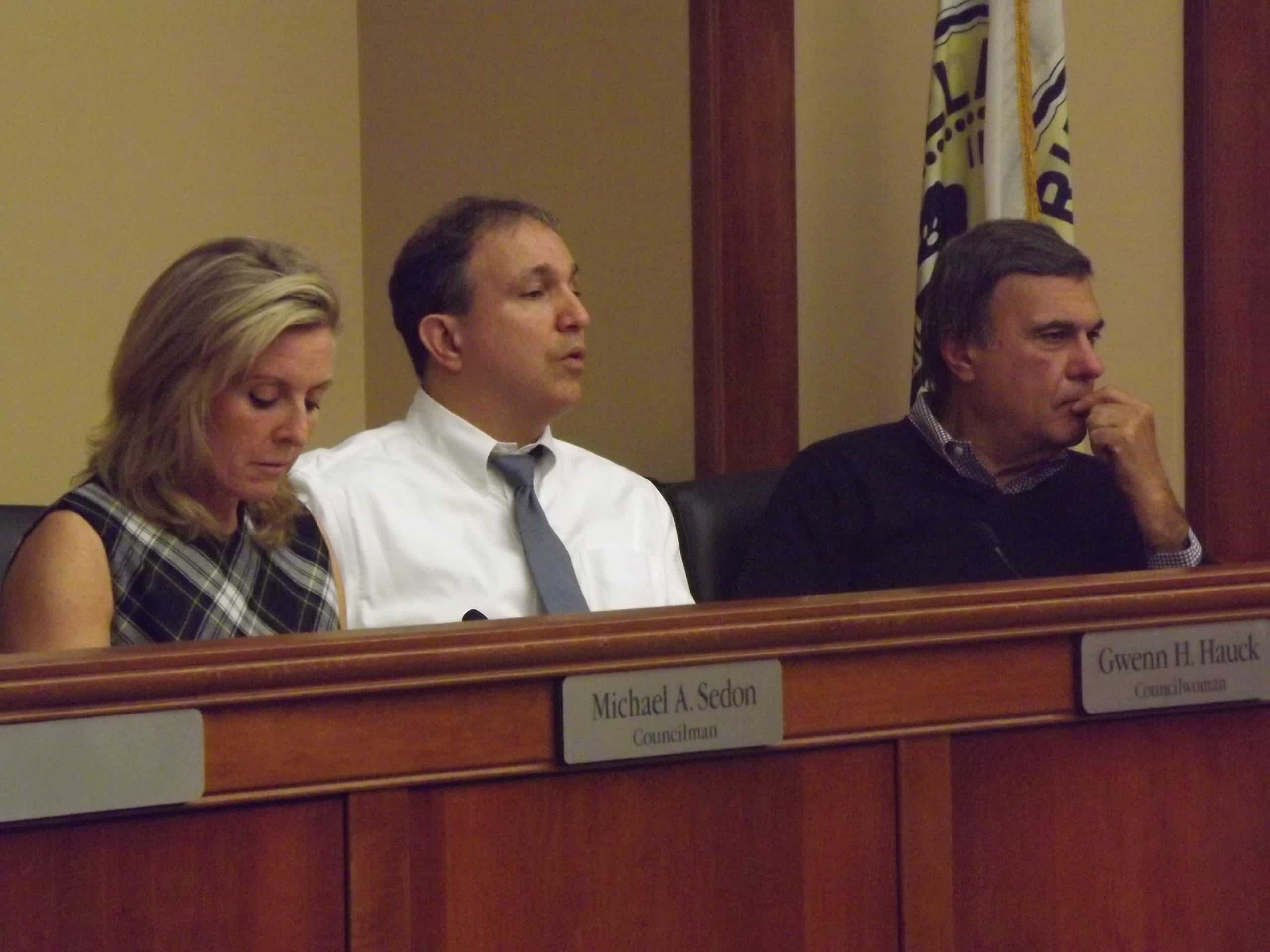
Ridgewood NJ, Aronsohn, Pucciarelli, and Hauck often referred to Roberta as a “breath of fresh air,” even though clearly the air around her became increasingly foul as her (thankfully) short time in the job progressed. Now that she has resigned and been escorted out of Village Hall, things are really running well. We have Heather Mailander in the manager’s seat. She is so capable, so professional, and she does her job without interjecting her opinion as if she were a 6th council member and without looking at Chris R and Janet F for affirmation every time she speaks.
We have a five-person council who are all independent thinkers, are polite, considerate, and they don’t interrupt each other at meetings. They are actually prepared for meetings (well, Susan and Mike always were, but now they are joined by three more who are equally informed and have done their homework). Now more nonsense like we used to have with Albert pontificating about anything and everything just to hear himself speak, and Gwenn reading from her ipad something that someone else wrote, and Paul furiously texting with Paul Vaggianos (yes, we witnessed this many times) during meetings and then giving us the doe-in-the-headlights look while saying “transparency, transparency, transparency.”
This new Council has been in place just since July 1, but so far they have accomplished volumes including that they:
1. are going to lengthen the time for public comments.
2. are respectful of members of the public who come to speak
3. overturned the much-hated Ordinance 3066
4. stopped the ridiculous Van Neste proposal
5. are going to prevent puppy-mill and kitten-mill animals from being sold in Ridgewood
6. are looking at many (and reasonable) ways to improve and increase the parking
7. are saving the Schedler House
8. will be putting grant money (hopefully) towards remediating Kings Pond
9. will be repealing the illegal ordinance that tried to prevent people from videotaping public meetings (put in place because hot-headed Aronsohn got caught getting nasty at an HPC meeting)
10. have hired a new Planning Board attorney (ok, so the VC didn’t do this, but it is yet another wonderful new development)
11. will be lowering the overkill lighting at Habernickel Park to be consistent with other parks and in response to the neighbors’ legitimate concerns about this ridiculous flood lighting
12. discovered that the extraordinarily cumbersome and confusing leaf collection process that Roberta put in place was based, in part, on a 7-day rule that has not been effective for a couple of years. So now they are putting a smooth and simple leaf collection schedule up and we can stop hearing about “no leaf left behind.”
13. will be revising the prohibition of parking on Pomander Walk, which is discriminatory and was put in place to serve Gwenn’s friends on that street.
Wow, how much has been accomplished and all with a pleasant and civil atmosphere. Way to go Susan, Mike, Ramon, Jeff and Bernie!!!
Ridgewood NJ, “PissedOff” writes from Starbucks perhaps :
“I wonder why there is so much hate and criticism. The role of the manager is to act as a spokesperson for the Village employees and be a part of the council. The council is elected to be a fair judge between the village government and the residents. Now, there is no way everyone would agree with the way things were handled and they certainly will not be 100% in support of going forward. It’s amusing to see how this blog is becoming a podium for people to anonymously shame, disrespect and disregard others. Bible says that the person who did no sin shall throw the first stone, and yet here we are. I would love to see the blog writers to put their energy into somethings more productive and help the community in a better way rather than just trying to creat a controversy. Paying taxes doesn’t mean we own people. This blog needs to be reported Since it’s acting as a platform for stirring hate and making the collar environment so toxic. SHAME AND DISGUSTING, THIS IS A PATHETIC EXCUSE FOR REPORTING.”
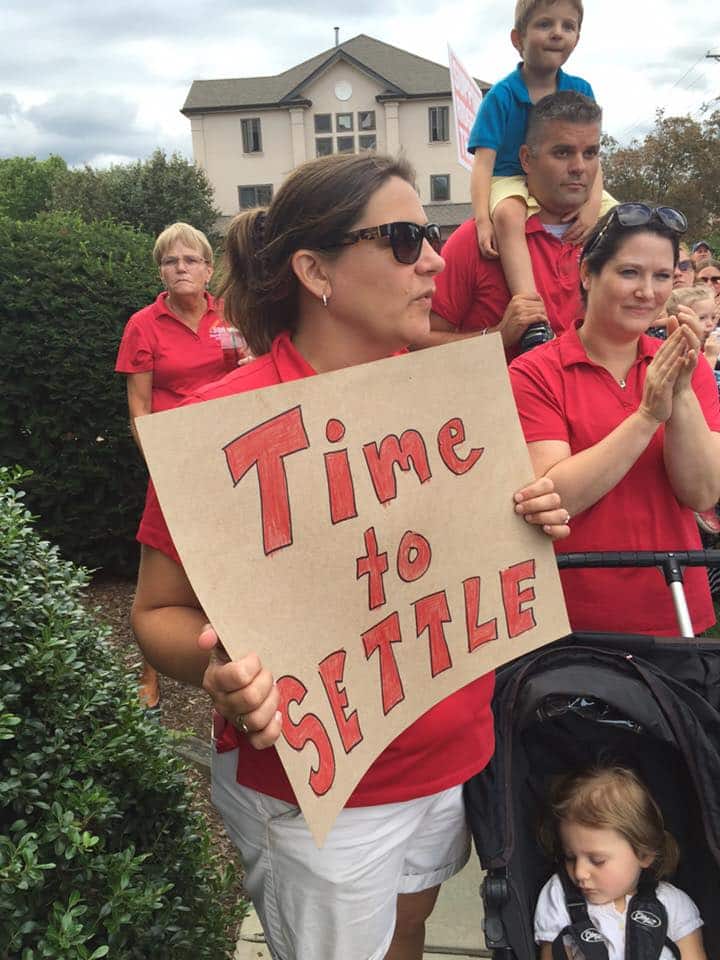
Ridgewood NJ, first day of school for students was marked by teacher contract protests . The Ridgewood Education Association held a rally at 4:00pm at the Ed Center. The REA was hopping to garner more support from parents and students and pressure the BOE to settle. The union has implied the possibility of a strike .
That evening a negotiation session was held the Board of Education members and the REA negotiating team met with the state-appointed super conciliator for ten hours. According to the BOE progress was made, but a settlement was not reached.
The BOE in a letter to parents also went to great lengths to assure parents that in New Jersey it is illegal for public employees to strike. A 1967 NJ Supreme Court decision, In Re Block, confirmed this. Since then, teachers in districts such as Manville and Middletown have tried to strike and have had the county courts grant injunctions stopping them. Some teachers were arrested for civil contempt in violating the court injunctions. The NJ Public Employment Relations Commission (PERC) has also re-affirmed that strikes are illegal and are not a protected union activity.
Ridgewood NJ, by all accounts last nights council meeting was very productive . In a major development Mayor Susan Knudsen publicly announced that the controversial proposed “revitalization” of Van Neste Memorial Park project has been suspended as of August 27,2016.
Now that your children have started the new school year, we wanted to provide you with information about the status of the contract negotiations with the Ridgewood Education Association (REA).
Last night, September 6, the Board of Education members and the REA negotiating team met with the state-appointed super conciliator for ten hours. Although progress was made, settlement was not reached.
While we strive to settle the contract, our teachers and support staff continue to be paid under the terms and conditions of the expired contract. Teachers and support staff will receive their full salaries and benefits without any interruption or reduction. Stipends paid to staff members hired as advisors to our clubs, sports and performing arts extra-curricular programs will also continue to be fully funded in accordance with the expired contract.
However, please understand that at this time, teachers may refuse to take on club advisory responsibilities. They also may refuse to volunteer in some activities that fall outside the contract. For example, they may refuse to chaperone overnight/after-school field trips. If such actions occur, your child’s principal or other administrator will communicate this information directly to you.
In conversations with parents, some have offered to volunteer and take over club and field trip responsibilities. Some activities can be sponsored or supervised by parents, while other can’t for various insurance and personal liability reasons. Your child’s principal is the best source of guidance on this topic.
Teachers and support staff may also choose to strictly adhere to their contractual 7.5-hour work day, as listed below in parentheses. To minimize any disruptions to our children or our programs, and to keep our school buildings running smoothly during this time, we are asking you to follow the designated drop-off and pick-up times:
• Elementary schools (8 a.m.-3:35 p.m.) o Drop-off time: not before 8:35 a.m. o Pick-up time: 3 p.m.
• Middle schools (7:45 a.m.-3:20 p.m.) o Drop-off time: not before 7:45 a.m. o Pick-up time: 2:55 p.m.
• High School (7:40 a.m.-3:15 p.m.) o Drop-off time: 7:40 a.m. o Pick-up time: 3:15 p.m.
Lastly, it is important to clear up any misconception that our teachers and secretaries can go on strike. In New Jersey it is illegal for public employees to strike. A 1967 NJ Supreme Court decision, In Re Block, confirmed this. Since then, teachers in districts such as Manville and Middletown have tried to strike and have had the county courts grant injunctions stopping them. Some teachers were arrested for civil contempt in violating the court injunctions.
The NJ Public Employment Relations Commission (PERC) has also re-affirmed that strikes are illegal and are not a protected union activity. The courts and PERC have consistently upheld the withholding of pay/benefits on days when teachers refuse to work.
While changes to activities may be an unfortunate reality during this period, it is important to stress that the Board of Education is committed to finalizing a contract that fairly compensates our teachers without jeopardizing the financial integrity of the district.
We are scheduled to meet again with the super conciliator on September 12 at 6:30 PM. Thank you in advance for your patience and understanding as the Board works through this process to finalize a labor contract.
Ridgewood Board of Education Sheila Brogan, President Vince Loncto, Vice President Christina Krauss Jim Morgan Jennie Smith Wilson
file photo by Boyd Loving Sen. Menendez at Ridgewood Train Station
September 6, 2016 6:53 PM
BURLINGTON COUNTY, N.J. (CBSNewYork) — Sen. Bob Menendez, D-N.J., is under fire again as he is accused of playing a staged role duringHillary Clinton’s Benghazi hearings.
CBS2’s Christine Sloan reported conservative group Citizens United said new emails it just obtained suggest that question was staged.
The first question Menendez – the acting chairman of the Foreign Relations Committee then – asked Clinton was, “Can you give us your insights on the decision making process regarding the location of the mission and as part of that can you also in your response – and you touched upon it in your opening statement – what actions were you and your staff taking on the night of Sept. 11 and the 12?”
Citizens United claims an email between a senior aide to the Democratic presidential nominee and Chelsea Clinton reveal that the question was staged.
The email reads, “We wired it that Menendez would provide an opportunity to address two topics we needed to debunk (her actions/whereabouts on 9/11 and these emails from Chris Stevens about moving locations).
It’s Not #CreepyClowns that Parents Should be Worried About
There’s been a lot of talk about creepy clown sightings these days. It’s true. Recently in both North and South Carolina, there have been reported sightings of, for lack of a better term, creepy clowns prowling around neighborhoods, scaring children. Some reports claim that these clowns could be a publicity stunt while others claim that these people have a much more sinister intent, which is supported by reports of some attempting to lure kids closer with money.
Well, we know that there are a lot of good, hard-working clowns right here in Jersey. Heck, you might even work with one or two (wink). Of course, it’s probably their part-time job, unless you all work for a circus. With that being said, we’re happy to report no suspicious or creepy clown activity here in Jersey
But these recent event gives us an opportunity to talk about safety tips that you can give your kids. After all, the kids are back in school, which means many are walking to and from home. You see, a scary-looking clown beckoning children closer may be all that is needed to have your child do the right thing, which is to walk in the other direction. It’s the unassuming person, man or woman, who your child should be wary of. Here are some tips:
*Talk to your kids
*Tell them who they can expect to come and get them in an emergency (family member or close friend)
*When walking to school, there is strength in numbers—walk in a group
*Never get into a stranger’s car
*Keep a safe distance from strangers asking for directions or help
*Tell your kids to yell, scream and kick if grabbed by a stranger
*Look around, stop looking for Pokemon—be aware of your surroundings
*If a stranger claims to be a cop but is not in uniform, kids should find a trusted adult
Let’s talk about that last tip for a minute. Are your kids familiar with the faces of the local police? Don’t just rely on the cops visiting schools. Drop by a station anytime to have your kids meet the troops or local police who patrol your area! It’s a great way get to know the troops and for the troops to get to know you and your kids!
For all of the coulrophobics out there, we apologize for the pic, but it was necessary. Sadly, at the end of the day, if all of the bad people out there stuck out as much as a person dressed as a clown, we wouldn’t have write posts like this.
Hillsdale, Mich, Hillsdale College is one of the nation’s best institutions for undergraduate education, according to The Princeton Review. The education services company features the College in the 2017 edition of its flagship college guide “The Best 381 Colleges,” published August 30, and cites the College as being one of the best in the Midwest.
“Hillsdale’s commitment to teaching not only the ‘what’ but also the ‘how’ and ‘why’ is rare in American colleges and universities today,” said Dr. David Whalen, provost of Hillsdale College. “But our inclusion among The Princeton Review’s ‘Best 381 Colleges,’ as an institution who accepts zero federal or state dollars, is further evidence that a classical liberal arts education is the best preparation for students to meet the challenges of modern life.”
In addition to profiling the nation’s 381 best colleges, The Princeton Review produces lists of the top 20 colleges ranked in various categories. Hillsdale College appeared on several of these lists, including:
No. 1 on Future Rotarians and Daughters of the American Revolution (DAR)
No. 6 on Professors Get High Marks
No. 9 on Best College Newspaper
No. 15 on Students Most Engaged in Community Service
The Princeton Review also calculates ratings in eight categories based on institutional data it collected during the 2015-16 academic year and/or its student survey for the book. The ratings are based on a scale of 60 to 99. Hillsdale College scored:
97 for Professor Accessibility
99 for Professor Interest
93 for Academics
92 for Quality of Life*
In its profile of Hillsdale College, The Princeton Review notes that admission “is a privilege extended to students who will benefit from, and contribute to, the academic, social and spiritual environments of the College. Important determinants for admission are intellectual curiosity, ambition, leadership and volunteerism.”
Published annually since 1992, the ‘381 Best Colleges’ list includes detailed profiles of the colleges with rating scores for all of the schools in eight categories based on The Princeton Review’s surveys of students attending the colleges.
About Hillsdale College
Hillsdale College, founded in 1844, has built a national reputation through its classical liberal arts core curriculum and its principled refusal to accept federal or state taxpayer subsidies — even indirectly in the form of student grants or loans. It also conducts on outreach effort promoting civil and religious liberty, including a free monthly speech digest, Imprimis, with a circulation of more than 3.5 million.
About The Princeton Review
The Princeton Review is a leading tutoring, test prep and college-admission services company. Every year, it helps millions of college- and graduate school-bound students achieve their education and career goals through online and in-person courses delivered by a network of more than 4,000 teachers and tutors, online resources and its more than 150 print and digital books published by Penguin Random House.
Trenton NJ, As many New Jersey students head back to school today, Governor Christie visited Grover Cleveland Middle School in Caldwell to act upon seven bills focused on improving education in the state.
“Over the last six years, my administration has prided itself on engaging in education reform to make sure our schools are safer, more effective, and facilitating the success of our students,” said Governor Christie. “Providing and ensuring a high quality education for every student in every corner of this state is a firm commitment of mine and it is why I continue to support and bolster education in the Garden State.”
For the last two months, Governor Christie has traveled the state talking about his Fairness Formula, which would change the school funding formula to provide equal funding of $6,599 per enrolled student, while continuing aid for special needs students and at the same time providing much-needed property tax relief to municipalities.
The Governor’s fiscal year 2017 budget spends more than $13.3 billion on education, an increase of $548 million from fiscal 2016, continuing a six-year commitment to providing the highest amount of school aid in New Jersey history.
The state’s high school graduation rate continues to increase. In 2015, the rate was 89.7 percent, up from 88.6 percent in 2014, the fourth straight year that the statewide high school graduation rate increased and the third consecutive year in which it grew by at least a full percentage point.
Other education accomplishments include reforming teacher tenure rules, greatly expanding charter schools, and establishing Renaissance schools under the Urban Hope Act.
The bills the Governor acted on today include measures to enhance school security and early intervention in situations where students exhibit behavioral or learning problems, and that will ensure that substance abuse instruction for students encompasses the latest research and best practices. Governor Christie has also signed two bills focused on higher education, to increase transparency and enable public colleges and universities to save money by engaging in cooperative purchasing agreements. Specifically, the Governor took the following action on the following pending legislation:
BILL SIGNINGS:
S-2081/A-3790 (Ruiz, Turner/Vainieri Huttle, Wimberly) – Limits expulsions and suspensions for students in preschool through grade 2 with certain exceptions; requires early detection and prevention programs for behavioral issues in preschool through grade 2
A-2292/S-372 (Vainieri Huttle, Benson, McKnight, Gusciora, Lampitt, Wimberly/Codey, Allen) – Requires review of Core Curriculum Content Standards to ensure guidance for substance abuse instruction provided to public school students incorporates most recent evidence-based standards and practices
A-2563/S-1753 (Jasey, Singleton, Wimberly, Danielsen/Turner) – Directs institutions of higher education and proprietary degree-granting institutions to provide Higher Education Student Assistance Authority with graduation and transfer rates of State tuition aid grant recipients
A-2566/S-496 (Jasey, Wimberly/Ruiz, Turner) – Establishes Response to Intervention initiative in DOE to support and encourage school districts in implementation of Response to Intervention framework
A-2689/S-754 (Schaer, Prieto, Lagana, Lampitt, Vainieri Huttle, Eustace, S. Kean, Auth, Quijano, Wimberly/Beach, Gordon) – “Secure Schools for All Children Act”; establishes State aid program for security services, equipment, or technology to ensure safe and secure school environment for nonpublic school students
A-3405/S-1822 (Coughlin, Schaer, Jasey, Benson/Sarlo, Cunningham) – Permits certain public institutions of higher education to make purchases and contract for services as participating contracting units in cooperative pricing systems and through use of nationally-recognized and accepted cooperative purchasing agreements
BILL VETOED:
S-86/A-3629 (A.R. Bucco, Sweeney/A.M. Bucco, Rible, Singleton, Caride, Moriarty, Schepisi, Wimberly) – CONDITIONAL – Establishes Class Three special law enforcement officers to provide security in public and nonpublic schools and county colleges