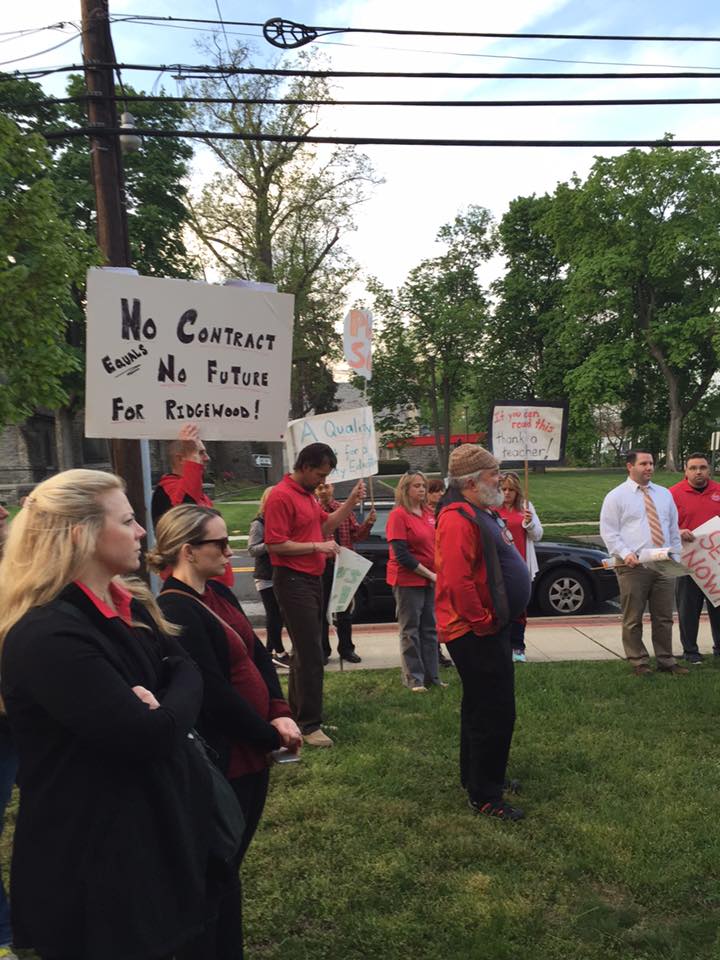
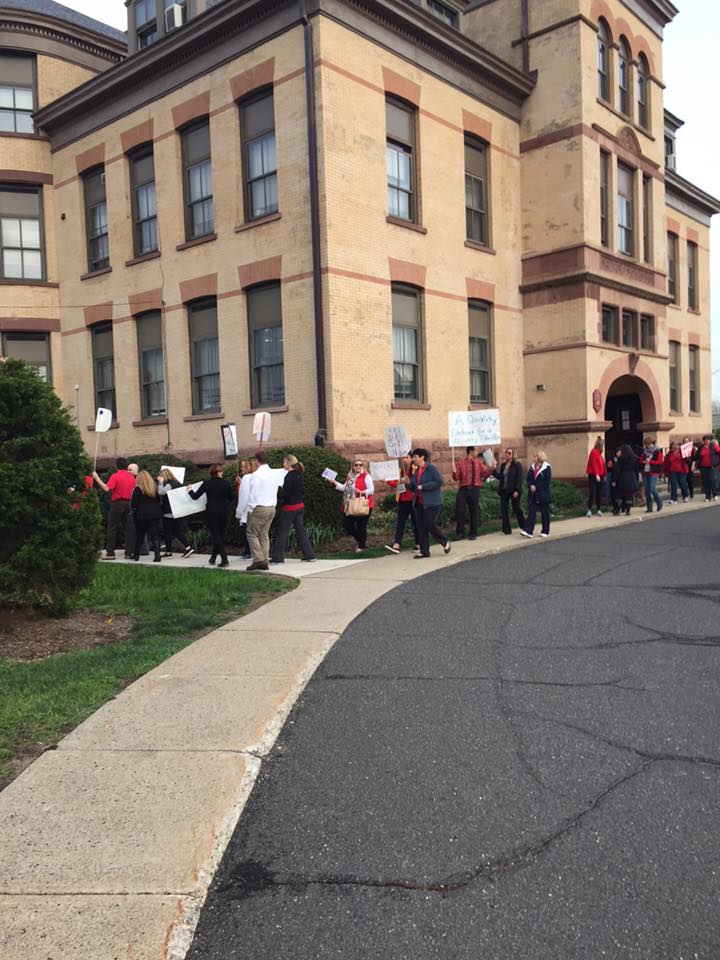
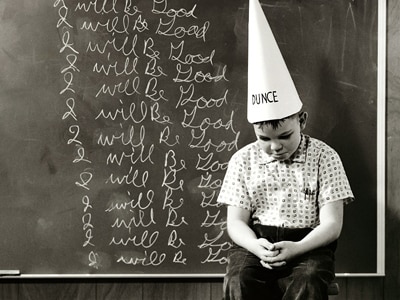
The median HOUSEHOLD incomes in Ridgewood are $138,000… teachers work for 10 months a year with tenure in many cases, so if you annualize teacher pay for 12 months work, they get paid paid the same as an entire household at the median in Ridgewood, i.e. $118,000 for 10 months = $136,000 for 12 months, with the added safety of tenured job security. Add in:
1) taxpayer subsidized $28,000 annual family “platinum” health benefit plan, which is much better than the average private sector employer plan (equivalent to “bronze”), and has much lower premiums, $5-10 co-pays, and covers up to 96% of all billable costs; as well as,
2) defined benefit pension plans for life which TPAF members contribute less than 7.5% of their annual wages towards (still!) and start drawing at an average age of 62 in NJ which can be worth over $2 million if the retiree lives to average US lifespan; and,
3) sick leave which gets carried over year after year instead of the “use it or lose it” sick leave offered by private sector employers
It becomes very clear that teachers have a MUCH better deal than the median Ridgewood household, which pays much higher health plan co-pays and deductibles for less health benefit coverage (on average, private sector plans only cover 84% of medical expenses), loses unused sick leave that cannot be carried over, runs the risk of job loss, and contributes up to 16% of their annual wages towards defined contribution pension plans, i.e. 401(k) plans. Combined teacher benefits are already too high even for well qualified, experienced, certified, professionals… which, by the way, is not what we got from the REA in the 2015/16 academic year. We got petulant, greedy, bad faith, so-called professionals who let our kids and schools down in a multitude of ways, from recommendation letters, to after school programs and activities, to community outreach. Notice the lack of signs supporting teachers in Ridgewood; we’ve had enough.
Ridgewood NJ, Ridgewood Schools had 3 teachers listed on the Department of Educations list of teachers in the $100,000 per year club.
The three Ridgewood teachers all make $116,173 annually. They are:
DEBELLA, MARGARET SCHAEFER
SCHAEFER, RICHARD MCNAMEE
MCNAMEE, HAROLD NELSON
The Department of Education releases this annual list of teachers and their salaries. The list of educators making joining the $100,000 club has grown . Over a decade ago the list barely had any teachers on it now has grown to more than 5,000.That’s only a tiny fraction of the more than 90,000 people who teach in public and charter schools in this state. The highest earners come from all different schools and not just the so-called “wealthy” districts that routinely rank highly on national and state lists for best schools.
BOE Meets on July 18 at 5 p.m.
Ridgewood NJ, The Ridgewood Board of Education will hold a Regular Public Meeting on Monday, July 18, 2016 at 5:00 p.m.The meeting will be held in the Board Room at the Education Center, 49 Cottage Place. The public is invited to attend the meeting or view it live via the district website at www.ridgewood.k12.nj.us using the “Live BOE Meeting” tab on the district website, or on Fios tv channel 33 or Optimum 77.
Click here to view the agenda for the July 18, 2016 Regular Public Meeting.
Click here to view the 2016-2017 Budget presented at the May 2, 2016 Regular Public Meeting.
Click here to view the Full Day Kindergarten Recommendation presented to the Board at their March 7, 2016 Regular Public Meeting.
Ridgewood NJ, The New Players online box office will close at noon on Thursday July 14th at noon for the July 14 at 8 performance of Prelude to a Kiss and at
noon on Friday July 15 for all other performances this weekend. Tickets will be available for purchase at the box office starting 30 minutes before the start of each performance.
RHS New Players Present:
Prelude to a Kiss by Craig Lucas
July 14 at 8 and July 16 at 8
Tickets go on sale on June 30 at 7:00 p.m.
Click here for tickets: Prelude tickets
Taxes are too high, why are we paying $102mn a year for schools that aren’t living up to their reputation? The teachers are a huge part of the problem here, and their “bad faith” negotiations are only making things worse. Why do they deserve better health care benefits, i.e. lower co-pays, than the taxpayers subsidizing their plans?
These teachers have lost so much credibility in our community through their actions/inactions, words, and greed. They’re riding the reputation of excellence despite not being excellent themslves – time for new educators who actually want to work with our students and help them.
This commentator is aware of a long-tenured RHS teacher in an important academic subject (won’t get any more specific than that) that was on full mail-it-in mode all year, for no good reason. Near the end of the year, it got even worse. The teacher’s students suffered needlessly, particularly grade-wise. Like, all of them. We need new blood. Teacher misbehavior in light of this contract dispute has gotten out of hand in terms of its spitefulness. Ridgewood residents and taxpayers should not allow themselves to forget this…
it’s even worse than that. The teachers recruit our own kids to fight their proxy war through indoctrination. I read a recent article in the paper about the various ‘Teachers of the Year’ nominated by students. One of Ridgewood’s teachers was complaining how anti-teacher it was in his school instead of being thankful for the nomination. He can always go to another district if he doesn’t like his six-figure 10 month job.
Many people in New Jersey do not understand the archaic formulas which drive state funding for our schools and the vastly different property tax results in our respective municipalities. Under the New Jersey Constitution, it is mandated that students be provided a thorough and efficient education. That phrase has been thrown around conveniently in defense of an inequitable formula that is too expensive to fund with results that scream failure. New Jersey needs a fair funding formula that fixes the problem, and Bergen taxpayers need real property tax relief.
A few weeks ago, Governor Christie proposed a formula that would provide equal funding on a per student basis. This new formula, called the fairness formula, is nearly identical to what I have introduced since 2012. The majority in the legislature wants to continue with a failed system, which has disproportionately and negatively impacted 69 out of 70 communities in Bergen County. What the Governor and I have proposed will fix the problem.
Under the proposed fairness formula, state aid would be $6,599 per pupil with additional funding provided for students with special needs. No student will be regarded as worth more than another. The state has thrown billions of dollars at underperforming districts for years and the situation hasn’t improved. The time is now that we face reality and provide fair funding for every student in the state and stop strangling taxpayers to fund failure.
One of those former Abbott districts is Passaic City. With only around 10,000 public students, it receives more money than all 70 municipalities combined in Bergen, which has approximately 250,000 students. Further, overfunded municipalities often use that money to pay for things other than students, such as Elizabeth which in 2015 spent more per student on legal and consulting fees ($237 per pupil) than on textbooks and supplies.
In comparison, Pascack Valley Regional High School District is rated the eighth best school district in New Jersey with a graduation rate of 98 percent, while receiving only $550 per student (a number only slightly higher than what Elizabeth spent on legal and consulting fees). The average property tax in Bergen County is well over $11,000. As a result of these increasingly high property taxes, Bergen County has found itself in recent years with one of the highest rates of foreclosures, pre-foreclosures and personal bankruptcies. On the flip side, Camden High School has only a 46 percent graduation rate and yet receives over $30,000 per student. The average property tax in Camden County is only slightly over $6,000. Other than a handful of exceptions, towns in Bergen and Passaic counties have carried the brunt of increasing property taxes, yet they have received the least amount of funding in the entire state.
This lopsided school funding formula is indefensible. Bergen and Passaic homeowners are paying sky high property taxes to fund a school district on the opposite side of the state that can’t graduate half of its students. What makes the students in Camden worth sixty-times more than a student who goes to Pascack Valley or any other school district in Bergen or Passaic? What makes 10,000 school age children in Passaic more valuable than every school district in Bergen County combined? The answer: court mandates on how the state should spend its money.
The state Supreme Court ruled in the Abbott v. Burke decisions that most money should be distributed to districts that have demonstrated an inability to provide educational excellence. The consequence has been diverting money from districts that pay through the nose for education to districts that don’t; such as Bergen paying for Camden. Diverting these funds has resulted in higher property taxes for districts that want to maintain the educational excellence they have achieved. In some cases the towns with diverted funds have large retiree populations, robbing senior citizens of their savings and the value of their homes.
The Corzine school funding formula the court approved has resulted in failure. The court ruled that nearly sixty percent of school funding provided to only 5 percent of school districts satisfies a constitutionally thorough and efficient education. This unfair formula has increased property taxes across the state and has failed to effectively educate the students in districts that cost the most taxpayer dollars. All the while, student enrollment in the former Abbott districts has decreased as funding has increased.
When schools are funded on a per pupil basis, taxpayers benefit. School funding will increase nearly 500 percent in Bergen and Passaic with the fairness formula, while average property taxes will be reduced by over $2,000. When schools aren’t funded on a per pupil basis, $5.1 billion goes to 31 districts and $4 billion goes to 546 districts. The fairness formula will equitably spend $9.1 billion across all 577 districts, without any property tax discrimination based on educational excellence. Any legislator representing these counties who does not support this fair and balanced approach is failing to represent their own constituents.
Providing funding equally on a per pupil basis will level out the playing field and decrease property taxes across the state. Extra aid will only be provided to make sure we take care of our special education students who need the extra help to get by. Three out of four school districts in the entire state would see an increase in aid, 69 out of 70 municipalities in Bergen County would see an increase in aid. That means 69 Bergen County towns will see a reduction in property taxes, providing much needed relief.
The current school funding formula has been a disaster that drives up property taxes and does nothing to help failing school districts reverse the course. The fairness formula will provide fair funding. Opponents to the idea will holler that it is unconstitutional. If that is their only concern, I have sponsored a resolution since 2012 (ACR35) amending the constitution to provide a thorough and efficient education on a per pupil basis. The current formula is an indefensible failure, if the constitution is the only concern, then pass my resolution and the fairness formula.
Attention Deficit Hyperactivity Disorder, or ADHD, “is a prime example of fictitious disease,” said Leon Eisenberg, the “scientific father of ADHD,” shortly before he passed away at the age of 87 in 2009.
Why would Eisenberg claim that a condition we’ve come to know so well is largely fictitious? While many have said that Eisenberg’s statement is highly exaggerated, it turns out that numerous doctors are finding conclusive evidence that ADHD is being “over-diagnosed” due to inaccurate diagnostic methods.
Jerome Kagan, a leading expert in child development, says:
“Let’s go back 50 years. We have a 7-year-old child who is bored in school and disrupts classes. Back then, he was called lazy. Today, he is said to suffer from ADHD (Attention Deficit Hyperactivity Disorder). . . . Every child who’s not doing well in school is sent to see a pediatrician, and the pediatrician says: “It’s ADHD; here’s Ritalin.” In fact, 90 percent of these 5.4 million kids don’t have an abnormal dopamine metabolism. The problem is, if a drug is available to doctors, they’ll make the corresponding diagnosis.”
Ridgewood teachers are some of the highest paid in the entire State. We all want raises and better health care from our employers but most of us are just happy to have a job now. In fact if anyone I know behaved the way these protesting teachers have been they would be fired. The teachers don’t seem to understand that things are not great for a lot of people since the recession and recovery has been slow. Those who enjoy the security of tenure, and automatic raises can’t seem to grasp what is going on for so many of us struggling to pay our taxes. Hold the line BOE. Teachers unhappy with their jobs in our school system should look elsewhere. We don’t need malcontents in our classrooms and there are a lot of people who would be very happy to have their jobs..
RIDGEWOOD — A state-appointed super conciliator will try this month to settle a labor dispute between the Board of Education and the district teachers’ union that’s left teachers working without a contract for more than a year.
There have been a number of disagreements throughout the 18 months of negotiations. But arguments over salaries, proposed changes to the union’s insurance plan and how much Ridgewood Education Association members must contribute to their health-insurance premiums have created deep rifts that two previous state mediators were unable to patch.
How Christie’s school funding plan could affect your property taxes
Gov. Chris Christie’s proposed school funding overhaul could produce property tax relief from as much as $4,500 for the average homeowner in Glen Ridge to a little as $5 on average in Mount Ephraim, according to state data. Stephen Stirling and Adam Clark, NJ.com Read more
Ridgewod NJ, The application deadline for the district’s pilot integrated preschool program has been extended to Friday, July 29. The preschool program will be taught by a dual-certified K-2 General Education and Special Education teacher. The program will strive to engage special needs and general education preschoolers in learning experiences through play in an integrated learning environment that employs a developmental approach. Children are engrossed in a variety of activities which promote language, cognitive, motor and social/emotional development. Special education children are placed in the program through an evaluation process performed by the Special Programs Department.
Click here for more information and the application form.
the staff of the Ridgewood blog
Ridgewood NJ, The Ridgewood Board of Education will hold a Regular Public Meeting on Monday, July 18, 2016 at 5 p.m.The meeting will be held in the Board Room at the Education Center, 49 Cottage Place. The public is invited to attend the meeting or view it live via the district website at www.ridgewood.k12.nj.us using the “Live BOE Meeting” tab on the district website, or on Fios tv channel 33 or Optimum 77.
Click here to view the agenda and addendum for the June 28, 2016 Regular Public Meeting.
Click here to view the minutes of the June 6, 2016 Regular Public Meeting.
Click here to view the 2016-2017 Budget presented at the May 2, 2016 Regular Public Meeting.
Click here to view the Full Day Kindergarten Recommendation presented to the Board at their March 7, 2016 Regular Public Meeting.
I like the idea of a referendum on the teachers contract, so long as it’s binding. We had great teachers and administrators who built up the reputation of Ridgewood schools. The current bunch? Meh. They seem to care more about their health benefits than our kids. If you witnessed their behavior this past school year you’d agree they’ve done nothing to carry on the “tradition of excellence”. More like “riding on the coat-tails of the reputation built by the predecessors.” They are trying to bully us with the backing of NJEA lawyers and lobbyists. We need to support our BOE and students, if only they elicited the same grassroots support that the we’ve seen opposing the most recent garage proposal and Valley!
photo courtesy of the Ridgewood High School Alumni Association
Dear RHS Alumni,
On June 20, 2016, Ridgewood High School graduates 424
seniors. As members of the Ridgewood High School Alumni Association (RHSAA), we are thrilled to have them join our ranks. We would like to wish our graduates the best of luck and good fortune in their ongoing pursuit of a “tradition of excellence” in college or their choice of post-graduation endeavors.
We would like to take this opportunity to fill you in on some of the steps the RHSAA has taken since our inception in 2014.
The RHSAA is now a 501(c)(3) nonprofit recognized by the state
of New Jersey. We are an active and dynamic board of alumni spanning graduating classes from the 1950s to the 2000s.
Since our website launched, we have had thousands visit the site and many alumni have registered via our online portal.
The reunion subcommittee has connected with dozens of class
years to help them plan alumni events, including campus tours. If you have an upcoming reunion, please let us know.
Our apparel team has created t-shirts (which will be featured
as Project Graduation’s Gift to all seniors). We have also added
umbrellas, blankets and hats. We are working on version 2.0 of apparel for the upcoming 2016-2017 academic year.
This past March, the RHSAA revitalized the Distinguished Alumni
program and introduced five new inductees who represent some of the best and brightest of RHS graduates. They joined the twelve previously inducted in 2008.
We will also be launching a brick buying campaign in an effort
to beautify our already lovely RHS campus and to celebrate our 125th anniversary in 2017.
If you are interested in supporting any of these programs or
otherwise supporting the RHSAA, please make a donation via our website.
If you would like to volunteer to help the current and future students of RHS, we would love for you to join our team.
BY HILLSDALE COLLEGE ONLINE COURSES APRIL 24, 2015
According to Professor Kenneth Calvert, Common Core, well-intentioned from the beginning, will utterly fail its students. Rather than raising the educational standard in the United States, it codifies and federally enforces mediocrity. Worse yet, in regulating education the federal government has overstepped its constitutional boundaries, by attempting to control teaching methods, preventing teachers from exercising their craft effectively.
The following video is a clip from Q&A 5 of Hillsdale’s Online Course: “A Proper Understanding of K-12 Education: Theory and Practice,” featuring Kenneth Calvert, Associate Professor of History and Headmaster of Hillsdale Academy, and John J. Miller, Director of the Dow Journalism Program.
Transcript:
John J. Miller:
What do you think of Common Core?
Kenneth Calvert:
Common Core is one of these well-intentioned pieces of legislation in which the federal government is trying to do something for children. They’ve perceived that children are behind the rest of the world and so let’s create a national legislation that’s not going to be forced on states, but we’ll give them money, and the states will take it. It’s just wrong-headed in so many ways. Number one, it’s unconstitutional. From the get-go there is nothing constitutional about the federal government getting its hand into education. Number two, it doesn’t do what they want it to do.
[The Federal Government] wanted to raise standards in their minds commensurate with, equal with, world standards. Neither the literature nor the science or the math standards come anywhere near that. What Common Core has ended up doing is creating, basically, what they considered to be, the lowest common denominator, the average point which students can be expected to reach. In our school and from the Hillsdale perspective it’s our belief that if you hold the bar high, very few kids are going to get there, but most of these kids are going to get beyond anywhere they ever thought they would get, that they would actually achieve higher goals than they thought they could.
By keeping the bar low, by keeping it at this kind of average, you have doomed [students] to a low level of education. They never know how far they can go. We think that it lowers the bar. It lowers the expectations.
It also does not allow teachers to be teachers. Teachers in the Common Core are teaching to tests. Much of the curriculum more and more is becoming scripted so that can’t have a Socratic dialogue, a give and take where most of the real education actually takes place.
Teachers are being robbed of their calling, of their discipline. What you begin to create here in a number of these efforts of the Federal Government to create new educational legislation, what you’ve done is begin to create bureaucrats in the classroom rather than real teachers. I’ve met teachers in public and private and charter schools who are looking at what’s coming down the pike, and they are not happy. More and more, especially some of the older teachers, they will tell me that what they used to be able to do twenty years ago, which was exciting, enlivening, and drawing out a love of the life of the mind in their students—all of that is beginning to disappear.
It’s well-intentioned legislation, right? We know what good intentions lead to. It is not to the right place. We need to give our teachers, our schools–public, private, charter–greater freedom to be what they need to be. This also demands that our teachers be highly educated, learned, true experts in their areas. They need to be the ones in the classrooms really bringing out this love of learning and love of the life of the mind in these young ones. Honestly, we’re not doing a lot of that right now either.