Eight partners of a politically active New Jersey law firm are accused of illegally funneling about $8,000 in political contributions to state and local candidates and committees through the firm’s associate attorneys. Samantha Marcus, NJ.com Read more
Opposition persists among most New Jersey residents to raising the tax on gasoline even if it means they’ll get a break in death taxes. Associated Press Read more
With an election for New Jersey Assembly two weeks away, the numbers don’t look good for the fiscal reform urgently needed in Trenton.
The staggering $194 billion liability for public employee pension and health benefits is seldom debated in campaigns for the 80 Assembly seats up for grabs on Nov. 3.
The status quo is a 47-32 advantage for Democrats over Republicans with one seat vacant – a balance not likely to change much. The incumbents have outspent challengers $10 million to $2.2 million, according to a report by a New Jersey election commission.
Even more lopsided, incumbents enjoyed a 10-to-1 cash-on-hand advantage – $5.2 million to $496,000 – over their opponents, as of Oct. 2.
That big edge in campaign finances helps them run for re-election while running away from their failure to solve New Jersey’s fiscal dilemma. The Assembly has been in recess since June – a spell approaching four months.
“The situation is not only getting worse, but is fast approaching a point at which it will be beyond remedy,” warned Gov. Chris Christie’s bipartisan, blue-ribbon Pension and Health Benefit Study Commission in a report released in February.
Keeping benefits at their current level would require a 29 percent hike in state income taxes or increasing the sales tax to 10 percent, the study estimated.
“The already narrow window for a reasonable solution is closing fast. Only decisive action now can preserve a solid foundation of public employee benefits before the ever-growing hole the state has dug itself into becomes too deep for the state to dig itself out of without crushing tax increases and deep cuts to employee benefits and public services,” the commission stated.
That was eight months ago. Since then, Christie and lawmakers have failed to realign New Jersey’s costly benefits to a level comparable to what private-sector employers offer their workers.
Now the unfunded liabilities have reached a staggering $194.5 billion, according to aNew Jersey Watchdog analysis of State Treasury records. Here’s a breakdown of that debt:
New Jersey’s public pensions are underfunded by $113.1 billion. The state bears $80.5 billion of that burden. Local governments are responsible for the remaining $32.6 billion. State and local governments are also on the hook for $81.4 billion in unfunded health benefits for retired and active workers. The state owes $65 billion; the local share is $16.4 billion. The total shortfall is nearly six times higher than New Jersey’s total annual budget, currently $33.8 billion. To wipe the liability clean, each household in the state would need to write a check for more than $60,000 per household.
At the present pace, the shortfall for public employee pensions and health benefits will exceed $210 billion next year.
“That, in brief, is New Jersey’s future without meaningful public employee benefits reform – a future that is bleak, burdensome and unacceptable to everyone,” the commission concluded.
None of the New Jersey Senate’s 40 seats are on the Nov. 3 ballot. The next statewide election will be in 2017, when Christie’s second and final term expires.
OCTOBER 18, 2015, 11:48 PM LAST UPDATED: MONDAY, OCTOBER 19, 2015, 9:03 AM
BY DUSTIN RACIOPPI
STATE HOUSE BUREAU |
THE RECORD
The biggest challenge candidates for the New Jersey Legislature may have is not persuading people to vote for them, but convincing people that there’s an election this November.
And it’s an election that may prove historic — a possible record high for money spent by the campaigns and super PACs, and a possible record low for voter turnout.
For the first time since 1999, all 80 seats in the Assembly top the ballot. But most eyes are on the 2016 presidential race, and off-year elections are “notoriously” known for little voter interest and lackluster crowds at the polls, said Ashley Koning, assistant director of Rutgers University’s Eagleton Center for Public Interest Polling.
Yet a fierce battle costing millions of dollars is being waged by candidates, committees and super PACs in a few legislative districts, including Bergen County’s District 38, where one of the candidates still on the ballot resigned in disgrace over a raunchy book he self-published 12 years ago.
A long-awaited report from a commission formed in the wake of the Sandy Hook Elementary School shooting in Connecticut recommends reforms to the state’s mental health programs to help curb violence. S.P. Sullivan, NJ.com Read more
Like many newlyweds, Matthew and Nazia Stevens searched for the best home to start their life together. They visited house after house in pursuit of a serene and secure setting for the children to come. The home would be close to work, close to family — all perfect for a lifetime of happiness. Paul D’Ambrosio, Asbury Park PressRead more
What would you say if you found out New Jersey taxes just went up $540 million? Surprise! They have. And they will grow by a half-billion dollars each year because of the state’s highest-in-the-nation property tax — even with the 2 percent cap. State and local leaders have run away from cutting this burden on homeowners. Why? Who profits from your tax misery? Why is this tax driving people out of state? Paul D’Ambrosio, Asbury Park Press Read more
SOMERSET, N.J. — Former state Assemblyman Robert Schroeder of Washington Township, who is accused of writing millions in bad checks, may go on trial in March 2016, according to a report in NJ Advance Media.
Schroeder, a Republican from Bergen County, appeared in court Friday, Sept. 25, for a status conference, NJ Advance Media reported. He is due back in court for another conference on Dec. 11, the report said.
The 55-year-old served in the 39th Legislative District for two terms. The district now includes parts of Bergen and Passaic counties, the media outlet reported.
According to NJ Advance Media, Schroeder has been charged with stealing close to $1.9 million from people who loaned him money for his private businesses and also with writing more than $3.4 million in bad checks. He also faces misconduct charges, the report said.
Meanwhile NJ Taxpayers can not even get New Jersey Division of Taxation to respond to a phone call ?
When United Airlines abruptly cancelled service out of Atlantic City last year after only eight months, the airline was on the hook to repay $104,000 in public subsidies provided in exchange for a promise to run flights to the struggling casino town for at least one year. Shawn Boburg, The Record Read more
Two things are clear. One, the state’s worst problem, by far, is a growing budget shortfall that leaves it unable to fund the outsized pension promises made by politicians. Two, elected leaders won’t even start trying to address that problem until residents make them do so by demanding proposals, voicing their preferences and voting for those taking action. The Press of Atlantic City Read more
The leadership of Camden came out to hear the announcement. Mayor Dana Redd said it’s another step on the way to Camden’s becoming a world class city. Michael Aron, NJTV News Read more
Executive Order Builds On Ongoing Preparation Efforts & Ensures Officials Have All Tools To Ensure A Safe And Orderly Visit
Trenton, NJ – With an estimated 2 million visitors expected to gather in Philadelphia for the upcoming World Meeting of Families and Papal visit, Governor Chris Christie today signed an Executive Order that puts in place measures to manage the occasion, coordinate any requests for mutual assistance with neighboring governments, and ensure a safe and orderly visit for New Jersey residents and many thousands of visitors expected to travel through New Jersey for the occasion. In effect, the Governor’s Order provides emergency management, law enforcement, county and local officials with the tools needed for a secure and orderly visit of His Holiness Pope Francis.
“Given the Pope’s comprehensive schedule and the influx of people traveling to see him, the events associated with his visit span the normal State, county and municipal operating services,” said Governor Christie. “Managing this historic event requires the coordinated deployment of personnel and other resources to ensure the health, safety and resources of the citizens of New Jersey.”
The order, which will remain in effect until Tuesday September 29, 2015 at 8:00 a.m., provides officials with the authority to accommodate mutual aid requests as well as contraflow of traffic on roadways and, consistent with the deployment of the National Guard in Philadelphia, authorizes use of the New Jersey National Guard to support events as needed.
According to Philadelphia officials, it is estimated that as many as 2 million people will attend the World Meeting of Families and Papal Mass on the Benjamin Franklin Parkway in Philadelphia. With tens of thousands of visitors travelling through the southwest region of New Jersey to access Philadelphia, gridlock on roadways within a 50-mile radius around the City is anticipated. In addition, as many as 250,000 additional vehicles and thousands of buses will be travelling through New Jersey into Philadelphia.
New Jersey officials already have put transportation plans in place:
New Jersey ranks worst in the country for state debt, according to a new nationwide study.
Each state taxpayer would need to pay $52,300 to erase New Jersey’s existing bills — including public pensions and retiree health benefits — reports Truth in Accounting, a think tank in Chicago.
Among “sinkhole states,” New Jersey was followed by Connecticut, $48,600 debt burden per taxpayer; Illinois, $45,000; Kentucky, $32,600; and Massachusetts, $27,400.
In the past year, the debt per taxpayer in New Jersey increased by $16,300, or 45 percent, according to the nonprofit.
The findings are consistent with a New Jersey Watchdog analysis of State Treasury records that found the Garden State’s pension and health benefit deficit for public workers is nearing $200 billion.
Earlier this week, New Jersey Watchdog reported:
New Jersey’s public pensions are underfunded by $113.1 billion. The state bears $80.5 billion of that burden. Local governments are responsible for the remaining $32.6 billion. State and local governments are also on the hook for $81.4 billion in unfunded health benefits for retired and active workers. The state owes $65 billion; the local share is $16.4 billion. The total shortfall is $194.5 billion – more than $60,000 per household. The figure is nearly six times higher than New Jersey’s total annual budget, currently $33.8 billion.
At the present pace, those unfunded liabilities will exceed $210 billion next year.
In its report, Truth in Accounting reported states have a combined total of $1.3 trillion in debt despite balanced budget requirements in 49 states.
The lack of truthful, timely and transparent financial information is increasing cynicism and mistrust and it is a risk for our representative form of government,” said Shelia Weinberg, CEO of Truth in Accounting. “Citizens do not have the information need to hold their politician accountable, much less cast an informed vote.”
The full study is scheduled for release next week.
State governments have had a hard time restoring budget reserves since the last recession, and New Jersey remains among those struggling the most, according to new state-by-state fiscal data released by The Pew Charitable Trusts. John Reitmeyer, NJSpotlight Read more
Three-fourths of NJ sheriffs double-dip, led by 25-year ‘retiree’
By Mark Lagerkvist / August 30, 2015 / 6 Comments
For the past quarter century, Armando Fontoura has been looting a New Jersey state pension fund. But it won’t do any good to call the cops.
Fontoura is sheriff of Essex County. A dean among double-dippers, he draws $207,289 a year from public coffers – $144,896 in salary plus $62,393 from pension as a retiree of his own office.
Today is the 25th anniversary of Fontoura’s faux retirement. So far, he has collected $1.35 million in retirement cash without ever giving up his full-time county paycheck
On Friday, Aug. 31, 1990, Fontoura retired as county undersheriff at age 47. The following Monday, he returned to work at Essex County with the same salary and duties, but a different title – sheriff’s officer chief. One year later, he took charge as sheriff, a post he’s held ever since.
“Does it look bad? Yes,” admitted Fontoura. “No question about it, it looks bad. Was it legal? Yes.”
Worse for taxpayers, three-fourths of New Jersey’s county sheriffs – plus hundreds of other public officials – are taking advantage of pension loopholes to collect dual incomes.
A continuing New Jersey Watchdog investigation found the sheriffs in 16 of the state’s 21 counties are double-dippers. In addition, the sheriffs also employ 37 undersheriffs who returned to work after retiring as local, county or state law enforcement officials at relatively young ages.
In total, the 53 officers collect nearly $10 million a year from public coffers – $5.7 million in salaries plus $4.1 million in retirement pay – according to payroll and pension records.
By order of annual incomes, the double-dipping posse includes:
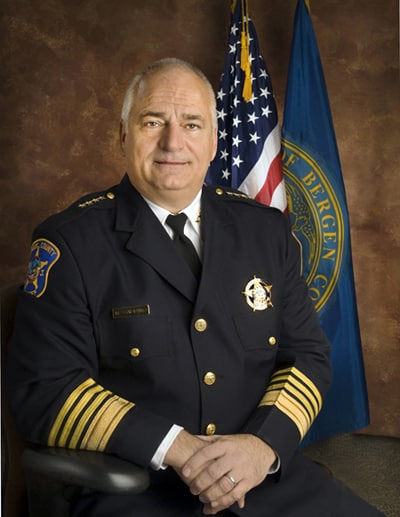
Bergen County Sheriff Michael Saudino (R), $267,987 – $138,000 salary + $129,987 pension as an Emerson Borough police retiree
Passaic County Sheriff Richard H. Berdnik (D), $253,957 – $151,887 salary + $102,070 pension as a Clifton police retiree
Ocean County Sheriff Michael Mastronardy (R), $231,315 – $107,250 salary + $124,065 pension as a Toms River Township police retiree
Mercer County Sheriff John Kemler (D), $227,330 – $142,499 salary + $84,831 pension as a Mercer County sheriff’s office retiree
Camden County Sheriff Charles J. Billingham (D), $219,232 – $144,753 salary + $74,479 pension as a Washington Township police retiree
Somerset County Sheriff Frank J. Provenzano (R), $208,576 – $132,555 salary + $76,021 pension as Bridgewater Township police retiree
Warren County Sheriff David P. Gallant (R), $208,432 – $125,945 salary + $82,487 pension as a State Police retiree
Morris County Sheriff Edward V. Rochford (R), $200,838 – $139,203 salary + $61,545 pension as a Morris Township police retiree
Middlesex County Sheriff Mildred S. Scott (D), $200,796 – $139,455 salary + $61,341 pension as a retiree of the Middlesex County sheriff’s office
Hunterdon County Sheriff Frederick W. Brown (R), $197,796 – $115,868 salary + $81,928 pension as a retiree of Raritan Township police
Salem County Sheriff Charles M. Miller, $195,452 (R) – $119,386 salary + $76,066 pension as a retiree of the Salem County prosecutor’s office
Gloucester County Sheriff Carmel M. Morina (D), $191,996 – $128,547 salary + $63,449 pension as a Greenwich Township police retiree
Sussex County Sheriff Michael Strada (R), $170,124 – $121,212 salary + $46,973 pension as Mount Olive Township police retiree
Cumberland County Sheriff Robert Austino (D), $166,938 – $107,250 salary + $59,688 pension as a Vineland police retiree
Cape May County Sheriff Gary Schaffer (R), $161,654 – $107,500 salary + $54,154 pension as an Ocean City police retiree.
Click here for the complete list of sheriffs and undersheriffs who collect pensions plus salaries.
New Jersey Watchdog began tracking double-dipping by sheriffs in 2011. The initial report found 16 sheriffs and 28 undersheriffs collecting a total of $8 million a year – $3.25 million from pensions plus $4.75 million in salaries.
Four years later, the tally has increased by nine undersheriffs and $1.8 million a year in total pay.
The investigative news site has also reported extensively on double-dipping by state legislators, administration officials, school superintendents, state police and the staffs of the attorney general and county prosecutors.
RELATED: ‘Seven deadly sins’ of New Jersey pensions
The millions being drained from retirement funds through double-dipping epitomize the woes of a pension system that faces $170 billion in underfunding – a point noted earlier this year by Gov. Christie’s blue-ribbon, bi-partisan Pension and Health Benefit Study Commission.
“It has great symbolic importance…as the double-dippers have become the ‘face’ of a dysfunctional public pension system,” the study concluded, citing New Jersey Watchdog’s reporting. “For this reason, the task force should consider ways to further limit this practice.”
Yet Gov. Chris Christie and the State Legislature have done little to halt the abuses that have profited well-connected Democrats and Republicans over the years.
One of the bigger beneficiaries is Sen. Fred Madden, D-Washington, a triple-dipper who receives nearly a quarter-million dollars a year – $85,272 from his state police pension, $113,810 as dean of law and justice of Rowan College at Gloucester County and $49,000 as a part-time state legislator.
“Obviously I don’t have a problem with people doing it,” Madden said in an interview with New Jersey Watchdog three years ago. “I’ve accepted that in my own personal life. I don’t have a problem with it at all.”
A bill co-sponsored by Sen. Jennifer Beck, R-Red Bank, would stop most double-dipping. It would suspend pension payments to retirees who return to public jobs paying more than $15,000 a year. The retirement benefits would resume when they permanently leave public employment.
“The pension system is intended to support you at a time you are no longer working,” said Beck. “So when you are an active employee, you should not be able to tap into both.”
The reform proposal has gone nowhere since it was first introduced in 2011 by Beck and Sen. Steven Oroho, R-Sparta. Its current incarnations – S-883 and A-114 – are trapped in legislative committees, unable to get enough support to reach the Senate or Assembly floors for votes.
Meanwhile, Fontoura is a heavy favorite to win re-election as sheriff in a Democratic stronghold that includes Newark. A victory would enable him to continue his double-dipping ways in Essex County for at least three more years.
“I retired, I collect my pension, and I am your sheriff,” Fontoura told NBC 4 New York, which partnered with New Jersey Watchdog for a report in 2012.
County personnel records show the retiring and rehiring of Fontoura had been plotted in advance. Then-sheriff Thomas D’Alessio approved the move on Aug. 7, 1990, more than three weeks before the switch.
“I said, as long as I can do this legally without breaking any law – and I can collect my pension and augment it with a salary — that’s fine, I will do this,” Fontoura recalled.
The sheriff’s office did not respond to a new request from New Jersey Watchdog for additional comment