Four years ago in Rochdale, when Gillian Duffy challenged Gordon Brown on immigration, the affronted prime minister shied away and muttered darkly about that ‘bigoted woman’. It is quite clear now who was the big
Are we all racist now?
As a survey of British social attitudes reveals a shocking upturn in prejudice, Allison Pearson argues that the political elite’s desire to advance multiculturalism with mass immigration has backfired…..
That was two months ago, and I wish I were more surprised to learn that a new British Social Attitudes survey has found that more than a third of Britons admit they are racially prejudiced. Prejudice fell to an all-time low in 2001, but the latest figures show that the problem has returned to the level of 30 years ago. More than 90 per cent of those who say they are racist want to see immigration halted. More interestingly, 72 per cent of those who do not consider themselves racist also want to see immigration cut drastically.
As shell-shocked politicians from the main parties struggle to discern the causes of Ukip’s deafening electoral success, here’s a tip: look in the mirror, chaps! It is politicians, not the British people, who are to blame for a resurgence in racism; politicians who have ignored public opinion and created the conditions in which resentments fester and grow. Specifically, though not exclusively, it is New Labour who welcomed workers from the new, accession countries of the EU at a time when countries such as France and Germany wisely exercised their right to keep them out for another seven years. According to Jack Straw, this was a “spectacular” error. And Jack should know, because he was Home Secretary at the time. The plan of Tony Blair’s government, as laid bare by Andrew Neather, then a Blair speechwriter, was to banish that old, hideously white, retrograde England and usher in a new, vibrant, multicultural country which, rather conveniently, would vote Labour. Mr Blair now works in international conflict resolution, having stored up enough conflict in his homeland to keep future generations busy for centuries.
Jorge Ramos: Reporters ‘Cozy with Power,’ Act Like They’re in a Club
by Josh Feldman | 2:28 pm, May 28th, 2014
POLITICO’s Dylan Byers has a profile out todayof Univision/Fusion anchor Jorge Ramos, branding him as one of the most confrontational newsmen out there these days, on the heels of his confronting John Boehner over immigration reform.
And it’s that very issue where Ramos is very comfortable calling out both parties for lack of action. Ramos is also a very outspoken news anchor, a trait which has not done him any favors in Washington. Chuck Todd was asked about Ramos for the profile and simply said, “It’s not about us.” Another reporter who didn’t go on the record took a swipe at Ramos for not understanding the “difference between activism and journalism.”
Ramos, of course, doesn’t see it that way, and the way he views it, it’s the establishment reporters in Washington who are falling behind when it comes to doing journalism right.
“You turn on the TV, and you see very bland interviews. Journalists in the United States are very cozy with power, very close to those in power. They laugh with them. They go to the [White House] correspondents’ dinner with them. They have lunch together. They marry each other. They’re way too close to each other. I think as journalists we have to keep our distance from power.”
“I’m not seeing tough questions asked on American television,” he added later. “I’m not seeing those correspondents that would question those in power. It’s like a club. We are not asking the tough questions.”
Ramos has been critical of Republicans who haven’t prioritized immigration reform and Democrats likePresident Obama who have yet to deliver on their promises. And Ramos’ hard-hitting interview withRahm Emanuel earned him praise from Matt Drudge as “the last journalist standing.”
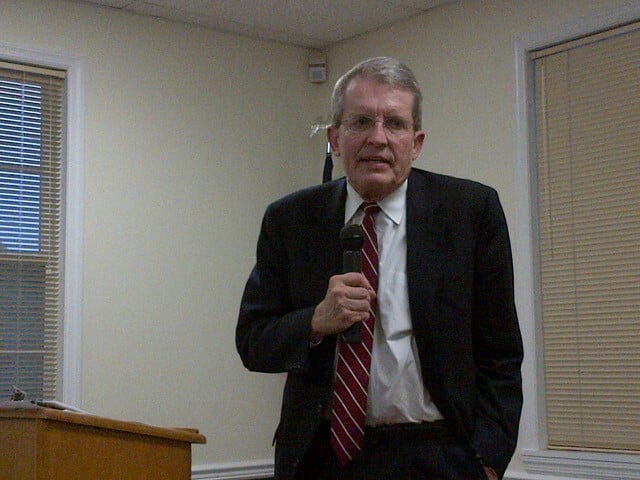
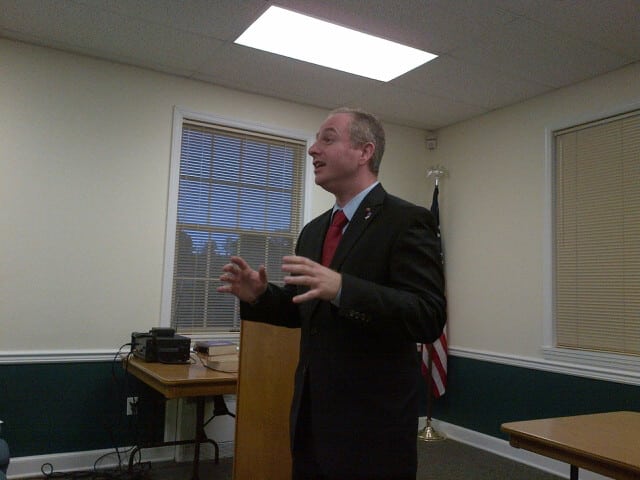
Wyckoff NJ, Jeff Bell , Brian Goldberg , Murray Sabrin Candidates for Senate ,looking to unseat Cory Booker spoke at the Larkin House in Wyckoff last night hosted by the West Bergen Tea Party.
Jeff Bell focused on Restoring Middle Class Prosperity , saying there was now NO Future for our grandchildren.
America was founded on the idea that hard work gets you ahead. But that social contract has withered away owing to dysfunctional government policy that favors the wealthy while necessitating huge budget deficits to provide a safety net large enough to support those left behind. Despite advances in technology that have improved the standard of living, it has become harder for working people to support a family and for young people to establish a career. The next U.S. Senator from New Jersey must be a tireless advocate for solutions that restore the middle-class prosperity that was once a hallmark of this nation.
The most important hindrance to middle-class prosperity is the condition of the U.S. dollar. Since 1994 it has lost over one-third of its value, and lost 10 percent in the last five years alone since the Federal Reserve began its “Quantitative Easing” program of creating new dollars. The effect of rising prices is felt everywhere: at the grocery store, the gas pump, in medical costs, and school tuition.
Instead of serving the people, our money serves the federal government, whose trillion-dollar borrowing is the main cause of the Fed’s money creation. To restore the money supply in the hands of the people, we need a dollar whose value is backed by gold. Read my specific plan to do that. The gold standard, which stabilized the dollar under various iterations through most of U.S. history, is the proven way to encourage stable long-term prices and preserve limited government. This is why the Constitution in Article I, Section 10 directs Congress to “coin money” and “regulate the value thereof.”
While Washington has gotten free financing from the Fed, families planning for college, retirees living on a fixed income, and everyone else hoping to earn a decent return on their savings rather than speculating in the markets have fallen behind. It is a travesty that our monetary policy has deprived seniors, parents, and savers in billions of income so Congress can rack up more debt.
This is the direct result of the Fed’s policy of near zero interest rates, now in its sixth year. The suppression of interest rates below the market level has also broken down the traditional banking system, in which small businesses borrow from their local banks. The total value of all small bank business loans is approximately half of what it was when “zero interest rates” was adopted. Now, neighborhood standbys like hair salons and restaurants are forced to seek alternative forms of credit like cash advance loans that often come with 50 percent effective interest rates.
Brian Goldberg focused on his electability saying his “positive message” and business experience could lead him to defeat Booker. He questioned whether Booker, who once lived by choice in a Newark housing project, can relate to the average Garden State resident.
Promoting the concept of Empowerment, not Entitlement, Mr. Goldberg brings a positive message to the race.
Goldberg said as a businessman,he has practical experience in the areas that matter most to NJ voters.He’ll combine that experience with his business experience to seek Win-Win solutions to the nation’s biggest challenges, providing NJ with a new voice in Washington.
Murray Sabrin focused on his back ground and how he arrived in America with his parents and older brother on August 6, 1949. His parents were the only members of their respective families to survive the Holocaust.
Rather than submit to the authoritarian regime of National Socialism, Murray’s father led a group of 241-armed partisans in Poland, and included the famed postwar Nazi hunter and writer Abba Kovner. The tragedy and triumph of Murray’s family has taught him to revere human life and hold dear those freedoms in our Bill of Rights — especially the right of citizens to protect themselves under the Second Amendment.
Murray Sabrin became a U.S. citizen in 1959 at age 12, and graduated from the Bronx High School of Science in 1964. He has a Ph.D. in economic geography from Rutgers University, an M.A. in social studies education from Lehman College and a B.A. in history, geography and social studies education from Hunter College.
His personal experience allowed him to see the dangers of big government and make him what he called himself New Jersey’s foremost defender of economic freedom and individual liberty. For three decades he has been fighting to end harmful government intrusion into our lives.
Like the other two he focused on how the U.S. economy is experiencing the worst recovery since the end of World War II. Despite trillion dollar budget deficits under President Obama and the Federal Reserve’s unconscionable money printing known as Quantitative Easing, which has dropped interest rates on savings accounts to virtually 0%, America’s real unemployment rate is more than 20%, according to some economists. In other words, the federal government’s fiscal and monetary policies have not “stimulated” the economy.
America’s free enterprise system has been replaced by crony capitalism–bailouts of Wall Street and politically connected firms, and subsidies to inefficient businesses. We need to return to a free market economy across the board so we can enjoy the fruits of a prosperity based on real savings and investments.
He then spoke on NSA spying ,and IRS Targeting and the growing threats to our Constitutional rights Saying the real threat to our rights is from the Obama administration, and he will work tirelessly in the United States Senate to repeal every law that infringes on the American people’s constitutional rights guaranteed in the Bill of Rights.
Facebook: new app feature listens to users’ conversations.
Facebook just announced a new feature to its app, which will let it listen to our conversations through our own phones’ microphone. Talk about a Big Brother move.
Facebook says the feature will be used for harmless things, like identifying the song or TV show playing in the background, but it actually has the ability to listen to everything — including your private conservations — and store it indefinitely.
Not only is this move just downright creepy, it’s also a massive threat to our privacy.This isn’t the first time Facebook has been criticized for breaching our right to privacy, and it’s hoping this feature will fly under the radar. No such luck for Facebook. If we act now, we can stop Facebook in its tracks before it has a chance to release the feature.
Tell Facebook not to release its creepy and dangerous new app feature that listens to users’ conversations.
Facebook says it’ll be responsible with this feature, but we know we can’t trust it.After all, just a few months ago Facebook came under fire for receiving millions of dollars for working with the National Security Agency’s PRISM, a wide-scale and highly controversial public electronic data surveillance program — something its CEO Mark Zuckerberg initially denied. This is also the company that lied about its now-scuttered Beacon program — an advertisement system that sent our “private” data from external websites to Facebook.
It seems like every few months, there’s another big Facebook privacy scandal, and yet the social media giant is pushing this new app anyway. Why? The information it gathers by listening to its 1.2 billion users worldwide can be sold for huge profits to advertisers and corporations looking for better information on consumer tastesand preferences.
Facebook is acting in the best interests of its bank account, not its users. This has gone too far – we have to stop it now.
Facebook: This is an extreme invasion of your users’ privacy. Do not release this new feature, and do not listen to us through our phones’ microphones.
Relocation of tree symbolizes Ridgewood group’s growth
MAY 27, 2014 LAST UPDATED: TUESDAY, MAY 27, 2014, 10:57 AM
BY TAYLER BENNETT
CORRESPONDENT
On Wednesday, May 14, a new tree was planted at Veterans Field, but the tree might actually already be familiar to members of the Ridgewood community.
A tree which was removed from the Travell School grounds was planted at Veterans Field last week.
The newly reestablished Shade Tree Commission sponsored the dedication of the tree.
A red maple that now has its home along the Linwood Avenue side of Veterans Field was originally planted for a number of years at Travell School. The tree was removed from the school about six or seven years ago, according to Tim Cronin, director of Parks and Recreation.
Cronin made the decision to keep the tree, which was removed to create space for a drop-off area for school buses near Travell. The tree has been growing in a small nursery behind the Recycling Center.
The orginal tree located in the space where the Travell tree is now planted had died. The Shade Tree Commission decided that the tree they had recently viewed on a walk behind the recycling center would be the perfect replacement, according to George Wolfson, chairman of the Shade Tree Commission.
“It’s a decent sized tree, not a little stick, a good 6- or 8-inch trunk. We think it’s a great addition to the park,” Wolfson said.
Cronin recalled the decision to keep the tree as a relatively easy one.
“They called me and said, ‘Do you want this tree?’ and I went over and looked at it … It was a nice size, nice shape, had a good crown and good structure, so I said, ‘Yeah I’ll take it,'” Cronin said.
– See more at: https://www.northjersey.com/community-news/clubs-and-service-organizations/relocation-of-tree-symbolizes-ridgewood-group-s-growth-1.1023928#sthash.SGo7pao5.dpuf
Applications for Teaching Position at Ridgewood Art Institute Being Accepted Through this Week
The Board of Directors of the Ridgewood Art Institute is seeking a qualified instructor for an “Oil Painting – Floral & Still Life” class to be held on Wednesdays from 10 am – 1 pm in the East Studio.
If interested, please send a resume, brief class description and ten JPEG images of your most recent work to:
Joel Popadics Education Chairman The Ridgewood Art Institute 12 East Glen Avenue Ridgewood, NJ 07450
Please note, 6 original paintings (plus a hard copy of your resume and class description) will be needed for the Executive Board Meeting which will be held onMonday, June 2nd.
Thomas Piketty (Photo: IBO/SIPA/Newscom) Piketty’s Questionable Data Salim Furth, Ph.D May 27, 2014 at 1:36 pm
Thomas Piketty made some questionable choices in adjusting and presenting the data that underlies his bestselling economics tome, “Capital in the Twenty-First Century.” Chris Giles, economics editor of the Financial Times newspaper, published a detailed list of apparent fudges in Piketty’s data.
Giles’ most explosive accusation is that Piketty chose data sources that were friendliest to his own preconceived ideas. For example, both the United States and the United Kingdom have two potential data sources for wealth: estate tax records and surveys of living households. In the U.S., Piketty uses the household survey, which showed rising wealth concentration. But in the U.K., he chose to use the inferior-quality estate tax data, which also showed rising wealth concentration. If he’d flipped both choices, he would have found falling inequality in the U.K. and steady inequality in the U.S. Giles is correct when he says, “Choices matter.” Giles’ estimates of U.K. wealth inequality in recent ecades are much lower than Piketty’s, and Piketty will need to defend his choices if we are to believe that U.K. wealth inequality has been rising.
Piketty presents data showing that wealth inequality rose slightly in Sweden from 2000 to 2010. But his “2000” data point actually is 2004 data, and his “2010” data point actually is an average of 2005 and 2006. When Giles used the data from 2000, he found that inequality actually fell slightly from 2000 to 2006 (the last year available). Perhaps Piketty had a good reason to use the years he did, but he has not offered an explanation.
These questionable choices have been reported as “errors” or “mistakes,” but the questions about Piketty’s data pertain to the choices he made, not the minor goofs. Historian Phillip Magness presents Piketty’s summary data on U.S. wealth inequality alongside its pre-1970 source. The graphs tell very different stories. Perhaps Piketty’s adjustments were valuable and moved the data in the right direction. But it is incumbent on Piketty to explain those adjustments, and it is incumbent on the reader to understand that the data was uncertain and incomplete to begin with and then was adjusted as the author believed necessary.
Even the best data on wealth distributions is uncertain. One of Piketty’s central ideas is that the amount and concentration of wealth has been rising steadily since 1980. He contends that the same economic forces are at work now and he projects the recent changes into the future. But if there is substantial uncertainty about each estimate and disagreement among data sources, then “trends” are highly subjective. As Yogi Berra may have said, “Predictions are hard to make, especially about the future.”
So how should we read Piketty? As others have noted, Capital can be divided into three components: history, prediction and prescription. One can believe the history without agreeing with Piketty’s predictions about the future. And if Piketty’s predictions are correct, he’s still wrong to prescribe brutal, confiscatory taxation, because that would increase poverty and lower wages, especially in poor countries.
What is at stake in Giles’ critique is Piketty’s account of history. Piketty’s story makes broad claims about global trends in the 19th and 20th centuries. If the trends turn out to depend on making specific choices, interpolations and adjustments in his collection of data, then we might have to conclude that predictions are hard to make, even about the past.
The Economic History Lessons We Never Learned Stephen Moore May 27, 2014 at 12:00 pm
Are conservatives going to allow liberals to rewrite the history of the Great Recession, just as they so successfully did in writing the fictitious account of the Great Depression, which now appears in almost every American history text?
The central message of former Obama Treasury Secretary Tim Geithner in his new book “Stress Test,” is that the bank bailouts and the Obama stimulus plan saved us from a second Great Depression. President Obama recites that same line in nearly every speech he delivers.
This is what we call a counterfactual – what might have happened if we hadn’t done what we did. The left loves counterfactuals, because – like “climate change” – they are impossible to refute. No one can say for certain what would have happened in some parallel universe.
But getting the story right on this episode of history is a critical issue for American economic policy going forward. We let the left write the history books on the Great Depression and it was an Aesops Fable. Most Americans, my 12-year-old included, are taught that FDR’s New Deal ended the Great Depression and moved millions of Americans out of misery.
Actually as Amity Shlaes shows in her classic book “The Forgotten Man,” and Burt Fulsom in “New Deal or Raw Deal” nearly every government regulatory bureau and spending program conceive during the Great Depression only lengthened the misery and disrupted the normal healing powers of a free economy. Eight years after the New Deal was launched, the unemployment rate was still in double digits, and it was not until the start of World War II, when millions of young men were put in military uniform and the nation mobilized for a global war, that the Depression ended.
Which brings us to the Great Recession in 2008 and its aftermath. What is highly inconvenient for apologists for the Obama blitzkrieg of government programs and debt in 2009 and 2010 is that at the start of his presidency, Barack Obama laid out his own counterfactual of what would have happened without the deluge of federal spending and debt.
According to the White House’s own calculations, the economy would have been better off today if the government had done nothing, rather than borrow and spend $6 trillion. The unemployment rate WITHOUT the stimulus was expected to be 5 percent today. Instead it is 6.3 percent and in reality closer to 10 percent.
Another way to put this is that if the labor force had not declined AND we had the 5 percent unemployment rate Mr. Obama says we would have had without the stimulus, there would be at least 10 million more Americans working today.
So, considering we are still 10 million jobs short and $6 trillion further in debt, here is another counterfactual to ponder: How much faster would the economy be growing today if we didn’t have the carrying cost of $6 trillion in debt to contend with? Think if we had used this money to finance a 21st century tax reform or for transitioning Social Security to a fully funded personal account system that has real assets building up each year, not a vault full of IOUs.
All this is important to remember as Geithner takes his faux victory lap around the country patting himself on the back for pulling America out of the financial abyss.
President Obama’s first chief of staff, Rahm Emanuel, let the cat out of the bag in the earliest days of the new administration by saying the president should never let a crisis “go to waste.” This burst of honesty was an admission that the left used the financial crisis as an excuse to do all the things it had wanted to do for years — redistribute trillions of dollars to their voters, reregulate the economy, build massive green energy projects, refinance the Great Society welfare state, rescue the unions with auto bailouts, print money in the trillions, and when the economy fails to perform, blame it all on George W. Bush.
The real story of the financial crisis of 2008 was a massive real estate bubble facilitated by easy money from the Fed, government policies through entities such as Fannie Mae and Freddie Mac that underwrite risky mortgage loans with near 100 percent loan guarantees, a Congress and White House that as Barnie Frank once famously put it “rolled the dice” on the housing market, and private banks, investors and home owners who got caught up in a speculation frenzy. Then we asked the bad actors such as Barney Frank to fix it. And now we’re repeating all those inane mistakes once more, with government again guaranteeing 90 percent of new mortgages, many with recklessly low down payments.
Here we go again. When we let the left write the history books, we never ever seem to learn from our mistakes.
Readers say Honeymoon Over for the New Village manager
I knew someone would get around to blaming Gabbert. Its not the council fault when something goes wrong. They only take the credit when something goes right and that is far and few.
This is the same Roberta Sonenfeld who was getting such praise when she was appointed.Looks like the “partisan hack” criticism was all true .
So what your saying is that are new hand pick Village Manager didn’t notify the Council because the past Village Manager had an arranged it that way. Really. A Village Manage with any background on that intersection should have brought it to the Council especially when they live on the West Side and should be familiar with that route. This is not on the job training. Next you are going to tell us that our mayor is going to use a page from our president book. “I only found out about this when he watched the news.” Please
trust us, we’re experts, we don’t need data or a study, full speed ahead.
In a heated Village Hall meeting Tuesday night with at least 30 residents in attendance, Ridgewood officials including the mayor did little to allay concerns about the outcome of the construction at the Franklin Ave. underpass. Mayor Paul Aronsohn vowed the project would go on as planned despite repeated requests to stop and study possible solutions. While vowing to make changes to the project, the mayor did not give any detail what the changes would be. The often loud and contentious meeting saw village engineer Chris Rutishauser under constant questioning to reveal facts and studies that led to the redesign of the heavily traveled east/west artery. Rutishauser admitted there had been no study, no hard count this year of the number of cars that travel the road, no estimation of the number of bikes and no counter to residents’ concerns that removing lanes would add to traffic congestion and therefore reduce overall pedestrian safety. Rutishauser was often combative with residents and seemed ill prepared for the onslaught of doubt and skepticism over the project. The best traffic data Rutishauser could offer was 7,000 cars traveled that area a day but he did not know how many years old that data was. Left unsaid by Rutishauser was the increase over the years in traffic at the underpass. While Police Chief Ward had the lone hard fact and data point of the night: 86 accidents at the trestle since 2008, he gave no context to the data point and did not say how that number compared to other high traffic areas of the village. Village Manager Roberta Sonenfeld called the project “a leap of faith”.
Other key revelations at the meeting:
No study of existing traffic patterns No facts to support the road changes No immediate change to traffic lights, changes that officials admitted would help facilitate left turns at the West side intersection. No timetable was given for acquiring those much needed newer lights. The project was designed with bike lanes to draw federal tax dollars under the complete streets planning doctrine. The theory behind the project is to “calm traffic”, a planning concept used overseas that involves narrowing roads and other measures designed to actively slow cars. No clear answers why the village failed to seek public input on the changes to the main artery.
A limit to pension investing oversight as political donations from executives can go unchecked
MAY 27, 2014, 11:10 PM LAST UPDATED: TUESDAY, MAY 27, 2014, 11:11 PM BY MELISSA HAYES AND JOHN REITMEYER STATE HO– USE BUREAU THE RECORD
Last year, nearly 2,000 businesses doing $6.4 billion in public work reported — as required by state law — that they made $10.1 million in contributions to New Jersey’s various political parties and candidates.
But when it comes to New Jersey’s pension fund — and the increasing share of the nearly $77 billion in assets going to hedge funds, private equity and venture capital funds — such disclosures aren’t so clear-cut.
The pay-to-play law makes it clear that executives and their employees working on the state’s pension fund investments cannot make political contributions to New Jersey candidates and political committees. But those venture capital firms and hedge funds often take the state pension dollars and invest them in other companies whose executives do not have to disclose their political donations.
Now the pension fund’s directors are putting more money into those alternative investments. The complex nature of those investments, the inability of the pay-to-play law to cover all their financial relationships and the lack of any accompanying public database like the one for state contractors make tracking political connections difficult. That comes as Governor Christie has built a national fundraising network that includes donors with backgrounds in the finance industry.
And the state Department of Treasury relies on the investment firms themselves to determine which employees are covered by the law, and to disclose any political contributions made by them. The Election Law Enforcement Commission, which regulates other businesses with state contracts, also relies on companies to self-report contributions. But the commission also maintains a public database of campaign donations and state contractors that allows for increased scrutiny of the donors doing public business.
The council that oversees the state’s investments will meet today for the first time since Christie announced last week that he would cut nearly $900 million from this year’s pension payment to close a budget gap.
The New Jersey State Investment Council, which manages the $76.76 billion pension system, is set to discuss three alternative investment proposals and get an update on its plan for the coming fiscal year. The meeting comes as questions have been raised over the legality of Christie’s scaled-back pension payments and amid claims that the state awarded investments to campaign contributors who support the governor.
From the council’s agenda, it’s unclear whether it will discuss Christie’s reductions or the pay-to-play allegations. A spokesman did not respond to a request for comment Tuesday.
The New Jersey Education Association and the Communications Workers of America, which represents state employees, are already threatening to sue Christie after he signed an executive order last week setting the pension payment for this year at $696 million, down from $1.58 billion. The governor is also calling on lawmakers to approve a $681 million payment for the fiscal year beginning July 1, down from the $2.25 billion the state was supposed to contribute under phased-in payments Christie signed into law in 2010.
The governor said the state cannot afford to pay for the “sins of the past” and acknowledged that the contributions he agreed to are too burdensome. Christie said he plans to announce additional changes to public employee pensions next month.
The Intellectual Dishonesty of Obama and Other False Purists By Ron Fournier
Yes, the GOP is obstinate. We get it. But assigning the White House some blame is no false equivalence.
To voters angry at Washington, President Obama has an explanation for the deepening of gridlock, incompetence, and zero-sum gain thinking during his five-plus years in office: It’s not his fault.
Not that finger-pointing solves anything, but Obama wants you to know that it was Republicans and the media who put his presidency on ice. At a fundraiser in Chicago on Thursday night, Obama said:
“You’ll hear if you watch the nightly news or you read the newspapers that, well, there’s gridlock, Congress is broken, approval ratings for Congress are terrible. And there’s a tendency to say, a plague on both your houses. But the truth of the matter is that the problem in Congress is very specific. We have a group of folks in the Republican Party who have taken over who are so ideologically rigid, who are so committed to an economic theory that says if folks at the top do very well then everybody else is somehow going to do well; who deny the science of climate change; who don’t think making investments in early-childhood education makes sense; who have repeatedly blocked raising a minimum wage so if you work full-time in this country you’re not living in poverty; who scoff at the notion that we might have a problem with women not getting paid for doing the same work that men are doing.
“They, so far, at least, have refused to budge on bipartisan legislation to fix our immigration system, despite the fact that every economist who’s looked at it says it’s going to improve our economy, cut our deficits, help spawn entrepreneurship, and alleviate great pain from millions of families all across the country.
The next Regular Public Meeting of the Ridgewood Board of Education will be held on Monday, June 2, 2014 at 7:30 p.m. The public is invited to attend the meeting at the Ed Center, 49 Cottage Place, Floor 3. The meeting will be aired live on FiOS channel 33 and Optimum channel 77. Or it may be viewed live via the district website atwww.ridgewood.k12.nj.us using the “Link in Live” tab.
Click here to view the agenda for the May 19, 2014 Regular Public Meeting.
Click here to view the webcast of the May 19, 2014 Regular Public Meeting.
2014-2015 Budget Information Taking effect this year, the Ridgewood Board of Education has opted to move the annual school board elections from April to November, thereby eliminating the public vote on the proposed general tax levy if it is at or below the statutory tax levy cap. Since next year’s proposed budget falls within the mandated cap, it will not be put to public vote. The Board approved the 2014-2015 budget at its April 28 Regular Public meeting.
Click here to view the Budget edition of Newsline, sent to Ridgewood residents in May. The newsletter provides information about next year’s school budget.
Click here to view the Fiscal Year 2015 User Friendly Budget.
Click here to view the Fiscal Year 2015 full budget.
Click here to view the 2014-2015 Budget Presentation.
To send a question or comment about the 2014-2015 school budget, please email the superintendent at[email protected].
The Village Council introduced the 2014 Village of Ridgewood Budget on April 23rd. The Public Hearing of the Budget will be May 28 at 7:30PM in the Sydney V. Stoldt, Jr. Court Room at Village Hall.
Click Here for Budget Newsletter
Click Here to view the budget details as required by the State of New Jersey.
Kids Reject Michelle Obama’s “Healthy” School Lunches Tiffiny Ruegner May 24, 2014
Michelle Obama’s new dietary restrictions is so bad that they can’t even GIVE the food away. A million kids have turned away from Obama’s school lunch and schools are feeling the huge hit.
Via The Hill:
More than a million kids confronted by healthier school lunches are turning up their noses, leaving the cafeteria and heading out to get a burger instead.
The difficulty in getting students to eat lower-fat, lower-sodium meals is at the center of a food fight between House Republicans and first lady Michelle Obama that erupted this week.
The Healthy, Hunger-Free Kids Act of 2010, supported by President Obama, requires lunch programs that receive federal dollars to provide healthier meals. The new standards began to go into effect in 2012. Childhood obesity has spiraled in recent decades, and the first lady has made the fight against it a signature issue. Democrats say stemming the epidemic will cut healthcare costs and keep the armed forces functioning.
But Agriculture Department statistics show the number of school children in the National School Lunch Program dropped from 31.8 million in 2011 to 30.7 million in 2013. School boards are asking Congress to allow schools to opt out. Some schools are raiding their teaching budgets to cover the costs of mounds of wasted fruits and vegetables, Lucy Gettman of the National School Boards Association said.
The dietary restrictions have not actually made the food healthier. They have cut down the amount of food to cut calories which has also cut nutrients to the growing generation. When a body doesn’t have enough nutrients… it craves food more. Give us 10 years and you will see this denying kids food will have exacerbated the obesity problem. What they really needed to do was increase the amount of fresh non packaged food and either increased the food cost or encouraged volunteers over paid employees in the cafeterias for food prep to balance the extra cost for quality food.