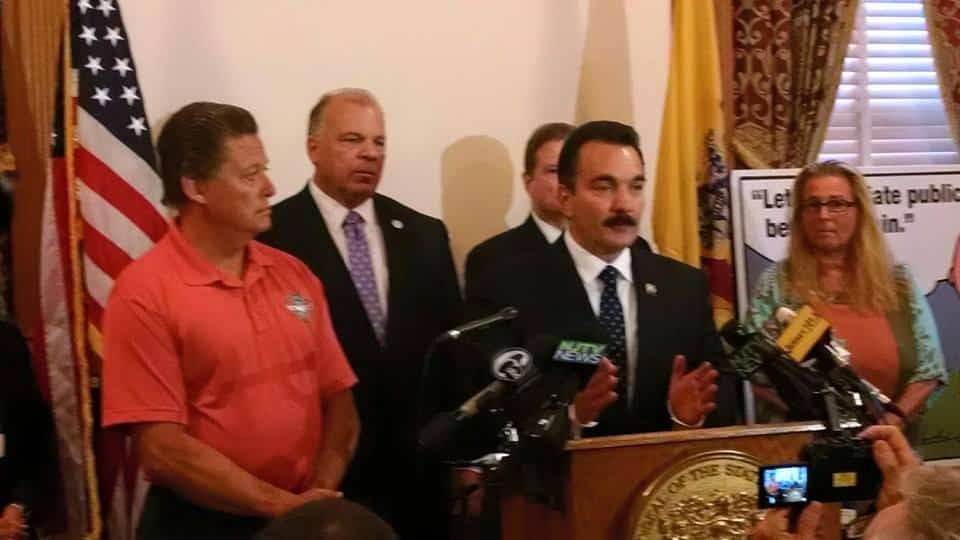
picture Steven Sweeney and Vincent Prieto and the Trenton gang
September 29,2016
the staff of the Ridgewood blog
Ridgewood NJ, It’s that time of the year again! The Rax Foundation released their 2017 State Business Tax Climate Index, which allows you to compare you state’s business tax burden across 5 major categories and taking into account over 100 variables. New Jersey ranked dead last in business tax climate . The report credits Trenton leadership with, “some of the worst-structured individual income taxes in the country.”
This year, the states at the top of the pack are Wyoming (1), South Dakota (2), Alaska (3), Florida (4), Nevada (5), Montana (6), New Hampshire (7), Indiana (8), Utah (9), and Oregon (10).
The states at the bottom of the pack include Louisiana (41), Maryland (42), Connecticut (43), Rhode Island (44), Ohio (45), Minnesota (46), Vermont (47), California (48), New York (49), and New Jersey (50).
According to the Tax Foundation ;the states in the bottom 10 tend to have a number of shortcomings in common: complex, non-neutral taxes with comparatively high rates. New Jersey, for example, is hampered by some of the highest property tax burdens in the country, is one of just two states to levy both an inheritance tax and an estate tax, and maintains some of the worst-structured individual income taxes in the country.
Ridgewood Nj, Governor Chris Christie School Funding Fairness Formula Catches the Eye of the Ridgewood Board of Education. In the latest RPS news letter Board President Sheila Brogan devoted a significant amount of space to the Christie Fairness formula and the failure of the Abbott School districts .
Sheila Brogan’s Legislative Report September 2016
Lately, there has been much discussion in Trenton about state funding for school districts. Governor Christie has asked the courts to give the state relief from the School Funding Reform Act of 2008 (SFRA) and to allow the NJDOE Commissioner relief from statutory and contractual impediments that negatively impact on the thorough and efficient education required by the state constitution. The State Auditor has issued a report listing the flaws in how state aid is distributed to school districts. Senator Sweeney has proposed that a 6-member commission be established to study the state school funding issues and propose recommendations and legislation.
The first link below will bring you to the Abbott Memorandum, filed for Governor Christie, asking the NJ Supreme Court for relief from the current funding formula. It is 95 pages, but worth the read.
Some of the issues discussed in the memorandum are —
#1 More funding does not equal higher student achievement in the School Development Authority (SDA) districts (formally the Abbott districts). The SDA districts have 22.8% of all NJ students and they receive 59% of the pre-K through grade 12 school aid.
#2 The most important factor for quality education is effective teachers. Districts must be allowed to have systems in place to attract and retain effective teachers. Statutory and contractual impediments to this must be eliminated. Essentially, the memorandum calls for eliminating LIFO (last in, first out) when there is a reduction in force (RIF) of the teaching staff. The memorandum also calls for streamlining the process of removing tenure teachers who are ineffective. It requests that the court allows the Commissioner to override contractual impediments in teacher contracts that negatively impact on student achievement.
In another document released last week, the State Auditor listed flaws in the way the state distributes school aid. There were four recommendations:
#1. School funding should be distributed based on current district data — for example — current enrollment and district demographics. The state is not using current data. Eighty percent of districts are receiving less aid than what they should receive under the current state aid formula, School Funding Reform Act of 2008 (SFRA).
#2. Special Education funding is not being distributed on the actual number of special education students in a district. Under the 2008 state aid formula, the state started using the census model to distribute money using the assumption that every district had a14.78% special education classification rate. Some districts have higher classification rates. According to the report in 2015, 234 districts, and in 2016, 258 districts, had actual classification rates that were more than10% higher than the state’s rate used for funding. This funding is not tied to actual need.
#3. Pre-school aid should be adjusted for actual enrollment. According to the report, in 2016, 30 districts over estimated enrollment and overpayments to these districts from the state amounted to $32.9 million
#4. The per pupil cost for preschool ranges from $2,036 to $27,663 and this disparity leads to imbalances in funding. It should be noted that districts receiving pre-school funding can offer half day or full day programs creating disparity in the educational experiences and opportunities offered these students.
This report is linked below.
Finally, Senate President Sweeney and Senator Ruiz introduced a concurrent resolution, SCR119, to establish the State School Aid Funding Fairness Commission consisting of six members who would be appointed by the Senate President (2 members ,one of whom would represent the NJEA), Speaker of the General Assembly (2 members, one of whom would represent a NJ education professional association), Senate Minority leader (1 member), and General Assembly Minority Leader (1 member). The Senate approved SC119 on Thursday. The Commission would be charged to study the following issues:
#1. the impact of School Funding Reform Act of 2008 (SFRA) adjustment aid and state aid growth limitation provisions;
#2. the tax levy growth limitation and the ability for school districts to adequately fund operating expenses;
#3. the per pupil administrative cost limits and its impact on district staffing and operations;
#4. determining local fair share amounts and how property tax abatements impact fair share; and
#5. the ability for districts that are at or above adequacy budget to lower their tax levy if given additional state aid
The report must be issued no later than June 30, 2017 with its findings, recommendations, and proposed legislation. The legislation would be introduced in the Senate and the Assembly. It would not be referred to committees. The proposed legislation would be given three readings and must be approved or rejected by the Senate and the Assembly without changes or amendments.
Over the next 5 years, $500 million would be added to the state budget for school districts to give districts 100% of the aid as determined by SFRA.
The process for the commission will include three public hearings to gather input and then three hearings after the report is issued to elicit public input on the findings, recommendations, and proposed legislation.
Reader ...”I worked part time and my kids got picked up at their elementary school and transported to enrichment 2-3x/week. My greatest joy was picking them up from kindergarten, watching them play with friend in the playground and then going out for lunch or.making.lunch together. As a parent, I would not want ffull day K…they grow up too quickly not to treasure those early years together.”
Forget the Common Core, Finland’s youngsters are in charge of determining what happens in the classroom.
“The changes to kindergarten make me sick,” a veteran teacher in Arkansas recently admitted to me. “Think about what you did in first grade—that’s what my 5-year-old babies are expected to do.”
The difference between first grade and kindergarten may not seem like much, but what I remember about my first-grade experience in the mid-90s doesn’t match the kindergarten she described in her email: three and a half hours of daily literacy instruction, an hour and a half of daily math instruction, 20 minutes of daily “physical activity time” (officially banned from being called “recess”) and two 56-question standardized tests in literacy and math—on the fourth week of school.
That American friend—who teaches 20 students without an aide—has fought to integrate 30 minutes of “station time” into the literacy block, which includes “blocks, science, magnetic letters, play dough with letter stamps to practice words, books, and storytelling.” But the most controversial area of her classroom isn’t the blocks nor the stamps: Rather, it’s the “house station with dolls and toy food”—items her district tried to remove last year. The implication was clear: There’s no time for play in kindergarten anymore.
Community Conversation September 21 – MAKING RIDGEWOOD MORE AGE FRIENDLY
WHAT: An Encore presentation of our 55 and Over Survey Data and Age-Friendly concepts. Then A GROUP THINK, a COMMUNITY BRAINSTORMING session- we need YOUR IDEAS about how to Ridgewood more Age Friendly
WHO: Anyone interested in life in Ridgewood after age 55. If you are 55 or over or you are planning for your future or you have parents in this age group or your customers are older please join us.
WHERE: Ridgewood Library Auditorium
WHEN: Wednesday September 21, 3:30-5:30 pm.
WHY: We have wonderful data about both the strengths and needs of the community from our Ridgewood 55 and Over
Survey. We are ready to take the next step and create an action plan. For that we need community input about specific improvements that we should consider implementing, especially in the following areas:
· housing options,
· flexible transportation
· pedestrian safety
· enhanced communication and marketing, directory of resources
· leveraging the expertise of the older population and
· assisting homeowners with difficult tasks.
We want Ridgewood to be as great a place to grow old as it is to grow up and we are interested in what age-friendly means to you and what your priorities are. What would make you remain in Ridgewood after your kids are grown and gone?
Any questions please email [email protected] or call 201-652-1614.
Beth Abbott and Sheila Brogan, of the Age-Friendly Ridgewood Initiative
Trenton NJ, Governor Chris Christie announced the Christie administration went to court on behalf of New Jersey taxpayers, to the Supreme Court, to say three things:” First, that this funding formula has failed for 30 years and that it needs to be overturned. Second, that the real thing that’s preventing us from teaching kids in these districts are the ridiculous work rules that are imposed upon us by statute and by collective bargaining agreements with the teachers union that prevents us from doing common sense things like, if there are going to be layoffs in our schools, that we should layoff the least effective teachers, not do layoffs, as we are required to do by state law, based purely upon seniority. If you’re there the longest you get to keep your job. If you’re there the shortest you lose your job. How does that ensure that children are getting a thorough and efficient system of education? And, how is it that in Camden, one of the worst school districts in the state, the union contract requires only four hours and forty five minutes of instruction for every seven and a half hour day that a teacher puts in. Four hours and forty-five minutes of instruction for every seven and a half hour day a teacher puts in. It’s these kinds of work rules and collective bargaining agreements that we are stuck with in this state that prevents these kids from having, in urban districts, that what they really need. Let’s talk about what happens in a lot of these urban districts, what happens is that the family life isn’t there often, to support what you need to do to make sure that your kids do well in school. Now sometimes this is because of broken homes but sometimes it’s in intact homes and because those families are struggling to make ends meet, sometimes those folks have to work three or four jobs to keep a roof over their heads, And when you have to do that you’re not going to be home at 3 o’clock when the kids get home from school. So who’s checking when they’re going to do their homework? Who’s encouraging them to do their reading. Who’s sitting down with them to help them do their math? It’s not happening. So what should we do? Should we just give up on those kids and give up on those families who out of no fault of their own, are just working 15, 16 hours a day to keep a roof over their head. In those districts, we should have a longer school day. In those districts we should have a longer school year. If those children are falling behind, let’s spend more time with them. That kind of result, we should be willing to pay for. “Gov. Christie On Urban Education: We’re Tired Of Paying For Failure, We Need This System To Change
Christie went on to say, “I’ve had enough of sitting back and waiting. I’ve tried negotiating with the legislature. I’ve tried negotiating with the teacher’s union. I’ve tried every other course, today my patience has run out. For the first time, it’s your governor going to the court and saying enough is enough, on behalf of the people of this state we’re tired of paying for failure we need this system to change, we filed that today and we’re going to fight for you in the Supreme Court rather than have the educational interest being the ones who are always fighting there with her handouts saying they need more of your money. And the fact is no one knows how it is going to go but I’m not going to sit back and be a bystander in this. I want urban education to get better in this state. I want those families to have an opportunity for their children to achieve their fullest potential. I also want your families to be able to continue to live here. “
Simply put..People will sell and move..lock in gains here and bank that result into a lower taxed town and in some cases another State.Boomers will avalanche out of here in the next 5 years.School issues costs and declining standings are a ticking time bomb..
Ridgewood NJ, In April Ridgewood joined over two dozen other municipalities, including Teaneck, Englewood, Wayne, Paterson, Pequannock and North Bergen challenging the tax exempt status of their local hospital
Like Ridgewood many of these municipalities are looking for new sources of cash to lower their high property taxes, local officials have now filed tax appeals challenging the tax-exempt status of 35 nonprofit hospitals according to NJ Advance Media for NJ.com .
The litigation continues to gain momentum in response to last year’s precedent-setting tax court ruling and settlement which required Morristown Medical Center to pay Morristown $15.5 million in lieu of property taxes. The judge in that case found the hospital operated like a for-profit entity and should share the cost of public safety and other municipal services.
While the Morristown case took 5 years to see it through ,so far two of the 35 cases have been settled already, resulting in additional revenue for the city of Elizabeth and Edison Township.
The settlements have already paid off for local taxpayers.The property tax rate has declined in Morristown by 2 cents this year, as a direct result of the “historic” agreement reached with Morristown Medical Center’s parent company, Atlantic Health Systems.
Ridgewood has quietly pursued Valley Hospital on the same grounds .It has been often repeated that Valley’s current 15 1/2-acre main campus would owe about $4.5 million in taxes if it were fully assessed. That is before the major increase in size by the proposed renovation double its size .
The N.J. Hospital Association says the tax-exempt status of these hospitals have been challenged:
Clara Maass Medical Center (Belleville)
Jersey City Medical Center (Jersey City)
Monmouth Medical Center (Long Branch)
Monmouth Medical Center Southern Campus (Lakewood)
Saint Barnabas Medical Center (Livingston)
Newark Beth Israel Medical Center (Newark)
Holy Name Medical Center (Teaneck)
Englewood Hospital and Medical Center (Englewood)
Hunterdon Medical Center (Raritan Township)
Bayshore Community Hospital (Holmdel)
Hackensack UMC Palisades (North Bergen)
Jersey Shore University Medical Center (Neptune)
Raritan Bay Medical Center (Old Bridge)
Raritan Bay Medical Center (Perth Amboy)
Riverview Medical Center (Red Bank)
Chilton Medical Center (Pequannock)
Overlook Medical Center (Summit)
Newton Memorial Hospital (Newton)
Robert Wood Johnson University Hospital (Rahway)
Robert Wood Johnson University Hospital (New Brunswick)
Robert Wood Johnson University Hospital Somerset (Somerville)
Robert Wood Johnson University Hospital Hamilton (Hamilton)
Trinitas Regional Medical Center (Elizabeth)
CentraState Medical Center (Freehold)
Virtua Memorial Hospital (Moorestown)
St. Joseph’s Regional Medical Center (Paterson)
St. Joseph’s Hospital Wayne (Wayne)
JFK Health (Edison)
Shore Memorial Hospital (Somers Point) The Valley Hospital (Ridgewood)
Capital Health (Hopewell)
Kennedy University Hospital (Stratford)
AtlantiCare Regional Medical Center City Campus (Atlantic City)
AtlantiCare Regional Medical Center Mainland Campus (Galloway)
Princeton Healthcare System (Plainsboro & Princeton)
Ridgewood NJ, readers say ,”No full-day kindergarten. We have many user-paid options without getting taxpayers involved” and other accuse the BOE of ,”BOE’s ambition will single-handedly drive everyone without schoolchildren at home out of town. Too bad if they had pressure from parents. This is unacceptable. Most referendums do pass, so tell your friends to vote no. Since it will be on a ballot for the Presidency, voter turnout will be higher than for other elections, although still a paltry and pathetic number. As always, every vote counts.”
The Ridgewood Blog has included the Ridgewood Board of Educations FAQ: Shifting to a Full-Day Kindergarten Program in Ridgewood .
We see almost no mention of the value to students and or whether it is even appropriate for the Village other than ,”the everyone else is doing it” ,”more time in school” .
● Why is the District considering a full-day program after years of a successful half-day program?
○ The definition of success has shifted with the times, and although Ridgewood has a high-quality Kindergarten program, it is rushed and lacks adequate time for structured socialization and free play. Students who encounter more structured play around learning will better internalize that learning because at this age, play is how children learn. Additionally, social skills such as executive functioning and self-regulation of behavior are learned through play, often which is unstructured. A half-day program does not allow time for these essential learning opportunities for our students.
● How will the curriculum of a full-day program differ from that of the half-day program?
○ A full-time program will include more time for learning centers, which are essentially structured play experiences designed to reinforce conceptual learning. Additionally, more time will be dedicated to free-play centers, in which students make up rules to self-created games and make-believe. This free-play socialization will be supervised by, not structured by, adults. Another change to the day is that students will remain in school for lunch and will have snack and extended time for key content such as shared reading and writing.
● What would be the daily schedule and hours of a full-day program? ○ Kindergarten will run on the same schedule as the other grades in the school (8:30 a.m. – 3 p.m.). A daily schedule for the full-day program was shared with the Board of Education and the public at the June 28, 2016 Board meeting. That presentation can be found in the Board of Education Presentations folder on the Curriculum page of the district website at www.ridgewood.k12.nj.us.
● How many other districts still have half-day Kindergarten programs? ○ Ridgewood is the only half-day program left in Bergen County. There are very few districts left in the state with a half-day program. The most common Kindergarten programs offer five full-days of school.
■ Those districts which were half-day have mostly moved to full-day programs in the last five years.
● In 2014, 73% of programs statewide were full-day. The percentage was even higher in Bergen County, where 65 out of 72 districts (about 90%) offered full day programs. Since 2014, Glen Rock, Fairlawn, Rutherford, Mahwah, Waldwick and Midland Park have moved to full-day.
● Currently, Ramsey offers a kindergarten enrichment extended day program and both Allendale and Wyckoff offer a modified half/full day program with two half-days in combination with three full days, but this model is also not very popular.
● Would parents be required to enroll their children for the entire day if Ridgewood moved to full-day Kindergarten?
○ Yes, if the Ridgewood Public School district shifts to a full-day Kindergarten program, all enrolled students will be registered for 5 full days each week.
● Where will Kindergarten children eat lunch? ○ This will be a building-by-building decision, based on space and what the principal deems best for the program in their building.
● Will Kindergarten students have recess with all other students and how will their recess be supervised? ○ Kindergarten students would have more than one “recess” play time in their schedule. The schedule, location, and supervision of that recess would depend on individual building schedules. However, in all buildings the recess/lunch period of 45 minutes would be extended to one hour for Kindergarten students. Classroom teachers would supervise the additional 15 minutes at the end of recess to settle students down and prepare them for afternoon learning sessions.
● What are the anticipated class sizes for a full-day program?
○ The Ridgewood Board of Education guidelines for Kindergarten are 22 children per classroom.
● How will the decision be made to move to full-day Kindergarten in Ridgewood?
○ On Election Day, Tuesday, November 8, Ridgewood voters will be asked to approve full-day K in the District. This vote will be done in the form of a “second question” on the ballot. All residents who are registered voters may participate. Voter registration forms may be found at on the Bergen Count website at https://www.co.bergen.nj.us/DocumentCenter/View/1224.
● What is the purpose of a second question on a ballot?
○ A second question can only be placed on the ballot when a school district is asking for something new, such as full-day Kindergarten or a new program. Since the costs of these additional services and associated personnel can exceed the state-imposed 2% cap on budget increases, the public must vote on them.
● What would be the tax impact on a “yes” vote for the second question on full-day Kindergarten?
○ The average Village assessed home of $693,904 would have taxes increase by approximately $111 if FDK were passed.
● Is there any possibility that the State will require Districts to provide full-day Kindergarten?
○ This is not known at this time.
● Where can I go for more information on Full-Day K in Ridgewood?
○ Full-Day K information may be found on the Curriculum page of the District website at www.ridgewood.k12.nj.us.
They are having committees to study why people over 55 are leaving. Shiela Brogan is on the committee. The survey showed that moving is a financial decision. She needs to pay attention.
Complete agreement with all of the above. Taxes are out of control. And as for the moving truck option, don’t think for a minute that Ridgewood taxes will make the town and your home desirable to young families. Nice towns with lower taxes and higher rated schools surround us. Pay for your own pre-K and Ridgewood teachers need to get a grip on reality when it comes to their demands.
Driving out seniors is not going to help the school population or tax base. Add-ons like this may be the last straw for many who already get nothing from approximately 2/3 of their enormous property tax bite. Tired of hearing that good schools help property values, etc. The fact is that this school system has been going down the tubes for years and the world at large is finally starting to realize it. Throwing more millions at it won’t help. Eliminate half the jobs at the Ed Center and resolve the teachers’ contract dispute before coming to taxpayers for more and more.
As for property values: People will just look at other towns – Allendale, Wyckoff, HoHoKus Upper Saddle River, Ramsey, Montvale, Woodcliff Lake all have lower taxes and comparable if not better schools. Yes, Ridgewood may have a certain status and reputation in its favor but times are different now. The town has changed and more changes are could be on their way. BOE needs to keep a strong position that considers taxpayers. Our teachers are already higher paid than most and pre-school should be the parents’ responsibility.
Schools used to be top class in the entire country 25 years ago. Now it’s all on fumes of past reputation. Current teachers care more about their health benefits than they do about our students, which is sad.
The village is becoming a flip model of graduations then For Sales signs as TAXES ,financial pressure ON JOB holders and families impacted by corporate downsizing and then college costs ,drive midlife families and seniors who have paid dearly for decades .We all loose unless we work to change this Tax and Spend model.Cost of money finding can only go up from current low interest rate and low energy costs environment ..more risks ahead..taxes likely to rise to meet
Inflation and general funding requirements.FEEL GOOD PROJECTS SHOULD BE derailed.Health Barn,full day Kindergarden. Ideas about performing arts and other build outs should be shelved.Ridgewood is worth the Fight. Versus the moving truck solution..
Fair Lawn NJ, Governor Chris Christie took his #fairschoolfunding message to Fair Lawn in Bergen County on Thursday, making the case for a new K-12 state aid formula to a town hall audience .
Governor Chris Christie proposed drastic changes to New Jersey’s school-aid formula that would distribute an equal amount for each student regardless of income, a move that would redirect money from cities to suburbs.
Over the past 30 years, New Jersey taxpayers have sent $97 billion to those 31 systems, while the other 546 have received $9 billion less. Worse yet by all standards the Abbott Schools have been a complete failure and are in violation of the very law that requires them to exist.
The average Ridgewood homeowner would save the second most at $4209 in Bergen County after Tenafly at $4478 .
Even Steve Sweeney’s home town, a leading opponent of the plan, way down in South Jersey would receive 58% more funding per student in addition to average net property tax decreases.
Many people in New Jersey do not understand the archaic formulas which drive state funding for our schools and the vastly different property tax results in our respective municipalities. Under the New Jersey Constitution, it is mandated that students be provided a thorough and efficient education. That phrase has been thrown around conveniently in defense of an inequitable formula that is too expensive to fund with results that scream failure. New Jersey needs a fair funding formula that fixes the problem, and Bergen taxpayers need real property tax relief.
A few weeks ago, Governor Christie proposed a formula that would provide equal funding on a per student basis. This new formula, called the fairness formula, is nearly identical to what I have introduced since 2012. The majority in the legislature wants to continue with a failed system, which has disproportionately and negatively impacted 69 out of 70 communities in Bergen County. What the Governor and I have proposed will fix the problem.
Under the proposed fairness formula, state aid would be $6,599 per pupil with additional funding provided for students with special needs. No student will be regarded as worth more than another. The state has thrown billions of dollars at underperforming districts for years and the situation hasn’t improved. The time is now that we face reality and provide fair funding for every student in the state and stop strangling taxpayers to fund failure.
One of those former Abbott districts is Passaic City. With only around 10,000 public students, it receives more money than all 70 municipalities combined in Bergen, which has approximately 250,000 students. Further, overfunded municipalities often use that money to pay for things other than students, such as Elizabeth which in 2015 spent more per student on legal and consulting fees ($237 per pupil) than on textbooks and supplies.
In comparison, Pascack Valley Regional High School District is rated the eighth best school district in New Jersey with a graduation rate of 98 percent, while receiving only $550 per student (a number only slightly higher than what Elizabeth spent on legal and consulting fees). The average property tax in Bergen County is well over $11,000. As a result of these increasingly high property taxes, Bergen County has found itself in recent years with one of the highest rates of foreclosures, pre-foreclosures and personal bankruptcies. On the flip side, Camden High School has only a 46 percent graduation rate and yet receives over $30,000 per student. The average property tax in Camden County is only slightly over $6,000. Other than a handful of exceptions, towns in Bergen and Passaic counties have carried the brunt of increasing property taxes, yet they have received the least amount of funding in the entire state.
This lopsided school funding formula is indefensible. Bergen and Passaic homeowners are paying sky high property taxes to fund a school district on the opposite side of the state that can’t graduate half of its students. What makes the students in Camden worth sixty-times more than a student who goes to Pascack Valley or any other school district in Bergen or Passaic? What makes 10,000 school age children in Passaic more valuable than every school district in Bergen County combined? The answer: court mandates on how the state should spend its money.
The state Supreme Court ruled in the Abbott v. Burke decisions that most money should be distributed to districts that have demonstrated an inability to provide educational excellence. The consequence has been diverting money from districts that pay through the nose for education to districts that don’t; such as Bergen paying for Camden. Diverting these funds has resulted in higher property taxes for districts that want to maintain the educational excellence they have achieved. In some cases the towns with diverted funds have large retiree populations, robbing senior citizens of their savings and the value of their homes.
The Corzine school funding formula the court approved has resulted in failure. The court ruled that nearly sixty percent of school funding provided to only 5 percent of school districts satisfies a constitutionally thorough and efficient education. This unfair formula has increased property taxes across the state and has failed to effectively educate the students in districts that cost the most taxpayer dollars. All the while, student enrollment in the former Abbott districts has decreased as funding has increased.
When schools are funded on a per pupil basis, taxpayers benefit. School funding will increase nearly 500 percent in Bergen and Passaic with the fairness formula, while average property taxes will be reduced by over $2,000. When schools aren’t funded on a per pupil basis, $5.1 billion goes to 31 districts and $4 billion goes to 546 districts. The fairness formula will equitably spend $9.1 billion across all 577 districts, without any property tax discrimination based on educational excellence. Any legislator representing these counties who does not support this fair and balanced approach is failing to represent their own constituents.
Providing funding equally on a per pupil basis will level out the playing field and decrease property taxes across the state. Extra aid will only be provided to make sure we take care of our special education students who need the extra help to get by. Three out of four school districts in the entire state would see an increase in aid, 69 out of 70 municipalities in Bergen County would see an increase in aid. That means 69 Bergen County towns will see a reduction in property taxes, providing much needed relief.
The current school funding formula has been a disaster that drives up property taxes and does nothing to help failing school districts reverse the course. The fairness formula will provide fair funding. Opponents to the idea will holler that it is unconstitutional. If that is their only concern, I have sponsored a resolution since 2012 (ACR35) amending the constitution to provide a thorough and efficient education on a per pupil basis. The current formula is an indefensible failure, if the constitution is the only concern, then pass my resolution and the fairness formula.
How Christie’s school funding plan could affect your property taxes
Gov. Chris Christie’s proposed school funding overhaul could produce property tax relief from as much as $4,500 for the average homeowner in Glen Ridge to a little as $5 on average in Mount Ephraim, according to state data. Stephen Stirling and Adam Clark, NJ.com Read more