Ridgewood NJ, Ridgewood will be paving this spring and summer in two rounds with two separate contractors. The Village posted an updated schedule on March 26, 2015.
According to the Village website during 2015 the Village will embark on a very ambitious street resurfacing and repair schedule
staring this spring .
Ridgewood Street Resurfacing and Repair Program – 2015
For the 2015 street paving list
Click Here
For the criteria for paving and maintaining streets
Village seeks bidders for “2015 Road Resurfacing and Repair of Various Village Streets In the Village of Ridgewood”
BID NOTICE – 2015 Road Resurfacing and Repair of Various Village Streets
Sealed bid proposals will be received by the Village of Ridgewood, in the Village Hall Level Three Conference Room, 131 North Maple Avenue, Ridgewood, New Jersey 07450, on Thursday, April 9, 2015, at 11:00 a.m. prevailing time, and then publicly opened and read aloud for the following project:
“2015 Road Resurfacing and Repair of Various Village Streets In the Village of Ridgewood”.
The principal items of the work of the project include: Installation of NJDOT HMA 9.5 M64 Top Course, approximately 7,500 tons; Installation of NJDOT HMA 19 M64 Base Course, approximately 1,900 tons; Installation of NJDOT DGA, 6 inches Thick, approximately 8,000 S.Y.; Thermoplastic Line Striping, 6-inch wide, approximately 10,000 L.F.; Milling 0 to 3 inches thick, 48,000 S.Y.; Topsoil and Seeding, 4 inches thick, 2,000 S.Y.; Installation of 7-inch Thick Concrete Driveway Aprons or Handicap Ramps, 1,500 S.Y.; 9-inch by 18-inch Concrete Vertical Curb, approximately 6,800 L.F.; Concrete Sidewalk, 4 inches thick, approximately 1,200 S.Y.; Bicycle Safe ECO-Grates, approximately 10 each; Repair Inlets and Manholes, 5 Each; Cast Iron Extension Frames for Inlets, 5 Each; NJPDES Storm water Management Phase II replacement curb inlet heads, Type N, approximately 5 each; Bituminous Concrete Driveway, 4 inches Thick, approximately 400 S.Y.; Reset manholes approximately 50 Each and other related work for a complete project.
Specifications and bid forms may be obtained by mail from the office of the Division of Engineering, 131 North Maple Avenue, Ridgewood, New Jersey 07450, for a non-refundable fee of $50.00 per set of bid documents. Documents may be examined or picked up in person between the hours of 8:30 a.m. and 4:30 p.m. at 131 North Maple Avenue, Ridgewood, New Jersey 07450, Monday through Friday. Prospective bidders requesting bid documents be mailed to them shall be responsible for providing their own postage/delivery service remuneration. No Specifications and/or Proposal forms shall be given out after 4:30 p.m. on Tuesday, April 7, 2015.
The contractual obligation of the Village of Ridgewood under this Contract for these items is contingent upon the availability of appropriated funds from which payment for this Contract can be made.
Prices quoted must be net and exclusive of all Federal, State and Local Sales and Excise Taxes. Bids may be submitted in person or by mail prior to the bid opening, addressed to the Office of the Village Clerk. The Village assumes no responsibility for loss or non-delivery of any bid sent to it prior to the Bid opening.
Each bid must be enclosed in a sealed envelope with the name of the bidder thereon and endorsed, “2015 Road Resurfacing and Repair of Various Village Streets in the Village of Ridgewood ” and must be accompanied by the following: a certified check, cashier’s check, or Bid Bond (Schedule B), drawn to the order of the Village of Ridgewood for ten percent (10%) of the amount bid, or $20,000, whichever is less; a Consent of Surety (Schedule A); a Corporation or Partnership Statement (Schedule C); a Non-Collusion Affidavit (Schedule D); and a Statement of Responsibility (Schedule E). Any award or awards may be made at a later or subsequent time or meeting of the Village Council. All required schedules, that is Schedule A, B, C, D, E, and G, are required to be submitted on the forms attached to the bid documents. No other forms will be accepted.
The successful bidder shall comply with all applicable provisions of the Prevailing Wage Act, as determined by the New Jersey Department of Labor. All contractors, their subcontractors, and material suppliers shall comply with all applicable provisions of the Public Works Contractor Registration Act, pursuant to Public Law 1999 Chapter 238 and the Contractor Business Registration Program, pursuant to Public Law 2004 Chapter 57. Evidence of satisfactory registrations shall be submitted at the time of the bid. All bids submitted shall contain a copy of the bidder’s New Jersey Business Registration Certificate and a copy of the bidder’s Certificate of Employee Information Report.
The successful bidder shall furnish and deliver to the Village of Ridgewood a performance and payment bond in the amount of 100 percent of the accepted bid amount as security for the faithful performance of the Contract. Additionally, the successful bidder shall furnish policies or Certificates of Insurance required by the Contract. In default thereof, said checks and/or bid bond and the amount represented thereby shall be forfeited to the Village of Ridgewood as liquidated damages, not as a penalty.
Proposals submitted by Bidders and/or Bidder’s Insurance Company(ies) not chartered in the State of New Jersey, must be accompanied by proper certificate(s) from the Secretary of State, indicating that such Bidders, Bidder’s Insurance Company(ies), and/or Surety Company(ies) is (are) authorized to do business in the State of New Jersey. The Village of Ridgewood reserves the right to reject any or all bids, to waive any informalities or to accept a bid, which in its judgment best serves the interest of the Village. No bids may be withdrawn for a period of sixty-days (60) after the date and time set for the opening of bids.
“BIDDERS ARE REQUIRED TO COMPLY WITH THE REQUIREMENTS OF N.J.S.A. 10:5-31 et seq. and N.J.A.C. 17:27). A complete statement as to these requirements is included in the specifications.”
No repair in sight for N.J. transportation fund; talks collapse in hunt for revenue
MARCH 25, 2015, 3:51 PM LAST UPDATED: WEDNESDAY, MARCH 25, 2015, 11:07 PM
BY CHRISTOPHER MAAG AND MELISSA HAYES
STAFF WRITERS |
THE RECORD
Negotiations to fix New Jersey’s depleted transportation funding system have broken down, the state transportation commissioner said Wednesday. That means any permanent fix — including a possible gas tax increase — probably will not happen this year, elected officials and transportation experts said.
“The likelihood of it being resolved for the moment is not ideal,” said Commissioner Jamie Fox in reference to the upcoming November election when all 80 seats of the state Assembly are on the ballot. The primary filing deadline for that race is Monday. “It’s election time, which makes it a much more difficult thing |to do.”
Since the beginning of the year, Fox and leaders of both political parties have said the state’s transportation system faces a serious budget shortfall, and they pushed to fix it immediately. The fund that pays for major transportation projects takes in $1.2 billion annually, mostly from motor fuels taxes and turnpike tolls. Nearly all the money is dedicated to paying off more than $18 billion in debt, however, with little left for big maintenance projects and new construction.
Reader says NJ Transportation Trust Fund is a Black Hole of Waste
Raising the gas tax is only for one reason… decades of bad management, deceptive accounting, and the continual awarding of higher wages and benefits to union workers without adequate funding by governors and legislatures.
Raising gasoline taxes in a state that is already the nation’s highest taxed isn’t plausible, and it only goes to fund a BLACK HOLE… NJ spends 12X the national average and 3X the next highest state at over $2 million per mile of state road; the whole system is corrupt (see this if you haven’t read it already https://watchdog.org/201704/new-jersey-gas-tax-highways-cost/ ). Given the gravity of the situation, no part of the status quo is acceptable, and yet Senators Sarlo and Sweeney just blindly want to raise taxes on our gasoline to keep their gravy train for overpaid union labor going..
Your editorial (“Sinking feeling is settling in,” March 13, page A6) prompted me to telephone the village’s 24-hour “pothole hotline” to report several very bone-jarring potholes on South Irving Street in the vicinity of Cedar Avenue and Arden Court.
Within one hour of placing the call, I observed a two-person crew from the village’s Streets Division working feverishly and skillfully to fill each of the potholes that I had reported.
Thanks are in order to the management and worker bees of the Streets Division for having moved so quickly and professionally to address a report of serious, and potentially hazardous, roadway impediments.
This is a fine example of how quickly the wheels of municipal government can turn if a customer focused action plan is developed, implemented, and assigned to knowledgeable and highly motivated employees.
Bergen County freeholders agree to enlist ‘Pothole Killer’
MARCH 18, 2015, 7:49 PM LAST UPDATED: WEDNESDAY, MARCH 18, 2015, 8:05 PM
BY JOHN C. ENSSLIN
STAFF WRITER |
THE RECORD
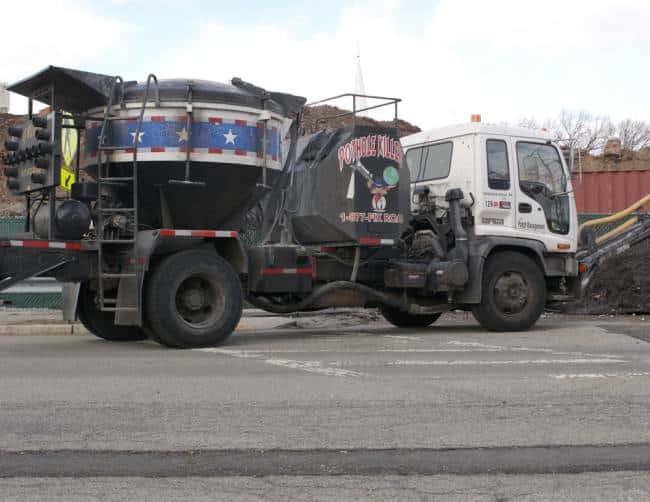
In the seemingly endless war against potholes, Bergen County officials are bringing back a big weapon: “the Pothole Killer.”
The freeholders voted unanimously to spend up to $60,000 to rent the pothole patching system from Patch Management Inc., a company based in Fairless, Pa.
The vote came after County Executive James Tedesco made a last-minute personal request for the device, which he described as far more effective than the so-called “hot patch” method the county has been using this winter.
The truck costs $9,000 a month to rent. Tedesco said the county was also exploring whether to buy the unit at a cost of about $700,000 and make it available to the 70 towns in the county as a shared service.
Tedesco said the potholes filled by the truck, which the county has used in the past, are guaranteed to stay filled for up to a year if the equipment is used properly.
He said the system had a long snout-like attachment with a compressor that blows out any water in the pothole and dries it.
the Village of Ridgewood : If you See a Pothole Report the Pothole
Welcome to the Ridgewood Service Request System (RSR)
This website will allow the registered user to report specific categorized items to the correct departments. Once the item is reported, the submitted information will be copied to the user that has created request. Throughout the entire process, the user will receive status update emails pertaining to the request until it is resolved.
Currently the request that can be submitted will be pertaining to the following categories (additional categories will be added in the future):
-Potholes
The request:
Each request must have a:
Title (example: “Big Pothole”, “Multiple Potholes”, “Deep Pothole”, ect…).
Category – Currently Pothole is the only choice.
Address – (Location of pothole) Address can be entered with just street number and name of street (example: 131 N Maple Ave). The user can also enter the entire address (example: 131 N Maple Ave, Ridgewood, NJ, 07450). After the address is entered, use the “Find Address on Map” button below to pinpoint the area on the map. The map is interactive, and the user can define the exact location of the request by zooming in and dragging the red marker to the exact location.
Upload an Image – While this is not mandatory, it will help in providing information that can be useful in determining needed materials or extent of damages that require attention. Do not put yourself in harm’s way in order to take a photo.
Description – The more information the better. An estimate on the size of the pothole (examples: “12 inches irregular, about 6″ deep”; “Multiple large potholes in a cluster covering a 10 foot section of the road on the northbound lane”) and any other pertinent information would be helpful.
The website can be accessed on most devices and has been tested on: Internet Explorer, Firefox, Safari, Android (internet app), iPhone (safari app), and iPad (safari app). If you experience any issues with RSR, please email: [email protected]. Please provide as much information pertaining to the issue, time and date of when the issue occurred in order to assist us in troubleshooting the problem.
IMPORTANT NOTICE ABOUT RSR
RSR IS NOT AN EMERGENCY REPORTING SYSTEM. If your issue or concern involves an immediate risk to life or personal safety, CALL 9-1-1 IMMEDIATELY. RSR requests are reviewed during the Village’s regular business hours, Monday through Friday from 8:30 a.m. to 4:30 p.m. All requests will be reviewed and addressed in accordance with Village polices and within the limits of available resources.
Highway robbery? Bill seeks probe of New Jersey road costs
By Mark Lagerkvist | New Jersey Watchdog
Why does New Jersey spend more on its highway system than any other state?
On the heels of reports by New Jersey Watchdog, a state senator is introducing legislation Monday to create a task force to address that question.
“When we’re spending two or three times more per mile than any other state, it’s extremely likely that significant savings can be found by the task force,” said Sen. Mike Doherty, R-Washington Township, the bill’s sponsor.
New Jersey pays in excess of $2 million a mile per year — more than 12 times higher than the national average — to maintain 3,338 miles of state-administered roads, according to a Reason Foundation study.
State transportation Commissioner Jamie Fox responded by calling the study “inaccurate and unfair” in a column published by NJ.com. However, Fox did not offer alternative figures, nor did he dispute that New Jersey has the costliest roads in the country.
“Some may quibble over how much more New Jersey spends on our highways than other states, but nobody disputes that we do spend more than everyone else,” said Doherty. “With New Jersey drivers already shouldering such a heavy tax and toll burden, it’s imperative that we find out why millions we spend on our roads get us so little in return.”
That weight will only get heavier if lawmakers pass a proposed 25-cents a gallon hike in the state gas tax. According to its proponents, the state must to raise $2 billion a year to fund its transportation projects.
The Transportation Trust Fund is almost out of cash and must repay $17 billion in debt for money already spent. That figure equals half of New Jersey’s entire annual state budget.
“It leaves us with this very, very long tail of debt,” testified David Rosen, budget officer for the nonpartisan Office of Legislative Services, at a public hearing in November. “Literally, out to the next 25 years, we still have over $1 billion a year in debt service for stuff we’ve already done.”
Even though TTF soon will run out of money, the state continues to build roads and bridges.
“We just don’t have any cash to do it, so we’re borrowing all the cash,” said Rosen.
The task force proposed by Doherty would be composed of 15 state officials, legislative leaders and transportation representatives. It would release its findings within six months of its organization.
Examining New Jersey’s Highest in Nation Highway Costs
SATURDAY, 07 MARCH 2015 12:36
BY BRAD SCHNURE
SPECIAL TO NEWJERSEYNEWSROOM.COM
In response to concerns that New Jersey highways are the nation’s most expensive to build, operate and maintain, Senator Mike Doherty (R-23) hasdrafted legislation that will give policymakers the information they need to lower costs for drivers and taxpayers.
As Doherty expressed in a recent editorial, the new measure addresses the dual concerns of excessive state highway costs highlighted in a recent report by the Reason Foundation and calls by some legislators to raise the state’s gas tax to fund new transportation projects.
“Some may quibble over how much more New Jersey spends on our highways than other states, but nobody disputes that we do spend more than everyone else,” said Doherty. “With New Jersey drivers already shouldering such a heavy tax and toll burden, it’s imperative that we find out why the many millions we spend on our roads get us so little in return.”
According to the Reason Foundation’s 21st Annual Highway Report, New Jersey’s overall highway performance ranked 48th among the states despite our roads being the nation’s most expensive. The next most expensive state, Massachusetts, was found to spend two-thirds less per mile than New Jersey despite similarities in population density, climate and highway system size.
Doherty’s legislation would create the “State Transportation Cost Analysis Task Force” to conduct a methodical analysis of the factors that contribute to New Jersey’s road costs, compare our costs to those of other states, and provide recommendations to complete projects more cost-effectively.
Gas Tax Hikes Are Not The Answer
Christine Harbin Hanson
For most Americans across the country, the lower prices at the gas pump have had a direct positive impact on everyday living. The average price of a gallon of gasoline hovers around $2 across the country, saving the average household about $100 every month. These lower gas prices shouldn’t be an excuse to raise taxes, but that’s exactly what many federal and state lawmakers are poised to do.
Governors and state legislators are currently considering per-gallon tax hikes of 2 cents per year in South Dakota, 10 cents in Iowa, 10 cents in Utah, 10 cents in Texas, 10 cents in South Carolina, 13 cents in Illinois, and a whopping 25 cents in New Jersey.
In Minnesota, Gov. Mark Dayton proposed a 6.5% gross receipts tax on gasoline at the wholesale level, in combination with a number of other tax hikes. In Michigan, legislators approved a plan that could push per gallon gas taxes as high as 40 cents by 2018, pending voter approval. In Georgia, lawmakers are considering replacing the state gasoline tax with state and local excise tax on gasoline, which would effectively raise the tax per gallon from 45.4 cents to 53.6 cents.
Additional states seem poised to follow suit in proposing gas tax hikes as governors around the country unveil ambitious comprehensive transportation plans.
Why are road, bridge and transit projects so expensive in NJ? Lawmaker wants answers
Why do roads, bridges and transit projects cost so much to build in New Jersey?
State Senator Michael Doherty, R-Warren, has proposed a bill to try and answer that question and recommend ways to cut those costs.
His bill to form a State Transportation Analysis Task Force will attempt to answer findings in a recent Reason Foundation report, which said New Jersey spent $2 million a mile for road bridge and transit construction. The foundation ranked the state 48th in overall performance and cost effectiveness.
A task force is proposed as lawmakers are wrestling with finding revenue to finance major road, bridge and transit projects through the state’s Transportation Trust Fund. On July 1, all revenues raised through the state gas tax and other related taxes will be consumed by debt payments, leaving no money for construction.
In an opinion article that Doherty wrote on NJ.com, he said the state needs “our own analysis of the factors that drive New Jersey’s road costs and a look at other states to determine how they are able to operate more efficiently.”
New Jersey Tries to Make Excuses for Expensive State Highways in Poor Condition
Taxpayers get traffic congestion, poor pavement conditions, deficient bridges and a big bill for state roads
David T. Hartgen and Baruch Feigenbaum
February 23, 2015
Reason Foundation’s Annual Highway Report, which found New Jersey’s state-controlled highway system ranks 48th out 50 states in cost-effectiveness and performance, has resonated with New Jersey’s taxpayers who have long complained of bumpy pavement and gridlocked roads and highways.
The Annual Highway Report measures the condition and cost-effectiveness of state-owned roads in numerous categories, including pavement condition on urban and rural Interstates, urban traffic congestion, deficient bridges, unsafe narrow lanes, traffic fatalities, total spending and administrative costs.
With a proposed increase to the state gas tax putting New Jersey’s roads under new scrutiny, Jamie Fox, commissioner of the New Jersey Department of Transportation, recently commented on the Annual Highway Report. Mr. Fox wrote, “Without the benefit of having the numbers the Reason Foundation used to base its calculations, there is no way to independently review its findings.”
That’s strange. Our Annual Highway Report is based on data that New Jersey, and other states, provide themselves to the federal government. And we’ve readily shared the report’s data with state transportation departments and members of the media across the country. The full Annual Highway Report is here (.pdf). Many of the tables we used are publicly available on the Federal Highway Administration’s website. Some of the key tables are HM-10 (mileage), SF-3 (Revenues for State-Administered Highways) and SF-4 (Disbursements for State-Administered Highways).
Mr. Fox also wrote, “NJDOT has jurisdiction over only 6 percent of the entire roadway network in the state.” That’s right, and the Reason Foundation’s Annual Highway Report ranks New Jersey based only on the roads the state actually controls. And that should be even more worrying New Jersey’s taxpayers: Despite the small size of the state-controlled highway system, New Jersey still has big trouble taking care of it. The state ranks near the bottom in poor pavement condition — 46th in urban Interstate pavement condition, 46th in rural primary road pavement condition—and 36th in deficient bridges.
New Jersey’s state government controls just over 3,300 miles of highway. Texas and North Carolina, for comparison, each control more than 20 times as much — over 80,000 miles of highway each. Texas ranks 11th in overall highway performance and cost-effectiveness, while North Carolina ranks 20th, and New Jersey ranks 48th.
Mr. Fox takes issue with how the state’s transportation spending is reported:
New Jersey gives out nearly $330 million a year in local transportation aid to counties and municipalities. This helps local government take care of local roads without having to raise property taxes. The Reason Foundation counts the spending we give to local government but doesn’t count all the miles of local roads that are repaired or built.
Like it does for county and municipal aid, the Reason Foundation also counts the investments made to maintain and run New Jersey Transit as part of our highway spending but gives the state no benefit for that spending. New Jersey is the only state that operates a statewide transit system, so including transit expenditures into highway construction costs is both inaccurate and unfair.
The report’s spending totals are pulled directly from numbers the state of New Jersey provided to the Federal Highway Administration under the category of “Disbursements For State-Administered Highways – 2012.” This federal table, used in our report, shows the breakdown that New Jersey provided for its spending on “capital outlays for roads and bridges; maintenance and highway services; administration research and planning; highway law enforcement and safety; interest; bond retirement; reserves for highway work; and reserves for debt service.”
None of those categories include “local transportation aid” or “statewide transit system.” If the state is claiming it mistakenly included local aid and mass transit spending in clearly defined state highway categories, New Jersey should correct the data it provided to FHWA.
Mr. Fox makes another claim:
The Reason Foundation uses a centerline mile as its denominator. A centerline mile measures the total length of a given road from Point A to Point B, but it doesn’t measure how many actual lanes of highway are going from Point A to Point B.
When was the last time you were on a single-lane highway in New Jersey? There are some, but not many. When we spend money to maintain or build a multiple lane highway, the Reason Foundation acts as if all that spending is to construct a single lane of highway, not the multiple lanes that are actually built.
Lane-miles are part of the report’s calculations. In fact, lane miles are inherent in calculating many of the report’s rankings, including traffic congestion and pavement condition. The Annual Highway Report clearly states: “The average number of lanes per mile is 2.40 lanes, but a few states (New Jersey, Florida, California and Massachusetts) manage significantly wider roads, averaging more than 3.0 lanes per mile.” The report goes on to detail the miles, lane miles and the average number of lanes for all 50 states. These factors are then used to adjust our figures to account for wider roads in some states, like New Jersey. So if New Jersey’s big spending were resulting in smoother pavement and less traffic congestion across many lanes, the state’s overall ranking and its rankings in those individual categories would be better. Instead, New Jersey ranks 31st or worse in nine of the 11 categories, and 41st or worse in seven of 11 categories.
It is incorrect, but let’s test the claim anyway — if the spending per mile metric is punishing New Jersey for having highways that are six or eight lanes wide, as Mr. Fox alleges, then it would make sense that other states with wide highways would suffer too. But that is not the case. California, home to many of the busiest and widest highways in the country, spends $500,000 per mile. New Jersey spends four times that — $2 million per mile. New Jersey spends three times as much as Massachusetts ($675,000 per mile), three-and-a-half times more than Florida ($572,000 per mile), four times as much as New York ($462,000 per mile), and 12 times more than Texas ($157,000 per mile), which is home to six of the 20 most populous cities in America.
Doherty on Transportation Trust Fund funding debate: New Jersey must make “informed decisions”
February 19, 2015
By Senator Mike Doherty (R-23)
There has been much discussion recently about a report on state highway systems by the Reason Foundation that found New Jersey’s roads to be the nation’s most expensive to build, operate and maintain.
According to that report, New Jersey’s state-administered highways cost taxpayers $2 million per mile, which the Reason Foundation claims to be 12 times the national average, three times the cost in the next highest state and four times the cost in New York.
The next most expensive state, according to the Reason Foundation, is Massachusetts, which spends a comparatively paltry $675,000 per mile. By most measures other than cost, apparently, our highway systems and the conditions they face seem nearly identical.
We have similar population densities — we are ranked first and they third in the nation — and our roads are both heavily travelled.
We share harsh northeast winters and maintain a comparable surface area of highway — they have 9,572 highway lane miles to our 8,496.
We also have similarly sized highways, with our state maintained roads averaging 3.65 lanes per mile and theirs 3.17 lanes per mile.
It also should be noted that Massachusetts is home to America’s most-expensive transportation project – the $24 billion “Big Dig” – that Bay State taxpayers will be paying off for the next 20+ years.
Despite all of the similarities in density, climate, actual area of road surface maintained and its own massive transportation spending, Massachusetts still manages to build and operate highways for what the Reason Foundation contends is one-third of what New Jersey pays.
If those numbers are correct, New Jersey’s taxpayers should be outraged and policymakers should take action.
Some, including state Transportation Commissioner Jamie Fox, have questioned the report’s findings and underlying methodology. Those concerns are valid and deserve to be investigated.
Despite his objections, Commissioner Fox concedes, however, that it is “more expensive to build a mile of road in New Jersey,” and few dispute the claim that New Jersey drivers and taxpayers pay more for our highways than anyone else in the nation.
It’s for that reason that the Reason Foundation report has suddenly become a central issue in the growing debate over how to address the long-term funding needs of the state’s Transportation Trust Fund (TTF).
The TTF, which helps pay for road and bridge projects around New Jersey, is in a perpetual state of financial distress and debt. Some would say it’s broke.
While we shouldn’t base state transportation funding policy on one organization’s report, we should pay attention when a seemingly well-formulated analysis raises such serious questions about where our money is going.
The Reason Foundation report, with its shocking conclusions, has fueled the argument that our transportation funding problem isn’t one of insufficient money, but of unreasonable spending.
A TTF plan put forward by New Jersey Democrats – who control both houses of the Legislature – doesn’t address spending, however. They simply want to increase the state’s gas tax, perhaps by 25 cents per gallon.
Such an increase would cost the average New Jersey driver $300 more per year at the pump, and the additional expense to our businesses would drive up the cost of virtually every product and service sold in the state.
According to the Tax Foundation, New Jersey residents already shoulder the second highest combined state and local tax burden, driven by our state’s highest in the nation property and business taxes, and sales and income taxes that are among the highest.
Perhaps the only source of relief for New Jerseyans in our entire tax structure is our gas tax, currently 14.5 cents per gallon, which is the second lowest in the nation.
Yet, this is precisely why Democrats see our gas tax as ripe for increasing. In their myopic view, we’re undertaxed!
Before we let Trenton politicians reach into the pockets of taxpayers yet again, shouldn’t we demand that we first find out why we spend so much more for our highways than every other state?
Shouldn’t we ask why we spend so much more than our peers, including Massachusetts, that have highway systems that are so similar to ours?
I think so, which is why I will introduce legislation requiring our own analysis of the factors that drive New Jersey’s road costs and a look at other states to determine how they are able to operate more efficiently.
If there were objections to the methodology employed by the Reason Foundation, the study I am proposing will be our opportunity to address those concerns and reach our own conclusions.
I hope Commissioner Fox, Governor Christie and other legislators will agree that this is necessary.
Until we determine exactly why we spend more than every other state, it will be impossible to lower our costs or make informed decisions about how much funding is really needed to complete important transportation projects at a cost reasonable to New Jersey taxpayers.
Jamie Fox’s inane op-ed illustrates why we went broke in the first place
Posted by Matt Rooney On February 16, 2015 2 Comments
By Matt Rooney | The Save Jersey Blog
The logic behind a guy seeking the GOP nomination for president appointing a former Torricelli/McGreevey bureaucrat to a critical cabinet post still eludes me, Save Jerseyans.
But here we are. We’re saddled with Jamie Fox now. And this is how he’s spending his time: advocating for a punishing increase in the one tax in New Jersey that isn’t suckily high (the gas tax) and, this past Sunday, penning a guest op-ed in the Star-Ledger claiming that New Jersey’s per-mile road maintenance isn’t nearly as expensive as claimed by gas tax hike opponents.
For starters, he complains that the study treats multiple lane highways like single-lane ones. Moreover, “New Jersey gives out nearly $330 million a year in local transportation aid to counties and municipalities. This helps local government take care of local roads without having to raise property taxes,” Commissioner Fox explains. “The Reason Foundation counts the spending we give to local government but doesn’t count all the miles of local roads that are repaired or built. Therefore, states with greater jurisdiction over local infrastructure fare better in the analysis as those centerline miles are credited to the state.”
You can find a copy of the eye-opening study here.
Congressman Scott Garrett’s tax plan would be a real gas for Jersey drivers: Mulshine
In the New York Times the other day a panel of experts debated the wisdom of lowering the drinking age. Those in favor of doing so pointed out that current law encourages younger people to binge on hard liquor in private instead of drinking beer or wine at a bar.
The article was sent to me by Assemblyman Mike Carroll of Morris County. Carroll, who is a father of five or six or some such number, said he supports lowering the drinking age to the voting age, which is 18.
“If you’re not capable of making a determination to drink a beer, are you capable of making a determination that Barack Obama should be president of the United States?” asked Carroll.
As you might deduce from that remark, Carroll is a conservative Republican. But there are liberal Democrats who also support lowering the drinking age. It all makes for a high-toned and illuminating debate and it might have great meaning – if this were a free country.
Unfortunately it’s not. Americans love to yammer on about their love for freedom, but they love pushing other people around even more. That’s how we ended up with such draconian regulations as a national 55-mph speed limit and a national drinking age of 21.
Scott Garrett has an idea that would end all that over-regulation – and free up a lot of money for transportation as well. Garrett, a conservative Republican who represents the northwest corner of the state, is sponsoring a bill that would accomplish both those ends through the simple expedient of turning the federal gas tax into a state tax.