Updated on August 8, 2017 at 2:26 PMPosted on August 8, 2017 at 1:55 PM
4shares
By Jeff Goldman
LAKEWOOD — A fledgling Lakewood company is attempting to put its own twist on Airbnb stays.
Instead of helping you arrange a short-term rental your home, Pool For U will put your backyard swimming pool on the market, according to app.com. The problem is that there are a slew of legal and insurances hurdles.
Pool For U says it’s a way for people without a pool to access one without a trip to the Shore or a costly pool membership. For homeowners, its helps them offset the thousands of dollars it often costs each year to maintain a swimming pool.
Problems could arise, though, if a homeowner’s insurance company found out, the report said. A policy would be canceled immediately if the insurer learned anyone but the home’s residents or invited guests were using the pool, the report said.
Ethical lapses at some of the tech industry’s biggest companies suggest a chilling reality of what really matters in the world’s most rollicking economy.
It has been said that Silicon Valley, or the 50 or so square-mile area extending from San Francisco to the base of the peninsula, has overseen the creation of more wealth than any place in the history of mankind. It’s made people richer than the oil industry; it has created more money than the Gold Rush. Silicon chips, lines of code, and rectangular screens have even minted more wealth than religious wars.
Wealthy societies, indeed, have their own complicated incentive structures and mores. But they do often tend, as any technological entrepreneur will be quick to remind you, to distribute value across numerous income levels, in a scaled capacity. The Ford line, for instance, may have eventually minted some serious millionaires in Detroit, but it also made transportation cheaper, helped drive down prices on countless consumer goods, and facilitated new trade routes and commercial opportunities. Smartphones, or any number of inventive modern apps or other software products, are no different. Sure, they throw off a lot of money to the geniuses who came up with them, and the people who got in at the ground floor. But they also make possible innumerable other opportunities, financial and otherwise, for their millions of consumers.
Silicon Valley is, in its own right, a dynasty. Instead of warriors or military heroes, it has nerds and people in half-zip sweaters. But it is becoming increasingly likely that the Valley might go down in history not only for its wealth, but also for creating more tone deaf people than any other ecosystem in the history of the world.
from the maybe-these-are-the-‘smart-people’-who-can-fix-Comey’s-encryption-&# dept
Law enforcement has a number of informants working for it and the companies that already pay their paychecks, like UPS, for example. It also has a number of government employees working for the TSA, keeping their eyes peeled for “suspicious” amounts of cash it can swoop in and seize.
Unsurprisingly, the FBI also has a number of paid informants. Some of these informants apparently work at Best Buy — Geek Squad by day, government informants by… well, also by day.
According to court records, Geek Squad technician John “Trey” Westphal, an FBI informant, reported he accidentally located on Rettenmaier’s computer an image of “a fully nude, white prepubescent female on her hands and knees on a bed, with a brown choker-type collar around her neck.” Westphal notified his boss, Justin Meade, also an FBI informant, who alerted colleague Randall Ratliff, another FBI informant at Best Buy, as well as the FBI. Claiming the image met the definition of child pornography and was tied to a series of illicit pictures known as the “Jenny” shots, agent Tracey Riley seized the hard drive.
Not necessarily a problem, considering companies performing computer/electronic device repair are legally required to report discovered child porn to law enforcement. The difference here is the paycheck. This Geek Squad member had been paid $500 for digging around in customers’ computers and reporting his findings to the FBI. That changes the motivation from legal obligation to a chance to earn extra cash by digging around in files not essential to the repair work at hand.
More of a problem is the FBI’s tactics. While it possibly could have simply pointed to the legal obligation Best Buy has to report discovered child porn, it proactively destroyed this argument by apparently trying to cover up the origin of its investigation, as well as a couple of warrantless searches.
It’s a job market revolution: an estimated 10.3 million Americans earned income through Web-based platforms like Uber and Airbnb between 2012 and 2015. That’s more people than reside in the entire state of Georgia and amounts to 6.5 percent of the total U.S. workforce.
So-called gig jobs, in which a person performs a task for another individual often through Web-based platforms, are often easier to land, and help generate additional income when regular earnings aren’t sufficient, according to a new study by the JPMorgan Chase Institute.
Participants in this economy are typically younger, with the 25 to 34 age group accounting for the largest part of the gig workforce. They are more likely to be male, live in the West and have an average median income of about $2,800 per month, according to the study.
The number of people earning income in the online economy over the three-year period of JPMorgan’s study increased 47-fold. Labor platforms, including ride-hailing service Uber, that connect customers with freelancers have grown more rapidly than capital platforms like Airbnb, which rent homes and assets or sell goods. Demand is also driving the growth as online service use becomes more common.
Now, “most people would know they can get their groceries picked up, they can get a ride from three or four different companies — things that only a year ago, only earlier adopters learned,” Diana Farrell, the institute’s founding president and chief executive officer, said in an interview. “It’s becoming more mainstream.”
Astra Taylor’s iPhone has a cracked screen. She has bandaged it with clear packing tape and plans to use the phone until it disintegrates. She objects to the planned obsolescence of today’s gadgetry, and to the way the big tech companies pressure customers to upgrade.
Taylor, 36, is a documentary filmmaker, musician and political activist. She’s also an emerging star in the world of technology criticism. She’s not paranoid, but she keeps duct tape over the camera lens on her laptop computer — because, as everyone knows, these gadgets can be taken over by nefarious agents of all kinds.
Taylor is a 21st-century digital dissenter. She’s one of the many technophiles unhappy about the way the tech revolution has played out. Political progressives once embraced the utopian promise of the Internet as a democratizing force, but they’ve been dismayed by the rise of the “surveillance state,” and the near-monopolization of digital platforms by huge corporations.
Last month, Taylor and more than 1,000 activists, scholars and techies gathered at the New School in New York City for a conference to talk about reinventing the Internet. They dream of a co-op model: people dealing directly with one another without having to go through a data-sucking corporate hub.
OCTOBER 23, 2015 LAST UPDATED: FRIDAY, OCTOBER 23, 2015, 12:31 AM
THE RIDGEWOOD NEWS
Print
Is technology helping or hurting in the classroom?
To the Editor:
As a district, we have enthusiastically embraced technology in our schools. And it is certainly understandable why. With technology came the promise of improved educational outcomes for our children, and a greater chance for success competing in the 21st century global economy.
But parents are beginning to question the validity of this promise: Are children really learning more? Is their reading comprehension improving? What about their math ability?
Now, the Organization for Economic Cooperation and Development (OECD) has published a 200-page study, concluding that investing heavily in classroom technology does not improve student performance, and, in fact, frequent use of computers is more likely to be associated with lower results. For math, the study found that almost any time spent on the computer leads to poorer performance.
Internationally, the best-performing education systems, such as those in East Asia, have been very cautious about using technology in the classroom. Countries with the highest level of Internet use in schools either experienced significant declines in reading performance or stagnated.
Because of my earlier career developing software for IBM, I am acutely aware of the limitations of technology and certainly not bedazzled by it. Now I tutor math for the SAT, so I get to hear unfiltered reports of students’ experiences with technology.
Some teachers, apparently, require students take notes on their Chromebooks, even though some prefer to take notes by hand, because they believe they learn better that way. Research supports these students’ preferences; taking notes by hand results in deeper learning.
Chromebooks in the classroom frequently cause distractions because some students play games during class.
Textbooks are increasingly online, even though many students would prefer to have good paper textbooks, because they are easier to read.
There also appears to be a tendency on the part of some teachers to delegate to the computer the task of teaching, so there’s less interaction between student and teacher. Students do best in close human-to-human contact. The research supports this.
It’s interesting: the students who complain most about technology in the schools are strong students, those most interested in learning.
I think we might want to consider why the executives and employees of the top Silicon Valley firms send their kids to schools that have no technology in the early grades, absolutely none, and when it is introduced in eighth grade, it is used sparingly. It should give us pause to hear that the innovators developing these products refuse to expose their own children’s minds to them. Their thinking is that technology interferes with creativity, and young minds learn best through movement, hands-on tasks and human-to-human interaction.
The OECD report now gives us solid data linking frequent computer use in school to declining academic performance. In September, we learned that – nationally – students in the high school class of 2015 turned in the lowest critical reading score on the SAT in more than 40 years. The average score on the math portion of the SAT was the lowest since 1999.
The Village of Ridgewood has partnered with Parkmobile the leading provider for on-demand and prepaid mobile payments for on- and off-street parking pay by phone. There will now be an easier effortless and innovative way of paying for parking transactions by mobile phone. The new partnership will allow pay by phone transactions so residents businesses and visitors will be able to conduct their parking transactions by mobile phone throughout Ridgewood.
Ridgewood NJ May 11 2015 – Parkmobile LLC announced today a new partnership with the Village of Ridgewood that will allow customers to use their mobile phones to pay for parking at all Village owned lots. This is the first step in expanding mobile payment transactions throughout the Village of Ridgewood. Parkmobile will be available for the on-street meters in the near future as well. Customers will be able to utilize their smartphones to pay for parking using Parkmobile’s mobile applications for iPhone Android Windows Blackberry and Amazon phones. After an exhaustive search Parkmobile was selected. Patrons may register in advance at www.parkmobile.com or download the mobile app in their phone’s app store.
“We are excited to work with Parkmobile pay by phone industry leader and implement a Village-wide pay by phone option. This partnership will expand current payment options and revolutionize the current parking operation as it has done for Glen Rock Summit Chatham and Montclair.”
“We are very happy to launch our mobile payment parking service in the Village of Ridgewood” said Cherie Fuzzell CEO of Parkmobile LLC. “This technology offers customers a new and better way to pay for parking and is truly beneficial to them as well as the city. Our service eliminates the need to swipe a card or feed coins to a meter and can make our lives easier and more efficient.”
Once registered customers may use the mobile app internet or call a toll free number to pay for parking. After setting up their account they can immediately start using the system with their registered mobile phone. This convenient service also provides customers the ability to receive alerts when their meter time is about to expire and use credit cards in locations that do not offer manual credit card payments. Meters accepting coins are still available except at the Chestnut Street Lot and some parking spaces at the Rt. 17 Park & Ride Lot.
MAY 10, 2015 LAST UPDATED: SUNDAY, MAY 10, 2015, 10:47 AM
BY JOAN VERDON
STAFF WRITER |
THE RECORD
Sixty years ago, when the first malls arrived here, they changed the landscape of North Jersey, replacing celery fields and woodlands with stores, food courts and parking lots. Now, new forces are at work altering the terrain of traditional suburban shopping centers.
The industry group International Council of Shopping Centers says America’s malls are undergoing the biggest transformation in their six-decade history. Next week, the council will unveil an initiative to examine and redefine the mall as developers, shopping center owners and the retail real estate industry gather in Las Vegas for their annual convention. The council will look at eight groundbreaking ideas, including using parts of shopping centers as distribution sites for filling online orders, as well as ways to bring residential, hotel and office uses into the mall.
“This is an industry that is constantly evolving,” said ICSC spokesman Jesse Tron. The shopping centers that will thrive in the future are those that are “willing to push the envelope to try what’s new,” he said.
As the industry grapples with change, two North Jersey malls find themselves at a crossroads, and the choices they make will affect their development for years.
When Bill Ochs was 21 and fresh out of Fairleigh Dickinson University with an electrical engineering degree in 1979, he landed a job with a local government contractor, Bendix in Teterboro. He soon found himself developing the software that would keep the Hubble Space Telescope pointed in the right direction for 25 years, providing unimaginably beautiful images of intergalactic space.
Hubble, which was intended to have a useful life of 15 years, hits the quarter-century mark today, and scientists expect its nearly 8-foot mirror to keep peering into deep space and providing spectacular sights for at least five more years. (Norman/The Record)
APRIL 19, 2015 LAST UPDATED: SUNDAY, APRIL 19, 2015, 10:24 AM
BY HUGH R. MORLEY
STAFF WRITER |
THE RECORD
What can New Jersey — once the home of storied inventors like Thomas Edison and the Bell and Sarnoff labs — do to get its innovation mojo back?
That question held center stage at a forum of business and civic leaders in Newark last week that outlined a way to jump-start New Jersey’s struggling economy by tapping into the traits that once made the state a thriving, innovation powerhouse.
The success of Bell Labs, created in 1925 with a staff of 4,000 scientists and engineers, has become a symbol of New Jersey’s former stellar, and now greatly diminished, technological prowess.
The laboratory’s string of groundbreaking discoveries, ranging from laser spectroscopy, cosmic microwave background radiation, the first orbiting communications satellite (Telstar), a solar battery cell and the UNIX operating system that transformed the Internet, garnered eight Nobel prizes and 32,000 patents — a daunting legacy that hangs over the state’s efforts to restore its reputation as a high-tech center.
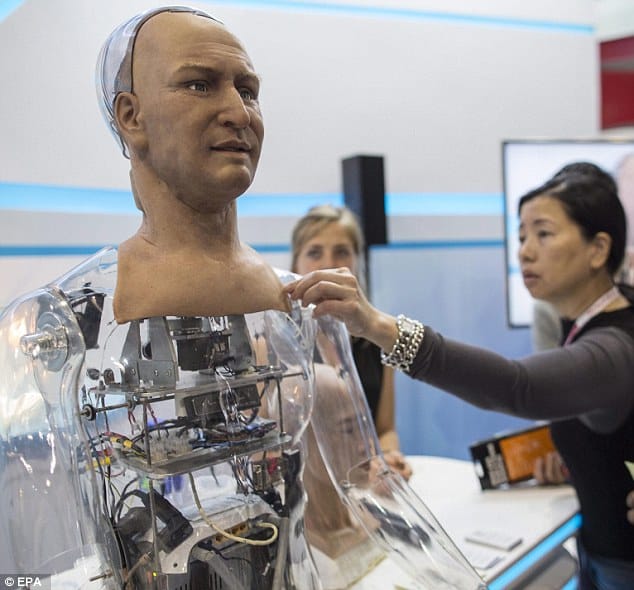
Aye, robot? Amazingly lifelike humanoid that can react to facial expressions, engage in conversation and even make eye contact
Robot has been drawing crowds at Hong Kong electronics event this week It can recognise and respond to human facial expressions in natural way Known as Ham, the head was designed by US firm Hanson Robotics Made using soft-bodied mechanical engineering and nanotechnology
By JACK CRONE FOR MAILONLINE
PUBLISHED: 12:14 EST, 18 April 2015 | UPDATED: 12:55 EST, 18 April 2015
With his lively eyebrows, winkled cheeks and eyes that follow you around the room – this state-of-the-art robotic head is menacingly lifelike.
The humanoid, known as Ham, has been drawing in crowds with his incredible range of facial expressions at an electronics event in Hong Kong this week.
The head, designed by American robotics designer David Hanson, is able to answer basic questions and can also be used in the simulation of medical scenarios.
Ham is currently on exhibit at the Global Sources spring electronics show at AsiaWorld Expo – the largest event of its kind in the world, with more than 4,000 booths displaying the latest gadgets.
The head is created with malleable material called Frubber using soft-bodied mechanical engineering and nanotechnology.
It contains realistic pores that measure just 4 to 40 nanometers across (there are 10million nanometers in one centimetre).
About one-quarter of the nation’s teenagers are online “almost constantly,” according to a new Pew Research Center study.
The study of Americans aged 13-17 found that 92 percent of teenagers go on the Internet every day, and 24 percent say they are “almost constantly” on the Internet, in a sign of just how central the Web is becoming for young people’s lives. More than half the nation’s teenagers — 56 percent — go online several times a day.
“Much of this frenzy of access is facilitated by mobile phones — particularly smartphones,” noted study author Amanda Lenhart.
About 73 percent of teenagers own or have access to a smartphone, the Pew survey found, while African-American teenagers were the most likely to own one.
Of those that use a mobile device to go online, 94 percent go on the Internet at least once a day.
Ridgewood NJ, The Stevens Institute of Technology awarded National Science Foundation certificates to students in Dr. Lillian Labowsky’s Chemistry Honors class for the students’ efforts to create a three-dimensionally printed periodic table of elements.
Dr. Labowsky’s class created the chart on a 3D printed model over three months and individually printed all 118 interlocking element pieces. The height of each piece corresponds to the element’s electronegativity and the radioactive element pieces were printed with glow-in-the-dark material.
A 3D printer uses an additive process to lay down successive layers of material in order to create a computer printed object.
Assembly Transportation Committee passes ride-share regulatory bill opposed by Uber
TRENTON – After all-day pushing and shoving between union taxi cab drivers and non-union drivers, the Assembly Transportation Committee this afternoon passed a thorny labor-backed bill aimed at protecting the safety of passengers who use Uber Technologies and similar ride-sharing services. (Pizarro/PolitickerNJ)
TRENTON -Cabs cluttered West State Street again this morning in a cabbie war with an Assembly Transportation hearing on the legislative horizon.
Screaming “No justice, no peace, no justice, no peace,” Communications Workers of America (CWA) members tramped around the statuary outside the Statehouse Annex in advance of a hearing for a bill that would impose restrictions on the smartphone-based ridesharing service company Uber. (Pizarro/PolitickerNJ)
Billionaire Mark Cuban Says Net Neutrality Will ‘Fuck Everything Up’
February 18, 2015, 6:26 PM PST
By Dawn Chmielewski
Billionaire investor and ABC “Shark Tank” star Mark Cuban unloaded on the Federal Communications Commission’s plan to fundamentally change how it oversees the open Internet.
“That will fuck everything up,” said the voluble Cuban in remarks Wednesday at theCode/Media conference at The Ritz-Carlton, Laguna Niguel, Calif.
In early February, FCC Chairman Tom Wheeler proposed tough new rules for Internet lines that would prohibit wired and wireless broadband providers from collecting payment to cut to the front of the line, or blocking and throttling lawful content and services.
Cuban said this bid to significantly expand the agency’s authority to regulate broadband providers is nothing more than an attack on giant media companies like Comcast*.
“Net neutrality is just a demonization of big companies,” Cuban said.
Cuban, who parlayed his windfall from the 1999 sale of Broadcast.com to Yahoo into an array of ventures that include the NBA’s Dallas Mavericks, AXS TV and the Landmark Theatres chain, said there is no evidence (beyond an isolated 2008 case) that Internet providers have throttled access to certain websites.