
Governor Christie plans to promote his school funding formula at a forum in Fair Lawn Thursday. John C. Ensslin, The Record Read more
Governor Christie plans to promote his school funding formula at a forum in Fair Lawn Thursday. John C. Ensslin, The Record Read more

Your pension and health benefits are better than the private sector. That’s always been the trade-off. Teachers make less than comparable professionals in the private sector, but get an incredible retirement deal. Now your union and the NJEA are telling you that you deserve equivalent wages, too? You are getting the wrong advice. Prorate your salary for 187 days a year, add in all of your excessive benefits, and remember there are 1,100 applicants to replace you if you decide there’s a better deal elsewhere. Stop holding us hostage.

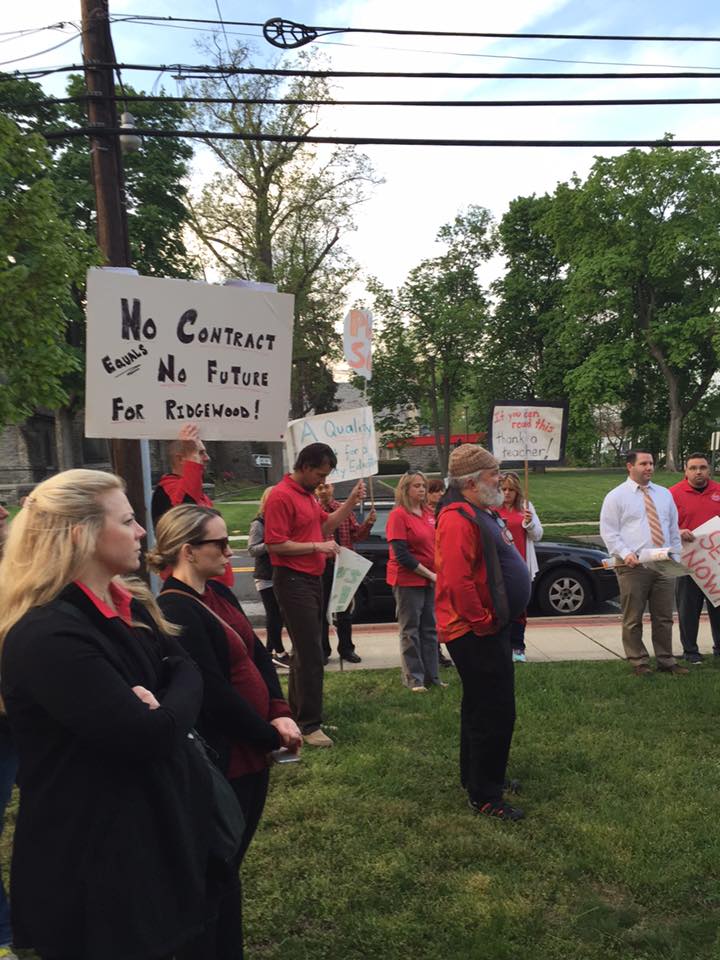
Picketing our BOE with red shirts and signs is a union thug tactic . There is no room for your NJEA style tactics in our Village. Tell the full-time NJEA lawyers, activists and lobbyists advising the REA that we have no room for their thug-like tactics in our beautiful Village. Take it back to Hudson County.
I think the term “thugs” was used referring to union tactics but our teachers are not behaving professionally. If you look at the faces in the middle picture above none of them look very happy. I’d say malcontent is an accurate description. If I made a face like that at my job, I’d be placed on a PIP for having a bad attitude! I believe the majority of Ridgewood residents support the BOE holding the line given that we already pay our teachers very generously. We live in a beautiful town and we value education but a lot of us are struggling to make ends meet and our property taxes are getting out of hand. We don’t speak openly because we do not want our children punished in the classroom for our opinions.
the staff of the Ridgewood blog
Mahwah NJ, William J. (Bill), Cobb of Mahwah, formerly of Ridgewood and Paramus, died on July 17, 2016. Bill Cobb was born in 1928 in Walton, NY, the second son of Russell Carpenter Cobb and Gertrude Sawyer Cobb. He grew up in Hasbrouck Heights, graduating in 1946 with honors and as class president. After graduation, he enlisted in the Navy. He entered the NROTC program at Princeton University. At graduation, he was commissioned an Ensign in the Navy on the aircraft carrier, U.S.S. Tarawa, in the sixth fleet in the Mediterranean.
In July 1954, he returned to Europe to marry Andree Hammer of Luxembourg. He earned his Master’s degree in Teaching and Administration at Columbia University, and then a Doctorate in Administration. He was employed by the Ridgewood public schools for 30 years serving as a teacher, principal of GW, assistant superintendent, and the “go to “acting superintendent.
Bill was particularly proud of his contribution at the Children’s Therapy Center in Fair Lawn, as well as serving on the school of the board of the Forum School in Waldwick for 25 years, 10 years as Board President.
Bill is survived by his wife Andree Hammer Cobb, his daughter Andree L. Cobb, and his granddaughter Katrina Cobb of Mahwah, NJ; his son Russell P. Cobb and daughter-in-law Cristine and son William J. Cobb and daughter-in-law Patricia of Lake Luzerne, NY; son Paul A. Cobb and his husband Tom Grady of Dartmouth, MA; and grandchildren Brian Cobb and wife Katie and great-grandson Liam of Ridgewood, NJ; Jessica McMahon and husband Christopher of Haskell, NJ; William Cobb and fiancée Kristin Dikun of Midland Park, NJ; Lindsay Moeller and husband Matthew of Haledon, NJ; and his sister Louise Cobb Moore of Highland, NY.
Bill passed away at home surrounded by his family. In lieu of flowers, donations may be made to Valley Hospital Foundation/Hospice, 223 North Van Dien Ave., Ridgewood, NJ 07450, in memory of Bill Cobb.
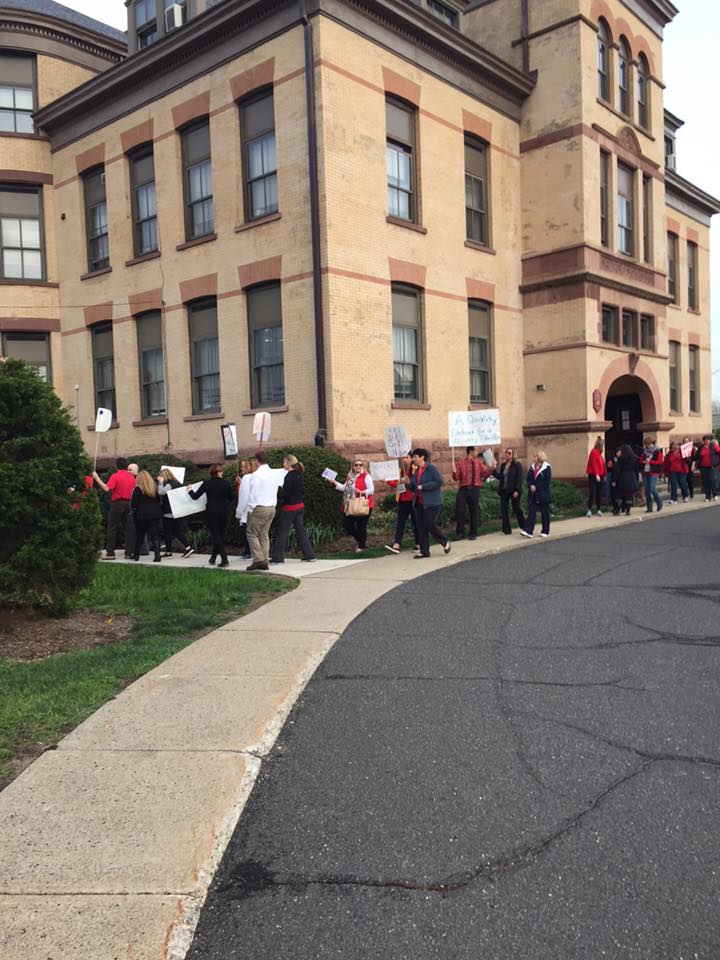
1,100 applicants for Ridgewood BOE job openings in the past 12 months. Hopefully there are a lot more job openings once we get rid of the thugs pictured above. Can anyone name these people? The look on their faces tells it all: they are smug, self-entitled, and angry about $15 co-pays instead of the current $10… let’s fire the malcontents and replace them with educators who want to work with our kids.
These teachers and their benefits are out of control. Hold the line BOE. Thank goodness most of our volunteer BOE members don’t have kids in the schools anymore – the REA abused previous board members who did have kids with veiled threats and heaped abuse. The REA’s tactics are in BAD faith, and they are selfish. Support our students, support the BOE and support Ridgewood taxpayers.
The greedy teachers don’t $15 co-pays, they want to keep $10. And their platinum coverage covers up to 96% of medical expenses both in and out of network with full family coverage worth $28,000 a year in premiums…. NO ONE in the private sector gets a plan like that, only greedy public sector workers who think it’s their right.
#DOITFIRDAKIDZ
The REA just wants more money taken from the students and extracurricular’s to pay for their average annual above inflation (and above 2% property tax cap) wage increases and “platinum” health plan benefits covering 96% of all medical benefits with $10 co-pays. Why are Ridgewood residents paying above average property taxes in Bergen County for schools to only cut spending on students to pay even more for teachers who already earn the highest average salaries in Bergen? Does this make any sense? Won’t our property values decline if our schools keep declining like they have?
You are blatantly misleading readers and twisting facts!!! Assuming you pay average Ridgewood property taxes of $16,000 a year, and assuming you are, in fact, a soon to retire teacher, then your $16,000 in property taxes helps cover the cost of Village contributions towards your lifetime defined benefit TPAF pension.
Assuming you are a Tier 1 member (enrolled in TPAF before July 2007), you can retire between age 55~60 you will receive full retirement benefits. To calculate how much your annual pension is worth, you divide your service time by 55, then multiple that by your average salary for the three years immediately preceding your retirement. So say 35 years divided by 55 = 63.6% of your average final salary $118,000 = $75,000 in taxpayer protected, defined benefit pension every year until you die which will be more than 25+ years if you retire at 60 and live to the average U.S. lifespan of 85 years. For this you contributed only 6.5% of your base salary but you get a defined benefit amount in retirement plan, i.e. you are insulated from any investment risk and benefit from taxpayer protected pension plan with an assumed annual rate of return of 7.95%. Yes the percentage contribution will gradually climb to 7.5% by 2018, but it’s still less than the 10% that PFRS members contribute and you take no investment risk like the rest of us with defined contribution IRAs or 401(k) plans. Those who enrolled in TPAF on June 28, 2011, or later are won’t be eligible until 65 for a pension, but that is for members who will retire in 35+ years from now, NOT you.
That $16,000 in property taxes also helps to subsidize your “Platinum” level health benefits, as defined by the ACA, which is an annual benefit of up to $28,000 a year depending on family member coverage. This plan covers up to 96% of eligible medial costs with $10 co-pays..TPAF members with at least 10 years of service time also receive a free group life insurance policy payable upon their death to their beneficiaries. You can also choose to purchase an additional group life policy that costs 0.4% of your paycheck. Not bad for $16,000 in property taxes, which is why it means you should be ASHAMED of your comment that “I am Ridgewood tax payer too and suffer just like you when the rates increase.” You don’t suffer, it’s in YOUR beneficial interest because you benefit from increased taxes which help pay for your retirement. Put in $16,000 a year in property taxes and get out over $105,000 in annual benefits. So please tell the whole story here or it truly is “shame on you.”
“Hold strong to your position REA. This heinous, negative sentiment toward educators is indicative of a minority of Ridgewood residents. Comments about not having the support of the community are inaccurate. More and more of the limited support Ridgewood Teacher signs are cropping up everyday despite this being vacation time. The premise that teachers are living in a fantasy world, are asking for pie-in-the-sky benefits and don’t understand the reality of the day are ridiculous. The REA has proposed what every other district in NJ has asked for, nothing more. Teacher hate is not the norm in other towns…… and not for the majority of Ridgewood residents.”
July 22, 2016
Ridgewood NJ, For six hours on Wednesday evening, July 20, the Board of Education members and the Ridgewood Education Association (REA) Negotiating Team met with Tim Huntley, the state-appointed super conciliator. The contract remains unsettled.
At the meeting, the Board reviewed its three-year contract proposal and the district’s finances with the super conciliator. The Board’s proposal included:
· Salary increases over three years of 1.1%, 2.8% and 2.8%;
· For the highest paid teachers, payments to offset a portion of the cost of their health insurance premium contributions. These amounts would be $500 year one, $1,000 year two, and $1,500 year three;
· A change in the health insurance plan from NJ Direct 10 to NJ Direct 15. According to our estimates, the change in the health insurance plan, if it happened by January 1, 2017, would reduce the cost of premium for the district by $722,878 and for the REA members by $250,040.
Contrary to the REA’s statement that was released after the meeting, this proposal is not the same proposal offered to them in February.
The current proposal reflects our sincere attempt to compromise and address the contract requests from the REA.
The Board’s offer is structured to keep salaries above the county average and maintain our standing as having the highest salaries in the county for new teachers. The district’s great reputation and our competitive salaries continue to attract job applicants. That is why eleven hundred applicants applied for open teaching positions in the last twelve months.
The Board’s offer also speaks to the REA’s request for relief for the highest paid teachers contributing 35% of the cost of their health care premiums. The proposal of one-time yearly payments of $500, $1,000, and $1,500 would provide this requested relief from increased contributions.
The change to the health insurance plan would lower premium costs and give further relief to all REA members.
The REA Negotiating Team did not come to the table with a contract proposal on Wednesday night. There was no willingness to negotiate or compromise. Rather, the team told us that they would only accept the settlement recommended by the fact-finder as outlined in his May 15th report and again said that the district has the money to fund those recommendations.
The fact-finding report was made public and is posted on the district’s website at www.ridgewood.k12.nj.us.
The fact-finder’s recommended settlement would cost the district $4.4 million over and above the state-mandated 2% cap during the life of the contract. For this reason, to fund that settlement and to balance the budget, the Board would have to make critical cuts to staff and programs that would severely diminish the quality of the instructional and extra-curricular programs for our students.
Cuts would include firing teachers, secretaries and administrators; reducing the number of athletic and co-curricular activities; and lowering the amount spent for custodial services, textbooks, professional development, and technology.
When by the end of the July 20th meeting settlement was not reached, the super conciliator set the date of September 6 for our next meeting. The full Board will be there. In the meantime, the Board is preparing documents to share with the REA verifying that breakage — the cost difference between the salary of retirees and salaries of new employees — is not available revenue to fund the settlement proposed by the fact-finder.
The REA has accused the Board of not caring about our students, the district, and the staff. These charges are false. In fact, the Board’s concern for our students and their educational well being is the reason why we did not originally accept the fact-finder’s recommendations and continue to maintain our position.

By Lindsey Burke, Jamie Bryan Hall and Mary Clare Reim
Lindsey BurkeWill Skillman Fellow in Education
Domestic Policy Studies
Center for Data Analysis
Mary Clare ReimResearch Associate
Domestic Policy Studies
College students understandably bemoan the costs of higher education. During the 2015–2016 school year, annual costs[1] at four-year public universities reached $19,548 for in-state students and $34,031 for out-of-state students. Annual costs at private institutions reached $43,921.[2] Federal student aid has likely exacerbated the college cost problem, providing short-term relief to students in the form of loans and grants, while enabling universities to increase tuition across the board.[3]
There is an additional consequence to taxpayer-subsidized federal student loans. The average full-time college student spends only 2.76 hours per day on all education-related activities. This helps explain why most full-time students today do not graduate in four years and rack up increasingly high loan debt during their extended enrollment. Taxpayers, who are increasingly on the hook for borrower defaults and loan forgiveness programs, deserve to know what their tax dollars subsidize.
Based on data from the Bureau of Labor Statistics’s American Time Use Survey from 2003–2014, during the academic year, the average full-time college student spent only 2.76 hours per day on all education-related activities, including 1.18 hours in class and 1.53 hours of research and homework, for a total of 19.3 hours per week.[4]
Full-time high school students, in comparison, spent 4.32 hours per day on all education-related activities, including 3.42 hours in class and 0.80 hours of research and homework, for a total of 30.2 hours per week. Thus, full-time college students spend 10.9 fewer hours per week on educational activities than full-time high school students.
Employment eliminates this gap between college and high school students.
Full-time college students, then, spend 35.6 hours per week on education-related and work-related activities, while full-time high school students spend 34.2 hours per week.
However, full-time college students spend significantly less combined time on education and work than do full-time employees. The average full-time employee works 41.7 hours per week. To match that, the typical college student would need 22.4 work hours per week, in addition to the 19.3 educational hours.
Non-employed full-time college students spend more time per week on educational activities than part-time or full-time employed students.
In combined education and work hours, however, there remains a deficit between non-employed and employed students:
The combined education and work effort of the average non-employed, full-time college student (25.8 hours per week) most closely matches that of a non-student, part-time employee (22.9 hours per week), but remains substantially less than that of a high school student (34.0 hours per week) or even a part-time employee, part-time college student (33.8 hours per week).
In order to match the combined work and education effort of the average full-time employee, the average non-employed, full-time college student would need to work 16.9 hours per week, in addition to the 24.9 hours spent on educational activities.
Although expectations undoubtedly vary across institutions and fields of study, on average, full-time college demands substantially less time commitment than do high school or regular full-time employment. 60.5 percent of full-time students and 79.9 percent of part-time students work at least part-time while in school, suggesting many students recognize the merits of minimizing the debt incurred to finance their degrees. However, nearly 40 percent of full-time students do not work at all while in college.
The average 17-year-old, who is generally in high school, spends 31.2 hours per week on education and work activities. For 19-year-olds, total hours per week for education and work activities decrease to 26.0, and do not exceed the efforts of a 17-year-old again until age 23, after the end of the traditional college years. Total hours of education and work activities per week peak at 34.8 among 29-year-olds.
On average, Americans will not work as little as they did at age 19 until they reach age 59, when significant numbers cut back on their work hours or enter retirement. With outstanding student loan debt currently at more than $1.2 trillion, these findings raise an important question: Why are taxpayers heavily subsidizing a period in some people’s lives when combined education and work efforts are at their lowest?
Among the 39.5 percent of full-time college students who are not employed, the average time spent engaged in education-related activities (both class and studying) is only 24.9 hours per week, or 3.56 hours per day.
In the context of a student loan system in which students borrowed primarily through private lenders and paid back their loans themselves, evaluation of time use would largely only be an issue for the individual student, who would accrue higher levels of debt the longer it took him to complete college.
Today, however, the federal government originates and manages 93 percent of all student loans, and taxpayers underwrite generous loan forgiveness programs along with the cost of defaulted student loans.[5]
In 2016, 43 percent of individuals with federal student loans (or about 9.3 million borrowers) were either in default, were delinquent, or had postponed payments, owing more than $200 billion.[6] A long and more expensive path to the bachelor’s degree may seem relatively harmless to the individual student, but federal subsidies put taxpayers on the hook for this more expensive route if students default on their debt or enter loan forgiveness. Nationwide, fewer than 19 percent of full-time students attending non-flagship public universities earn a bachelor’s degree within four years; meanwhile, just 36 percent of students attending selective public research-based institutions will earn their degrees within four years.[7]
A study by researchers from Northwestern University suggests that, among other reasons such as lost transfer credits and remedial coursework, “most full-time students do not take the credits necessary to graduate on schedule (15 credits per semester or 30 credits per year), opting instead for lighter course loads that put them on five- and six-year plans.”[8]
Many colleges charge students based on whether a student is full-time or part-time, and in-state or out-of-state, so a full-time student who does not optimize the amount of credits he is taking would spend substantially more over a five- or six-year period in pursuit of a bachelor’s degree than the student who acquires the degree in four years, particularly if the student is paying room and board. The per-credit cost for a full-time student is typically lower than that of a part-time student. Further, at many universities, tuition for a full-time student is a fixed rate that then allows a student to enroll in a chosen number of credit hours, typically ranging from 12 to 18 per semester. With full-time tuition typically set as a flat rate, students minimize their per-credit cost as a full time student the more hours they take. Not maximizing credit hours can translate into considerable additional spending and debt for students. Estimates show that every extra year a student spends at a public four-year college costs an additional $22,826.[9]
Students are accruing more debt to earn a bachelor’s degree, and the burden of loan repayment is increasingly being shifted to taxpayers. Not only do taxpayers bear the burden of defaults, but thanks to an expansion of federal loan forgiveness programs, they are also responsible for an increasing number of student loans that now qualify for forgiveness.[10] In 2015, the Obama Administration promulgated regulations expanding the income-based repayment program, which caps at 10 percent of discretionary income the amount borrowers can be required to repay per month, to all individuals with federal Direct Loans. All borrowers with undergraduate loans also have any remaining debt forgiven after 20 years. For graduates entering public-sector work upon college completion, loans are eligible for forgiveness after just 10 years. Some parent borrowers qualify for loan forgiveness of their Parent PLUS loan after 10 years if they work in the public sector.[11]
Loan forgiveness and repayment caps increase the likelihood that taxpayers will bear responsibility for a portion of students’ extended time taken to earn a degree. Loan forgiveness is bad policy in general, further enabling colleges to increase tuition and fees and shifting the burden of paying for college from the student who benefits from the education they receive to the taxpayers.
The limited amount of time spent engaged in education-related activities on average suggests that, for some students, the amount of debt accumulated finances a significant amount of non-education hours. When loans are forgiven, then, both education and non-education time is financed by taxpayers. Although numerous exogenous factors play into time to degree, such as when courses are offered and the mitigating circumstances of individual students, time-use data suggest that taxpayers end up generously subsidizing the non-education time of many college students.
An examination of the typical college student’s day reveals that the average full-time college student spends only 2.76 hours per day on all education-related activities. With the federal government today originating and managing 93 percent of all student loans, these data add to questions about the type of time use federal assistance is subsidizing. Taxpayers deserve to know.
Lindsey M. Burke is the Will Skillman Fellow in Education Policy in Domestic Policy Studies, of the Institute for Family, Community, and Opportunity, at The Heritage Foundation. Jamie Bryan Hallis Senior Policy Analyst in the Center for Data Analysis, of the Institute for Economic Freedom and Opportunity, at The Heritage Foundation. Mary Clare Reim is Research Associate in Education Policy in Domestic Policy Studies.
I think it is time for the parents to speak up. Clearly there are many of us that feel the teachers have been handed a pretty sweet deal over the years. Why should they be entitled to anything more than the rest of us deserve? Just because they look after our children? The fact that they are only required to actually teach them 23 hours a week blows my mind. We have tried to speak on social media, but when we do we are shot down. We try to speak anonymously but again we are attacked. The lack of signs that around town show how little support the teachers are getting. I think at the next BOE meeting we need to show ourselves in numbers. We need to speak and let our voices be heard. We need to show them that there are fewer supporters for the teachers than they they think. It is time for the bullying by the teachers and union end and we take a stand and support our children and the BOE. The fact is that the teachers are complaining that morale is low. Just by signing a contract is not going to change anything. You have lost the respect of many of the parents in this town and the example you are setting is not the one I want to have my children live by. I think that many of us would gladly welcome new blood. As teachers I thought you would support your peers. The attitude you have is there is none better than you. Remember you were young once too. Don’t take your job for granted!..
…We can’t speak because our children would likely by personally targeted by Yannone and the REA. It is despicable what the REA is doing. Last year teachers at the high school turned out the lights at 3:14 on kids coming for extra help during period 9. They also had their coats on 3:12 just to make sure they didn’t spend an “extra” minute in the building. Several overnight field trips including those associated with special honors programs and sold as part of the curriculum were cancelled in a capricious and arbitrary manner, and despite the strenuous efforts of the classroom teachers to hold the trips. Of course this year we won’t have to worry about that since we have been told that ALL clubs and field trips will be cancelled. I imagine this will start to more directly impact the younger kids this year. Hard to feel sympathetic for the teachers and their fight against the $5 copay bump. But having seen how they operated last year – there is no way I would speak publicly at a board meeting. The REA, in my opinion, would not hesitate to harass students that are children of complainers.
BY MATTHEW SCHNEIDER
STAFF WRITER |
THE RIDGEWOOD NEWS
RIDGEWOOD – This week’s Board of Education (BOE) meeting contained an update on the status of contract negotiations between the board and the Ridgewood Education Association (REA), as well as the announcement of a new administrator.
Contract Status
BOE President Sheila Brogan reiterated that the board is committed to settling the contract with the REA.
https://www.northjersey.com/news/education/teacher-contract-negotiations-stagnant-1.1633839
I highly doubt the BOE is looking to the blog for guidance. HOWEVER, this blog has been pretty on the money as it relates to Ridgewood sentiment having predicted recent council elections and referendum votes correctly. Perhaps the BOE SHOULD be reading here? Furthermore, if you look at the Ridgewood Moms and DADs facebook page, most posts about the REA are met with silence. Why do you think that is? Lastly, the losing council candidates had probably 10x as many visible signs as the support the Ridgewood teachers sign. What does THAT tell you?

the staff of the Ridgewood blog
Ridgewood NJ, Brianna Alexandra Patek, of Ridgewood High School will present a research project Friday at the 2016 Research Symposium of the New Jersey Governor’s School of Engineering & Technology at Rutgers University’s Busch campus in Piscataway. Patek will be joining 80 of her peers in presenting the results of their respective research projects.
11:20 AM – 11:40 AM Health-Monitoring Wearables Amy Liang, Brianna Patek, Sruthi Srinivasan, Eileen Wang, Andrew Zheng
The introduction of the final symposium from 10:00 AM – 10:50 AM in the Allison Road Classroom Building Room 103 on Rutgers’ Busch Campus (directions at the end of this invitation). (Visitors on the day of the symposium may park in Lots 51, 59, 60B, and 67 without permits.
Links to the parking lots are at the bottom of this document). Light refreshments will be served. Students’ research presentations will run from 11:00 AM – 2:00 PM concurrently in three locations: the Computing Research and Education (CoRE) Building Auditorium, located on the first floor of the CoRE Building; the Easton Hub Auditorium, located in the Fiber Optic Materials Research Building; and the CAIT Auditorium, located in the Center for Advanced Infrastructure and Transportation Building.
The schedule of presentations from 12:00 PM – 1:00 PM there will be a one hour break for individuals to examine the final project results in the Life Sciences Building Atrium
Ridgewood Board of Ed Statement:
The Board of Education is committed to settling the contract with the Ridgewood Education Association (REA). To this end, the full Board will meet with the state-appointed super conciliator on July 20 at 5 p.m. at the Education Center, 49 Cottage Place.
“Once again tonight the BOE has refused to accept the report from the impartial State Appointed Fact Finder. In fact the Board has not improved its position since February, and tonight presented nothing new to the REA negotiating team.The BOE continues in its position that it cannot afford the Fact Finder report. The impartial Fact Finder examined the Board’s books when he made his recommendation. Despite the BOE’s false statements, the report shows it has the resources to fund the recommended settlement. If the BOE cuts programs, it will not be because of the REA. Instead the Board is using scare tactics and the threat of cutting programs as an attempt to scapegoat the REA. This is no time for divisiveness; instead it is time for compromise. But as long as the Board remains set in their discredited “cost neutral” position, until it is willing to truly negotiate, this impasse will not end.
This meeting was the last chance of a settlement before September. Its failure to negotiate tonight means that teachers and secretaries will return to work beginning their second year under an expired contract. In addition, the Ridgewood Administrators Association (RAA) contract has also expired. The recalcitrance of the Board now means that in addition to teachers and secretaries, every principal, assistant principal, and supervisor will also begin September under an expired contract. This should not be acceptable in Ridgewood.
The Board needs to stop posturing and begin the work of negotiating in good faith to settle this contract. The BOE obviously, as stated in its email to the school community, is NOT “prepared to stay as long as needed to finalize the settlement and reach an agreement on a successor contract”.