Trenton NJ, multistate lawsuit over “citizenship census question ” Attorney General Gurbir S. Grewal all but admits states like New Jersey are allowing illegal aliens to vote ,receive federal benefits , federal funding and federal representation.
In his press release Attorney General Gurbir S. Grewal cited the Voting Rights Act and the apportion seats in the House of Representatives.
Attorney General Gurbir S. Grewal announced today that New Jersey will join a multi-state coalition in suing the federal government to block the inclusion of a proposed citizenship question in the 2020 decennial Census.
“Notwithstanding the Administration’s rhetoric, we don’t need a citizenship question on the 2020 census. And the reality is that such a question would only do harm,” said Attorney General Grewal. “Particularly in the current national climate, a citizenship question will obviously cause great consternation and discourage participation in the census. That lack of participation will inevitably have far-reaching, negative effects – particularly in New Jersey, where we have the third largest percentage of immigrants in the country.”
The impending multi-state lawsuit, which is led by New York’s Attorney General, will name the U.S. Department of Commerce and the U.S. Census Bureau as defendants.
The complaint will challenge addition of the citizenship question as a violation of the U.S. Constitution, and assert that such a question threatens the fair representation of states with large immigrant communities in Congress and the Electoral College, as well as cost those states billions of dollars in critical federal funds for programs like Medicaid.
Under the Constitution, the federal Census Bureau has an obligation to determine “the whole number of persons in each state.” However, the states’ lawsuit will assert, adding a citizenship question to the 2020 Census – an idea four prior census directors appointed by Presidents from both parties have advised against — will limit participation in the census among immigrants. That lack of participation will inevitably result in a population undercount that will disproportionately harm states and cities with large immigrant communities.
“We are glad to stand with New York and the other participating states in challenging this unnecessary question regarding citizenship status – both to protect New Jersey residents and ensure a fair and accurate census,” said Attorney General Grewal. “Our objective is to have this citizenship question – which arbitrarily ignores decade after decade of our nation’s regular census practices – not included in the 2020 Census.”
On December 12, 2017, the U.S. Department of Justice requested that the Census Bureau include a citizenship question on the 2020 census form sent to every household in the United States, even though the Census is supposed to count all persons—citizens and non-citizens alike. The Department of Justice argued that the collection of such information was necessary to ensure an accurate count, consistent with proper enforcement of the 1965 Voting Rights Act.
The multi-state lawsuit argues that a citizenship question would have precisely the opposite effect by driving down participation in immigrant communities—a concern that is even more acute in today’s political climate. The resulting undercount would deprive immigrant communities of fair representation when legislative seats are apportioned and district lines are drawn.
To the extent that the Voting Rights Act requires a calculation of the number of eligible voters in a given jurisdiction, the Census Bureau provides an adequate—and far less intrusive—source of citizenship information based on sampling, including the American Community Survey, the participating states maintain.
The decennial census is used to apportion seats in the House of Representatives, and to determine the total number of delegates each state receives in the Electoral College. As a result, an undercount of population in states that are home to large immigrant communities will impair fair representation, a principle fundamental to the fabric of our democracy, the multi-state lawsuit contends.
Bill Aims to Stop Corruption on NJ State Investment Council In Wake of Pension Scandals Legislation sponsored by Senate Republicans Joe Pennacchio and Kristin Corrado to combat corruption on the State Investment Council, by forbidding members from voting on investments that present a financial or familial conflict of interest, has passed the New Jersey Senate.
Ridgewood NJ, Sens. Joe Pennacchio and Kristin Corrado’s bill would combat corruption on the State Investment Council, by forbidding members from voting on investments that present a financial or familial conflict of interest. The bill was introduced in response to scandals involving the council and the state pension system. (Pixabay)
“State Investment Council members should serve the people of New Jersey, not themselves,” Senator Pennacchio (R-26) said. “We cannot turn a blind eye to the despicable violations of public trust that have occurred in recent years. People who handle taxpayer dollars must be held accountable.”
The Senators’ bill, S-396, was introduced in light of reports that in 2008, the State Investment Council invested in Lehman Brothers right before the firm went bankrupt. The Lehman Brothers managers who sat on the council did not recuse themselves prior to voting to approve the investment in their firm. The misguided vote cost the pension system nearly $116 million.
Additionally, in 2014, concerns arose that Robert Grady, the former chairman of the council, had invested public money into a fund which his own private firm also invested in. Such potential conflicts of interest would not be tolerated under the Pennacchio/Corrado legislation.
The State Investment Council was created by the New Jersey Legislature in 1950 to develop policies governing the investment of funds by the Director of the Division of Investment.
S-396, would require members of the State Investment Council to recuse themselves from a vote if the matter before the council involves one of the following conflicts of interest:
The member or their spouse is or was employed by the entity in which the investment is being made.
The member or their spouse has a direct investment exceeding $5,000 in the entity in which the investment is being made.
Under S-396, a member who breaks this law would be removed from the council, and must be immediately reported to the Governor and the Legislature.
“Any member who casts a vote despite an obvious conflict of interest does not deserve to sit on the State Investment Council,” Senator Corrado (R-40) said. “The hardworking families we represent must be able to trust that the state is investing and spending these funds wisely. This legislation will ensure council members who use public money for personal or political gain are punished accordingly.”
TRENTON NJ, Attorney General Gurbir S. Grewal today announced the following new law enforcement policies designed to identify and address problematic behavior and illegal drug use by police officers:
Random Drug Testing Policy – Attorney General Directive 2018-2 establishes a uniform policy requiring all law enforcement agencies statewide to conduct mandatory random drug testing of all sworn officers and requires that officers who test positive for illegal drug use must be suspended immediately from all duties pending termination of their employment.
Early Warning Systems Policy – Attorney General Directive 2018-3 establishes a uniform policy requiring all law enforcement agencies statewide to establish early warning systems to identify officers at risk for harmful behavior and mandate remedial programs for them before their conduct escalates.
The Attorney General’s Office developed both of these policies in close collaboration with stakeholders, including law enforcement leaders, community leaders, and advocacy groups. Indeed, the new statewide policies improve upon and standardize protocols that a great number of law enforcement agencies have already implemented as part of their efforts to not only improve officer and public safety, but also the public’s confidence in law enforcement.
“For our police to perform their jobs effectively, they need the trust of all of the communities they serve,” said Attorney General Grewal. “These policies promote that trust by assuring the public that police are going to be proactive in addressing internal problems. A majority of our police departments already have implemented random drug testing and early warning systems to identify at-risk officers, but these directives make these important programs universal in New Jersey. We support our officers in their difficult jobs, and at times that means intervening with a troubled officer to protect the public, the individual officer, and his or her fellow officers.”
“These are commonsense policies to promote safety and build trust in police-community relations,” said Director Elie Honig of the Division of Criminal Justice. “Police officers are granted extraordinary authority to protect us and enforce our laws, including authority to use lethal and non-lethal force, and we must ensure that those who wield such power are individuals of sound mind, body and judgment. An officer who uses illegal drugs or has repeatedly shown poor judgment cannot be trusted to make rational decisions and exercise appropriate discretion.”
Random Drug Testing
Testing of law enforcement officers in New Jersey for illegal drug use is governed by the Attorney General’s Law Enforcement Drug Testing Policy (“AG Drug Testing Policy”). That policy was established in 1986 and has been regularlyreviewed and updated over the years. The AG Drug Testing Policy already included a requirement that applicants and trainees be tested, and that individual officers be tested when there is reasonable suspicion that they are using drugs illegally. That does not change under the new directive.
With respect to random drug testing, the policy previously encouraged such testing, but did not require it. The new directive issued by Attorney General Grewal, Directive 2018-2, amends the AG Drug Testing Policy to require, at a minimum, that every police agency in New Jersey conduct random drug testing at least once in 2018, and at least twice in every subsequent calendar year, and that at least 10 percent of the officers within an agency be tested each time. Each agency must ensure that its random drug testing policy is consistent with the procedures set forth in the AG Drug Testing Policy.
The AG Drug Testing Policy is found at this link: www.nj.gov/oag/dcj/agguide/drugtest2012.pdf
In the event of (1) a positive drug test by an officer, (2) a refusal by an officer to take the drug test, or (3) administration of a reasonable suspicion drug test to an officer, the law enforcement agency’s chief executive or a designee shall provide a confidential written notice to the county prosecutor or a designee within 10 days. Upon completion of any disciplinary action, each agency shall report the discipline to the county prosecutor or designee.
Early Warning Systems
Early warning systems are designed to monitor officer conduct using objective measures that indicate a potentially escalating risk of harm to the public, the agency, and/or the officer. They are intended to increase public safety and public confidence, while assisting officers through early intervention. While such systems previously have been adopted by individual police departments and mandated by certain county prosecutors, Attorney General Grewal’s directive is the first statewide mandate that all police agencies in New Jersey must implement them.
Under Directive 2018-2, the following performance indicators are required to be included in all early warning systems:
Internal affairs complaints against the officer, whether initiated by another officer or by a member of the public;
Civil actions filed against the officer;
Criminal investigations of or criminal complaints against the officer;
Any use of force by the officer that is formally determined or adjudicated (for example, by internal affairs or a grand jury) to have been excessive, unjustified, or unreasonable;
Domestic violence investigations in which the officer is an alleged subject;
An arrest of the officer, including on a driving under the influence charge;
Sexual harassment claims against the officer;
Vehicular collisions involving the officer that are formally determined to have been the fault of the officer;
A positive drug test by the officer;
Cases or arrests by the officer that are rejected or dismissed by a court;
Cases in which evidence obtained by an officer is suppressed by a court;
Insubordination by the officer;
Neglect of duty by the officer;
Unexcused absences by the officer; and
Any other indicators, as determined by the agency’s chief executive.
Under the policy, if an officer engages in conduct involving three separate instances of performance indicators within any 12-month period, then the department’s early warning system review and intervention process will be triggered. If one incident triggers multiple performance indicators, that incident shall not be double- or triple-counted, but instead shall count as one performance indicator. The agency’s chief executive may, in his or her discretion, adopt additional performance indicators tailored to the department and the community it serves and determine that a lower number of performance indicators within a 12-month period will trigger the intervention process. Each department is required to adopt a tracking system to enable it to identify officers who display the requisite number of performance indicators necessary to trigger the early warning system review process.
The agency’s chief executive must assign personnel to conduct the early warning system function, typically members of the internal affairs unit. Supervisory officers in the subject officer’s chain of command also will be directly involved in any early warning system review process. Once an officer has displayed the requisite number of performance indicators necessary to trigger the review process, assigned supervisory personnel must initiate remedial action to address the officer’s behavior, which may include, but is not limited to, the following:
Training or re-training;
Counseling;
Intensive supervision;
Fitness-for-duty examination;
Employee Assistance Program referral; and
Any other appropriate remedial or corrective action.
Early warning system personnel must continue to monitor the subject officer for at least three months, or until the supervisor concludes that the officer’s behavior has been remediated, whichever is longer. Early warning systems generally are focused on corrective actions to remediate officer behavior and to provide assistance to the officer. They generally do not address disciplinary actions (to include termination of an officer) that might be warranted against an officer, which remain within the purview of the agency’s internal affairs function.
The agency’s chief executive must notify the county prosecutor in writing regarding any officer who triggers the early warning system, both at the initiation of the review process and upon completion of that process. The written notifications are to include information on the triggering performance indicators, the outcome of the review process, and the remedial steps planned/taken for the officer.
If any officer who is or has been subject to an early warning system review process applies to or accepts employment at a different law enforcement agency than the one where he or she underwent such process, it is the responsibility of the prior or current employing law enforcement agency to notify the subsequent employing law enforcement agency of the officer’s early warning system review process history and outcomes.
Ridgewood NJ, got a few mails by readers asking what does it really mean with the Governor declares a state of emergency? We found this on the New Jersey State Police Facebook page
So, what does a State of Emergency mean? Here are a few Q & A’s provided by the New Jersey Office of Emergency Management.
Q: What does a State of Emergency mean?
A: A State of Emergency means more for the police, fire and other public safety officials responding to the event than it does for the average person. New Jersey State law (N.J.S.A. App.A:9-37) allows the Governor and County and Local Emergency Management Coordinators to declare a State of Emergency during significant weather events and natural disasters. The emergency declaration is a tool used by the government officials who are managing the emergency. It allows State agencies to quickly respond to needs of citizens, reassign personnel, and deploy vehicles, trucks, and equipment to respond to the incident. A State of Emergency allows the government to act more quickly than it can during non-emergency times.
Q: What does this mean to me?
A: When a State of Emergency is issued, State and/or local Emergency Management officials will communicate with New Jersey’s citizens through traditional media outlets such as television, radio and newspapers, and through other information channels, such as the Internet or the Emergency Alert System. Citizens should pay close attention to news reports when a State of Emergency is announced.
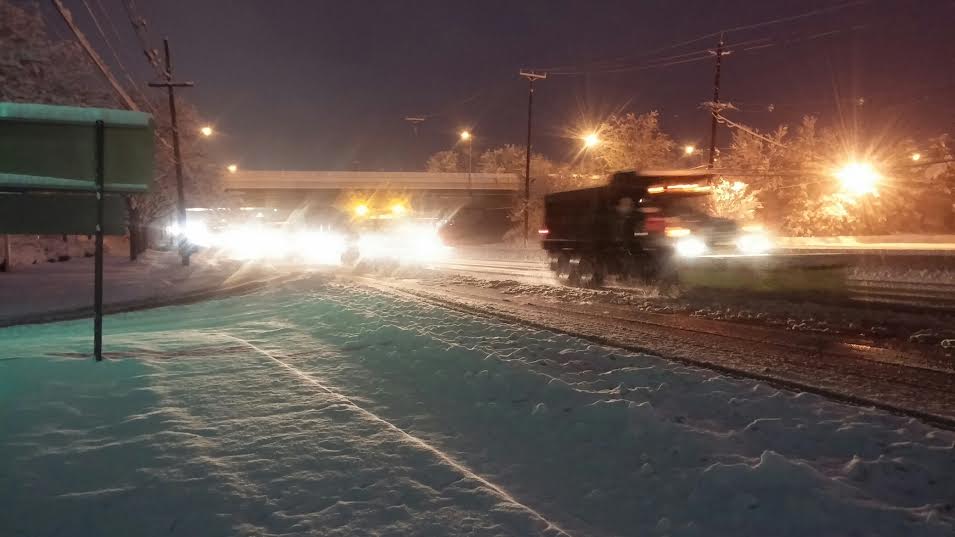
At times, travel restrictions are part of a State of Emergency. This is typically done to allow snowplows to clear the roads. At other times government offices may be closed, or evacuations may be recommended. A State of Emergency permits government officials to recommend specific actions that citizens should take to insure the safety of their families and homes during the emergency. Each emergency is different, and different factors will impact the decisions made by State officials in response to the incident.
Note: In response to this nor’easter a commercial vehicle travel ban was implemented as of March 20, 2018 effective 8pm by New Jersey State Police. For more information check out https://www.facebook.com/READYNEWJERSEY/photos/a.176301939053879.48503.165525506798189/2077783765572344/?type=3&theater
Q: Do I have to stay home? Am I allowed to drive?
A: By declaring a State of Emergency, the Governor urges all nonessential personnel to stay off the roads so not to interfere with law enforcement and emergency responders. An emergency declaration does not mean motorists will be ticketed for merely being on the roads, and “essential” personnel is not defined by law.
If conditions were to worsen and driving needs to be restricted for public safety reasons, the New Jersey Office of Emergency Management will alert the public using all available means, including, but not limited to: the Emergency Alert System, urgent press releases, DOT highway signs, social media and law enforcement advisories.
Large and small private businesses should make informed decisions about early closures, delayed openings, cancellations and closures based on current and impending weather conditions, emergency plans and policies of your organization, designation of essential employees, and restrictions on travel. If travel restrictions are put into place, it will limit whether or not employees can travel to your worksite.
Q: Are all State Offices closed during a State of Emergency?
A: The Governor’s declaration does not automatically close State Offices. Should it be necessary due to conditions experienced during the Emergency to scale back or close State Offices, the Governor will make an announcement to his/her Cabinet and through the media, similar to what is done during a snow storm.
Note: In response to this nor’easter all State Offices have been closed on March 21, 2018.
One more thing…..The New Jersey Office of Emergency Management does NOT make decisions about school closings. That includes colleges and universities. Those decisions are made by individual school districts.
Trenton NJ, this is from an article called , New Jersey’s Fiscal Train Wreck, Just ask Greece how well continually raising taxes and spending works.
by Daniel J. Mitchell, Daniel J. Mitchell is a Washington-based economist who specializes in fiscal policy, particularly tax reform, international tax competition, and the economic burden of government spending. He also serves on the editorial board of the Cayman Financial Review.
He starts with , here’s something especially amazing from a bit more than five decades in the past. New Jersey used to have no state income tax and no state sales tax.
Yes, your eyes are not deceiving you. The basket case of New Jersey used to be a mid-Atlantic version of New Hampshire. But once the sales tax was imposed in 1966 and the income tax was imposed in 1976, it’s been all downhill ever since.
An article in the City Journal helps explain the state’s fiscal decay.
Brendan Byrne, a Democratic former governor of the Garden State, …told mayors that the state would need a “large revenue package”… The heart of the package would be a new statewide income tax, which went into permanent effect in 1977. Byrne promised that the additional money would help relieve the high property-tax burden on New Jersey’s citizens… Four decades later, the plan has failed. …politicians and special interests don’t see new streams of tax revenue as a means to replace or eliminate an existing stream, but rather as a way of adding to the public coffers. (For those who entertain fantasies of a value-added tax replacing the federal income tax, take heed.) New Jersey’s income tax started with a top rate of about 2.5 percent; it’s now around 9 percent.
Needless to say, nothing politicians promised has happened.
Property taxes haven’t been reduced. They’ve gone up. The government schools haven’t improved. Instead, the test scores in the state are embarrassing. And debt hasn’t gone down. Red ink instead has skyrocketed.
And what’s amazing—and depressing—is that New Jersey politicians continue to make a bad situation worse. Here are some excerpts from a Bloomberg report.
New Jersey Governor Phil Murphy proposed taxing online-room booking, ride-sharing, marijuana, e-cigarettes and Internet transactions along with raising taxes on millionaires and retail sales to fund a record $37.4 billion budget that would boost spending on schools, pensions and mass transit. …Murphy, a Democrat…has promised additional spending on underfunded schools and transportation in a credit-battered state with an estimated $8.7 billion structural deficit for the fiscal year that starts July 1. …Murphy said Tuesday in his budget address to lawmakers, “A millionaire’s tax is the right thing to do—and now is the time to do it.” …The budget…would…restore the state’s sales tax to 7 percent from 6.625 percent… Murphy’s proposal would almost triple the direct state subsidy for New Jersey Transit, which has been plagued by safety and financial issues.
More taxes, more spending, followed by even more taxes and more spending.
I wonder if Greek taxpayers would want to tell their counterparts in New Jersey how that story ends.
Assuming, of course, there are any taxpayers left in the Garden State. There’s already been a big exodus of productive people who are tired of being treated like fatted calves.
And don’t forget that New Jersey taxpayers no longer have unlimited ability to deduct their state and local taxes on their federal tax return. So these tax hikes will hurt much more than past increases.
In any event, taxpayers better escape before they die.
Though I know one guy who won’t be leaving.
P.S. Anybody want to guess whether New Jersey collapses before California, Illinois, or Connecticut? They’re all in the process of committing slow-motion suicide.
Trenton NJ, Assemblyman Robert Auth (R-Bergen) issued the following statement in response to Gov. Phil Murphy’s $37.4 billion spending proposal:
“Governor Murphy has something for everyone with this budget whether you’re a business owner or hardworking citizen: taxes, taxes and more taxes. Raising taxes on the state’s job creators and spiking the minimum wage by $2.40 an hour will be devastating to our business community and, ultimately, our economy. Middle class families will also take a direct hit with a sales tax increase. The governor obviously is not listening to the people. Asking already overburdened taxpayers to pay more to balance this governor’s budget is grossly irresponsible.”
Wayne NJ , Calling Gov. Phil Murphy FY-2019 budget another nail in New Jersey’s economic coffin, the New Jersey Organization for Economic Growth is calling on all legislatures to reject the governor spending plan and create a fiscally responsible budget.
“The governor’s economic plan in no way represents the fiscal reality facing New Jersey; nor does it address the concerns of the business community,” said OEG Chairman Joseph Caruso. “New Jersey leads the nation in taxes and has the worst business reputation in the country — and Gov. Murphy, unfortunately, wants to continue those trends”.
Murphy’s $37.4 billion spending plan is $2.7 billion – or 8 percent higher than the state’s current budget. Murphy’s FY-2019 budget increases spending by $1.5 billion and calls for an increase in the sales tax, as well as increases in the corporate business tax and another millionaire’s tax .
Murphy called his budget proposal “fiscally and morally sound,” which raised the ire of OEG Executive Director Alex Cucciniello.
“There is nothing moral about raising taxes on hardworking people and those who are trying to run businesses,” said Cucciniello. “There is nothing moral about supporting a budget plan that will lead to fewer jobs. The governor’s sense of morality is out step with residents of this state,” said Cucciniello.
“This budget will crush small businesses and the middle class in New Jersey. If the Governors goal is to get people to leave the state he is doing the right thing, ” said OEG Vice-Chairwoman Katie Cericola, an accountant. “New Jersey already has the highest corporate tax in the nation, increasing it will result in fewer jobs.
“Young people like me want to stay in New Jersey; it’s our home. But politicians like Gov. Murphy are making it hard for us to live here. He and his administration are out of touch with the economic struggles of Millennials,” added Cericola.
The governor’s proposed increased in taxes and spending — including adding $2.1 million to pay for legal fees for illegal immigrants who face federal justice, is an attack on working people in New Jersey, said Vice-Chairman John DePinto.
‘There are hard working legal residents of our state who cannot afford an attorney; yet we have a governor who wants those working people to pay for the legal bills of illegal immigrants so they can continue to violate federal law. That is not a morally or fiscally acceptable position,” said DePinto.
“The governor wants the already overtaxed people of New Jersey to pay for his progressive ideology. His personal priorities are wrong for the state,” added DePinto.
OEG officials said Murphy’s FY 2019 budget proposal failed to even consider cutting spending.
“In a state that is recognized as the most overtaxed in the nation; a state that is losing jobs and business investment; the fiscally prudent thing to do would be to find ways to reduce spending. But it appears that the governor’s team just larded more fat on an already bloated state budget,” said Cucciniello.
DISAPPOINTING
Caruso called the governor’s introduction of his first budget disappointing beyond expectations.
“The people of New Jersey elected a governor who ran on a platform of raising taxes. and that’s just what he intends to do. But I don’t think anyone could imagine that it would be this bad,” he said.
Caruso noted that the governor’s budget proposal fails to address the state’s very real and very damaging pension deficit.
“Like governor’s before him, Mr. Murphy actually believes New Jersey taxpayers can afford the public pension system the politicians created. And to continue the deception, Gov. Murphy, like governor’s before him, has greatly exaggerated the return on pension investments so he doesn’t have to deal with the giant pension and retiree benefits hole that gets bigger every month.”
REJECT THE PROPOSAL
Cucciniello said he hopes the legislature will reject the governor’s proposal and start over.
“Hopefully there are fiscally responsible people in Trenton who will not ignore the fact that New Jersey’s fiscal policies are causing great damaging the people of this state Hopefully, they will not continue to ignore the plight of many people — Millennials and retirees – who have to make the tough decision to leave New Jersey because our elected officials simply don’t want to make the tough decisions required to make this state affordable for the middle class,” said Cucciniello.
Trenton NJ, Gov. Murphy introduces 2019 budget in State House address, and no surprise he rattled off a series of significant tax increases for the garden State . Murphy had run on a platform of raising taxes or what critics called “Murphy’s Law” and here is just a few he wants to start with ; a sales tax increase to 7%, tax on AirBnB rentals , new taxes on Uber and Lyft, E- Cigarette taxes, legal Marijuana taxes of 25% plus sales tax, income tax for $1 million plus and new business taxes.
photos courtesy of NJ State Police
March 8,2018
the staff of the Ridgewood blog
Trenton NJ, New Jersey State Police update storm totals . It was a busy day yesterday, but we’re not out of the woods yet. Roads are still being cleared, and many schools are closed or have delays.
Yesterday, New Jersey State Police responded to 530 motor vehicle crashes and 1,017 motorist aids in #NJSP patrolled areas. Motor Vehical aids can be anything from mechanical breakdowns, spin outs, and flat tires.
Trenton NJ, In order to allow ample time for roadways, parking lots and sidewalks to be cleared and made safe for travel, the State of New Jersey has authorized a delayed opening two hours from normal start times for all non-essential state employees on Thursday, March 8, 2018.
Essential employees should report to work on their regular schedule.
Current road conditions are available at the New Jersey Department of Transportation website at www.511nj.org
New Jersey State Police will be out on patrol if you need us.
Remember…driving at speeds too fast for the road conditions is often a contributing factor in snow-related crashes and spinouts. Take it slow and leave extra room between yourself and the vehicle in front of you should you have to brake unexpectedly.
Steer clear of downed power lines. Always assume they are live and dangerous!!!
Be sure to follow us on social media and check the weather in your area for updates and to plan ahead! For those living in Central and Southern New Jersey visit US National Weather Service Philadelphia/Mount Holly https://www.weather.gov/phi/.
For those living in Northern New Jersey and the New York Metro area visit US National Weather Service New York NY https://www.weather.gov/okx/.
Pets are family too! Include them in your emergency plans. Bring them indoors! If you’re cold, they are cold! Visit animalemergency.nj.gov to find out more!
If you, a family member or a neighbor have special needs, be sure to visit Register Ready, New Jersey’s Special Needs Registry for Disaster Planning, to get started on making your emergency plan NOW. Visit www.registerready.nj.gov or call NJ 2-1-1 for assistance.
Trenton NJ, New Jersey suffers from the worst business climate in the United States . If not for the close proximity to New York in the north and Philadelphia in the south there would be virtually no business here at all . Jobs and companies have fled the Garden State non stop since the Kean Administration and yes it can only get worse. Democratic state Senate President Stephen Sweeney said on Tuesday that state coffers can get the money they need by enacting a 3 percent surcharge on corporate income.
The increase in the state’s corporation business tax rate from 9 percent to 12 percent on businesses with more than $1 million in income is the Democrats’ latest counterpunch to federal tax reform that slashed taxes on corporations but limited the state and local taxes residents can deduct.
It seems New Jersey Democrats will not rest until the very last business has left the state .
In 2017 the Tax Foundation rated New Jersey’s Business Climate the worst in the nation. The Tax Foundation said “New Jersey, for example, is hampered by some of the highest property tax burdens in the country, is one of just two states to levy both an inheritance tax and an estate tax, and maintains some of the worst-structured individual income taxes in the country.”
In the 2017 Tax Foundation State Business Tax Climate Index , New Jersey scored and Overall Rank of 50 (Dead Last) Corporate Tax Rank 42, Individual Income Tax 48, Sales Tax 45 , Unemployment Insurance Tax 25,Property Tax Rank 50 (Dead Last again) .
So it is no surprise to everyone except New Jersey Democrats , the when moving company United Van Lines released its 36th in 2014 annual study of customer migration patterns, analyzing a total of 125,000 moves across the 48 continental states in 2012. The study provides an up-to-date, representative snapshot of overarching moving patterns in the U.S., and reveals a mass exodus from the Northeast. At No. 1, New Jersey has the highest ratio of people moving out compared to those moving in. Of the 6,300 total moves tracked in the state last year, 62% were outbound.
In 2016 the same annual moving survey from United Van Lines reveals the states where the most people move from and again for 2016, New Jersey holds the top honor in the latter category for the fifth year running.
Far be it from us to speculate, but CNN affiliate News 12 New Jersey suggests the exodus may be related to “common complaints from state residents about high property taxes, the recent gas tax hike and the poor conditions of state roads.”
Trenton NJ, Governor Phil Murphy today declared that New Jersey will enter a state of emergency at 8 p.m. on Tuesday ahead of tomorrow’s anticipated nor’easter, authorizing the State Director of Emergency Management to activate and coordinate response and recovery efforts. Executive Order No. 14 declares the state emergency across all 21 counties in the state, and allows for the extension of resources into other parts of the state as the storm continues to impact New Jersey.
“Following last weekend’s nor’easter and with another destructive winter storm approaching, I am declaring a state of emergency across all 21 counties in the State,” Governor Murphy said. “We are taking every precaution necessary and will continue to monitor and assess the storm throughout the night to ensure all residents are safe and secure.”
The impending storm is expected to produce as many as 4 to 13 inches of snow beginning Tuesday evening and lasting until late Wednesday night. Winds are expected to reach 30 mph causing power outages throughout the State. Roughly 41,000 households remain without power from last weekend’s storm.
In preparation for the winter storm, the New Jersey State Police has activated the State Emergency Operations Center for round-the-clock operations. This activation pulls together multiple departments to ensure the situation is constantly being monitored and assessed from critical angles.
Additionally, the Department of Transportation is prepared to activate more than 2,500 pieces of snow-clearing equipment, including plows, spreaders, and loaders, and the New Jersey National Guard is prepared to respond to requests for assistance from the Office of Emergency Management, and will be positioning vehicles at select armories.
Trenton NJ, Senator Gerry Cardinale, the ranking Republican member of the Senate Judiciary Committee, issued the following statement opposing legislation that would allow incarcerated prisoners, as well as those on parole and probation, to vote.
Sen. Gerry Cardinale opposes legislation that would allow incarcerated prisoners, as well as those on parole and probation, to vote.
“People who are serving prison sentences for breaking the law are subject to a loss of certain freedoms.
“That’s part of the risk they assume when they break the law, and part of the incentive structure for people to follow the law.
“Do we really believe that murderers and rapists who are serving prison sentences should be allowed to influence elections and public policy?
“We shouldn’t trust people who have demonstrated such bad judgment that they are removed from society with the responsibility that comes with voting.
“Let’s not forget that we restore voting rights once a person has paid their debt to society and proven themselves to be trustworthy following parole or probation.
Ridgewood NJ, According to the American Community Survey, telecommuting doubled from 2005 to 2014 and employers in 2017 were more likely to be looking for live-work-play communities that offer affordability as well as lifestyle benefits for their employees.
The American Community Survey (ACS) is an ongoing statistical survey by the U.S. Census Bureau. It regularly gathers information previously contained only in the long form of the decennial census, such as ancestry, educational attainment, income, language proficiency, migration, disability, employment, and housing characteristics.
PlanSmart NJ, says New Jersey is the most exited state in the nation, with owner-occupied home ownership down by 100,000 in the years since the Great Recession. We need a new policy approach, one prepared to grapple with the following realities: New Jersey has five new renters for every three homeowners; New Jersey has 14 million square feet of empty office space; New Jersey has seven million square feet of empty retail. At our current rate, it will take more than 20 years to re-tenant these stranded assets.
PlanSmart NJ is an independent, non-profit planning and research organization committed to improving the quality of community life through the advancement of sound land use planning and regional cooperation.
Jim Hughes, the dean at Rutgers University’s Edward J. Bloustein School of Planning and Public Policy, and co-author Joseph Seneca put it most succinctly in their recent work on New Jersey’s postsuburban economy: “New Jersey’s core advantage in the late 20th century – a suburban-dominated, automobile-dependent economy and lifestyle – is (now) regarded as a disadvantage.”
The report for all its gloom offers barely a mention of the elephant in the room , the oversized property taxes and very high taxes in general on residents which will continue to raise as the tax base disappears .
Ridgewood NJ, Almost a year after U.S. Transportation Secretary Elaine Chao called the Gateway Program “an absolute priority,” she said federal loans shouldn’t count toward the states’ share of funding. New York and New Jersey have pledged some $6 billion, mostly from federal loans, toward a proposed new $12.7 billion commuter rail tunnel under the Hudson River and were counting on federal grants to cover the remainder. Federal authorities have said loans shouldn’t count as the states’ share.
This is a big issue for “dead broke” New Jersey and close to broke New York state.
On Thursday during a committee hearing on President Donald Trump’s infrastructure plan ,New York Sen. Kirsten Gillibrand and New Jersey Sen. Cory Booker asked Chao on Thursday during a committee hearing on President Donald Trump’s infrastructure plan why the federal loans that the states must repay don’t count as local funding.
Cho responded ,“We’re not anxious for a fight on this, but for New York and New Jersey to consider funds, debt that we have given them, as part of their equity back to us is something that we disagree with,” Chao went on that under federal calculations that disregard the loans, the two states are putting up only 5%.
Chao repeated again that there is no agreement for the federal government to fund half the Gateway program as state officials have said. That agreement with the Obama administration was a sentence “given at a rally, a political rally, no less,”
While New Jersey Gov. Phil Murphy, speaking at a state Chamber of Commerce dinner in Washington, D.C., on Thursday night, said he was “committed to getting Gateway back on President Trump’s priority list.”
And stated ,“No single project is more critical, not just to our state’s economy but to our nation’s economy as well,” said Murphy, a Democrat who took office in January.


![Lehman_Brothers_Times_Square_by_David_Shankbone[1]](https://theridgewoodblog.net/wp-content/uploads/2018/03/2048px-Lehman_Brothers_Times_Square_by_David_Shankbone1.jpg "Pennacchio & Corrado Bill to Combat Conflicts of Interest State Investment Council")