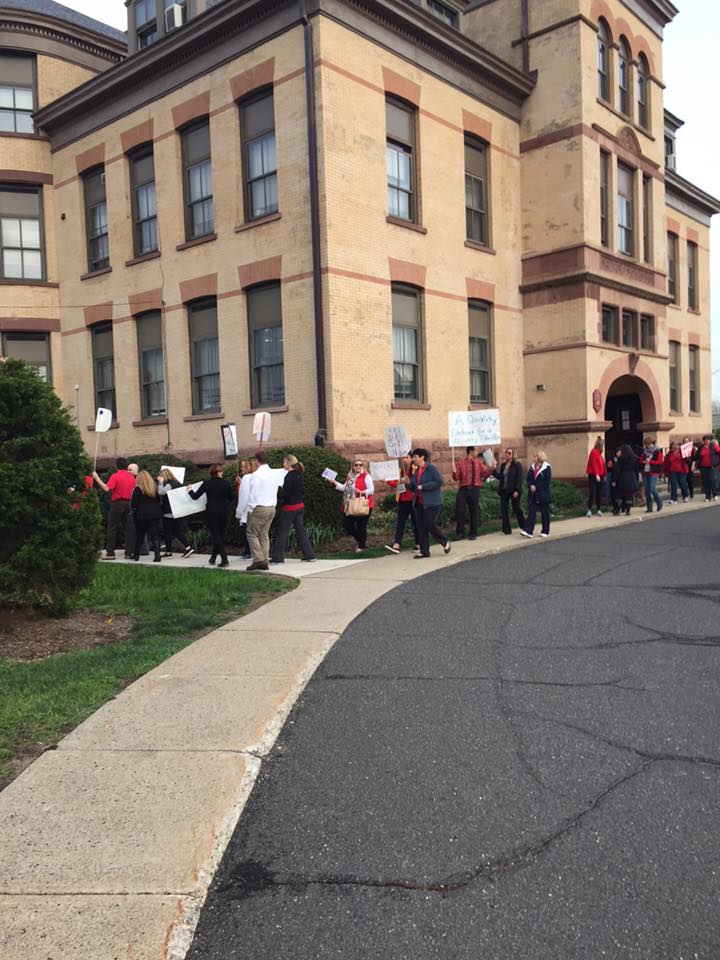
Oral arguments before a Mercer County Superior Court judge are scheduled for May 3
March 31,2017
the staff of the Ridgewood blog
Trenton NJ, Six Newark parents yesterday opposed motions to dismiss HG v. Harrington, the lawsuit they filed last November challenging the constitutionality of New Jersey’s quality-blind “last in, first out” (LIFO) teacher layoff law. The motions to dismiss the case were filed earlier this month by local and national teachers unions, who intervened as defendants in the case last December. Oral arguments on the motions to dismiss are scheduled for 2pm on May 3 before the Mercer County Superior Court. Defendants from Newark Public Schools and the New Jersey Department of Education did not move to dismiss the case.
“The teachers unions clearly are not looking out for students’ best interests,” said Kathleen Reilly, attorney with Arnold & Porter Kaye Scholer, one of the law firms representing the Newark parents pro bono. “With education budget deficits in the tens of millions of dollars, the court urgently needs to hear these parents’ concerns about laws that require schools to keep ineffective teachers while letting effective ones go. If students’ educational rights are valued, these laws cannot stand.”
In their answer to the lawsuit, defendants from the Newark Public Schools overwhelmingly conceded that the LIFO law harms students, acknowledging that enforcement of LIFO in Newark will remove quality teachers, which leads to lower test scores, lower high school graduation rates, lower college attendance rates, and sharply reduced lifetime earnings. They also admit that the current practice of keeping ineffective teachers on the district payroll, including those in a pool of “educators without placement sites” (EWPS) is harmful and unsustainable, and that the EWPS pool would be wholly unnecessary were it not for LIFO.
To learn more about the parent-led lawsuit to end LIFO in New Jersey, please go to edjustice.org/nj. All legal filings related to HG v. Harrington are available online here.
by Andrew Seidman, Trenton Bureau @AndrewSeidman | [email protected]
TRENTON — Gov. Christie has antagonized New Jersey’s largest teachers’ union since he took office in 2010, once declaring on television that the national organization deserved a punch in the face.
The union has struggled under Christie’s eight-year governorship, but as the Republican prepares to leave office next year, the New Jersey Education Association is punching back at someone it sees as Christie’s chief collaborator: Senate President Stephen Sweeney.
“We’re looking for a new governor and a new Senate president,” Wendell Steinhauer, the group’s president, said in an interview.
A New York man serving 15 years for selling weapons he believed would be sent to terrorists overseas will not have his New Jersey teaching certificates waiting for him when he is released.
Theophilis “Mike” Burroughs, of Newark, was sentenced in 2015 after being convicted of first-degree criminal sale of a firearm, money laundering and tax fraud.
Robert Johnson, the Bronx district attorney at the time, said Burroughs had agreed to sell 13 weapons including assault rifles and hand guns, and had also bought 27,000 cartons of what he believed were untaxed cigarettes during exchanges with undercover officers. In addition to the weapons, he also had offered to sell explosives, night-vision goggles and illegal drugs.
Bronx District Attorney’s Office
Johnson said Burroughs believed the officers he was dealing with were connected to the terrorist organization Hamas, and had expressed support for them and other terror groups.
“It is particularly disturbing when someone who is tasked with educating our young commits crimes,” Johnson said at the time. “It is more disturbing that he did so complicit in the belief he was promoting terrorism
Those who obstruct choice are more interested in protecting their special interests than in protecting the interests of all children to access a quality education
Ruthven Haneef Auguste
Earlier this week I was in Trenton with other public charter school parents to meet with legislators, advocate for the opportunity to choose a school that best fits the needs of our children, and commit to a year of action supporting education equality for all. Whether you’re a charter, district, or private school parent, we can all agree we want the best for our kids no matter where you choose to send them to school.
The opposition to school choice has regularly used certain words for parents in New Jersey’s worst-performing school districts when they have the audacity to choose to send their kids to public charter schools — “pawn” and “parasite” come to mind. However, in no area of life is less choice good, and it is upsetting that these adults, many who presumably have children of their own, seem determined to take away opportunity and choice from parents like me. I don’t presume to think I have enough information to form an opinion of how schools should be run in their towns and would guess things are vastly different in Newark where I work and live. We have amazing schools, terrible schools, and everything in the middle, which is why I wanted to be able to make the choice of where my children go to school.
By Adam Clark | NJ Advance Media for NJ.com
on March 07, 2017 at 8:45 AM, updated March 07, 2017 at 11:42 AM
TRENTON — Facing a shortage of bilingual teachers in its public schools, New Jersey has made it easier to become one.
The state Board of Education this month approved what education officials called a “slight relaxation” to the score teachers need on the written proficiency test for bilingual teachers, a move officials expect will boost the number of bilingual educators by 10 to 15 percent.
The change applies only to prospective teachers for students learning English as their second language. It does not affect foreign language teachers for native English speakers.
Despite the lower qualifications, the state isn’t expecting any decline in the quality of its bilingual teachers, said Mark Biedron, president of the Board of Education.
“I am confident that teachers coming through the program will be highly proficient,” Biedron said.
By Adam Clark | NJ Advance Media for NJ.com
on February 28, 2017 at 7:15 AM, updated February 28, 2017 at 7:53 AM
TRENTON — When Gov. Chris Christie delivers his 2018 budget address on Tuesday, New Jersey school officials will be listening especially closely.
How Christie will address education funding is the biggest question about his final budget, leaving administrators bracing for the possibility of funding cuts.
There’s some concern Christie could follow through with the “Fairness Formula,” a plan he unveiled last summer to give every district $6,599 per student regardless of income or other needs. Though many education groups are convinced Christie won’t do that, they still don’t have high hopes for increases in school funding.
“I’m not expecting any good news in the budget,” said Richard Bozza, executive director of the New Jersey Association of School Administrators.
Michael W. Curley, Jr. , Staff Writer, @MCurleyGannettPublished 11:35 p.m. ET Feb. 16, 2017 | Updated 1 hour ago
ENGLEWOOD — The Dwight Morrow High School principal and nine other high-level district employees were suspended with pay Thursday night after a review by an independent consultant turned up more than 3,000 graduation credit and grade changes in the previous year.
Superintendent Robert Kravitz read a letter from the Department of Education at Thursday’s meeting saying the Office of Fiscal Accountability and Compliance will conduct a review of the district’s high school transcript records with respect to allocation of credit hours. Later in the meeting, he said the 3,000 credit and grade changes were considered “extremely high” by the state.
The truth will out. Teachers’ unions are 100 percent motivated to advance the interests of their tenutred members. When push comes to shove, the unions ALWAYS reveal their contempt for public school students. New laws are needed to stop this nonsense in its tracks. Teachers’ unions, bulletproof tenure, and foolish “last in first out” teacher hiring/firing rules HAVE TO GO. Take what the municipality chooses to give you or quit.
Hackensack NJ, Ridgewood teachers joined the “Bergen County Unity March and Rally” on Sunday, February 12th, at the Bergen County Courthouse in Hackensack . It was promoted by the NJEA , REA and its bought and paid for Democrat allies and claimed,”as we come together to celebrate and reaffirm our American values of freedom, diversity, and inclusively, and to push back against hateful, divisive rhetoric. With one voice, we will send a clear message to those around the country who seek to drive us apart: We will not be divided, and we will not be silenced.”
Very high-minded words but in reality, the rally was another attempt by teachers unions to suppress school choice and charter schools. There is nothing high-minded about repressing a child’s education and forcing kids into failed schools.
The rally commenced in the snow at 2:00 PM at the municipal parking lot near Foschini Park before marching to the Courthouse where we will hold our rally.
Anti-Choice Sponsor Organizations were:
Communication Workers of America
Bergen County Education Association
Bergen County NAACP
Bergen County LGBTQ Advisory Committee
Mount Olive Baptist Church, Hackensack
Central Unitarian Church, Paramus
The Latino Coalition
Women for Progress
WEDO of Bergen County
Democratic Women of Bergen County
Bergen County Brady Campaign Chapter
Women Lawyers of Bergen County
Garden State Equality
Smile for Charity
Northern NJ Chapter, NOW
Latino American Democratic Association
Council of the Unitarian Society, Ridgewood
Korean American Civic Empowerment (KACE)
Indivisible NJ 5th
Darulislah Mosque, Teaneck
Young Democrats of Bergen County.
Get past all the noise, and the opposition to Betsy DeVos, President Trump’s pick for the Education Department, is all about the teachers unions — which consider it their right to have a friendly face running federal policy even in Republican administrations.
Yes, two Senate Republicans have come out against DeVos — the only two who routinely get A’s on the National Education Association’s “report card” because they vote the union line. Efforts to find another GOP vote against her will almost surely fail, because the other 50 Republicans aren’t in unions’ pocket, and Vice President Mike Pence can deliver a 51st vote if needed.
WEST DEPTFORD — A South Jersey elementary school principal got a lesson on checking her work after assigning students as young as 6 a project that honored a convicted cop killer.
The school-wide assignment at Red Bank Elementary School was actually supposed to honor famous black Americans for Black History Month.
But the list of notable black figures included Mumia Abu-Jamal and Angela Davis alongside Louis Armstrong, Mohammad Ali, Crispus Attucks and George Washington Carver.
Abu-Jamal, a black nationalist, was convicted of killing Philadelphia police officer Daniel Faulkner in 1981. He has maintained his innocence even though he was found wounded from a gunshot at the scene alongside his fired gun.
Davis, meanwhile, is a social justice activist and communist who was a one-time fugitive after being charged as an accessory in a violent and deadly 1970 takeover of a California courtroom. Prosecutors tried to tie her to the incident because the guns had belonged to her, but an all-white federal jury acquitted her.
What the principal failed to notice, many parents did — including Bryan Klugh, who alerted his friends on the police force.
Newark NJ, in a statement from the Partnership for Educational Justice comments on the New Jersey Supreme Court’s denial of State motion to re-open Abbott v. Burke.
The New Jersey Supreme Court today denied the State’s September 2016 motion to re-open the decades-old school funding lawsuit, Abbott v. Burke. As part of their broad motion, the State had asked the court to grant the State Commissioner of Education – a political appointee – the authority to waive enforcement of the State’s “last in, first out” (LIFO) teacher layoff law, among other education laws and negotiated policies.
In response to the State’s motion, six Newark parents also filed a motion with the Supreme Court against the State’s legal tactics to address LIFO. These same parents instead are fighting the LIFO statute on its own in the trial court. Their case, HG v. Harrington, asserts that New Jersey’s quality-blind LIFO law violates students’ constitutional right to a “thorough and efficient” education by allowing ineffective teachers to remain in classrooms while effective teachers are let go. The plaintiff families have asked the court to declare LIFO unconstitutional and render it unenforceable in Newark and similar districts.
The Supreme Court’s denial of the State’s motion today means that the lawsuit filed in November by six Newark parents is the only case pending to address New Jersey’s outdated LIFO statute.
The following is a statement by Ralia Polechronis, Executive Director of Partnership for Educational Justice:
“This ruling is a big win for New Jersey parents and schoolchildren. The Supreme Court has echoed the position of a group of Newark parents, who argued to this court that the state’s unjust quality-blind teacher layoff law must be evaluated on its own, and not in connection with a decades-old school funding lawsuit. Concerned about looming school budget cuts, these same parents – the plaintiffs in HG v. Harrington – will continue their fight in the state’s trial court to invalidate the “last in, first out” law that prevents the retention of Newark’s best teachers during funding crises. These brave parents are leading the charge for students’ rights in New Jersey, and they will not back down until the harmful impact of this law is revealed and deemed unconstitutional.”
To learn more about HG v. Harrington, the parent-led lawsuit challenging New Jersey’s “last in, first out” teacher layoff law, please go to edjustice.org/nj. To read all legal filings related to HG v. Harrington, click here.
School Choice — Who Opposes It and Why?
1)The leaders of teachers unions(NJEA), though not all of the teachers themselves, see school choice as a threat to their “virtual monopoly on education.”
2)Other critics of school choice think that it violates the First Amendment’s clause separating church and state, because some religious schools can end up receiving taxpayer funds.
5 Myths About School Choice
To help you better understand the ongoing debate, we want to dispel some common myths about school choice. But first:
What is school choice?
School choice isn’t just about charter schools. It refers broadly to a range of options and policies which provide alternatives to public school, including but not limited to publicly funded charter schools, magnet schools, school vouchers, and tax credits.
The goal of school choice is to improve student outcomes by giving parents a wider range of educational options and find what works best for their children.
Myth #1: School choice promotes inequality.
Opponents of school choice believe that increasing choices will benefits mostly middle and upper class families, leaving low-income students stuck in failing public schools with dwindling resources. They believe parents, if given a choice, won’t want to send their kids to school with minority or low-income students, and that increased choice will lead to increased segregations.
Fact: Public schools are already segregated; charter schools see increased diversity.
Under the current public school system, the school you go to is determined by where you live. What happens under this system is that higher-income households move to communities with other high-income families and better schools, while low-income families who can’t afford to move are stuck with the local public school. The segregation of race and income in public schools is a direct result of this self-segregation in housing.
School choice programs can create more diverse schools by overcoming this location-based segregation. Indeed, research shows that school choice programs create to more integrated, less segregated schools.
Myth #2: School choice harms public schools.
Opponents worry that school choice programs will harm public schools by diverting away much-needed funds, and forcing public schools to compete with other alternatives.
Fact: Losing students can help public schools, and so can competition.
There are several assumptions in this argument: 1. That losing students will cost public schools money, 2. That losing money will lead to a decline in school quality, and 3. That competition is harmful to public schools.
First, while public schools may lose money when students leave, the money lost may be less than the cost of educating the student, leaving more resources to educate the remaining students.
Second, more money doesn’t always lead to better outcomes. For many schools, budget concerns are less about how much money they have, and more about how that money is spent.
Finally, research shows that competition improves performance in public schools. When public schools are forced to compete, they have to show improvement in order to keep students and resources. When there are no alternatives to public schools, there is no incentive to prioritize student-focused improvements.
Myth #3: School choice is bad for teachers.
Opponents of school choice argue that holding teachers accountable by measuring their students’ performance on standardized tests punishes teachers and does nothing to improve the quality. They also argue that more charter schools, whose teachers are often non-unionized, harm the teachers unions, and by extension teachers.
Fact: School choice is good for teachers.
While it might be unfair to punish teachers for poor test scores when outside factors like poverty and lack of funding affect student performance, it is also unfair to students to keep poor-quality teachers employed.
It can be very hard to fire bad teachers in public schools. When budget cuts require layoffs, tenure rules can protect older, less competent teachers, while newer, more competent teachers are let go. Increased school choice means more options, not just for students, but also for teachers.
Myth 4: it doesn’t empower parents.
While the goal of school choice is to provide families with more educational options, opponents argue that through school choice, parents actually have less power to control their children’s education. Without parent-teacher associations at charter or private schools, parents would have less direct influence over school policy. Meanwhile, opponents express concern that parents aren’t equipped to consider all the different educational choices available and determine what’s best for their children.
Fact: Parents get to choose what’s best for their children.
In a public school system, parents might be able to influence some policies at their child’s public school—but if they can’t, or that school doesn’t have the resources their child needs, they have no other options.
Parents know their children’s education needs best, and school choice empowers parents to pick the option that’s best for their them. Indeed, when asked, most Americans favor some form of school choice.
Myth #5: School choice doesn’t work.
Opponents argue that charter and privates schools perform no better than public schools. This myth often refers back to Myth #2, saying that if charter and private school don’t perform better than public schools, then they shouldn’t be allowed to divert resources from them.
Fact: School choice improves outcomes across the board.
School choice improves educational outcomes for those in choice programs, but it also improves educational outcomes of the public schools which compete with alternative educational choices.
by DAVID HARSANYI January 20, 2017 12:00 AM @DAVIDHARSANYI
Betsy DeVos wants better education for minority and low-income kids. There’s something perverse about an ideology that views the disposing of an unborn child in the third trimester of pregnancy as an indisputable right but the desire of parents to choose a school for their kids as zealotry. Watching President-elect Donald Trump’s pick for education secretary, Betsy DeVos, answer an array of frivolous questions this week was just another reminder of how irrational liberalism has become.
Democrats often tell us that racism is one of the most pressing problems in America. And yet, few things have hurt African Americans more over the past 40 years than inner-city public-school systems. If President Obama is correct and educational attainment is the key to breaking out of a lower economic stratum, then no institution is driving inequality quite as effectively as public schools.
Actually, teachers’ unions are the only organizations in America that openly support segregated schools. In districts across the country — even ones in cities with some form of limited movement for kids — poor parents, typically those who are black or Hispanic, are forced to enroll their kids in underperforming schools when there are good ones nearby, sometimes just blocks away.
Ridgewood NJ, so who’s Afraid of Betsy DeVos? “Mrs. Devos’s Most Important Qualification is that She Has the Courage of Her Convictions”, in an editorial the Wall Street Journal attempts to answer the critics and make the case to provide poor children with better educational opportunities. We know the unions don’t like it and neither do Democrat, lawmakers looking to stifle their constituents keeping them fat, dumb and happy. Who’s Afraid of Betsy DeVos?
The Wall Street Journal
Wall Street Journal Opinion
January 14th, 2017 Click Here to Read
Democrats are searching for a cabinet nominee to defeat, and it’s telling that progressive enemy number one is Betsy DeVos. Donald Trump’s choice to run the Education Department has committed the unpardonable sin of devoting much of her fortune to helping poor kids escape failing public schools.
Mrs. DeVos’s most important qualification is that she has the courage of her convictions.
The DeVoses have donated tens of millions of dollars to charity including a children’s hospital in Michigan and an international art competition in Grand Rapids. They’ve also given to Christian organizations, which the left cites as evidence of concealed bigotry. Yet education has been their main philanthropic cause.
During the 1990s, they patronized a private-school scholarship fund for low-income families and championed Michigan’s first charter school law. In 2000 they helped bankroll a voucher initiative, which was defeated by a union blitz. The DeVoses then turned to expanding charters, which have become Exhibit A in the progressive campaign against her.
Two studies from Stanford’s Center for Research on Education Outcomes (2013, 2015) found that students attending Michigan charters gained on average an additional two months of learning every year over their traditional school counterparts. Charter school students in Detroit gained three months.
The real reason unions fear Mrs. DeVos is that she’s a rare reformer who has defeated them politically. Prior to being tapped by Mr. Trump, she chaired the American Federation for Children (AFC), which has helped elect hundreds of legislators across the country who support private school choice.
AFC has built a broad coalition that includes black and Latino Democrats, undercutting the union conceit that vouchers are a GOP plot to destroy public schools. In 2000 four states had private-school choice programs with 29,000 kids. Today, 25 states have vouchers, tax-credit scholarships or education-savings accounts benefitting more than 400,000 students.
You know progressives have lost their moral bearings when they save their most ferocious assault for a woman who wants to provide poor children with the education they need to succeed in America.