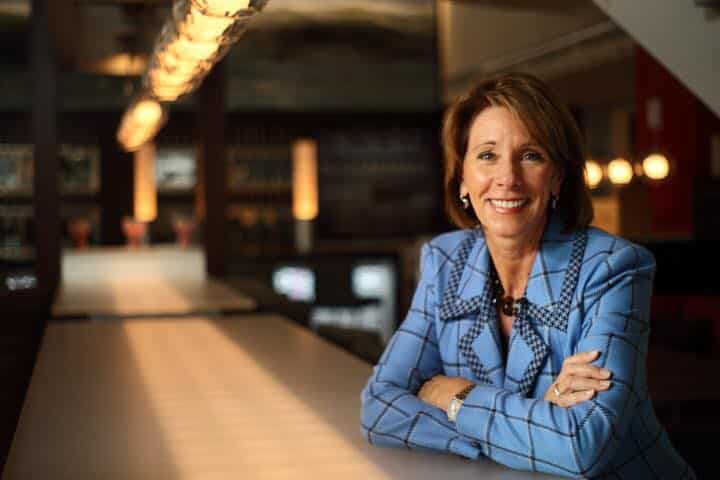
Inside a decimated party’s not-so-certain revival strategy.
DOVERE January 19, 2017
Standing with some 30,000 people in front of Independence Hall in Philadelphia the night before the election watching Hillary Clinton speak, exhausted aides were already worrying about what would come next. They expected her to win, of course, but they knew President Clinton was going to get thrashed in the 2018 midterms—the races were tilted in Republicans’ favor, and that’s when they thought the backlash would really hit. Many assumed she’d be a one-term president. They figured she’d get a primary challenge. Some of them had already started gaming out names for who it would be.
“Last night I stood at your doorstep / Trying to figure out what went wrong,” Bruce Springsteen sang quietly to the crowd in what he called “a prayer for post-election.” “It’s gonna be a long walk home.”
What happened the next night shocked even the most pessimistic Democrats. But in another sense, it was the reckoning the party had been expecting for years. They were counting on a Clinton win to paper over a deeper rot they’ve been worrying about—and to buy them some time to start coming up with answers. In other words, it wasn’t just Donald Trump. Or the Russians. Or James Comey. Or all the problems with how Clinton and her aides ran the campaign. Win or lose, Democrats were facing an existential crisis in the years ahead—the result of years of complacency, ignoring the withering of the grass roots and the state parties, sitting by as Republicans racked up local win after local win.
“The patient,” says Colorado Governor John Hickenlooper, “was clearly already sick.”
As Trump takes over the GOP and starts remaking its new identity as a nationalist, populist party, creating a new political pole in American politics for the first time in generations, all eyes are on the Democrats. How will they confront a suddenly awakened, and galvanized, white majority? What’s to stop Trump from doing whatever he wants? Who’s going to pull a coherent new vision together? Worried liberals are watching with trepidation, fearful that Trump is just the beginning of worse to come, desperate for a comeback strategy that can work.
Donald Trump is ready to take an ax to government spending.
Staffers for the Trump transition team have been meeting with career staff at the White House ahead of Friday’s presidential inauguration to outline their plans for shrinking the federal bureaucracy, The Hill has learned.
The changes they propose are dramatic.
The departments of Commerce and Energy would see major reductions in funding, with programs under their jurisdiction either being eliminated or transferred to other agencies. The departments of Transportation, Justice and State would see significant cuts and program eliminations.
The Corporation for Public Broadcasting would be privatized, while the National Endowment for the Arts and National Endowment for the Humanities would be eliminated entirely.
Overall, the blueprint being used by Trump’s team would reduce federal spending by $10.5 trillion over 10 years.
The proposed cuts hew closely to a blueprint published last year by the conservative Heritage Foundation, a think tank that has helped staff the Trump transition.
Similar proposals have in the past won support from Republicans in the House and Senate, who believe they have an opportunity to truly tackle spending after years of warnings about the rising debt.
Many of the specific cuts were included in the 2017 budget adopted by the conservative Republican Study Committee (RSC), a caucus that represents a majority of House Republicans. The RSC budget plan would reduce federal spending by $8.6 trillion over the next decade.
Two members of Trump’s transition team are discussing the cuts at the White House budget office: Russ Vought, a former aide to Vice President-elect Mike Pence and the former executive director of the RSC, and John Gray, who previously worked for Pence, Sen. Rand Paul (R-Ky.) and Speaker Paul Ryan (R-Wis.) when Ryan headed the House Budget Committee.
Ridgewood NJ, Since March of 2010, the American people have had to suffer under the incredible economic burden of the Affordable Care Act—Obamacare. This legislation, passed by totally partisan votes in the House and Senate and signed into law by the most divisive and partisan President in American history, has tragically but predictably resulted in runaway costs, websites that don’t work, greater rationing of care, higher premiums, less competition and fewer choices. Obamacare has raised the economic uncertainty of every single person residing in this country. As it appears Obamacare is certain to collapse of its own weight, the damage done by the Democrats and President Obama, and abetted by the Supreme Court, will be difficult to repair unless the next President and a Republican congress lead the effort to bring much-needed free market reforms to the healthcare industry.
But none of these positive reforms can be accomplished without Obamacare repeal. On day one of the Trump Administration, we will ask Congress to immediately deliver a full repeal of Obamacare.
However, it is not enough to simply repeal this terrible legislation. We will work with Congress to make sure we have a series of reforms ready for implementation that follow free market principles and that will restore economic freedom and certainty to everyone in this country. By following free market principles and working together to create sound public policy that will broaden healthcare access, make healthcare more affordable and improve the quality of the care available to all Americans.
Any reform effort must begin with Congress. Since Obamacare became law, conservative Republicans have been offering reforms that can be delivered individually or as part of more comprehensive reform efforts. In the remaining sections of this policy paper, several reforms will be offered that should be considered by Congress so that on the first day of the Trump Administration, we can start the process of restoring faith in government and economic liberty to the people.
Congress must act. Our elected representatives in the House and Senate must:
Completely repeal Obamacare. Our elected representatives must eliminate the individual mandate. No person should be required to buy insurance unless he or she wants to.
Modify existing law that inhibits the sale of health insurance across state lines. As long as the plan purchased complies with state requirements, any vendor ought to be able to offer insurance in any state. By allowing full competition in this market, insurance costs will go down and consumer satisfaction will go up.
Allow individuals to fully deduct health insurance premium payments from their tax returns under the current tax system. Businesses are allowed to take these deductions so why wouldn’t Congress allow individuals the same exemptions? As we allow the free market to provide insurance coverage opportunities to companies and individuals, we must also make sure that no one slips through the cracks simply because they cannot afford insurance. We must review basic options for Medicaid and work with states to ensure that those who want healthcare coverage can have it.
Allow individuals to use Health Savings Accounts (HSAs). Contributions into HSAs should be tax-free and should be allowed to accumulate. These accounts would become part of the estate of the individual and could be passed on to heirs without fear of any death penalty. These plans should be particularly attractive to young people who are healthy and can afford high-deductible insurance plans. These funds can be used by any member of a family without penalty. The flexibility and security provided by HSAs will be of great benefit to all who participate.
Require price transparency from all healthcare providers, especially doctors and healthcare organizations like clinics and hospitals. Individuals should be able to shop to find the best prices for procedures, exams or any other medical-related procedure.
Block-grant Medicaid to the states. Nearly every state already offers benefits beyond what is required in the current Medicaid structure. The state governments know their people best and can manage the administration of Medicaid far better without federal overhead. States will have the incentives to seek out and eliminate fraud, waste and abuse to preserve our precious resources.
Remove barriers to entry into free markets for drug providers that offer safe, reliable and cheaper products. Congress will need the courage to step away from the special interests and do what is right for America. Though the pharmaceutical industry is in the private sector, drug companies provide a public service. Allowing consumers access to imported, safe and dependable drugs from overseas will bring more options to consumers.
The reforms outlined above will lower healthcare costs for all Americans. They are simply a place to start. There are other reforms that might be considered if they serve to lower costs, remove uncertainty and provide financial security for all Americans. And we must also take actions in other policy areas to lower healthcare costs and burdens. Enforcing immigration laws, eliminating fraud and waste and energizing our economy will relieve the economic pressures felt by every American. It is the moral responsibility of a nation’s government to do what is best for the people and what is in the interest of securing the future of the nation.
Providing healthcare to illegal immigrants costs us some $11 billion annually. If we were to simply enforce the current immigration laws and restrict the unbridled granting of visas to this country, we could relieve healthcare cost pressures on state and local governments.
To reduce the number of individuals needing access to programs like Medicaid and Children’s Health Insurance Program we will need to install programs that grow the economy and bring capital and jobs back to America. The best social program has always been a job – and taking care of our economy will go a long way towards reducing our dependence on public health programs.
Finally, we need to reform our mental health programs and institutions in this country. Families, without the ability to get the information needed to help those who are ailing, are too often not given the tools to help their loved ones. There are promising reforms being developed in Congress that should receive bi-partisan support.
To reform healthcare in America, we need a President who has the leadership skills, will and courage to engage the American people and convince Congress to do what is best for the country. These straightforward reforms, along with many others I have proposed throughout my campaign, will ensure that together we will Make America Great Again.
Ridgewood NJ, As inauguration day approaches for president-elect Donald Trump, NJ politicians continue to make fools out of themselves. While some are sitting out the inauguration, others are protesting or criticizing Trumps cabinet picks.
Yesterday “environmental advocates” in New Jersey leveled scathing criticisms of Trump’s cabinet picks and issuing warnings that environmental protections stand to be significantly weakened under his administration. They were accompanied by former governors Jim Florio and Christine Todd Whitman who called on all sides in the state’s 2017 gubernatorial race to draw up plans to counteract environmental deregulation at the state level. State level , folks this is New Jersey who are you kidding?
This is the same Christine Todd Whitman who stole money from New Jersey Pensioners, and who initiated the Pension crisis we currently find ourselves in with her actions. This is also the same Christine Todd Whitman that as head of the EPA and assured rescue workers that the air was fine at the World Trade Center site post 9/11.This is the same Jim Florio who looked to tax New Jersey out of business before it became fashionable.
New Jersey is by all negative measures, taxes, quality of life, cost of living, job growth leading the nation in failure.
Recent reports suggest 37% of people in N.J. are among the working poor and New Jersey leads the nation 5 years in a row for the state with the most people moving out of. New Jersey’s Pensions are in crisis, drug addiction is rampant, crime is on the rise, cities roads and bridges are dilapidated. The reality is if you live in New Jersey you far bigger things to worry about than who gets sworn in on January 20th. Maybe politicians who do not attend the inauguration will donate their days pay to the state to help pay for some of their mistakes. Otherwise we suggest its time to get to work and do your job.
Ridgewood NJ, Intensifying his Administration’s commitment in the fight against substance abuse, Governor Chris Christie today signed Executive Order 219 declaring the opioid epidemic a public health crisis in New Jersey. The action requires the marshalling of all appropriate resources to combat its harmful effects on state citizens.
“We must take aggressive action to get this insidious crisis under control so I am calling together all resources of state government in order to save lives,” said Governor Christie. “The human cost of this epidemic is incalculable, impacting every part of life in New Jersey, affecting our education system, our health care system, public safety and the financial security of every person it touches.”
According to the U.S. Surgeon General, an American dies every 19 minutes from an opioid or heroin overdose. New Jersey’s drug overdose death rate increased by almost 22 percent between 2014 and 2015. There was a 30 percent increase in heroin deaths over the previous year and triple the number of deaths caused by the synthetic opioid fentanyl. Additionally, the CDC reports that in 2012, health care providers wrote 259 million prescriptions for opioid pain medication, enough for every adult in the United States to have a bottle of pills.
The new Executive Order creates the Governor’s Task Force on Drug Abuse Control, to be headed by Charlie McKenna, Executive Director of the New Jersey Schools Development Authority, which will be charged with developing and executing a comprehensive, coordinated strategy to combat the drug-abuse epidemic by working with all areas of state government, in addition to local, federal, and private entities, as well as the Facing Addiction Task Force.
The Drug Abuse Task Force will consist of eight members, including the Attorney General and the Commissioners of Health, Human Services, Corrections, Education, Children and Families, and Banking and Insurance.
The Task Force will review current statutes and regulations that present barriers to individuals suffering from addiction to receiving treatment from rapid opiate detox centers and make recommendations to rescind or amend any such statutes or regulations to remove those barriers. The panel is authorized to call upon any department, office, division, or agency of this state to supply it with information, personnel, or other assistance available as the Task Force deems necessary to discharge its duties. The Task Force may consult with experts or other knowledgeable individuals in the public or private sector on any aspect of its mission.
The Executive Order also directs Attorney General Chris Porrino to take all necessary steps to limit the initial prescription of opioids for acute pain and establish standards such that additional quantities may only be prescribed after further consultation with the patient.
The Order further directs Department of Children and Families Commissioner Allison Blake to ensure residential substance abuse disease treatment facilities and similar facilities utilize their existing spaces effectively, including ensuring that 18 and 19-year-olds with substance abuse problems are able to take advantage of any vacancies in existing facilities wherever appropriate.
In addition, the Governor is directing Acting Education Commissioner Kimberley Harrington to develop a new, comprehensive grade-specific curriculum to educate children about the dangers of substance abuse.
“Opioid drug abuse is one of the most challenging issues facing us not only as Americans but as New Jerseyans,” said Governor Christie. “The crisis is pervasive – impacting our families, friends, neighbors and coworkers. The steps I am taking today through this Executive Order recognize the severity of the crisis and pull together the efforts of all state government agencies.”
Ridgewood NJ, so who’s Afraid of Betsy DeVos? “Mrs. Devos’s Most Important Qualification is that She Has the Courage of Her Convictions”, in an editorial the Wall Street Journal attempts to answer the critics and make the case to provide poor children with better educational opportunities. We know the unions don’t like it and neither do Democrat, lawmakers looking to stifle their constituents keeping them fat, dumb and happy. Who’s Afraid of Betsy DeVos?
The Wall Street Journal
Wall Street Journal Opinion
January 14th, 2017 Click Here to Read
Democrats are searching for a cabinet nominee to defeat, and it’s telling that progressive enemy number one is Betsy DeVos. Donald Trump’s choice to run the Education Department has committed the unpardonable sin of devoting much of her fortune to helping poor kids escape failing public schools.
Mrs. DeVos’s most important qualification is that she has the courage of her convictions.
The DeVoses have donated tens of millions of dollars to charity including a children’s hospital in Michigan and an international art competition in Grand Rapids. They’ve also given to Christian organizations, which the left cites as evidence of concealed bigotry. Yet education has been their main philanthropic cause.
During the 1990s, they patronized a private-school scholarship fund for low-income families and championed Michigan’s first charter school law. In 2000 they helped bankroll a voucher initiative, which was defeated by a union blitz. The DeVoses then turned to expanding charters, which have become Exhibit A in the progressive campaign against her.
Two studies from Stanford’s Center for Research on Education Outcomes (2013, 2015) found that students attending Michigan charters gained on average an additional two months of learning every year over their traditional school counterparts. Charter school students in Detroit gained three months.
The real reason unions fear Mrs. DeVos is that she’s a rare reformer who has defeated them politically. Prior to being tapped by Mr. Trump, she chaired the American Federation for Children (AFC), which has helped elect hundreds of legislators across the country who support private school choice.
AFC has built a broad coalition that includes black and Latino Democrats, undercutting the union conceit that vouchers are a GOP plot to destroy public schools. In 2000 four states had private-school choice programs with 29,000 kids. Today, 25 states have vouchers, tax-credit scholarships or education-savings accounts benefitting more than 400,000 students.
You know progressives have lost their moral bearings when they save their most ferocious assault for a woman who wants to provide poor children with the education they need to succeed in America.
Ridgewood NJ, on January 16th, the Village of Ridgewood Observed Martin Luther King day . Mayor Susan Kundsen was joined by Ridgewood Police Chief Jacqueline Luthcke.
The annual Ridgewood/Glen Rock Martin Luther King Jr. celebration began in 1983 in an effort to unite area residents, regardless of faith or ethnic background, in worship and action as they work towards peace and justice for all. More than 20 religious groups, local government, and civic organizations participate in and support the event each year.
Noted Muslim scholar Imam Zaid Shakir will deliver remarks addressing the theme, “Together in Hope,” as The Rev. Dr. Martin Luther King, Jr. Celebration Committee of Ridgewood and Glen Rock marks the 35th year of its annual celebration of Dr. King’s life and legacy.
The Ridgewood Police swept the area and security was tight. Resident Boyd Loving captured the well attended event with photos.
Today our nation pauses to honor a legend, an icon, and an American hero. The Reverend Dr. Martin Luther King Jr. lifted up the conscience of our nation — a towering leader in his day, and a lasting inspiration for all generations to follow.
Our Declaration declares that ‘all men are created equal,’ and Dr. King challenged our nation to live out that sacred truth: to banish the evils of bigotry, segregation and oppression from the institutions of society and the hearts of men.
His legacy of freedom is the true memorial to his life: no testimonial can pay better tribute than the faces of young children living out their dreams.
But his work is not done: all around us today we see communities and schools falling behind and not sharing in the prosperity of American life. Each of us has a solemn obligation to ensure that no American is left behind — and that all Americans are fully included in the American Dream. When young Americans of color are left on the sidelines, our nation is denied a lifetime of contributions to this society — and when any of our American brothers and sisters is forced to live in fear, or poverty, or violence, it is setback for the entire nation.
We rise and fall together, and today we pledge to follow in Dr. King’s footsteps so that all Americans may know the full blessings of this God-blessed land.
President Elect Donald Trump
BY MALLORY SHELBOURNE – 01/16/17 02:53 PM EST
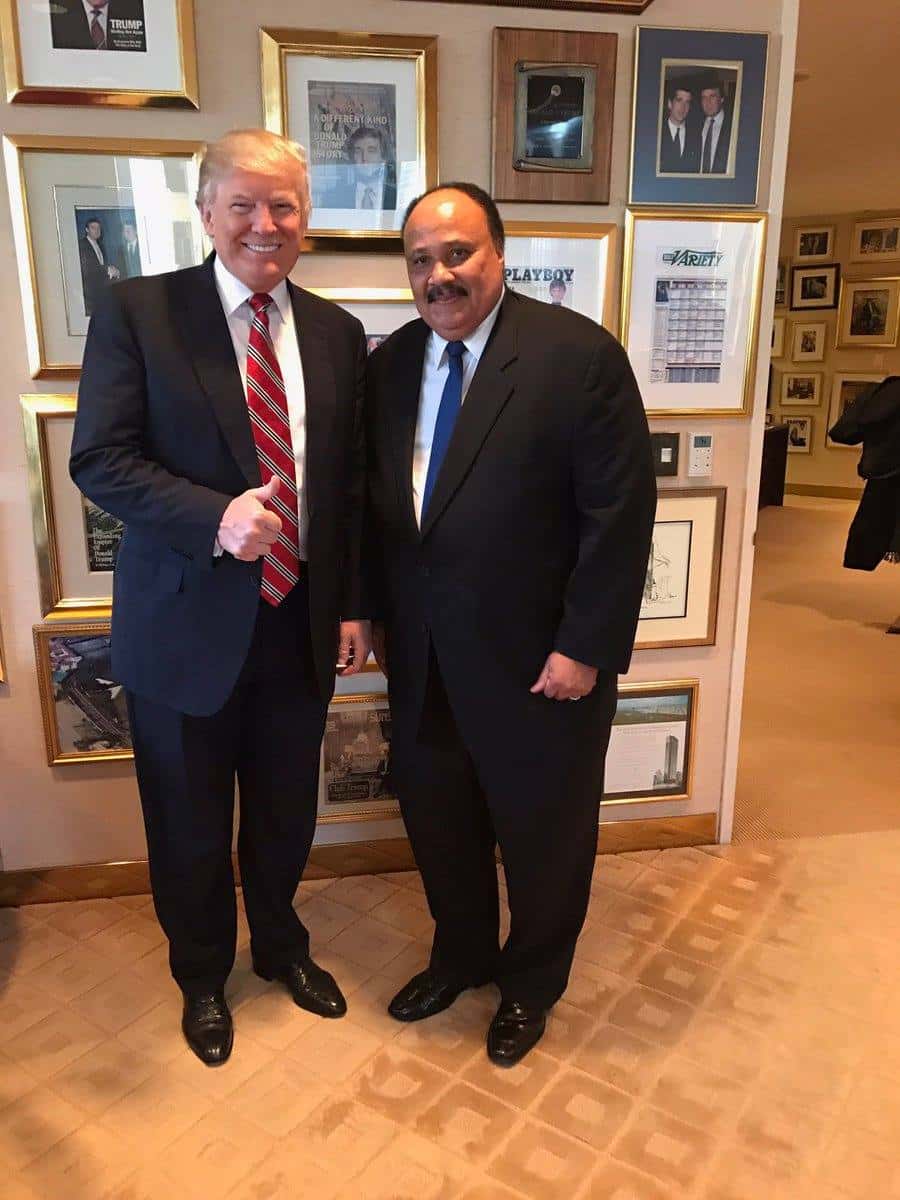
Martin Luther King III said Monday — the federal holiday honoring his father — said he had a “very constructive” meeting with President-elect Donald Trump at Trump Tower in New York.
But he declined to say whether he was offended by Trump’s weekend criticism of civil rights icon Rep. John Lewis (D-Ga.).
“Well, first of all I think that in the heat of emotion a lot of things get said on both sides. And I think that at some point — I am, as John Lewis and many others, a bridge builder,” King told reporters in the lobby of Trump Tower.
“The goal is to bring America together and Americans. We are a great nation but we must become a greater nation. And what my father represented, my mother represented through her life, what I hope that I am trying to do is always bring people together.”
Trump criticized Lewis over the weekend, calling the congressman “all talk” and “no action” after Lewis said he did not view Trump as a “legitimate president.”
Trump administration’s proposal for new venue and inclusion of non-traditional media follows president-elect’s latest outbursts against mainstream reporters.
Talk radio hosts and bloggers could be invited to official White House press briefings once the Trump administration takes office, under a highly irregular proposal being floated that may also remove briefings from the West Wing.
Trump’s pick for White House press secretary, Sean Spicer, said on Sunday that due to “off the chart” interest in the new administration, the president-elect was considering moving briefings from the James S Brady press briefing room, which has been used by presidents to address the media since 1970, to a venue with a greater capacity.
A report published by Esquire magazine on Saturday indicated the venue could be inside the Old Executive Office Building, just west of the White House.
“I know change is difficult sometimes,” Spicer told Fox News. “But sometimes change can actually be better.”
Spicer argued the proposal would mean “you can involve more people, be more transparent, have more accessibility”. He suggested that this would mean outlets that are not traditionally part of the White House press corps would be able to ask questions during presidential press briefings.
“There’s a lot of talk radio and bloggers and people that can’t fit in right now and maybe don’t have a permanency because they’re not part of the Washington elite media,” Spicer said, “but to allow them an opportunity to ask the press secretary or the president a question is a positive thing. It’s more democratic.”
Around 200 journalists make up the White House press corps. The Brady press briefing room holds 49 seats for major media organisations, which are granted space by the White House Correspondent Association (WHCA). The Guardian is among those outlets allocated a space.
Author, Israel Vincente – Special Guest Speaker
January 17, Tuesday – 7PM
650 American Legion Drive, Teaneck N J
NJTPC is proud to have as our guest speaker, Israel Vicente.
Israel is a technology entrepreneur and founder of GCS, a successful global IT consulting firm based in New Jersey, where he lives. In his role as CEO of GCS, Israel has had the opportunity to speak to many people throughout the U.S. and overseas, giving a firsthand perspective of their experiences, successes, and hardships.
In 2014, he published two nonfiction books, The Courage to Be Different and Divergent Lives. The lead-up to the 2016 presidential contest served as inspiration for his third book………..
“For the People – Time to Take Our Country Back!”
America is still the greatest country in the world, although plagued with many challenges that have been ignored or exacerbated by our leaders. The American people are fed up, tired, and angry. The most recent Presidential election is proof that people are driving towards taking our country back from the cliff from which it is now perched.
With the national debt hovering above $19 trillion and rising; the middle class still decimated by the Great Recession that followed the financial crisis of 2008; millions of Americans either unemployed or severely underemployed as more U.S. companies replace American workers with lower wage staff by either relocating their businesses overseas or employing illegal immigrants and foreigners with worker visas here at home; and the constant fear of terrorism at home and abroad – all while seeing President Obama and Former Secretary Hillary Clinton work tirelessly to diminish American exceptionalism. America looks towards new leadership that will reset the direction of the country before the U.S. economy fully collapses, Iran secures a nuclear weapon, North Korea succeeds in launching one, and a resurgent Russia further expands its dominance in Eastern Europe and the Middle East.
For the People gives an American citizen’s voice to the people’s dissatisfaction with how our leaders in Washington have managed, or, more accurately, mismanaged the people’s affairs. Americans are exhausted with the constant bickering between Congress and the Executive branch of our government that has resulted in years of stagnation. The turmoil has caused far too many citizens to lament the demise of the American dream of prosperity and upward mobility.
This book is a wakeup call to all Americans to protect and secure the future of the United States of America.
Come and hear Israel’s perspective and treat a friend to a great night out!
The closing arguments for the Obama years are arriving, and they aren’t helping the outgoing president. A case in point is a new book published this week, one that acknowledges “Obama’s supporters have experienced [his presidency] as a continuous disappointment.”
Those supporters, and others, must have noticed that “for most of Obama’s term, wage gains were largely confined to the rich.” Or that “The administration’s planning in Libya clearly failed” or “It is certain that the actual outcome [of Obama’s Syria policy] was disastrous.”
Even many of President Obama’s proudest achievements look about as enduring as April snow: “If there was a single aspect of Obama’s legacy most vulnerable to reversal, it was his achievements on climate change,” the book says, and “Obama’s regulatory offensive is, of course, vulnerable to reversal by Donald Trump or the Supreme Court, since it rested upon executive action.” The longest chapter is titled “The Inevitability of Disappointment.”
There are several projects and services I want to share with you…
Traffic Alert – Starting Monday, January 16th PSEG will be working on Broad Street to upgrade the service in Ridgewood.Construction activities include the installation of manholes and underground pipe.The work will be done from 7:00 a.m. to 5:00 p.m. Mondaythrough Friday for approximately 3 months, weather permitting.Paving will take place after the 3-month construction period.Police will monitor the traffic but please try to plan alternate routes in order to avoid the traffic congestion in the construction area.
2017 Annual Parking Permits – Annual Resident, Non-resident and CBD employee parking permits are available for purchase at Village Hall.Driver’s License and car registration are required to apply for all parking permits.The Annual Parking Permits for residents which are available, cost $750 annually, and it allows residents to park in the Chestnut, North Walnut, and Cottage parking lots.We have reached our current capacity for the $1,000 Premium Permits, but you may call the Receptionist at 201-670-5500 ext. 200 to put your name on a waiting list for these permits, as new commuter parking spaces become available.
New in 2017 – “Shopper/Diner” parking spots are available in the Hudson, Prospect and Chestnut Lots.These parking spaces are marked with white signs and arrows, and commuter parking will not be allowed in these parking spaces.
Leaves…Our annual leaf collection is finished and we ask that from this time forward, please do not put any leaves in the street. Branches, plants and leaves can be brought to the Recycling Center or placed in paper biodegradable bags.All yard waste must be brought to the recycling center or held until yard waste pickup begins in the spring.Please consult your 2017 calendar for spring pickup schedules.
Christmas trees are still being picked up on both the east and west side of the Village each week.Please place them on your curb, and not into the street.
Snow and Ice Reminder – When there is snow and ice forecast, please assist us by placing your garbage cans at the end of your driveway, by the curb, but not in the street.This will ensure that our employees are able to safely pick up your solid waste. Additionally please remember to clear your sidewalks within 24 hours of snowfall.This is especially important on school walking routes, but is required in all residential zones.
In observance of the Dr. Martin Luther King, Jr. holiday, Village Hall and The Stable offices will be closed on Monday, January 16th There will be no sanitation or recycling pick up on that day.
Thank you for your cooperation,
Heather A. Mailander
Acting Village Manager
201/670-5500 x202
State and local governments have promised an estimated $5.6 trillion in pension benefits that they cannot afford to pay. (Photo: iStock Photos)
COMMENTARY BY
Rachel Greszler
Rachel Greszler is a senior policy analyst in economics and entitlements at The Heritage Foundation’s Center for Data Analysis. Read her research.
Pensions are a huge part of public employees’ compensation, often providing a quarter to a third of their total compensation. A new report from the American Legislative Exchange Council shows how politicians play politics with public pensions, threatening public employees and taxpayers alike.
State and local governments across the U.S. hold about $3.8 trillion in public employee pension assets. Unfortunately, the politicians and pension officials who manage these assets often sacrifice higher returns for personal and political gain.
Pension plan officials are supposed to look out for the best interests of pension beneficiaries, but the American Legislative Exchange Council report, “Keeping the Promise: Getting Politics Out of Pensions,” tells a different story:
Rather than investing to earn the best return for workers, [lawmakers and pension plan officials] use pension funds in a misguided attempt to boost their local economies, provide kickbacks to their political supporters, reward industries they like, punish those they don’t, and bully corporations into silence and behaving as they see fit.
The report shows three ways that pension officials play politics with public worker pensions:
1. Economically targeted investments. These are a way for public pension plans to buoy local projects at the cost of receiving significantly lower returns. These subpar investments strip pensions of billions of dollars in returns. Alabama is the biggest offender, with over 16 percent of its pension assets invested in them.
One particularly egregious example is Alabama’s pension fund investment in the troubled oil repair and shipbuilding firm Signal International. Alabama invested $21 million and later loaned $73 million to Signal (despite three years of it providing 11 percent losses).
Shortly thereafter, Signal was forced to pay $21 million to settle what was called “one of the largest cases of labor trafficking in modern times.” Signal later entered bankruptcy and was purchased by one of Alabama’s pension funds.
2. Political kickbacks. These allow private individuals and companies to buy access to public pension investments by making political contributions to certain local politicians, and by lobbying pension funds to invest in them. Investments based on politics instead of performance costs the average pension fund over $200 million a year.
The California Public Employees’ Retirement System, known as CalPERS, suffered massive losses from political investments, largely at the helm of board member and union leader Charles Valdes.
Despite having no investment experience and twice filing for personal bankruptcy, Valdes spent 25 years as a CalPERS board member where he added significantly to pension deficits by granting investment contracts to political donors and engaging in suspect behavior with other board members.
During his 13 years as the investment committee chair, CalPERS experienced one of the worst investment performances of any public pension plan in the nation.
3. Political crusades. These are a way for politicians and pension officials to use pension investments to advance political views or causes. The most common example of late is pension funds divesting from energy companies.
Since divestment is based on political agendas instead of returns, it should come as no surprise that it results in significantly lower returns. A hypothetical portfolio showed divestment from energy products resulted in a 23 percent loss over five years, compared to no divestment.
There are also significant administrative and frictional costs (the impact of selling large quantities at once). Administrative costs for large college endowments were 12 times higher than socially conscious funds, and frictional costs were estimated to reduce the value of a fund by 2 to 12 percent over 20 years.
Moreover, political crusades have extended from certain sectors of the economy to personal objections.
For example, the American Federation of Teachers union has used its influence over an estimated $1 trillion in pension assets to “blacklist” about three dozen individual hedge fund managers who donated to causes and organizations that the union doesn’t like. Consequently, pension funds in at least seven states divested their pensions from these hedge fund managers to some degree.
One of the main reasons state and local pensions can get away with politically motivated pension fund management is that they lack adequate regulations and enforcement. State and local pensions are not subject to the federal Employee Retirement Income Security Act of 1974, but rather are regulated by states themselves.
The easiest way for states to eliminate the negative influence of politics in pensions is to shift to defined contribution plans. This would require governments to pay their workers’ retirement benefits immediately and would prevent politicians from having any role in workers’ personal investment decisions. Moreover, taxpayers would no longer be on the hook for unfunded promises.
Short of a complete shift to defined contribution plans, however, states need to strengthen fiduciary responsibilities to ensure pension officials are acting in the exclusive interests of participants, require greater oversight and transparency of public pension operations, and diversify pension boards.
State and local governments have already promised an estimated $5.6 trillion in pension benefits that they can’t afford to pay. Governments cannot afford to continue sacrificing valuable investment returns for the sake of short-term political and personal gains.
Let’s dispense with the obvious — while it’s far too early for political prognostication surrounding the 2020 presidential campaign, it doesn’t take too much effort to see that the Democrats have very little in the way of worthy candidates for nomination.
For this, they can thank Barack Obama and his eight years of hollowing out that party by relying on vicious identity politics and Hard Left cultural aggression to pile up near-unanimous votes in urban areas dominated by racial and ethnic minorities and “lifestyle liberals” at the expense of “normal” Americans in suburbs and small towns. Consequently, state legislatures are becoming more and more uniformly Republican and governor’s mansions are already there. The only path to national relevance for Democrat politicians is becoming the mayor’s office in larger cities Dems dominate.
Which is where Cory Booker, who appears to be the preener-in-chief among the rag-tag roster of 2020 Democrat presidential hopefuls, came from.
What Booker proves is it’s not important whether a Democrat is actually successful as a mayor on his or her ascent up the political totem pole — Booker, as mayor of Newark, couldn’t be considered a success by any rational measure. He rode some of the economic effects of an economic boom in New York City to an uneven construction boom in the city’s downtown and he managed to buy a couple of corporate headquarters away from other New Jersey cities with taxpayer dollars redistributed from what was left of Newark’s middle class. But in Booker’s time as mayor Newark went from 67 murders in 2008, a decline from 105 in 2006, to 112 killings in 2013, the year after he left office. Booker never presided over an unemployment rate in the single digits. And he laid off 163 policemen amid budget deficits his mismanagement produced.
Ridgewood NJ, Bottom line, there’s now an ordinance that prohibits such short term rentals. Those wishing to snub their noses at it and continue (or start) running such operations risk being fined $1000 per day if found guilty in municipal court.
ORDINANCE NO. 3570 AN ORDINANCE TO AMEND CHAPTER 117 OF THE CODE OF THE VILLAGE OF RIDGEWOOD ENTITLED “BUSINESSES AND OCCUPATIONS” AT ARTICLE I, SECTION 1A, AND TO CREATE A NEW ARTICLE IX ENTITLED “SHORT TERM RENTALS”. AMEND: ARTICLE I Section 117-1A ADVERTISE OR ADVERTISING: Any form of solicitation, promotion, and communication for marketing, used to solicit, encourage, persuade, or manipulate viewers, readers, or listeners into contacting for goods and/or services in violation of this Ordinance, as same may be viewed through various media including, but not limited to, newspapers, magazines, flyers, handbills, pamphlets, commercials, radio, direct mail, internet websites, or text or other electronic messages for the purpose of establishing occupancies or uses of rental property, for Consideration, which are prohibited by this Ordinance. HOUSKEEPING UNIT: Constitutes a family-type situation, ,involving one-or-more persons, living together that exhibit the kind of stability, permanency and functional lifestyle equivalent to that of a traditional family unit, as further described in the applicable reported and unreported decisions of the New Jersey Superior Court. OCCUPANT: Any individual inhabiting, using, living, gathering, entertaining, being entertained as a guest, or sleeping in a dwelling or a portion thereof, or having other permission or possessory rights or interest in the dwelling. OWNER: Any person(s) or entity(ies), association, limited liability company, corporation, or partnership, or any combination, who legally use, possess, own, lease, sub-lease or license (including an operator, principal, shareholder, director, agent, or employee, individually or collectively) that has charge, care, control ,or participates in the expenses and/or profit of a Dwelling Unit pursuant to a written or unwritten agreement, rental, lease, license, use, occupancy agreement or any other agreement. NEW ARTICLE ARTICLE IX: SHORT TERM RENTALS SECTION 117-56 – PERMITTED USE The residential occupancy of an otherwise lawful and lawfully occupied dwelling for a period of thirty (30) days or less by a person who is a member of the Housekeeping Unit of the Owner, without Consideration, such as house guests, is permitted. SECTION 117-57 – PROHIBITIONS: No person shall undertake, maintain, authorize, aid, facilitate, solicit and advertise any rental activity that violates any part or provisions of this Article. SECTION 117-57 -SHORT TERM RENTAL PROPERTY: Notwithstanding anything to the contrary in the Village Code, it shall be unlawful for any person, including but not limited to, and owner, lessor, sub lessor with any possessory interest in any dwelling, to receive compensation of any kind for the use, occupancy, or rental of any dwelling for a period of thirty (30) days or less. SECTION 117-59 – ENFORCEMENT: The provisions of this Article shall be enforced by the Village Zoning Officer, Fire Department, Police Department and any other Village Official or employee so designated by the Village Manager who all shall be authorized to issue summons or other appropriate civil violations or complaints for any violations of the terms and provisions of this Article. SECTION 117-60 – FINES AND PENALITES: Any person who is found or adjudicated to have violated any provisions of this Article shall be liable for a fine not to exceed one thousand ($1000.00) Dollars. Each day of any such violation after receiving written notice of same shall be a new and separate violation. SEVERABILTY: If any portion of this Ordinance is adjudged unconstitutional or invalid by a court of competent jurisdiction, such judgment shall not affect or invalidate the remainder of this Ordinance but shall be confined in its effect to the provision directly involved in the controversy in which such judgment shall have been rendered. Except as hereby amended, all other sections of the Code of the Village of Ridgewood shall remain in full force and effect. This Ordinance shall take effect upon final passage and publication according to law. Ridgewood News-4116350 Fee: $71.30 December 16, 2016